
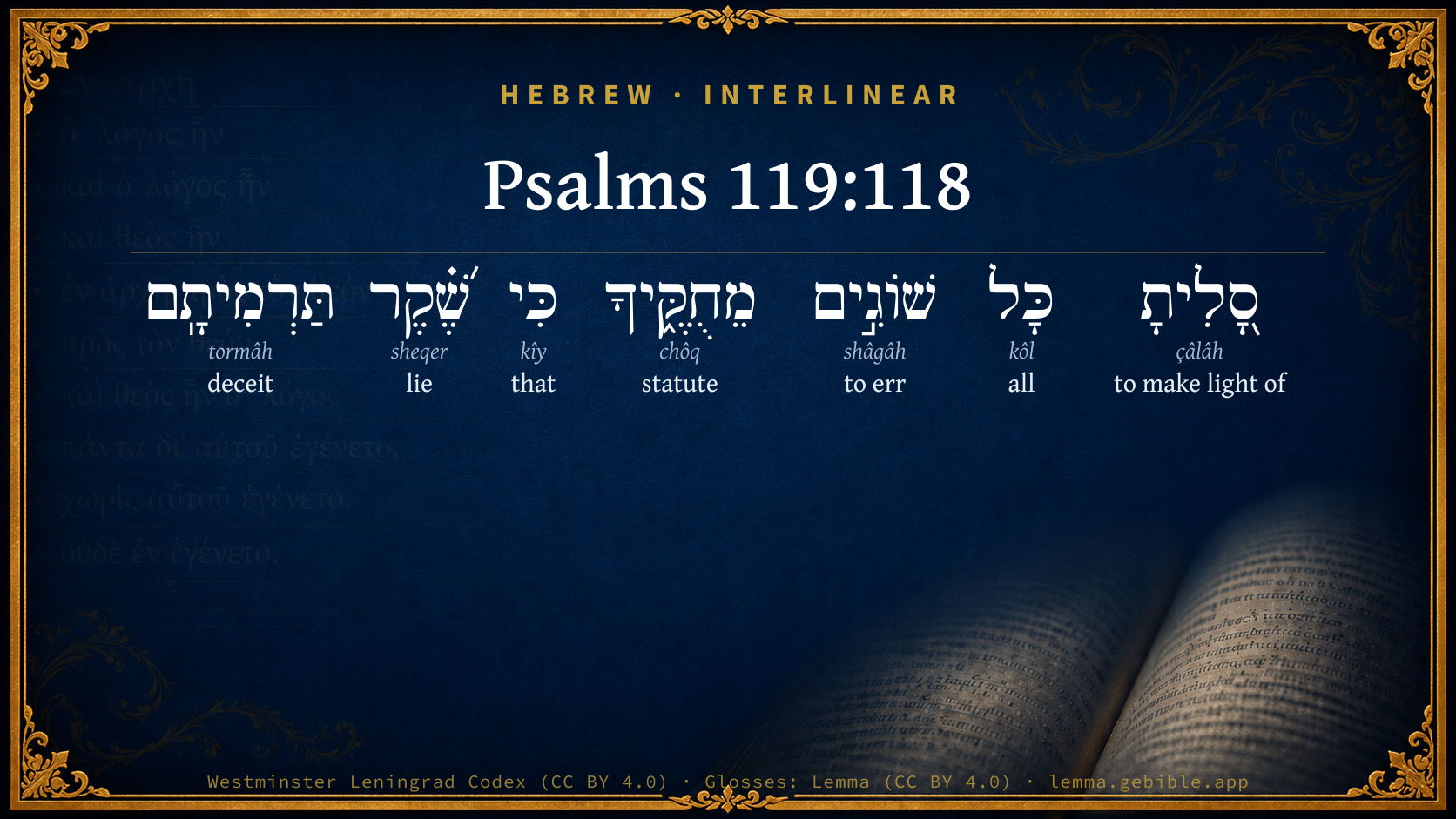
Psalms 119:118

Hebrew (Westminster Leningrad Codex) Psalms 119:118 appears in the Hebrew Old Testament. The text above is from the Westminster Leningrad Codex. Each word links to its Strong’s number, a concise gloss, and parsing drawn from the Open Scriptures Hebrew Bible morphology. Click any word for its full Brown-Driver-Briggs (BDB) entry.
Download image
Cite this verse

Psalms 119:118 (World English Bible). Public Domain. Lemma interlinear Bible study tool, https://lemma.gebible.app/v/psalms/119/118.

Show BibTeX & RIS
BibTeX
RIS
English Translation
You reject all those who stray from your statutes, For their deceit is in vain.
World English Bible · Public Domain
Download a study sheet

One document with this verse’s original text, its word-by-word gloss line, the meaning frame, cross-references with their text, attributed commentary, and full source and license credits — printable, and it pastes into notes with its structure intact.

This verse Autodidact and up

Study sheet (.html) Plain text (.txt)

A passage Seminary Student

Up to 50 verses in one chapter. A passage sheet keeps up to 6 commentary sources and 12 cross-references per verse, in the order this page ranks them, and says so on the sheet whenever that leaves anything out. Ask for a single verse and you get the Autodidact verse sheet above.

Everything on this page stays free to read, with no account — the sheet is a download of what is already on screen, not access to it.

Want to remove ads? Support Godless Engineer
Compare translations 3

The same verse in 3 English versions, stacked beneath the original-language interlinear above. Click any original word for its lexicon entry.

Each is an independent rendering of the whole verse — the interlinear is not word-aligned to these translations.

Highlighted words mark where these versions differ — a whole-verse word diff, not a word-by-word alignment.

  • World English Bible Public Domain
    You reject all those who stray from your statutes, For their deceit is in vain.
  • King James Version Public Domain
    Thou hast trodden down all them that err from thy statutes: for their deceit is falsehood.
  • unfoldingWord Literal Text CC BY-SA 4.0
    You reject all those straying from your statutes, for their deceit falsehood.

unfoldingWord Literal Text — © unfoldingWord, licensed CC BY-SA 4.0. Word-aligned USFM3 via Door43 (git.door43.org/unfoldingWord/en_ult).

Versions to compare (up to 4)

3 of 4 selected

Show all 17 translations

Every available English version of this verse, each an independent rendering of the whole verse.

  • World English Bible Public Domain
    You reject all those who stray from your statutes, For their deceit is in vain.
  • Berean Standard Bible Public Domain
    You reject all who stray from Your statutes, for their deceitfulness is in vain.
  • Majority Standard Bible Public Domain
    You reject all who stray from Your statutes, for their deceitfulness is in vain.
  • King James Version Public Domain
    Thou hast trodden down all them that err from thy statutes: for their deceit is falsehood.
  • American Standard Version (1901) Public Domain
    Thou hast set at nought all them that err from thy statutes; For their deceit is falsehood.
  • Revised Version (1885) Public Domain
    Thou hast set at nought all them that err from thy statutes; for their deceit is falsehood.
  • Geneva Bible (1599) Public Domain
    Thou hast troden downe all them that depart from thy statutes: for their deceit is vaine.
  • Young's Literal Translation Public Domain
    Thou hast trodden down All going astray from Thy statutes, For falsehood `is' their deceit.
  • Literal Standard Version CC BY-SA 4.0
    You have trodden down || All going astray from Your statutes, || For their deceit [is] falsehood.
  • Unlocked Literal Bible CC BY-SA 4.0
    You reject all those who stray from your statutes, for those people are deceptive and unreliable.
  • unfoldingWord Literal Text CC BY-SA 4.0
    You reject all those straying from your statutes, for their deceit falsehood.
  • Darby Bible Public Domain
    Thou hast set at nought all them that wander from thy statutes; for their deceit is falsehood.
  • World Messianic Bible Public Domain
    You reject all those who stray from your statutes, for their deceit is in vain.
  • Webster's Bible Public Domain
    Thou hast trodden down all them that err from thy statutes: for their deceit is falsehood.
  • Free Bible Version CC BY-SA 4.0
    You reject all those who don't follow your instructions—they're fooling themselves by living a lie.
  • Bible in Basic English Public Domain
    You have overcome all those who are wandering from your rules; for all their thoughts are false.
  • JPS Tanakh (1917) Public Domain
    Thou hast made light of all them that err from Thy statutes; for their deceit is vain.

Literal Standard Version (2020), Covenant Press — licensed CC BY-SA 4.0. Text via the HelloAO Bible API (eBible.org). Unlocked Literal Bible (unfoldingWord) — licensed CC BY-SA 4.0. Text via the HelloAO Bible API (eBible.org). unfoldingWord Literal Text — © unfoldingWord, licensed CC BY-SA 4.0. Word-aligned USFM3 via Door43 (git.door43.org/unfoldingWord/en_ult). Free Bible Version, Dr. Jonathan Gallagher — licensed CC BY-SA 4.0. Text via the HelloAO Bible API (eBible.org).

Word by word

More ways to search: Search by grammar → Find every occurrence → Compare this word →

Practice this passage: Drill this verse → Learn its vocabulary →

About this verse

These counts appear in no published source. They are computed here, from the morphology-tagged text and Lemma’s own curated glosses. What Lemma adds →

7
words
7
distinct lemmas
Wisdom
section

Notable vocabulary

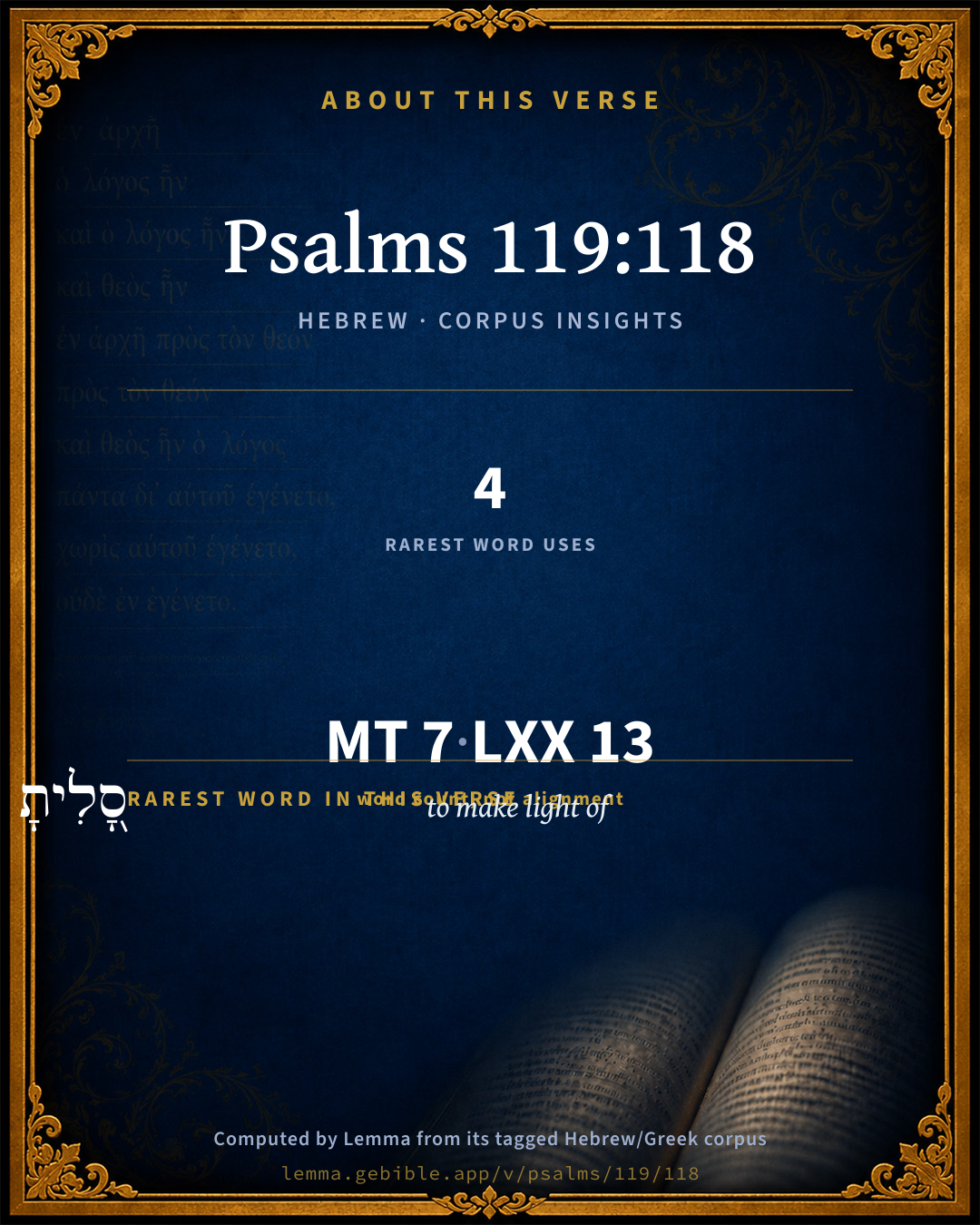
The rarest word here is סָ֭לִיתָ to make light of H5541 — appearing just 4 times in the whole Hebrew Bible.

Shared distinctive vocabulary

סָ֭לִיתָ to make light of H5541 occurs in 4 verses of the Hebrew Bible. Also found in:

Grammatical profile

  • 2 verbs
  • 4 nouns
  • 1 conjunction

Verb forms

  • סָ֭לִיתָ Qal · Perfect
  • שׁוֹגִ֣ים Qal · Participle Active

Hebrew & Septuagint length

In English translation the verse runs 15 words from the Hebrew and 17 from the Septuagint (LXX English) — closely comparable.

A rough comparison of the two English renderings, which tokenize alike — not a word-level alignment.

Word counts can differ between the Hebrew and the Greek without any difference in meaning — e.g. the Hebrew direct-object marker אֵת has no separate Greek word, and Greek often adds the article ὁ.

In the original languages it is 7 Hebrew tokens and 13 Greek tokens — but the two are counted differently (Hebrew bundles its prefixes and suffixes into one token; the Greek is in lemma form), so that isn’t a like-for-like length.

Cross-references

17

Topical passages linked to Psalms 119:118 in the Treasury of Scripture Knowledge — connected by theme and wording, ordered by reader-vote popularity; previews shown in the World English Bible.

  • Psalms 119:10 With my whole heart, I have sought you. Don't let me wander from your commandments.
  • Psalms 119:21 You have rebuked the proud who are cursed, Who wander from your commandments.
  • Psalms 119:29 Keep me from the way of deceit. Grant me your law graciously!
  • Isaiah 44:20 He feeds on ashes; a deceived heart has turned him aside; and he can't deliver his soul, nor say, Is there not a lie in my right hand?
  • Isaiah 63:3 I have trodden the winepress alone; and of the peoples there was no man with me: yes, I trod them in my anger, and trampled them in my wrath; and their lifeblood is sprinkled on my garments, and I have stained all my clothing.
  • Ephesians 4:22 that you put away, as concerning your former way of life, the old man, that grows corrupt after the lusts of deceit;
  • Ephesians 5:6 Let no one deceive you with empty words. For because of these things, the wrath of God comes on the children of disobedience.
  • 2 Timothy 3:13 But evil men and impostors will grow worse and worse, deceiving and being deceived.
  • Revelation 18:23 The light of a lamp will shine no more at all in you. The voice of the bridegroom and of the bride will be heard no more at all in you; for your merchants were the princes of the earth; for with your sorcery all the nations were deceived.
  • Psalms 78:36–37 But they flattered him with their mouth, And lied to him with their tongue.
  • Psalms 78:57 But turned back, and dealt treacherously like their fathers. They were turned aside like a deceitful bow.
  • Psalms 95:10 Forty long years I was grieved with that generation, And said, "It is a people that errs in their heart. They have not known my ways."
  • Isaiah 25:10 For in this mountain will the hand of Yahweh rest; and Moab shall be trodden down in his place, even as straw is trodden down in the water of the dung-hill.
  • Malachi 4:3 You shall tread down the wicked; for they will be ashes under the soles of your feet in the day that I make," says Yahweh of Hosts.
  • Luke 21:24 They will fall by the edge of the sword, and will be led captive into all the nations. Jerusalem will be trampled down by the Gentiles, until the times of the Gentiles are fulfilled.
  • 2 Thessalonians 2:9–11 even he whose coming is according to the working of Satan with all power and signs and lying wonders,
  • 1 John 2:21 I have not written to you because you don't know the truth, but because you know it, and because no lie is of the truth.

Cross-references courtesy of OpenBible.info (CC BY 4.0).

Hebrew and Greek witnesses Masoretic Hebrew ↔ Greek Septuagint

The same verse in the two great witnesses to the Old Testament, shown verse-for-verse.

You’re reading Greek Psalm 118 (Hebrew Psalm 119). The Septuagint counts the superscription, so verse numbers can differ from the Hebrew — chapter-level alignment, not verse-by-verse. Numbering follows Rahlfs.

These are two independent witnesses, not word-aligned to each other, and the Septuagint is shown in lemma (dictionary) form.

Hebrew Psalms 119:118 Masoretic · Westminster Leningrad Codex

סָ֭לִיתָ כָּל שׁוֹגִ֣ים מֵחֻקֶּ֑יךָ כִּי שֶׁ֝֗קֶר תַּרְמִיתָֽם

You reject all those who stray from your statutes, For their deceit is in vain.

World English Bible · Public Domain

Greek LXX Greek Psalm 118:118 Septuagint · lemma form

ἐκοὐδενόω πᾶς ὁ ἀποἵστημι ἀπό ὁ δικαίωμα σύ ὅτι ἄδικος ὁ ἐνθύμημα αὐτός

You have brought to nothing all that depart from your ordinances; for their inward thought is unrighteous.

LXX2012 (modern English Septuagint) · Public Domain

On this verse, Ellicott's Commentary for English Readers discusses the Septuagint’s reading. Read the note in Commentary ↓

Hebrew: Westminster Leningrad Codex (CC BY 4.0). Greek: Septuagint (public domain); English from LXX2012 (modern English Septuagint) (Public Domain). How the Septuagint differs from the Hebrew →

Commentary

Notes on Psalms 119:118 from classic Christian and Jewish commentators (each source and its license shown beneath its notes). The classic Christian expositions comment on the surrounding passage and are grouped to its opening verse, so a note may address several verses; the Jewish commentaries on the Tanakh (Rashi and others) are per-verse, so they appear only where the commentator wrote on this verse.

Lemma curates 59 commentaries, every one of them public domain or Creative Commons licensed, each selected and text-cleaned for this edition rather than reprinted as found. About our sources →

Trapp's Complete Commentary

John Trapp

Psa 119:118 Thou hast trodden down all them that err from thy statutes: for their deceit [is] falsehood.

Ver. 118. Thou hast trodden down all them, &c.] Thou, as a mighty king or conqueror, hast made use of them for a footstool, as Sapores, king of Persia, did Valentinian the Roman emperor, and as Tamerlane did Bajazet.

For their deceit is falsehood] They think themselves to be out of the reach of thy rod, but they will find it somewhat otherwise.

John Trapp, A Commentary or Exposition upon All the Books of the Old and New Testament (1647–1656) — public domain. Text from a community e-Sword module.

Joseph Benson's Commentary

Psa 119:118-120. Thou hast trodden down all them that err, &c. — Thou hast brought them to ruin, utter and shameful ruin; thou hast made them thy footstool. He seems to speak of those proud persecutors who trampled upon God’s people, and on whom he saw that sooner or later God would trample; for their deceit is falsehood — All their crafty and deceitful devices, by which they design to insnare and ruin good men, shall deceive their expectations, and bring that destruction upon themselves which they designed for others. Thou puttest away all the wicked — Thou removest them from thy presence, from the society of thy people, and from the land of the living; like dross — Which, though for a season it be mixed with gold or silver, is not only separated from it, as a useless and contemptible thing, but also is utterly consumed by fire; therefore I love thy testimonies — Because they are the best preservatives against wickedness, and against those dreadful punishments attending upon it. Of these he professes his fear, adding, in the next verse, My flesh trembleth for fear of thee, &c. — As if he had said, The observation of thy terrible judgments against ungodly men, and the consciousness which I have of my own manifold sins and great weakness, make me fear lest thou shouldest punish me also, as thou justly mightest, if thou shouldest be so strict as to mark what is amiss in me; or lest I should partake with them in their sins, and consequently in their plagues.

Joseph Benson's Commentary on the Old and New Testaments (1811–1818) — public domain. Text from a community e-Sword module.

J. A. Alexander on Psalms

Joseph Addison Alexander

118. (Psa 119:118) Thou despisest all (those) straying from thy statutes, for a lie (is) their deceit. They are objects not only of disapprobation but of scorn, because in attempting to deceive others they deceive themselves. Their deception of others is a lie to themselves.

Joseph Addison Alexander, The Psalms Translated and Explained (1850) — public domain. Text from a community e-Sword module.

Geneva Bible (1599)

Geneva Bible translators

The crafty practices of them that contemn thy Law, shall be brought to naught.

Geneva Bible (1599) marginal notes — public domain. Text via Bolls.life.

Matthew Henry's Commentary

Here is, I. God's judgment on wicked people, on those that wander from his statutes, that take their measures from other rules and will not have God to reign over them. All departure from God's statutes is certainly an error, and will prove a fatal one. These are the wicked of the earth; they mind earthly things, lay up their treasures in the earth, live in pleasure on the earth, and are strangers and enemies to heaven and heavenly things. Now see how God deals with them, that you may neither fear them nor envy them. 1. He treads them all down. He brings them to ruin, to utter ruin, to shameful ruin; he makes them his footstool. Though they are ever so high, he can bring them low (Amo 2:9); he has done it many a time, and he will do it, for he resists the proud and will triumph over those that oppose his kingdom. Proud persecutors trample upon his people, but, sooner or later, he will trample upon them. 2. He puts them all away like dross. Wicked people are as dross, which, though it be mingled with the good metal in the ore, and seems to be of the same substance with it, must be separated from it. And in God's account they are worthless things, the scum and refuse of the earth, and no more to be compared with the righteous than dross with fine gold. There is a day coming which will put them away from among the righteous (Mat 13:49), so that they shall have no place in their congregation (Psa 1:5), which will put them away into everlasting fire, the fittest place for the dross. Sometimes, in this world, the wicked are, by the censures of the church, or the sword of the magistrate, or the judgments of God, put away as dross, Pro 25:4, Pro 25:5.

II. The reasons of these judgments. God casts them off because they err from his statutes (those that will not submit to the commands of the word shall feel the curses of it) and because their deceit is falsehood, that is, because they deceive themselves by setting up false rules, in opposition to God's statutes, which they err from, and because they go about to deceive others with their hypocritical pretences of good and their crafty projects of mischief. Their cunning is falsehood, so Dr. Hammond. The utmost of their policy is treachery and perfidiousness; this the God of truth hates and will punish.

III. The improvement David made of these judgments. He took notice of them and received instruction from them. The ruin of the wicked helped to increase, 1. His love to the word of God. "I see what comes of sin; therefore I love thy testimonies, which warn me to take heed of those dangerous courses and keep me from the paths of the destroyer." We see the word of Go fulfilled in his judgments on sin and sinners, and therefore we should love it. 2. His fear of the wrath of God: My flesh trembles for fear of thee. Instead of insulting over those who fell under God's displeasure, he humbled himself. What we read and hear of the judgments of God upon wicked people would make us, (1.) To reverence his terrible majesty, and to stand in awe of him: Who is able to stand before this holy Lord God? Sa1 6:20. (2.) To fear lest we offend him and become obnoxious to his wrath. Good men have need to be restrained from sin by the terrors of the Lord, especially when judgment begins at the house of God and hypocrites are discovered and put away as dross.

Matthew Henry's Commentary on the Whole Bible (1708–1710) — public domain (CC PDM 1.0). Text via the HelloAO Bible API.

Adam Clarke's Commentary

Verse 118. Thou hast trodden down] All thy enemies will be finally trodden down under thy feet.

Their deceit is falsehood.] Their elevation is a lie. The wicked often become rich and great, and affect to be happy, but it is all false; they have neither a clean nor approving conscience. Nor can they have thy approbation; and, consequently, no true blessedness.

Adam Clarke's Commentary on the Bible (1810–1826) — public domain. Text from a community e-Sword/MySword module.

John Calvin's Commentaries

118. Thou hast trodden under foot all those who wander from thy statutes. By treading under foot he means, that God overthrows all the despisers of his law, and casts them down from that loftiness which they assume to themselves. The phrase is directed against the foolish, or rather frantic, confidence with which the wicked are inflated, when they recklessly deride the judgments of God; and, what is more, scruple not to magnify themselves against him, as if they were not subject to his power. The last clause is to be particularly noticed: for their deceit is falsehood By these words the prophet teaches, that the wicked gain nothing by their wiles, but that they are rather entangled in them, or at length discover that they were mere sleight of hand. Those ignorantly mar the sense who interpose the copula and, as if it had been said, that deceit and falsehood were in them The word רמוה, remyah, signifies a subtle and crafty device. Interpreters, indeed, often translate it thought; but this term does not sufficiently express the propriety and force of the Hebrew word. The prophet means, that, however well pleased the wicked are with their own cunning, they yet do nothing else than deceive themselves with falsehood. And it was needful to add this clause; for we see how the great bulk of mankind are fatally intoxicated with their own vain imaginations, and how difficult it is to believe what is here asserted, — that the more shrewd they are in their own estimation, the more do they deceive themselves.

John Calvin's Commentaries (1540-1563) — public domain. Text from the Calvin Translation Society English edition (1840s-50s) via the Christian Classics Ethereal Library (ccel.org). Calvin's coverage is partial (roughly two-thirds of the Bible); uncommented books and verses are honest gaps, never fabricated. The 19th-century editor's footnotes and remarks are omitted so the notes are faithfully Calvin's own voice.

Ellicott's Commentary for English Readers

(118) Trodden down.—Better, thou despisest. So LXX. and Vulg. Aquila, “Thou hast impaled.” Symmachus, “Thou hast convicted.” Literally the word seems to mean to weigh or value, but, from the habit of the buyer beating down the price by depreciating, comes to have a sense of this kind. Mr. Burgess aptly quotes Pro_20:14. We may compare the English word cheapen, which originally only meant to buy.

For their deceit is falsehood.—Rather, as the parallelism indicates, for their tricks are in vain; or perhaps, to bring out the full intention of the Hebrew, we must paraphrase: “for their wiles are as fruitless as they are deceitful.” So Symmachus: “all their craft is vain.”

A Bible Commentary for English Readers, edited by Charles John Ellicott (1878–1897) — public domain. Text from a community e-Sword module.

The Cambridge Bible for Schools and Colleges

gen. ed. J. J. S. Perowne

118. Thou hast trodden down] Rather, hast set at nought (R.V.), or hast rejected.

for their deceit is falsehood] Not, their crafty schemes are vain (R.V. marg.), doomed to be frustrated: but, the principles with which they deceive themselves and mislead others are false and baseless; therefore God rejects them. P.B.V. for they imagine but deceit is derived through the Vulg. (quia iniusta cogitatio eorum) from the LXX, which with Jer., Theod. and Syr. seems to have read tar‘îthâm, ‘their thought,’ for tarmîthâm, ‘their deceit.’ It is an Aramaic word, but the occurrence of an Aramaic word in so late a Psalm would not be impossible, and it may be the right reading.

The Cambridge Bible for Schools and Colleges (gen. ed. J. J. S. Perowne; Cambridge University Press, 1878–1918) — public domain. Text from a community e-Sword module.

John Gill's Exposition

Be surety for thy servant for good,.... The psalmist was, in a like case with Hezekiah, oppressed; and therefore desires the Lord would undertake for him, appear on his side, and defend him, Psa 38:14; and if God himself is the surety of his people, and engages in their behalf, they need fear no enemy. What David prays to God to be for him, that Christ is for all his people, Heb 7:22. He drew nigh to God, struck hands with him, gave his word and bond to pay the debts of his people; put himself in their legal place and stead, and became responsible to law and justice for them; engaged to make satisfaction for their sins, to bring in everlasting righteousness for their justification, and to preserve and keep them, and bring them safe to eternal glory and happiness; and this was being a surety for them for good. The Syriac version is, "delight that servant with good things"; and to the same sense the Targum and Kimchi interpret it: but Jarchi and Aben Ezra take the word to have the same meaning we do; and so Aquila and Theodotion translate it: the sense Arama gives is,

"be surety for thy servant, that I may be good;''

let not the proud oppress me; the oppressors of God's people are generally proud; they are such who deal in proud wrath; it is in their pride, and owing to it, they persecute them, Psa 10:2. This has been their character in all ages, and agrees with the man of sin and his followers, who is king over all the children of pride; but wherein such men deal proudly and oppress, God is higher than they, and therefore most proper to be applied unto.

John Gill's Exposition of the Whole Bible (1746–1763) — public domain (CC PDM 1.0). Text via the HelloAO Bible API.

Albert Barnes' Notes on the Bible

Thou hast trodden down all them that err from thy statutes - Compare the notes at Psa 119:21. Rather, “Thou hast made light of,” or “thou despisest.” The Hebrew word means properly to suspend in a balance; to weigh. Then it means to lift up lightly or easily; and then, to make light of; to contemn; to regard anything as “light.” The Septuagint and Latin Vulgate render it, “Thou dost despise.” That is, God regards them as of no account; as a light substance of no value; as chaff which the wind carries away. Compare Job 21:18; Psa 1:4; Psa 35:5; Isa 17:13.

For their deceit is falsehood - This seems to be a truism - for deceit must imply falsehood. In the original this is an emphatic way of declaring the whole thing to be false, as the Hebrew language often expresses emphasis by mere repetition - thus “pits, pits,” meaning many pits. The psalmist first characterizes their conduct as deceitful - as that which cannot be relied on - as that which must fail in the end; he then speaks of this system on which they acted as altogether a “lie” - as that which is utterly “false;” thus giving, as it were, a double emphasis to the statement, and showing how utterly delusive and vain it must be.

Albert Barnes' Notes on the Bible (1834–1885) — public domain. Text from a community e-Sword/MySword module.

Matthew Poole's English Annotations

All their crafty and deceitful devices, by which they design to insnare and ruin me, and other good men, shall deceive them and their own expectations, and bring that destruction upon themselves which they design for others.

Matthew Poole's English Annotations on the Holy Bible (1683–1685) — public domain. Text from a community e-Sword/MySword module.

The Treasury of David

Charles H. Spurgeon

Ver. 118. Thou hast trodden down all them that err from thy statutes. There is no holding up for them; they are thrown down and then trodden down, for they choose to go down into the wandering ways of sin. Sooner or later God will set his foot on those who turn their foot from his commands: it has always been so, and it always will be so to the end. If the salt has lost its savour, what is it fit for but to be trodden under foot? God puts away the wicked like dross, which is only fit to be cast out as road metal to be trodden down.

For their deceit is falsehood. They call it far seeing policy, but it is absolute falsehood, and it shall be treated as such. Ordinary men call it clever diplomacy, but the man of God calls a spade a spade, and declares it to be falsehood, and nothing less, for he knows that it is so in the sight of God. Men who err from the right road invent pretty excuses with which to deceive themselves and others, and so quiet their consciences and maintain their credits; but their mask of falsehood is too transparent. God treads down falsehoods; they are only fit to be spurned by his feet, and crushed into the dust. How horrified must those be who have spent all their lives in contriving a confectionery religion, and then see it all trodden upon by God as a sham which he cannot endure!

Ver. 118. Thou hast trodden down, etc. David here, by a new meditation, confirms himself in the course of godliness: for considering the judgments of God, executed according to his word in all ages upon the wicked, he resolves so much the more to fear God and keep his testimonies. Thus the judgments of God, executed on others, should be awe bands to keep us from sinning after their similitude.

The Lord in chastising his own children takes them in hand like a father to correct them; but when his wrath is kindled against the wicked he tramples them under his feet, as vile creatures which are no account with him. William Cowper.

Ver. 118. Thou hast trodden down. The Septuagint, ebouoenwsav, ad nihil deduxisti;thou hast brought to nothing; Aquila, confixisti, thou hast stricken through: Symmachus, aphlebav, reprobasti, thou hast disproved; the Vulgate sprevisti, thou hast contemned; Apollinarius, aferibav, parvi pependisti, thou hast little esteemed: all to the same purpose. The phrase of treading tinder foot, used by us, implies, 1. A full punishment; 2. A disgraceful one. 1. A full punishment. God will pull them down from their altitudes, even to the dust, though never so high and proudly exalting themselves against God. A full conquest of enemies is thus often expressed in Scripture. The Assyrian is said "to take the prey, and to tread them down like the mire of the streets" (Isa 5:6).

2. It implies a disgraceful punishment: "Until I make thine enemies thy footstool" (Ps 105:1); an expression used to show the ignominy and contempt God will put upon them. Thus Sapores, the king of Persia, trampled upon Valentinian the emperor, and Tamerlane made Bajazet his footstool. The meaning is, God will not only bring them under, but reduce them to an abject mid contemptible condition. So Chrysostom on the text expounds this phrase, that God will make them eponeiooistouv kai katalelastouv, ignominious and contemptible. They shall not go off honourably, but with scorn and confusion of face, miserably broken. Thomas Manton.

Ver. 118. Thou hast trodden down, etc. There is a disposition to merge all the characteristics of the Divinity into one; and while with many of our most eminent writers, the exuberant goodness, the soft and yielding benignity, the mercy that overlooks and makes liberal allowance for the infirmities of human weakness, have been fondly and most abundantly dwelt upon there has been what the French would call, if not a studied, at least an actually observed reticence, on the subject of his truth and purity and his hatred of moral evil. There can be no government without a law; and the question is little entertained how are the violations of that law to be disposed of? Every law has its sanctions the hopes of proffered reward on the one hand, the fears of threatened vengeance on the other. Is the vengeance to be threatened only, but never to be executed? Is guilt only to be dealt with by proclamations that go before, but never by punishments that are to follow?...Take away from jurisprudence its penalties, or, what were still worse, let the penalties only be denounced but never exacted; and we reduce the whole to an unsubstantial mockery. The fabric of moral government falls to pieces; and, instead of a great presiding authority in the universe, we have a subverted throne and a degraded Sovereign...If there is only to be the parade of a judicial economy, without any of its power or its performance; if the truth is only to be kept in the promises of reward, but as constantly to be receded from in the threats of vengeance; if the judge is thus to be lost in the overweening parent there is positively nothing of a moral government over us but the name, we are not the subjects of God's authority; we are the fondlings of his regard. Under a system like this, the whole universe would drift, as it were, into a state of anarchy; and, in the uproar of this wild misrule, the King who sitteth on high would lose his hold on the creation that he had formed. Thomas Chalmers.

Ver. 118 For their deceit is falsehood. The true sense of the passage is, "for their cunning hath been fallacious, "that is, it hath deceived them themselves and brought on their ruin. Samuel Horsley, 1733-1806.

Ver. 118. Their deceit is falsehood. He means not here of that deceit whereby the wicked deceive others, but that whereby they deceive themselves. And this is two fold: first, in that they look for a good in sin, which sin deceitfully promises, but they shall never find. Next, that they flatter themselves with a vain conceit to escape judgment, which shall assuredly overtake them. William Cowper.

Ver. 118. Sin and falsehood: their connection, punishment, and cure.

Ver. 118.

1. Hearken to the tramp of God's armies. In nature; providence; angelic hosts of last day.

2. The mangled victims. Cunning deceivers specially obnoxious to God. Examples: Balaam, Pharaoh, Rome, the deceiver of the nations.

3. The warnings to us of this Aceldama. Repent. Avoid deceit. Mind God's landmarks. Hide in Christ. W.B.H.

Ver. 118. God's punishment of the wicked though awfully severe is just and necessary.

1. It is due as the merited wages of iniquity.

2. It is demanded by the position of God as moral governor, and by his character as righteous.

3. It is necessary to mark the real worth of righteousness and its reward. If the wicked are not punished, the full worth of righteousness cannot appear.

4. In the nature of the case, it is absolutely unavoidable, except upon one condition, namely, the gift of genuine repentance and holiness after death; that no man has any right to expect, nor has God given the slightest intimation that he will bestow if.

5. Hell lies in the bosom of sin; and if the wicked were taken to heaven, they would carry hell thither. Heaven supplies not the things in which the wicked delight, while it abounds in those they can neither understand nor sympathise with. J.F.

Ver. 118 (second clause). The deceits of the wicked are all falsehoods.

1. The world they embrace is a false Delilah.

2. The pleasure they enjoy is a Satanic snare.

3. Their formal religiousness is a vain delusion.

4. Their conceits of God are self invented lies. J.F.

Ver. 118-120. Saved by fear.

1. The wrath of God revealed against sin.

2. The judgment of God executed upon sinners.

3. The fear of God created in the heart. G.A.D.

Psalms 119:119*

Charles H. Spurgeon's The Treasury of David (1869–1885) — public domain. Psalms only. Text from a community e-Sword/MySword module.

The Pulpit Commentary

Thou hast trodden down all them that err from thy statutes; rather, thou despisest all them that go astray from thy statutes. Thou makest light of them. The LXX have, For their deceit is falsehood. "Their subtle policy is but a lie" (Kay). It rests on lies, and ends in disappointment.

The Pulpit Commentary (1880–1919), ed. H.D.M. Spence-Jones & Joseph S. Exell — public domain. Text from a community e-Sword module.

John Wesley's Explanatory Notes

Deceit - Their deceitful devices, shall bring that destruction upon themselves which they design for others.

John Wesley, Explanatory Notes Upon the Whole Bible (1754–1765) — public domain. Text via the GEBible commentary corpus.

Rashi

Rabbi Shlomo Yitzchaki (Rashi)

You trampled Heb. סלית, You trampled; You made them a thing trampled on, like (Lam. 1: 15): “The Lord trampled (סלה) all my mighty men.”

Rashi on the Tanakh — English translations: “The Judaica Press complete Tanach with Rashi, translated by A. J. Rosenberg” (CC BY 4.0); “Pentateuch with Rashi's commentary by M. Rosenbaum and A.M. Silbermann, 1929-1934” (public domain); “The Metsudah Tanach series, Lakewood, N.J” (CC BY 4.0); and “The Book of Joshua, Metsudah Publications, 1997” (CC BY 4.0). Text via Sefaria.

Lesson kit

Teaching starters — assembled from the data on this page, not authored interpretation. Every prompt links to the verse data it draws on. Edit before teaching.

Psalms, in the Wisdom, opens this verse with 7 words (7 distinct Hebrew lemmas). Its most distinctive word is çâlâh (“to make light of”). A historical commentator’s framing appears above. Read the whole chapter for the surrounding context.

Discussion questions

  1. What does “to make light of” (çâlâh) contribute to the verse as a whole?
  2. How does Job 28:16, which shares the word «to make light of», read alongside this verse?
  3. These translations render this verse differently; the difference is in the English rendering, not the original. What questions does that raise?
  4. «סָ֭לִיתָ» is a Qal Perfect verb. How does that grammatical form shape the action described?
  5. Compare how Trapp's Complete Commentary and Joseph Benson's Commentary read this verse. Where do they agree or differ?

Things to notice

Reading settings

Reading text

Shown beneath each verse's original-language words.

Old Testament
Old Testament edition

Read the OT as the Masoretic Hebrew (MT) or the Greek Septuagint (LXX).

English shown for the Greek Septuagint (in the Hebrew ↔ Greek comparison).

Comparing translations? Open the Compare panel on any verse page to stack up to four side by side.