
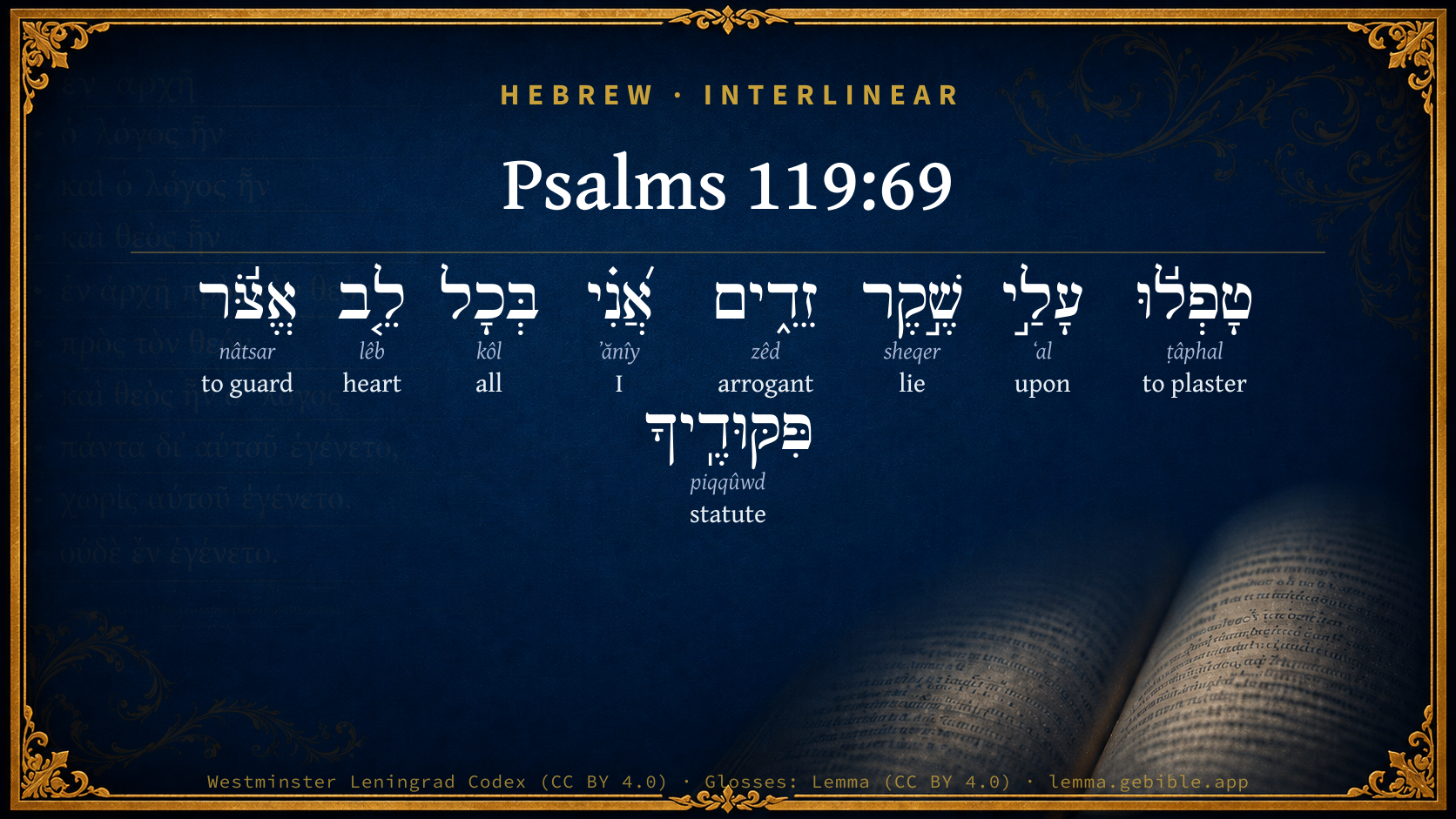
Psalms 119:69

Hebrew (Westminster Leningrad Codex) Psalms 119:69 appears in the Hebrew Old Testament. The text above is from the Westminster Leningrad Codex. Each word links to its Strong’s number, a concise gloss, and parsing drawn from the Open Scriptures Hebrew Bible morphology. Click any word for its full Brown-Driver-Briggs (BDB) entry.
Download image
Cite this verse

Psalms 119:69 (World English Bible). Public Domain. Lemma interlinear Bible study tool, https://lemma.gebible.app/v/psalms/119/69.

Show BibTeX & RIS
BibTeX
RIS
English Translation
The proud have smeared a lie upon me. With my whole heart, I will keep your precepts.
World English Bible · Public Domain
Download a study sheet

One document with this verse’s original text, its word-by-word gloss line, the meaning frame, cross-references with their text, attributed commentary, and full source and license credits — printable, and it pastes into notes with its structure intact.

This verse Autodidact and up

Study sheet (.html) Plain text (.txt)

A passage Seminary Student

Up to 50 verses in one chapter. A passage sheet keeps up to 6 commentary sources and 12 cross-references per verse, in the order this page ranks them, and says so on the sheet whenever that leaves anything out. Ask for a single verse and you get the Autodidact verse sheet above.

Everything on this page stays free to read, with no account — the sheet is a download of what is already on screen, not access to it.

Want to remove ads? Support Godless Engineer
Compare translations 3

The same verse in 3 English versions, stacked beneath the original-language interlinear above. Click any original word for its lexicon entry.

Each is an independent rendering of the whole verse — the interlinear is not word-aligned to these translations.

Highlighted words mark where these versions differ — a whole-verse word diff, not a word-by-word alignment.

  • World English Bible Public Domain
    The proud have smeared a lie upon me. With my whole heart, I will keep your precepts.
  • King James Version Public Domain
    The proud have forged a lie against me: but I will keep thy precepts with my whole heart.
  • unfoldingWord Literal Text CC BY-SA 4.0
    The arrogant smear lies on me; I, with a whole heart, I keep your precepts.

unfoldingWord Literal Text — © unfoldingWord, licensed CC BY-SA 4.0. Word-aligned USFM3 via Door43 (git.door43.org/unfoldingWord/en_ult).

Versions to compare (up to 4)

3 of 4 selected

Show all 17 translations

Every available English version of this verse, each an independent rendering of the whole verse.

  • World English Bible Public Domain
    The proud have smeared a lie upon me. With my whole heart, I will keep your precepts.
  • Berean Standard Bible Public Domain
    Though the arrogant have smeared me with lies, I keep Your precepts with all my heart.
  • Majority Standard Bible Public Domain
    Though the arrogant have smeared me with lies, I keep Your precepts with all my heart.
  • King James Version Public Domain
    The proud have forged a lie against me: but I will keep thy precepts with my whole heart.
  • American Standard Version (1901) Public Domain
    The proud have forged a lie against me: With my whole heart will I keep thy precepts.
  • Revised Version (1885) Public Domain
    The proud have forged a lie against me: with my whole heart will I keep thy precepts.
  • Geneva Bible (1599) Public Domain
    The proud haue imagined a lie against me: but I wil keepe thy precepts with my whole heart.
  • Young's Literal Translation Public Domain
    Forged against me falsehood have the proud, I with the whole heart keep Thy precepts.
  • Literal Standard Version CC BY-SA 4.0
    The proud have forged falsehood against me, || I keep Your precepts with the whole heart.
  • Unlocked Literal Bible CC BY-SA 4.0
    The arrogant have smeared me with lies, but I keep your instructions with my whole heart.
  • unfoldingWord Literal Text CC BY-SA 4.0
    The arrogant smear lies on me; I, with a whole heart, I keep your precepts.
  • Darby Bible Public Domain
    The proud have forged falsehood against me: I will observe thy precepts with [my] whole heart.
  • World Messianic Bible Public Domain
    The proud have smeared a lie upon me. With my whole heart, I will keep your precepts.
  • Webster's Bible Public Domain
    The proud have forged a lie against me: but I will keep thy precepts with my whole heart.
  • Free Bible Version CC BY-SA 4.0
    Arrogant people smear my reputation with lies; but I whole-heartedly follow your commands.
  • Bible in Basic English Public Domain
    The men of pride have said false things about me; but I will keep your orders in my heart.
  • JPS Tanakh (1917) Public Domain
    The proud have forged a lie against me; but I with my whole heart will keep Thy precepts.

Literal Standard Version (2020), Covenant Press — licensed CC BY-SA 4.0. Text via the HelloAO Bible API (eBible.org). Unlocked Literal Bible (unfoldingWord) — licensed CC BY-SA 4.0. Text via the HelloAO Bible API (eBible.org). unfoldingWord Literal Text — © unfoldingWord, licensed CC BY-SA 4.0. Word-aligned USFM3 via Door43 (git.door43.org/unfoldingWord/en_ult). Free Bible Version, Dr. Jonathan Gallagher — licensed CC BY-SA 4.0. Text via the HelloAO Bible API (eBible.org).

Word by word

More ways to search: Search by grammar → Find every occurrence → Compare this word →

Practice this passage: Drill this verse → Learn its vocabulary →

About this verse

These counts appear in no published source. They are computed here, from the morphology-tagged text and Lemma’s own curated glosses. What Lemma adds →

9
words
9
distinct lemmas
Wisdom
section

Notable vocabulary

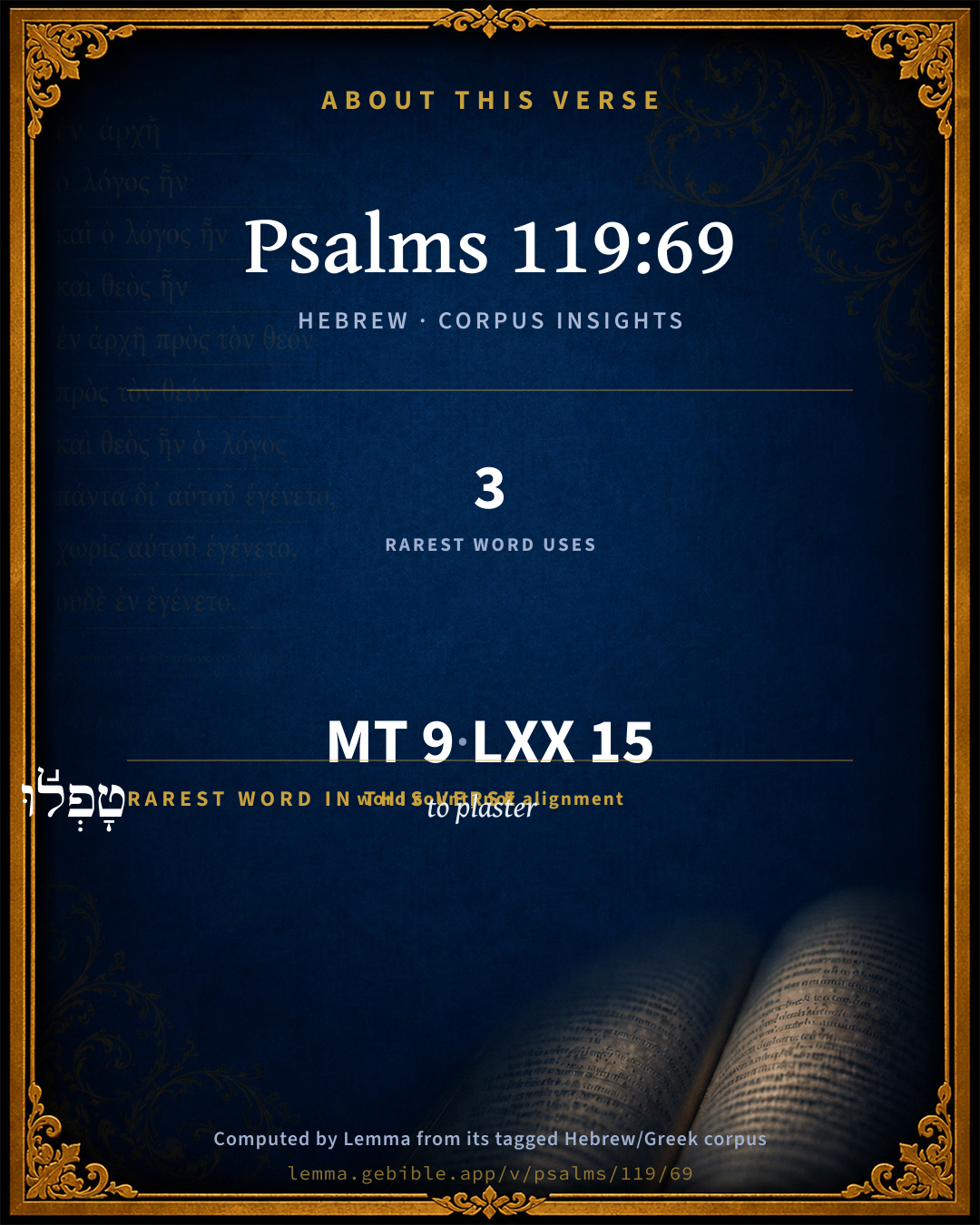
The rarest word here is טָפְל֬וּ to plaster H2950 — appearing just 3 times in the whole Hebrew Bible.

Shared distinctive vocabulary

טָפְל֬וּ to plaster H2950 occurs in 3 verses of the Hebrew Bible. Also found in:

Grammatical profile

  • 2 verbs
  • 4 nouns
  • 1 adjective
  • 1 pronoun
  • 1 preposition

Verb forms

  • טָפְל֬וּ Qal · Perfect
  • אֱצֹּ֬ר Qal · Imperfect

Hebrew & Septuagint length

In English translation the verse runs 17 words from the Hebrew and 21 from the Septuagint (LXX English) — closely comparable.

A rough comparison of the two English renderings, which tokenize alike — not a word-level alignment.

Word counts can differ between the Hebrew and the Greek without any difference in meaning — e.g. the Hebrew direct-object marker אֵת has no separate Greek word, and Greek often adds the article ὁ.

In the original languages it is 9 Hebrew tokens and 15 Greek tokens — but the two are counted differently (Hebrew bundles its prefixes and suffixes into one token; the Greek is in lemma form), so that isn’t a like-for-like length.

Cross-references

14

Topical passages linked to Psalms 119:69 in the Treasury of Scripture Knowledge — connected by theme and wording, ordered by reader-vote popularity; previews shown in the World English Bible.

  • Job 13:4 But you are forgers of lies. You are all physicians of no value.
  • Matthew 5:11–12 "Blessed are you when people reproach you, persecute you, and say all kinds of evil against you falsely, for my sake.
  • Psalms 109:2–3 For they have opened the mouth of the wicked and the mouth of deceit against me. They have spoken to me with a lying tongue.
  • Psalms 119:157 Many are my persecutors and my adversaries. I haven't swerved from your testimonies.
  • Matthew 26:59–68 Now the chief priests, the elders, and the whole council sought false testimony against Jesus, that they might put him to death;
  • Psalms 119:34 Give me understanding, and I will keep your law. Yes, I will obey it with my whole heart.
  • Psalms 119:51 The arrogant mock me excessively, But I don't swerve from your law.
  • Psalms 119:58 I sought your favor with my whole heart. Be merciful to me according to your word.
  • Acts 24:5 For we have found this man to be a plague, an instigator of insurrections among all the Jews throughout the world, and a ringleader of the sect of the Nazarenes.
  • Acts 24:13 Nor can they prove to you the things of which they now accuse me.
  • James 1:8 He is a double-minded man, unstable in all his ways.
  • Psalms 35:11 Unrighteous witnesses rise up. They ask me about things that I don't know about.
  • Jeremiah 43:2–3 then spoke Azariah the son of Hoshaiah, and Johanan the son of Kareah, and all the proud men, saying to Jeremiah, You speak falsely: Yahweh our God has not sent you to say, You shall not go into Egypt to sojourn there;
  • Matthew 6:24 "No one can serve two masters, for either he will hate the one and love the other; or else he will be devoted to one and despise the other. You can't serve both God and Mammon.

Cross-references courtesy of OpenBible.info (CC BY 4.0).

Hebrew and Greek witnesses Masoretic Hebrew ↔ Greek Septuagint

The same verse in the two great witnesses to the Old Testament, shown verse-for-verse.

You’re reading Greek Psalm 118 (Hebrew Psalm 119). The Septuagint counts the superscription, so verse numbers can differ from the Hebrew — chapter-level alignment, not verse-by-verse. Numbering follows Rahlfs.

These are two independent witnesses, not word-aligned to each other, and the Septuagint is shown in lemma (dictionary) form.

Hebrew Psalms 119:69 Masoretic · Westminster Leningrad Codex

טָפְל֬וּ עָלַ֣י שֶׁ֣קֶר זֵדִ֑ים אֲ֝נִ֗י בְּכָל לֵ֤ב אֱצֹּ֬ר פִּקּוּדֶֽיךָ

The proud have smeared a lie upon me. With my whole heart, I will keep your precepts.

World English Bible · Public Domain

Greek LXX Greek Psalm 118:69 Septuagint · lemma form

πληθύνω ἐπί ἐγώ ἀδικία ὑπερήφανος ἐγώ δέ ἐν ὅλος καρδία ἐγώ ἐκἐρευνάω ὁ ἐντολή σύ

The injustice of the proud has been multiplied against me: but I will search out your commandments with all my heart.

LXX2012 (modern English Septuagint) · Public Domain

Hebrew: Westminster Leningrad Codex (CC BY 4.0). Greek: Septuagint (public domain); English from LXX2012 (modern English Septuagint) (Public Domain). How the Septuagint differs from the Hebrew →

Commentary

Notes on Psalms 119:69 from classic Christian and Jewish commentators (each source and its license shown beneath its notes). The classic Christian expositions comment on the surrounding passage and are grouped to its opening verse, so a note may address several verses; the Jewish commentaries on the Tanakh (Rashi and others) are per-verse, so they appear only where the commentator wrote on this verse.

Lemma curates 59 commentaries, every one of them public domain or Creative Commons licensed, each selected and text-cleaned for this edition rather than reprinted as found. About our sources →

Trapp's Complete Commentary

John Trapp

Psa 119:69 The proud have forged a lie against me: [but] I will keep thy precepts with [my] whole heart.

Ver. 69. The proud have forged a lie against me] Heb. They have cunningly and finely aspersed me. Mendacium mendacio assuentes, piecing one lie to another, and drawing together iniquity with the cart ropes of vanity. Concinnarunt, artificiose confinxerunt.

But l will keep thy precepts] Notwithstanding their slanders; and the rather.

John Trapp, A Commentary or Exposition upon All the Books of the Old and New Testament (1647–1656) — public domain. Text from a community e-Sword module.

The Biblical Illustrator

Joseph S. Exell

Psa_119:69-71

The proud have forged a lie against me.

The slanderer, the corrupt, the pious

I. The tongue of the slanderer. Slander is--

1. Malicious. Its inspiration is envy, jealousy, or revenge.

2. Mischievous. It often lacerates a mans heart, and destroys his good name, which may be dearer than life. He that steals my purse, etc.

3. Cowardly. The man who confronts another, strikes him with fist or sword, shows some bravery. But he who injures a man by slander is a miserable sneak.

II. The heart of the corrupt. As fat as grease--insensible to moral motives. All the moral nerves of the soul are benumbed by sin.

III. The avowal of the pious. The avowal--

1. Of a good resolution.

2. Of a blessed experience. Affliction evermore serves the good. (Homilist.)

The Biblical Illustrator, edited by Joseph S. Exell (c. 1880s–1900s) — public domain. Text from a community e-Sword module.

Joseph Benson's Commentary

Psa 119:69-70. The proud have forged a lie against me — A slander, charging me with hypocrisy toward God, and other sins. But I will keep thy precepts — My practice shall confute their calumnies. “Every disciple of Christ, who, like his Master, goeth contrary to the ways of the world, and condemneth them, must expect to be, like that Master, slandered and calumniated by the world. To such slanders and calumnies, a good life is the best answer.” — Horne. Their heart is as fat as grease — Hebrew, שׂפשׁ כחלב, tapash chacheleb, which Dr. Waterland renders, is gross, as with fat: and Houbigant, gross as fat. The sense is, either, 1st, They are dull, stupid, insensible, and past feeling, neither affected with the terrors nor comforts of God’s word: so a similar phrase signifies, Isa 6:10, compared with Joh 12:40. Or, 2d, They prosper exceedingly, and are even glutted with the wealth and comforts of this life. But I delight in thy law — I do not envy them their prosperity and pleasure: for I have as much delight in God’s law as they have in worldly things.

Joseph Benson's Commentary on the Old and New Testaments (1811–1818) — public domain. Text from a community e-Sword module.

J. A. Alexander on Psalms

Joseph Addison Alexander

69. (Psa 119:69) Proud (men) have forged a lie against me; I, with all (my) heart, will keep thy precepts. Proud, presumptuous, overbearing sinners, as in Psa 119:51. Forged expresses the essential meaning of the Hebrew word, but not its figurative form, which seems to be that of sewing, analogous to that of weaving, as applied to the same thing, both in Hebrew and in other languages. We may also compare our figurative phrase, to patch up, which, however, is not so much suggestive of artifice or skill as of the want of it. The connection of the clauses is, that all the craft and malice of his enemies should only lead him to obey God with a more undivided heart than ever. See above, on Psa 119:58. With the same surprising skill and wisdom as in many other cases which have been already mentioned, this verse is so framed as to be equally well suited to such national and public evils as those described in the fourth chapter of Ezra, and to the sufferings of the pious individual, arising from the pride and spite of wicked enemies.

Joseph Addison Alexander, The Psalms Translated and Explained (1850) — public domain. Text from a community e-Sword module.

Matthew Henry's Commentary

David here tells us how he was affected as to the proud and wicked people that were about him. 1. He did not fear their malice, nor was he by it deterred from his duty: They have forged a lie against me. Thus they aimed to take away his good name. Nay, all we have in the world, even life itself, may be brought into danger by those who make no conscience of forging a lie. Those that were proud envied David's reputation, because it eclipsed them, and therefore did all they could to blemish him. They took a pride in trampling upon him. They therefore persuaded themselves it was no sin to tell a deliberate lie if it might but expose him to contempt. Their wicked wit forged lies, invented storied which there was not the least colour for, to serve their wicked designs. And what did David do when he was thus belied? He will bear it patiently; he will keep that precept which forbids him to render railing for railing, and will with all his heart sit down silently. He will go on in his duty with constancy and resolution: "Let them say what they will, I will keep thy precepts, and not dread their reproach." 2. He did not envy their prosperity, nor was he by it allured from his duty. Their heart is as fat as grease. The proud are at ease (Psa 123:4); they are full of the world, and the wealth and pleasures of it; and this makes them, (1.) Senseless, secure, and stupid; they are past feeling: thus the phrase is used, Isa 6:10. Make the heart of this people fat. They are not sensible of the touch of the word of God or his rod. (2.) Sensual and voluptuous: "Their eyes stand out with fatness (Psa 73:7); they roll themselves in the pleasures of sense, and take up with them as their chief good; and much good may it do them. I would not change conditions with them. I delight in thy law; I build my security upon the promises of God's word and have pleasure enough in communion with God, infinitely preferable to all their delights." The children of God, who are acquainted with spiritual pleasures, need not envy the children of this world their carnal pleasures.

Matthew Henry's Commentary on the Whole Bible (1708–1710) — public domain (CC PDM 1.0). Text via the HelloAO Bible API.

Adam Clarke's Commentary

Verse 69. The proud have forged a lie] The poor captives in Babylon had their conduct and motives continually misrepresented, and themselves belied and calumniated.

Adam Clarke's Commentary on the Bible (1810–1826) — public domain. Text from a community e-Sword/MySword module.

John Calvin's Commentaries

69. The proud have weaved lies against me He declares that, notwithstanding the malignant interpretation which the wicked put upon all that he did, and their attempts, by this artifice, to turn him aside from following after and loving uprightness, the state of his mind remained unaltered. It is a severe temptation, when, although innocent, we are loaded with reproach and infamy, and are not only assailed by injurious words, but also held up to the odium of the world by wicked persons, under some specious pretense or other. We see many who otherwise are good people, and inclined to live uprightly, either become discouraged, or are greatly shaken, when they find themselves so unworthily rewarded. On this account the prophet’s example is the more to be attended t that we may not be appalled by the malignity of men; that we may not cease to nourish within us the fear of God, even when they may have succeeded in destroying our reputation in the sight of our fellow-creatures; and that we may be contented to have our piety shining at the judgment-scat of God, although it may be defaced by the calumnies of men. So long as we depend upon the judgment of men, we will always be in a state of fluctuation, as has been already observed. Farther, let our works be never so splendid, we know that they will be of no account in the sight of God, if, in performing them, our object is to gain the favor of the world. Let us therefore learn to cast our eyes to that heavenly stage, and to despise all the malicious reports which men may spread against us. Let us leave the children of this world to, enjoy their reward, since our crown is laid up for us in heaven, and not on the earth. Let us disentangle ourselves from the snares with which Satan endeavors to obstruct us, by patiently bearing infamy for a season. The verb טפל, taphal, which otherwise signifies to join together, is here, by an elegant metaphor, taken for to weave, or to trim; intimating that the enemies of the prophet not only loaded him with coarse reproaches, but also invented crimes against him, and did so with great cunning and color of truth, that he might seem to be the blackest of characters. But though they ceased not to weave for him this web, he was enabled to break through it by his invincible constancy; and, exercising a strict control over his heart, he continued faithfully to observe the law of God. He applies to them the appellation of proud; and the reason of this, it may be conjectured, is, that the persons of whom he speaks were not the common people, but great men, who inflated with confidence in their honors and riches, rose up against him with so much the more audacity. He evidently intimates that they trampled him under their feet by their proud disdain, just as if he had been a dead dog.

With this corresponds the statement in the subsequent verse (70th) that their heart is fat as grease, — a vice too common among the despisers of God. Whence is it that wicked men, whom their own conscience gnaws within, vaunt themselves so insolently against the most eminent servants of God, but because a certain grossness overgrows their hearts, so that they are stupefied, and even frenzied by their own obstinacy? But wonderful and worthy of the highest praise is the magnanimity of the prophet, who found all his delight in the law of God: it is as if he declared that this was the food on which he fed, and with which he was refreshed in the highest degree; which could not have been the case had not his heart been freed, and thoroughly cleansed from all unhallowed pleasures.

John Calvin's Commentaries (1540-1563) — public domain. Text from the Calvin Translation Society English edition (1840s-50s) via the Christian Classics Ethereal Library (ccel.org). Calvin's coverage is partial (roughly two-thirds of the Bible); uncommented books and verses are honest gaps, never fabricated. The 19th-century editor's footnotes and remarks are omitted so the notes are faithfully Calvin's own voice.

Ellicott's Commentary for English Readers

(69) Have forged.—Rather, patched. The verb occurs twice besides (Job_13:4; Job_14:17). Gesenius compares the Greek, δόλον ἐάπτειν, and the Latin, suere dolos. Comp. also

“You praise yourself by laying defects of judgment to me;

but you patched up your excuses.”

Antony and Cleopatra: Acts 2, Scene 2.

A Bible Commentary for English Readers, edited by Charles John Ellicott (1878–1897) — public domain. Text from a community e-Sword module.

The Cambridge Bible for Schools and Colleges

gen. ed. J. J. S. Perowne

69. The proud have forged a lie against me] Lit. have plastered falsehood over me, “making his true character unrecognisable” (Del.), or perhaps, questioning the sincerity and disinterestedness of his service; but his answer to their calumny is a more resolute determination to obey: as for me, with my whole heart will I keep thy precepts.

The Cambridge Bible for Schools and Colleges (gen. ed. J. J. S. Perowne; Cambridge University Press, 1878–1918) — public domain. Text from a community e-Sword module.

John Gill's Exposition

The law of thy mouth is better unto me than thousands of gold and silver. The word of God, the doctrines contained in it; which, coming out of the mouth of God, and spoken by him, carries in it weight and authority, commands reverence and respect; and ought to be considered as indeed the word of God and not of man; and so of more value than thousands of pieces of gold and silver; or, as the Targum, than a thousand talents of gold and silver. The truths and doctrines of the word of God are not only comparable to gold and silver for their intrinsic worth and value; but are preferable to them, and to be received before them: David had his thousands of gold and silver, but he esteemed the word of God above them all; and willingly suffered afflictions, that he might understand it better; see Psa 119:127.

.

Psalms 119:73

psa 119:73

psa 119:73

psa 119:73

JOD.--The Tenth Part.

JOD. Thy hands have made me and fashioned me,.... Not the psalmist himself, nor his parents, but the Lord alone: for though parents are fathers of our flesh, they are but instruments in the hand of the Lord; though man is produced by natural generation, yet the formation and fashioning of men are as much owing to the power and wisdom of God, which are his hands, as the formation of Adam was. Job owns this in much the same words as the psalmist does, Job 10:8; see Psa 139:13. God not only gives conception, and forms the embryo in the womb, but fashions and gives it its comely and proportionate parts. Or, "covered me"; the first word may respect conception, and this the covering of the fetus with the secundine (t); see Psa 139:13;

give me understanding, that I may learn thy commandments; since he had a proper comely body, and a reasonable soul; though debased by sin, and brought into a state of ignorance, especially as to spiritual things, he desires he might have a spiritual understanding given him; of the word of God in general, the truths and doctrines of it, which are not understood by the natural man; and of the precepts of it in particular, that he might so learn them as to know the sense and meaning of them, their purity and spirituality; and so as to do them from a principle of love, in faith, and to the glory of God: for it is not a bare learning them by heart, or committing them to memory, nor a mere theory of them, but the practice of them in faith and love, which is here meant.

(t) Vid. Hackmam. Praecid. Sacr. p. 195.

John Gill's Exposition of the Whole Bible (1746–1763) — public domain (CC PDM 1.0). Text via the HelloAO Bible API.

Albert Barnes' Notes on the Bible

The proud - The psalmist had before referred to the “proud” as those from whom he had suffered injury, or as having been exposed to their derision. See the notes at Psa 119:51. He here reverts to another form in which he had suffered from them.

Have forged a lie against me - Compare Job 13:4. The word rendered “forged,” means to patch together; and then it is applied to charges or accusations against anyone, perhaps from their being made up (as they often are) of shreds and patches - hints, small matters, things having no necessary connection in themselves, but brought together as if they pertained to the same transaction - words dropped here and there in conversation, which, being artfully woven together, seem to make out a plausible case against a man. Most slanders are formed and sustained in this way, for it is rare that an absolutely forged slander is uttered against a man, or that a charge is brought which cannot be made to have plausibility from such circumstances as those referred to above. Even the most pure and circumspect cannot always avoid this, for there is something in every man’s life of which a malignant and cunning enemy may take advantage, and which he may weave into a story which some will believe, and which it may not be easy to confute. A malicious man may thus start a slander which may require years to correct, and which may even operate injuriously against a man all his life.

But I will keep thy precepts with my whole heart - Notwithstanding their accusations, and their attempts to turn me away from thee, or to represent me as false and hypocritical. Whatever they may do; whatever reports they may start to my disadvantage, it is my fixed purpose to obey entirely and always thy law. See the notes at Psa 119:51.

Albert Barnes' Notes on the Bible (1834–1885) — public domain. Text from a community e-Sword/MySword module.

Matthew Poole's English Annotations

Forged a lie; a slander, charging me with hypocrisy towards God, and rebellion against my prince.

But I will keep thy precepts; my practice shall confute their calumnies.

Matthew Poole's English Annotations on the Holy Bible (1683–1685) — public domain. Text from a community e-Sword/MySword module.

The Treasury of David

Charles H. Spurgeon

Ver. 69. The proud have forged a lie against me. They first derided him (Ps 119:51), then defrauded him (Ps 119:61), and now they have defamed him. To injure his character they resorted to falsehood, for they could find nothing against him if they spoke the truth. They forged a lie as a blacksmith beats out a weapon of iron, or they counterfeited the truth as men forge false coin. The original may suggest a common expression "They have patched up a lie against me." They were not too proud to lie. Pride is a lie, and when a proud man utters lies "he speaketh of his own." Proud men are usually the bitterest opponents of the righteous: they are envious of their good fame and are eager to ruin it. Slander is a cheap and handy weapon if the object is the destruction of a gracious reputation; and when many proud ones conspire to concoct, exaggerate, and spread abroad a malicious falsehood, they generally succeed in wounding their victim, and it is no fault of theirs if they do not kill him outright. O the venom which lies under the tongue of a liar! Many a happy life has been embittered by it, and many a good repute has been poisoned as with the deadliest drug. It is painful to the last degree to hear unscrupulous men hammering away at the devil's anvil forging a new calumny; the only help against it is the sweet promise, "No weapon that is formed against thee shall prosper, and every tongue that riseth against thee in judgment thou shalt condemn."

But I will keep thy precepts with my whole heart. My one anxiety shall be to mind my own business and stick to the commandments of the Lord. If the mud which is thrown at us does not blind our eyes or bruise our integrity it will do us little harm. If we keep the precepts, the precepts will keep us in the day of contumely and slander. David renews his resolve "I will keep"; he takes a new look at the commands, and sees them to be really the Lord's "thy precepts"; and he arouses his entire nature to the work "with my whole heart." When slanders drive us to more resolute and careful obedience they work our lasting good; falsehood hurled against us may be made to promote our fidelity to the truth, and the malice of men may increase our love to God. If we try to answer lies by our words we may be beaten in the battle; but a holy life is an unanswerable refutation of all calumnies. Spite is balked if we persevere in holiness despite all opposition.

Ver. 69. The proud have forged a lie against me. If in the present day the enemies of the truth in their lying writings rail against the orthodox teachers in the Church, that is a very old artifice of the Devil, since David complains that in his day it happened unto him. Solomon Gesner.

Ver. 69. The proud have forged a lie. They trim up lies with shadows of truth and neat language; they have mints to frame their lies curiously in, and presses to print their lies withal. William Greenhill, 1591-1677.

Ver. 69. The proud. Faith humbleth, and infidelity maketh proud. Faith humbleth, because it letteth us see our sins, and the punishments thereof, and that we have no dealing with God but through the mediation of Christ; and that we can do no good, nor avoid evil, but by grace. But when men know not this, then they think much of themselves, and therefore are proud. Therefore all ignorant men, all heretics, and worldlings are proud. They that are humbled under God's hands, are humble to men; but they that despise God do also persecute his servants. Richard Greenham.

Ver. 69. Forged a lie. Vatablus translates it, "coneinnarunt mendacta". So Tremellius: they have trimmed up lies. As Satan can transform himself into an angel of light, so he can trim up his lies under coverings of truth, to make them the more plausible unto men. And indeed this is no small temptation, when lies made against the godly are trimmed up with the shadows of truth, and wicked men cover their unrighteous dealings with appearances of righteousness. Thus, not only are the godly unjustly persecuted, but simple ones are made to believe that they have most justly deserved it. In this case the godly are to sustain themselves by the testimony of a good conscience. William Cowper.

Ver. 69. Forged. expresses the essential meaning of the Hebrew word, but not its figurative form which seems to be that of sewing, analogous to that of weaving, as applied to the same thing, both in Hebrew and in other languages. We may also compare our figurative phrase, to patch up, which, however, is not so much suggestive of artifice or skill as of the want of it. The connection of the clauses is, that all the craft and malice of his enemies should only lead him to obey God, with a more undivided heart than ever. Joseph Addison Alexander.

Ver. 69. Forged. The metaphor may be like the Greek (raptein doloul), from sewing or patching up: or, from smearing, or daubing (Delitzsch, Moll, etc.), a wall, so as to hide the real substance. The Psalmist remains true to God despite the falsehoods with which the proud smear and hide his true fidelity. The Speaker's Commentary.

Ver. 69. A lie. Satan's two arms by which he wrestles against the godly are violence and lies: where he cannot, or dare not, use violence, there be sure he will not fail to fight with lies. And herein doth the Lord greatly show his careful providence, in fencing his children against Satan's malice and the proud brags of his instruments, in such sort, that their proudest hearts are forced to forge lies; their malice being so great that they must do evil; and yet their power so bridled that they cannot do what they would. William Cowper.

Ver. 69. I will keep thy precepts with my whole heart. Let the word of the Lord come, let it come; and if we had six hundred necks, we would submit them all to his dictates. Augustine.

Ver. 69. Wholehearted obedience the best solace under slander; the best answer to it; and the best way of converting the slanderers.

Psalms 119:70*

Charles H. Spurgeon's The Treasury of David (1869–1885) — public domain. Psalms only. Text from a community e-Sword/MySword module.

The Pulpit Commentary

The proud have forged a lie against me; literally, patched up a lie against me (comp. vers. 22, 23, 42, 78, etc.). But I will keep thy precepts with my whole heart (comp. vers. 2, 10, 34, etc.). "The connection of the clauses is that all the craft and malice of his enemies should only lead him to obey God with a more undivided heart than ever" (Professor Alexander).

The Pulpit Commentary (1880–1919), ed. H.D.M. Spence-Jones & Joseph S. Exell — public domain. Text from a community e-Sword module.

unfoldingWord translationNotes

Door43 World Missions Community

The arrogant

This nominal adjective can be stated as an adjective. AT: "Arrogant people" (See: Nominal Adjectives)

smeared me with lies

People telling many lies about a person is spoken of as if they made the person dirty by spreading lies over him. (See: Metaphor)

with my whole heart

Here "heart" represents a person's will. AT: "with complete commitment" or "completely" (See: Metonymy)

Their hearts are hardened

Here "hearts" represents the people's wills. A person being stubborn is spoken of as if their hearts or wills were hard like a rock. AT: "They are stubborn" (See: Metonymy and Metaphor)

translationWords

arrogant

instruct

heart

delight

law

unfoldingWord translationNotes — © Distant Shores Media and the Door43 World Missions Community, licensed CC BY-SA 4.0. Source: git.door43.org/Door43/en_tn.

Rashi

Rabbi Shlomo Yitzchaki (Rashi)

Willful sinners have heaped false accusations upon me Heb. טפלו, they joined upon me, and similarly (Job 14:17): “and You have attached Yourself (ותטפל) to my iniquity.”

Rashi on the Tanakh — English translations: “The Judaica Press complete Tanach with Rashi, translated by A. J. Rosenberg” (CC BY 4.0); “Pentateuch with Rashi's commentary by M. Rosenbaum and A.M. Silbermann, 1929-1934” (public domain); “The Metsudah Tanach series, Lakewood, N.J” (CC BY 4.0); and “The Book of Joshua, Metsudah Publications, 1997” (CC BY 4.0). Text via Sefaria.

Lesson kit

Teaching starters — assembled from the data on this page, not authored interpretation. Every prompt links to the verse data it draws on. Edit before teaching.

Psalms, in the Wisdom, opens this verse with 9 words (9 distinct Hebrew lemmas). Its most distinctive word is ṭâphal (“to plaster”). A historical commentator’s framing appears above. Read the whole chapter for the surrounding context.

Discussion questions

  1. What does “to plaster” (ṭâphal) contribute to the verse as a whole?
  2. Job 13:4 shares the word «to plaster» with this verse. How do the two illuminate each other?
  3. The translations on this page render this verse differently — a whole-verse word diff, not a word-by-word alignment. What might account for the different wordings?
  4. The verb «טָפְל֬וּ» is Qal Perfect. How does its form color the action?
  5. Reading how Trapp's Complete Commentary and The Biblical Illustrator read this verse, where do the two commentators agree and where do they part?

Things to notice

Reading settings

Reading text

Shown beneath each verse's original-language words.

Old Testament
Old Testament edition

Read the OT as the Masoretic Hebrew (MT) or the Greek Septuagint (LXX).

English shown for the Greek Septuagint (in the Hebrew ↔ Greek comparison).

Comparing translations? Open the Compare panel on any verse page to stack up to four side by side.