
Psalms 31:18

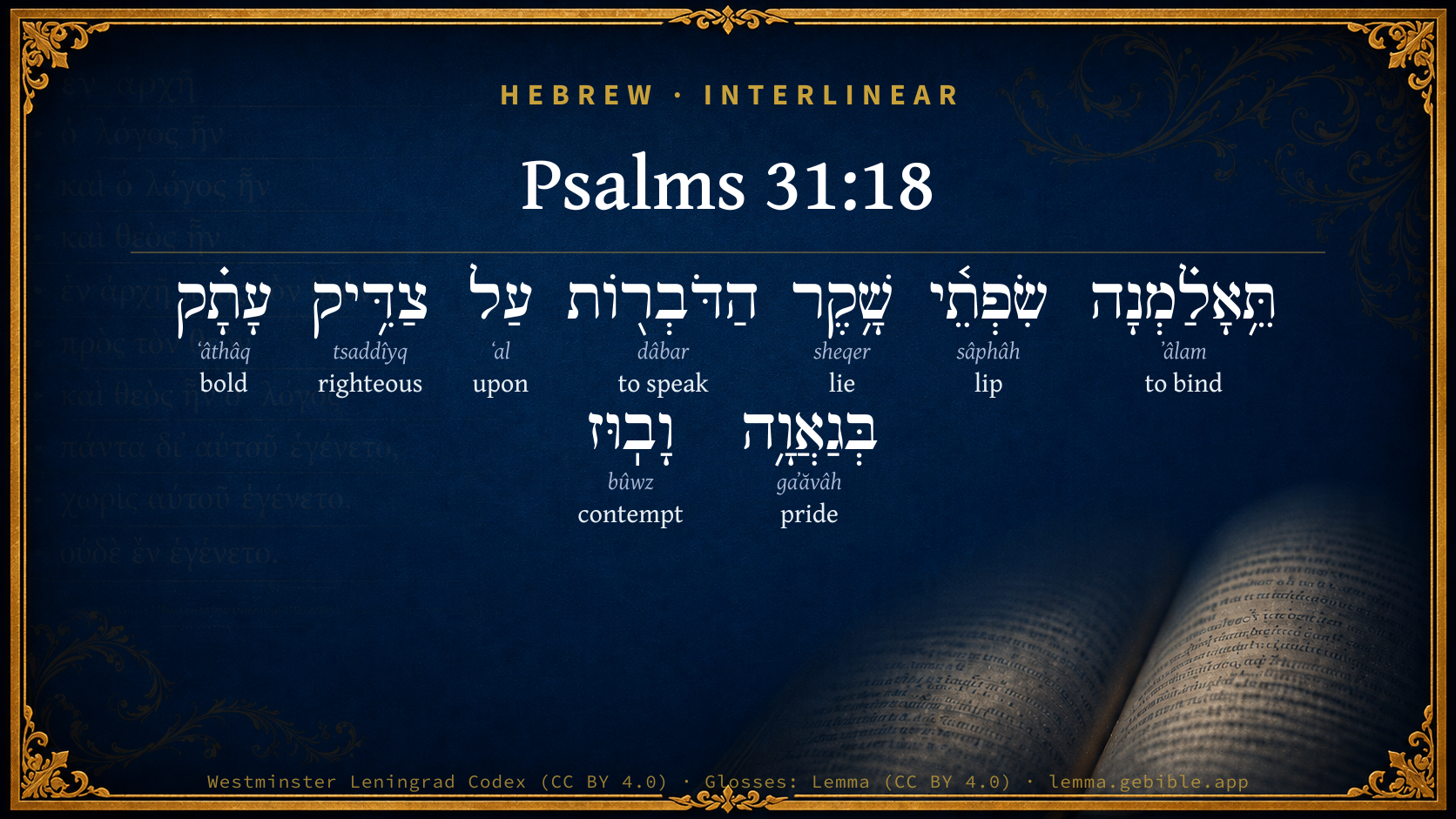
Hebrew (Westminster Leningrad Codex) Psalms 31:18 appears in the Hebrew Old Testament. The text above is from the Westminster Leningrad Codex. Each word links to its Strong’s number, a concise gloss, and parsing drawn from the Open Scriptures Hebrew Bible morphology. Click any word for its full Brown-Driver-Briggs (BDB) entry.
Download image
Cite this verse

Psalms 31:18 (World English Bible). Public Domain. Lemma interlinear Bible study tool, https://lemma.gebible.app/v/psalms/31/18.

Show BibTeX & RIS
BibTeX
RIS
English Translation
Let the lying lips be mute, Which speak against the righteous insolently, with pride and contempt.
World English Bible · Public Domain
Download a study sheet

One document with this verse’s original text, its word-by-word gloss line, the meaning frame, cross-references with their text, attributed commentary, and full source and license credits — printable, and it pastes into notes with its structure intact.

This verse Autodidact and up

Study sheet (.html) Plain text (.txt)

A passage Seminary Student

Up to 50 verses in one chapter. A passage sheet keeps up to 6 commentary sources and 12 cross-references per verse, in the order this page ranks them, and says so on the sheet whenever that leaves anything out. Ask for a single verse and you get the Autodidact verse sheet above.

Everything on this page stays free to read, with no account — the sheet is a download of what is already on screen, not access to it.

Want to remove ads? Support Godless Engineer
Compare translations 3

The same verse in 3 English versions, stacked beneath the original-language interlinear above. Click any original word for its lexicon entry.

Each is an independent rendering of the whole verse — the interlinear is not word-aligned to these translations.

Highlighted words mark where these versions differ — a whole-verse word diff, not a word-by-word alignment.

  • World English Bible Public Domain
    Let the lying lips be mute, Which speak against the righteous insolently, with pride and contempt.
  • King James Version Public Domain
    Let the lying lips be put to silence; which speak grievous things proudly and contemptuously against the righteous.
  • unfoldingWord Literal Text CC BY-SA 4.0
    Let lying lips be silenced, the ones speaking insolent things against the righteous, in pride and contempt.

unfoldingWord Literal Text — © unfoldingWord, licensed CC BY-SA 4.0. Word-aligned USFM3 via Door43 (git.door43.org/unfoldingWord/en_ult).

Versions to compare (up to 4)

3 of 4 selected

Show all 18 translations

Every available English version of this verse, each an independent rendering of the whole verse.

  • World English Bible Public Domain
    Let the lying lips be mute, Which speak against the righteous insolently, with pride and contempt.
  • Berean Standard Bible Public Domain
    May lying lips be silenced—lips that speak with arrogance against the righteous, full of pride and contempt.
  • Majority Standard Bible Public Domain
    May lying lips be silenced—lips that speak with arrogance against the righteous, full of pride and contempt.
  • King James Version Public Domain
    Let the lying lips be put to silence; which speak grievous things proudly and contemptuously against the righteous.
  • American Standard Version (1901) Public Domain
    Let the lying lips be dumb, Which speak against the righteous insolently, With pride and contempt.
  • Revised Version (1885) Public Domain
    Let the lying lips be dumb; which speak against the righteous insolently, with pride and contempt.
  • Geneva Bible (1599) Public Domain
    Let the lying lips be made dumme, which cruelly, proudly and spitefully speake against the righteous.
  • Douay-Rheims (1899) Public Domain
    Let me not be confounded, O Lord, for I have called upon thee. Let the wicked be ashamed, and be brought down to hell.
  • Young's Literal Translation Public Domain
    Let lips of falsehood become dumb, That are speaking against the righteous, Ancient sayings, in pride and contempt.
  • Literal Standard Version CC BY-SA 4.0
    Let lips of falsehood become mute, || That are speaking against the righteous, || Ancient sayings, in pride and contempt.
  • Unlocked Literal Bible CC BY-SA 4.0
    May lying lips be silenced that speak against the righteous defiantly with arrogance and contempt.
  • unfoldingWord Literal Text CC BY-SA 4.0
    Let lying lips be silenced, the ones speaking insolent things against the righteous, in pride and contempt.
  • Darby Bible Public Domain
    Let the lying lips become dumb, which speak insolently against the righteous in pride and contempt.
  • World Messianic Bible Public Domain
    Let the lying lips be mute, which speak against the righteous insolently, with pride and contempt.
  • Webster's Bible Public Domain
    \\31:17\\Let me not be ashamed, O LORD; for I have called upon thee: let the wicked be ashamed, and let them be silent in the grave.
  • Free Bible Version CC BY-SA 4.0
    Shut the mouths of those who tell lies against good people—those who speak contemptuously in their pride and arrogance!
  • Bible in Basic English Public Domain
    Let the false lips be shut, which say evil against the upright, looking down on him in their pride.
  • JPS Tanakh (1917) Public Domain
    (31-19) Let the lying lips be dumb, which speak arrogantly against the righteous, with pride and contempt.

Literal Standard Version (2020), Covenant Press — licensed CC BY-SA 4.0. Text via the HelloAO Bible API (eBible.org). Unlocked Literal Bible (unfoldingWord) — licensed CC BY-SA 4.0. Text via the HelloAO Bible API (eBible.org). unfoldingWord Literal Text — © unfoldingWord, licensed CC BY-SA 4.0. Word-aligned USFM3 via Door43 (git.door43.org/unfoldingWord/en_ult). Free Bible Version, Dr. Jonathan Gallagher — licensed CC BY-SA 4.0. Text via the HelloAO Bible API (eBible.org).

Word by word

More ways to search: Search by grammar → Find every occurrence → Compare this word →

Practice this passage: Drill this verse → Learn its vocabulary →

About this verse

These counts appear in no published source. They are computed here, from the morphology-tagged text and Lemma’s own curated glosses. What Lemma adds →

9
words
9
distinct lemmas
Wisdom
section

Notable vocabulary

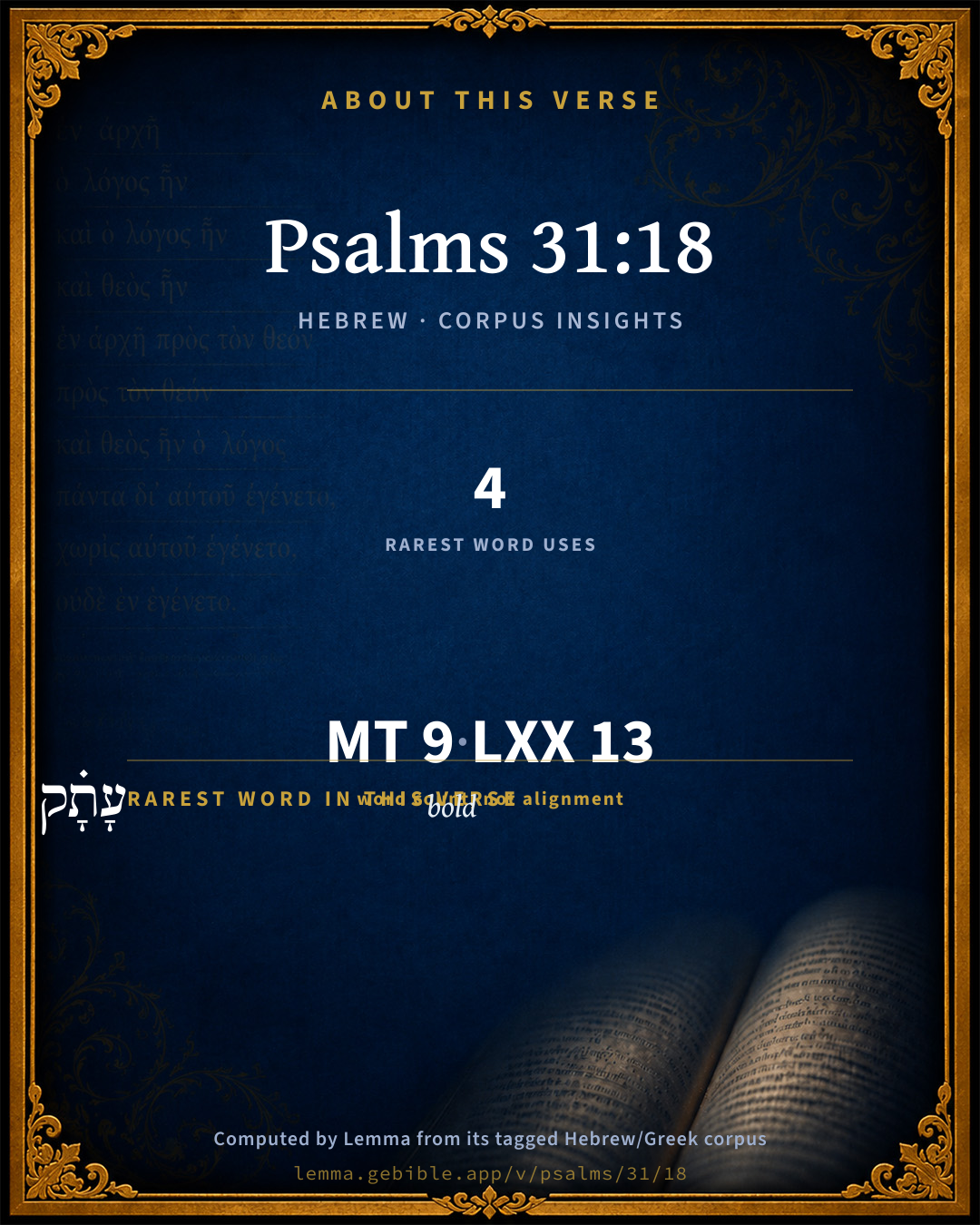
The rarest word here is עָתָ֗ק bold H6277 — appearing just 4 times in the whole Hebrew Bible.

Shared distinctive vocabulary

עָתָ֗ק bold H6277 occurs in 4 verses of the Hebrew Bible. Also found in:

Grammatical profile

  • 2 verbs
  • 5 nouns
  • 1 adjective
  • 1 preposition

Verb forms

  • תֵּ֥אָלַ֗מְנָה Niphal · Imperfect
  • הַדֹּבְר֖וֹת Qal · Participle Active

Hebrew & Septuagint length

In English translation the verse runs 16 words from the Hebrew and 16 from the Septuagint (LXX English) — the same length.

A rough comparison of the two English renderings, which tokenize alike — not a word-level alignment.

Word counts can differ between the Hebrew and the Greek without any difference in meaning — e.g. the Hebrew direct-object marker אֵת has no separate Greek word, and Greek often adds the article ὁ.

In the original languages it is 9 Hebrew tokens and 13 Greek tokens — but the two are counted differently (Hebrew bundles its prefixes and suffixes into one token; the Greek is in lemma form), so that isn’t a like-for-like length.

Cross-references

21

Topical passages linked to Psalms 31:18 in the Treasury of Scripture Knowledge — connected by theme and wording, ordered by reader-vote popularity; previews shown in the World English Bible.

  • Psalms 94:4 They pour out arrogant words. All the evil-doers boast.
  • Jude 1:15 to execute judgment on all, and to convict all the ungodly of all their works of ungodliness which they have done in an ungodly way, and of all the hard things which ungodly sinners have spoken against him."
  • 1 Samuel 2:3 Talk no more so exceeding proudly; Don't let arrogance come out of your mouth; For Yahweh is a God of knowledge, By him actions are weighed.
  • Isaiah 54:17 No weapon that is formed against you shall prosper; and every tongue that shall rise against you in judgment you shall condemn. This is the heritage of the servants of Yahweh, and their righteousness which is of me, says Yahweh.
  • Psalms 64:3–4 Who sharpen their tongue like a sword, And aim their arrows, deadly words,
  • Matthew 12:24 But when the Pharisees heard it, they said, "This man does not cast out demons, except by Beelzebul, the prince of the demons."
  • John 8:44 You are of your Father, the devil, and you want to do the desires of your father. He was a murderer from the beginning, and doesn't stand in the truth, because there is no truth in him. When he speaks a lie, he speaks on his own; for he is a liar, and the father of it.
  • John 8:48 Then the Jews answered him, "Don't we say well that you are a Samaritan, and have a demon?"
  • Acts 25:7 When he had come, the Jews who had come down from Jerusalem stood around him, bringing against him many and grievous charges which they could not prove,
  • Revelation 21:8 But for the cowardly, unbelieving, sinners, abominable, murderers, sexually immoral, sorcerers, idolaters, and all liars, their part is in the lake that burns with fire and sulfur, which is the second death."
  • Revelation 22:15 Outside are the dogs, the sorcerers, the sexually immoral, the murderers, the idolaters, and everyone who loves and practices falsehood.
  • 2 Chronicles 32:16 His servants spoke yet more against Yahweh God, and against his servant Hezekiah.
  • Psalms 12:3 May Yahweh cut off all flattering lips, And the tongue that boasts,
  • Psalms 59:12 For the sin of their mouth, and the words of their lips, Let them be caught in their pride, For the curses and lies which they utter.
  • Psalms 63:11 But the king shall rejoice in God. Everyone who swears by him will praise him, For the mouth of those who speak lies shall be silenced.
  • Psalms 120:2 Deliver my soul, Yahweh, from lying lips, From a deceitful tongue.
  • Psalms 123:3–4 Have mercy on us, Yahweh, have mercy on us, For we have endured much contempt.
  • Psalms 140:9–11 As for the head of those who surround me, Let the mischief of their own lips cover them.
  • Proverbs 12:19 Truth's lips will be established forever, But a lying tongue is only momentary.
  • Isaiah 37:22–24 this is the word which Yahweh has spoken concerning him: The virgin daughter of Zion has despised you and ridiculed you; the daughter of Jerusalem has shaken her head at you.
  • Matthew 10:25 It is enough for the disciple that he be like his teacher, and the servant like his lord. If they have called the master of the house Beelzebul, how much more those of his household!

Cross-references courtesy of OpenBible.info (CC BY 4.0).

Hebrew and Greek witnesses Masoretic Hebrew ↔ Greek Septuagint

The same verse in the two great witnesses to the Old Testament, shown verse-for-verse.

You’re reading Greek Psalm 30 (Hebrew Psalm 31). The Septuagint counts the superscription, so verse numbers can differ from the Hebrew — chapter-level alignment, not verse-by-verse. Numbering follows Rahlfs.

These are two independent witnesses, not word-aligned to each other, and the Septuagint is shown in lemma (dictionary) form.

Hebrew Psalms 31:18 Masoretic · Westminster Leningrad Codex

תֵּ֥אָלַ֗מְנָה שִׂפְתֵ֫י שָׁ֥קֶר הַדֹּבְר֖וֹת עַל צַדִּ֥יק עָתָ֗ק בְּגַאֲוָ֥ה וָבֽוּז

Let the lying lips be mute, Which speak against the righteous insolently, with pride and contempt.

World English Bible · Public Domain

Greek LXX Greek Psalm 30:18 Septuagint · lemma form

κύριος μή κατααἰσχύνω ὅτι ἐπικαλέω σύ αἰσχύνω ὁ ἀσεβής καί καταἄγω εἰς ᾅδης

Let the deceitful lips become dumb, which speak iniquity against the righteous with pride and scorn.

LXX2012 (modern English Septuagint) · Public Domain

Hebrew: Westminster Leningrad Codex (CC BY 4.0). Greek: Septuagint (public domain); English from LXX2012 (modern English Septuagint) (Public Domain). How the Septuagint differs from the Hebrew →

Commentary

Notes on Psalms 31:18 from classic Christian and Jewish commentators (each source and its license shown beneath its notes). The classic Christian expositions comment on the surrounding passage and are grouped to its opening verse, so a note may address several verses; the Jewish commentaries on the Tanakh (Rashi and others) are per-verse, so they appear only where the commentator wrote on this verse.

Lemma curates 59 commentaries, every one of them public domain or Creative Commons licensed, each selected and text-cleaned for this edition rather than reprinted as found. About our sources →

Trapp's Complete Commentary

John Trapp

Psa 31:18 Let the lying lips be put to silence; which speak grievous things proudly and contemptuously against the righteous.

Ver. 18. Let the lying lips be put to silence] Heb. the lips of a lie, mendaciorum artifices, as Jer 9:3; Jer 9:5. Among the Persians it was αιχιστον το φευδεσθαι, held a base shame to tell a lie. Oh that it were so among Christians! When shall that golden age return, that the argument may again proceed, Sacerdos est, non fallet; Christianus est, non mentietur; He is a minister, he will not deceive; he is a Christian, therefore he will not lie? (Herod. in Clio; Xenoph. Cyroep.; Strab. lib. 15).

Which speak grievous things] Heb. a hard thing; dura et atr ociaverba, durable and longlasting reproaches, such as stick, and leave a scar, though the wound be healed up. Calumniare audacter, aliquid saltem adhaerebit. Such mouths shall one day smoke for it, Jdg 1:15.

Proudly and contemptuously] Heb. In pride and contempt. It is pride that causeth contempt of others. Compare Pro 3:34 1Pe 5:5. David elsewhere complaineth of proud, rhetorical mockers.

John Trapp, A Commentary or Exposition upon All the Books of the Old and New Testament (1647–1656) — public domain. Text from a community e-Sword module.

The Biblical Illustrator

Joseph S. Exell

Psa_31:18

Let the lying lips be put to silence, which cruelly, disdainfully, and, maliciously, speak against the righteous.

On scepticism

To neglect those popular calumnies which are in circulation against any system either moral, religious, or political, is rather magnanimous than wise, and savours more of a generous contempt for danger than of prudent precaution against it. Bold assertions, and specious invectives often repeated, begin at last to be credited. There is too, besides, a fashion in thinking as in everything else, and the giddy part of mankind must ever appear in the newest philosophy. It is important, therefore, to mark the modes of thinking of the time, and especially those which are aimed against the Christian faith. It is a leading object with sceptics to bring this into disrepute. And they seek so to do by charging Christians with intolerance, bigotry, and narrowness of mind. The opposite virtues, candour, liberality, and freedom from prejudice, they claim for themselves. And the young are much attracted by such professions, as it is natural they should be. Their vanity, also,--desire of notoriety, and their impatience, help the evil; soon they parade their disbelief, and sink into a state of complete scepticism. All this is very sad. A young man standing on the threshold of life, and just going into all the business of the world, with a heart in which every principle of right and wrong is thoroughly shaken and impaired! If not destined for great offices in public life, yet he is a brother, a son, a friend; he is to be a husband, and a father of children; some must trust him, and some must love him. Call it bigotry, and cover these notions with mockery and derision; but I say it would be better for this young man that the work of death were going on within him, that the strength and the roses of his youth were fading away, and that he were wasting down to the tombs of his ancestors, wept by his friends, and pitied by the world. Therefore let us examine the foundations of such scepticism. I speak not of all who disbelieve in Christianity, but of those who presume to look down upon Christians with anger and contempt. The fact is, disbelief not only in Christianity but in Providence is becoming general, and men are giving up all the wholesome restraints of religion. These are the dangers which now threaten us. We need not fear that we shall be manacled again by superstition, but that the golden chain which reaches from heaven to earth should be broken asunder, and not one link of it again be found. The infidel clings as tenaciously to what he denies, as the religionist does to what he affirms;--arm him with power, will he be more tolerant?--will he suffer you to build temples? to pray openly to your God, and to insult his doubts with the profession of a faith, which, in the deep wickedness of his heart, lie judges to be the consummation of all absurdity?--Toleration is the creature of benevolence and of wisdom; what have the shallow sneers and scoffings of infidelity to do with this Heavenly forbearance? do not be mocked by such idle pretensions; if atheism ever rears its head among men, piety will mourn and bleed. Let us be thankful, therefore, for that small but invaluable class of men who, sincerely loving truth, and pursuing it with exquisite tact and skill, will even resist the wild unbelief of the day. Against ignorant and evil men they will steadily strive, and they will exert all their authority to put to silence the lips which cruelly, disdainfully, and despitefully, speak against the righteous. (Sydney Smith, M. A.)

The Biblical Illustrator, edited by Joseph S. Exell (c. 1880s–1900s) — public domain. Text from a community e-Sword module.

Joseph Benson's Commentary

Psa 31:18. Let the lying lips — The slanderous tongues; be put to silence — Either by thy discovery and vindication of my integrity; or by some imminent judgment, which may either convince them, or take them off. Which speak grievous things — Hebrews עתק, gnatak, what is hard, or hard things, the singular number being put for the plural; he means such things as were grievous and hard to be borne, such as bitter calumnies, cruel mockings, terrible threatenings, and the like. Proudly and contemptuously — With great arrogance, and confidence of success, and contempt of me and my friends, whom they look upon as few in number, and impotent fugitives, and such as they can blow away with their breath; against the righteous — Against us, whom thou knowest to be righteous, notwithstanding all their false accusations, and therefore for thy love of righteousness save us, and silence our unjust enemies.

Joseph Benson's Commentary on the Old and New Testaments (1811–1818) — public domain. Text from a community e-Sword module.

J. A. Alexander on Psalms

Joseph Addison Alexander

19. (Psa 31:18). Struck dumb be the lips of lying, the (lips) speaking against a righteous (man), insolently in pride and scorn. This wish has special reference to the slanders mentioned in Psa 31:14 (13).—Insolently, literally insolent, that which is insolent, or as an abstract, insolence, audacity.

Joseph Addison Alexander, The Psalms Translated and Explained (1850) — public domain. Text from a community e-Sword module.

Adam Clarke's Commentary

Verse 18. Let the lying lips be put to silence] As to my enemies, persecutors, and slanderers, abate their pride, assuage their malice, and confound their devices. See Jer 18:18.

Adam Clarke's Commentary on the Bible (1810–1826) — public domain. Text from a community e-Sword/MySword module.

Ellicott's Commentary for English Readers

(18) Silence.—As a different word is used from that rendered silent in Psa_31:17, translate let the lying lips be made dumb.

Grievous.—Better, arrogant, as in 1Sa_2:3. (Comp. Psa_94:4.) So in Psa_75:5, “a stiff neck” is a neck thrown impudently back.

Proudly and contemptuously.—Literally, in pride and contempt.

A Bible Commentary for English Readers, edited by Charles John Ellicott (1878–1897) — public domain. Text from a community e-Sword module.

The Cambridge Bible for Schools and Colleges

gen. ed. J. J. S. Perowne

18. Let the lying lips be dumb;

Which speak against the righteous arrogantly,

In pride and contempt.

Cp. Psa_12:3; Psa_94:4.

The Cambridge Bible for Schools and Colleges (gen. ed. J. J. S. Perowne; Cambridge University Press, 1878–1918) — public domain. Text from a community e-Sword module.

John Gill's Exposition

Let the lying lips be put to silence,.... Being convicted of the lies told by them, and so silenced and confounded; or being cut off and destroyed, as all such will be in the Lord's own time, Psa 12:3. It is very likely the psalmist may have respect either to Doeg the Edomite, who loved lying rather than righteousness; or to others that were about Saul, who lying said to him that David sought his harm, even to take away his kingdom and his life, Psa 52:3;

which speak grievous things proudly and contemptuously against the righteous; meaning himself; not that he thought himself righteous in the sight of God by any righteousness of his own, but by the righteousness of Christ imputed to him; see Psa 143:2. Though he may have regard here to the righteousness of his cause before men, and assert himself righteous, as he might with respect to the "grievous things", the hard and lying speeches, which were spoken against him, in a proud, haughty, and contemptuous manner. And it is no unusual thing for such false charges to be brought against righteous men; nay, such hard speeches were spoken by ungodly men against Jesus Christ the righteous himself, Jde 1:15. The Targum interprets it of "reproaches".

John Gill's Exposition of the Whole Bible (1746–1763) — public domain (CC PDM 1.0). Text via the HelloAO Bible API.

Albert Barnes' Notes on the Bible

Let the lying lips be put to silence - See the notes at Psa 12:2-3. The lips which speak lies. The reference here is especially to those who had spoken in this manner against the psalmist himself, though he makes the language general, or prays in general that God would silence all liars: a prayer certainly in which all persons may properly join.

Which speak grievous things - Margin, “a hard thing.” The Hebrew word - עתק ‛âthâq - means “bold, impudent, wicked.” Gesenius, Lexicon. The phrase here means, therefore, to speak wickedly, or to speak in a bold, reckless, impudent manner; that is, without regard to the truth of what is said.

Proudly and contemptuously - Hebrew, in pride and contempt: that is, in a manner which shows that they are proud of themselves and despise others. Slander always perhaps implies this. People are secretly proud of themselves; or they “desire” to cherish an exalted opinion of themselves, and to have others entertain the same opinion of them; and hence, if they cannot exalt themselves by their own merit, as they wish, they endeavor to humble others below their real merit, and to a level lower than themselves, by detraction.

Albert Barnes' Notes on the Bible (1834–1885) — public domain. Text from a community e-Sword/MySword module.

Matthew Poole's English Annotations

Lying lips; slanderous tongues. Be put to silence, either by thy vindication and discovery of my integrity; or by some eminent judgment, which may either convince them, or cut them off.

Grievous things, Heb. hard words, or things, the singular number being put for the plural. Of this expression, see 1Sa 2:3; Psa 60:3; 94:4; Jude 15. He means such as were grievous, and hard to be borne, as bitter calumnies, cruel mockings, terrible threatenings, and the like.

Proudly and contemptuously; with great arrogancy, and confidence of success, and contempt of me and mine, whom they look upon as few in number, and impotent and fugitives, and such whom they can blow away with a breath.

Against the righteous; against us, whom thou knowest to be righteous, notwithstanding all their false accusations; and therefore for thy love to righteousness save us, and silence our unjust enemies.

Matthew Poole's English Annotations on the Holy Bible (1683–1685) — public domain. Text from a community e-Sword/MySword module.

The Treasury of David

Charles H. Spurgeon

Ver. 18. Let the lying lips be put to silence. A right good and Christian prayer; who but a bad man would give liars more license than need be? May God silence them either by leading them to repentance, by putting them to thorough shame, or by placing them in positions where what they may say will stand for nothing. Which speak grievous things proudly and contemptuously against the righteous. The sin of slanderers lies partly in the matter of their speech; "they speak grievous things; "things cutting deep into the feelings of good men, and wounding them sorely in that tender placetheir reputations. The sin is further enhanced by the manner of their speech; they speak proudly and contemptuously; they talk as if they themselves were the cream of society, and the righteous the mere scum of vulgarity. Proud thoughts of self are generally attended by debasing estimates of others. The more room we take up ourselves, the less we can afford our neighbours. What wickedness it is that unworthy characters should always be the loudest in railing at good men! They have no power to appreciate moral worth of which they are utterly destitute, and yet they have the effrontery to mount the judgment seat, and judge the men compared with whom they are as so much chaff. Holy indignation may well prompt us to desire anything which may rid the world of such unbearable impertinence and detestable arrogance.

Ver. 18. Lying lips...which speak grievous things proudly and contemptuously against the righteous. The primitive persecutors slighted the Christians for a company of bad, illiterate fellows, and therefore they used to paint the God of the Christians with an ass's head and a book in his hand, saith Tertullian; to signify, that though they pretended learning, yet they were silly and ignorant people. Bishop Jewel, in his sermon upon Lu 11:15, cites this out of Tertullian and applies it to his times. Do not our adversaries the like, saith he, against all that profess the gospel? Oh! say they, who are those that favour this way? None but shoemakers, tailors, weavers, and such as never were at the University. These are the bishop's own words. Bishop White said in open court, that the Puritans were all a company of blockheads. Charles Bradbury.

Ver. 18. Lying lips...which speak grievous things proudly and contemptuously against the righteous. In that venerable and original monument of the Vaudois Church, entitled "The Golden Lesson, " of the date 1100, we meet with a verse, which has been thus translated:

"If there be anyone who loves and fears Jesus Christ,

Who will not curse, nor swear, nor lie,

Nor be unchaste, nor kill, nor take what is another's.

Nor take vengeance on his enemies;

They say that he is a Vaudes, and worthy of punishment."

Antoine Monastier, in "A History of Vaudois Church, "1859.

None.

Psalms 31:19*

Charles H. Spurgeon's The Treasury of David (1869–1885) — public domain. Psalms only. Text from a community e-Sword/MySword module.

Whedon's Commentary on the Bible

Daniel D. Whedon

18. Lying lips be put to silence— “Silence,” here, is a different word from that so rendered in Psa_31:17, and means tongue-tied, dumb, bound.

Proudly and contemptuously—Contemptuous of all restraint by the laws of God or man.

Daniel D. Whedon (gen. ed.), Commentary on the Old and New Testaments (1874–1909) — public domain. Text from a community e-Sword module.

The Pulpit Commentary

Let the lying lips be put to silence, which speak grievous things proudly and contemptuously against the righteous; rather, which speak arrogancy. (comp. 1Sa_2:3) The pride and insolence of David"s enemies is strongly noted in the Second Book of Samuel. (see 2Sa_16:7, 8 17:1-3)

The Pulpit Commentary (1880–1919), ed. H.D.M. Spence-Jones & Joseph S. Exell — public domain. Text from a community e-Sword module.

Rashi

Rabbi Shlomo Yitzchaki (Rashi)

let me not be shamed because I called out to You Since I called You, it is not fitting that I should be shamed.

let them be silenced to the grave Heb. ידמו, let them be silenced and made dumb to die.

Rashi on the Tanakh — English translations: “The Judaica Press complete Tanach with Rashi, translated by A. J. Rosenberg” (CC BY 4.0); “Pentateuch with Rashi's commentary by M. Rosenbaum and A.M. Silbermann, 1929-1934” (public domain); “The Metsudah Tanach series, Lakewood, N.J” (CC BY 4.0); and “The Book of Joshua, Metsudah Publications, 1997” (CC BY 4.0). Text via Sefaria.

Lesson kit

Teaching starters — assembled from the data on this page, not authored interpretation. Every prompt links to the verse data it draws on. Edit before teaching.

Psalms, in the Wisdom, opens this verse with 9 words (9 distinct Hebrew lemmas). Its most distinctive word is ʻâthâq (“bold”). A historical commentator’s framing appears above. Read the whole chapter for the surrounding context.

Discussion questions

  1. What does “bold” (ʻâthâq) contribute to the verse as a whole?
  2. How does 1 Samuel 2:3, which shares the word «bold», read alongside this verse?
  3. The translations on this page render this verse differently — a whole-verse word diff, not a word-by-word alignment. What might account for the different wordings?
  4. «תֵּ֥אָלַ֗מְנָה» is a Niphal Imperfect verb. How does that grammatical form shape the action described?
  5. Compare how Trapp's Complete Commentary and The Biblical Illustrator read this verse. Where do they agree or differ?

Things to notice

Reading settings

Reading text

Shown beneath each verse's original-language words.

Old Testament
Old Testament edition

Read the OT as the Masoretic Hebrew (MT) or the Greek Septuagint (LXX).

English shown for the Greek Septuagint (in the Hebrew ↔ Greek comparison).

Comparing translations? Open the Compare panel on any verse page to stack up to four side by side.