
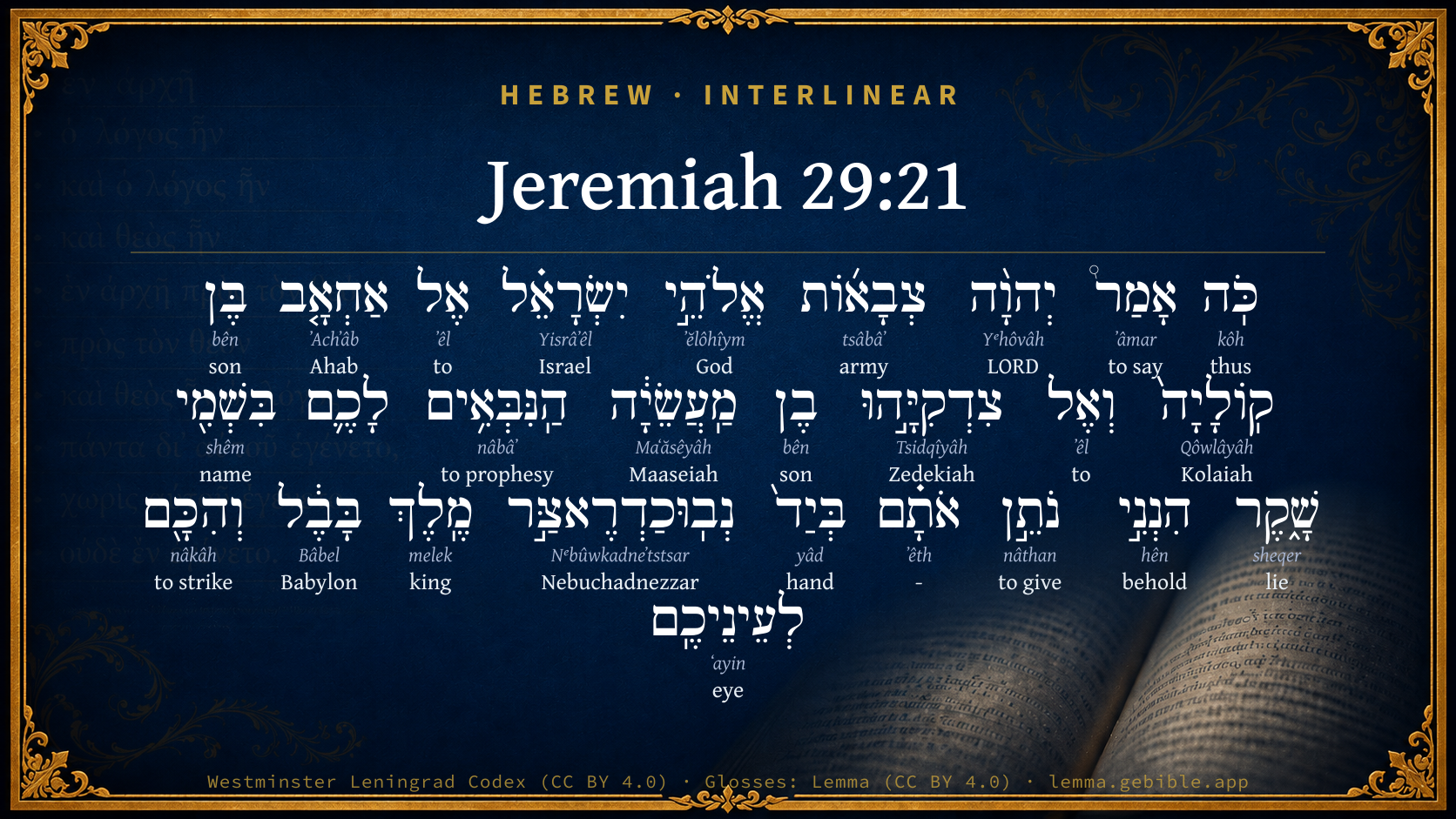
Jeremiah 29:21

Hebrew (Westminster Leningrad Codex) Jeremiah 29:21 appears in the Hebrew Old Testament. The text above is from the Westminster Leningrad Codex. Each word links to its Strong’s number, a concise gloss, and parsing drawn from the Open Scriptures Hebrew Bible morphology. Click any word for its full Brown-Driver-Briggs (BDB) entry.
Download image
Cite this verse

Jeremiah 29:21 (World English Bible). Public Domain. Lemma interlinear Bible study tool, https://lemma.gebible.app/v/jeremiah/29/21.

Show BibTeX & RIS
BibTeX
RIS
English Translation
Thus says Yahweh of Hosts, the God of Israel, concerning Ahab the son of Kolaiah, and concerning Zedekiah the son of Maaseiah, who prophesy a lie to you in my name: Behold, I will deliver them into the hand of Nebuchadrezzar king of Babylon; and he shall kill them before your eyes;
World English Bible · Public Domain
Download a study sheet

One document with this verse’s original text, its word-by-word gloss line, the meaning frame, cross-references with their text, attributed commentary, and full source and license credits — printable, and it pastes into notes with its structure intact.

This verse Autodidact and up

Study sheet (.html) Plain text (.txt)

A passage Seminary Student

Up to 50 verses in one chapter. A passage sheet keeps up to 6 commentary sources and 12 cross-references per verse, in the order this page ranks them, and says so on the sheet whenever that leaves anything out. Ask for a single verse and you get the Autodidact verse sheet above.

Everything on this page stays free to read, with no account — the sheet is a download of what is already on screen, not access to it.

Want to remove ads? Support Godless Engineer
Compare translations 3

The same verse in 3 English versions, stacked beneath the original-language interlinear above. Click any original word for its lexicon entry.

Each is an independent rendering of the whole verse — the interlinear is not word-aligned to these translations.

Highlighted words mark where these versions differ — a whole-verse word diff, not a word-by-word alignment.

  • World English Bible Public Domain
    Thus says Yahweh of Hosts, the God of Israel, concerning Ahab the son of Kolaiah, and concerning Zedekiah the son of Maaseiah, who prophesy a lie to you in my name: Behold, I will deliver them into the hand of Nebuchadrezzar king of Babylon; and he shall kill them before your eyes;
  • King James Version Public Domain
    Thus saith the LORD of hosts, the God of Israel, of Ahab the son of Kolaiah, and of Zedekiah the son of Maaseiah, which prophesy a lie unto you in my name; Behold, I will deliver them into the hand of Nebuchadrezzar king of Babylon; and he shall slay them before your eyes;
  • unfoldingWord Literal Text CC BY-SA 4.0
    ‘Yahweh of hosts, God of Israel, says this about Ahab son of Kolaiah and Zedekiah son of Maaseiah, who prophesy falsely to you in my name: See, I am about to put them into the hand of Nebuchadnezzar king of Babylon. He will kill them before your eyes.

unfoldingWord Literal Text — © unfoldingWord, licensed CC BY-SA 4.0. Word-aligned USFM3 via Door43 (git.door43.org/unfoldingWord/en_ult).

Versions to compare (up to 4)

3 of 4 selected

Show all 18 translations

Every available English version of this verse, each an independent rendering of the whole verse.

  • World English Bible Public Domain
    Thus says Yahweh of Hosts, the God of Israel, concerning Ahab the son of Kolaiah, and concerning Zedekiah the son of Maaseiah, who prophesy a lie to you in my name: Behold, I will deliver them into the hand of Nebuchadrezzar king of Babylon; and he shall kill them before your eyes;
  • Berean Standard Bible Public Domain
    This is what the LORD of Hosts, the God of Israel, says about Ahab son of Kolaiah and Zedekiah son of Maaseiah, who are prophesying to you lies in My name: “I will deliver them to Nebuchadnezzar king of Babylon, and he will kill them before your very eyes.
  • Majority Standard Bible Public Domain
    This is what the LORD of Hosts, the God of Israel, says about Ahab son of Kolaiah and Zedekiah son of Maaseiah, who are prophesying to you lies in My name: “I will deliver them to Nebuchadnezzar king of Babylon, and he will kill them before your very eyes.
  • King James Version Public Domain
    Thus saith the LORD of hosts, the God of Israel, of Ahab the son of Kolaiah, and of Zedekiah the son of Maaseiah, which prophesy a lie unto you in my name; Behold, I will deliver them into the hand of Nebuchadrezzar king of Babylon; and he shall slay them before your eyes;
  • American Standard Version (1901) Public Domain
    Thus saith Jehovah of hosts, the God of Israel, concerning Ahab the son of Kolaiah, and concerning Zedekiah the son of Maaseiah, who prophesy a lie unto you in my name: Behold, I will deliver them into the hand of Nebuchadrezzar king of Babylon; and he shall slay them before your eyes;
  • Revised Version (1885) Public Domain
    Thus saith the LORD of hosts, the God of Israel, concerning Ahab the son of Kolaiah, and concerning Zedekiah the son of Maaseiah, which prophesy a lie unto you in my name: Behold, I will deliver them into the hand of Nebuchadrezzar king of Babylon; and he shall slay them before your eyes;
  • Geneva Bible (1599) Public Domain
    Thus saith the Lord of hostes, the God of Israel, of Ahab the sonne of Kolaiah, and of Zedekiah the sonne of Maaseiah, which prophecie lyes vnto you in my Name, Beholde, I will deliuer them into the hande of Nebuchad-nezzar King of Babel, and he shall slay them before your eyes.
  • Douay-Rheims (1899) Public Domain
    Thus saith the Lord of hosts the God of Israel, to Achab the son of Colias, and to Sedecias the son of Maasias, who prophesy unto you in my name falsely: Behold I will deliver them up into the hands of Nabuchodonosor the king of Babylon: and he shall kill them before your eyes.
  • Young's Literal Translation Public Domain
    Thus said Jehovah of Hosts, God of Israel, concerning Ahab son of Kolaiah, and concerning Zedekiah son of Maaseiah, who are prophesying to you in My name falsehood: Lo, I am giving them into the hand of Nebuchadrezzar king of Babylon, and he hath smitten them before your eyes,
  • Literal Standard Version CC BY-SA 4.0
    thus said YHWH of Hosts, God of Israel, concerning Ahab son of Kolaiah, and concerning Zedekiah son of Maaseiah, who are prophesying falsehood to you in My Name: Behold, I am giving them into the hand of Nebuchadnezzar king of Babylon, and he has struck them before your eyes,
  • Unlocked Literal Bible CC BY-SA 4.0
    'Yahweh of hosts, God of Israel, says this about Ahab son of Kolaiah and Zedekiah son of Maaseiah, who prophesy falsely to you in my name: See, I am about to put them into the hand of Nebuchadnezzar king of Babylon. He will kill them before your eyes.
  • unfoldingWord Literal Text CC BY-SA 4.0
    ‘Yahweh of hosts, God of Israel, says this about Ahab son of Kolaiah and Zedekiah son of Maaseiah, who prophesy falsely to you in my name: See, I am about to put them into the hand of Nebuchadnezzar king of Babylon. He will kill them before your eyes.
  • Darby Bible Public Domain
    Thus saith Jehovah of hosts, the God of Israel, concerning Ahab the son of Kolaiah, and concerning Zedekiah the son of Maaseiah, who prophesy falsehood unto you in my name: Behold, I will give them into the hand of Nebuchadrezzar king of Babylon, and he shall smite them before your eyes.
  • World Messianic Bible Public Domain
    The LORD of Hosts, the God of Israel, says concerning Ahab the son of Kolaiah, and concerning Zedekiah the son of Maaseiah, who prophesy a lie to you in my name: “Behold, I will deliver them into the hand of Nebuchadnezzar king of Babylon; and he will kill them before your eyes.
  • Webster's Bible Public Domain
    Thus saith the LORD of hosts, the God of Israel, concerning Ahab the son of Kolaiah, and concerning Zedekiah the son of Maaseiah, who prophesy a lie to you in my name; Behold, I will deliver them into the hand of Nebuchadrezzar king of Babylon; and he shall slay them before your eyes;
  • Free Bible Version CC BY-SA 4.0
    This is what the Lord Almighty, the God of Israel, says about Ahab son of Kolaiah and Zedekiah son of Maaseiah, who are prophesying lies to you in my name. I'm going to hand them over to Nebuchadnezzar king of Babylon, and he will kill them right before your eyes.
  • Bible in Basic English Public Domain
    This is what the Lord of armies, the God of Israel, has said about Ahab, the son of Kolaiah, and about Zedekiah, the son of Maaseiah, who are saying to you what is false in my name: See, I will give them up into the hands of Nebuchadrezzar, king of Babylon, and he will put them to death before your eyes.
  • JPS Tanakh (1917) Public Domain
    Thus saith the LORD of hosts, the God of Israel, concerning Ahab the son of Kolaiah, and concerning Zedekiah the son of Maaseiah, who prophesy a lie unto you in My name: Behold, I will deliver them into the hand of Nebuchadrezzar king of Babylon; and he shall slay them before your eyes;

Literal Standard Version (2020), Covenant Press — licensed CC BY-SA 4.0. Text via the HelloAO Bible API (eBible.org). Unlocked Literal Bible (unfoldingWord) — licensed CC BY-SA 4.0. Text via the HelloAO Bible API (eBible.org). unfoldingWord Literal Text — © unfoldingWord, licensed CC BY-SA 4.0. Word-aligned USFM3 via Door43 (git.door43.org/unfoldingWord/en_ult). Free Bible Version, Dr. Jonathan Gallagher — licensed CC BY-SA 4.0. Text via the HelloAO Bible API (eBible.org).

Word by word

More ways to search: Search by grammar → Find every occurrence → Compare this word →

Practice this passage: Drill this verse → Learn its vocabulary →

קֽוֹלָיָה֙
Qôwlâyâh
H6964
“Kolaiah”
Noun, Proper
Part of Speech
Noun
Type
Proper
Full BDB Definition

Origin: from H6963 and H3050

TWOT: None

Kolaiah = "voice of Jehovah" - father of the false prophet Ahab - a Benjamite whose descendants settled in Jerusalem after the return from captivity - a Levite in the time of Ezra
  1. כֹּֽה kôh H3541 “thus” Adverb
  2. אָמַר֩ ʼâmar H559 “to say” Verb, Qal, Perfect, 3rd Person, Masculine, Singular
  3. יְהוָ֨ה Yᵉhôvâh H3068 “LORD” Noun, Proper
  4. צְבָא֜וֹת tsâbâʼ H6635 “armies” Noun, Common, Both, Plural, Absolute
  5. אֱלֹהֵ֣י ʼĕlôhîym H430 “God(s) of” Noun, Common, Masculine, Plural, Construct
  6. יִשְׂרָאֵ֗ל Yisrâʼêl H3478 “Israel” Noun, Proper
  7. אֶל ʼêl H413 “to” Preposition
  8. אַחְאָ֤ב ʼAchʼâb H256 “Ahab” Noun, Proper
  9. בֶּן bên H1121 “son of” Noun, Common, Masculine, Singular, Construct
  10. וְאֶל ʼêl H413 “and · to” Conjunction + Preposition
  11. צִדְקִיָּ֣הוּ Tsidqîyâh H6667 “Zedekiah” Noun, Proper
  12. בֶן bên H1121 “son of” Noun, Common, Masculine, Singular, Construct
  13. מַֽעֲשֵׂיָ֔ה Maʻăsêyâh H4641 “Maaseiah” Noun, Proper
  14. הַֽנִּבְּאִ֥ים nâbâʼ H5012 “the · prophesying” Particle, Definite Article + Verb, Niphal, Participle Active, Masculine, Plural, Absolute
  15. בִּשְׁמִ֖י shêm H8034 “in/at · name · my” Preposition + Noun, Common, Masculine, Singular, Construct + Suffix, Personal, 1st Person, Common, Singular
  16. שָׁ֑קֶר sheqer H8267 “lie” Noun, Common, Masculine, Singular, Absolute
  17. הִנְנִ֣י hên H2005 “behold · me” Particle, Demonstrative + Suffix, Personal, 1st Person, Common, Singular
  18. נֹתֵ֣ן nâthan H5414 “giving” Verb, Qal, Participle Active, Masculine, Singular, Absolute
  19. אֹתָ֗ם ʼêth H853 “- · them” Particle, Direct Object + Suffix, Personal, 3rd Person, Masculine, Plural
  20. בְּיַד֙ yâd H3027 “in/at · hand of” Preposition + Noun, Common, Both, Singular, Construct
  21. נְבֽוּכַדְרֶאצַּ֣ר Nᵉbûwkadneʼtstsar H5019 “Nebuchadnezzar” Noun, Proper
  22. מֶֽלֶךְ melek H4428 “king of” Noun, Common, Masculine, Singular, Construct
  23. בָּבֶ֔ל Bâbel H894 “Babylon” Noun, Proper
  24. וְהִכָּ֖ם nâkâh H5221 “and · to strike · them” Conjunction + Verb, Hiphil, Sequential Perfect, 3rd Person, Masculine, Singular + Suffix, Personal, 3rd Person, Masculine, Plural
  25. לְעֵינֵיכֶֽם ʻayin H5869 “to/for · eyes · your” Preposition + Noun, Common, Both, Dual, Construct + Suffix, Personal, 2nd Person, Masculine, Plural

About this verse

These counts appear in no published source. They are computed here, from the morphology-tagged text and Lemma’s own curated glosses. What Lemma adds →

27
words
24
distinct lemmas
Prophets
section

Notable vocabulary

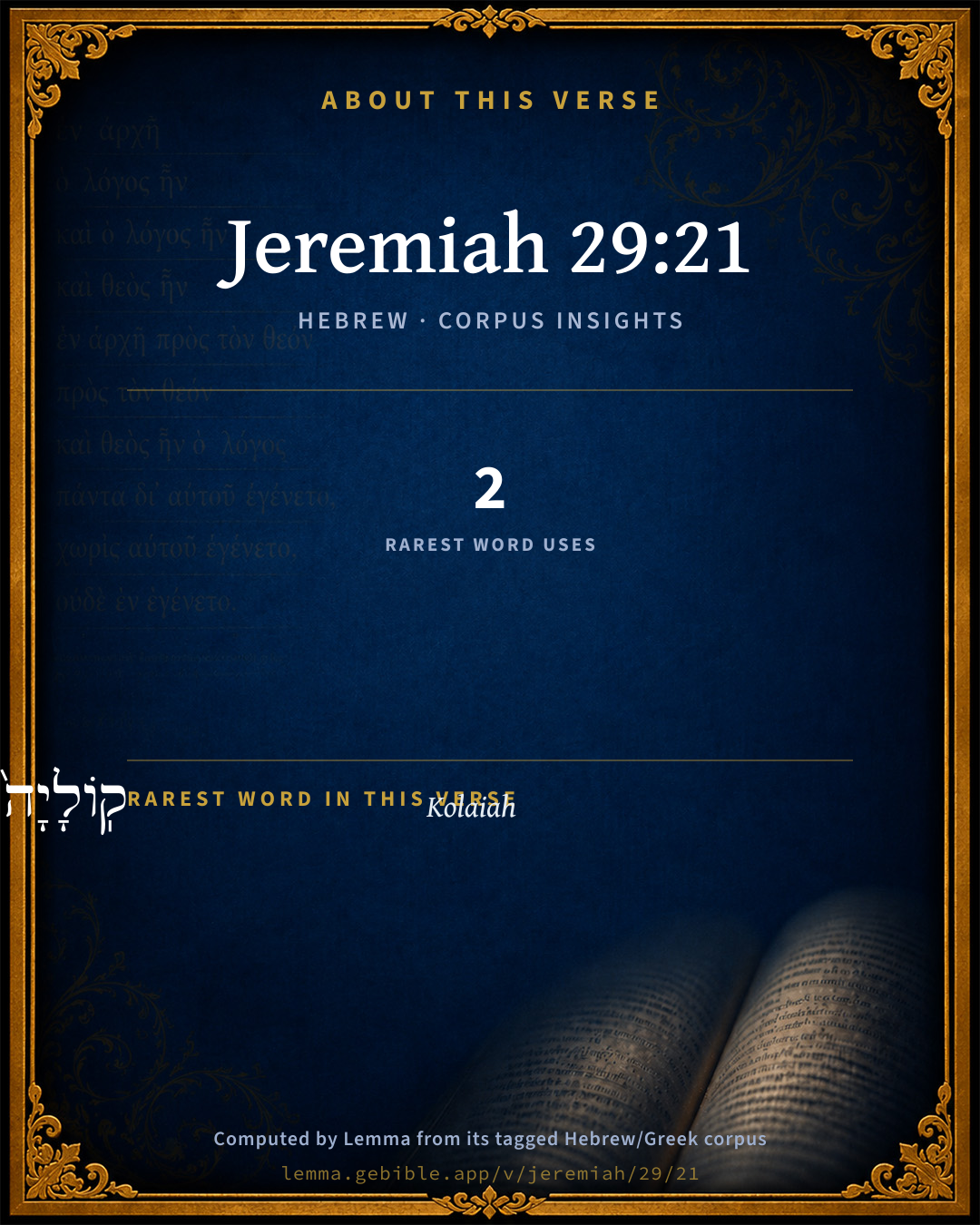
The rarest word here is קֽוֹלָיָה֙ Kolaiah H6964 — appearing just 2 times in the whole Hebrew Bible.

Shared distinctive vocabulary

קֽוֹלָיָה֙ Kolaiah H6964 occurs in 2 verses of the Hebrew Bible. Also found in:

Grammatical profile

  • 4 verbs
  • 17 nouns
  • 3 prepositions
  • 1 adverb
  • 2 particles

Verb forms

  • אָמַר֩ Qal · Perfect
  • הַֽנִּבְּאִ֥ים Niphal · Participle Active
  • נֹתֵ֣ן Qal · Participle Active
  • וְהִכָּ֖ם Hiphil · Sequential Perfect

Repetition

Words recur within this verse — often emphatic in Hebrew:

Cross-references

3

Topical passages linked to Jeremiah 29:21 in the Treasury of Scripture Knowledge — connected by theme and wording, ordered by reader-vote popularity; previews shown in the World English Bible.

  • Jeremiah 14:14–15 Then Yahweh said to me, The prophets prophesy lies in my name; I didn't send them, neither have I commanded them, neither spoke I to them: they prophesy to you a lying vision, and divination, and a thing of nothing, and the deceit of their own heart.
  • Jeremiah 29:8–9 For thus says Yahweh of hosts, the God of Israel: Don't let your prophets who are in the midst of you, and your diviners, deceive you; neither listen you to your dreams which you cause to be dreamed.
  • Lamentations 2:14 Your prophets have seen for you false and foolish visions; They have not uncovered your iniquity, to bring back your captivity, But have seen for you false oracles and causes of banishment.

Cross-references courtesy of OpenBible.info (CC BY 4.0).

Hebrew and Greek witnesses Masoretic Hebrew ↔ Greek Septuagint

The same verse in the two great witnesses to the Old Testament, shown verse-for-verse.

These are two independent witnesses, not word-aligned to each other, and the Septuagint is shown in lemma (dictionary) form.

Hebrew Jeremiah 29:21 Masoretic · Westminster Leningrad Codex

כֹּֽה אָמַר֩ יְהוָ֨ה צְבָא֜וֹת אֱלֹהֵ֣י יִשְׂרָאֵ֗ל אֶל אַחְאָ֤ב בֶּן קֽוֹלָיָה֙ וְאֶל צִדְקִיָּ֣הוּ בֶן מַֽעֲשֵׂיָ֔ה הַֽנִּבְּאִ֥ים לָכֶ֛ם בִּשְׁמִ֖י שָׁ֑קֶר הִנְנִ֣י נֹתֵ֣ן אֹתָ֗ם בְּיַד֙ נְבֽוּכַדְרֶאצַּ֣ר מֶֽלֶךְ בָּבֶ֔ל וְהִכָּ֖ם לְעֵינֵיכֶֽם

Thus says Yahweh of Hosts, the God of Israel, concerning Ahab the son of Kolaiah, and concerning Zedekiah the son of Maaseiah, who prophesy a lie to you in my name: Behold, I will deliver them into the hand of Nebuchadrezzar king of Babylon; and he shall kill them before your eyes;

World English Bible · Public Domain

Greek LXX Structure differs

In the Septuagint, Jeremiah is about an eighth shorter than the Hebrew and arranges its material differently — the Oracles Against the Nations (Hebrew chapters 46–51) appear in the middle of the Greek book, after 25:13. Because the chapter and verse boundaries do not line up, a verse-for-verse comparison with the Hebrew is not shown.

A verse-for-verse comparison isn’t shown here because the chapters and verses don’t line up. Switch to the LXX edition with the MT / LXX toggle above to read the Greek directly.

On this verse, The Cambridge Bible for Schools and Colleges discusses the Septuagint’s reading. Read the note in Commentary ↓

Hebrew: Westminster Leningrad Codex (CC BY 4.0). Greek: Septuagint (public domain); English from a public-domain English Septuagint. How the Septuagint differs from the Hebrew →

Targum (Aramaic paraphrase)

1

The Targum is the ancient Jewish Aramaic paraphrase of the Hebrew Scriptures — an interpretive translation, not the Hebrew text itself. Onkelos (literal) and Pseudo-Jonathan (expansive) render the Torah, and Jonathan the Prophets. Coverage is partial: where no permissively-licensed English translation exists for a verse, only the Aramaic is shown. This is verse-level text, not a word-by-word alignment to the Hebrew.

  1. Targum Jonathan Prophets (Joshua–Malachi)
    כִּדְנַן אֲמַר יְיָ צְבָאוֹת אֱלָהָא דְיִשְׂרָאֵל עַל אַחְאָב בַּר קוֹלָיָה וְעַל צִדְקִיָה בַּר מַעֲשֵׂיָה דְאִתְנַבִּיאוּ לְכוֹן בִּשְׁמִי שִׁקְרָא הָאֲנָא מְסַר יַתְהוֹן בְּיַד נְבוּכַדְרֶאצַר מַלְכָּא דְבָבֶל וְיִקְטְלִינוּן לְעֵינֵיכוֹן:

    (no public-domain English translation for this verse)

    Targum Jonathan — Aramaic: “Mikraot Gedolot” (public domain). English: “Sefaria Community Translation” (CC0 1.0 (public-domain dedication)); “London "Chaldee Paraphrase," 1871” (public domain). Text via Sefaria.

Commentary

Notes on Jeremiah 29:21 from classic Christian and Jewish commentators (each source and its license shown beneath its notes). The classic Christian expositions comment on the surrounding passage and are grouped to its opening verse, so a note may address several verses; the Jewish commentaries on the Tanakh (Rashi and others) are per-verse, so they appear only where the commentator wrote on this verse.

Lemma curates 59 commentaries, every one of them public domain or Creative Commons licensed, each selected and text-cleaned for this edition rather than reprinted as found. About our sources →

Trapp's Complete Commentary

John Trapp

Jer 29:21 Thus saith the LORD of hosts, the God of Israel, of Ahab the son of Kolaiah, and of Zedekiah the son of Maaseiah, which prophesy a lie unto you in my name; Behold, I will deliver them into the hand of Nebuchadrezzar king of Babylon; and he shall slay them before your eyes;

Ver. 21. Thus saith the Lord … of Ahab the son of Kolaiah.] These two - though not the two elders that assaulted Susanna, as some have fabled - are singled out, as arch-imposters and filthy adulterers, to be exemplarily punished; to whom also is added Shemaiah the Nehelamite. {Jer 29:24}

And he shall slay them before your eyes.] Vide autem iustam poenam martyrum diaboli, saith Oecolampadius. See here the just punishment of the devil’s martyrs: this evil couple had prophesied, like, the destruction of Babylon, bade the Jews put themselves in a posture to return home, promised to conduct them to Jerusalem, played many lewd pranks besides, and were therefore worthily put to a cruel death by Nebuchadnezzar, in the presence of their friends and followers.

John Trapp, A Commentary or Exposition upon All the Books of the Old and New Testament (1647–1656) — public domain. Text from a community e-Sword module.

Keil & Delitzsch

C. F. Keil & F. Delitzsch

After having set forth the divine determination, the prophet's letter addresses itself specially against the false prophets and tells them their punishment from God. Jer 29:21. "Thus saith Jahveh, the God of hosts, of Ahab the son of Kolaiah, and of Zedekiah the son of Maaseiah, who prophesy to you in my name falsely: Behold, I give them into the hand of Nebuchadrezzar the king of Babylon, that he may smite them before your eyes. Jer 29:22. And of them shall be taken up a curse by all the exiles of Judah that are in Babylon, saying: Jahveh make thee like Zedekiah and like Ahab, whom the king of Babylon roasted in the fire, Jer 29:23. Because they have done folly in Israel, and have committed adultery with their neighbours' wives, and have spoken in my name lying words which I have not commanded them. But I know it and am witness, saith Jahveh." - Beyond what is here told, we know nothing of these two pseudo-prophets. The name אחאב is written in Jer 29:20 without א; thus the Kametz comes to be under the ח, and in consequence of this the Pathach is changed into a Seghol "Smite," i.e., slay. The manner of their death is called, probably with allusion to the name Kolaiah, קלה, roast, burn in a heated furnace; a mode of execution usual in Babylon, acc. to Dan 3:6. This punishment is to fall on them because of two kinds of sin: 1. Because they have done folly in Israel, namely, committed adultery with their neighbours' wives; 2. Because they have prophesied falsely in the name of Jahveh. Except in Jos 7:15, the phrase: commit folly in Israel, is always used of the grosser sins of uncleanness; see on Gen 34:7. So here also. - The Chet. הוידע is expounded in the Keri by היּודע, according to which there has been a transposition of the letters ו and י, as in Jer 2:25; Jer 8:6, etc. Still the article here is extraordinary, since עד has none. Therefore J. D. Mich., Ew., Hitz., Graf suppose we should read הוּ ידע, the א having been dropped from הוּא in scriptio continua, as it often is, especially after י, in הביא and other words, cf. Jer 19:15; Jer 39:16, Kg1 21:29, etc. הוּא is then the copula between subject and predicate, as in Isa 43:25; cf. Ew. 297, b.

Keil & Delitzsch — Biblical Commentary on the Old Testament (1861–1891) — public domain (CC PDM 1.0). Text via the HelloAO Bible API. (Old Testament only.)

Jamieson, Fausset & Brown

Robert Jamieson, A. R. Fausset & David Brown

Zedekiah--brother of Zephaniah (Jer 29:25), both being sons of Maaseiah; probably of the same family as the false prophet under Ahab in Israel (Kg1 22:11, Kg1 22:24).

Jamieson, Fausset & Brown — Commentary Critical and Explanatory on the Whole Bible (1871) — public domain (CC PDM 1.0). Text via the HelloAO Bible API.

Adam Clarke's Commentary

Verse 21. He shall slay them before your eyes.] Nebuchadnezzar would be led by political reasons to punish these pretended prophets, as their predictions tended to make his Israelitish subjects uneasy and disaffected, and might excite them to rebellion. He therefore slew them; two of them, it appears, he burnt alive, viz., Ahab and Zedekiah, who are supposed by the rabbins to be the two elders who endeavoured to seduce Susanna, see Jer 29:23. Burning alive was a Chaldean punishment, Da 3:6, and Am 2:1. From them other nations borrowed it.

Adam Clarke's Commentary on the Bible (1810–1826) — public domain. Text from a community e-Sword/MySword module.

John Calvin's Commentaries

By saying, I will give (or deliver) them into the hand of Nebuchadnezzar, the Prophet still more clearly expresses what I have just said, that they would be thus slain by the order of the king, because God had determined what was to be done to them. And he assigns the cause of their death or mentions its author, that the Jews might not fix their eyes on the king of Babylon. What had Nebuchadnezzar in view? to preserve a peaceable kingdom; he saw the danger of a tumult if he pardoned these two men, who had disturbed the people. Lest, then, the Jews should look only on the design of the king, God here sets before them another and a higher reason, even because they prophesied falsely in his name. A clearer explanation follows, —

John Calvin's Commentaries (1540-1563) — public domain. Text from the Calvin Translation Society English edition (1840s-50s) via the Christian Classics Ethereal Library (ccel.org). Calvin's coverage is partial (roughly two-thirds of the Bible); uncommented books and verses are honest gaps, never fabricated. The 19th-century editor's footnotes and remarks are omitted so the notes are faithfully Calvin's own voice.

Ellicott's Commentary for English Readers

(21, 22) Ahab the son of Kolaiah . . .—We know nothing, beyond what is here recorded, of either of these prophets. They would seem to have been the leaders of the party of revolt, and to have been conspicuous, like their brethren at Jerusalem (Jer_23:14), for base and profligate lives. The record of the prediction of their fate implies its fulfilment. They were punished by the Chaldæan king as traitors and rebels, and were burnt alive. The history of the “three children” in Dan_3:6; Dan_3:20, shows that this was a sufficiently familiar punishment. A strange legend in the Targum of Rabbi Joseph on 2Ch_28:3 records that the future high-priest Joshua, the son of Jozedek, was thrown into the furnace with them, and came out uninjured (Smith’s Dict, of the Bible, Art. “Zedekiah”). We may, perhaps, trace the source of the legend in the figurative language of Zec_3:2, “Is not this a brand plucked out of the fire?” The name Kolaiah (which admits of being derived from a verb meaning “roasting”) possibly suggested the cruel mockery of a punishment which turned it into an omen of the false prophet’s fate.

A Bible Commentary for English Readers, edited by Charles John Ellicott (1878–1897) — public domain. Text from a community e-Sword module.

The Cambridge Bible for Schools and Colleges

gen. ed. J. J. S. Perowne

21. Of these two prophets nothing further is known. The LXX omit the fathers’ names, and the words “which prophesy … name.” Co. denies, while Du. and Gi. admit, the historical accuracy of the story, Du. pointing out that, had the prediction not been fulfilled, the passage would not have appeared in the Book.

Kolaiah, curse (kĕlâlâh) and roasted (kâlâh) are three such similar words that a play on them as used in these verses seems intended. The son of Kolaiah was to be called Kĕlâlâh (a curse) because the king of Babylon kâlâh (roasted) him in the fire. It may have been for sedition or for an attack on Babylonian worship that the two met their end.

The Cambridge Bible for Schools and Colleges (gen. ed. J. J. S. Perowne; Cambridge University Press, 1878–1918) — public domain. Text from a community e-Sword module.

John Gill's Exposition

Thus saith the Lord of hosts, the God of Israel,.... See Gill on Jer 29:4;

of Ahab the son of Kolaiah, and of Zedekiah the son of Maaseiah, which prophesy a lie unto you: two false prophets, of whom we have no account any where else but here; and are, no doubt, the prophets, or however two of them, that they of the captivity boasted of that God had raised unto them in Babylon, Jer 29:15. The Jews (c) say, and so Jerom relates, that these are the two elders that attempted the chastity of Susannah:

behold, I will deliver them into the hand of Nebuchadrezzar king of Babylon: they should be suffered to commit some crime against the state, of which notice should be given, and they should be seized as seditious persons; which was so permitted in providence, that they might be brought to punishment for other sins they were guilty of:

and he shall slay them before your eyes; by roasting them with fire: as follows:

(c) R. Gedaliah Shalshelet Hakabala, fol. 80. 1.

John Gill's Exposition of the Whole Bible (1746–1763) — public domain (CC PDM 1.0). Text via the HelloAO Bible API.

Matthew Poole's English Annotations

Of these two persons we read no more in holy writ: that they pretended to be prophets, that they abused the name of God, pretending to reveal his will, wheras what they said was not the will of God, but a falsehood, we learn out of this verse; and that they were both of them burnt by the king of Babylon we find in Jer 29:22. What the falsehoods they published were is not expressed, but it is most probable they were some of those that pretended that God had revealed to them, that within two years, or a short time, the captives carried away with Jehoiakim should return out of Babylon. God here tells those that were of the captivity, that those two wretches should themselves be slain by the king of Babylon.

Matthew Poole's English Annotations on the Holy Bible (1683–1685) — public domain. Text from a community e-Sword/MySword module.

Whedon's Commentary on the Bible

Daniel D. Whedon

21. Ahab… Zedekiah — Of these men we have no knowledge outside of this passage. But the manner in which they are mentioned here attests their influence and their infamy. For two crimes, adultery and false prophesying, they would be roasted in the fire by the king of Babylon. The mention of prophesying a lie as one of the crimes for which they suffered may be explained by reference to Jehovah. The king of Babylon punished them for crimes against society; God, for rebellion and sacrilege. But it may be that even the king punished them for speaking lying words, because these words tended to produce uneasiness and incite to revolt.

Daniel D. Whedon (gen. ed.), Commentary on the Old and New Testaments (1874–1909) — public domain. Text from a community e-Sword module.

The Pulpit Commentary

Zedekiah. The name is into-resting; it shows that this prophet belonged to a family which took pleasure in the thought of Jehovah and his righteousness. Doubtless, too, he did so himself; but he under-estimated the demands of that righteousness, which extended to the heart as well as to the outward conduct.

The Pulpit Commentary (1880–1919), ed. H.D.M. Spence-Jones & Joseph S. Exell — public domain. Text from a community e-Sword module.

Lesson kit

Teaching starters — assembled from the data on this page, not authored interpretation. Every prompt links to the verse data it draws on. Edit before teaching.

Jeremiah, in the Prophets, opens this verse with 27 words (24 distinct Hebrew lemmas). Its most distinctive word is Qôwlâyâh (“Kolaiah”). A historical commentator’s framing appears above. Read the whole chapter for the surrounding context.

Discussion questions

  1. How does “Kolaiah” (Qôwlâyâh) shape what this verse is saying?
  2. How does Nehemiah 11:7, which shares the word «Kolaiah», read alongside this verse?
  3. What does the repetition of “son” (2× in this one verse) do in this verse?
  4. The translations on this page render this verse differently — a whole-verse word diff, not a word-by-word alignment. What might account for the different wordings?
  5. «אָמַר֩» is a Qal Perfect verb. How does that grammatical form shape the action described?
  6. Compare how Trapp's Complete Commentary and Keil & Delitzsch read this verse. Where do they agree or differ?

Things to notice

Reading settings

Reading text

Shown beneath each verse's original-language words.

Old Testament
Old Testament edition

Read the OT as the Masoretic Hebrew (MT) or the Greek Septuagint (LXX).

English shown for the Greek Septuagint (in the Hebrew ↔ Greek comparison).

Comparing translations? Open the Compare panel on any verse page to stack up to four side by side.