
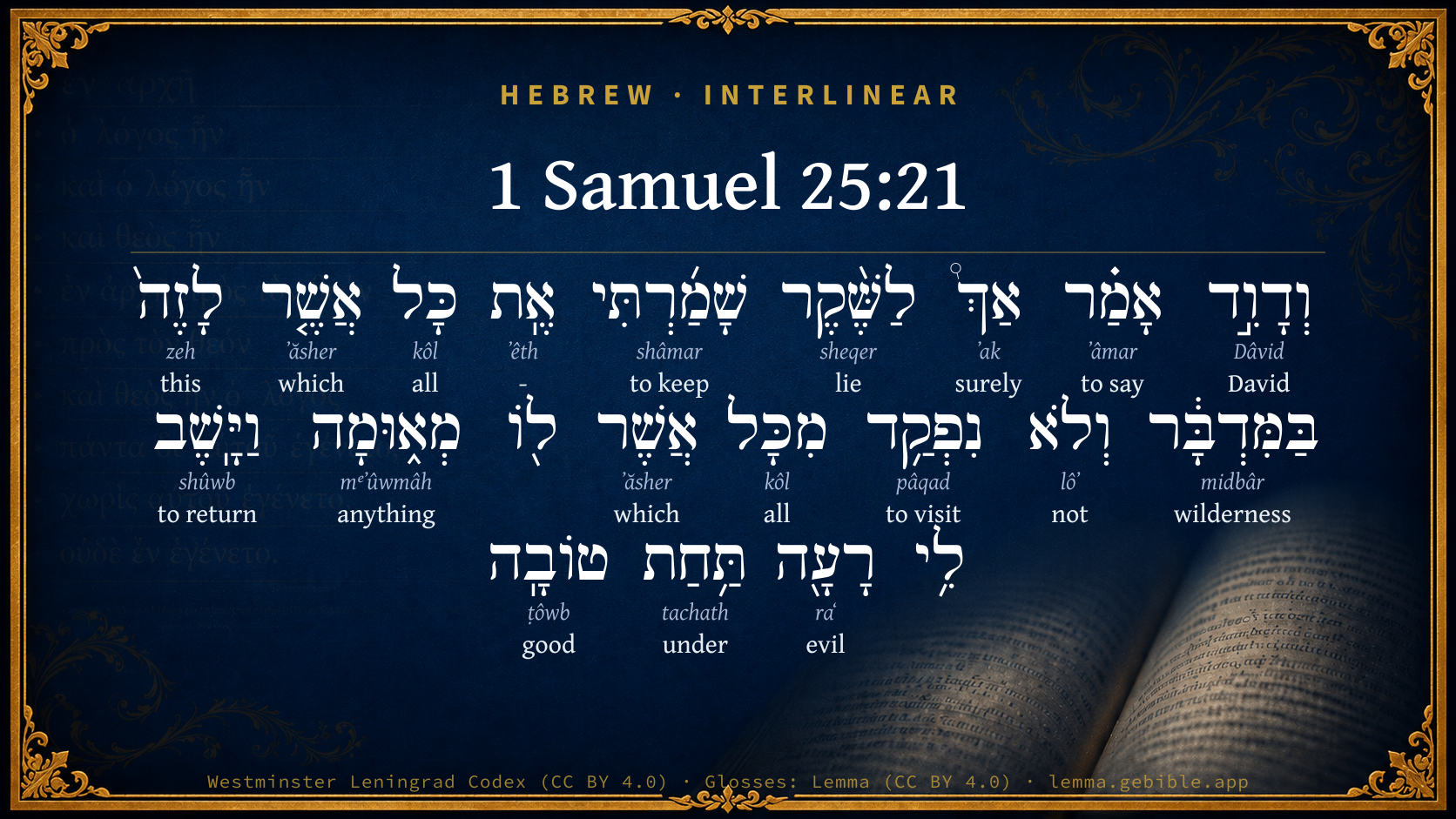
1 Samuel 25:21

Hebrew (Westminster Leningrad Codex) 1 Samuel 25:21 appears in the Hebrew Old Testament. The text above is from the Westminster Leningrad Codex. Each word links to its Strong’s number, a concise gloss, and parsing drawn from the Open Scriptures Hebrew Bible morphology. Click any word for its full Brown-Driver-Briggs (BDB) entry.
Download image
Cite this verse

1 Samuel 25:21 (World English Bible). Public Domain. Lemma interlinear Bible study tool, https://lemma.gebible.app/v/1-samuel/25/21.

Show BibTeX & RIS
BibTeX
RIS
English Translation
Now David had said, Surely in vain have I kept all that this fellow has in the wilderness, so that nothing was missed of all that pertained to him: and he has returned me evil for good.
World English Bible · Public Domain
Download a study sheet

One document with this verse’s original text, its word-by-word gloss line, the meaning frame, cross-references with their text, attributed commentary, and full source and license credits — printable, and it pastes into notes with its structure intact.

This verse Autodidact and up

Study sheet (.html) Plain text (.txt)

A passage Seminary Student

Up to 50 verses in one chapter. A passage sheet keeps up to 6 commentary sources and 12 cross-references per verse, in the order this page ranks them, and says so on the sheet whenever that leaves anything out. Ask for a single verse and you get the Autodidact verse sheet above.

Everything on this page stays free to read, with no account — the sheet is a download of what is already on screen, not access to it.

Want to remove ads? Support Godless Engineer
Compare translations 3

The same verse in 3 English versions, stacked beneath the original-language interlinear above. Click any original word for its lexicon entry.

Each is an independent rendering of the whole verse — the interlinear is not word-aligned to these translations.

Highlighted words mark where these versions differ — a whole-verse word diff, not a word-by-word alignment.

  • World English Bible Public Domain
    Now David had said, Surely in vain have I kept all that this fellow has in the wilderness, so that nothing was missed of all that pertained to him: and he has returned me evil for good.
  • King James Version Public Domain
    Now David had said, Surely in vain have I kept all that this fellow hath in the wilderness, so that nothing was missed of all that pertained unto him: and he hath requited me evil for good.
  • unfoldingWord Literal Text CC BY-SA 4.0
    Now David had said, “Surely for a lie I kept all that to this in the wilderness, and not anything was missed from all that to him. For he has returned evil to me for good.

unfoldingWord Literal Text — © unfoldingWord, licensed CC BY-SA 4.0. Word-aligned USFM3 via Door43 (git.door43.org/unfoldingWord/en_ult).

Versions to compare (up to 4)

3 of 4 selected

Show all 18 translations

Every available English version of this verse, each an independent rendering of the whole verse.

  • World English Bible Public Domain
    Now David had said, Surely in vain have I kept all that this fellow has in the wilderness, so that nothing was missed of all that pertained to him: and he has returned me evil for good.
  • Berean Standard Bible Public Domain
    Now David had just finished saying, “In vain I have protected all that belonged to this man in the wilderness. Nothing that belongs to him has gone missing, yet he has paid me back evil for good.
  • Majority Standard Bible Public Domain
    Now David had just said, “In vain I have protected all that belonged to this man in the wilderness. Nothing that belongs to him has gone missing, yet he has paid me back evil for good.
  • King James Version Public Domain
    Now David had said, Surely in vain have I kept all that this fellow hath in the wilderness, so that nothing was missed of all that pertained unto him: and he hath requited me evil for good.
  • American Standard Version (1901) Public Domain
    Now David had said, Surely in vain have I kept all that this fellow hath in the wilderness, so that nothing was missed of all that pertained unto him: and he hath returned me evil for good.
  • Revised Version (1885) Public Domain
    Now David had said, Surely in vain have I kept all that this fellow hath in the wilderness, so that nothing was missed of all that pertained unto him: and he hath returned me evil for good.
  • Geneva Bible (1599) Public Domain
    And Dauid said, In deede I haue kept all in vaine that this fellow had in the wildernesse, so that nothing was missed of all that pertained vnto him: for he hath requited me euill for good.
  • Douay-Rheims (1899) Public Domain
    And David said: Truly in vain have I kept all that belonged to this man in the wilderness, and nothing was lost of all that pertained unto him: and he hath returned me evil for good.
  • Young's Literal Translation Public Domain
    And David said, `Only, in vain I have kept all that this `one' hath in the wilderness, and nothing hath been looked after of all that he hath, and he turneth back to me evil for good;
  • Literal Standard Version CC BY-SA 4.0
    And David said, “Surely in vain I have kept all that this [one] has in the wilderness, and nothing has been looked after of all that he has, and he turns back to me evil for good;
  • Unlocked Literal Bible CC BY-SA 4.0
    Now David had said, “Surely in vain have I guarded all that this man has in the wilderness, so that nothing was missed of all that belonged to him, and he has returned me evil for good.
  • unfoldingWord Literal Text CC BY-SA 4.0
    Now David had said, “Surely for a lie I kept all that to this in the wilderness, and not anything was missed from all that to him. For he has returned evil to me for good.
  • Darby Bible Public Domain
    Now David had said, Surely, in vain have I kept all that this [man] had in the wilderness, so that nothing was missed of all that was his; and he has requited me evil for good.
  • World Messianic Bible Public Domain
    Now David had said, “Surely in vain I have kept all that this fellow has in the wilderness, so that nothing was missed of all that pertained to him. He has returned me evil for good.
  • Webster's Bible Public Domain
    (Now David had said, Surely in vain have I kept all that this man hath in the wilderness, so that nothing was missed of all that pertained to him: and he hath requited me evil for good.
  • Free Bible Version CC BY-SA 4.0
    David had just been complaining, “So much for my protecting everything that belonged to this man in the wilderness! Nothing at all was stolen from him, and yet what does he do? Pay me back evil for good!
  • Bible in Basic English Public Domain
    Now David had said, What was the use of my taking care of this man's goods in the waste land, so that there was no loss of anything which was his? he has only given me back evil for good.
  • JPS Tanakh (1917) Public Domain
    Now David had said: 'Surely in vain have I kept all that this fellow hath in the wilderness, so that nothing was missed of all that pertained unto him; and he hath returned me evil for good.

Literal Standard Version (2020), Covenant Press — licensed CC BY-SA 4.0. Text via the HelloAO Bible API (eBible.org). Unlocked Literal Bible (unfoldingWord) — licensed CC BY-SA 4.0. Text via the HelloAO Bible API (eBible.org). unfoldingWord Literal Text — © unfoldingWord, licensed CC BY-SA 4.0. Word-aligned USFM3 via Door43 (git.door43.org/unfoldingWord/en_ult). Free Bible Version, Dr. Jonathan Gallagher — licensed CC BY-SA 4.0. Text via the HelloAO Bible API (eBible.org).

Word by word

More ways to search: Search by grammar → Find every occurrence → Compare this word →

Practice this passage: Drill this verse → Learn its vocabulary →

מְא֑וּמָה
mᵉʼûwmâh
H3972
“anything”
Noun, Common, Feminine, Singular, Absolute
Part of Speech
Noun
Type
Common
Gender
Feminine
Number
Singular
State
Absolute
Full BDB Definition

Origin: apparently a form of H3971

TWOT: 1136

anything
  1. וְדָוִ֣ד Dâvid H1732 “and · David” Conjunction + Noun, Proper
  2. אָמַ֗ר ʼâmar H559 “to say” Verb, Qal, Perfect, 3rd Person, Masculine, Singular
  3. אַךְ֩ ʼak H389 “surely” Particle, Accusative
  4. לַשֶּׁ֨קֶר sheqer H8267 “to/for the · lie” Preposition, Determined + Noun, Common, Masculine, Singular, Absolute
  5. שָׁמַ֜רְתִּי shâmar H8104 “to keep” Verb, Qal, Perfect, 1st Person, Common, Singular
  6. אֶֽת ʼêth H853 “-” Particle, Direct Object
  7. כָּל kôl H3605 “all of” Noun, Common, Masculine, Singular, Construct
  8. אֲשֶׁ֤ר ʼăsher H834 “which” Particle, Relative
  9. לָזֶה֙ zeh H2088 “to/for · this” Preposition + Pronoun, Demonstrative, Masculine, Singular
  10. בַּמִּדְבָּ֔ר midbâr H4057 “in/at the · wilderness” Preposition, Determined + Noun, Common, Masculine, Singular, Absolute
  11. וְלֹא lôʼ H3808 “and · not” Conjunction + Particle, Negative
  12. נִפְקַ֥ד pâqad H6485 “to visit” Verb, Niphal, Perfect, 3rd Person, Masculine, Singular
  13. מִכָּל kôl H3605 “from · all of” Preposition + Noun, Common, Masculine, Singular, Construct
  14. אֲשֶׁר ʼăsher H834 “which” Particle, Relative
  15. וַיָּֽשֶׁב shûwb H7725 “and · to return” Conjunction + Verb, Hiphil, Sequential Imperfect, 3rd Person, Masculine, Singular
  16. רָעָ֖ה raʻ H7451 “evil” Noun, Common, Feminine, Singular, Absolute
  17. תַּ֥חַת tachath H8478 “under” Preposition
  18. טוֹבָֽה ṭôwb H2896 “good” Adjective, Adjective, Feminine, Singular, Absolute

About this verse

These counts appear in no published source. They are computed here, from the morphology-tagged text and Lemma’s own curated glosses. What Lemma adds →

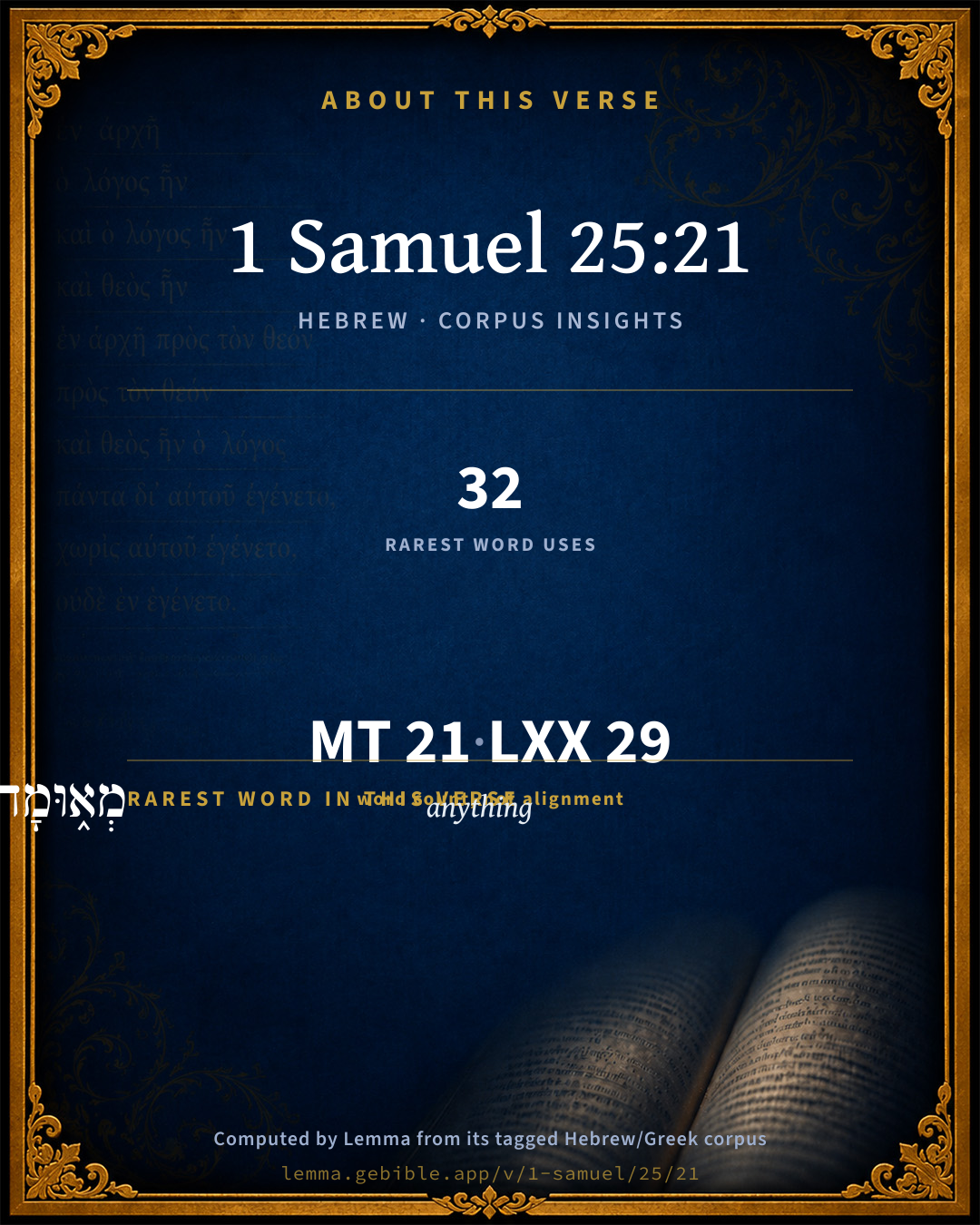
21
words
17
distinct lemmas
Historical
section

Shared distinctive vocabulary

מְא֑וּמָה anything H3972 occurs in 32 verses of the Hebrew Bible. Also found in:

Grammatical profile

  • 4 verbs
  • 7 nouns
  • 1 adjective
  • 1 pronoun
  • 3 prepositions
  • 5 particles

Verb forms

  • אָמַ֗ר Qal · Perfect
  • שָׁמַ֜רְתִּי Qal · Perfect
  • נִפְקַ֥ד Niphal · Perfect
  • וַיָּֽשֶׁב Hiphil · Sequential Imperfect

Repetition

Words recur within this verse — often emphatic in Hebrew:

  • כָּל all H3605 ×2
  • אֲשֶׁ֤ר which H834 ×2

Hebrew & Septuagint length

In English translation the verse runs 37 words from the Hebrew and 38 from the Septuagint (LXX English) — closely comparable.

A rough comparison of the two English renderings, which tokenize alike — not a word-level alignment.

Word counts can differ between the Hebrew and the Greek without any difference in meaning — e.g. the Hebrew direct-object marker אֵת has no separate Greek word, and Greek often adds the article ὁ.

In the original languages it is 21 Hebrew tokens and 29 Greek tokens — but the two are counted differently (Hebrew bundles its prefixes and suffixes into one token; the Greek is in lemma form), so that isn’t a like-for-like length.

Cross-references

16

Topical passages linked to 1 Samuel 25:21 in the Treasury of Scripture Knowledge — connected by theme and wording, ordered by reader-vote popularity; previews shown in the World English Bible.

  • Proverbs 17:13 Whoever rewards evil for good, Evil shall not depart from his house.
  • Romans 12:21 Don't be overcome by evil, but overcome evil with good.
  • Ephesians 4:26 "Be angry, and don't sin." Don't let the sun go down on your wrath,
  • Ephesians 4:31 Let all bitterness, wrath, anger, outcry, and slander, be put away from you, with all malice.
  • 1 Thessalonians 5:15 See that no one returns evil for evil to anyone, but always follow after that which is good, for one another, and for all.
  • 1 Peter 2:20–23 For what glory is it if, when you sin, you patiently endure beating? But if, when you do well, you patiently endure suffering, this is commendable with God.
  • 1 Peter 3:17 For it is better, if the will of God should so will, that you suffer for doing well than for doing evil.
  • Genesis 44:4 When they had gone out of the city, and were not yet far off, Joseph said to his steward, "Up, follow after the men. When you overtake them, ask them, 'Why have you rewarded evil for good?
  • 1 Samuel 25:13 David said to his men, Gird you on every man his sword. They girded on every man his sword; and David also girded on his sword: and there went up after David about four hundred men; and two hundred abode by the baggage.
  • Job 30:8 They are children of fools, yes, children of base men. They were flogged out of the land.
  • Psalms 35:12 They reward me evil for good, To the bereaving of my soul.
  • Psalms 37:8 Cease from anger, and forsake wrath. Don't fret, it leads only to evildoing.
  • Psalms 38:20 They who also render evil for good are adversaries to me, Because I follow what is good.
  • Psalms 109:3–5 They have also surrounded me with words of hatred, And fought against me without a cause.
  • Jeremiah 18:20 Shall evil be recompensed for good? for they have dug a pit for my soul. Remember how I stood before you to speak good for them, to turn away your wrath from them.
  • 1 Peter 3:9 not rendering evil for evil, or reviling for reviling; but instead blessing; knowing that to this were you called, that you may inherit a blessing.

Cross-references courtesy of OpenBible.info (CC BY 4.0).

Hebrew and Greek witnesses Masoretic Hebrew ↔ Greek Septuagint

The same verse in the two great witnesses to the Old Testament, shown verse-for-verse.

These are two independent witnesses, not word-aligned to each other, and the Septuagint is shown in lemma (dictionary) form.

Hebrew 1 Samuel 25:21 Masoretic · Westminster Leningrad Codex

וְדָוִ֣ד אָמַ֗ר אַךְ֩ לַשֶּׁ֨קֶר שָׁמַ֜רְתִּי אֶֽת כָּל אֲשֶׁ֤ר לָזֶה֙ בַּמִּדְבָּ֔ר וְלֹא נִפְקַ֥ד מִכָּל אֲשֶׁר ל֖וֹ מְא֑וּמָה וַיָּֽשֶׁב לִ֥י רָעָ֖ה תַּ֥חַת טוֹבָֽה

Now David had said, Surely in vain have I kept all that this fellow has in the wilderness, so that nothing was missed of all that pertained to him: and he has returned me evil for good.

World English Bible · Public Domain

Greek LXX 1 Samuel 25:21 Septuagint · lemma form

καί δαυίδ εἶπον ἴσως εἰς ἄδικος φυλάσσω πᾶς ὁ αὐτός ἐν ὁ ἔρημος καί οὐ ἐντέλλομαι λαμβάνω ἐκ πᾶς ὁ αὐτός οὐδείς καί ἀντι ἀποδίδωμι ἐγώ πονηρός ἀντί ἀγαθός

And David said, Perhaps I have kept all his possessions in the wilderness that he should wrong me, and we did not order the taking anything of all his goods; yet he has rewarded me evil for good.

LXX2012 (modern English Septuagint) · Public Domain

Hebrew: Westminster Leningrad Codex (CC BY 4.0). Greek: Septuagint (public domain); English from LXX2012 (modern English Septuagint) (Public Domain). How the Septuagint differs from the Hebrew →

Targum (Aramaic paraphrase)

1

The Targum is the ancient Jewish Aramaic paraphrase of the Hebrew Scriptures — an interpretive translation, not the Hebrew text itself. Onkelos (literal) and Pseudo-Jonathan (expansive) render the Torah, and Jonathan the Prophets. Coverage is partial: where no permissively-licensed English translation exists for a verse, only the Aramaic is shown. This is verse-level text, not a word-by-word alignment to the Hebrew.

  1. Targum Jonathan Prophets (Joshua–Malachi)
    וְדָוִד אֲמַר בְּרַם לְשִׁקְרָא נְטָרִית יַת כָּל דִי לְדֵין בְּמַדְבְּרָא וְלָא שְׁגָא מִכָּל דִי לֵיהּ מִדָעַם וַאַתֵיב לִי בִּישְׁתָּא חֲלַף טַבְתָא:

    (no public-domain English translation for this verse)

    Targum Jonathan — Aramaic: “Mikraot Gedolot” (public domain). English: “Sefaria Community Translation” (CC0 1.0 (public-domain dedication)); “London "Chaldee Paraphrase," 1871” (public domain). Text via Sefaria.

Commentary

Notes on 1 Samuel 25:21 from classic Christian and Jewish commentators (each source and its license shown beneath its notes). The classic Christian expositions comment on the surrounding passage and are grouped to its opening verse, so a note may address several verses; the Jewish commentaries on the Tanakh (Rashi and others) are per-verse, so they appear only where the commentator wrote on this verse.

Lemma curates 59 commentaries, every one of them public domain or Creative Commons licensed, each selected and text-cleaned for this edition rather than reprinted as found. About our sources →

Trapp's Complete Commentary

John Trapp

1Sa 25:21 Now David had said, Surely in vain have I kept all that this [fellow] hath in the wilderness, so that nothing was missed of all that [pertained] unto him: and he hath requited me evil for good.

Ver. 21. Now David had said,] viz., Either before he set forth, or else whilst he was upon the way: and so, haply, Abigail might overhear him, and thereupon fall down at his feet and say, "Upon me, upon me be this iniquity," &c. {1Sa 25:24}

And he hath requited me evil for good.] This is gross ingratitude, and doth mainly provoke. Such was that of Michael Balbus to Leo Armenius, the emperor, of Parry to Queen Elizabeth, of Bonner to Bishop Ridley, &c.

John Trapp, A Commentary or Exposition upon All the Books of the Old and New Testament (1647–1656) — public domain. Text from a community e-Sword module.

Joseph Benson's Commentary

1Sa 25:21. Surely in vain have I kept all that this fellow hath — Though David justly thought he had no right to take any part of the flock of Nabal by way of plunder; yet, when he and his men had taken the trouble of defending them for some time from all damage, which, probably, they otherwise could not have escaped, he concluded, with much reason, that he and his men, when reduced to necessity, had cause to expect something by way of gratuity from Nabal, for the services they had done him.

Joseph Benson's Commentary on the Old and New Testaments (1811–1818) — public domain. Text from a community e-Sword module.

Tyndale Open Study Notes

Tyndale Open Resources

25:21 he has repaid me evil for good: Cp. 24:17.

Tyndale Open Study Notes — © Tyndale Open Resources, licensed CC BY-SA 4.0. Text via the HelloAO Bible API.

Ellicott's Commentary for English Readers

(21) Now David had said.—This verse and the following (22nd) must be understood as a kind of parenthesis in the narrative. They express what David felt, and, as it were, his justification in his own mind for the violent and vengeful act he was about to carry out. The argument was, Nabal had returned indeed evil for good. For a long time David’s band had guarded faithfully his vast scattered flocks, and had preserved them safely, and now, when he asked a small favour in return, the churl repaid him by throwing in his teeth the taunt that he was a rebel and a runaway slave.

A Bible Commentary for English Readers, edited by Charles John Ellicott (1878–1897) — public domain. Text from a community e-Sword module.

The Cambridge Bible for Schools and Colleges

gen. ed. J. J. S. Perowne

21. Surely in vain] Only to be deceived and disappointed. The same word is used in Jer_3:23.

pertained] i.e. belonged. “Pertain” is derived from Lat. pertineo, through O. Fr. partenir. Cp. “appertain” from appartenir.

The Cambridge Bible for Schools and Colleges (gen. ed. J. J. S. Perowne; Cambridge University Press, 1878–1918) — public domain. Text from a community e-Sword module.

John Gill's Exposition

Now David had said,.... When the messengers returned and told him how they had been used by Nabal; or he "said" (c), or was saying within himself, or to his men, what follows, just as Abigail met him:

surely in vain have I kept all that this fellow hath in the wilderness; which shows that lie was in a violent passion, and had Nabal in the utmost contempt and indignation, in that he mentions not his name, only says "this", this man or follow; leaving a blank to be filled up with the most ignominious name and character that could be thought of; and repents that he had taken so much care of his flocks when they were feeding by him in the wilderness:

so that nothing was missed of all that pertained unto him; and seems to have wished he had suffered his flocks to have been robbed by the Arabs, or worried by wild beasts, since he had been such an ungrateful wretch to him:

and he hath requited me evil for good; he had requited evil to him by denying to send him any of his provisions, and by abusing him and his men with opprobrious language; and this was done in return for the good deeds he had done in protecting his servants and his flocks in the wilderness, and for the good words and respectful message he had sent unto him.

(c) "ait", V. L. "dixit", Pagninus, Montanus; "dicebat", Vatablus.

John Gill's Exposition of the Whole Bible (1746–1763) — public domain (CC PDM 1.0). Text via the HelloAO Bible API.

Albert Barnes' Notes on the Bible

In vain - i. e., under false expectation.

Albert Barnes' Notes on the Bible (1834–1885) — public domain. Text from a community e-Sword/MySword module.

Matthew Poole's English Annotations

David had said; either in his journey, or as soon as he heard that reproachful answer.

This fellow; whom he thought unworthy to be named, for his barbarous ingratitude and churlishness.

Matthew Poole's English Annotations on the Holy Bible (1683–1685) — public domain. Text from a community e-Sword/MySword module.

The Pulpit Commentary

Vers. 21, 22. David justifies his fierce anger by referring to the services he had rendered Nabal, and which had been requited so shabbily. For the phrase so do God unto the enemies of David see on 1Sa_20:16. A superstitious feeling probably lay at the root of this substitution of David"s enemies for himself when thus invoking a curse.

The Pulpit Commentary (1880–1919), ed. H.D.M. Spence-Jones & Joseph S. Exell — public domain. Text from a community e-Sword module.

unfoldingWord translationNotes

Door43 World Missions Community

Connecting Statement:

The writer gives background information before he continues with the story. (See: Background Information)

Now David had said, "Surely ... to him."

The reader needs to understand that David had said these things before he said, "Every man strap on his sword" in 1 Samuel 25:13.

Now David

The word "Now" shows that the writer has stopped writing about Abigail and started writing about David.

nothing was missed of all that belonged to him

This can be stated positively and in active form. AT: "he still has everything that was his" (See: Litotes and Active or Passive)

May God do so to me, David

The Hebrew text has "May God strike the enemies of David," and some versions follow this. However, the reading of the ULB follows the main Greek tradition of the Old Testament, as some other modern versions do.

all who belong

"all the people who belong to him" or "those in his family"

translationWords

David

vain

desert

evil

good

God

unfoldingWord translationNotes — © Distant Shores Media and the Door43 World Missions Community, licensed CC BY-SA 4.0. Source: git.door43.org/Door43/en_tn.

Rashi

Rabbi Shlomo Yitzchaki (Rashi)

Dovid said. To himself when his youths told him of Novol's insults, 'It was for naught that I guarded, etc.'

Rashi on the Tanakh — English translations: “The Judaica Press complete Tanach with Rashi, translated by A. J. Rosenberg” (CC BY 4.0); “Pentateuch with Rashi's commentary by M. Rosenbaum and A.M. Silbermann, 1929-1934” (public domain); “The Metsudah Tanach series, Lakewood, N.J” (CC BY 4.0); and “The Book of Joshua, Metsudah Publications, 1997” (CC BY 4.0). Text via Sefaria.

Lesson kit

Teaching starters — assembled from the data on this page, not authored interpretation. Every prompt links to the verse data it draws on. Edit before teaching.

1 Samuel, in the Historical, opens this verse with 21 words (17 distinct Hebrew lemmas). Its most distinctive word is mᵉʼûwmâh (“anything”). A historical commentator’s framing appears above. Read the whole chapter for the surrounding context.

Discussion questions

  1. How does “anything” (mᵉʼûwmâh) shape what this verse is saying?
  2. Genesis 22:12 shares the word «anything» with this verse. How do the two illuminate each other?
  3. “all” occurs 2× in this one verse. What is the effect of the repetition?
  4. These translations render this verse differently. What is at stake in choosing one wording over another?
  5. The verb «אָמַ֗ר» is Qal Perfect. How does its form color the action?
  6. Reading how Trapp's Complete Commentary and Joseph Benson's Commentary read this verse, where do the two commentators agree and where do they part?

Things to notice

Reading settings

Reading text

Shown beneath each verse's original-language words.

Old Testament
Old Testament edition

Read the OT as the Masoretic Hebrew (MT) or the Greek Septuagint (LXX).

English shown for the Greek Septuagint (in the Hebrew ↔ Greek comparison).

Comparing translations? Open the Compare panel on any verse page to stack up to four side by side.