
2 Kings 9:12

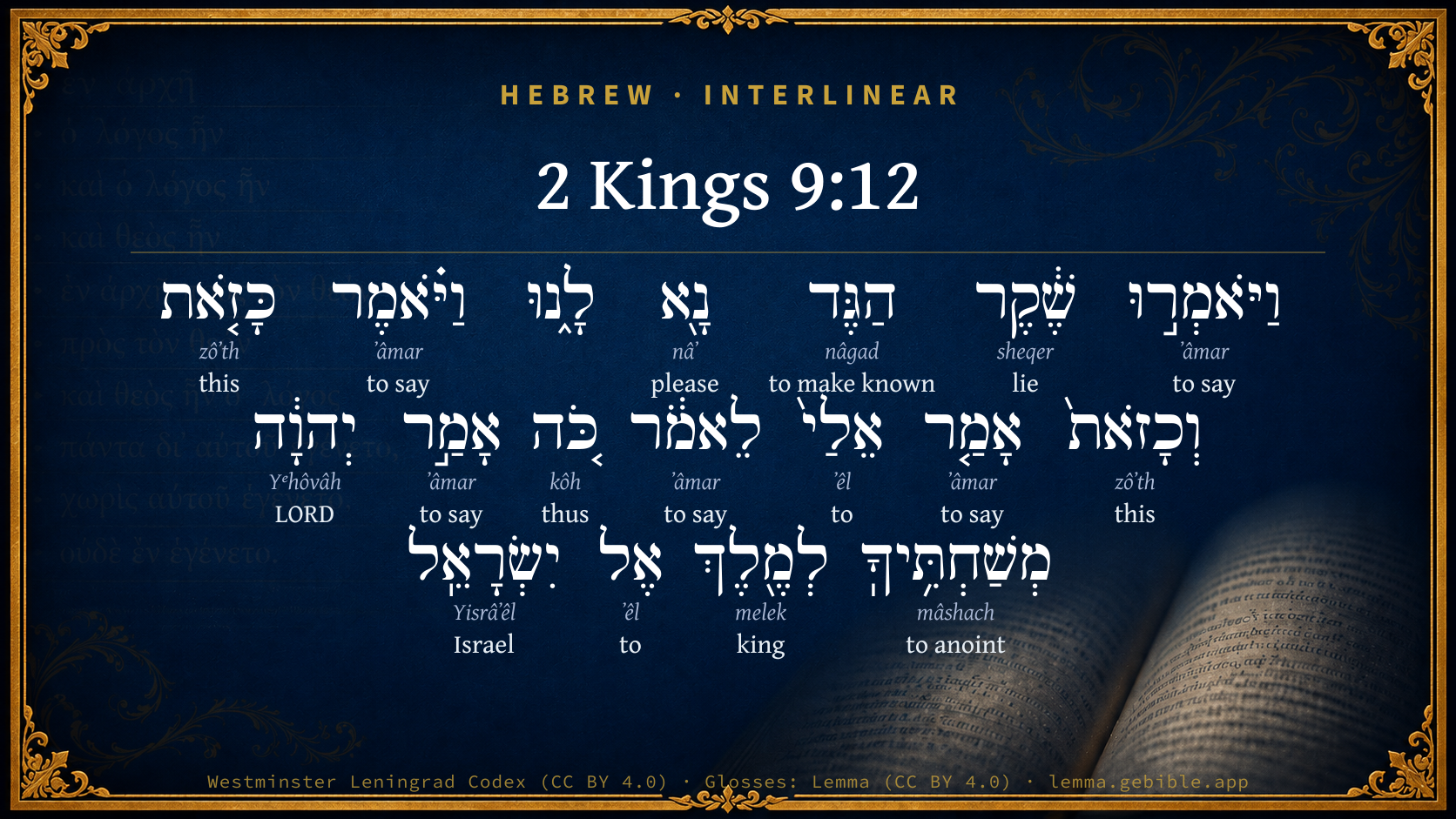
Hebrew (Westminster Leningrad Codex) 2 Kings 9:12 appears in the Hebrew Old Testament. The text above is from the Westminster Leningrad Codex. Each word links to its Strong’s number, a concise gloss, and parsing drawn from the Open Scriptures Hebrew Bible morphology. Click any word for its full Brown-Driver-Briggs (BDB) entry.
Download image
Cite this verse

2 Kings 9:12 (World English Bible). Public Domain. Lemma interlinear Bible study tool, https://lemma.gebible.app/v/2-kings/9/12.

Show BibTeX & RIS
BibTeX
RIS
English Translation
They said, It is false; tell us now. He said, Thus and thus spoke he to me, saying, Thus says Yahweh, I have anointed you king over Israel.
World English Bible · Public Domain
Download a study sheet

One document with this verse’s original text, its word-by-word gloss line, the meaning frame, cross-references with their text, attributed commentary, and full source and license credits — printable, and it pastes into notes with its structure intact.

This verse Autodidact and up

Study sheet (.html) Plain text (.txt)

A passage Seminary Student

Up to 50 verses in one chapter. A passage sheet keeps up to 6 commentary sources and 12 cross-references per verse, in the order this page ranks them, and says so on the sheet whenever that leaves anything out. Ask for a single verse and you get the Autodidact verse sheet above.

Everything on this page stays free to read, with no account — the sheet is a download of what is already on screen, not access to it.

Want to remove ads? Support Godless Engineer
Compare translations 3

The same verse in 3 English versions, stacked beneath the original-language interlinear above. Click any original word for its lexicon entry.

Each is an independent rendering of the whole verse — the interlinear is not word-aligned to these translations.

Highlighted words mark where these versions differ — a whole-verse word diff, not a word-by-word alignment.

  • World English Bible Public Domain
    They said, It is false; tell us now. He said, Thus and thus spoke he to me, saying, Thus says Yahweh, I have anointed you king over Israel.
  • King James Version Public Domain
    And they said, It is false; tell us now. And he said, Thus and thus spake he to me, saying, Thus saith the LORD, I have anointed thee king over Israel.
  • unfoldingWord Literal Text CC BY-SA 4.0
    And they said, “A lie! Now declare to us.” And he said, “Like this and like this he spoke to me, saying, ‘Thus says Yahweh, “I have anointed you as king over Israel.”’”

unfoldingWord Literal Text — © unfoldingWord, licensed CC BY-SA 4.0. Word-aligned USFM3 via Door43 (git.door43.org/unfoldingWord/en_ult).

Versions to compare (up to 4)

3 of 4 selected

Show all 18 translations

Every available English version of this verse, each an independent rendering of the whole verse.

  • World English Bible Public Domain
    They said, It is false; tell us now. He said, Thus and thus spoke he to me, saying, Thus says Yahweh, I have anointed you king over Israel.
  • Berean Standard Bible Public Domain
    “That is a lie!” they said. “Tell us now!” So Jehu answered, “He talked to me about this and that, and he said, ‘This is what the LORD says: I anoint you king over Israel.’”
  • Majority Standard Bible Public Domain
    “That is a lie!” they said. “Tell us now!” So Jehu answered, “He talked to me about this and that, saying, ‘This is what the LORD says: I anoint you king over Israel.’”
  • King James Version Public Domain
    And they said, It is false; tell us now. And he said, Thus and thus spake he to me, saying, Thus saith the LORD, I have anointed thee king over Israel.
  • American Standard Version (1901) Public Domain
    And they said, It is false; tell us now. And he said, Thus and thus spake he to me, saying, Thus saith Jehovah, I have anointed thee king over Israel.
  • Revised Version (1885) Public Domain
    And they said, It is false; tell us now. And he said, Thus and thus spake he to me, saying, Thus saith the LORD, I have anointed thee king over Israel.
  • Geneva Bible (1599) Public Domain
    And they sayde, It is false, tell vs it nowe. Then he sayd, Thus and thus spake he to me, saying, Thus saieth the Lord, I haue anointed thee for King ouer Israel.
  • Douay-Rheims (1899) Public Domain
    But they answered: It is false, but rather do thou tell us. And he said to them: Thus and thus did he speak to me: and he said: Thus saith the Lord: I have anointed thee king over Israel.
  • Young's Literal Translation Public Domain
    And they say, `False, declare, we pray thee, to us;' and he saith, `Thus and thus spake he unto me, saying, Thus said Jehovah, I have anointed thee for king unto Israel.'
  • Literal Standard Version CC BY-SA 4.0
    And they say, “False! Declare to us now”; and he says, “He spoke thus and thus to me, saying, Thus said YHWH: I have anointed you for king to Israel.”
  • Unlocked Literal Bible CC BY-SA 4.0
    They said, “That is a lie. Tell us.” Jehu answered, “He said this and that to me, and he also said, 'This is what Yahweh says: I have anointed you as king over Israel.'”
  • unfoldingWord Literal Text CC BY-SA 4.0
    And they said, “A lie! Now declare to us.” And he said, “Like this and like this he spoke to me, saying, ‘Thus says Yahweh, “I have anointed you as king over Israel.”’”
  • Darby Bible Public Domain
    And they said, It is false! tell us now. And he said, Thus and thus spoke he to me saying, Thus saith Jehovah: I have anointed thee king over Israel.
  • World Messianic Bible Public Domain
    They said, “That is a lie. Tell us now.” He said, “He said to me, ‘The LORD says, I have anointed you king over Israel.’”
  • Webster's Bible Public Domain
    And they said, It is false; tell us now. And he said, Thus and thus he spoke to me, saying, Thus saith the LORD, I have anointed thee king over Israel.
  • Free Bible Version CC BY-SA 4.0
    “Liar!” they said. “Please tell us what's going on.” “Well, he talked to me about this and that, and he told me, ‘This is what the Lord says: I anoint you king over Israel.’”
  • Bible in Basic English Public Domain
    And they said, That is not true; now give us his story. Then he said, This is what he said to me: The Lord says, I have made you king over Israel.
  • JPS Tanakh (1917) Public Domain
    And they said: 'It is false; tell us now.' And he said: 'Thus and thus spoke he to me, saying: Thus saith the LORD: I have anointed thee king over Israel.'

Literal Standard Version (2020), Covenant Press — licensed CC BY-SA 4.0. Text via the HelloAO Bible API (eBible.org). Unlocked Literal Bible (unfoldingWord) — licensed CC BY-SA 4.0. Text via the HelloAO Bible API (eBible.org). unfoldingWord Literal Text — © unfoldingWord, licensed CC BY-SA 4.0. Word-aligned USFM3 via Door43 (git.door43.org/unfoldingWord/en_ult). Free Bible Version, Dr. Jonathan Gallagher — licensed CC BY-SA 4.0. Text via the HelloAO Bible API (eBible.org).

Word by word

More ways to search: Search by grammar → Find every occurrence → Compare this word →

Practice this passage: Drill this verse → Learn its vocabulary →

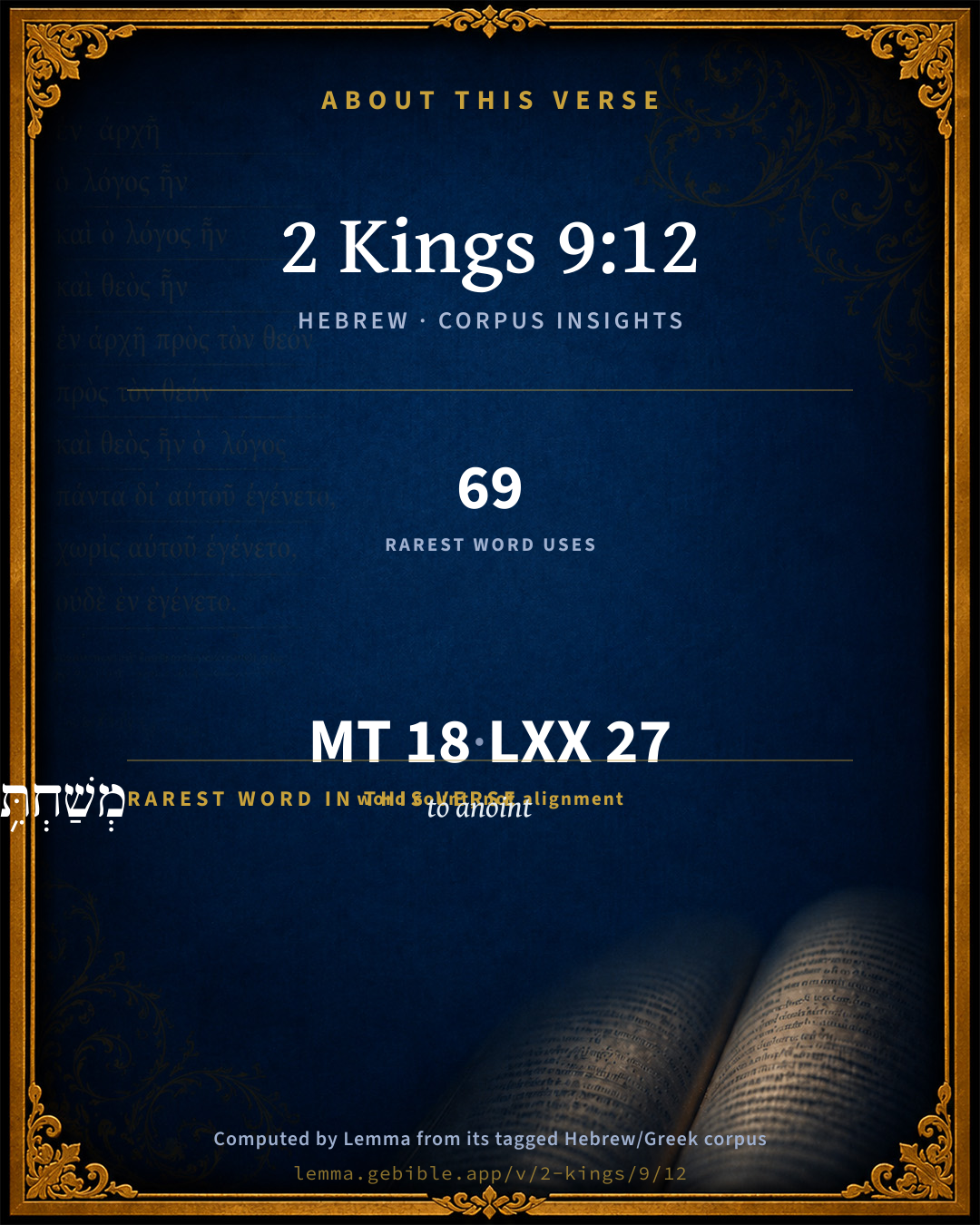
מְשַׁחְתִּ֥יךָֽ
mâshach
H4886
“to anoint · you”
Verb, Qal, Perfect, 1st Person, Common, Singular + Suffix, Personal, 2nd Person, Masculine, Singular
Part of Speech
Verb
Stem
Qal
Form
Perfect
Person
1st Person
Gender
Common
Number
Singular
Full BDB Definition

Origin: a primitive root

TWOT: 1255

to smear, anoint, spread a liquid - (Qal) - to smear - to anoint (as consecration) - to anoint, consecrate - (Niphal) to be anointed
  1. וַיֹּאמְר֣וּ ʼâmar H559 “and · to say” Conjunction + Verb, Qal, Sequential Imperfect, 3rd Person, Masculine, Plural
  2. שֶׁ֔קֶר sheqer H8267 “lie” Noun, Common, Masculine, Singular, Absolute
  3. הַגֶּד nâgad H5046 “make known” Verb, Hiphil, Imperative, 2nd Person, Masculine, Singular
  4. נָ֖א nâʼ H4994 “please” Particle, Exhortation
  5. וַיֹּ֗אמֶר ʼâmar H559 “and · to say” Conjunction + Verb, Qal, Sequential Imperfect, 3rd Person, Masculine, Singular
  6. כָּזֹ֤את zôʼth H2063 “like/as · this” Preposition + Pronoun, Demonstrative, Feminine, Singular
  7. וְכָזֹאת֙ zôʼth H2063 “and · like/as · this” Conjunction + Preposition + Pronoun, Demonstrative, Feminine, Singular
  8. אָמַ֤ר ʼâmar H559 “to say” Verb, Qal, Perfect, 3rd Person, Masculine, Singular
  9. אֵלַי֙ ʼêl H413 “to · me” Preposition + Suffix, Personal, 1st Person, Common, Singular
  10. לֵאמֹ֔ר ʼâmar H559 “to say” Preposition + Verb, Qal, Infinitive Construct
  11. כֹּ֚ה kôh H3541 “thus” Adverb
  12. אָמַ֣ר ʼâmar H559 “to say” Verb, Qal, Perfect, 3rd Person, Masculine, Singular
  13. יְהוָ֔ה Yᵉhôvâh H3068 “LORD” Noun, Proper
  14. לְמֶ֖לֶךְ melek H4428 “to/for · king” Preposition + Noun, Common, Masculine, Singular, Absolute
  15. אֶל ʼêl H413 “to” Preposition
  16. יִשְׂרָאֵֽל Yisrâʼêl H3478 “Israel” Noun, Proper

About this verse

These counts appear in no published source. They are computed here, from the morphology-tagged text and Lemma’s own curated glosses. What Lemma adds →

18
words
11
distinct lemmas
Historical
section

Grammatical profile

  • 7 verbs
  • 4 nouns
  • 2 pronouns
  • 3 prepositions
  • 1 adverb
  • 1 particle

Verb forms

  • וַיֹּאמְר֣וּ Qal · Sequential Imperfect
  • הַגֶּד Hiphil · Imperative
  • וַיֹּ֗אמֶר Qal · Sequential Imperfect
  • אָמַ֤ר Qal · Perfect
  • לֵאמֹ֔ר Qal · Infinitive Construct
  • אָמַ֣ר Qal · Perfect
  • מְשַׁחְתִּ֥יךָֽ Qal · Perfect

Repetition

Words recur within this verse — often emphatic in Hebrew:

  • וַיֹּאמְר֣וּ to say H559 ×5
  • כָּזֹ֤את this H2063 ×2
  • אֵלַי֙ to H413 ×2

Hebrew & Septuagint length

In English translation the verse runs 28 words from the Hebrew and 38 from the Septuagint (LXX English) — closely comparable.

A rough comparison of the two English renderings, which tokenize alike — not a word-level alignment.

Word counts can differ between the Hebrew and the Greek without any difference in meaning — e.g. the Hebrew direct-object marker אֵת has no separate Greek word, and Greek often adds the article ὁ.

In the original languages it is 18 Hebrew tokens and 27 Greek tokens — but the two are counted differently (Hebrew bundles its prefixes and suffixes into one token; the Greek is in lemma form), so that isn’t a like-for-like length.

Hebrew and Greek witnesses Masoretic Hebrew ↔ Greek Septuagint

The same verse in the two great witnesses to the Old Testament, shown verse-for-verse.

These are two independent witnesses, not word-aligned to each other, and the Septuagint is shown in lemma (dictionary) form.

Hebrew 2 Kings 9:12 Masoretic · Westminster Leningrad Codex

וַיֹּאמְר֣וּ שֶׁ֔קֶר הַגֶּד נָ֖א לָ֑נוּ וַיֹּ֗אמֶר כָּזֹ֤את וְכָזֹאת֙ אָמַ֤ר אֵלַי֙ לֵאמֹ֔ר כֹּ֚ה אָמַ֣ר יְהוָ֔ה מְשַׁחְתִּ֥יךָֽ לְמֶ֖לֶךְ אֶל יִשְׂרָאֵֽל

They said, It is false; tell us now. He said, Thus and thus spoke he to me, saying, Thus says Yahweh, I have anointed you king over Israel.

World English Bible · Public Domain

Greek LXX 2 Kings 9:12 Septuagint · lemma form

καί εἶπον ἄδικος ἀποἀγγέλλω δή ἐγώ καί εἶπον ιου πρός αὐτός οὕτως καί οὕτως λαλέω πρός ἐγώ λέγω ὅδε λέγω κύριος χρίω σύ εἰς βασιλεύς ἐπί ἰσραήλ

And they said, It is wrong: tell us now. And Ju said to them, Thus and thus spoke he to me, saying, —and he said, Thus says the Lord, I have anointed you to be king over Israel.

LXX2012 (modern English Septuagint) · Public Domain

Hebrew: Westminster Leningrad Codex (CC BY 4.0). Greek: Septuagint (public domain); English from LXX2012 (modern English Septuagint) (Public Domain). How the Septuagint differs from the Hebrew →

Targum (Aramaic paraphrase)

1

The Targum is the ancient Jewish Aramaic paraphrase of the Hebrew Scriptures — an interpretive translation, not the Hebrew text itself. Onkelos (literal) and Pseudo-Jonathan (expansive) render the Torah, and Jonathan the Prophets. Coverage is partial: where no permissively-licensed English translation exists for a verse, only the Aramaic is shown. This is verse-level text, not a word-by-word alignment to the Hebrew.

  1. Targum Jonathan Prophets (Joshua–Malachi)
    וַאֲמַרוּ שִׁקְרָא אַתְּ אֲמַר חֲוֵי כְעַן לָנָא וַאֲמַר כְּדֵין וּכְדֵין אֲמַר לִי לְמֵימַר כִּדְנַן אֲמַר יְיָ מְשַׁחְתָּךְ לְמֶהֱוֵי מַלְכָּא עַל יִשְׂרָאֵל:

    (no public-domain English translation for this verse)

    Targum Jonathan — Aramaic: “Mikraot Gedolot” (public domain). English: “Sefaria Community Translation” (CC0 1.0 (public-domain dedication)); “London "Chaldee Paraphrase," 1871” (public domain). Text via Sefaria.

Commentary

Notes on 2 Kings 9:12 from classic Christian and Jewish commentators (each source and its license shown beneath its notes). The classic Christian expositions comment on the surrounding passage and are grouped to its opening verse, so a note may address several verses; the Jewish commentaries on the Tanakh (Rashi and others) are per-verse, so they appear only where the commentator wrote on this verse.

Lemma curates 59 commentaries, every one of them public domain or Creative Commons licensed, each selected and text-cleaned for this edition rather than reprinted as found. About our sources →

Trapp's Complete Commentary

John Trapp

2Ki 9:12 And they said, [It is] false; tell us now. And he said, Thus and thus spake he to me, saying, Thus saith the LORD, I have anointed thee king over Israel.

Ver. 12. And they said, It is false.] It is no ordinary errand that he cometh on to thee; and this they might gather by the prophet’s calling Jehu into an inner chamber, and perhaps by Jehu’s troubled thoughts appearing in his countenance.

John Trapp, A Commentary or Exposition upon All the Books of the Old and New Testament (1647–1656) — public domain. Text from a community e-Sword module.

Adam Clarke's Commentary

Verse 12. They said, It is false] Or, as the Chaldee has it, Thou liest. Or, perhaps, it might be thus understood, "We know he has said nothing but folly and lies, nevertheless, let us hear what he has said."

Adam Clarke's Commentary on the Bible (1810–1826) — public domain. Text from a community e-Sword/MySword module.

Ellicott's Commentary for English Readers

(12) It is false.—This is rather too strong, and does not convey the exact force of the reply. The captains reply to Jehu’s “Oh, you know all about it!” with the one word, “trickery!” i.e., “you are pretending!” “mere evasion!” They then assume a tone of persuasion: “Do tell us.” Even if they had really guessed the import of the prophet’s visit, their manner now convinced Jehu that he might safely trust them.

A Bible Commentary for English Readers, edited by Charles John Ellicott (1878–1897) — public domain. Text from a community e-Sword module.

The Cambridge Bible for Schools and Colleges

gen. ed. J. J. S. Perowne

12. It is false] In the bluntest way they make Jehu understand that his answer is a mere subterfuge, and that in spite of having called the prophet a madman, they feel that he has not come without some special errand.

Thus saith the Lord, I have anointed thee] It is worthy of notice how constantly the people of the northern kingdom, though it was given up to calf-worship, and Baal-worship, yet attach the highest importance to the messages of God’s prophets, and act upon them without demur. Jehu and his companions, being about the court of Ahab, Ahaziah and Joram, no doubt joined in the idolatry and excesses of the time. But at the voice of the prophet they are prepared to dethrone the house of Ahab and put Jehu in his place.

The Cambridge Bible for Schools and Colleges (gen. ed. J. J. S. Perowne; Cambridge University Press, 1878–1918) — public domain. Text from a community e-Sword module.

John Gill's Exposition

So Jehu the son of Jehoshaphat the son of Nimshi conspired against Joram,.... He and the captains with him entered into a confederacy to depose Joram, and set him up as king:

now Joram had kept Ramothgilead, he and all Israel, because of Hazael king of Syria; having taken it, he left his army in it, under the command of his captains, of which Jehu was the chief, to keep it from the king of Syria; which gave Jehu a fairer opportunity, having the army at his command, and at a distance from Joram, of forming a conspiracy against him.

John Gill's Exposition of the Whole Bible (1746–1763) — public domain (CC PDM 1.0). Text via the HelloAO Bible API.

Haydock's Catholic Bible Commentary

False. We know not who he was, or what he said; though, from his conduct, we judge that he was one of the prophets. Hence they so readily acquiesced in saluting Jehu king. (Haydock)

George Leo Haydock (1774–1849), Haydock's Catholic Family Bible and Commentary, 1859 edition — public domain. Excludes Psalms (Douay-Rheims chapter numbering differs from Protestant) and Deuterocanonical books (Catholic canon only).

Matthew Poole's English Annotations

It is false: there is something extraordinary and of great importance in his message, as we plainly perceive by his calling thee into an inner chamber, by his great expedition, and by his gesture and carriage.

Tell us now: his concealment of the thing made them more greedy to know it.

Matthew Poole's English Annotations on the Holy Bible (1683–1685) — public domain. Text from a community e-Sword/MySword module.

Whedon's Commentary on the Bible

Daniel D. Whedon

12. False; tell us now — Though they had contemptuously called him a madman, their better nature told them that this was false, and now, as they notice Jehu’s disposition to evade their question, they insist on knowing the prophet’s mission.

Thus and thus spake he to me — He at once decides to tell them just that part of the prophet’s discourse and action which referred to his being made king, thinking, possibly, that they might consider that declaration further evidence of his being crazy. Of his commission to destroy the house of Ahab he said nothing.

Daniel D. Whedon (gen. ed.), Commentary on the Old and New Testaments (1874–1909) — public domain. Text from a community e-Sword module.

The Pulpit Commentary

And they said, It is false. There was no rudeness in the reply. It merely denied that Jehu"s supposition was correct. There had been no collusion between the spiritual and temporal authorities. The captains had no knowledge of the young prophet"s errand. Tell us now. "Tell us," i.e. , "what the young prophet said, since we are completely in the dark upon the subject." And he said, Thus and thus spoke he to me, saying, Thus saith the Lord, I have anointed thee king over Israel. Jehu declared to them without any reserve all that the young prophet had said to him. He accepted their declaration that they were not in league with him, and then gave them an exact account of all that had occurred. He left it for them to determine what, under the circumstances, they would do.

The Pulpit Commentary (1880–1919), ed. H.D.M. Spence-Jones & Joseph S. Exell — public domain. Text from a community e-Sword module.

Rashi

Rabbi Shlomo Yitzchaki (Rashi)

They said, “That is a lie.” [What] you are saying; you are hiding what he said to you.

Rashi on the Tanakh — English translations: “The Judaica Press complete Tanach with Rashi, translated by A. J. Rosenberg” (CC BY 4.0); “Pentateuch with Rashi's commentary by M. Rosenbaum and A.M. Silbermann, 1929-1934” (public domain); “The Metsudah Tanach series, Lakewood, N.J” (CC BY 4.0); and “The Book of Joshua, Metsudah Publications, 1997” (CC BY 4.0). Text via Sefaria.

Lesson kit

Teaching starters — assembled from the data on this page, not authored interpretation. Every prompt links to the verse data it draws on. Edit before teaching.

2 Kings, in the Historical, opens this verse with 18 words (11 distinct Hebrew lemmas). Its most distinctive word is mâshach (“to anoint”). A historical commentator’s framing appears above. Read the whole chapter for the surrounding context.

Discussion questions

  1. How does “to anoint” (mâshach) shape what this verse is saying?
  2. “to say” occurs 5× in this one verse. What is the effect of the repetition?
  3. The translations on this page render this verse differently — a whole-verse word diff, not a word-by-word alignment. What might account for the different wordings?
  4. The verb «וַיֹּאמְר֣וּ» is Qal Sequential Imperfect. How does its form color the action?
  5. Reading how Trapp's Complete Commentary and Adam Clarke's Commentary read this verse, where do the two commentators agree and where do they part?

Things to notice

Reading settings

Reading text

Shown beneath each verse's original-language words.

Old Testament
Old Testament edition

Read the OT as the Masoretic Hebrew (MT) or the Greek Septuagint (LXX).

English shown for the Greek Septuagint (in the Hebrew ↔ Greek comparison).

Comparing translations? Open the Compare panel on any verse page to stack up to four side by side.