Isaiah 32:7

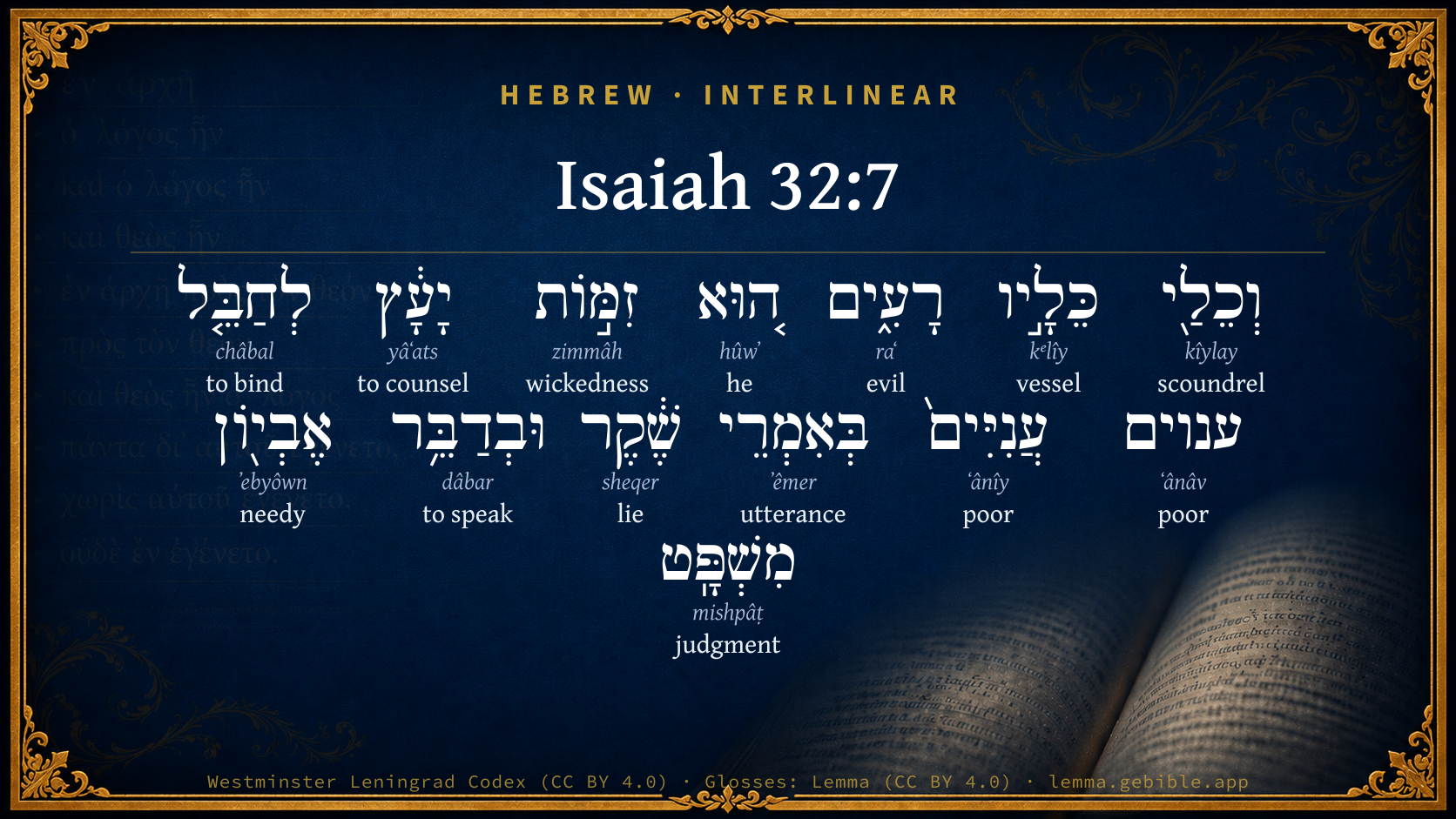
Hebrew (Westminster Leningrad Codex) Isaiah 32:7 appears in the Hebrew Old Testament. The text above is from the Westminster Leningrad Codex. Each word links to its Strong’s number, a concise gloss, and parsing drawn from the Open Scriptures Hebrew Bible morphology. Click any word for its full Brown-Driver-Briggs (BDB) entry.
Download image
Cite this verse

Isaiah 32:7 (World English Bible). Public Domain. Lemma interlinear Bible study tool, https://lemma.gebible.app/v/isaiah/32/7.

Show BibTeX & RIS
BibTeX
RIS
English Translation
The instruments of the churl are evil: he devises wicked devices to destroy the humble with lying words, even when the needy speaks right.
World English Bible · Public Domain
Download a study sheet

One document with this verse’s original text, its word-by-word gloss line, the meaning frame, cross-references with their text, attributed commentary, and full source and license credits — printable, and it pastes into notes with its structure intact.

This verse Autodidact and up

Study sheet (.html) Plain text (.txt)

A passage Seminary Student

Up to 50 verses in one chapter. A passage sheet keeps up to 6 commentary sources and 12 cross-references per verse, in the order this page ranks them, and says so on the sheet whenever that leaves anything out. Ask for a single verse and you get the Autodidact verse sheet above.

Everything on this page stays free to read, with no account — the sheet is a download of what is already on screen, not access to it.

Want to remove ads? Support Godless Engineer
Compare translations 3

The same verse in 3 English versions, stacked beneath the original-language interlinear above. Click any original word for its lexicon entry.

Each is an independent rendering of the whole verse — the interlinear is not word-aligned to these translations.

Highlighted words mark where these versions differ — a whole-verse word diff, not a word-by-word alignment.

  • World English Bible Public Domain
    The instruments of the churl are evil: he devises wicked devices to destroy the humble with lying words, even when the needy speaks right.
  • King James Version Public Domain
    The instruments also of the churl are evil: he deviseth wicked devices to destroy the poor with lying words, even when the needy speaketh right.
  • unfoldingWord Literal Text CC BY-SA 4.0
    And the scoundrel, his instruments evil. He, he devises wicked plans to ruin the poor with sayings of falsehood, though the needy speaks justice.

unfoldingWord Literal Text — © unfoldingWord, licensed CC BY-SA 4.0. Word-aligned USFM3 via Door43 (git.door43.org/unfoldingWord/en_ult).

Versions to compare (up to 4)

3 of 4 selected

Show all 18 translations

Every available English version of this verse, each an independent rendering of the whole verse.

  • World English Bible Public Domain
    The instruments of the churl are evil: he devises wicked devices to destroy the humble with lying words, even when the needy speaks right.
  • Berean Standard Bible Public Domain
    The weapons of the scoundrel are destructive; he hatches plots to destroy the poor with lies, even when the plea of the needy is just.
  • Majority Standard Bible Public Domain
    The weapons of the scoundrel are destructive; he hatches plots to destroy the poor with lies, even when the plea of the needy is just.
  • King James Version Public Domain
    The instruments also of the churl are evil: he deviseth wicked devices to destroy the poor with lying words, even when the needy speaketh right.
  • American Standard Version (1901) Public Domain
    And the instruments of the churl are evil: he deviseth wicked devices to destroy the meek with lying words, even when the needy speaketh right.
  • Revised Version (1885) Public Domain
    The instruments also of the churl are evil: he deviseth wicked devices to destroy the meek with lying words, even when the needy speaketh right.
  • Geneva Bible (1599) Public Domain
    For the weapons of the churle are wicked: hee deuiseth wicked counsels, to vndoe the poore with lying words: and to speake against the poore in iudgement.
  • Douay-Rheims (1899) Public Domain
    The vessels of the deceitful are most wicked: for he hath framed devices to destroy the meek, with lying words, when the poor man speaketh judgment.
  • Young's Literal Translation Public Domain
    And the miser -- his instruments `are' evil, He hath counselled wicked devices, To corrupt the poor with lying sayings, Even when the needy speaketh justly.
  • Literal Standard Version CC BY-SA 4.0
    And the miser—his instruments [are] evil, || He has counseled wicked schemes, || To corrupt the poor with lying sayings, || Even when the needy speaks justly.
  • Unlocked Literal Bible CC BY-SA 4.0
    The deceiver's methods are evil. He devises wicked schemes to ruin the poor with lies, even when the poor say what is right.
  • unfoldingWord Literal Text CC BY-SA 4.0
    And the scoundrel, his instruments evil. He, he devises wicked plans to ruin the poor with sayings of falsehood, though the needy speaks justice.
  • Darby Bible Public Domain
    The instruments also of the churl are evil: he deviseth wicked devices to destroy the meek with lying words, even when the needy speaketh right.
  • World Messianic Bible Public Domain
    The ways of the scoundrel are evil. He devises wicked plans to destroy the humble with lying words, even when the needy speaks right.
  • Webster's Bible Public Domain
    The instruments also of the churl are evil: he deviseth wicked devices to destroy the poor with lying words, even when the needy speaketh right.
  • Free Bible Version CC BY-SA 4.0
    Cheats use evil methods; they devise schemes to ruin the poor with lies, even when right is on the side of the poor.
  • Bible in Basic English Public Domain
    The designs of the false are evil, purposing the destruction of the poor man by false words, even when he is in the right.
  • JPS Tanakh (1917) Public Domain
    The instruments also of the churl are evil; he deviseth wicked devices to destroy the poor with lying words, and the needy when he speaketh right.

Literal Standard Version (2020), Covenant Press — licensed CC BY-SA 4.0. Text via the HelloAO Bible API (eBible.org). Unlocked Literal Bible (unfoldingWord) — licensed CC BY-SA 4.0. Text via the HelloAO Bible API (eBible.org). unfoldingWord Literal Text — © unfoldingWord, licensed CC BY-SA 4.0. Word-aligned USFM3 via Door43 (git.door43.org/unfoldingWord/en_ult). Free Bible Version, Dr. Jonathan Gallagher — licensed CC BY-SA 4.0. Text via the HelloAO Bible API (eBible.org).

Word by word

More ways to search: Search by grammar → Find every occurrence → Compare this word →

Practice this passage: Drill this verse → Learn its vocabulary →

וְכֵלַ֖י
kîylay
H3596
“and · scoundrel”
Conjunction + Noun, Common, Masculine, Singular, Absolute
Part of Speech
Conjunction + Noun
Type
Common
Gender
Masculine
Number
Singular
State
Absolute
Full BDB Definition

Origin: from H3557 in the sense of withholding

TWOT: 1366b

scoundrel, knave
  1. כֵּלָ֣יו kᵉlîy H3627 “vessels · his” Noun, Common, Masculine, Plural, Construct + Suffix, Personal, 3rd Person, Masculine, Singular
  2. רָעִ֑ים raʻ H7451 “evil” Adjective, Adjective, Masculine, Plural, Absolute
  3. ה֚וּא hûwʼ H1931 “he” Pronoun, Personal, 3rd Person, Masculine, Singular
  4. זִמּ֣וֹת zimmâh H2154 “evil devices” Noun, Common, Feminine, Plural, Absolute
  5. יָעָ֔ץ yâʻats H3289 “to counsel” Verb, Qal, Perfect, 3rd Person, Masculine, Singular
  6. לְחַבֵּ֤ל châbal H2254 “to bind” Preposition + Verb, Piel, Infinitive Construct
  7. ענוים ʻânâv H6035 “poor” Adjective, Adjective, Masculine, Plural, Absolute
  8. עֲנִיִּים֙ ʻânîy H6041 “poor” Adjective, Adjective, Masculine, Plural, Absolute
  9. בְּאִמְרֵי ʼêmer H561 “in/at · utterances of” Preposition + Noun, Common, Masculine, Plural, Construct
  10. שֶׁ֔קֶר sheqer H8267 “lie” Noun, Common, Masculine, Singular, Absolute
  11. וּבְדַבֵּ֥ר dâbar H1696 “and · in/at · to speak” Conjunction + Preposition + Verb, Piel, Infinitive Construct
  12. אֶבְי֖וֹן ʼebyôwn H34 “needy” Adjective, Adjective, Masculine, Singular, Absolute
  13. מִשְׁפָּֽט mishpâṭ H4941 “judgment” Noun, Common, Masculine, Singular, Absolute

About this verse

These counts appear in no published source. They are computed here, from the morphology-tagged text and Lemma’s own curated glosses. What Lemma adds →

14
words
14
distinct lemmas
Prophets
section

Notable vocabulary

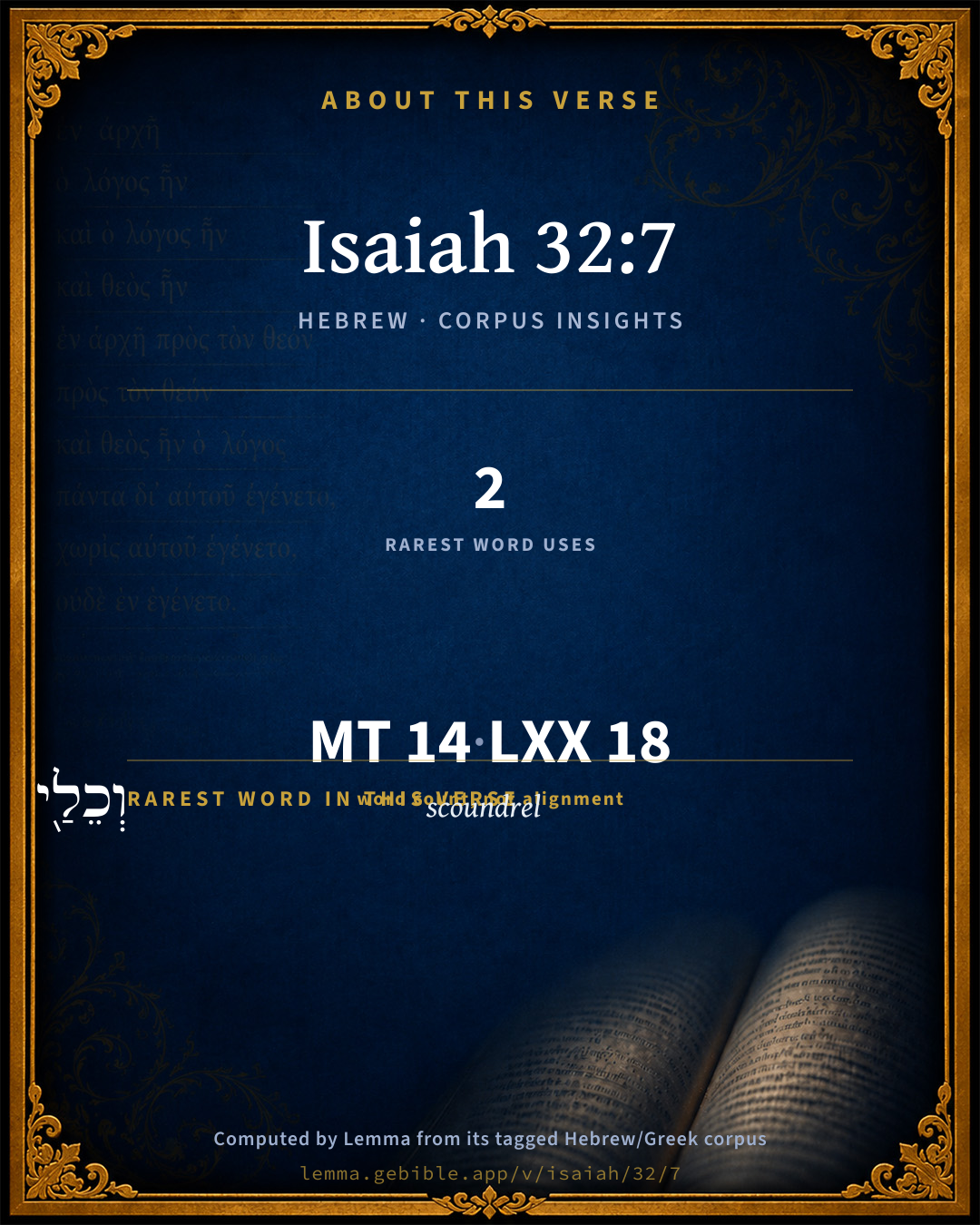
The rarest word here is וְכֵלַ֖י scoundrel H3596 — appearing just 2 times in the whole Hebrew Bible.

Shared distinctive vocabulary

וְכֵלַ֖י scoundrel H3596 occurs in 2 verses of the Hebrew Bible. Also found in:

Grammatical profile

  • 3 verbs
  • 6 nouns
  • 4 adjectives
  • 1 pronoun

Verb forms

  • יָעָ֔ץ Qal · Perfect
  • לְחַבֵּ֤ל Piel · Infinitive Construct
  • וּבְדַבֵּ֥ר Piel · Infinitive Construct

Hebrew & Septuagint length

In English translation the verse runs 24 words from the Hebrew and 25 from the Septuagint (LXX English) — closely comparable.

A rough comparison of the two English renderings, which tokenize alike — not a word-level alignment.

Word counts can differ between the Hebrew and the Greek without any difference in meaning — e.g. the Hebrew direct-object marker אֵת has no separate Greek word, and Greek often adds the article ὁ.

In the original languages it is 14 Hebrew tokens and 18 Greek tokens — but the two are counted differently (Hebrew bundles its prefixes and suffixes into one token; the Greek is in lemma form), so that isn’t a like-for-like length.

Cross-references

16

Topical passages linked to Isaiah 32:7 in the Treasury of Scripture Knowledge — connected by theme and wording, ordered by reader-vote popularity; previews shown in the World English Bible.

  • Jeremiah 5:26–28 For among my people are found wicked men: they watch, as fowlers lie in wait; they set a trap, they catch men.
  • Psalms 64:4–6 To shoot innocent men from ambushes. They shoot at him suddenly and fearlessly.
  • Isaiah 5:23 Who acquit the guilty for a bribe, But deny justice for the innocent!
  • Matthew 26:14–16 Then one of the twelve, who was called Judas Iscariot, went to the chief priests,
  • Matthew 26:59–60 Now the chief priests, the elders, and the whole council sought false testimony against Jesus, that they might put him to death;
  • Acts 6:11–13 Then they secretly induced men to say, "We have heard him speak blasphemous words against Moses and God."
  • 1 Kings 21:10–14 and set two men, base fellows, before him, and let them testify against him, saying, You did curse God and the king. Then carry him out, and stone him to death.
  • Psalms 10:7–10 His mouth is full of cursing, deceit, and oppression. Under his tongue is mischief and iniquity.
  • Psalms 82:2–5 "How long will you judge unjustly, And show partiality to the wicked?" Selah.
  • Isaiah 1:23 Your princes are rebellious, and companions of thieves. Everyone loves bribes, and follows after rewards. They don't judge the fatherless, Neither does the cause of the widow come to them.
  • Isaiah 59:3–4 For your hands are defiled with blood, and your fingers with iniquity; your lips have spoken lies, your tongue mutters wickedness.
  • Isaiah 61:1 The Spirit of the Lord Yahweh is on me; because Yahweh has anointed me to preach good news to the humble; he has sent me to bind up the broken-hearted, to proclaim liberty to the captives, and the opening [of the prison] to those who are bound;
  • Jeremiah 18:18 Then said they, Come, and let us devise devices against Jeremiah; for the law shall not perish from the priest, nor counsel from the wise, nor the word from the prophet. Come, and let us strike him with the tongue, and let us not give heed to any of his words.
  • Micah 2:11 If a man walking in a spirit of falsehood lies: 'I will prophesy to you of wine and of strong drink;' He would be the prophet of this people.
  • Micah 7:2–3 The godly man has perished out of the earth, And there is no one upright among men. They all lie in wait for blood; Every man hunts his brother with a net.
  • Matthew 26:4 They took counsel together that they might take Jesus by deceit, and kill him.

Cross-references courtesy of OpenBible.info (CC BY 4.0).

Hebrew and Greek witnesses Masoretic Hebrew ↔ Greek Septuagint

The same verse in the two great witnesses to the Old Testament, shown verse-for-verse.

These are two independent witnesses, not word-aligned to each other, and the Septuagint is shown in lemma (dictionary) form.

Hebrew Isaiah 32:7 Masoretic · Westminster Leningrad Codex

וְכֵלַ֖י כֵּלָ֣יו רָעִ֑ים ה֚וּא זִמּ֣וֹת יָעָ֔ץ לְחַבֵּ֤ל ענוים עֲנִיִּים֙ בְּאִמְרֵי שֶׁ֔קֶר וּבְדַבֵּ֥ר אֶבְי֖וֹן מִשְׁפָּֽט

The instruments of the churl are evil: he devises wicked devices to destroy the humble with lying words, even when the needy speaks right.

World English Bible · Public Domain

Greek LXX Isaiah 32:7 Septuagint · lemma form

ὁ γάρ βουλή ὁ πονηρός ἄνομος βουλεύω καταφθείρω ταπεινός ἐν λόγος ἄδικος καί διασκεδάζω λόγος ταπεινός ἐν κρίσις

For the counsel of the wicked will devise iniquity, to destroy the poor with unjust words, and ruin the cause of the poor in judgment.

LXX2012 (modern English Septuagint) · Public Domain

On this verse, Adam Clarke's Commentary discusses the Septuagint’s reading. Read the note in Commentary ↓

Hebrew: Westminster Leningrad Codex (CC BY 4.0). Greek: Septuagint (public domain); English from LXX2012 (modern English Septuagint) (Public Domain). How the Septuagint differs from the Hebrew →

Targum (Aramaic paraphrase)

1

The Targum is the ancient Jewish Aramaic paraphrase of the Hebrew Scriptures — an interpretive translation, not the Hebrew text itself. Onkelos (literal) and Pseudo-Jonathan (expansive) render the Torah, and Jonathan the Prophets. Coverage is partial: where no permissively-licensed English translation exists for a verse, only the Aramaic is shown. This is verse-level text, not a word-by-word alignment to the Hebrew.

  1. Targum Jonathan Prophets (Joshua–Malachi)
    וְרַשִׁיעַיָא דְעוֹבָדֵיהוֹן בִּישִׁין וְאִינוּן עַל עֵיצַת חֶטְאִין מִתְמַלְכִין לְחַבָּלָא עִנְוְתָנַיָא בְּמִלֵי שְׁקַר וּפִּתְגָמֵי חֲשִׁיכַיָא בְּדִינָא:

    And the wicked, whose works are evil, take counsel with sinners to destroy the poor with lying words, and the words of the needy in judgment.

    Targum Jonathan — Aramaic: “Mikraot Gedolot” (public domain). English: “Sefaria Community Translation” (CC0 1.0 (public-domain dedication)); “London "Chaldee Paraphrase," 1871” (public domain). Text via Sefaria.

Commentary

Notes on Isaiah 32:7 from classic Christian and Jewish commentators (each source and its license shown beneath its notes). The classic Christian expositions comment on the surrounding passage and are grouped to its opening verse, so a note may address several verses; the Jewish commentaries on the Tanakh (Rashi and others) are per-verse, so they appear only where the commentator wrote on this verse.

Lemma curates 59 commentaries, every one of them public domain or Creative Commons licensed, each selected and text-cleaned for this edition rather than reprinted as found. About our sources →

Trapp's Complete Commentary

John Trapp

Isa 32:7 The instruments also of the churl [are] evil: he deviseth wicked devices to destroy the poor with lying words, even when the needy speaketh right.

Ver. 7. The instruments also of the churl are evil.] There is an elegance in the original, Cuius lepos in vertendo perit. {a} By his instruments or vessels are meant, say some, his evil arts and deceits of all sorts; or, as others hold, his subordinate officers and teasers.

Even when the needy speaketh right.] Right or wrong, he is sure to be undone; the doing of anything or of nothing he findeth alike dangerous.

{a} Scalig.

John Trapp, A Commentary or Exposition upon All the Books of the Old and New Testament (1647–1656) — public domain. Text from a community e-Sword module.

Joseph Benson's Commentary

Isa 32:7-8. The instruments also of the churl are evil — Hebrew, כלי, the vessels. It is a word of a very general signification among the Hebrews, and signifies any person or thing which is employed in a man’s service. The sense is, that such covetous or wicked princes most willingly choose and employ wicked men in their affairs, because such men will, without any regard to conscience or justice: serve all their exorbitant desires. It includes, however, his counsels, practices, and arts, which are here declared to be generally evil. He deviseth wicked devices — He uses all his understanding and art to do injuries to others; to destroy the poor with lying words — With false and unrighteous decrees. When the needy speaketh right — When their cause is just and good. But the liberal deviseth liberal things — He who is truly liberal and virtuous, will show it by designing and practising liberal or virtuous actions. And by liberal things shall he stand — He who does so will not destroy himself thereby, as wicked men falsely suppose, but establish and advance himself. “The Christian reader need not be told how exactly the particulars, expressed in these verses, belong to Christ’s kingdom, who is a hiding-place from the storm of sin and the world, Joh 16:33; whose kingdom is a kingdom of light, of faith, of love; all whose subjects are enlightened by the knowledge of the glory of God, in the face of Jesus Christ; who gave eyes to the blind, ears to the deaf, tongues to the dumb, and, by his divine grace, changed the most churlish and illiberal dispositions into generosity and love.” Vitringa.

Joseph Benson's Commentary on the Old and New Testaments (1811–1818) — public domain. Text from a community e-Sword module.

Tyndale Open Study Notes

Tyndale Open Resources

32:7 smooth tricks . . . crooked schemes: See Prov 6:12, 18; 16:27; 24:8-9.

Tyndale Open Study Notes — © Tyndale Open Resources, licensed CC BY-SA 4.0. Text via the HelloAO Bible API.

Jamieson, Fausset & Brown

Robert Jamieson, A. R. Fausset & David Brown

churl--"the fraudulent"; this verse refers to the last clause of Isa 32:5; as Isa 32:6 referred to its first clause.

speaketh right--pleadeth a just cause (Isa 29:21); spiritually, "the poor man's cause" is the divine doctrine, his rule of faith and practice.

Jamieson, Fausset & Brown — Commentary Critical and Explanatory on the Whole Bible (1871) — public domain (CC PDM 1.0). Text via the HelloAO Bible API.

Adam Clarke's Commentary

Verse 7. The instruments also of the churl are evil - "As for the niggard, his instruments are evil"] His machinations, his designs. The paronomasia, which the prophet frequently deals in, suggested this expression וכלי כליו vechelai kelaiv. The first word is expressed with some variety in the MSS. Seven MSS. read וכילי vekili, one וכל vechol, another וכולי vecoli.

To destroy the poor with lying words - "To defeat the assertions of the poor in judgment"] A word seems to have been lost here, and two others to have suffered a small alteration, which has made the sentence very obscure. The Septuagint have happily retained the rendering of the lost word, and restored the sentence in all its parts: Και διασκεδασαι λογους ταπεινων εν κρισει· ולהפר דברי אביון במשפט ulehapher dibrey ebyon bemishpat, "And disperse the words of the poor in judgment." They frequently render the verb הפר haphar by διασκεδασαι, A MS. reads ולדבר uledabber, which gives authority for the preposition ל lamed, to, necessary to the sense, and the Septuagint, Syriac, and Chaldee read במשפט bemishpat, IN judgment.

Adam Clarke's Commentary on the Bible (1810–1826) — public domain. Text from a community e-Sword/MySword module.

Ellicott's Commentary for English Readers

(7) To destroy the poor with lying words . . .—The words, though perfectly generic in their form, are probably not without an implied reference to those who had thus acted towards Isaiah himself, making even him an “offender for a word” (Isa_29:21).

A Bible Commentary for English Readers, edited by Charles John Ellicott (1878–1897) — public domain. Text from a community e-Sword module.

The Cambridge Bible for Schools and Colleges

gen. ed. J. J. S. Perowne

7. The instruments] i.e. the weapons or methods, of the knave. The word is chosen because of its close similarity to that for “knave” (kçlai—kçlâv). On these machinations of the knave, see ch. Isa_29:21.

even when the needy speaketh right] in a forensic sense (= “speaks with right on his side”).

The Cambridge Bible for Schools and Colleges (gen. ed. J. J. S. Perowne; Cambridge University Press, 1878–1918) — public domain. Text from a community e-Sword module.

John Gill's Exposition

The instruments also of the churl are evil,.... Not his vessels or measures he sells by, which are small and deficient, as Kimchi and Ben Melech interpret it; nor his servants, his tools in doing his wickedness, which are fit for his purpose, wicked men; but rather these are much the same with "the instruments of the foolish shepherd", Zac 11:15 and may signify the evil ways and methods which covetous pastors or shepherds take to fleece the flock, and to increase their own gain:

he deviseth wicked devices to destroy the poor with lying words, even when the needy speaketh right; he consults, contrives, and forms schemes with all craft and cunning, on purpose, to corrupt, as the word (h) signifies, the poor and meek, humble and afflicted souls, with false doctrines; even when these poor and needy ones, who want to have sound and comfortable doctrine delivered to them, speak and ask for that which is right and just, agreeably to the oracles of God, and the analogy of faith, but can not have it; wherefore such a man is unfit to be a ruler in the house of God.

(h) "ad corrumpendum afflictos in eloquiis falsitaits", Montanus.

John Gill's Exposition of the Whole Bible (1746–1763) — public domain (CC PDM 1.0). Text via the HelloAO Bible API.

Albert Barnes' Notes on the Bible

The instruments also - In the Hebrew here there is a paronomasia which cannot be imitated in a translation. The word ‘instruments’ here denotes evidently the means by which the churl accomplishes his object; whether it be by words, by judicial decisions, or by crafty devices. This is also a kind of proverbial expression, and is given as a further reason why such a person would not be employed by a wise and virtuous prince.

Are evil - He will make use of any unprincipled means, any wicked plan or device, to accomplish his purpose. “With lying words.” With false representations; or with deceitful promises and assurances. His aim would be particularly directed to the poor and humble, as more easily deprived of their rights than the rich and powerful. It was also of greater importance to defend the rights of the poor, and therefore the prophet says that such a person should not be in the employ of a just and virtuous ruler.

Even when the needy speaketh right - That is, although the cause of the needy is one of truth and equity. When this would be manifest, the unprincipled man in power would deprive him of his rights, and, therefore, under a wise and virtuous administration, such a person should not be employed.

Albert Barnes' Notes on the Bible (1834–1885) — public domain. Text from a community e-Sword/MySword module.

Haydock's Catholic Bible Commentary

Vessels. Arms, (Calmet) or all the words and actions of the miser are bent on evil. (Haydock) --- The ministers of wicked princes resemble them. (Menochius)

George Leo Haydock (1774–1849), Haydock's Catholic Family Bible and Commentary, 1859 edition — public domain. Excludes Psalms (Douay-Rheims chapter numbering differs from Protestant) and Deuterocanonical books (Catholic canon only).

Matthew Poole's English Annotations

The instruments also of the churl are evil, Heb. The vessels, &c., which is a word of a very general signification among the Hebrews, and signifies any person or thing which is employed in a man’s use and service. I say person, for the name of vessel is given to such persons as are instrumental to another, as to the Babylonians, who were God’s instruments in executing his vengeance, Isa 13:5 to God’s ministers, Act 9:15; 2Co 4:5; and to useful Christians, 2Ti 2:20; and to wives, 1Pe 3:7. And so it may be here noted, that such covetous or wicked princes most willingly choose and employ wicked men in their affairs, because such men will, without any regard to conscience or justice, serve all their exorbitant desires or lusts. But withal, it seems to include his counsels, and practices, and arts, which are here declared to be generally evil. But this verse is and may be otherwise rendered, as the former was; And (repeat, he shall be called) a churl (as indeed he is one) whose instruments are evil, and who deviseth, &c.; which agrees with the order of the words in the Hebrew text, and with the order of the foregoing verses: for as he speaks of the vile person, and of the churl, Isa 32:6; so he gives a description of the vile person, Isa 32:6, and then of the churl, in this verse.

He deviseth wicked devices; he useth all his wit and art to do injury to others, without any inconvenience to himself.

With lying words; with false and unrighteous decrees.

When the needy speaketh right; when their cause is just and good.

Matthew Poole's English Annotations on the Holy Bible (1683–1685) — public domain. Text from a community e-Sword/MySword module.

The Pulpit Commentary

The instruments. Mr. Cheyne translates, "the machinations," which gives a better sense; but the rendering is scarcely borne out by any parallel use of the term cli in Scripture or elsewhere. Cli properly means "vessels," "weapons," "implements." He deviseth wicked devices; rather, he deviseth plots. The word "he" is emphatic. Unlike the fool, who passively does evil through thoughtlessness, the niggard actively devises crafty plans against his fellow-men. He seeks to cheat the poor out of their rights by false witness, (comp. Isa_1:17, 23 3:14, 15 5:28, etc.) Even when the needy speaketh right; i.e. "has right on his side." The translation in the text is to be preferred to that in the margin.

The Pulpit Commentary (1880–1919), ed. H.D.M. Spence-Jones & Joseph S. Exell — public domain. Text from a community e-Sword module.

John Wesley's Explanatory Notes

Lying words - With false and unrighteous decrees. Even - When their cause is just and good.

John Wesley, Explanatory Notes Upon the Whole Bible (1754–1765) — public domain. Text via the GEBible commentary corpus.

J. A. Alexander on Isaiah

Joseph Addison Alexander

Such is the fool: as for the churl, although his making money be not sinful in itself, his arms or instruments, the means which he employs, are evil. He that hastens to be rich can scarcely avoid the practice of dishonest arts and of unkindness to the poor. “He deviseth plots to destroy the oppressed (or afflicted) with words of falsehood, and (i.e., even) in the poor (man’s) speaking right” (i.e., even when the poor man’s claim is just, or in a more general sense, when the poor man pleads his cause).

Joseph Addison Alexander, The Prophecies of Isaiah (1846–1847; New York: Scribner, 1870–1878) — public domain. Text from a community e-Sword module.

unfoldingWord translationNotes

Door43 World Missions Community

The deceiver's

This refers to a person who deceives others. AT: "The deceptive person's" (See: Nominal Adjectives)

to ruin the poor with lies

"The poor" refers to poor people. Also, the phrase "to ruin" does not means to kill them but to harm them by telling lies about them. AT: "to harm the poor people by telling lies" (See: Nominal Adjectives)

he will stand

This means that he will be successful. AT: "he will be successful" (See: Idiom)

translationWords

deceive

evil

ruin

honor

unfoldingWord translationNotes — © Distant Shores Media and the Door43 World Missions Community, licensed CC BY-SA 4.0. Source: git.door43.org/Door43/en_tn.

Rashi

Rabbi Shlomo Yitzchaki (Rashi)

and when the needy speaks a plea (מִשְׁפָּט) To destroy the needy in his plea (מִשְׁפָּטוֹ). This word מִשְׁפָּט is an expression denoting the initial presentation of the case; when the needy presents his pleas, this one plans wicked plots to trap him with his devices. The word מִשְׁפָּט has three meanings: the initial pleas (derajjsnement in O.F.), the sentence (joujjment), and the execution of the verdict, that they discipline him with chastisement (joustize in O.F.).

Rashi on the Tanakh — English translations: “The Judaica Press complete Tanach with Rashi, translated by A. J. Rosenberg” (CC BY 4.0); “Pentateuch with Rashi's commentary by M. Rosenbaum and A.M. Silbermann, 1929-1934” (public domain); “The Metsudah Tanach series, Lakewood, N.J” (CC BY 4.0); and “The Book of Joshua, Metsudah Publications, 1997” (CC BY 4.0). Text via Sefaria.

Ibn Ezra

Rabbi Abraham ibn Ezra

The instruments also, etc. The instruments of justice; for the officers were judges, whose principle was to arrest judgment.

Ibn Ezra on the Tanakh — English translations: “Sefaria Community Translation” (CC0 1.0 (public-domain dedication)); “Yalkut, Sifsei Chachomim Chumash, Metsudah Publications, 2009” (CC BY 4.0); and “Commentary of Ibn Ezra on Isaiah - trans. by M. Friedlander, 1873” (public domain). Text via Sefaria.

Lesson kit

Teaching starters — assembled from the data on this page, not authored interpretation. Every prompt links to the verse data it draws on. Edit before teaching.

Isaiah, in the Prophets, opens this verse with 14 words (14 distinct Hebrew lemmas). Its most distinctive word is kîylay (“scoundrel”). A historical commentator’s framing appears above. Read the whole chapter for the surrounding context.

Discussion questions

  1. The word kîylay carries the sense “scoundrel.” How does it shape the verse?
  2. How does Isaiah 32:5, which shares the word «scoundrel», read alongside this verse?
  3. These translations render this verse differently. What is at stake in choosing one wording over another?
  4. «יָעָ֔ץ» is a Qal Perfect verb. How does that grammatical form shape the action described?
  5. Compare how Trapp's Complete Commentary and Joseph Benson's Commentary read this verse. Where do they agree or differ?

Things to notice

Reading settings

Reading text

Shown beneath each verse's original-language words.

Old Testament
Old Testament edition

Read the OT as the Masoretic Hebrew (MT) or the Greek Septuagint (LXX).

English shown for the Greek Septuagint (in the Hebrew ↔ Greek comparison).

Comparing translations? Open the Compare panel on any verse page to stack up to four side by side.