
Isaiah 59:13

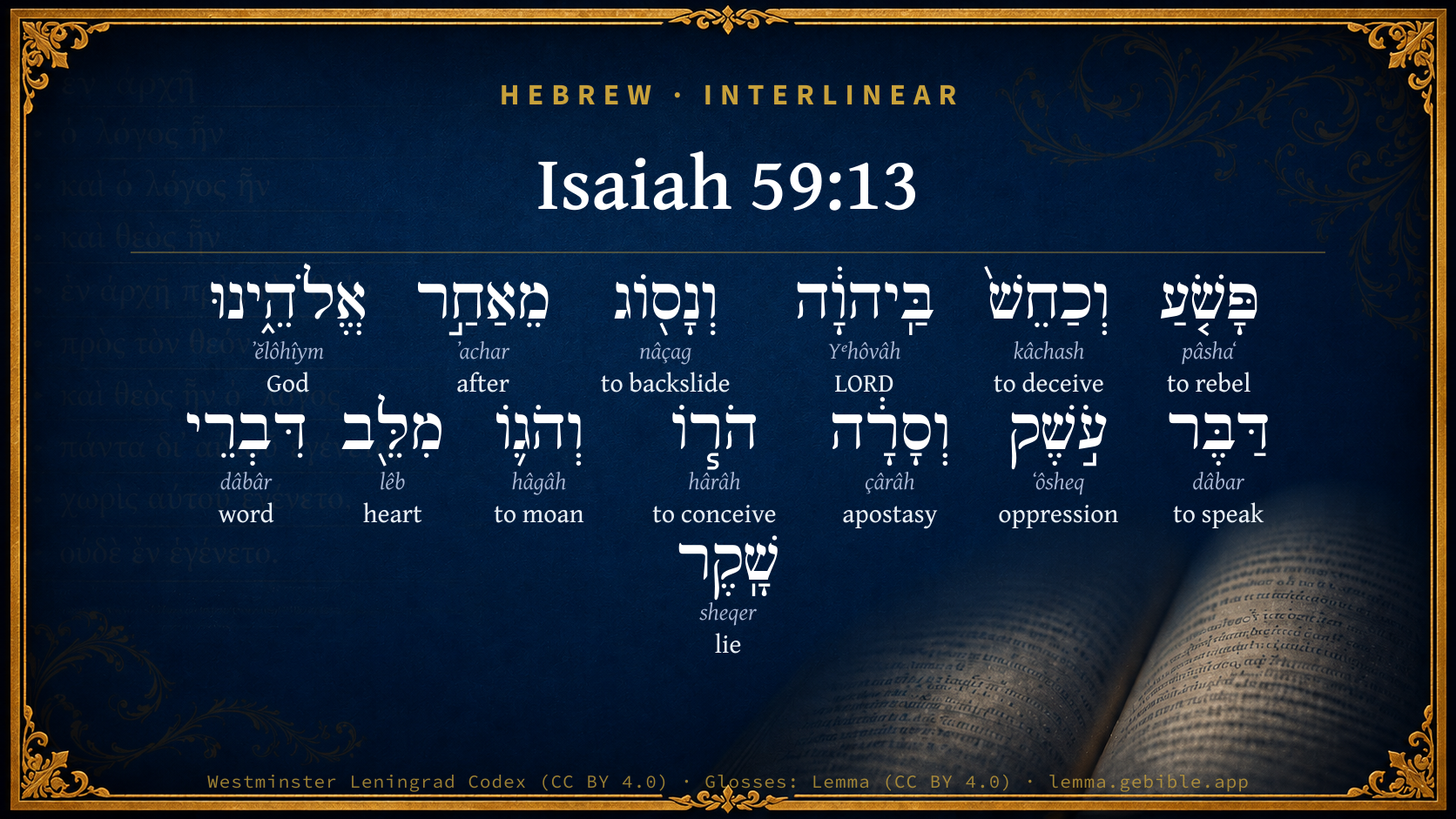
Hebrew (Westminster Leningrad Codex) Isaiah 59:13 appears in the Hebrew Old Testament. The text above is from the Westminster Leningrad Codex. Each word links to its Strong’s number, a concise gloss, and parsing drawn from the Open Scriptures Hebrew Bible morphology. Click any word for its full Brown-Driver-Briggs (BDB) entry.
Download image
Cite this verse

Isaiah 59:13 (World English Bible). Public Domain. Lemma interlinear Bible study tool, https://lemma.gebible.app/v/isaiah/59/13.

Show BibTeX & RIS
BibTeX
RIS
English Translation
transgressing and denying Yahweh, and turning away from following our God, speaking oppression and revolt, conceiving and uttering from the heart words of falsehood.
World English Bible · Public Domain
Download a study sheet

One document with this verse’s original text, its word-by-word gloss line, the meaning frame, cross-references with their text, attributed commentary, and full source and license credits — printable, and it pastes into notes with its structure intact.

This verse Autodidact and up

Study sheet (.html) Plain text (.txt)

A passage Seminary Student

Up to 50 verses in one chapter. A passage sheet keeps up to 6 commentary sources and 12 cross-references per verse, in the order this page ranks them, and says so on the sheet whenever that leaves anything out. Ask for a single verse and you get the Autodidact verse sheet above.

Everything on this page stays free to read, with no account — the sheet is a download of what is already on screen, not access to it.

Want to remove ads? Support Godless Engineer
Compare translations 3

The same verse in 3 English versions, stacked beneath the original-language interlinear above. Click any original word for its lexicon entry.

Each is an independent rendering of the whole verse — the interlinear is not word-aligned to these translations.

Highlighted words mark where these versions differ — a whole-verse word diff, not a word-by-word alignment.

  • World English Bible Public Domain
    transgressing and denying Yahweh, and turning away from following our God, speaking oppression and revolt, conceiving and uttering from the heart words of falsehood.
  • King James Version Public Domain
    In transgressing and lying against the LORD, and departing away from our God, speaking oppression and revolt, conceiving and uttering from the heart words of falsehood.
  • unfoldingWord Literal Text CC BY-SA 4.0
    rebelling and denying Yahweh, and turning away from after our God; speaking oppression and revolt, conceiving and murmuring words of falsehood from the heart.

unfoldingWord Literal Text — © unfoldingWord, licensed CC BY-SA 4.0. Word-aligned USFM3 via Door43 (git.door43.org/unfoldingWord/en_ult).

Versions to compare (up to 4)

3 of 4 selected

Show all 18 translations

Every available English version of this verse, each an independent rendering of the whole verse.

  • World English Bible Public Domain
    transgressing and denying Yahweh, and turning away from following our God, speaking oppression and revolt, conceiving and uttering from the heart words of falsehood.
  • Berean Standard Bible Public Domain
    rebelling and denying the LORD, turning away from our God, speaking oppression and revolt, conceiving and uttering lies from the heart.
  • Majority Standard Bible Public Domain
    rebelling and denying the LORD, turning away from our God, speaking oppression and revolt, conceiving and uttering lies from the heart.
  • King James Version Public Domain
    In transgressing and lying against the LORD, and departing away from our God, speaking oppression and revolt, conceiving and uttering from the heart words of falsehood.
  • American Standard Version (1901) Public Domain
    transgressing and denying Jehovah, and turning away from following our God, speaking oppression and revolt, conceiving and uttering from the heart words of falsehood.
  • Revised Version (1885) Public Domain
    in transgressing and denying the LORD, and turning away from following our God, speaking oppression and revolt, conceiving and uttering from the heart words of falsehood.
  • Geneva Bible (1599) Public Domain
    In trespassing and lying against the Lord, and wee haue departed away from our God, and haue spoken of crueltie and rebellion, conceiuing and vttering out of the heart false matters.
  • Douay-Rheims (1899) Public Domain
    In sinning and lying against the Lord: and we have turned away so that we went not after our God, but spoke calumny and transgression: we have conceived, and uttered from the heart, words of falsehood.
  • Young's Literal Translation Public Domain
    Transgressing, and lying against Jehovah, And removing from after our God, Speaking oppression and apostacy, Conceiving and uttering from the heart Words of falsehood.
  • Literal Standard Version CC BY-SA 4.0
    Transgressing, and lying against YHWH, || And removing from after our God, || Speaking oppression and apostasy, || Conceiving and uttering from the heart || Words of falsehood.
  • Unlocked Literal Bible CC BY-SA 4.0
    We have rebelled, denying Yahweh and turning away from following our God. We have spoken extortion and turning aside, conceived complaining from the heart and words of lying.
  • unfoldingWord Literal Text CC BY-SA 4.0
    rebelling and denying Yahweh, and turning away from after our God; speaking oppression and revolt, conceiving and murmuring words of falsehood from the heart.
  • Darby Bible Public Domain
    in transgressing and lying against Jehovah, and departing away from our God, speaking oppression and revolt, conceiving and uttering from the heart words of falsehood.
  • World Messianic Bible Public Domain
    transgressing and denying the LORD, and turning away from following our God, speaking oppression and revolt, conceiving and uttering from the heart words of falsehood.
  • Webster's Bible Public Domain
    In transgressing and lying against the LORD, and departing away from our God, speaking oppression and revolt, conceiving and uttering from the heart words of falsehood.
  • Free Bible Version CC BY-SA 4.0
    We have disobeyed and denied you, Lord; we have turned our backs on our God. We have encouraged oppression and rebellion, telling lies we've carefully thought out.
  • Bible in Basic English Public Domain
    We have gone against the Lord, and been false to him, turning away from our God, our words have been uncontrolled, and in our hearts are thoughts of deceit.
  • JPS Tanakh (1917) Public Domain
    Transgressing and denying the LORD, and turning away from following our God, speaking oppression and perverseness, conceiving and uttering from the heart words of falsehood.

Literal Standard Version (2020), Covenant Press — licensed CC BY-SA 4.0. Text via the HelloAO Bible API (eBible.org). Unlocked Literal Bible (unfoldingWord) — licensed CC BY-SA 4.0. Text via the HelloAO Bible API (eBible.org). unfoldingWord Literal Text — © unfoldingWord, licensed CC BY-SA 4.0. Word-aligned USFM3 via Door43 (git.door43.org/unfoldingWord/en_ult). Free Bible Version, Dr. Jonathan Gallagher — licensed CC BY-SA 4.0. Text via the HelloAO Bible API (eBible.org).

Word by word

More ways to search: Search by grammar → Find every occurrence → Compare this word →

Practice this passage: Drill this verse → Learn its vocabulary →

וְסָרָ֔ה
çârâh
H5627
“and · apostasy”
Conjunction + Noun, Common, Feminine, Singular, Absolute
Part of Speech
Conjunction + Noun
Type
Common
Gender
Feminine
Number
Singular
State
Absolute
Full BDB Definition

Origin: from H5493

TWOT: 1480a

apostasy, defection, turning aside, withdrawal - defection (of moral or legal offenses) - apostasy - withdrawal (negated)
  1. פָּשֹׁ֤עַ pâshaʻ H6586 “to rebel” Verb, Qal, Infinitive Absolute
  2. וְכַחֵשׁ֙ kâchash H3584 “and · to deceive” Conjunction + Verb, Piel, Infinitive Absolute
  3. בַּֽיהוָ֔ה Yᵉhôvâh H3068 “in/at · LORD” Preposition + Noun, Proper
  4. וְנָס֖וֹג nâçag H5253 “and · to backslide” Conjunction + Verb, Niphal, Infinitive Absolute
  5. מֵאַחַ֣ר ʼachar H310 “from · after” Preposition + Preposition
  6. אֱלֹהֵ֑ינוּ ʼĕlôhîym H430 “God(s) · our” Noun, Common, Masculine, Plural, Construct + Suffix, Personal, 1st Person, Common, Plural
  7. דַּבֶּר dâbar H1696 “to speak” Verb, Piel, Infinitive Absolute
  8. עֹ֣שֶׁק ʻôsheq H6233 “oppression” Noun, Common, Masculine, Singular, Absolute
  9. הֹר֧וֹ hârâh H2029 “to conceive” Verb, Poel, Infinitive Absolute
  10. וְהֹג֛וֹ hâgâh H1897 “and · to moan” Conjunction + Verb, Poel, Infinitive Absolute
  11. מִלֵּ֖ב lêb H3820 “from · heart” Preposition + Noun, Common, Masculine, Singular, Absolute
  12. דִּבְרֵי dâbâr H1697 “words of” Noun, Common, Masculine, Plural, Construct
  13. שָֽׁקֶר sheqer H8267 “lie” Noun, Common, Masculine, Singular, Absolute

About this verse

These counts appear in no published source. They are computed here, from the morphology-tagged text and Lemma’s own curated glosses. What Lemma adds →

14
words
14
distinct lemmas
Prophets
section

Notable vocabulary

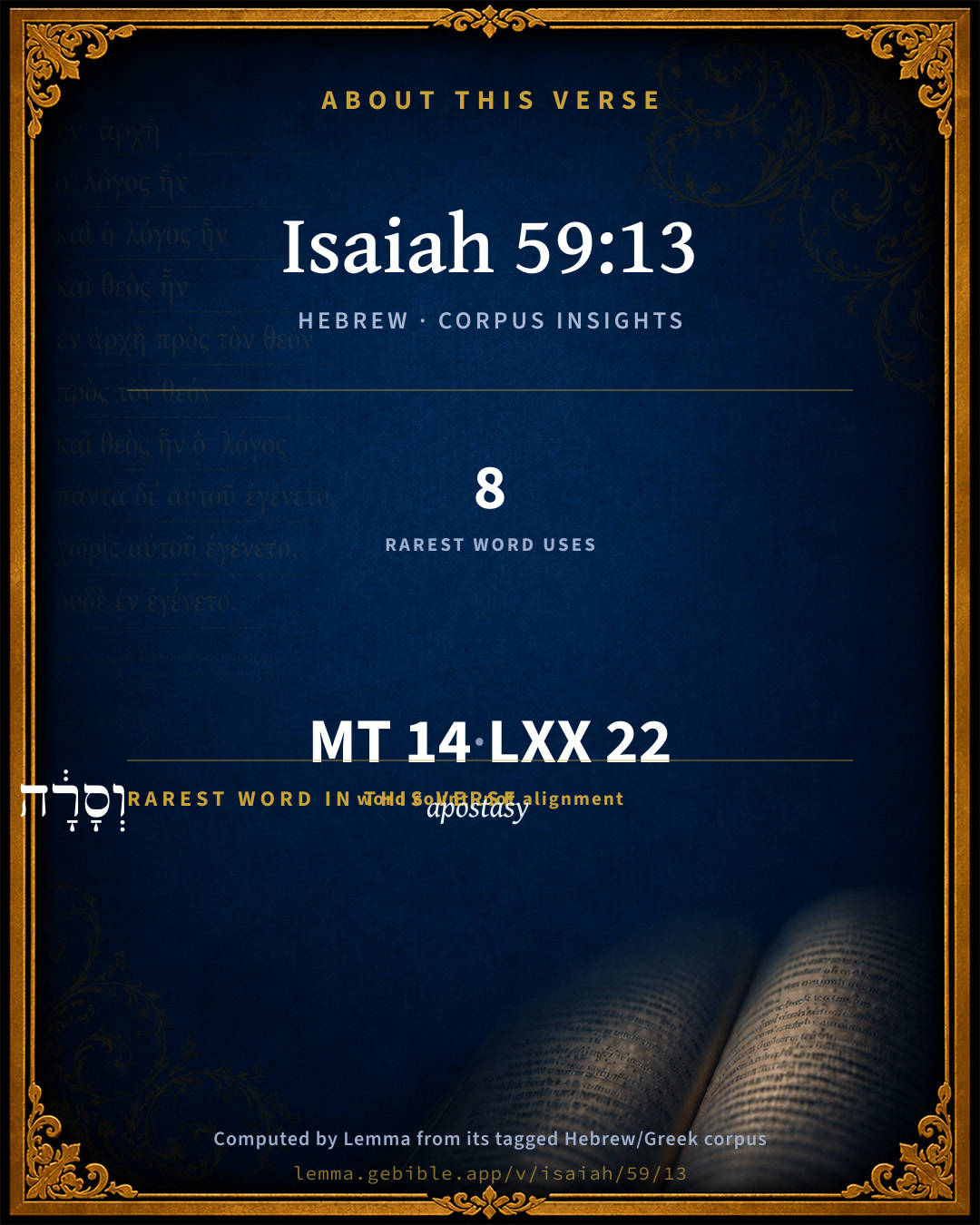
The rarest word here is וְסָרָ֔ה apostasy H5627 — appearing just 8 times in the whole Hebrew Bible.

Shared distinctive vocabulary

וְסָרָ֔ה apostasy H5627 occurs in 8 verses of the Hebrew Bible. Also found in:

Grammatical profile

  • 6 verbs
  • 7 nouns
  • 1 preposition

Verb forms

  • פָּשֹׁ֤עַ Qal · Infinitive Absolute
  • וְכַחֵשׁ֙ Piel · Infinitive Absolute
  • וְנָס֖וֹג Niphal · Infinitive Absolute
  • דַּבֶּר Piel · Infinitive Absolute
  • הֹר֧וֹ Poel · Infinitive Absolute
  • וְהֹג֛וֹ Poel · Infinitive Absolute

Hebrew & Septuagint length

In English translation the verse runs 24 words from the Hebrew and 30 from the Septuagint (LXX English) — closely comparable.

A rough comparison of the two English renderings, which tokenize alike — not a word-level alignment.

Word counts can differ between the Hebrew and the Greek without any difference in meaning — e.g. the Hebrew direct-object marker אֵת has no separate Greek word, and Greek often adds the article ὁ.

In the original languages it is 14 Hebrew tokens and 22 Greek tokens — but the two are counted differently (Hebrew bundles its prefixes and suffixes into one token; the Greek is in lemma form), so that isn’t a like-for-like length.

Cross-references

33

Topical passages linked to Isaiah 59:13 in the Treasury of Scripture Knowledge — connected by theme and wording, ordered by reader-vote popularity; previews shown in the World English Bible.

  • Mark 7:21–22 For from within, out of the hearts of men, proceed evil thoughts, adulteries, sexual sins, murders, thefts,
  • Hebrews 3:12 Beware, brothers, lest perhaps there be in any one of you an evil heart of unbelief, in falling away from the living God;
  • James 3:6 And the tongue is a fire. The world of iniquity among our members is the tongue, which defiles the whole body, and sets on fire the course of nature, and is set on fire by Gehenna.
  • Psalms 18:21 For I have kept the ways of Yahweh, And have not wickedly departed from my God.
  • Psalms 78:36 But they flattered him with their mouth, And lied to him with their tongue.
  • Proverbs 30:9 Lest I be full, deny you, and say, 'Who is Yahweh?' Or lest I be poor, and steal, And so dishonor the name of my God.
  • Isaiah 5:7 For the vineyard of Yahweh of Hosts is the house of Israel, And the men of Judah his pleasant plant: And he looked for justice, but, behold, oppression; For righteousness, but, behold, a cry of distress.
  • Isaiah 31:6 Turn you to him from whom you have deeply revolted, children of Israel.
  • Isaiah 32:6 For the fool will speak folly, and his heart will work iniquity, to practice profanity, and to utter error against Yahweh, to make empty the soul of the hungry, and to cause the drink of the thirsty to fail.
  • Isaiah 48:8 Yes, you didn't hear; yes, you didn't know; yes, from of old your ear was not opened: for I knew that you did deal very treacherously, and was called a transgressor from the womb.
  • Isaiah 57:11 Of whom have you been afraid and in fear, that you lie, and have not remembered me, nor laid it to your heart? Haven't I held my peace even of long time, and you don't fear me?
  • Isaiah 59:3–4 For your hands are defiled with blood, and your fingers with iniquity; your lips have spoken lies, your tongue mutters wickedness.
  • Jeremiah 2:13 For my people have committed two evils: they have forsaken me, the spring of living waters, and hewed them out cisterns, broken cisterns, that can hold no water.
  • Jeremiah 2:19–21 Your own wickedness shall correct you, and your backsliding shall reprove you: know therefore and see that it is an evil thing and a bitter, that you have forsaken Yahweh your God, and that my fear is not in you, says the Lord, Yahweh of Hosts.
  • Jeremiah 3:10 Yet for all this her treacherous sister Judah has not returned to me with her whole heart, but only in pretense, says Yahweh.
  • Jeremiah 3:20 Surely as a wife treacherously departs from her husband, so have you dealt treacherously with me, house of Israel, says Yahweh.
  • Jeremiah 5:23 But this people has a revolting and a rebellious heart; they are revolted and gone.
  • Jeremiah 9:2–5 Oh that I had in the wilderness a lodging-place of wayfaring men; that I might leave my people, and go from them! for they are all adulterers, an assembly of treacherous men.
  • Jeremiah 17:13 Yahweh, the hope of Israel, all who forsake you shall be disappointed. Those who depart from me shall be written in the earth, because they have forsaken Yahweh, the spring of living waters.
  • Jeremiah 32:40 and I will make an everlasting covenant with them, that I will not turn away from following them, to do them good; and I will put my fear in their hearts, that they may not depart from me.
  • Jeremiah 42:20 For you have dealt deceitfully against your own souls; for you sent me to Yahweh your God, saying, Pray for us to Yahweh our God; and according to all that Yahweh our God shall say, so declare to us, and we will do it:
  • Ezekiel 6:9 Those of you that escape shall remember me among the nations where they shall be carried captive, how that I have been broken with their lewd heart, which has departed from me, and with they eyes, which play the prostitute after their idols: and they shall loathe themselves in their own sight for the evils which they have committed in all their abominations.
  • Ezekiel 18:25 Yet you say, The way of the Lord is not equal. Hear now, house of Israel: Is my way not equal? Aren't your ways unequal?
  • Hosea 1:2 When Yahweh spoke at the first by Hosea, Yahweh said to Hosea, "Go, take for yourself a wife of prostitution and children of unfaithfulness; for the land commits great adultery against from Yahweh."
  • Hosea 6:7 But they, like Adam, have broken the covenant. They were unfaithful to me, there.
  • Hosea 7:13 Woe to them! For they have wandered from me. Destruction to them! For they have trespassed against me. Though I would redeem them, Yet they have spoken lies against me.
  • Hosea 11:12 Ephraim surrounds me with falsehood, And the house of Israel with deceit; And Judah still us unruly with God, And is unfaithful to the Holy One.
  • Matthew 10:33 But whoever denies me before men, him I will also deny before my Father who is in heaven.
  • Matthew 12:34–36 You offspring of vipers, how can you, being evil, speak good things? For out of the abundance of the heart, the mouth speaks.
  • Acts 5:3–4 But Peter said, "Ananias, why has Satan filled your heart to lie to the Holy Spirit, and to keep back part of the price of the land?
  • Romans 3:10–18 As it is written, "There is no one righteous. No, not one.
  • Titus 1:16 They profess that they know God, but by their works they deny him, being abominable, disobedient, and unfit for any good work.
  • James 1:15 Then the lust, when it has conceived, bears sin; and the sin, when it is full grown, brings forth death.

Cross-references courtesy of OpenBible.info (CC BY 4.0).

Hebrew and Greek witnesses Masoretic Hebrew ↔ Greek Septuagint

The same verse in the two great witnesses to the Old Testament, shown verse-for-verse.

These are two independent witnesses, not word-aligned to each other, and the Septuagint is shown in lemma (dictionary) form.

Hebrew Isaiah 59:13 Masoretic · Westminster Leningrad Codex

פָּשֹׁ֤עַ וְכַחֵשׁ֙ בַּֽיהוָ֔ה וְנָס֖וֹג מֵאַחַ֣ר אֱלֹהֵ֑ינוּ דַּבֶּר עֹ֣שֶׁק וְסָרָ֔ה הֹר֧וֹ וְהֹג֛וֹ מִלֵּ֖ב דִּבְרֵי שָֽׁקֶר

transgressing and denying Yahweh, and turning away from following our God, speaking oppression and revolt, conceiving and uttering from the heart words of falsehood.

World English Bible · Public Domain

Greek LXX Isaiah 59:13 Septuagint · lemma form

ἀσεβέω καί ψεύδω καί ἀποἵστημι ἀπό ὄπισθεν ὁ θεός ἐγώ λαλέω ἄδικος καί ἀπειθέω κύω καί μελετάω ἀπό καρδία ἐγώ λόγος ἄδικος

We have sinned, and dealt falsely, and revolted from our God: we have spoken unrighteous words, and have been disobedient; we have conceived and uttered from our heart unrighteous words.

LXX2012 (modern English Septuagint) · Public Domain

Hebrew: Westminster Leningrad Codex (CC BY 4.0). Greek: Septuagint (public domain); English from LXX2012 (modern English Septuagint) (Public Domain). How the Septuagint differs from the Hebrew →

Targum (Aramaic paraphrase)

1

The Targum is the ancient Jewish Aramaic paraphrase of the Hebrew Scriptures — an interpretive translation, not the Hebrew text itself. Onkelos (literal) and Pseudo-Jonathan (expansive) render the Torah, and Jonathan the Prophets. Coverage is partial: where no permissively-licensed English translation exists for a verse, only the Aramaic is shown. This is verse-level text, not a word-by-word alignment to the Hebrew.

  1. Targum Jonathan Prophets (Joshua–Malachi)
    מְרֵידְנָא וְכַדִיבְנָא בְּמֵימְרָא דַייָ וְאִסְתְּחַרְנָא לְאַחוֹרָא מִבָּתַר פּוּלְחָנָא דֶאֱלָהָנָא וַהֲוֵינָא מְמַלְלִין שְׁקַר וְסַטְיָא מוֹחַן וּמַפְקִין מִלִבְּהוֹן פִּתְגָמֵי שְׁקָר:

    We have rebelled, and acted falsely against the WORD of the Lord; we have turned backward from following after the worship of our God; we have spoken falsehood and apostasy, hastening and bringing forth from their hearts lying words.

    Targum Jonathan — Aramaic: “Mikraot Gedolot” (public domain). English: “Sefaria Community Translation” (CC0 1.0 (public-domain dedication)); “London "Chaldee Paraphrase," 1871” (public domain). Text via Sefaria.

Commentary

Notes on Isaiah 59:13 from classic Christian and Jewish commentators (each source and its license shown beneath its notes). The classic Christian expositions comment on the surrounding passage and are grouped to its opening verse, so a note may address several verses; the Jewish commentaries on the Tanakh (Rashi and others) are per-verse, so they appear only where the commentator wrote on this verse.

Lemma curates 59 commentaries, every one of them public domain or Creative Commons licensed, each selected and text-cleaned for this edition rather than reprinted as found. About our sources →

Trapp's Complete Commentary

John Trapp

Isa 59:13 In transgressing and lying against the LORD, and departing away from our God, speaking oppression and revolt, conceiving and uttering from the heart words of falsehood.

Ver. 13. In transgressing and lying against the Lord.] Or, Dealing disloyally with him. This is to lay on load, to be full in the mouth, to enter into particulars, and to confess them all with utmost aggravation.

John Trapp, A Commentary or Exposition upon All the Books of the Old and New Testament (1647–1656) — public domain. Text from a community e-Sword module.

Geneva Bible (1599)

Geneva Bible translators

To wit, against our neighbors.

Geneva Bible (1599) marginal notes — public domain. Text via Bolls.life.

Jamieson, Fausset & Brown

Robert Jamieson, A. R. Fausset & David Brown

The particulars of the sins generally confessed in Isa 59:12 (Isa 48:8; Jer 2:19-20). The act, the word, and the thought of apostasy, are all here marked: transgression and departing, &c.; lying (compare Isa 59:4), and speaking, &c.; conceiving and uttering from the heart.

Jamieson, Fausset & Brown — Commentary Critical and Explanatory on the Whole Bible (1871) — public domain (CC PDM 1.0). Text via the HelloAO Bible API.

Ellicott's Commentary for English Readers

(13) In transgressing . . .—The clauses point respectively (1) to false and hypocritical worship; (2) to open apostacy; (3) to sins against man, and these subdivided into (a) sins against truth, and (b) sins against justice.

A Bible Commentary for English Readers, edited by Charles John Ellicott (1878–1897) — public domain. Text from a community e-Sword module.

The Cambridge Bible for Schools and Colleges

gen. ed. J. J. S. Perowne

13. The sins referred to in Isa_59:12 are enumerated in a series of infinitives (cf. Isa_59:4), which should be construed as in apposition to the terms “sin,” “iniquities,” &c. employed in the general confession of Isa_59:12.

Rebellion and denial of Jehovah,

and turning back from after our God, etc.

It is doubtful if there is any reference here to the sin of idolatry; the charge of apostasy is perhaps rather to be understood of offences against social morality, which amounted to a renunciation of the authority of Jehovah.

The last two lines deal with sins of speech, committed against men.

revolt is literally “defection,” and appears to be used in the same general sense as Deu_19:16 of declension from truth and right.

uttering from the heart] The verb here is identical in form with that rendered “mutter” in Isa_59:3 and “mourn” in Isa_59:11. The vocalisation of both the verbs in this clause is anomalous, and should probably be changed (read hârô, hâgô).

The Cambridge Bible for Schools and Colleges (gen. ed. J. J. S. Perowne; Cambridge University Press, 1878–1918) — public domain. Text from a community e-Sword module.

John Gill's Exposition

In transgressing and lying against the Lord,.... The word of the Lord, as the Targum; they transgress the doctrine of Christ, as well as the law of God, and deny him the only Lord God, even our Lord Jesus Christ, his proper deity, his righteousness, and satisfaction, which is notorious in our days; so the Syriac version renders it,

we have denied the Lord; the Lord that bought them: this is the case of many under a profession of Christ:

and departing away from our God: from following him, from walking in his ways, from attending his worship, word, and ordinances; so the Targum,

"from the worship of our God;''

from Immanuel, God with us, God in our nature; from him the living God, as every degree of unbelief is a departing from him; and especially he is departed from when his divine Person is denied; when neglected as the Saviour; his Gospel corrupted; his ordinances perverted, and his worship, or the assembly of the saints, forsaken:

speaking oppression and revolt: such who are in public office, speakers in the church of God; these speak what is oppressive and burdensome to the minds and consciences of those who are truly gracious; make their hearts sad, whom God would not have made sad, by their false doctrines; and which have a tendency to cause men to revolt from the Lord, and turn their backs on him: or "speak calumny and defection" (e), as some render it; calumniate, reproach, and revile the few faithful ones, and draw off many from the truths of the Gospel, and a profession of them. The Targum renders it, "falsehood and apostasy"; false doctrine, which leads to apostasy from Christ; with which the next clause agrees:

conceiving and uttering from the heart words of falsehood; false doctrines; such as agree not with, but are contrary to, the word of God; these are of their own conceiving and contriving; the produce of their own brains; the fruit of their own fancy and imaginations; and which, out of the abundance of their hearts, they utter, even premeditated falsehoods, studied lies, as in Isa 59:3; see Gill on Isa 59:3.

(e) "calumniam et perversitatem", Pagninus; "calumniam et defectionem", Montanus; "calumniam et transgressionem", V. L.

John Gill's Exposition of the Whole Bible (1746–1763) — public domain (CC PDM 1.0). Text via the HelloAO Bible API.

Albert Barnes' Notes on the Bible

In transgressing - That is, we have been guilty of this as a continuous act.

And lying against the Lord - We have proved false to Yahweh. Though we have been professedly his people, yet we have been secretly attached to idols, and have in our hearts been devoted to the service of false gods.

And departing away from our God - By the worship of idols, and by the violation of his law.

Speaking oppression and revolt - Forming plans to see how we might best take advantage of the poor and the defenseless, and to mature our plans of revolt against God.

Conceiving and uttering from the heart - (See the notes at Isa 59:4). The idea is, that they had formed in their hearts schemes of deception, and that in their conversation and their lives they had given utterance to them. All this is the language of genuine contrition, where there is a consciousness of deep guilt in the sight of God. There is an overpowering sense of the evil of sin. and a willingness to make the most full and ample acknowledgment, however mortifying it may be, of the errors and follies of the life.

Albert Barnes' Notes on the Bible (1834–1885) — public domain. Text from a community e-Sword/MySword module.

Matthew Poole's English Annotations

He now enumerates some of those particular sins they profess themselves to be convinced of, whereby he doth not mean the sins of some particular persons, or some slight sins, but a general defection and corruption of the whole body.

In transgressing: properly, we rebel against God, so the word is Isa 1:2, and have persisted in our rebellion.

Lying; being true to none of their engagements, vows, and promises. Some make transgressing here and lying to be one and the same thing, inasmuch as in their transgressing of the law of God they did break their solemn engagement to God upon Mount Sinai, Exo 19:8; 24:3, and elsewhere frequently, which is a downright lying against God; for wherein do we more lie to God than in a perfidious withdrawing from him? So that by transgressing here he doth mean not a breach of One or another of the laws of God, but their being as it were fugitives, that would be under no yoke.

Departing, i.e. turning from God to idols.

Speaking; as it were talking of little else one among another but how to oppress their neighbours, and apostatize from God.

Conceiving and uttering, i.e. first contriving and forging in their heart false accusations to the ruin of their neighbour, and false worship to the dishonour of God, laying the contrivance so that it might be effectual; and then uttering it, or venting themselves one to another in their discourses, thereby encouraging each other in their perverse ways; see Isa 59:3; and whereas it is said

from the heart, it notes a resoluteness in their wickedness, being a great deal worse than now and then to deal falsely upon some occasion or temptation.

From the heart words of falsehood: they are called words of falsehood, both with reference to men, and so signify slanders and false accusations; as also to God, and so signify their dealing falsely with God, as an adulteress doth with her husband: hence idolaters are called the seed of falsehood, Isa 57:3-5; and it is said from the heart, to show that when they dealt with men in ways of fraud, it was from the heart, but when they spake with God, it was but from the lip.

Matthew Poole's English Annotations on the Holy Bible (1683–1685) — public domain. Text from a community e-Sword/MySword module.

The Pulpit Commentary

An enumeration of special sins. First, sins of the heart. Transgressing and lying against the Lord; or rather, treason and unfaithfulness to Jehovah (Cheyne); followed by departing away from God, or the secret act of apostasy. Next, sins of the tongue: Speaking oppression and revolt; or, oppression and wrong the "wrong," probably, of false accusation; (comp. Deu_19:16) and, lastly, conceiving and uttering words of falsehood generally.

The Pulpit Commentary (1880–1919), ed. H.D.M. Spence-Jones & Joseph S. Exell — public domain. Text from a community e-Sword module.

John Wesley's Explanatory Notes

Lying - Transgressing here, and lying, seem to be one and the same thing, inasmuch as in their transgressing the law of God, they broke their solemn engagement to God upon Mount Sinai. Departing - Turning from God to idols. Speaking - As it were, talking of little else one among another, but how to oppress their neighbours, and apostatize from God. Uttering - That is, first contriving in their heart false accusations, false worship to the dishonour of God; laying the contrivances and uttering them. From the heart - And when they dealt with men in ways of fraud, it was from the heart, but when they spake with God it was but from the lip.

John Wesley, Explanatory Notes Upon the Whole Bible (1754–1765) — public domain. Text via the GEBible commentary corpus.

J. A. Alexander on Isaiah

Joseph Addison Alexander

“To transgress and lie against Jehovah, and to turn back from behind our God, to speak oppression and departure, to conceive and utter from the heart words of falsehood.” The specifications of the general charge are now expressed by an unusual succession of infinitives, because the writer wished to concentrate and condense his accusation. This rhetorical effect is materially injured by the substitution of the finite verb. Although by no means equal in conciseness to the Hebrew, our infinitive may be employed as the most exact translation. ‘Departure’ means departure from the right course or the law, (i.e., transgression or iniquity).

Joseph Addison Alexander, The Prophecies of Isaiah (1846–1847; New York: Scribner, 1870–1878) — public domain. Text from a community e-Sword module.

Rashi

Rabbi Shlomo Yitzchaki (Rashi)

speaking oppression Like: to speak oppression.

sprouting and giving forth Heb. הֹרוֹ וְהֹגוֹ to shoot and to give forth. הֹרוֹ is an expression of (Ex. 15:4) “He shot (יָרָה) into the sea.” (Another explanation: הֹרוֹ means: the teacher and the disciple, a gerund.) הֹגוֹ is an expression of (II Sam. 20:13) “When he was removed (הֹגָה) from the highway”; (Prov. 25:4) “Take away (הָגוֹ) the dross from the silver.”

Rashi on the Tanakh — English translations: “The Judaica Press complete Tanach with Rashi, translated by A. J. Rosenberg” (CC BY 4.0); “Pentateuch with Rashi's commentary by M. Rosenbaum and A.M. Silbermann, 1929-1934” (public domain); “The Metsudah Tanach series, Lakewood, N.J” (CC BY 4.0); and “The Book of Joshua, Metsudah Publications, 1997” (CC BY 4.0). Text via Sefaria.

Ibn Ezra

Rabbi Abraham ibn Ezra

פׇּשֹׁעַ וְכַחֵשׁ In transgressing and lying. These are infinitives; the meaning of פשע is to renounce obedience.

נסג Departing. It is infinitive Niphal, similar in form to ונשלח and being sent (Est. 3:13).

סרה Revolt. Comp. סורר rebellious (Deut. 21:18).

הורו Conceiving it, that is, forming it; comp. הורי my progenitors (Gen. 49:26); ותהר and she conceived (1 Chr. 4:17). Its form is the same as that of the succeeding והגו and uttering it; the possessive pronoun (וֹ) refers to שקר falsehood. Some say that הֹרוֹ and הֹגוֹ are irregular forms of the infinitive; the regular infinitive would be הׇגֹה,הׇרֹה, comp. בׇּנֹה to build (1 Kings 8:13.)

מלב From the heart. They bring forth words of falsehood out of their hearts.

Ibn Ezra on the Tanakh — English translations: “Sefaria Community Translation” (CC0 1.0 (public-domain dedication)); “Yalkut, Sifsei Chachomim Chumash, Metsudah Publications, 2009” (CC BY 4.0); and “Commentary of Ibn Ezra on Isaiah - trans. by M. Friedlander, 1873” (public domain). Text via Sefaria.

Lesson kit

Teaching starters — assembled from the data on this page, not authored interpretation. Every prompt links to the verse data it draws on. Edit before teaching.

Isaiah, in the Prophets, opens this verse with 14 words (14 distinct Hebrew lemmas). Its most distinctive word is çârâh (“apostasy”). A historical commentator’s framing appears above. Read the whole chapter for the surrounding context.

Discussion questions

  1. How does “apostasy” (çârâh) shape what this verse is saying?
  2. How does Deuteronomy 13:5, which shares the word «apostasy», read alongside this verse?
  3. These translations render this verse differently; the difference is in the English rendering, not the original. What questions does that raise?
  4. «פָּשֹׁ֤עַ» is a Qal Infinitive Absolute verb. How does that grammatical form shape the action described?
  5. Compare how Trapp's Complete Commentary and Geneva Bible (1599) read this verse. Where do they agree or differ?

Things to notice

Reading settings

Reading text

Shown beneath each verse's original-language words.

Old Testament
Old Testament edition

Read the OT as the Masoretic Hebrew (MT) or the Greek Septuagint (LXX).

English shown for the Greek Septuagint (in the Hebrew ↔ Greek comparison).

Comparing translations? Open the Compare panel on any verse page to stack up to four side by side.