
Proverbs 10:18

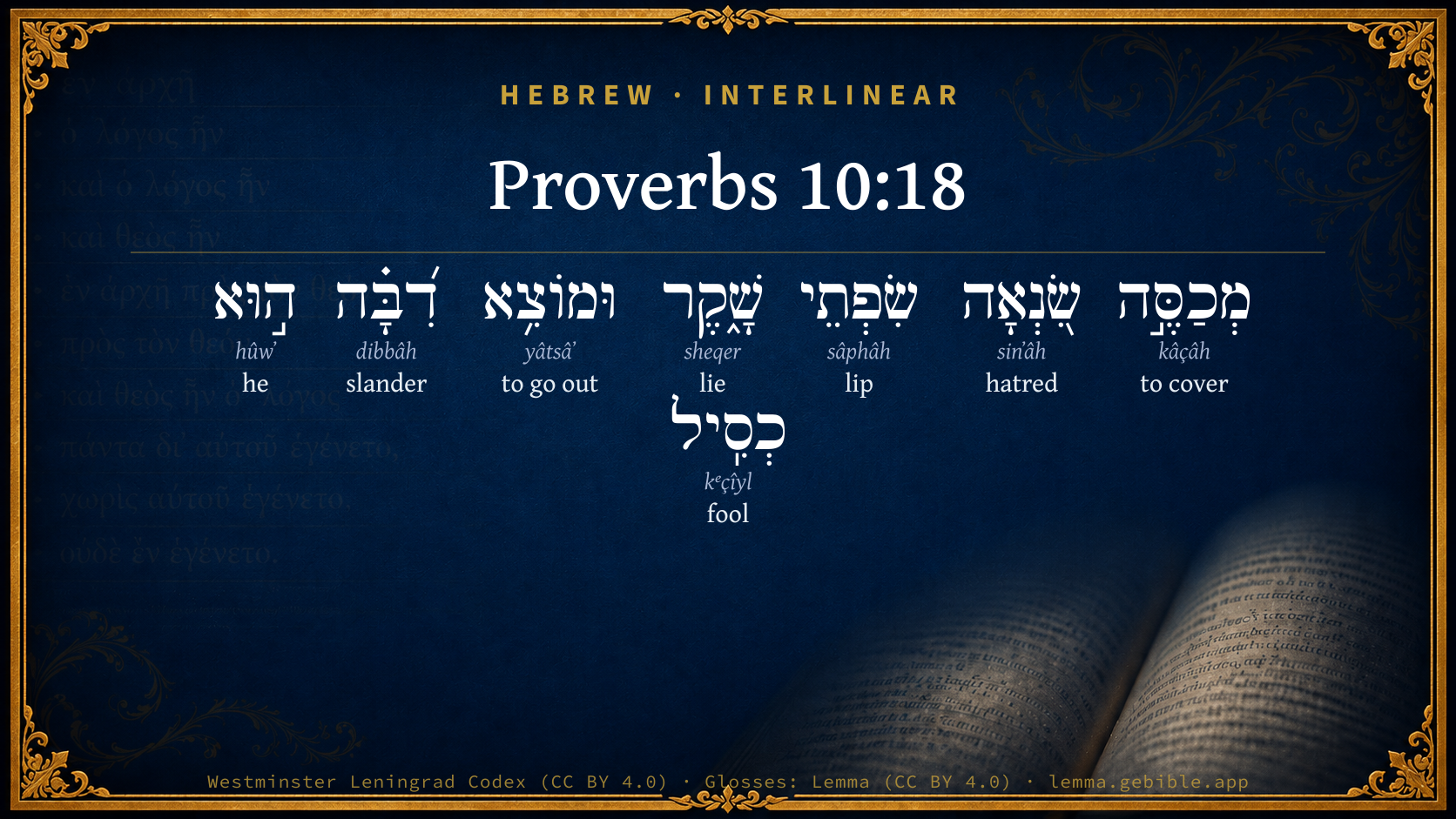
Hebrew (Westminster Leningrad Codex) Proverbs 10:18 appears in the Hebrew Old Testament. The text above is from the Westminster Leningrad Codex. Each word links to its Strong’s number, a concise gloss, and parsing drawn from the Open Scriptures Hebrew Bible morphology. Click any word for its full Brown-Driver-Briggs (BDB) entry.
Download image
Cite this verse

Proverbs 10:18 (World English Bible). Public Domain. Lemma interlinear Bible study tool, https://lemma.gebible.app/v/proverbs/10/18.

Show BibTeX & RIS
BibTeX
RIS
English Translation
He who hides hatred has lying lips. He who utters a slander is a fool.
World English Bible · Public Domain
Download a study sheet

One document with this verse’s original text, its word-by-word gloss line, the meaning frame, cross-references with their text, attributed commentary, and full source and license credits — printable, and it pastes into notes with its structure intact.

This verse Autodidact and up

Study sheet (.html) Plain text (.txt)

A passage Seminary Student

Up to 50 verses in one chapter. A passage sheet keeps up to 6 commentary sources and 12 cross-references per verse, in the order this page ranks them, and says so on the sheet whenever that leaves anything out. Ask for a single verse and you get the Autodidact verse sheet above.

Everything on this page stays free to read, with no account — the sheet is a download of what is already on screen, not access to it.

Want to remove ads? Support Godless Engineer
Compare translations 3

The same verse in 3 English versions, stacked beneath the original-language interlinear above. Click any original word for its lexicon entry.

Each is an independent rendering of the whole verse — the interlinear is not word-aligned to these translations.

Highlighted words mark where these versions differ — a whole-verse word diff, not a word-by-word alignment.

  • World English Bible Public Domain
    He who hides hatred has lying lips. He who utters a slander is a fool.
  • King James Version Public Domain
    He that hideth hatred with lying lips, and he that uttereth a slander, is a fool.
  • unfoldingWord Literal Text CC BY-SA 4.0
    One who covers hate lips of falsehood, and one who causes an evil report to go forth, he a stupid one.

unfoldingWord Literal Text — © unfoldingWord, licensed CC BY-SA 4.0. Word-aligned USFM3 via Door43 (git.door43.org/unfoldingWord/en_ult).

Versions to compare (up to 4)

3 of 4 selected

Show all 18 translations

Every available English version of this verse, each an independent rendering of the whole verse.

  • World English Bible Public Domain
    He who hides hatred has lying lips. He who utters a slander is a fool.
  • Berean Standard Bible Public Domain
    The one who conceals hatred has lying lips, and whoever spreads slander is a fool.
  • Majority Standard Bible Public Domain
    The one who conceals hatred has lying lips, and whoever spreads slander is a fool.
  • King James Version Public Domain
    He that hideth hatred with lying lips, and he that uttereth a slander, is a fool.
  • American Standard Version (1901) Public Domain
    He that hideth hatred is of lying lips; And he that uttereth a slander is a fool.
  • Revised Version (1885) Public Domain
    He that hideth hatred is of lying lips; and he that uttereth a slander is a fool.
  • Geneva Bible (1599) Public Domain
    He that dissembleth hatred with lying lips, and he that inuenteth slaunder, is a foole.
  • Douay-Rheims (1899) Public Domain
    Lying lips hide hatred: he that uttereth reproach is foolish.
  • Young's Literal Translation Public Domain
    Whoso is covering hatred with lying lips, And whoso is bringing out an evil report is a fool.
  • Literal Standard Version CC BY-SA 4.0
    Whoever is covering hatred with lying lips, || And whoever is bringing out an evil report is a fool.
  • Unlocked Literal Bible CC BY-SA 4.0
    Whoever conceals hatred has lying lips, and whoever spreads slander is a fool.
  • unfoldingWord Literal Text CC BY-SA 4.0
    One who covers hate lips of falsehood, and one who causes an evil report to go forth, he a stupid one.
  • Darby Bible Public Domain
    He that covereth hatred hath lying lips, and he that sendeth forth a slander is a fool.
  • World Messianic Bible Public Domain
    He who hides hatred has lying lips. He who utters a slander is a fool.
  • Webster's Bible Public Domain
    He that hideth hatred with lying lips, and he that uttereth a slander, is a fool.
  • Free Bible Version CC BY-SA 4.0
    Anyone who hides their hatred is lying, and anyone who spreads slander is stupid.
  • Bible in Basic English Public Domain
    Hate is covered up by the lips of the upright man, but he who lets out evil about another is foolish.
  • JPS Tanakh (1917) Public Domain
    He that hideth hatred is of lying lips; and he that uttereth a slander is a fool.

Literal Standard Version (2020), Covenant Press — licensed CC BY-SA 4.0. Text via the HelloAO Bible API (eBible.org). Unlocked Literal Bible (unfoldingWord) — licensed CC BY-SA 4.0. Text via the HelloAO Bible API (eBible.org). unfoldingWord Literal Text — © unfoldingWord, licensed CC BY-SA 4.0. Word-aligned USFM3 via Door43 (git.door43.org/unfoldingWord/en_ult). Free Bible Version, Dr. Jonathan Gallagher — licensed CC BY-SA 4.0. Text via the HelloAO Bible API (eBible.org).

Word by word

More ways to search: Search by grammar → Find every occurrence → Compare this word →

Practice this passage: Drill this verse → Learn its vocabulary →

About this verse

These counts appear in no published source. They are computed here, from the morphology-tagged text and Lemma’s own curated glosses. What Lemma adds →

8
words
8
distinct lemmas
Wisdom
section

Notable vocabulary

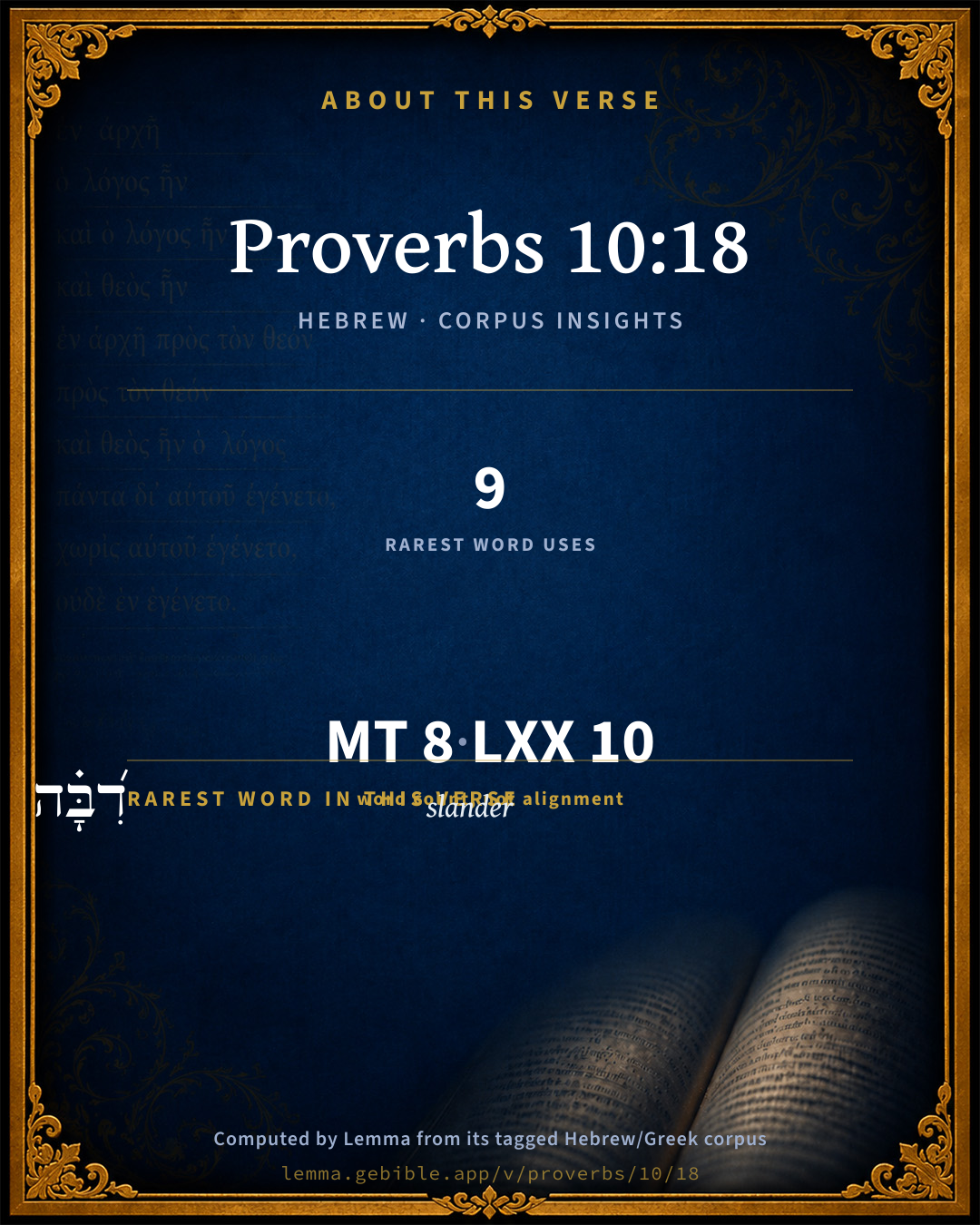
The rarest word here is דִ֝בָּ֗ה slander H1681 — appearing just 9 times in the whole Hebrew Bible.

Shared distinctive vocabulary

דִ֝בָּ֗ה slander H1681 occurs in 9 verses of the Hebrew Bible. Also found in:

Grammatical profile

  • 2 verbs
  • 4 nouns
  • 1 adjective
  • 1 pronoun

Verb forms

  • מְכַסֶּ֣ה Piel · Participle Active
  • וּמוֹצִ֥א Hiphil · Participle Active

Hebrew & Septuagint length

In English translation the verse runs 15 words from the Hebrew and 12 from the Septuagint (LXX English) — closely comparable.

A rough comparison of the two English renderings, which tokenize alike — not a word-level alignment.

Word counts can differ between the Hebrew and the Greek without any difference in meaning — e.g. the Hebrew direct-object marker אֵת has no separate Greek word, and Greek often adds the article ὁ.

In the original languages it is 8 Hebrew tokens and 10 Greek tokens — but the two are counted differently (Hebrew bundles its prefixes and suffixes into one token; the Greek is in lemma form), so that isn’t a like-for-like length.

Cross-references

14

Topical passages linked to Proverbs 10:18 in the Treasury of Scripture Knowledge — connected by theme and wording, ordered by reader-vote popularity; previews shown in the World English Bible.

  • Proverbs 26:24–26 A malicious man disguises himself with his lips, But he harbors evil in his heart.
  • Psalms 55:21 His mouth was smooth as butter, But his heart was war. His words were softer than oil, Yet they were drawn swords.
  • 2 Samuel 3:27 When Abner was returned to Hebron, Joab took him aside into the midst of the gate to speak with him quietly, and struck him there in the body, so that he died, for the blood of Asahel his brother.
  • 2 Samuel 13:23–29 It happened after two full years, that Absalom had sheep-shearers in Baal Hazor, which is beside Ephraim: and Absalom invited all the king's sons.
  • Psalms 15:3 He who doesn't slander with his tongue, Nor does evil to his friend, Nor casts slurs against his fellow man;
  • 1 Samuel 18:21–22 Saul said, I will give her to him, that she may be a snare to him, and that the hand of the Philistines may be against him. Therefore Saul said to David, You shall this day be my son-in-law a second time.
  • 1 Samuel 18:29 Saul was yet the more afraid of David; and Saul was David's enemy continually.
  • 2 Samuel 11:8–15 David said to Uriah, Go down to your house, and wash your feet. Uriah departed out of the king's house, and there followed him a mess [of food] from the king.
  • 2 Samuel 20:9–10 Joab said to Amasa, Is it well with you, my brother? Joab took Amasa by the beard with his right hand to kiss him.
  • Psalms 5:9 For there is no faithfulness in their mouth. Their heart is destruction. Their throat is an open tomb. They flatter with their tongue.
  • Psalms 12:2 Everyone lies to his neighbor. They speak with flattering lips, and with a double heart.
  • Psalms 50:20 You sit and speak against your brother. You slander your own mother's son.
  • Psalms 101:5 I will silence whoever secretly slanders his neighbor. I won't tolerate one who is haughty and conceited.
  • Luke 20:20–21 They watched him, and sent out spies, who pretended to be righteous, that they might trap him in something he said, so as to deliver him up to the power and authority of the governor.

Cross-references courtesy of OpenBible.info (CC BY 4.0).

Hebrew and Greek witnesses Masoretic Hebrew ↔ Greek Septuagint

The same verse in the two great witnesses to the Old Testament, shown verse-for-verse.

These are two independent witnesses, not word-aligned to each other, and the Septuagint is shown in lemma (dictionary) form.

Hebrew Proverbs 10:18 Masoretic · Westminster Leningrad Codex

מְכַסֶּ֣ה שִׂ֭נְאָה שִׂפְתֵי שָׁ֑קֶר וּמוֹצִ֥א דִ֝בָּ֗ה ה֣וּא כְסִֽיל

He who hides hatred has lying lips. He who utters a slander is a fool.

World English Bible · Public Domain

Greek LXX Proverbs 10:18 Septuagint · lemma form

καλύπτω ἐχθρός χεῖλος δίκαιος ὁ δέ ἐκφέρω λοιδορία ἄφρων εἰμί

Righteous lips cover enmity; but they that utter railings are most foolish.

LXX2012 (modern English Septuagint) · Public Domain

On this verse, Haydock's Catholic Bible Commentary discusses the Septuagint’s reading. Read the note in Commentary ↓

Hebrew: Westminster Leningrad Codex (CC BY 4.0). Greek: Septuagint (public domain); English from LXX2012 (modern English Septuagint) (Public Domain). How the Septuagint differs from the Hebrew →

Commentary

Notes on Proverbs 10:18 from classic Christian and Jewish commentators (each source and its license shown beneath its notes). The classic Christian expositions comment on the surrounding passage and are grouped to its opening verse, so a note may address several verses; the Jewish commentaries on the Tanakh (Rashi and others) are per-verse, so they appear only where the commentator wrote on this verse.

Lemma curates 59 commentaries, every one of them public domain or Creative Commons licensed, each selected and text-cleaned for this edition rather than reprinted as found. About our sources →

Trapp's Complete Commentary

John Trapp

Pro 10:18 He that hideth hatred [with] lying lips, and he that uttereth a slander, [is] a fool.

Ver. 18. He that hideth hatred, &c.] These are dangerous creatures that thus lie at the catch, and wait advantages to do a man mischief, as Cain dealt by Abel, Absalom by Amnon, Joab by Amasa, Judas by Jesus. Tuta frequensque via est, &c.

And he that uttereth a slander is a fool.] Because he hath no command of his passions, as the former seems to have, because close in cloaking his malice, who yet is a fool too before God.

John Trapp, A Commentary or Exposition upon All the Books of the Old and New Testament (1647–1656) — public domain. Text from a community e-Sword module.

The Biblical Illustrator

Joseph S. Exell

Pro_10:18

He that uttereth a slander is a fool.

The folly of slander

I. Slandering is foolish, as sinful and wicked. All sin is foolish upon many accounts. To lie simply is a great fault, being a deviation from that good rule which prescribeth truth in all our words. Of all lies those certainly are the worst which proceed from malice, or from vanity, or from both, and which work mischief; such slanders are. To bear any hatred or ill-will towards any man is a heinous fault. Of this the slanderer is most guilty in the highest degree. Incurable are the wounds which the slanderer inflicteth, irreparable the damages which he causeth, indelible the marks which he leaveth. All injustice is abominable; and of this the slanderer is most deeply guilty. The slanderer may indeed conceive it no great matter that he committeth; because he doth not act in a boisterous and bloody way, but only by words, which are subtle, slim, and transient things. Tis only an imaginary stain that he daubeth his neighbour with; therefore he supposeth no great wrong done. But these conceits arise from great inconsiderateness or mistake.

II. The slanderer is a fool, because he maketh wrong judgments and valuations of things. And accordingly driveth on silly bargains for himself, in result whereof he proveth a great loser. The slanderer may pretend that what he does is for the sake of orthodox doctrines, or for advantage of the true Church. This indeed is the covert of innumerable slanders; zeal for some opinion, or some party, beareth out men of sectarian and factious spirits in such practices; they may do, they may say, anything for those fine ends. This plea will in no wise justify such practices. Truth does not need, and it loathes and scorns the patronage and the succour of lies. To prostitute the conscience, or sacrifice our honesty, for any cause, in any interest whatever, can never be warrantable or wise.

III. The slanderer is a fool, because he useth improper means and preposterous methods of effecting his purposes. The straight way is always shorter than the oblique and crooked. The plain way is easier than the rough and cragged. Using strict veracity and integrity, candour and equity, is the best method of accomplishing good designs.

IV. The slanderer is a very fool, as bringing many great inconveniences, troubles, and mischiefs on himself.

1. A fools mouth is his destruction. If any kind of speech is destructive and dangerous, then is this slander kind most dangerous of all. Men will rather pardon a robber of their goods, than a defamer of their good Dame.

2. The slanderer is apprehended as a common enemy; all men are rendered averse from him, and ready to cross him.

3. All ingenious and honest persons have an aversion from the practice of the slanderer, and cannot entertain it with any acceptance or complacence. It is only ill-natured and ill-nurtured, unworthy and naughty people, that are willing auditors or encouragers thereof.

4. The slanderer doth banish himself from all conversation and company.

5. He derogateth wholly from his own credit in all matters of discourse.

6. This practice is perpetually haunted with most troublesome companions, inward regret, self-condemnation, fear and disquiet.

7. The consequence of this practice is commonly shameful disgrace, with an obligation to retract, and render satisfaction; for seldom doth calumny pass long without being detected and confuted.

8. He can never have sound quiet in his mind, he can never expect pardon from heaven, without acknowledging his fault, repairing the wrong he hath done, restoring that good name of which he dispossessed his neighbour.

9. This practice doth also certainly revenge itself, imposing on its actor a perfect retaliation, an irrecoverable infamy to himself, for the infamy he caused to others.

10. The slanderer doth banish himself from heaven and happiness, doth expose himself to endless miseries and sorrows. Is not he, then, who, out of malignity or vanity, to serve any design, or soothe any humour in himself or others, involves himself in all these great evils, a most desperate and deplorable fool? Persons of a generous and honest mind cannot but scorn to debase and defile themselves by so mean and vile a practice; and so do those who seriously profess Christianity; that is, the religion which peculiarly above all others prescribeth the constant truth, strictest justice, and highest charity. (I. Barrow, D.D.)

The tongue

Sent by his master to purchase the best dish the market could supply, AEsop provided only tongues, which were served up with different sauces for every course; ordered afterwards to provide the worst things he could find, he again appeared with a supply of tongues. The moral is obvious.

I. The language of deceit (Pro_10:18). Lying is a sin committed by--

1. The false witness (Pro_14:5).

2. The dishonest tradesman (Pro_20:14).

II. The language of slander (Pro_10:18). The safe rule as to the government of the tongue in society, says Dean Goulburn, is to stand at a very respectful distance from all such topics as our neighbours conduct and character.

III. The language of profusion (verse 19). It is better to say nothing than that what we say should be nothing to the purpose. Profuse talkers often transgress the law of--

1. Reverence (Ecc_5:2).

2. Courtesy. Conversation is not merely talking to people, but talking with people (Rom_15:2).

3. Integrity. When speech runs in advance of thought, it is apt to run in advance of truth (Col_4:6; Tit_2:8).

4. Prudence (Joh_16:12). The restraint of the tongue is a Christian duty (Mat_27:14; Jam_1:26).

IV. The language of instruction (Pro_10:20-21). Two figures are used. Choice silver represents worth, Good words are a choice heritage. They are valuable because they create good thoughts and often lead to good acts (Psa_34:11). The 21st verse gives us the thought of food (feed many). The words of the true man of God are food for the soul. The lips of the righteous utter the words of wisdom (Pro_10:30), for there is a vital connection between what a man is and what he says and does (Act_4:20; Corinthians 4:13). (H. Thorne.)

The Biblical Illustrator, edited by Joseph S. Exell (c. 1880s–1900s) — public domain. Text from a community e-Sword module.

Joseph Benson's Commentary

Pro 10:18. He that hideth hatred with lying lips — With flattering words, and false pretences of friendship; and he that uttereth slander — That is, both of them, one no less than the other; is a fool — Because a sinner; and because the mischief of these things will fall upon himself. So he condemns two opposite vices, secret hatred and manifest slander.

Joseph Benson's Commentary on the Old and New Testaments (1811–1818) — public domain. Text from a community e-Sword module.

The Preacher's Complete Homiletical Commentary

Joseph S. Exell (gen. ed.)

CRITICAL NOTES.—

Pro_10:18. Not with lying lips, but “is of lying lips.” “The meaning of this second clause does not stand in the relation of an antithesis to the preceding, but in that of a climax, adding a worse case to one not so bad. If one conceals his hatred within himself, he becomes a malignant flatterer; but if he gives expression to it in slander, abuse, and base detraction, then, as a genuine fool, he brings upon himself the greatest injury” (Zöckler).

MAIN HOMILETICS OF Pro_10:18

THREE DEGREES OF MORAL FOOLISHNESS

I. A liar.

1. A liar is a fool because he fights for a weak cause. When a case can only be made out by lying it is manifestly a bad one. A man who will strive to uphold such a cause reveals his folly.

2. Because he makes use of a weak weapon. Among tribes ignorant of the methods of civilised warfare we find weapons which are little better than slim rods, and, although their points are sharp and poisoned, yet they proclaim their weakness when they come into collision with an experienced swordsman. Lying is such a weapon, and its use reveals the utter folly of him who wields it. It can no more stand against truth than the wooden spear of a savage can turn aside the thrust of a Damascus blade.

3. Because by lying he degrades his moral character. The serpent lost his upright position by being linked with lying, instead of going erect, God passed upon him the sentence—“Upon thy belly shalt thou go, and dust shalt thou eat all the days of thy life” (Gen_3:14). The liar finds that this is his doom. He can no longer hold up his head like an honest man among his fellow-men, he must henceforth crawl and wind his way through the world, and eat the dust of ignominy and scorn. Men turn from a liar as they do from a serpent. It is assuredly the height of folly for a man thus to throw away that which alone makes him worthy to be called a man.

II. A liar who conceals hatred by lying. This man displays a higher degree of iniquity and folly. There are those who lie simply to serve their own purposes and have no dislike to the person whom they deceive. There is often much lying where there is no special malice. But when lying is used to conceal hatred—which is murder

(1. Joh_3:15)—there is a double folly because there is a double sin. The lying of the “father of lies” is simply a blind to conceal his intense hatred of the human race, and this makes him the greater sinner.

III. A liar who utters slander. When malice finds vent in lying slander we have an exhibition of greater iniquity and therefore of greater folly. It is bad to be a liar, it is worse to conceal hatred by lying, but it is worse to let the hatred of the heart break forth into false accusations of the innocent. The tree that is most richly laden with the ripest fruit is the one upon which the birds will congregate. We never find them passing by such booty to peck at green fruit. The pirates lay in wait for vessels with a rich cargo, empty vessels pass by unmolested and secure from attack. So it is always the best men who attract slanderers, men of little or no moral worth are not considered foemen worthy of their steel. God declared Job to be the best man in all the earth, “perfect and upright, one who feared Him, and eschewed evil” (Job_1:8). And it was because he stood thus pre-eminent that the tongue of the great slanderer was used against him; being from the begining a liar and a murderer of character he gave one of the most complete exhibitions of his real nature when he pointed his lying hatred agains the best man of his day. The Holy One of God did not escape the tongue of the slanderer. He was a “man gluttonous, and a wine-bibber” (Mat_11:19), “one that perverteth the people” (Luk_23:14). When “He bore our griefs and carried our sorrows” He was esteemed “smitten of God and afflicted” (Isa_53:4). All lying and malice, whether concealed or manifested, becomes the most palpable folly when looked at in the light of the “coming of the Lord, who both will bring to light the hidden things of darkness and make manifest the counsels of the hearts” (1Co_4:5).

OUTLINES AND SUGGESTIVE COMMENTS

If we desire the credit of wisdom let us use better means to obtain it than artificial disgracings of our brethren, for that cometh not from above; it is no gift of God; it is sensual, carnal, and devilish. Do not hearken to the reports of such wicked persons as seek to defame others and detract from their good name; they are but foolish and base pedlars that utter such infectious wares, and therefore they cannot be wise chapmen that traffic with them and receive them at their hands. Here is consolation for them that are molested and vexed unjustly for the Gospel’s sake by clamourous and false accusers; let them consider what account God maketh of their malicious adversaries; He calls them fools and derideth their practices, and, therefore, in the end it shall be seen that when they have spat all their venom they have but shot a fool’s bolt and procured shame and sorrow to themselves.—Dod.

The folly of slander.

1. If this practice be proved extremly sinful it will thence be demonstrated no less foolish. And it is indeed plainly the blackest and most hellish sin that can be; that which giveth the grand fiend his name, and most expresseth his nature. He is the slanderer, Satan, the spiteful adversary, the old serpent or dragon spitting forth the venom of calumnious accusation, the accuser of the brethren, the father of lies, the grand defamer of God to man, of man to God, of one man to another. And highly wicked that practice must be whereby we grow namesakes to him.

2. The slanderer is plainly a fool because he makes wrong judgments and valuations of things, and accordingly driveth on silly bargains for himself, in result whereof he proveth a great loser. He means by his calumnious stories either to vent some passion boiling within him, or to compass some design which he affecteth, or to please some humour that he is possessed with; but is any of these things worth purchasing at so dear a rate? Can there be any valuable exchange for our honesty? Can anything in the world be so considerable that for its sake we should defile our souls?

3. Because he uses improper means and preposterous methods of effecting his purposes. As there is no design worth the carrying on by ways of falsehood and iniquity, so there is scarce any (no good and lawful one at least) which may not more surely, more safely, more cleverly be achieved by means of truth and justice … He that is observed to practise falsehood will be declined by some, opposed by others, disliked by all.

4. The slanderer is a fool, as bringing many great inconveniences and troubles upon himself.

(1.) By no means can a man inflame so fierce anger, impress so stiff hatred, raise so deadly enmity against himself, and consequently so endanger his safety, ease, and welfare as by this practice. Men will rather pardon a robber of their goods than of their good name.

(2.) And he is not only odious to the person immediately concerned, but generally to all men who observe his practice; every man presently will be sensible how easily it may be his own case to be thus abused.

(3.) He also derogateth wholly from his own credit, for he that dareth thus to injure his neighbour, who can trust him in anything that he speaks?

(4.) This practice is perpetually haunted with most troublesome companions, inward regret, and self-condemnation.

(5.) The consequence of this practice is commonly shameful disgrace, with an obligation to retract and to render satisfaction; for seldom doth calumny pass long without being detected and confuted.

(6.) The slanderer doth banish himself from heaven and happiness. For, if none that “maketh a lie” (Rev_22:15) shall enter the heavenly city, assuredly the capital liar, the slanderer, shall be far excluded from felicity. All these things being considered, we may, I think, reasonably conclude it most evidently true that “he who uttereth slander is a fool.”—Barrow.

Better. He who hideth hatred is of lying lips. The alternative is offered with a delicate touch of irony. He who cherishes hatred must choose between being a knave or a fool—a knave if he hides, a fool if he utters it.—Plumptre.

The Preacher's Complete Homiletical Commentary (gen. ed. Joseph S. Exell; Funk & Wagnalls, c. 1892) — public domain (pre-1929). A full-Bible homiletical/sermon-outline anthology covering 65 of 66 books (2 John is absent from the source module). Text from a community e-Sword module.

Matthew Henry's Commentary

Observe here, Malice is folly and wickedness. 1. It is so when it is concealed by flattery and dissimulation: He is a fool, though he may think himself a politician, that hides hatred with lying lips, lest, if it break out, he should be ashamed before men and should lose the opportunity of gratifying his malice. Lying lips are bad enough of themselves, but have a peculiar malignity in them when they are made a cloak of maliciousness. But he is a fool who thinks to hide any thing from God. 2. It is no better when it is vented in spiteful and mischievous language: He that utters slander is a fool too, for God will sooner or later bring forth that righteousness as the light which he endeavours to cloud, and will find an expedient to roll the reproach away.

Matthew Henry's Commentary on the Whole Bible (1708–1710) — public domain (CC PDM 1.0). Text via the HelloAO Bible API.

Jamieson, Fausset & Brown

Robert Jamieson, A. R. Fausset & David Brown

Both vices must one day be known and punished, and hence their folly.

Jamieson, Fausset & Brown — Commentary Critical and Explanatory on the Whole Bible (1871) — public domain (CC PDM 1.0). Text via the HelloAO Bible API.

Adam Clarke's Commentary

Verse 18. He that hideth] This is a common case. How many, when full of resentment, and deadly hatred, meditating revenge and cruelty, and sometimes even murder, have pretended that they thought nothing of the injury they had sustained; had passed by the insult, &c.! Thus lying lips covered the malevolence of a wicked heart.

Adam Clarke's Commentary on the Bible (1810–1826) — public domain. Text from a community e-Sword/MySword module.

Ellicott's Commentary for English Readers

(18) He that hideth hatred . . .—This would be more correctly translated, “He that hideth hatred is a mouth of falsehood: he that spreadeth slander is a fool” (khesîl: Pro_1:22). (For the construction, “he . . . is a mouth of falsehood,” comp. note on Pro_8:30; and for the sentiment, David’s complaint, Psa_41:6).

Is a fool.—For he does mischief to his neighbour, and only gets ill-will for himself.

A Bible Commentary for English Readers, edited by Charles John Ellicott (1878–1897) — public domain. Text from a community e-Sword module.

The Cambridge Bible for Schools and Colleges

gen. ed. J. J. S. Perowne

18. with lying lips] Rather, is of lying lips, R.V.

The Cambridge Bible for Schools and Colleges (gen. ed. J. J. S. Perowne; Cambridge University Press, 1878–1918) — public domain. Text from a community e-Sword module.

John Gill's Exposition

He that hideth hatred with lying lips,.... Or he whose "lying lips hide hatred", which is much the same; who pretends to be a friend, and outwardly behaves as one, but inwardly nourishes and cherishes hatred in his heart, which he covers and conceals, till he has a proper opportunity of showing it; as Absalom to Ammon, Joab to Amasa, the men of Anathoth to Jeremiah, and Judas to Christ; see Pro 26:24. Or, "he that hideth hatred is a man of lying lips" (m); he is a liar, as the person next described is a fool. And he that uttereth slander is a fool; that brings it out by wholesale, and hides it not; who openly defames his neighbour, and in the most public manner; and with a multitude of words detracts from his good name, credit, and reputation, and loads him with calumny and reproach; such a man is a fool, a very wicked man: yea, not only the public slanderer, but the secret dissembler, who thinks himself a cunning man because he hides himself; each of these is a fool, the one as well as the other. Gersom thinks there is a comparison made between the dissembler and the slanderer; the one being a liar, and the other a fool; and that the former is more abominable and pernicious than the latter.

(m) "Est vir laborium falsitatis", Piscator, "vel fallacium", Gejerus.

John Gill's Exposition of the Whole Bible (1746–1763) — public domain (CC PDM 1.0). Text via the HelloAO Bible API.

Albert Barnes' Notes on the Bible

Better, He who hideth hatred is of lying lips. He who cherishes hatred, is either a knave, or a fool - a knave if he hides, a fool if he utters it.

Albert Barnes' Notes on the Bible (1834–1885) — public domain. Text from a community e-Sword/MySword module.

Haydock's Catholic Bible Commentary

CHAPTER X.

Title. Solomon. This title is not found in Sixtus V or Septuagint. Hitherto the preface extends, shewing the advantages of wisdom. (Calmet) --- The subsequent chapters more properly contain the parables, and are written with great elegance, so as to oppose vice to virtue. See Bain.; St. Jerome, &c. (Worthington)

Foolish. We must neither dissemble our resentment, through hypocrisy, nor manifest it without reason. (Calmet)

George Leo Haydock (1774–1849), Haydock's Catholic Family Bible and Commentary, 1859 edition — public domain. Excludes Psalms (Douay-Rheims chapter numbering differs from Protestant) and Deuterocanonical books (Catholic canon only).

Matthew Poole's English Annotations

With lying lips; with flattering words and false pretences of friendship.

And he, Heb. he, i. e both of them, one no less than the other. So he condemneth two opposite vices, secret hatred and manifest slander.

Is a fool, because a sinner, and because the mischief of these things will fall upon himself.

Matthew Poole's English Annotations on the Holy Bible (1683–1685) — public domain. Text from a community e-Sword/MySword module.

Whedon's Commentary on the Bible

Daniel D. Whedon

18. Hideth — מכסה, (mekhasseh,) covereth. (See Pro_10:6; Pro_10:12.)

Lying lips — Hebrews, lips of lying: the Hebrew way of saying, He is a liar.

Uttereth a slander — Literally, causes a murmur — an evil report — to go forth. The verse is difficult, and probably our version has missed the sense. Stuart renders, “He who concealeth hatred is of lying lips, and he who uttereth slander is a fool.” The Septuagint, for “lying lips,” reads righteous lips, which is not approved. Rueetschi, whom Miller follows, contends that the two clauses make but one proposition, rendering them, “He that hides hatred with lying lips, but puts forth slander, is himself the fool.” But the Speaker’s Commentary has, “He who hideth hatred is of lying lips,” and remarks: “The alternative is offered with a delicate touch of irony. He who cherishes hatred must choose between being a knave or a fool — a knave if he hides it, a fool if he utters it.” Compare Pro_12:19-22; Pro_26:24.

Daniel D. Whedon (gen. ed.), Commentary on the Old and New Testaments (1874–1909) — public domain. Text from a community e-Sword module.

The Pulpit Commentary

This verse ought to be translated, He that hideth hatred is a man of lying lips, and he that uttereth slander is a fool. He who cherishes hatred in the heart must be a liar and a hypocrite, speaking and acting in a way contrary to his real sentiments; if he divulges his slander, he is a stupid fool, injuring his neighbour, and procuring ill will for himself. The LXX reads, "Just (dikaia ) lips conceal hatred;" but probably dikaia is an error for adika or dolia , though Ewald defends it, and would alter the Hebrew to suit it.

The Pulpit Commentary (1880–1919), ed. H.D.M. Spence-Jones & Joseph S. Exell — public domain. Text from a community e-Sword module.

John Wesley's Explanatory Notes

Lying lips - With flattering words. He here condemns two opposite vices, secret hatred, and manifest slander.

John Wesley, Explanatory Notes Upon the Whole Bible (1754–1765) — public domain. Text via the GEBible commentary corpus.

Keil & Delitzsch

C. F. Keil & F. Delitzsch

18 He that hideth hatred is a mouth of falsehood;

And he that spreadeth slander is a fool.

The lxx, καλύπτουσιν ἔχθραν χεῖλα δίκαια, which Ewald prefers, and which has given occasion to Hitzig to make a remarkable conjecture ("He who conceals hatred, close lips," which no one understands without Hitzig's comment. to this his conjecture). But (1) to hide hatred (cf. Pro 10:11, Pro 26:24) is something altogether different from to cover sin (Pro 10:12, Pro 17:9), or generally to keep anything secret with discretion (Pro 10:13); and (2) that δίκαια is a corrupt reading for ἄδικα (as Grabe supposes, and Symmachus translates) or δόλια (as Lagarde supposes, and indeed is found in Codd.). Michaelis well remarks: odium tectum est dolosi, manifesta sycophantia stultorum. Whoever conceals hateful feelings behind his words is שׂפתי־שׂקר, a mouth of falsehood (cf. the mouth of the fool, Pro 10:14); one does not need to supply אישׁ, but much rather has hence to conclude that a false man is simply so named, as is proved by Psa 120:3. There is a second moral judgment, 18b: he who spreadeth slander (וּמוצא, according to the Masoretic writing: he who divulges it, the correlate to הביא, to bring to, Gen 37:2) is a Thor fool, stupid, dull, כּסיל (not a Narr fool, godless person, אויל); for such slandering can generally bring no advantage; it injures the reputation of him to whom the דבּה, i.e., the secret report, the slander, refers; it sows discord, has incalculable consequences, and finally brings guilt on the tale-bearer himself.

Keil & Delitzsch — Biblical Commentary on the Old Testament (1861–1891) — public domain (CC PDM 1.0). Text via the HelloAO Bible API. (Old Testament only.)

Bridges on Proverbs

Charles Bridges

Scripture history from the first chapter of fallen man abundantly illustrates this proverb. Cain talking with his brother (Gen 4:8 ); Saul plotting against David (1Sa 18:21-22, 1Sa 18:29 ); Joab’s treachery to Abner and Amasa (2Sa 3:27 ; 2Sa 20:9-10 . 2Sa 13:23, 2Sa 13:29 ; Psa 5:9 ; Psa 55:21 ); the enemies of the Church on the return from Babylon (Ezr 4:1-16, Neh 6:2 ) — all hid hatred with lying lips. Such was also the smooth tongue of the Herodians (Luk 20:20-21 ), and more than all — the deadly kiss of Judas. (Luk 22:47-48, with Psa 55:12-14 ; Psa 41:9 .) So perfectly, yet with the most exquisite sensibility of pain, did our Blessed Lord identify himself with the trials of his people! Closely allied with the hypocrite is the slanderer (Psa 50:16-20 ) — both stamped by God with the mark of fools. For of what avail is this mask? Is there not an Eye that looks through, and a Hand that will tear off, the flimsy cover? (Pro 26:23-28 . Compare Psa 50:21 ; Luk 12:1-2 .) And if their hatred be vented against the godly, is not the day at hand, when their "rebuke and slander shall be taken away from the earth"? (Isa 25:8 .)

But is this "root of bitterness" thoroughly mortified in the Christian’s heart? Is there no insincerity in our intercourse with those, to whom we feel, if not hatred, at least strong repugnance? In the language of polite courtesy, there is much that is hollow, if not false. Do we really mean what we say? Or rather is not the profession of regard often absolutely contrary to our real feelings? Do we never bring them under ridicule, set them out in an unfavorable light, assert things upon mere suspicion,†1 or attempt to raise our own name upon the ruin of their reputation? In common society, how is it often considered the acme of disappointment, when this conversation flags, or comes to a pause; whereas the reverse ought to be the true subject of regret. This spirit surely in the eyes of God is slander; an offense against the "new commandment of love" — which is the badge of all the disciples of Jesus. (Joh 13:34-35 .) These noxious humours are the bane of true godliness. They must not only be restrained, but "laid aside," if ever we would, "as new-born babes, desire the sincere milk of the word, that we may grow thereby." (1Pe 2:1-2 . Jas 1:21 .) Lord, purge our hearts from these hateful hidden corruptions; even though it be by "the Spirit of judgment and the Spirit of burning." (Isa 4:4 .)

Footnotes:

†1 ’Occasions of evil report can never be wanting to them who seek, or are ready to embrace them. No innocence, no wisdom, can anywise prevent them; and if they be admitted as grounds of defamation, no man’s good name can be secure. It is not every possibility, every seeming, every faint show, or glimmering appearance, which sufficeth to ground bad opinion, or reproachful discourse concerning our fellow-creature. The matter should be clear, notorious, and palpable, before we admit a disadvantageous conceit into our head, a distasteful resentment into our heart, a harsh word into our mouth about him . . . . Justice requireth full proof, "Charity thinketh no evil, and believeth all things" for the best. Wisdom is not forward to pronounce before full evidence.’ — Barrow’s Sermons.

Charles Bridges, An Exposition of the Book of Proverbs (1846) — public domain. Text from a community e-Sword module.

Kretzmann's Popular Commentary

Paul E. Kretzmann

v. 18. He that hideth hatred with lying lips, deliberately deceiving others as to the real condition of his heart, being hypocritical falsehood personified, and he that uttereth a slander, spreading abuse and base detraction concerning his neighbor, is a fool, for slander is one of the most odious of vices, making a person loathsome and despised in the sight of God and men.

Paul E. Kretzmann, Popular Commentary of the Bible (1921–1924) — public domain. Text from a community e-Sword module.

unfoldingWord translationNotes

Door43 World Missions Community

has lying lips

"Lips" represent what a person says. AT: "tells lies" (See: Metonymy)

transgression is not lacking

This phrase uses a negative to emphasize a positive idea. AT: "there is much sin" (See: Litotes)

translationWords

slander

fool

word

transgress

wise

unfoldingWord translationNotes — © Distant Shores Media and the Door43 World Missions Community, licensed CC BY-SA 4.0. Source: git.door43.org/Door43/en_tn.

Rashi

Rabbi Shlomo Yitzchaki (Rashi)

He who covers up hatred has false lips The flatterer has false lips, and he hides hatred in his heart.

and he who spreads slander is a fool Heb. דבה, a rumor about his friend, about which people will converse (דובבין).

Rashi on the Tanakh — English translations: “The Judaica Press complete Tanach with Rashi, translated by A. J. Rosenberg” (CC BY 4.0); “Pentateuch with Rashi's commentary by M. Rosenbaum and A.M. Silbermann, 1929-1934” (public domain); “The Metsudah Tanach series, Lakewood, N.J” (CC BY 4.0); and “The Book of Joshua, Metsudah Publications, 1997” (CC BY 4.0). Text via Sefaria.

Lesson kit

Teaching starters — assembled from the data on this page, not authored interpretation. Every prompt links to the verse data it draws on. Edit before teaching.

Proverbs, in the Wisdom, opens this verse with 8 words (8 distinct Hebrew lemmas). Its most distinctive word is dibbâh (“slander”). A historical commentator’s framing appears above. Read the whole chapter for the surrounding context.

Discussion questions

  1. What does “slander” (dibbâh) contribute to the verse as a whole?
  2. How does Genesis 37:2, which shares the word «slander», read alongside this verse?
  3. These translations render this verse differently. What is at stake in choosing one wording over another?
  4. «מְכַסֶּ֣ה» is a Piel Participle Active verb. How does that grammatical form shape the action described?
  5. Compare how Trapp's Complete Commentary and The Biblical Illustrator read this verse. Where do they agree or differ?

Things to notice

Reading settings

Reading text

Shown beneath each verse's original-language words.

Old Testament
Old Testament edition

Read the OT as the Masoretic Hebrew (MT) or the Greek Septuagint (LXX).

English shown for the Greek Septuagint (in the Hebrew ↔ Greek comparison).

Comparing translations? Open the Compare panel on any verse page to stack up to four side by side.