

Proverbs 20:17

Hebrew (Westminster Leningrad Codex) Proverbs 20:17 appears in the Hebrew Old Testament. The text above is from the Westminster Leningrad Codex. Each word links to its Strong’s number, a concise gloss, and parsing drawn from the Open Scriptures Hebrew Bible morphology. Click any word for its full Brown-Driver-Briggs (BDB) entry.
Download image
Cite this verse

Proverbs 20:17 (World English Bible). Public Domain. Lemma interlinear Bible study tool, https://lemma.gebible.app/v/proverbs/20/17.

Show BibTeX & RIS
BibTeX
RIS
English Translation
Fraudulent food is sweet to a man, But afterwards his mouth is filled with gravel.
World English Bible · Public Domain
Highlights
  • 1 first appearance in the Hebrew Bible
Full analysis ↓
Download a study sheet

One document with this verse’s original text, its word-by-word gloss line, the meaning frame, cross-references with their text, attributed commentary, and full source and license credits — printable, and it pastes into notes with its structure intact.

This verse Autodidact and up

Study sheet (.html) Plain text (.txt)

A passage Seminary Student

Up to 50 verses in one chapter. A passage sheet keeps up to 6 commentary sources and 12 cross-references per verse, in the order this page ranks them, and says so on the sheet whenever that leaves anything out. Ask for a single verse and you get the Autodidact verse sheet above.

Everything on this page stays free to read, with no account — the sheet is a download of what is already on screen, not access to it.

Want to remove ads? Support Godless Engineer
Compare translations 3

The same verse in 3 English versions, stacked beneath the original-language interlinear above. Click any original word for its lexicon entry.

Each is an independent rendering of the whole verse — the interlinear is not word-aligned to these translations.

Highlighted words mark where these versions differ — a whole-verse word diff, not a word-by-word alignment.

  • World English Bible Public Domain
    Fraudulent food is sweet to a man, But afterwards his mouth is filled with gravel.
  • King James Version Public Domain
    Bread of deceit is sweet to a man; but afterwards his mouth shall be filled with gravel.
  • unfoldingWord Literal Text CC BY-SA 4.0
    Sweet to a man bread of falsehood, but afterward his mouth will be filled gravel.

unfoldingWord Literal Text — © unfoldingWord, licensed CC BY-SA 4.0. Word-aligned USFM3 via Door43 (git.door43.org/unfoldingWord/en_ult).

Versions to compare (up to 4)

3 of 4 selected

Show all 18 translations

Every available English version of this verse, each an independent rendering of the whole verse.

  • World English Bible Public Domain
    Fraudulent food is sweet to a man, But afterwards his mouth is filled with gravel.
  • Berean Standard Bible Public Domain
    Food gained by fraud is sweet to a man, but later his mouth is full of gravel.
  • Majority Standard Bible Public Domain
    Food gained by fraud is sweet to a man, but later his mouth is full of gravel.
  • King James Version Public Domain
    Bread of deceit is sweet to a man; but afterwards his mouth shall be filled with gravel.
  • American Standard Version (1901) Public Domain
    Bread of falsehood is sweet to a man; But afterwards his mouth shall be filled with gravel.
  • Revised Version (1885) Public Domain
    Bread of falsehood is sweet to a man; but afterwards his mouth shall be filled with gravel.
  • Geneva Bible (1599) Public Domain
    The bread of deceit is sweete to a man: but afterward his mouth shalbe filled with grauel.
  • Douay-Rheims (1899) Public Domain
    The bread of lying is sweet to a man: but afterwards his mouth shall be filled with gravel.
  • Young's Literal Translation Public Domain
    Sweet to a man `is' the bread of falsehood, And afterwards is his mouth filled `with' gravel.
  • Literal Standard Version CC BY-SA 4.0
    The bread of falsehood [is] sweet to a man, || And afterward his mouth is filled [with] gravel.
  • Unlocked Literal Bible CC BY-SA 4.0
    Bread gained by deceit tastes sweet, but afterward his mouth will be full of gravel.
  • unfoldingWord Literal Text CC BY-SA 4.0
    Sweet to a man bread of falsehood, but afterward his mouth will be filled gravel.
  • Darby Bible Public Domain
    Bread of falsehood is sweet to a man, but afterwards his mouth shall be filled with gravel.
  • World Messianic Bible Public Domain
    Fraudulent food is sweet to a man, but afterwards his mouth is filled with gravel.
  • Webster's Bible Public Domain
    Bread of deceit is sweet to a man; but afterwards his mouth shall be filled with gravel.
  • Free Bible Version CC BY-SA 4.0
    Food you get by cheating may taste sweet, but afterwards it will be like a mouthful of gravel.
  • Bible in Basic English Public Domain
    Bread of deceit is sweet to a man; but after, his mouth will be full of sand.
  • JPS Tanakh (1917) Public Domain
    Bread of falsehood is sweet to a man; but afterwards his mouth shall be filled with gravel.

Literal Standard Version (2020), Covenant Press — licensed CC BY-SA 4.0. Text via the HelloAO Bible API (eBible.org). Unlocked Literal Bible (unfoldingWord) — licensed CC BY-SA 4.0. Text via the HelloAO Bible API (eBible.org). unfoldingWord Literal Text — © unfoldingWord, licensed CC BY-SA 4.0. Word-aligned USFM3 via Door43 (git.door43.org/unfoldingWord/en_ult). Free Bible Version, Dr. Jonathan Gallagher — licensed CC BY-SA 4.0. Text via the HelloAO Bible API (eBible.org).

Word by word

More ways to search: Search by grammar → Find every occurrence → Compare this word →

Practice this passage: Drill this verse → Learn its vocabulary →

About this verse

These counts appear in no published source. They are computed here, from the morphology-tagged text and Lemma’s own curated glosses. What Lemma adds →

8
words
8
distinct lemmas
Wisdom
section

Notable vocabulary

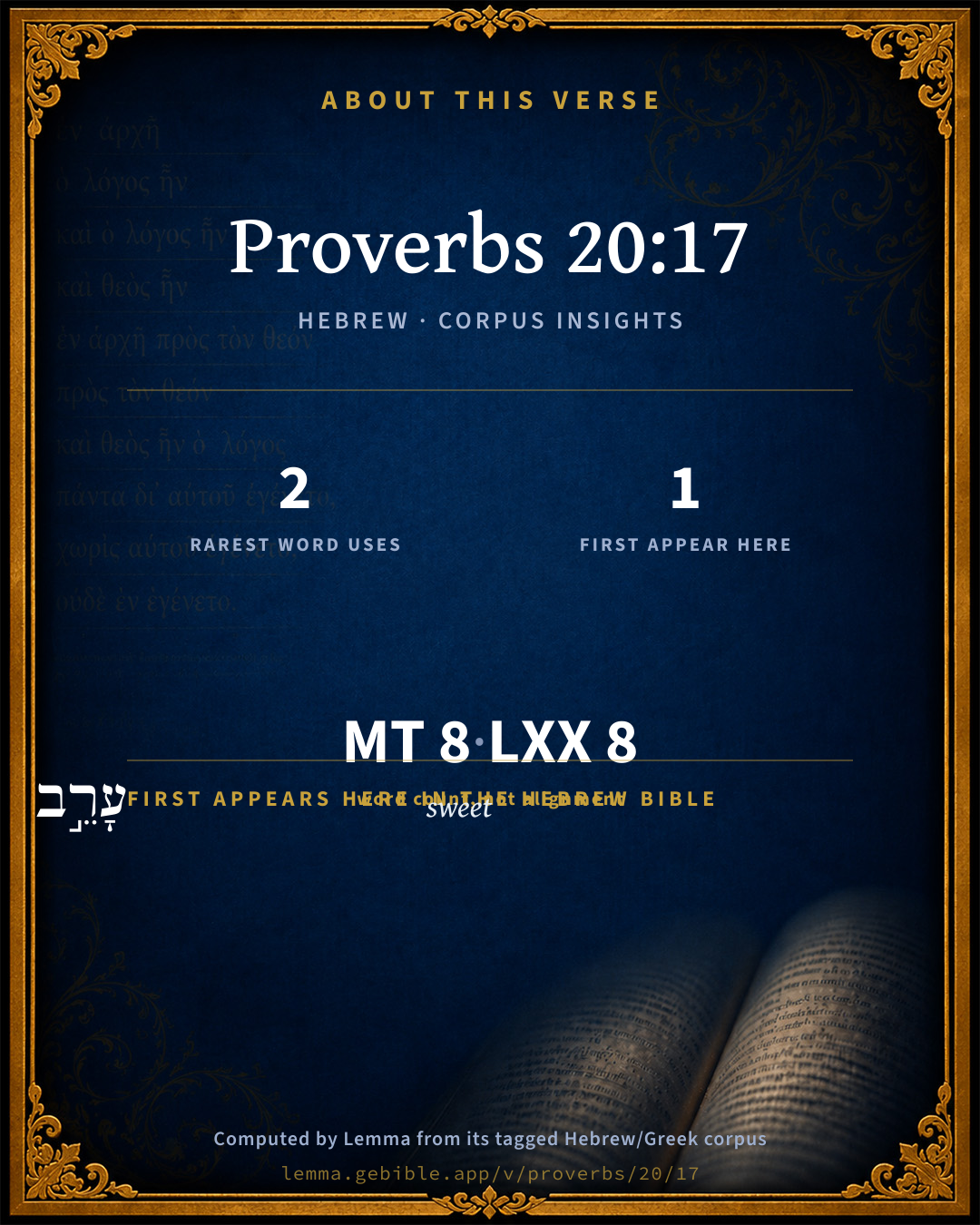
The rarest word here is עָרֵ֣ב sweet H6156 — appearing just 2 times in the whole Hebrew Bible.

First appearance in Scripture

This word makes its first canonical appearance in the Hebrew Bible here:

  • עָרֵ֣ב sweet H6156

Shared distinctive vocabulary

עָרֵ֣ב sweet H6156 occurs in 2 verses of the Hebrew Bible. Also found in:

Grammatical profile

  • 1 verb
  • 5 nouns
  • 1 adjective
  • 1 adverb

Verb forms

  • יִמָּֽלֵא Niphal · Imperfect

Hebrew & Septuagint length

In the original languages it is 8 Hebrew tokens and 8 Greek tokens — but the two are counted differently (Hebrew bundles its prefixes and suffixes into one token; the Greek is in lemma form), so that isn’t a like-for-like length.

Cross-references

7

Topical passages linked to Proverbs 20:17 in the Treasury of Scripture Knowledge — connected by theme and wording, ordered by reader-vote popularity; previews shown in the World English Bible.

  • Ecclesiastes 11:9 Rejoice, young man, in your youth, And let your heart cheer you in the days of your youth, And walk in the ways of your heart, And in the sight of your eyes; But know that for all these things God will bring you into judgment.
  • Proverbs 9:17–18 "Stolen water is sweet. Food eaten in secret is pleasant."
  • Job 20:12–20 "Though wickedness is sweet in his mouth, Though he hide it under his tongue,
  • Lamentations 3:15–16 He has filled me with bitterness, he has sated me with wormwood.
  • Hebrews 11:25 choosing rather to share ill treatment with God's people, than to enjoy the pleasures of sin for a time;
  • Genesis 3:6–7 When the woman saw that the tree was good for food, and that it was a delight to the eyes, and that the tree was to be desired to make one wise, she took of the fruit of it, and ate; and she gave some to her husband with her, and he ate.
  • Proverbs 4:17 For they eat the bread of wickedness, And drink the wine of violence.

Cross-references courtesy of OpenBible.info (CC BY 4.0).

Hebrew and Greek witnesses Masoretic Hebrew ↔ Greek Septuagint

The same verse in the two great witnesses to the Old Testament, shown verse-for-verse.

These are two independent witnesses, not word-aligned to each other, and the Septuagint is shown in lemma (dictionary) form.

Hebrew Proverbs 20:17 Masoretic · Westminster Leningrad Codex

עָרֵ֣ב לָ֭אִישׁ לֶ֣חֶם שָׁ֑קֶר וְ֝אַחַ֗ר יִמָּֽלֵא פִ֥יהוּ חָצָֽץ

Fraudulent food is sweet to a man, But afterwards his mouth is filled with gravel.

World English Bible · Public Domain

Greek LXX Proverbs 20:17 Septuagint · lemma form

λικμήτωρ ἀσεβής βασιλεύς σοφός καί ἐπιβάλλω αὐτός τροχός

No English rendering of this Greek verse — the small residue in the structurally divergent books.

Hebrew: Westminster Leningrad Codex (CC BY 4.0). Greek: Septuagint (public domain); English from a public-domain English Septuagint. How the Septuagint differs from the Hebrew →

Commentary

Notes on Proverbs 20:17 from classic Christian and Jewish commentators (each source and its license shown beneath its notes). The classic Christian expositions comment on the surrounding passage and are grouped to its opening verse, so a note may address several verses; the Jewish commentaries on the Tanakh (Rashi and others) are per-verse, so they appear only where the commentator wrote on this verse.

Lemma curates 59 commentaries, every one of them public domain or Creative Commons licensed, each selected and text-cleaned for this edition rather than reprinted as found. About our sources →

Trapp's Complete Commentary

John Trapp

Pro 20:17 Bread of deceit [is] sweet to a man; but afterwards his mouth shall be filled with gravel.

Ver. 17. Bread of deceit is sweet to a man.] Sin’s murdering morsels will deceive those that devour them. There is a deceitfulness in all sin, {Heb 3:13} a lie in all vanity. {Jer 2:8} The stolen waters of adultery are sweet, {Pro 9:17} but bitterness in the end: such sweet meat hath sour sauce. Commodities craftily or cruelly compassed, yield a great deal of content for present. But when the unconscionable cormorant hath "swallowed down such riches, he shall vomit them up again; God shall cast them out of his belly." {Joh 20:15} Either by remorse and restitution in the meantime, or with despair and impenitent horror hereafter.

His mouth shall be filled with gravel.] Pane lapidoso, as Seneca hath it - with grit and gravel, to the torment of the teeth; that is, terror of the conscience, and torture of the whole man. Such a bitter-sweet was Adam’s apple, Esau’s mess, the Israelites’ quails, Jonathan’s honey, the Amalekites’ cates after the sack of Ziklag, {1Sa 30:16} Adonijah’s dainties, {1Ki 1:9} which ended in horror; ever after the meal is ended, comes the reckoning. Men must not think to dine with the devil, and then to sup with Abraham, Isaac, and Jacob in the kingdom of heaven: to feed upon the poison of asps, and yet that the viper’s tongue shall not slay them. {Job 20:16} When the asp stings a man, it doth first tickle him, so as it makes him laugh, till the poison by little and little gets to the heart, and then it pains him more than ever it delighted him. So doth sin. At Alvolana in Portugal, three miles from Lisbon, many of our English soldiers under the Earl of Essex perished, by eating of honey, purposely left in the houses and spiced with poison, as it was thought. {a} And how the treacherous Greeks destroyed many of the western Christians, French and English, marching toward the Holy Land, by selling them meal mingled with lime, is well known out of the Turkish history.

{a} Speed in Queen Elizabeth.

John Trapp, A Commentary or Exposition upon All the Books of the Old and New Testament (1647–1656) — public domain. Text from a community e-Sword module.

Joseph Benson's Commentary

Pro 20:17. Bread of deceit — Gain or pleasure procured by unrighteous courses; is sweet to a man — And the more sweet, because it is unlawfully obtained; such pleasure doth the carnal mind take in the success of its wicked projects! Observe, reader, all the pleasures and profits of sin are bread of deceit; they are stolen; they are forbidden fruit; and they deceive men; for they do not perform what they promise. For a time, indeed, they are, perhaps, rolled under the tongue as a sweet morsel, and the sinner blesses himself in them, but afterward his mouth shall be filled with gravel — His bread of deceit will be bitter and pernicious, and produce pain and sickness in his stomach; when his conscience is awakened, when he sees himself cheated, and becomes apprehensive of the wrath of God against him for his sin, how painful and distressing then is the thought of it!

Joseph Benson's Commentary on the Old and New Testaments (1811–1818) — public domain. Text from a community e-Sword module.

The Preacher's Complete Homiletical Commentary

Joseph S. Exell (gen. ed.)

CRITICAL NOTES.—

Pro_20:17. A man. The Hebrew word here used is the one which denotes a superior man.

MAIN HOMILETICS OF Pro_20:17

BAD BREAD

I. Some gratification is to be obtained from dishonest gain. Many a swindler gets not only bread by swindling, but many other things, which not only minister to his senses, but gratify mental appetites not in themselves unlawful. And he finds pleasure in the fruit of his dishonesty—in, it may be, his well-furnished table, his luxurious mansion, his social position. It is not the highest and the purest pleasure, but there is a sweetness in it, or men would not grasp so eagerly the “bread of deceit.”

II. A time will come when it will not only cease to give pleasure, but will bring misery. The dishonest man will find that, after all, his gains are not bread for his higher nature—that his soul is still unsatisfied, and crying out for sustenance—and, more than this, that his conscience demands satisfaction for the wrong-doing of the past—that even if he is permitted to keep possession of his ill-gotten wealth, it is not only what chaff without the grain, or the husk without the kernel, is to the starving man, but as the very sand of the desert or the dust of the highway in the mouth, tormenting as well as unsatisfying.

OUTLINES AND SUGGESTIVE COMMENTS

“Everything gotten wrongfully is here implied.” Bitter was Achan’s sweet, deceitfully hid in the tent, which brought ruin upon himself and his family (Jos_7:21-24). Look at Gehazi. What profit had he from his talents of silver and changes of garments? Bitter indeed was the bread of deceit to him (2Ki_5:20-27). Look even at Jacob, a true servant of God; and yet chastened heavily almost to the end of his days with the bitter fruits of deceit (Genesis 27; Gen_42:36-38).—Bridges.

Men must not think to dine with the devil, and then to sup with Abraham, Isaac, and Jacob in the kingdom of heaven.—Trapp.

It is crusted without, as if it were bread; but within, contrary to bread, is not soft. The deceived, tasting it with the tongue of his hope and presuming confidence, findeth nothing which is not grateful unto him: the deceiver tasting it with the tongue of present profit findeth it most luscious unto him. But when the deceiver, having it in his mouth, pierceth it with the teeth of his trial, then as gravel breaketh the teeth so it breaketh his heart; and when the deceiver comes to feed upon it he findeth there is no juice of true profit.—Jermin.

The Preacher's Complete Homiletical Commentary (gen. ed. Joseph S. Exell; Funk & Wagnalls, c. 1892) — public domain (pre-1929). A full-Bible homiletical/sermon-outline anthology covering 65 of 66 books (2 John is absent from the source module). Text from a community e-Sword module.

MacLaren's Expositions of Holy Scripture

Alexander MacLaren

Proverbs

BREAD AND GRAVEL

Pro 20:17.

‘Bread of deceit’ is a somewhat ambiguous phrase, which may mean either of two things, and perhaps means both. It may either mean any good obtained by deceit, or good which deceives in its possession. In the former signification it would appear to have reference primarily to unjustly gotten gain, while in the latter it has a wider meaning and applies to all the worthless treasures and lying delights of life. The metaphor is full of homely vigour, and the contrast between the sweet bread and the gravel that fills the mouth and breaks the teeth, carries a solemn lesson which is perpetually insisted upon in this book of Proverbs, and confirmed in every man’s experience.

I. The first lesson here taught is the perpetuity of the most transient actions.

We are tempted to think that a deed done is done with, and to grasp at momentary pleasure, and ignore its abiding consequences. But of all the delusions by which men are blinded to the true solemnity of life none is more fatal than that which ignores the solemn ‘afterward’s that has to be taken into account. For, whatever issues in outward life our actions may have, they have all a very real influence on their doers; each of them tends to modify character, to form habits, to drag after itself a whole trail of consequences. Each strikes inwards and works outwards. The whole of a life may be set forth in the pregnant figure, ‘A sower went forth to sow,’ and ‘Whatsoever a man soweth, that shall he also reap.’ The seed may lie long dormant, but the green shoots will appear in due time, and pass through all the stages of ‘first the blade, and then the ear, and after that the full corn in the ear.’ The sower has to become the reaper, and the reaper has to eat of the bread made from the product of the long past sowing. Shall we have to reap a harvest of poisonous tares, or of wholesome wheat? ‘If ‘twere done when ‘tis done, ‘twere well it were done quickly’; but since it begins to do when ‘tis done, it were often better that it were not done at all. A momentary pause to ask ourselves when tempted to evil, ‘And what then?’ would burst not a few of the painted bubbles after which we often chase.

Is there any reason to suppose that these permanent consequences of our transient actions are confined in their operation to this life? Does not such a present, which is mainly the continuous result of the whole past, seem at least to prophesy and guarantee a similar future? Most of us, I suppose, believe in the life continuous through and after death retributive in a greater degree than life here. Whatever changes may be involved in the laying aside of the ‘earthly house of this tabernacle,’ it seems folly to suppose that in it we lay aside the consequences of our past inwrought into our very selves. Surely wisdom suggests that we try to take into view the whole scope of our actions, and to carry our vision as far as the consequences reach. We should all be wiser and better if we thought more of the ‘afterwards,’ whether in its partial form in the present, or in its solemn completion in the future beyond.

II. The bitterness of what is sweet and wrong.

There is no need to deny that ‘bread of deceit is sweet to a man.’ There is a certain pleasure in a lie, and the taste of the bread purchased by it is not embittered because it has been bought by deceit. If we succeed in getting the good which any strong desire hungers after, the gratification of the desire ministers pleasure. If a man is hungry, it matters not to his hunger how he has procured the bread which he devours. And so with all forms of good which appeal to sense. The sweetness of the thing desired and obtained is more subtle, but not less real, if it nourishes some inclination or taste of a higher nature. But such sweetness in its very essence is momentary, and even, whilst being masticated, ‘bread of deceit’ turns into gravel; and a mouthful of it breaks the teeth, excoriates the gums, interferes with breathing, and ministers no nourishment. The metaphor has but too familiar illustrations in the experience of us all. How often have we flattered ourselves with the thought, ‘If I could but get this or that, how happy I should be’? How often when we got it have we been as happy as we expected? We had forgotten the voice of conscience, which may be overborne for a moment, but begins to speak more threateningly when its prohibitions have been neglected; we had forgotten that there is no satisfying our hungry desires with ‘bread of deceit,’ but that they grow much faster than it can be presented to them; we had forgotten the evil that was strengthened in us when it has been fed; we had forgotten that the remembrance of past delights often becomes a present sorrow and shame; we had forgotten avenging consequences of many sorts which follow surely in the train of sweet satisfactions which are wrong.

So, even in this life nothing keeps its sweetness which is wrong, and nothing which is sweet and wrong avoids a tang of intensest bitterness ‘afterwards.’ And all that bitterness will be increased in another world, if there is another, when God gives us to read the book of our lives which we ourselves have written. Many a page that records past sweetness will then be felt to be written, ‘within and without,’ with lamentation and woe.

All bitterness of what is sweet and wrong makes it certain that sin is the stupidest, as well as the wickedest, thing that a man can do.

III. The abiding sweetness of true bread.

In a subordinate sense, the true bread may be taken as meaning our own deeds inspired by love of God and approved by conscience. They may often be painful to do, but the pain merges into calm pleasure, and conscience whispers a foretaste of heaven’s ‘Well done! good and faithful servant.’ The roll may be bitter to the lips, but, eaten, becomes sweet as honey; whereas the world’s bread is sweet at first but bitter at last. The highest wisdom and the most exacting conscience absolutely coincide in that which they prescribe, and Scripture has the warrant of universal experience in proclaiming that sin in its subtler and more refined forms, as well as in its grosser, is a gigantic mistake, and the true wisdom and reasonable regard for one’s own interest alike point in the same direction,-to a life based on the love of God in Christ Jesus our Lord, as being the life which yields the happiest results today and perpetual bliss hereafter. But let us not forget that in the highest sense Christ Himself is the ‘true bread that cometh down from heaven.’ He may be bitter at first, being eaten with tears of penitence and painful efforts at conquering sin, but even in the first bitterness there is sweetness beyond all the earth can give. He ‘spreads a table before us in the presence of our enemies,’ and the bread which He gives tastes as the manna of old did, like wafers made of honey. Only perverted appetites loathe this light bread and prefer the strong-favoured leeks and garlics of Egypt. They who sit at the table in the wilderness will finally sit at the table prepared in the kingdom of the heavens.

Alexander MacLaren, Expositions of Holy Scripture (1904–1910) — public domain. Text from a community e-Sword module.

Matthew Henry's Commentary

Note, 1. Sin may possibly be pleasant in the commission: Bread of deceit, wealth gotten by fraud, by lying and oppression, may be sweet to a man, and the more sweet for its being ill-gotten, such pleasure does the carnal mind take in the success of its wicked projects. All the pleasures and profits of sin are bread of deceit. They are stolen, for they are forbidden fruit; and they will deceive men, for they are not what they promise. For a time, however, they are rolled under the tongue as a sweet morsel, and the sinner blesses himself in them. But, 2. It will be bitter in reflection. Afterwards the sinner's mouth shall be filled with gravel. When his conscience is awakened, when he sees himself cheated, and becomes apprehensive of the wrath of God against him for his sin, how painful and uneasy then is the thought of it! The pleasures of sin are but for a season, and are succeeded with sorrow. Some nations have punished malefactors by mingling gravel with their bread.

Matthew Henry's Commentary on the Whole Bible (1708–1710) — public domain (CC PDM 1.0). Text via the HelloAO Bible API.

Jamieson, Fausset & Brown

Robert Jamieson, A. R. Fausset & David Brown

Bread . . . sweet--either as unlawfully (Pro 9:17) or easily obtained.

mouth . . . gravel--well expresses the pain and grief given at last.

Jamieson, Fausset & Brown — Commentary Critical and Explanatory on the Whole Bible (1871) — public domain (CC PDM 1.0). Text via the HelloAO Bible API.

Adam Clarke's Commentary

Verse 17. Bread of deceit is sweet] Property acquired by falsehood, speculation, c., without labour, is pleasant to the unprincipled, slothful man but there is a curse in it, and the issue will prove it.

Adam Clarke's Commentary on the Bible (1810–1826) — public domain. Text from a community e-Sword/MySword module.

The Cambridge Bible for Schools and Colleges

gen. ed. J. J. S. Perowne

17. Bread of deceit] or of falsehood, R.V., i.e. bread (or whatever else that word represents) gotten by dishonest and deceitful methods.

with gravel] Comp. Lam_3:16.

The Cambridge Bible for Schools and Colleges (gen. ed. J. J. S. Perowne; Cambridge University Press, 1878–1918) — public domain. Text from a community e-Sword module.

John Gill's Exposition

Bread of deceit is sweet to a man,.... Which may be understood of sin in general, which is bread to the sinner, he eats it: it is called "the bread of wickedness", Pro 4:17; but it is but poor bread, no other than ashes Isa 44:20; it is "bread of deceit"; there is a deceitfulness in all sin; it is in appearance fair and pleasant to the eye, like the fruit our first parents ate of; or like the apples of Sodom, of which it is reported that they are very beautiful to look at, but when touched drop into ashes; sin promises pleasure, profit, honour, liberty, peace, and impunity, yet gives neither; but the reverse, pain, loss, shame, servitude distress, and destruction; and yet it is sweet to an unregenerate man, one of a vicious taste, or whose taste remains unchanged; it is natural to him and he takes as much delight in it as in eating and drinking; and especially such sins as are called constitution ones, which he is not easily prevailed upon to part with; wickedness is sweet in his mouth, he rolls it and keeps it as a sweet morsel under his tongue, and forsakes it not, Job 20:12. It may be applied to particular sins, as to adultery, as it is by Jarchi, and with which may be compared Pro 9:17; and to riches unlawfully gotten; see Job 20:15; and to the cruel usage and persecution of the people of God, called the bread of wickedness and wine of violence, which wicked men take as much delight in as in eating and drinking, Pro 4:17; particularly the cruelty of the church of Rome, who has made herself drunk with the blood of the saints, in which she delights, and will be bitter to her in the end, Rev 17:6. It may be interpreted of false doctrine; so the doctrine of the Pharisees and Sadducees is signified by leavened bread, Mat 16:6; this is not true bread, does not strengthen, nourish, and refresh, as the Gospel does, but eats as a canker; it is not solid and substantial, but mere chaff, it is bread of falsehood and lying; false teachers lie in wait to deceive, their doctrines are lies in hypocrisy, and, yet these are sweet unto, and taken down greedily by carnal persons; particularly the doctrine of justification by works: this is the bread some men live on, but it is only husks which swine eat; it is feeding on wind, and filling the belly with east wind, which swells and vainly puffs up the fleshly mind; it is contrary to the, Gospel, and is not of the truth, and will deceive persons that trust to it; and yet it is sweet to a natural man; his own righteousness, and to trust to it, is natural to him; it is his own, and what he has laboured for, and is fond of; it affords room for boasting, and he does not care to part with it;

but afterwards his mouth shall be filled with gravel; with that which will be ungrateful, uncomfortable, and distressing to him; the conscience of a sinner, who has been taking his fill of sin and pleasure in it shall be filled with remorse and distress; and with bitter reflections upon himself; with a dreadful sense of divine wrath, and fearful apprehensions of it now; and destruction and damnation will be his portion hereafter; and this will be the consequence of all false doctrine, and of a man's trusting to his own righteousness and despising Christ's; see Pe2 2:1.

John Gill's Exposition of the Whole Bible (1746–1763) — public domain (CC PDM 1.0). Text via the HelloAO Bible API.

Albert Barnes' Notes on the Bible

“To eat gravel” was a Hebrew Lam 3:16, and is an Arabic, phrase for getting into trouble. So “bread,” got by deceit, tastes sweet at first, but ends by leaving the hunger of the soul unsatisfied. There is a pleasure in the sense of cleverness felt after a hard bargain or a successful fraud, which must be met by bidding men look on the after consequences.

Albert Barnes' Notes on the Bible (1834–1885) — public domain. Text from a community e-Sword/MySword module.

Haydock's Catholic Bible Commentary

Lying. Deceit, and unlawful pleasures, chap. ix. 17. But God mingles disgust with them, and will punish the guilty, at least hereafter. Worldly enjoyments seem sweet, but they are full of gravel, and hurtful.

George Leo Haydock (1774–1849), Haydock's Catholic Family Bible and Commentary, 1859 edition — public domain. Excludes Psalms (Douay-Rheims chapter numbering differs from Protestant) and Deuterocanonical books (Catholic canon only).

Matthew Poole's English Annotations

Bread of deceit; gain or pleasure procured by unrighteous courses.

His mouth shall be filled with gravel; it shall be bitter and pernicious at last, like gritty bread, which offends the teeth and stomach. It will certainly bring upon him the horrors of a guilty conscience, and the wrath and judgments of the Almighty God.

Matthew Poole's English Annotations on the Holy Bible (1683–1685) — public domain. Text from a community e-Sword/MySword module.

Whedon's Commentary on the Bible

Daniel D. Whedon

17. Bread of deceit — Enjoyments and possessions acquired by fraud, or any illicit means. (Compare Pro_23:3; Pro_9:17.)

Filled with gravel — Comp. Lam_3:16. His unlawful gratifications will be turned to grievous annoyances.

Daniel D. Whedon (gen. ed.), Commentary on the Old and New Testaments (1874–1909) — public domain. Text from a community e-Sword module.

The Pulpit Commentary

Bread of deceit is sweet to a man; Revised Version, bread of falsehood; i.e. bread gained without labour, or by unrighteous means. (Pro_10:2) This is agreeable because it is easily won, and has the relish of forbidden fruit. "Wickedness is sweet in his mouth". (comp. Job_20:12) But afterwards his mouth shall be filled with gravel. He will find in his "bread" no nourishment, but rather discomfort and positive injury. (comp. Job_20:14) The expression, "to eat gravel," is intimated in Lam_3:16, "He hath broken my teeth with gravel stones;" it implies grievous disappointment and unprofitableness. See here a warning against evil plesaures Feug hdonhrousan usteron blabhn. "Sperne voluptates: nocet empta dolore voluptas.

Oort supposes that the gnome in the text is derived from a riddle, which asked, "What is sweet at first, but afterwards like sand in the mouth?"

The Pulpit Commentary (1880–1919), ed. H.D.M. Spence-Jones & Joseph S. Exell — public domain. Text from a community e-Sword module.

Keil & Delitzsch

C. F. Keil & F. Delitzsch

17 Sweet to a man is the bread of deceit;

Yet at last his mouth is full of gravel.

"Bread of deceit" is not deceit itself, as that after which the desire of a man goes forth, and that for which he has a relish (thus, e.g., Immanuel and Hitzig); but that which is not gained by labour, and is not merited. Possession (vid., Pro 4:17) or enjoyment (Pro 9:17) obtained by deceit is thus called, as לחם כּזבים, Pro 23:3, denotes bread; but for him who has a relish for it, it is connected with deceit. Such bread of lies is sweet to a man, because it has come to him without effort, but in the end not only will he have nothing to eat, but his tongue, teeth, and mouth will be injured by small stones; i.e., in the end he will have nothing, and there will remain to him only evil (Fleischer). Or: it changes itself (Job 20:14) at last into gravel, of which his mouth is filled full, as we might say, "it lies at last in his stomach like lead." חצץ is the Arab. ḥaṭny, gravel (Hitzig, grien = gries, coarse sand, grit), R. חץ, scindere. Similarly in Arab. ḥajar, a stone, is used as the image of disappointed expectations, e.g., the adulterer finds a stone, i.e., experiences disappointment.

Keil & Delitzsch — Biblical Commentary on the Old Testament (1861–1891) — public domain (CC PDM 1.0). Text via the HelloAO Bible API. (Old Testament only.)

Bridges on Proverbs

Charles Bridges

Holiness is sweet in the way and end too. Wickedness is sometimes sweet in the way, but always bitter in the end.’†1 It is with deceit, as with every other sin, Satan always holds out a bait; always promises gain or pleasure as the wages of his service, and as surely disappoints the victims of his delusion.†2 If corn be thrashed upon a gravelly floor, the grating soil would spoil the sweetness of the bread. Oh! how many has this arch-deceiver allured by the sweetness of his bread, whose mouths have been afterwards filled with gravel! ’The bread, which a man hath got by fraud and cozenage, seems sweet and pleasant at the first taste of it; but by that time he hath chewed it a little, he shall find it to be but harsh gravel, that crasheth between his teeth, galls his jaws, wounds his tongue, and offends his palate.’†3 ’Everything gotten wrongfully is here implied.’†4 Bitter was Achan’s sweet, deceitfully hid in the tent, which brought ruin upon himself and his family. (Jos 7:21-24 .) Look at Gehazi. What profit had he from his talents of silver and changes of garments? Bitter indeed was the bread of deceit to him. (2Ki 5:20-27 .) Look even at Jacob, a true servant of God; and yet chastened heavily almost to the end of his days with the bitter fruits of deceit. (Gen 27:1-46 ; Gen 42:36-38 .) To the mass of such blinded sinners it is eternal ruin. Whatever be the tempter’s proffered advantage, his price is the soul, to be pain in the dying hour. Oh! the undoing bargain! an eternal treasure bartered for the trifle of a moment! Charmed we may be with the present sweetness; but bitter indeed will be the after-fruits, when the poor deluded sinner shall cry — "I tasted but a little honey, and I must die." (1Sa 14:43 .) So surely is the bitterness that springs out of sin the bitterness of death.

Not a single step can be trodden in the way of godliness, without an entire renunciation of every accursed practice. Not even the smallest violation of the law admits of palliation. To venture on what we fancy the lesser shades of sin is a most dangerous experiment. The smallest sin breaks down the fence; and this once overstepped, the impulse is beyond our restraint. Universal uprightness is the mark of the true servant of God. Let the man of doctrine exhibit the holiness of doctrine. Never let our religion be one thing, and our business another. But let the image and glory of the Lord give the pervading expression to our whole history. Every turning aside from the straight path "grieves the Holy Spirit of God," darkens the sunshine of our soul, blasts the consistency of our profession, and wounds the church of God.

Footnotes:

†1 Caryl on Job 20:14 .

†2 Pro 9:17-18; Pro 23:31-32 . Job 20:12-16 .

†3 Bishop Hall. Compare Lam 3:16 .

†4 Bishop Patrick.

Charles Bridges, An Exposition of the Book of Proverbs (1846) — public domain. Text from a community e-Sword module.

Kretzmann's Popular Commentary

Paul E. Kretzmann

v. 17. Bread of deceit is sweet to a man, what he gains by such means may seem pleasant and enjoyable to him at first; but afterwards his mouth shall be filled with gravel, it will be most disagreeable and grievous to him.

Paul E. Kretzmann, Popular Commentary of the Bible (1921–1924) — public domain. Text from a community e-Sword module.

unfoldingWord translationNotes

Door43 World Missions Community

Bread gained by deceit

This can be stated in active form. AT: "Bread that someone gained by deceit" (See: Active or Passive)

by deceit

The word "deceit" can be expressed as a verb. AT: "by deceiving others" (See: Abstract Nouns)

Bread

Here "bread" refers to food in general. AT: "Food" (See: Metonymy)

tastes sweet

"tastes good"

but afterward his mouth will be full of gravel

This speaks of the food tasting unpleasant as if his mouth were actually full of gravel instead of food. AT: "but afterwards it tastes like gravel in his mouth" or "but soon it tastes like sand in his mouth" (See: Metaphor)

gravel

small pieces of rock

Plans are established by advice

This can be stated in active form. AT: "People establish plans based on advice" (See: Active or Passive)

translationWords

bread

advice

wise

unfoldingWord translationNotes — © Distant Shores Media and the Door43 World Missions Community, licensed CC BY-SA 4.0. Source: git.door43.org/Door43/en_tn.

Rashi

Rabbi Shlomo Yitzchaki (Rashi)

Bread of falsehood is sweet to a man Adultery with a married woman.

but afterwards his mouth will be filled with gravel Heb. חצץ, fine pebbles. Similarly, (Lam. 3:16): “And He has made my teeth grind on gravel (בחצץ).”

Rashi on the Tanakh — English translations: “The Judaica Press complete Tanach with Rashi, translated by A. J. Rosenberg” (CC BY 4.0); “Pentateuch with Rashi's commentary by M. Rosenbaum and A.M. Silbermann, 1929-1934” (public domain); “The Metsudah Tanach series, Lakewood, N.J” (CC BY 4.0); and “The Book of Joshua, Metsudah Publications, 1997” (CC BY 4.0). Text via Sefaria.

Lesson kit

Teaching starters — assembled from the data on this page, not authored interpretation. Every prompt links to the verse data it draws on. Edit before teaching.

Proverbs, in the Wisdom, opens this verse with 8 words (8 distinct Hebrew lemmas). Its most distinctive word is ʻârêb (“sweet”). A historical commentator’s framing appears above. Read the whole chapter for the surrounding context.

Discussion questions

  1. The word ʻârêb carries the sense “sweet.” How does it shape the verse?
  2. This is the first place “sweet” appears in Scripture (first appears here). What does its debut here establish?
  3. How does Song of Solomon 2:14, which shares the word «sweet», read alongside this verse?
  4. The translations on this page render this verse differently — a whole-verse word diff, not a word-by-word alignment. What might account for the different wordings?
  5. «יִמָּֽלֵא» is a Niphal Imperfect verb. How does that grammatical form shape the action described?
  6. Compare how Trapp's Complete Commentary and Joseph Benson's Commentary read this verse. Where do they agree or differ?

Things to notice

Reading settings

Reading text

Shown beneath each verse's original-language words.

Old Testament
Old Testament edition

Read the OT as the Masoretic Hebrew (MT) or the Greek Septuagint (LXX).

English shown for the Greek Septuagint (in the Hebrew ↔ Greek comparison).

Comparing translations? Open the Compare panel on any verse page to stack up to four side by side.