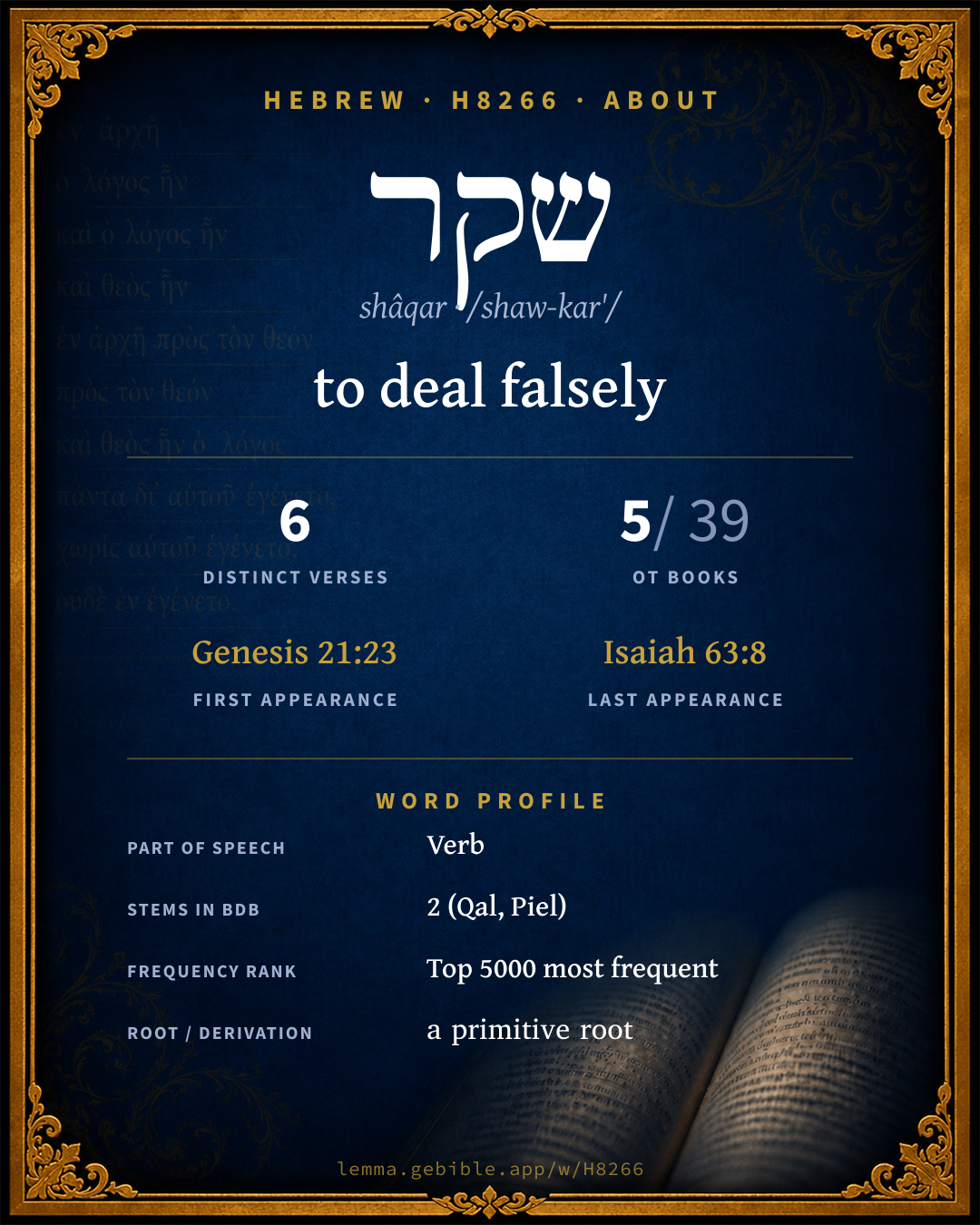
שָׁקַר
to deal falsely
‘to deal falsely’ is one of 3 main senses fuller range ↓
Full lexicon entry — Brown-Driver-Briggs (BDB)
From Brown-Driver-Briggs (BDB)
Where this word appears
See every Piel verb in the Hebrew Bible →
Grammar key — what these labels mean
Part of speech
- Verb
- An action or state-of-being word.
Stem
- Piel
- An intensive or resultative active stem.
- Qal
- The basic, simple active stem — the plain form of the verb (“he wrote”). Here: ‘thou wilt not do falsely to me’
Form
- Imperfect
- An incomplete, ongoing, or future action (“he will / would write”).
- Perfect
- A completed action or state — Hebrew marks aspect (completeness) more than strict tense (“he wrote”).
Person
- 1st Person
- The speaker (“I / we”).
- 2nd Person
- The one addressed (“you”).
- 3rd Person
- The one spoken about (“he / she / it / they”).
Gender
- Common
- Either gender — not distinguished for this form.
- Masculine
- Grammatically masculine.
Number
- Singular
- One.
- Plural
- More than one (in Hebrew, generally three or more).
Grammatical forms
- Verb, Piel, Imperfect, 1st Person, Common, Singular 1 time (17%)
- Verb, Piel, Imperfect, 2nd Person, Masculine, Plural 1 time (17%)
- Verb, Piel, Imperfect, 3rd Person, Masculine, Plural 1 time (17%)
- Verb, Piel, Imperfect, 3rd Person, Masculine, Singular 1 time (17%)
- Verb, Piel, Perfect, 1st Person, Common, Plural 1 time (17%)
- Verb, Qal, Imperfect, 2nd Person, Masculine, Singular 1 time (17%)
Parsed forms decoded from the imported morphology (morphhb / Westminster Leningrad Codex — WLC text public domain, morphhb tagging CC BY 4.0), counted across 6 parsed occurrences — not distinct verses.
Every verse where H8266 appears — 6 distinct verses across 5 books. Click any verse to open its interlinear word-by-word view. Verse text shown in the World English Bible for context — . Each verse’s Hebrew form is shown with its reference; the English is not keyword-highlighted, since the data carries no word-level English alignment. Use “Compare translations” on any verse to read it across multiple English versions. This concordance covers the Hebrew Bible; Septuagint (Greek Old Testament) occurrences are not indexed here.
Genesis 1 verse
Leviticus 1 verse
1 Samuel 1 verse
Psalms 2 verses
Isaiah 1 verse
About this entry
At a glance — auto-summarized from this page’s data, not written by a person. Every figure links to its source below. This summary describes the numbers; it doesn’t interpret them.
At its core, שקר (shâqar) means “to deal falsely.” It first appears in Genesis 21:23. Spanning 6 verses in 5 books, it ranks among the uncommon words of the Hebrew Bible. Its uses concentrate in Psalms (33% of all occurrences). As a verb its force shifts by stem, across 2 stems (Qal, Piel, and more). Each statement above links to its evidence; the full detail follows below.
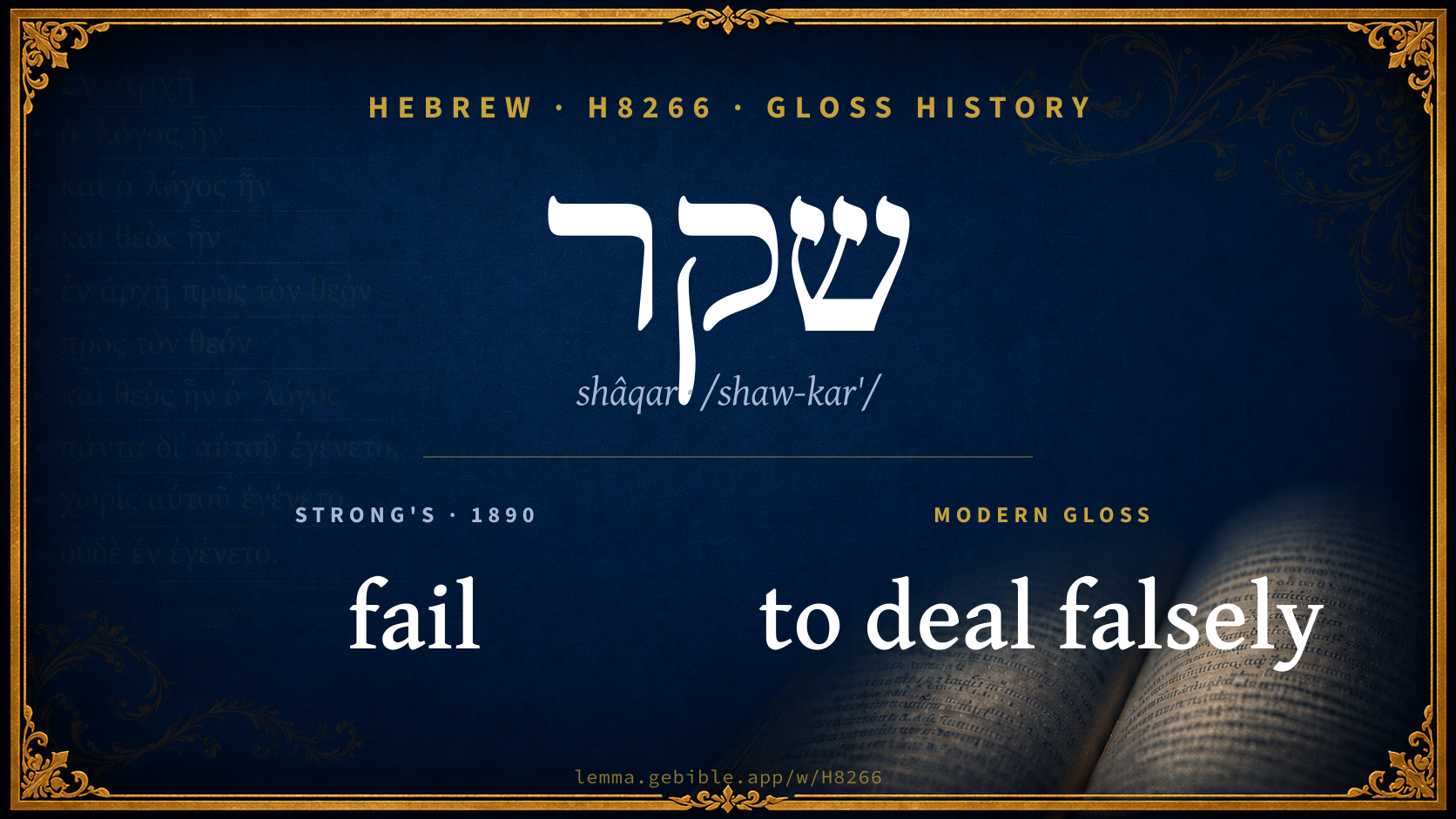
Gloss history
Strong's 1890 vs modern scholarship
About this word
Strong's H8266 catalogs a Hebrew word from the Hebrew Old Testament.
These counts are not copied from any lexicon or concordance. They are computed here, from the morphology-tagged Hebrew Old Testament. What Lemma adds →
- 6
- distinct verses
- The word appears in 6 distinct verses.
- 5 / 39
- OT books
- The word appears in 5 of 39 Old Testament books.
- #3,040
- by frequency
- Top 5000 most frequent Hebrew words (rank 3,040 of 8,640 Hebrew words by occurrence).
View all 6 occurrences in the concordance →
By section of the Old Testament
By traditional corpus
Conventional, traditional groupings — biblical authorship is debated, so this is a traditional corpus grouping, not an authorship claim. Each share is this word’s portion of its verses in that division of the Hebrew canon. Each figure is a share of the word’s 6 distinct verses.
- Torah (Pentateuch) 2 verses · 33%
- Prophets (Nevi'im) 2 verses · 33%
- Writings (Ketuvim) 2 verses · 33%
How translations render this word
Counts come from each version’s own published word-to-Strong’s tagging or interlinear alignment — an approximate guide to how each version renders this word, not a word-level alignment the data otherwise carries. Because each total is that version’s own tagged count, the per-version totals vary from one another and need not match the appearance or distinct-verse counts above. These counts may also differ from a printed concordance because Lemma counts each distinctly tagged rendering and does not collapse phrase taggings into a single head-word total. This is a fixed set of word-tagged versions (KJV, ASV, BSB, ULT) and does not change with the reading translation you choose elsewhere. Each version’s license is shown beside its name below (and on Sources).
- King James Version: Will not lie 2×
- American Standard Version: Have we not forgotten thee 1×, Lie 1×, Suffer my faithfulness to fail 1×
- Berean Standard Bible: Be disloyal 1×, Betray 1×, Deal falsely 1×
- unfoldingWord Literal Text: Deal falsely 2×, Lie 2×
King James Version Public Domain
Renders H8266 across 6 tagged occurrences — most commonly:
Plus 4 renderings that appear only once — usually multi-word phrases or single function words the recovered tagging swept in, not distinct renderings.
American Standard Version Public Domain
Renders H8266 across 6 tagged occurrences — most commonly:
Berean Standard Bible Public Domain
Renders H8266 across 6 tagged occurrences — most commonly:
unfoldingWord Literal Text CC BY-SA 4.0
Renders H8266 across 11 tagged occurrences — most commonly:
Plus 7 renderings that appear only once — usually multi-word phrases or single function words the recovered tagging swept in, not distinct renderings.
Senses in the full BDB
Hebrew verbs can shift meaning by stem (binyan): Qal is the basic action, Niphal is often passive or reflexive, Piel often intensifies or makes it factitive, and Hiphil is typically causative. The senses below are grouped under the stem BDB assigns to each.
What do BDB’s symbols mean?
BDB uses these scholarly abbreviations:
| Symbol | Meaning |
|---|---|
| 𝔊 | the Septuagint (the ancient Greek translation, LXX) |
| 𝔙 | the Vulgate (the Latin translation) |
| 𝔖 | the Syriac version (the Peshitta) |
| 𝔗 | the Targum (the Aramaic translation) |
| ψ | the Psalms |
| √ | root (the underlying root or stem) |
| ‖ | parallel passage (a synonymous or contrasted parallel) |
| † | the dagger: every passage where the word occurs is cited |
The 2 senses and sub-senses the full Brown-Driver-Briggs lexicon distinguishes for this word, in lexicon order (not ranked by frequency), with BDB’s own verbatim wording and sub-sense lettering. Shown in Hebrew script with BDB’s own scholarly abbreviations. The condensed entry is in the Lexicon Entry tab. See also the Forms in the corpus table below.
Qal
- thou wilt not do falsely to me
Piel
- . deal falsely
Senses from the full Brown-Driver-Briggs lexicon (Brown, Driver, Briggs; Oxford 1906 — public domain), digitized via Sefaria, supplemented by the OpenScriptures HebrewLexicon (CC BY 4.0). Full attribution on Sources.
Word origin
[ שָׁקַר ] vb. denom. do or deal falsely;—
— Brown-Driver-Briggs (Oxford 1906, public domain), digitized via Sefaria, supplemented by the OpenScriptures HebrewLexicon (CC BY 4.0). See Sources.
Origin: a primitive root
Jastrow Dictionary
A second Hebrew/Aramaic lexicon for comparison, covering Aramaic and post-biblical (Talmudic, Targumic, Midrashic) usage that the biblical-Hebrew BDB does not. Matched by lemma rather than by Strong’s number, so a lemma may carry more than one Jastrow headword (shown separately below), and the entries cover usage well beyond the Bible.
שָׂקַר
- , v. סָקר II
שָׁקַר
- (b. h.) to be false. Gen. R. s. 85, beg. שָׁקַרְתָּ יהודה thou hast been false, O Judah; Yalk. ib. 144; Yalk. Mal. 589.
- 1. same, same, to lie; to defraud.—מה לי לשַׁקּר what reason should I have for making a false statement?, i.e. a person’s statement is to be credited, when he gains nothing by it, since he might have obtained the same advantage in another way. Kidd. 64ᵇ אמרינן מה לי לשקר וכ׳ we apply the principle that we believe him, because he gains nothing by falsehood: for, why should he have said so? In order to release her from leviratical marriage after his death? If so, he might have said to her: I release thee by a divorce. Ib. מה לי לש׳ כי עדים דמי a person’s statement accepted on the ground that he had no reason for lying, has the same legal value as the statement of witnesses; מה לי לש׳ כי חזקה דמי it has only the same value as a presumption (חֲזָקָה). Keth. 27ᵇ מה לי לש׳ אי בעי וכ׳ we must believe him, for, if he had wanted, he might have said &c. Ib. מה לי לש׳ במקום עדים וכ׳ we do not apply the principle of mah li l’shaḳḳer, when the person’s statement is contradicted by witnesses (by well-known facts); B. Mets. 81ᵇ; a. fr.—Y. Snh. XI, 30ᶜ top (expl. כחש לו, I Kings XIII, 18) שי׳ בו (not ביה) he played him false; Cant. R. to II, 5 שי׳ לו; ib. ומה שי׳ לו שהאכילהו וכ׳ and wherein did he play him false? In that he gave him the bread of deceit to eat (made him the recipient of treacherous hospitality). Num. R. s. 2018; Tanḥ. Balak 12 מְשַׁקֵּר במשקלות, v. מִשְׁקָל; a. fr. e.g. 1 Kings 13:18
- 2. to prove false; to contradict, refute. Macc. 5ᵃ (ref. to Deut. XIX, 18) עד שתְּשַׁקֵּר גופה וכ׳ until thou disprovest the body of the testimony (provest an alibi of the witnesses). e.g. Deuteronomy 19:18
- to be refuted, be proved to be a liar. Y. ib. I, beg. 31ᵃ [read:] עדים שנזדממו וחזרו ונִשְׁתַּקְּרוּ if witnesses against whom an alibi had been proved were also proved to have told a falsehood (as to the fact to which they testified).
שְׁקַר I
- Targ. Mal. II, 10 (ed. Wil. Pa.). Targ. Josh. XXII, 16; 22; 31; a. e.—Yeb. 55ᵇ, v. שַׁקָּרָא.
- same. Targ. O. Gen. XXI, 23 (Y. Pe.). Targ. Ps. XLIV, 18; a. fr.—Gitt. 57ᵃ שַׁקּוּרֵי מְשַׁקְּרִיתוּ you tell a falsehood. Taan. 9ᵇ כי היכי דמְשַׁקְּרֵי … משקרי וכ׳ as the Babylonians are deceivers, so their rains are, v. מִטְרָא. R. Hash. 22ᵇ לא משקרי וכ׳, v. גְּלֵי; a. fr.
שַׁקָּר
- (preced.) liar.—Pl. שַׁקָּרִים, שַׁקָּרִין. Sot. 42ᵃ; Yalk. Hos. 524, v. שַׁקְרָן.
שֶׁקֶר
- preced.) lie, falsehood, vanity. Y. Snh. XI, 30ᶜ top מי שהאכיל … לחם ש׳ he that offered to his friend bread of falsehood (treacherous hospitality, v. שָׁקַר), opp. לחם אמת true hospitality. Shebu. 21ᵃ שבועת ש׳ נשבע להחליף a false oath is, if one swears to what is the opposite of true (that something happened which has not happened &c.), (modified) נשבע ומחליף he swears (vows that he will or will not do a certain thing), and does the opposite. Macc. 3ᵃ עדות ש׳ העדתי I have given false testimony. Lev. R. s. 6 המשביע … לש׳ וכ׳ he who lets his neighbor swear in vain (when he knows that he has no claim), shall finally leave his house empty-handed; R. A. says על ש׳ וכ׳ if he lets him swear to what he knows to be a lie; R. J. says, even if he lets him swear to a truth. Sabb. 104ᵃ, v. קְרֵב; a. v. fr.—Y. Macc. I, beg. 31ᵃ עדים שנזדממו … ש׳ ש׳ when witnesses have been convicted of an alibi, R. J. says, we draw an analogy between sheḳer (Ex. XX, 16) and sheḳer (Deut. XIX, 18), i.e. they must suffer corporal punishment in addition to pecuniary penalty.—Pl. שְׁקָרִים. Gen. R. s. 8 אל יברא שכולו ש׳ let man not be created, for he will be full of falsehoods; a. e. e.g. Exodus 20:16
שְׁקַר
- Targ. I Sam. XII, 3 ממון דש׳ (h. text כפר). Ib. XV, 29. Targ. O. Ex. XX, 7 (h. text שוא). Targ. ib. 13; a. fr.—Sabb. 104ᵃ (v. קְרֵב) ש׳ שכיח וכ׳ lie is frequent, truth rare. Ib. קושטא קאי ש׳ וכ׳ truth stands firm, falsehood does not. B. Bath. 82ᵃ, a. fr. מחזי כש׳ it looks like a lie. Lev. R. s. 26; Midr. Sam. ch. XXIV; Yalk. ib. 139 עלמא דש׳, v. עַלְמָא. Ib. מלין דש׳ words of falsehood; Lev. R. l. c. מלין שַׁקָּרִין. Succ. 46ᵇ לא … דאתי לאגמוריה ש׳ one should not say to a child, I shall give thee something, and not give it, because he may teach him falsehood; a. fr.—Pl. שִׁקְרִין, שִׁי׳. Targ. Ps. CI, 7. Targ. Jer. XXIII, 32; a. e.—[Y. Snh. VI, 23ᵇ bot., v. next w.]
A Dictionary of the Targumim, the Talmud Babli and Yerushalmi, and the Midrashic Literature (Marcus Jastrow; London, Luzac, 1903) — Public Domain. Digitized via Sefaria. Digitized via Sefaria. Full attribution on Sources.
Forms in the corpus
The 6 distinct written forms H8266 takes in the Hebrew Bible, most frequent first — each parse links to that stem’s occurrences in the concordance. Hebrew forms include their vowel points and cantillation, so a single lemma takes many written forms.
| Form | Parsing | Example | Uses |
|---|---|---|---|
| אֲ֝שַׁקֵּ֗ר | Verb, Piel, Imperfect, 1st Person, Common, Singular | Psalms 89:33 | 1 |
| יְשַׁקֵּ֑רוּ | Verb, Piel, Imperfect, 3rd Person, Masculine, Plural | Isaiah 63:8 | 1 |
| יְשַׁקֵּ֖ר | Verb, Piel, Imperfect, 3rd Person, Masculine, Singular | 1 Samuel 15:29 | 1 |
| שִׁ֝קַּ֗רְנוּ | Verb, Piel, Perfect, 1st Person, Common, Plural | Psalms 44:17 | 1 |
| תְשַׁקְּר֖וּ | Verb, Piel, Imperfect, 2nd Person, Masculine, Plural | Leviticus 19:11 | 1 |
| תִּשְׁקֹ֣ר | Verb, Qal, Imperfect, 2nd Person, Masculine, Singular | Genesis 21:23 | 1 |
Same root — word family
Other BDB entries built from the same root as H8266, grouped by Strong’s listed origin. These share a root / origin per the lexicon — not necessarily a shared meaning. Each links to that word’s own entry.
Derived from this word
Compare all same-root words → They share a root, not necessarily a meaning.
Septuagint verse parallels
This word appears in 5 verses that also exist in the Greek Old Testament (Septuagint), out of the 6 Hebrew verses it occurs in. You can read those verses in Greek by switching the Old Testament edition to the Septuagint.
Read these verses in the Septuagint
This is a verse-level parallel only — the same verses exist in both the Hebrew and Greek Old Testaments. No word-level Hebrew↔Greek correspondence is claimed: the data carries no such alignment, so no Greek word is shown as this Hebrew word’s translation. Coverage is not total — the Septuagint omits the deuterocanon and renumbers the Psalms, so some Hebrew verses have no direct Greek parallel.