
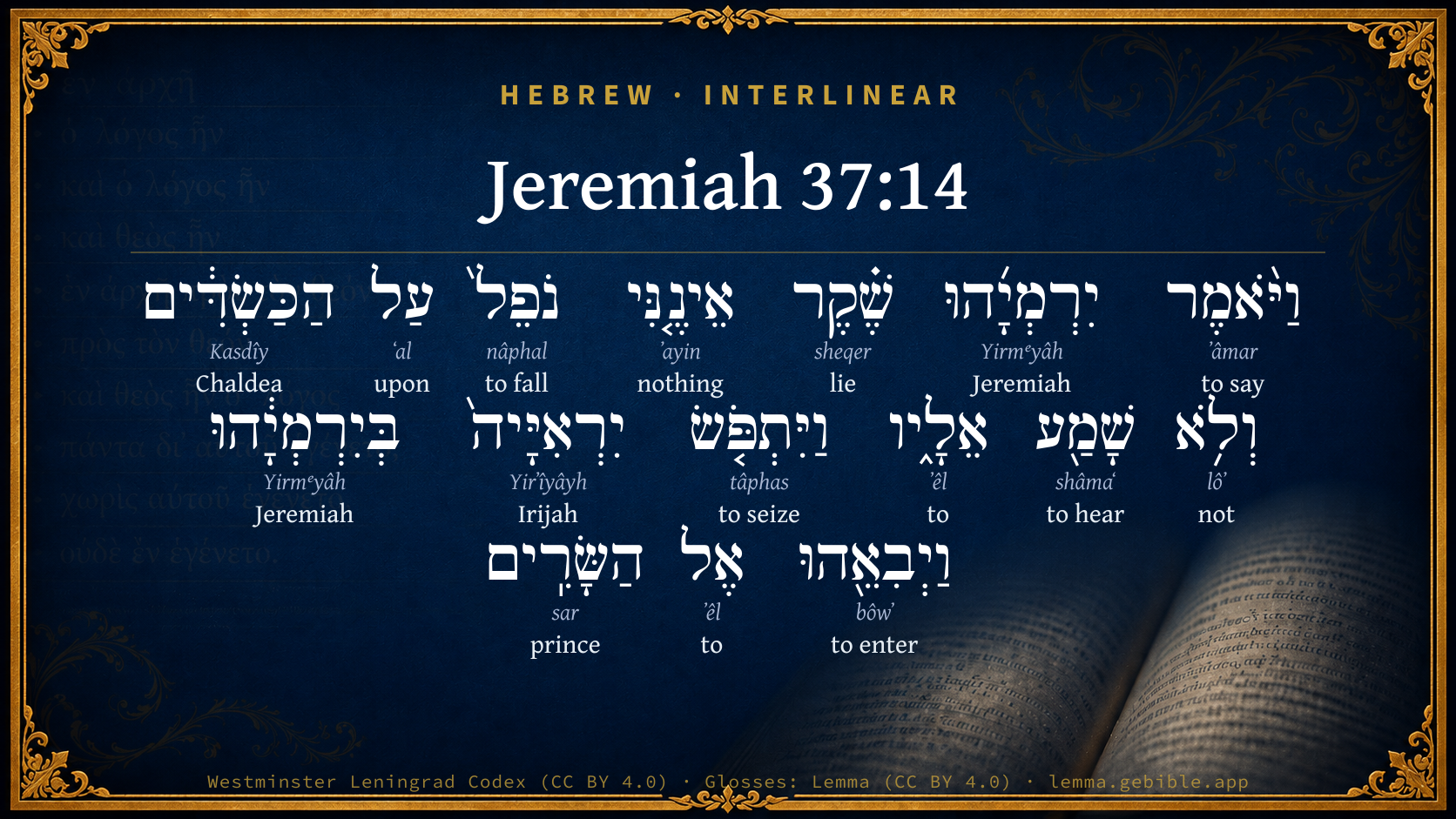
Jeremiah 37:14

Hebrew (Westminster Leningrad Codex) Jeremiah 37:14 appears in the Hebrew Old Testament. The text above is from the Westminster Leningrad Codex. Each word links to its Strong’s number, a concise gloss, and parsing drawn from the Open Scriptures Hebrew Bible morphology. Click any word for its full Brown-Driver-Briggs (BDB) entry.
Download image
Cite this verse

Jeremiah 37:14 (World English Bible). Public Domain. Lemma interlinear Bible study tool, https://lemma.gebible.app/v/jeremiah/37/14.

Show BibTeX & RIS
BibTeX
RIS
English Translation
Then said Jeremiah, It is false; I am not falling away to the Chaldeans. But he didn't listen to him; so Irijah laid hold on Jeremiah, and brought him to the princes.
World English Bible · Public Domain
Download a study sheet

One document with this verse’s original text, its word-by-word gloss line, the meaning frame, cross-references with their text, attributed commentary, and full source and license credits — printable, and it pastes into notes with its structure intact.

This verse Autodidact and up

Study sheet (.html) Plain text (.txt)

A passage Seminary Student

Up to 50 verses in one chapter. A passage sheet keeps up to 6 commentary sources and 12 cross-references per verse, in the order this page ranks them, and says so on the sheet whenever that leaves anything out. Ask for a single verse and you get the Autodidact verse sheet above.

Everything on this page stays free to read, with no account — the sheet is a download of what is already on screen, not access to it.

Want to remove ads? Support Godless Engineer
Compare translations 3

The same verse in 3 English versions, stacked beneath the original-language interlinear above. Click any original word for its lexicon entry.

Each is an independent rendering of the whole verse — the interlinear is not word-aligned to these translations.

Highlighted words mark where these versions differ — a whole-verse word diff, not a word-by-word alignment.

  • World English Bible Public Domain
    Then said Jeremiah, It is false; I am not falling away to the Chaldeans. But he didn't listen to him; so Irijah laid hold on Jeremiah, and brought him to the princes.
  • King James Version Public Domain
    Then said Jeremiah, It is false; I fall not away to the Chaldeans. But he hearkened not to him: so Irijah took Jeremiah, and brought him to the princes.
  • unfoldingWord Literal Text CC BY-SA 4.0
    But Jeremiah said, “That is not true. I am not deserting to the Chaldeans.” But Irijah did not listen to him. He took Jeremiah and brought him to the officials.

unfoldingWord Literal Text — © unfoldingWord, licensed CC BY-SA 4.0. Word-aligned USFM3 via Door43 (git.door43.org/unfoldingWord/en_ult).

Versions to compare (up to 4)

3 of 4 selected

Show all 18 translations

Every available English version of this verse, each an independent rendering of the whole verse.

  • World English Bible Public Domain
    Then said Jeremiah, It is false; I am not falling away to the Chaldeans. But he didn't listen to him; so Irijah laid hold on Jeremiah, and brought him to the princes.
  • Berean Standard Bible Public Domain
    “That is a lie,” Jeremiah replied. “I am not deserting to the Chaldeans!” But Irijah would not listen to him; instead, he arrested Jeremiah and took him to the officials.
  • Majority Standard Bible Public Domain
    “That is a lie,” Jeremiah replied. “I am not deserting to the Chaldeans!” But Irijah would not listen to him; instead, he arrested Jeremiah and took him to the officials.
  • King James Version Public Domain
    Then said Jeremiah, It is false; I fall not away to the Chaldeans. But he hearkened not to him: so Irijah took Jeremiah, and brought him to the princes.
  • American Standard Version (1901) Public Domain
    Then said Jeremiah, It is false; I am not falling away to the Chaldeans. But he hearkened not to him; so Irijah laid hold on Jeremiah, and brought him to the princes.
  • Revised Version (1885) Public Domain
    Then said Jeremiah, It is false; I fall not away to the Chaldeans; but he hearkened not to him: so Irijah laid hold on Jeremiah, and brought him to the princes.
  • Geneva Bible (1599) Public Domain
    Then sayde Ieremiah, That is false, I flee not to the Caldeans: but he would not heare him: so Iriiah tooke Ieremiah, and brought him to the princes.
  • Douay-Rheims (1899) Public Domain
    Wherefore the princes were angry with Jeremias, and they beat him, and cast him into the prison that was in the house of Jonathan the scribe: for he was chief over the prison.
  • Young's Literal Translation Public Domain
    And Jeremiah saith, `Falsehood -- I am not falling unto the Chaldeans;' and he hath not hearkened unto him, and Irijah layeth hold on Jeremiah, and bringeth him in unto the heads,
  • Literal Standard Version CC BY-SA 4.0
    And Jeremiah says, “Falsehood! I am not defecting to the Chaldeans”; and he has not listened to him, and Irijah lays hold on Jeremiah, and brings him to the heads,
  • Unlocked Literal Bible CC BY-SA 4.0
    But Jeremiah said, “That is not true. I am not deserting to the Chaldeans.” But Irijah did not listen to him. He took Jeremiah and brought him to the officials.
  • unfoldingWord Literal Text CC BY-SA 4.0
    But Jeremiah said, “That is not true. I am not deserting to the Chaldeans.” But Irijah did not listen to him. He took Jeremiah and brought him to the officials.
  • Darby Bible Public Domain
    And Jeremiah said, It is false: I am not deserting to the Chaldeans. But he hearkened not to him; and Irijah laid hold on Jeremiah, and brought him to the princes.
  • World Messianic Bible Public Domain
    Then Jeremiah said, “That is false! I am not defecting to the Kasdim.” But he didn’t listen to him; so Irijah seized Jeremiah, and brought him to the princes.
  • Webster's Bible Public Domain
    Then said Jeremiah, It is false; I fall not away to the Chaldeans. But he hearkened not to him: so Irijah took Jeremiah, and brought him to the princes.
  • Free Bible Version CC BY-SA 4.0
    “That's not true,” Jeremiah replied. “I'm not defecting to the Babylonians!” But Irijah refused to listen to him. He arrested Jeremiah and took him before the officers.
  • Bible in Basic English Public Domain
    Then Jeremiah said, That is not true; I am not going to the Chaldaeans. But he would not give ear to him: so Irijah made him prisoner and took him to the rulers.
  • JPS Tanakh (1917) Public Domain
    Then said Jeremiah: 'It is false; I fall not away to the Chaldeans'; but he hearkened not to him; so Irijah laid hold on Jeremiah, and brought him to the princes.

Literal Standard Version (2020), Covenant Press — licensed CC BY-SA 4.0. Text via the HelloAO Bible API (eBible.org). Unlocked Literal Bible (unfoldingWord) — licensed CC BY-SA 4.0. Text via the HelloAO Bible API (eBible.org). unfoldingWord Literal Text — © unfoldingWord, licensed CC BY-SA 4.0. Word-aligned USFM3 via Door43 (git.door43.org/unfoldingWord/en_ult). Free Bible Version, Dr. Jonathan Gallagher — licensed CC BY-SA 4.0. Text via the HelloAO Bible API (eBible.org).

Word by word

More ways to search: Search by grammar → Find every occurrence → Compare this word →

Practice this passage: Drill this verse → Learn its vocabulary →

יִרְאִיָּיה֙
Yirʼîyâyh
H3376
“Irijah”
Noun, Proper
Part of Speech
Noun
Type
Proper
Full BDB Definition

Origin: from H3373 and H3050

TWOT: None

Irijah = "Jehovah sees me" - son of Shelemiah, a captain of the guard who arrested Jeremiah
  1. וַיֹּ֨אמֶר ʼâmar H559 “and · to say” Conjunction + Verb, Qal, Sequential Imperfect, 3rd Person, Masculine, Singular
  2. יִרְמְיָ֜הוּ Yirmᵉyâh H3414 “Jeremiah” Noun, Proper
  3. שֶׁ֗קֶר sheqer H8267 “lie” Noun, Common, Masculine, Singular, Absolute
  4. אֵינֶ֤נִּי ʼayin H369 “nothing · me” Particle, Negative + Suffix, Personal, 1st Person, Common, Singular
  5. נֹפֵל֙ nâphal H5307 “falling” Verb, Qal, Participle Active, Masculine, Singular, Absolute
  6. עַל ʻal H5921 “upon” Preposition
  7. הַכַּשְׂדִּ֔ים Kasdîy H3778 “the · Chaldea” Particle, Definite Article + Noun, Proper
  8. וְלֹ֥א lôʼ H3808 “and · not” Conjunction + Particle, Negative
  9. שָׁמַ֖ע shâmaʻ H8085 “to hear” Verb, Qal, Perfect, 3rd Person, Masculine, Singular
  10. אֵלָ֑יו ʼêl H413 “to · him” Preposition + Suffix, Personal, 3rd Person, Masculine, Singular
  11. וַיִּתְפֹּ֤שׂ tâphas H8610 “and · to seize” Conjunction + Verb, Qal, Sequential Imperfect, 3rd Person, Masculine, Singular
  12. בְּיִרְמְיָ֔הוּ Yirmᵉyâh H3414 “in/at · Jeremiah” Preposition + Noun, Proper
  13. וַיְבִאֵ֖הוּ bôwʼ H935 “and · to enter · him” Conjunction + Verb, Hiphil, Sequential Imperfect, 3rd Person, Masculine, Singular + Suffix, Personal, 3rd Person, Masculine, Singular
  14. אֶל ʼêl H413 “to” Preposition
  15. הַשָּׂרִֽים sar H8269 “the · princes” Particle, Definite Article + Noun, Common, Masculine, Plural, Absolute

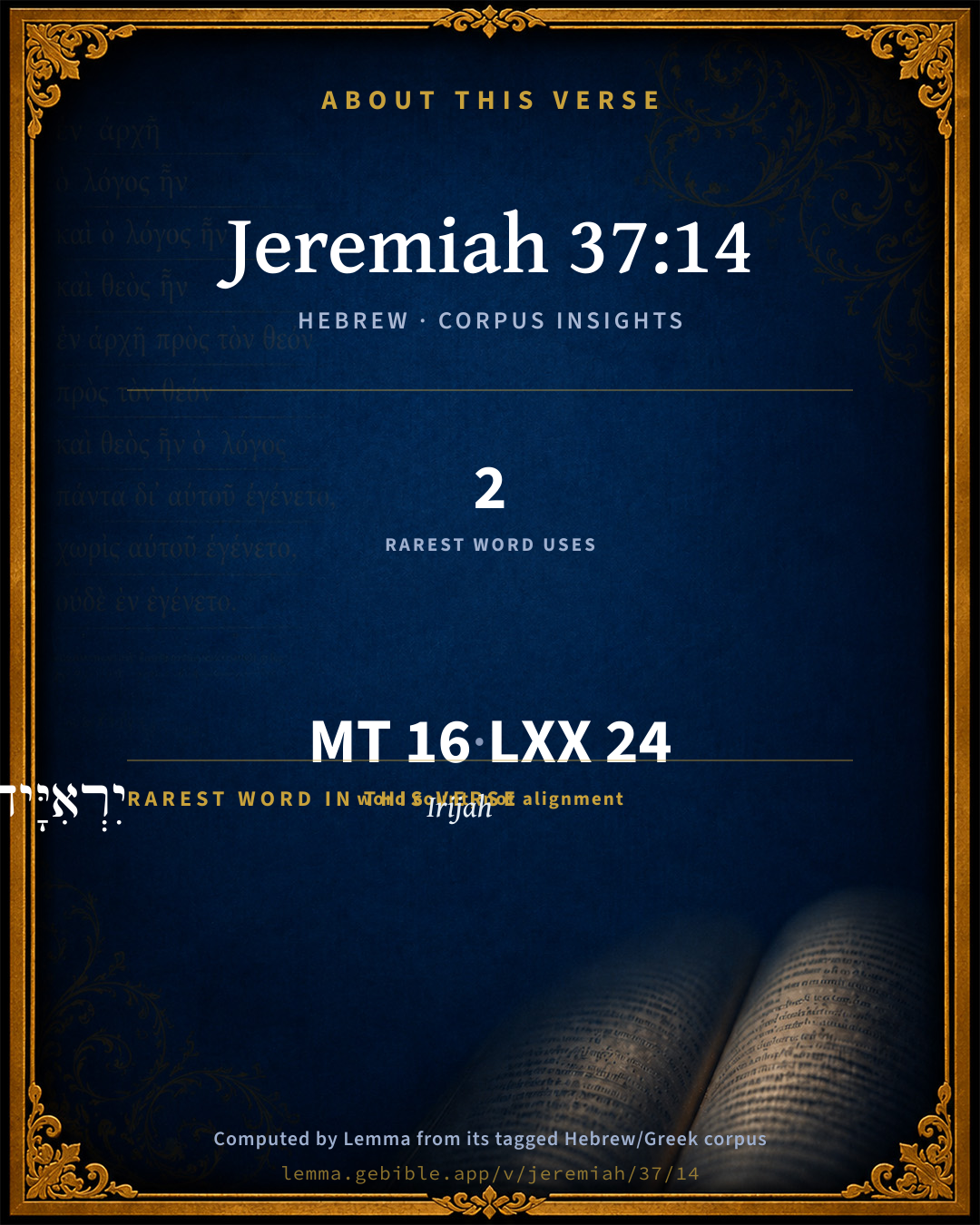
About this verse

These counts appear in no published source. They are computed here, from the morphology-tagged text and Lemma’s own curated glosses. What Lemma adds →

16
words
14
distinct lemmas
Prophets
section

Notable vocabulary

The rarest word here is יִרְאִיָּיה֙ Irijah H3376 — appearing just 2 times in the whole Hebrew Bible.

Shared distinctive vocabulary

יִרְאִיָּיה֙ Irijah H3376 occurs in 2 verses of the Hebrew Bible. Also found in:

Grammatical profile

  • 5 verbs
  • 6 nouns
  • 3 prepositions
  • 2 particles

Verb forms

  • וַיֹּ֨אמֶר Qal · Sequential Imperfect
  • נֹפֵל֙ Qal · Participle Active
  • שָׁמַ֖ע Qal · Perfect
  • וַיִּתְפֹּ֤שׂ Qal · Sequential Imperfect
  • וַיְבִאֵ֖הוּ Hiphil · Sequential Imperfect

Repetition

Words recur within this verse — often emphatic in Hebrew:

  • יִרְמְיָ֜הוּ Jeremiah H3414 ×2
  • אֵלָ֑יו to H413 ×2

Hebrew & Septuagint length

In the original languages it is 16 Hebrew tokens and 24 Greek tokens — but the two are counted differently (Hebrew bundles its prefixes and suffixes into one token; the Greek is in lemma form), so that isn’t a like-for-like length.

Cross-references

10

Topical passages linked to Jeremiah 37:14 in the Treasury of Scripture Knowledge — connected by theme and wording, ordered by reader-vote popularity; previews shown in the World English Bible.

  • Psalms 27:12 Don't deliver me over to the desire of my adversaries, For false witnesses have risen up against me, Such as breathe out cruelty.
  • Psalms 52:1–2 Why do you boast of mischief, mighty man? God's loving kindness endures continually.
  • Jeremiah 40:4–6 Now, behold, I loose you this day from the chains which are on your hand. If it seem good to you to come with me into Babylon, come, and I will look well to you; but if it seem ill to you to come with me into Babylon, forbear: behold, all the land is before you; where it seems good and right to you to go, there go.
  • Matthew 5:11–12 "Blessed are you when people reproach you, persecute you, and say all kinds of evil against you falsely, for my sake.
  • Nehemiah 6:8 Then I sent to him, saying, There are no such things done as you say, but you feign them out of your own heart.
  • Psalms 35:11 Unrighteous witnesses rise up. They ask me about things that I don't know about.
  • Luke 6:22–23 Blessed are you when men shall hate you, and when they shall exclude and mock you, and throw out your name as evil, for the Son of Man's sake.
  • Luke 6:26 Woe, when men speak well of you! For their fathers did the same thing to the false prophets.
  • 1 Peter 3:16 having a good conscience; that, while you are spoken against as evildoers, they may be disappointed who curse your good manner of life in Christ.
  • 1 Peter 4:14–16 If you are insulted for the name of Christ, blessed are you; because the Spirit of glory and of God rests on you. On their part he is blasphemed, but on your part he is glorified.

Cross-references courtesy of OpenBible.info (CC BY 4.0).

Hebrew and Greek witnesses Masoretic Hebrew ↔ Greek Septuagint

The same verse in the two great witnesses to the Old Testament, shown verse-for-verse.

These are two independent witnesses, not word-aligned to each other, and the Septuagint is shown in lemma (dictionary) form.

Hebrew Jeremiah 37:14 Masoretic · Westminster Leningrad Codex

וַיֹּ֨אמֶר יִרְמְיָ֜הוּ שֶׁ֗קֶר אֵינֶ֤נִּי נֹפֵל֙ עַל הַכַּשְׂדִּ֔ים וְלֹ֥א שָׁמַ֖ע אֵלָ֑יו וַיִּתְפֹּ֤שׂ יִרְאִיָּיה֙ בְּיִרְמְיָ֔הוּ וַיְבִאֵ֖הוּ אֶל הַשָּׂרִֽים

Then said Jeremiah, It is false; I am not falling away to the Chaldeans. But he didn't listen to him; so Irijah laid hold on Jeremiah, and brought him to the princes.

World English Bible · Public Domain

Greek LXX Structure differs

In the Septuagint, Jeremiah is about an eighth shorter than the Hebrew and arranges its material differently — the Oracles Against the Nations (Hebrew chapters 46–51) appear in the middle of the Greek book, after 25:13. Because the chapter and verse boundaries do not line up, a verse-for-verse comparison with the Hebrew is not shown.

A verse-for-verse comparison isn’t shown here because the chapters and verses don’t line up. Switch to the LXX edition with the MT / LXX toggle above to read the Greek directly.

Hebrew: Westminster Leningrad Codex (CC BY 4.0). Greek: Septuagint (public domain); English from a public-domain English Septuagint. How the Septuagint differs from the Hebrew →

Targum (Aramaic paraphrase)

1

The Targum is the ancient Jewish Aramaic paraphrase of the Hebrew Scriptures — an interpretive translation, not the Hebrew text itself. Onkelos (literal) and Pseudo-Jonathan (expansive) render the Torah, and Jonathan the Prophets. Coverage is partial: where no permissively-licensed English translation exists for a verse, only the Aramaic is shown. This is verse-level text, not a word-by-word alignment to the Hebrew.

  1. Targum Jonathan Prophets (Joshua–Malachi)
    וַאֲמַר יִרְמְיָה שִׁקְרָא אַתְּ אֲמַר לֵית אֲנָא מִשְׁתְּמַע לְכַסְדָאֵי וְלָא קַבֵּיל מִנֵיהּ וַאֲחַד יִרְאִיָה בְּיִרְמְיָה וְאַיְתֵיהּ לְוַת רַבְרְבַיָא:

    (no public-domain English translation for this verse)

    Targum Jonathan — Aramaic: “Mikraot Gedolot” (public domain). English: “Sefaria Community Translation” (CC0 1.0 (public-domain dedication)); “London "Chaldee Paraphrase," 1871” (public domain). Text via Sefaria.

Commentary

Notes on Jeremiah 37:14 from classic Christian and Jewish commentators (each source and its license shown beneath its notes). The classic Christian expositions comment on the surrounding passage and are grouped to its opening verse, so a note may address several verses; the Jewish commentaries on the Tanakh (Rashi and others) are per-verse, so they appear only where the commentator wrote on this verse.

Lemma curates 59 commentaries, every one of them public domain or Creative Commons licensed, each selected and text-cleaned for this edition rather than reprinted as found. About our sources →

Trapp's Complete Commentary

John Trapp

Jer 37:14 Then said Jeremiah, [It is] false; I fall not away to the Chaldeans. But he hearkened not to him: so Irijah took Jeremiah, and brought him to the princes.

Ver. 14. Then said Jeremiah, It is false.] Satanae pectus mendaciis faecundissimum est. {a} It is no news for innocence to be slandered, and to go with a scratched face.

But he hearkened not unto him.] Right or wrong, he must come before the princes, who do also handle the good prophet very coarsely.

{a} Luther.

John Trapp, A Commentary or Exposition upon All the Books of the Old and New Testament (1647–1656) — public domain. Text from a community e-Sword module.

Ellicott's Commentary for English Readers

(14) Irijah took Jeremiah, and brought him to the princes.—These were probably, as a body, identical with those named in Jer_36:12, but the party opposed to the prophet were now apparently stronger than they had been. Neither they nor Irijah would listen to the prophet’s denial of the accusation. The fact that the siege had been raised by the Chaldæans may have given fresh strength to the party of resistance. Possibly also many of the prophet’s friends had shared the captivity of Jehoiakim.

A Bible Commentary for English Readers, edited by Charles John Ellicott (1878–1897) — public domain. Text from a community e-Sword module.

John Gill's Exposition

Then said Jeremiah, it is false,.... Or a "falsehood" (k); as undoubtedly it was;

I fall not away to the Chaldeans; for the Chaldean army was gone from the city; nor did Jeremiah like so well to be with an idolatrous people; for after the city was taken, when Nebuzaradan the captain of the guard gave him his choice, either to go with him to Babylon, where he promised to take care of him; or to go to Gedaliah, who was made governor of Judah; he chose rather to be with him, and his poor company:

but he hearkened not to him; would not hear his defence, or however would not give any credit to it, being unwilling to let slip this opportunity of doing him ill will:

so Irijah took Jeremiah, and brought him to the princes; the princes of Zedekiah's court, or the princes of the people, the civil magistrates; or it may be the great sanhedrim, who he knew had no good disposition towards the prophet.

(k) "mendacium est", Vatablus; "falsitas, calumnia", Schmidt.

John Gill's Exposition of the Whole Bible (1746–1763) — public domain (CC PDM 1.0). Text via the HelloAO Bible API.

Albert Barnes' Notes on the Bible

The princes - Not the noblemen trained in the days of Josiah and Jeremiah’s friends Jer 26:16, but those described in Jer 24:8. They assumed that the accusation was true; they first scourged and then imprisoned Jeremiah.

Albert Barnes' Notes on the Bible (1834–1885) — public domain. Text from a community e-Sword/MySword module.

Haydock's Catholic Bible Commentary

Beat him, as a traitor and fugitive. --- Prison, very deep, ver. 19. (Calmet)

George Leo Haydock (1774–1849), Haydock's Catholic Family Bible and Commentary, 1859 edition — public domain. Excludes Psalms (Douay-Rheims chapter numbering differs from Protestant) and Deuterocanonical books (Catholic canon only).

Matthew Poole's English Annotations

Though Jeremiah, as the Lord’s prophet, faithfully revealed the will of God, that the Chaldeans should take the city, to warn the people (if possible) to prevent it by solemn addresses unto God, or at least to prevent what mischief might be prevented by a timely surrender to the king of Babylon, yet he had no design to fly to them; he was so far from delighting in their company, that when the city was taken, and the captain of the guard offered him either to go along with him to Babylon, promising to look well to him, Jer 40:4,5, or to go back to Gedaliah, whom the king of Babylon had left as deputy governor in Judea, he chose rather to go and dwell under Gedaliah’s government in a poor condition, than to mend his commons in an idolatrous country: but the captain would not believe him, but carrieth him before the princes.

Matthew Poole's English Annotations on the Holy Bible (1683–1685) — public domain. Text from a community e-Sword/MySword module.

Whedon's Commentary on the Bible

Daniel D. Whedon

14. The princes — These were not the men who had twice before espoused the cause of Jeremiah. Chaps. 26 and 36. Probably those had been carried away with Jeconiah, and their places were now filled by men less worthy.

Daniel D. Whedon (gen. ed.), Commentary on the Old and New Testaments (1874–1909) — public domain. Text from a community e-Sword module.

The Pulpit Commentary

Vers. 14, 15. Characteristics of injustice.

They may be traced in the incident recorded in these verses. Unjust judges as were these

I WILL NOT HEARKEN TO THE ACCUSED.

II ARE BIASED BY PASSION.

III ARE NEEDLESSLY CRUEL.

IV SEEK NOT EIGHT, BUT REVENGE.

LEARN. To be careful what manner of spirit we are of whenever we are called upon to judge one another. Let us be thankful that the Judge before whom we stand, and who surveys all our ways, is that gracious Lord to whom the Father has committed all judgment, and who judges not righteously only, but in all mercy as well. C.

The Pulpit Commentary (1880–1919), ed. H.D.M. Spence-Jones & Joseph S. Exell — public domain. Text from a community e-Sword module.

Keil & Delitzsch

C. F. Keil & F. Delitzsch

Jeremiah replied: "A lie [= not true; cf. Kg2 9:12]; I am not going over to the Chaldeans. But he gave no heed to him; so Jeriah seized Jeremiah, and brought him to the princes. Jer 37:15. And the princes were angry against Jeremiah, and smote him, and put him in prison, in the house of Jonathan the scribe; for they had made it the prison," - probably because it contained apartments suitable for the purpose. From Jer 37:16 we perceive that they were subterranean prisons and vaults into which the prisoners were thrust; and from v. 28 and Jer 38:26, it is clear that Jeremiah was in a confinement much more severe and dangerous to his life. There he sat many days, i.e., a pretty long time.

Keil & Delitzsch — Biblical Commentary on the Old Testament (1861–1891) — public domain (CC PDM 1.0). Text via the HelloAO Bible API. (Old Testament only.)

unfoldingWord translationNotes

Door43 World Missions Community

deserting

This means escaping trouble and leaving people who need help.

Irijah

See how you translated this man's name in Jeremiah 37:13. (See: How to Translate Names)

officials

See how you translated this in Jeremiah 1:18.

Jonathan the scribe

"Jonathan, who was a scribe." This is a man's name. (See: Numbers)

translationWords

Jeremiah

true

Chaldea

anger

prison

house

Jonathan

scribe

unfoldingWord translationNotes — © Distant Shores Media and the Door43 World Missions Community, licensed CC BY-SA 4.0. Source: git.door43.org/Door43/en_tn.

Lesson kit

Teaching starters — assembled from the data on this page, not authored interpretation. Every prompt links to the verse data it draws on. Edit before teaching.

Jeremiah, in the Prophets, opens this verse with 16 words (14 distinct Hebrew lemmas). Its most distinctive word is Yirʼîyâyh (“Irijah”). A historical commentator’s framing appears above. Read the whole chapter for the surrounding context.

Discussion questions

  1. How does “Irijah” (Yirʼîyâyh) shape what this verse is saying?
  2. Jeremiah 37:13 shares the word «Irijah» with this verse. How do the two illuminate each other?
  3. “Jeremiah” occurs 2× in this one verse. What is the effect of the repetition?
  4. The translations on this page render this verse differently — a whole-verse word diff, not a word-by-word alignment. What might account for the different wordings?
  5. The verb «וַיֹּ֨אמֶר» is Qal Sequential Imperfect. How does its form color the action?
  6. Reading how Trapp's Complete Commentary and Ellicott's Commentary for English Readers read this verse, where do the two commentators agree and where do they part?

Things to notice

Reading settings

Reading text

Shown beneath each verse's original-language words.

Old Testament
Old Testament edition

Read the OT as the Masoretic Hebrew (MT) or the Greek Septuagint (LXX).

English shown for the Greek Septuagint (in the Hebrew ↔ Greek comparison).

Comparing translations? Open the Compare panel on any verse page to stack up to four side by side.