
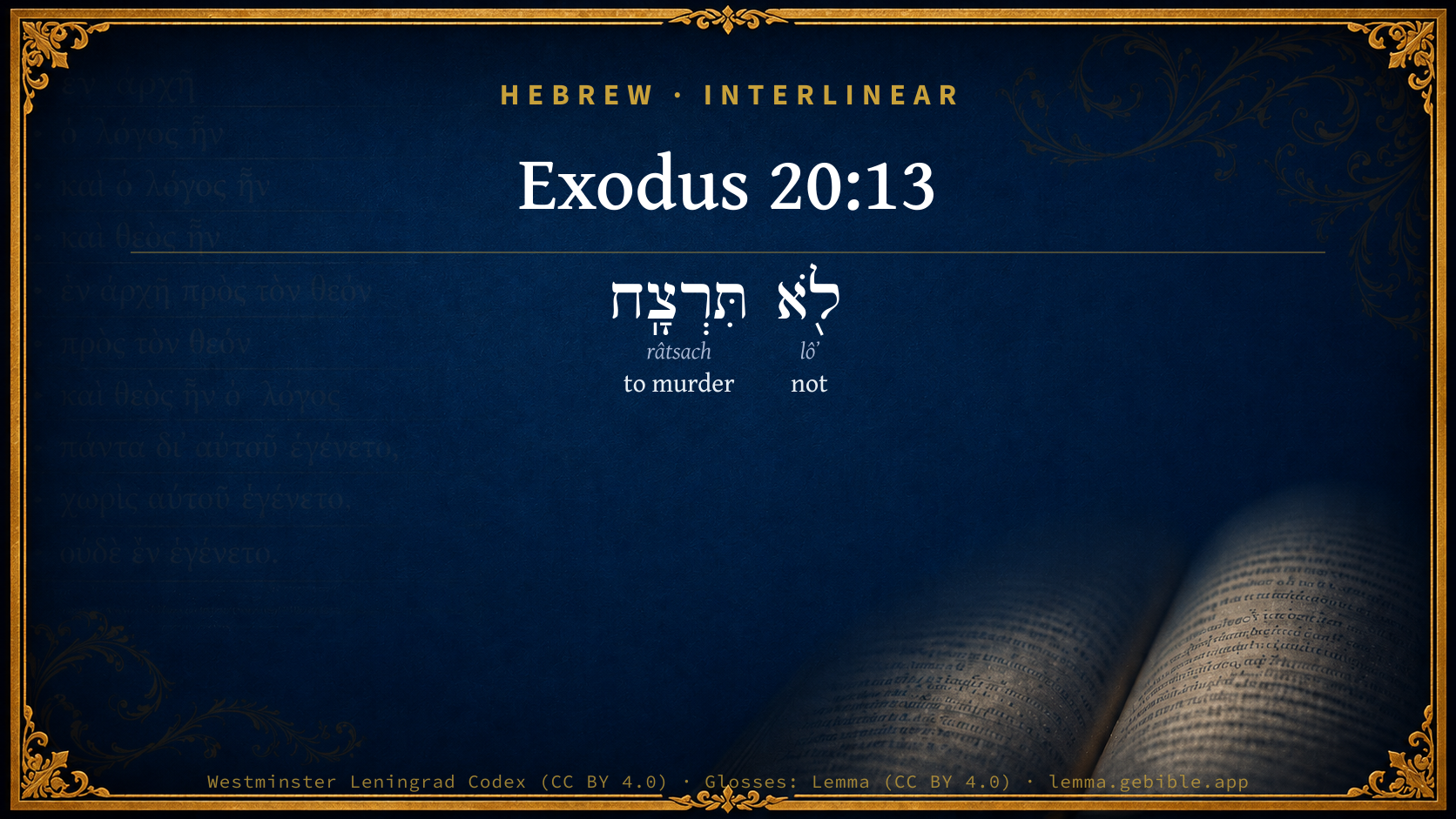
Exodus 20:13

Hebrew (Westminster Leningrad Codex) Exodus 20:13 appears in the Hebrew Old Testament. The text above is from the Westminster Leningrad Codex. Each word links to its Strong’s number, a concise gloss, and parsing drawn from the Open Scriptures Hebrew Bible morphology. Click any word for its full Brown-Driver-Briggs (BDB) entry.
Download image
Cite this verse

Exodus 20:13 (World English Bible). Public Domain. Lemma interlinear Bible study tool, https://lemma.gebible.app/v/exodus/20/13.

Show BibTeX & RIS
BibTeX
RIS
English Translation
"You shall not murder.
World English Bible · Public Domain
Highlights
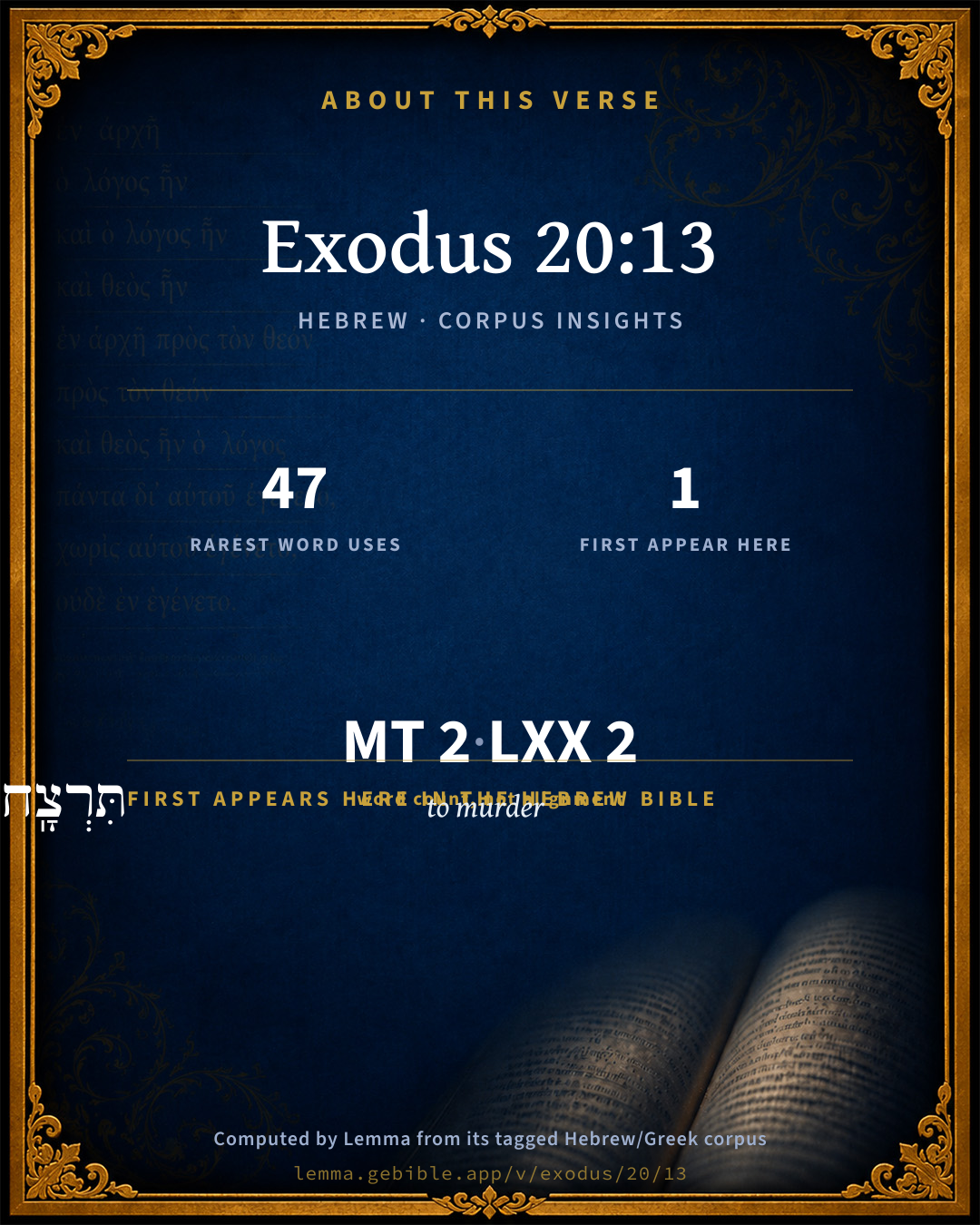
  • 1 first appearance in the Hebrew Bible
Full analysis ↓
Download a study sheet

One document with this verse’s original text, its word-by-word gloss line, the meaning frame, cross-references with their text, attributed commentary, and full source and license credits — printable, and it pastes into notes with its structure intact.

This verse Autodidact and up

Study sheet (.html) Plain text (.txt)

A passage Seminary Student

Up to 50 verses in one chapter. A passage sheet keeps up to 6 commentary sources and 12 cross-references per verse, in the order this page ranks them, and says so on the sheet whenever that leaves anything out. Ask for a single verse and you get the Autodidact verse sheet above.

Everything on this page stays free to read, with no account — the sheet is a download of what is already on screen, not access to it.

Want to remove ads? Support Godless Engineer
Compare translations 3

The same verse in 3 English versions, stacked beneath the original-language interlinear above. Click any original word for its lexicon entry.

Each is an independent rendering of the whole verse — the interlinear is not word-aligned to these translations.

Highlighted words mark where these versions differ — a whole-verse word diff, not a word-by-word alignment.

  • World English Bible Public Domain
    "You shall not murder.
  • King James Version Public Domain
    Thou shalt not kill.
  • unfoldingWord Literal Text CC BY-SA 4.0
    You shall not murder.

unfoldingWord Literal Text — © unfoldingWord, licensed CC BY-SA 4.0. Word-aligned USFM3 via Door43 (git.door43.org/unfoldingWord/en_ult).

Versions to compare (up to 4)

3 of 4 selected

Show all 18 translations

Every available English version of this verse, each an independent rendering of the whole verse.

  • World English Bible Public Domain
    "You shall not murder.
  • Berean Standard Bible Public Domain
    You shall not murder.
  • Majority Standard Bible Public Domain
    You shall not murder.
  • King James Version Public Domain
    Thou shalt not kill.
  • American Standard Version (1901) Public Domain
    Thou shalt not kill.
  • Revised Version (1885) Public Domain
    Thou shalt do no murder.
  • Geneva Bible (1599) Public Domain
    Thou shalt not kill.
  • Douay-Rheims (1899) Public Domain
    Thou shalt not kill.
  • Young's Literal Translation Public Domain
    `Thou dost not murder.
  • Literal Standard Version CC BY-SA 4.0
    You do not murder.
  • Unlocked Literal Bible CC BY-SA 4.0
    You must not murder anyone.
  • unfoldingWord Literal Text CC BY-SA 4.0
    You shall not murder.
  • Darby Bible Public Domain
    Thou shalt not kill.
  • World Messianic Bible Public Domain
    “You shall not murder.
  • Webster's Bible Public Domain
    Thou shalt not kill.
  • Free Bible Version CC BY-SA 4.0
    You must not murder.
  • Bible in Basic English Public Domain
    Do not put anyone to death without cause.
  • JPS Tanakh (1917) Public Domain
    Thou shalt not murder.

Literal Standard Version (2020), Covenant Press — licensed CC BY-SA 4.0. Text via the HelloAO Bible API (eBible.org). Unlocked Literal Bible (unfoldingWord) — licensed CC BY-SA 4.0. Text via the HelloAO Bible API (eBible.org). unfoldingWord Literal Text — © unfoldingWord, licensed CC BY-SA 4.0. Word-aligned USFM3 via Door43 (git.door43.org/unfoldingWord/en_ult). Free Bible Version, Dr. Jonathan Gallagher — licensed CC BY-SA 4.0. Text via the HelloAO Bible API (eBible.org).

Word by word

More ways to search: Search by grammar → Find every occurrence → Compare this word →

Practice this passage: Drill this verse → Learn its vocabulary →

תִּרְצָֽח
râtsach
H7523
“to murder”
Verb, Qal, Imperfect, 2nd Person, Masculine, Singular
Part of Speech
Verb
Stem
Qal
Form
Imperfect
Person
2nd Person
Gender
Masculine
Number
Singular
Full BDB Definition

Origin: a primitive root

TWOT: 2208

to murder, slay, kill - (Qal) to murder, slay - premeditated - accidental - as avenger - slayer (intentional) (participle) - (Niphal) to be slain - (Piel) - to murder, assassinate - murderer, assassin (participle) (substantive) - (Pual) to be killed
  1. לֹ֖א lôʼ H3808 “not” Particle, Negative

About this verse

These counts appear in no published source. They are computed here, from the morphology-tagged text and Lemma’s own curated glosses. What Lemma adds →

2
words
2
distinct lemmas
Pentateuch
section

First appearance in Scripture

This word makes its first canonical appearance in the Hebrew Bible here:

  • תִּרְצָֽח to murder H7523

Shared distinctive vocabulary

תִּרְצָֽח to murder H7523 occurs in 40 verses of the Hebrew Bible. Also found in:

Grammatical profile

  • 1 verb
  • 1 particle

Verb forms

  • תִּרְצָֽח Qal · Imperfect

Hebrew & Septuagint length

In English translation the verse runs 4 words from the Hebrew and 5 from the Septuagint (LXX English) — closely comparable.

A rough comparison of the two English renderings, which tokenize alike — not a word-level alignment.

Word counts can differ between the Hebrew and the Greek without any difference in meaning — e.g. the Hebrew direct-object marker אֵת has no separate Greek word, and Greek often adds the article ὁ.

In the original languages it is 2 Hebrew tokens and 2 Greek tokens — but the two are counted differently (Hebrew bundles its prefixes and suffixes into one token; the Greek is in lemma form), so that isn’t a like-for-like length.

Cross-references

26

Topical passages linked to Exodus 20:13 in the Treasury of Scripture Knowledge — connected by theme and wording, ordered by reader-vote popularity; previews shown in the World English Bible.

  • Romans 13:9 For the commandments, "You shall not commit adultery," "You shall not murder," "You shall not steal," "You shall not give false testimony," "You shall not covet," and whatever other commandments there are, are all summed up in this saying, namely, "You shall love your neighbor as yourself."
  • Deuteronomy 5:17 "You shall not murder.
  • Genesis 9:5–6 I will surely require your blood of your lives. At the hand of every animal I will require it. At the hand of man, even at the hand of every man's brother, I will require the life of man.
  • Exodus 21:14 If a man schemes and comes presumptuously on his neighbor to kill him, you shall take him from my altar, that he may die.
  • Matthew 5:21–22 "You have heard that it was said to the ancient ones, 'You shall not murder;' and 'Whoever shall murder shall be in danger of the judgment.'
  • Leviticus 24:21 He who kills an animal shall make it good; and he who kills a man shall be put to death.
  • Deuteronomy 19:11–13 But if any man hate his neighbor, and lie in wait for him, and rise up against him, and strike him mortally so that he dies, and he flee into one of these cities;
  • Matthew 19:18 He said to him, "Which ones?" Jesus said, "'You shall not murder.' 'You shall not commit adultery.' 'You shall not steal.' 'You shall not offer false testimony.'
  • James 2:11 For he who said, "Do not commit adultery," said also, "Do not commit murder." Now if you do not commit adultery, but murder, you have become a transgressor of the law.
  • Exodus 21:20 "If a man strikes his servant or his maid with a rod, and he dies under his hand, he shall surely be punished.
  • James 2:13 For judgment is without mercy to him who has shown no mercy. Mercy triumphs over judgment.
  • 1 John 3:12–15 unlike Cain, who was of the evil one, and killed his brother. Why did he kill him? Because his works were evil, and his brother's righteous.
  • Isaiah 26:21 For, behold, Yahweh comes forth out of his place to punish the inhabitants of the earth for their iniquity: the earth also shall disclose her blood, and shall no more cover her slain.
  • 1 Timothy 1:9 as knowing this, that law is not made for a righteous man, but for the lawless and insubordinate, for the ungodly and sinners, for the unholy and profane, for murderers of fathers and murderers of mothers, for manslayers,
  • Proverbs 1:11 If they say, "Come with us, Let's lay in wait for blood; Let's lurk secretly for the innocent without cause;
  • Proverbs 1:18 But these lay wait for their own blood. They lurk secretly for their own lives.
  • Galatians 5:21 envyings, murders, drunkenness, orgies, and things like these; of which I forewarn you, even as I also forewarned you, that those who practice such things will not inherit the Kingdom of God.
  • Genesis 4:8–23 Cain said to Abel, his brother, "Let's go into the field." It happened, when they were in the field, that Cain rose up against Abel, his brother, and killed him.
  • Exodus 21:29 But if the bull had a habit of goring in the past, and it has been testified to its owner, and he has not kept it in, but it has killed a man or a woman, the bull shall be stoned, and its owner shall also be put to death.
  • Numbers 35:16–34 But if he struck him with an instrument of iron, so that he died, he is a murderer: the murderer shall surely be put to death.
  • 2 Samuel 12:9–10 Why have you despised the word of Yahweh, to do that which is evil in his sight? You have struck Uriah the Hittite with the sword, and have taken his wife to be your wife, and have slain him with the sword of the children of Ammon.
  • 2 Kings 21:16 Moreover Manasseh shed innocent blood very much, until he had filled Jerusalem from one end to another; besides his sin with which he made Judah to sin, in doing that which was evil in the sight of Yahweh.
  • 2 Chronicles 24:22 Thus Joash the king didn't remember the kindness which Jehoiada his father had done to him, but killed his son. When he died, he said, Yahweh look on it, and require it.
  • Psalms 10:8–11 He lies in wait near the villages. From ambushes, he murders the innocent. His eyes are secretly set against the helpless.
  • Jeremiah 26:15 Only know for certain that, if you put me to death, you will bring innocent blood on yourselves, and on this city, and on the inhabitants of it; for of a truth Yahweh has sent me to you to speak all these words in your ears.
  • Acts 28:4 When the natives saw the creature hanging from his hand, they said one to another, "No doubt this man is a murderer, whom, though he has escaped from the sea, yet Justice has not allowed to live."

Cross-references courtesy of OpenBible.info (CC BY 4.0).

Hebrew and Greek witnesses Masoretic Hebrew ↔ Greek Septuagint

The same verse in the two great witnesses to the Old Testament, shown verse-for-verse.

These are two independent witnesses, not word-aligned to each other, and the Septuagint is shown in lemma (dictionary) form.

Hebrew Exodus 20:13 Masoretic · Westminster Leningrad Codex

לֹ֖א תִּרְצָֽח

"You shall not murder.

World English Bible · Public Domain

Greek LXX Exodus 20:13 Septuagint · lemma form

οὐ μοιχεύω

You shall not commit adultery.

LXX2012 (modern English Septuagint) · Public Domain

On this verse, John Gill's Exposition discusses the Septuagint’s reading. Read the note in Commentary ↓

Hebrew: Westminster Leningrad Codex (CC BY 4.0). Greek: Septuagint (public domain); English from LXX2012 (modern English Septuagint) (Public Domain). How the Septuagint differs from the Hebrew →

Targum (Aramaic paraphrase)

2

The Targum is the ancient Jewish Aramaic paraphrase of the Hebrew Scriptures — an interpretive translation, not the Hebrew text itself. Onkelos (literal) and Pseudo-Jonathan (expansive) render the Torah, and Jonathan the Prophets. Coverage is partial: where no permissively-licensed English translation exists for a verse, only the Aramaic is shown. This is verse-level text, not a word-by-word alignment to the Hebrew.

  1. Targum Onkelos Torah (Genesis–Deuteronomy)
    לָא תִקְטוֹל נְפָשׁ לָא תְגוּף לָא תִגְנוּב לָא תַסְהֵד בְּחַבְרָךְ סַהֲדוּתָא דְשִׁקְרָא:

    (no public-domain English translation for this verse)

    Targum Onkelos — Aramaic: “Onkelos Genesis” (public domain); “Onkelos Exodus” (public domain); “Onkelos Leviticus” (public domain); “Onkelos Numbers” (public domain); “Onkelos Deuteronomy” (public domain). English: “Sefaria Community Translation” (CC0 1.0 (public-domain dedication)); “J.W. Etheridge. The Targums of Onkelos and Jonathan Ben Uzziel on the Pentateuch. London: Longmans, Green, 1862” (public domain). Text via Sefaria.

  2. Targum Pseudo-Jonathan Torah (Genesis–Deuteronomy)
    עַמִּי בְּנֵי יִשְרָאֵל לָא תֶהֱווּן קְטוֹלִין לָא חַבְרִין וְלָא שׁוּתְּפִין עִם קְטוֹלִין וְלָא יִתְחָמֵי בִּכְנִשְׁתְּהוֹן דְּיִשְרָאֵל עִם קְטוֹלִין וְלָא יְקוּמוּן בְּנֵיכוֹן מִן בַּתְרֵיכוֹן וְיִלְפוּן לְחוֹד הִינוּן לְמֶהֱוֵי עִם קְטוֹלִין אֲרוּם בְּחוֹבֵי קְטוֹלַיָא חַרְבָּא נָפִיק עַל עַלְמָא: לא תנאף עַמִּי בְּנֵי יִשְרָאֵל לָא תֶהֱווּן גִּיּוּרִין לָא חַבְרִין וְלָא שׁוּתָּפִין עִם גִּיּוּרִין וְלָא יִתְחָמֵי בִּכְנִשְׁתְּהוֹן דְּיִשְרָאֵל עִם גִּיּוּרִין דְּלָא יְקוּמוּן בְּנֵיכוֹן מִן בַּתְרֵיכוֹן וְיִלְפוּן לְחוֹד הִינוּן לְמֶהֱוֵי עִם גִּיּוּרִין אֲרוּם בְּחוֹבֵי גִיּוּרָא מוֹתָא נָפִיק עַל עַלְמָא: לא תגנוב עַמִּי בְּנֵי יִשְרָאֵל לָא תֶהֱווּן גַּנָּבִין לָא חַבְרִין וְלָא שׁוּתָּפִין עִם גַּנָּבִין וְלָא יִתְחָמֵי בִּכְנִשְׁתְּהוֹן דְּיִשְרָאֵל עִם גַּנָּבִין דְּלָא יְקוּמוּן בְּנֵיכוֹן מִן בַּתְרֵיכוֹן וְיִלְפוּן לְחוֹד הִינוּן לְמֶהֱוֵי עִם גַּנָּבִין אֲרוּם בְּחוֹבֵי גַנָבַיָא כַּפְנָא נָפִיק עַל עַלְמָא: לא תענה עַמִּי בְּנֵי יִשְרָאֵל לָא תֶהֱווּן מְסַהֲדִין בְּחַבְרֵיכוֹן סַהֲדֵי שִׁיקְרָא לָא חַבְרִין וְלָא שׁוּתָּפִין עִם מְסַהְדִין סַהֲדֵי שִׁקְרָא וְלָא יִתְחָמֵי בִּכְנִשְׁתְּהוֹן דְּיִשְרָאֵל עִם מְסַהֲדִין סַהֲדֵי שִׁיקְרָא דְלָא יְקוּמוּן בְּנֵיכוֹן בַּתְרֵיכוֹן וְיִלְפוּן לְחוֹד הִינוּן לְמֶהֱוֵי עִם מְסַהֲדִין סַהֲדֵי שִׁיקְרָא אֲרוּם בְּחוֹבֵי סַהֲדֵי שִׁיקְרָא עֲנָנָן סַלְקִין וּמִטְרָא לָא נָחִית וּבְצוֹרָתָא אַתְיָא עַל עַלְמָא

    My people, the sons of Israel, You. shall not be murderers; you shall not be companions of or partakers with murderers: in the congregations of Israel there shall not be seen a murderous people; neither shall your sons rise up after you and teach one another to take part with murderers: for on account of the guilt of murder the sword cometh forth upon the world: My people of the house of Israel, Be ye not adulterers, nor companions nor partakers with adulterers: nor in the congregations of Israel shall there be seen an adulterous people, that your sons may not arise after you to teach one another to have part with adulterers: for through the guilt of adultery death cometh forth upon the world: Sons of Israel My people, Ye shall not be thieves, nor companions nor partakers with thieves: there shall not be seen in the congregations of Israel a thievish people; that your sons may not arise after you to teach one another to have part with thieves: for on account of the guilt of theft famine cometh forth upon the world: Sons of Israel My people, Ye shall not testify against your neighbours a testimony of falsehood, nor be companions or partakers with those who bear false witness nor shall there be seen in the congregations of Israel a people who testify a testimony of falsehood; neither shall your sons arise after you to teach one another to have part with those who testify falsehood: for because of the guilt of false testimony the clouds go up and the rain cometh not down, and dryness cometh upon the world.

    Targum Pseudo-Jonathan — Aramaic: “Targum Jonathan on Genesis” (public domain); “Targum Jonathan on Exodus” (public domain); “Targum Jonathan on Leviticus” (public domain); “Targum Jonathan on Numbers” (public domain); “Targum Jonathan on Deuteronomy” (public domain). English: “The Targum of Jonathan ben Uzziel, trans. J. W. Etheridge, London, 1862” (public domain). Text via Sefaria.

Commentary

Notes on Exodus 20:13 from classic Christian and Jewish commentators (each source and its license shown beneath its notes). The classic Christian expositions comment on the surrounding passage and are grouped to its opening verse, so a note may address several verses; the Jewish commentaries on the Tanakh (Rashi and others) are per-verse, so they appear only where the commentator wrote on this verse.

Lemma curates 59 commentaries, every one of them public domain or Creative Commons licensed, each selected and text-cleaned for this edition rather than reprinted as found. About our sources →

Trapp's Complete Commentary

John Trapp

Exo 20:13 Thou shalt not kill.

Ver. 13. Thou shalt not kill.] A crying sin. {Gen 4:8-26; Gen 4:24} For the which God makes inquisition, {Psa 9:12} and strangely brings it to light. It was a saying of King James, that if God did allow him to kill a man, he would think God did not love him. {See Trapp (for summary of Law) on "Exo 20:17"}

John Trapp, A Commentary or Exposition upon All the Books of the Old and New Testament (1647–1656) — public domain. Text from a community e-Sword module.

The Biblical Illustrator

Joseph S. Exell

Exo_20:13

Thou shalt not kill.

The Sixth Commandment

I. That this Commandment was intended, as some suppose, to forbid the infliction of capital punishment, is inconceivable. The Mosaic law itself inflicted death for murder, Sabbath-breaking, and the selling of a Jew into slavery. The root of the Commandment lies in the greatness of human nature; man is invested with a supernatural and Divine glory; to maintain the greatness of man it may be sometimes necessary that the murderer, who in his malice forgets the mystery and wonderfulness of his intended victim, should be put to death.

II. Does the Commandment absolutely forbid war between nations? Certainly not. The nation to which it was given had a strict military organization, organized by the very authority from which the Commandment came. Moses himself prayed to God that the hosts of Israel might be victorious over their enemies. Wars of ambition, wars of revenge--these are crimes. But the moral sense of the purest and noblest of mankind has sanctioned and honoured the courage and heroism which repel by force of arms an assault on a nations integrity, and the great principle which underlies this Commandment sanctions and honours them too. (R. W. Dale, D. D.)

The Sixth and Seventh Commandments

There are very sad and fearful thoughts connected with these Commandments. But there are also very blessed thoughts connected with them.

I. Is it nothing to remember that the Lord God Himself watches over the life of every one of us, poor creatures as we are, that He has declared, and does declare, how precious it is in His eyes? Our life is subject to a thousand accidents. All things seem to conspire against it. Death seems to get the mastery over it at last. But no; He has said, Death, I will be thy plague. As every plant and tree seems to die in winter and revive in spring, so He says to this more wonderful life in our bodies, It shall go on, and this is the pledge and witness that it shall: the Head of you all, the Son of man, the only-begotten Son of God, died Himself and rose again. Gods conflict with death is accomplished. The grave shall not kill.

II. And so, again, the Lord is the God over the household. He who says, Thou shalt not kill, bids us understand that it is well to pour out blood as if it were water rather than to become base and foul creatures, beasts instead of His servants and children. That was the reason He sent the Israelites to drive out the Canaanites. They were corrupting and defiling the earth with their abominations. It was time that the earth should be cleared of them. The God who gave these Commandments is King now, and there is no respect of persons with Him.

III. Christ died to take away the sins of men. He died to unite men to the righteous and sinless God. The Lord our God, who has redeemed us out of the house of bondage, will always deliver us from sin, will give us a new, right, and clean heart. (F. D. Maurice, M. A.)

The Sixth Commandment

I. The sin forbidden. In this, thou shalt not kill, is meant the not injuring another.

1. We must not injure another in his name. We injure others in their name when we calumniate and slander them. No physician can heal the wounds of the tongue.

2. We must not injure another in his body. The life is the most precious thing; and God hath set this Commandment as a fence about it, to preserve it. All these sins which lead to murder are here forbidden: As

(1) Unadvised anger. Anger boils up the blood in the veins, and oft produceth murder; in their anger they slew a man.

(2) Envy. Anger is sometimes soon over, like fire kindled in straw, which is quickly out; but envy is a radicated thing, and will not quench its thirst without blood; who is able to stand before envy?

(3) Hatred. How many ways is murder committed?

We may be said to murder another:

1. With the hand: as Joab killed Abner and Amasa; he smote him in the fifth rib, and shed out his bowels.

2. Murder is committed with the mind. Malice is mental murder; whoso hateth his brother is a murderer.

3. Murder is committed with the tongue, by speaking to the prejudice of another, and causing him to be put to death.

4. Murder is committed with the pen. Uriah.

5. By consenting to anothers death. Saul.

6. By not hindering the death of another when in our power. Pilate.

7. By unmercifulness.

8. By taking away that which is necessary for the sustentation of life.

9. By not helping him when he is ready to perish. We must not injure anothers soul. Who do this?

(1) Such as corrupt others by bad example.

(2) Such as entice others to sin.

(3) Ministers are murderers, who starve, poison, or infect souls.

(4) Such as destroy others, by getting them into bad company, and so making them proselytes to the devil.

The second thing forbidden in it is, the injuring one-self; thou shalt not kill: thou shalt do no hurt to thyself.

1. Thou shalt not hurt thy own body. One may be guilty of self-murder, either

(1) Indirectly and occasionally; as, first, when a man thrusts himself into danger which he might prevent. Secondly, a person may be in some sense guilty of his own death, by neglecting the use of means. If sick, and use no physic, if he hath received a wound and will not apply balsam, he hastens his own death. Thirdly, by immoderate grief: the sorrow of the world worketh death; when God takes away a dear relation, and one is swallowed up with sorrow. How many weep themselves into their graves! Queen Mary grieved so excessively for the loss of Calais, that it broke her heart. Fourthly, by intemperance, excess in diet. Surfeiting shortens life; more die of it than by the sword; many dig their grave with their teeth; too much oil chokes the lamp; the cup kills more than the cannon.

(2) One may be guilty of self- murder, directly and absolutely. First, by envy. Envy corrodes the heart, dries up the blood, rots the bones; envy is the rottenness of the bones. It is to the body, as the moth to the cloth, it eats it, and makes its beauty consume; envy drinks its own venom. Second, by laying violent hands on himself, and thus he is felo de se; as Saul fell upon his own sword and killed himself. A mans self is most near to him, therefore this sin of self-murder breaks both the law of God, and the bonds of nature. Self-murderers are worse than the brute-creatures; they will tear and gore one another, but no beast will go to destroy itself. Self-murder is occasioned usually from discontent; discontent is joined with a sullen melancholy. The bird that beats herself in the cage, and is ready to kill herself, is the true emblem of a discontented spirit.

2. Here is forbidden hurting ones own soul.

Who are they that go about desperately to murder their own souls?

1. Such wilfully go about to murder their souls, who have no sense of God, or the other world; they are past feeling.

2. Such as are set wilfully to murder their own souls, are they who are resolved upon their lusts, let what will come of it. Men will, for a drop of pleasure, drink a sea of wrath.

3. They murder their souls, who avoid all means of saving their souls.

4. They do voluntarily murder their souls, who suck in false prejudices against religion; as if religion were so strict and severe, that they who espouse holiness, must live a melancholy life, like hermits and anchorites, and drown all their joy in tears. This is a slander which the devil hath cast upon religion: for there is no true joy but in believing.

5. They are wilfully set to murder their own souls, who will neither be good themselves, nor suffer others to be so.

II. The duty implied. That we should do all the good we can to ourselves and others.

1. In reference to others.

(1) To preserve the life of others. Comfort them in their sorrows, relieve them in their wants, be as the good Samaritan, pour wine and oil into their wounds. Grace makes the heart tender, it causeth sympathy and charity; as it melts the heart, in contrition towards God, so in compassion towards others.

(2) Love. Love loves mercy: it is a noble bountiful grace. Love, like a full vessel, will have vent; it vents itself in acts of liberality. To communicate to the necessities of others, is not arbitrary, it is not left to our choice whether we will or no, but it is a duty incumbent; charge them that are rich in this world that they do good, that they be rich in good works. God supplies our wants, and shall not we supply the wants of others? Shall we be only as a sponge to suck in mercy, and not as breasts to milk it out to others?

(3) It is implied, that we should endeavour to preserve the souls of others; counsel them about their souls, set life and death before them, help them to heaven.

2. In reference to ourselves.

The Commandment, thou shalt not kill, requires that we should preserve our own life and soul.

1. It is engraven upon every creature, that we should preserve our own natural life.

2. This Commandment requires, that we should endeavour, as to preserve our own life, so especially, to preserve our own souls. (T. Watson.)

The Sixth Commandment

This command forbids the illegal and unrighteous taking of life. What a terrible commentary upon the condition of man that there needs to be such a command as this, Thou shalt not kill! Sin is its only explanation. Consider--

I. The murderer.

1. This crime comes as the sequence to a life of terrible guilt.

2. It subjects him to the extreme penalty of the law, and holds him up as a monster unfit for human fellowship and life.

3. It does violence to the highest interests of his soul.

II. The murdered man.

1. Murder cuts him off in the midst of his days.

2. It destroys all his earthly interests, and does him the greatest injustice. No time given to set business in order or provide for household.

3. It endangers his eternal welfare.

III. Society.

1. Murder outrages the rights of life and property.

(1) It brings disgrace to the relations of the murderer.

(2) It injures the connections of the murdered one.

(3) It disturbs the peace of society, and even threatens the stability of good government.

2. Hence to defend life becomes a duty (Psa_82:3-4; Job_29:13).

(1) We are not at liberty to take our own life (Act_16:28).

(2) When a man is attacked be should defend himself; or, if others need help, he should assist them (Pro_24:11-12).

(3) The welfare of society demands that the life of the murderer should be exacted by the government, or that he should be kept in perpetual durance (Gen_9:6).

IV. Applications.

1. We should keep the heart free from hatred and the like.

2. We should cultivate a sweet disposition and control over temper and passion. The passionate man may commit murder in the frenzy of his excitement.

3. We should avoid everything that tends toward this crime, such as quarrels, differences, strong drink, and all other things whose tendency is to evolve passion and destroy self.control. (L. O. Thompson.)

The Sixth Commandment

Man alone has the inspiration of Deity. This Divine inbreathing is the august peculiarity which separates man discretively and everlastingly from the animal creation. On his body side he sprang from dust; on his soul side he sprang with the animals; on his spirit side he sprang from God. Thus in his very beginning, in the original make-up of him, man was a religious being. Coming into existence as Jehovahs inbreathing, man was, in the very fact of being Divinely inbreathed, Gods Son and Image. Hence it is that the human body is such a sacred thing. It is the shrine of Gods Son, Gods image, Gods likeness, Gods spirit, Gods breath. As such it is the priceless casket of unknown sacred potentialities. Hence, murder is, in the intensest sense of the word, sacrilege: not only a crime against man, but a crime against God, in whose image man is made. But murder may be of varying degrees of atrocity. Accordingly, let us now glance at some of the various forms of murder.

1. And, first, there is the murder which is born of malice, or murder in the common acceptation of the term. Murder of this kind, whether perpetrated swiftly, as by the bullet, or slowly, as by arsenic, is the most fiendish of crimes. And nature, in an especial manner, ever waits to avenge it. Nor is this strange; for, as we have seen, man, on his body side, is linked with the material creation. The same elements which compose our physical organism compose, although in different proportions, the water we drink, the food we eat, the air we breathe, the dust we await. Hence nature herself often becomes a principal factor in the detection of the murderer. She ever stands ready to be murders avenger, supplying the prosecuting attorney with her re-agents, even with blood-corpuscles themselves.

2. Again, there is the murder which is born of sudden passion: the murder, for example, of lynch-law, when a mob usurps the functions of a court of justice; the murder of sudden vengeance, as when an outraged husband encounters and slays the destroyer of his home; the murder of manslaughter, whether voluntary or involuntary, whether provoked by insult, by menace, or by alcohol.

3. Again, there is the murder which is born of despair. Suicide, when committed by a sane person, is murder. Indeed, how often the two crimes are committed by the same person--the murderer first slaying his victim, then slaying himself. Justly does the law pronounce a suicide a felo de se--that is, one who makes a felon of himself, suicide being felonious self-murder.

4. Again, there is the murder which is born of shame: I mean infanticide.

5. Again, there if the murder which is born of harmful occupations. First in this list I would put the dram shop; it matters not that the killing is slow; the killing is moral murder; and before every saloon I would post a placard.bearing the Sinaitic legend: Thou shalt not kill. Again, there is the sale, when not prescribed by the physician, of narcotic drugs, in their various forms, from opium joints to chloral drops. Again, there are the slow murders which are perpetrated in houses of nameless sin--murders which are particularly sacrilegious, because, as we have seen, the body is the temple of the Holy Spirit.

6. Again, there is the murder which is born of thoughtlessness (see Deu_22:8). It is one of the cheering signs of the times that the public is awakening to the sense of its grave responsibility in this direction, for example, demanding that life shall not be imperiled by the failure to provide substantial structures, fire-escapes, life-preservers, railway precautions, sanitary arrangements of fresh air and wholesome food and pure water and clean streets, isolated refuges for sufferers from contagious and infectious diseases, competent physicians and druggists and nurses, sufficient hours for rest on the part of operatives, excursions for children, sanitariums for the poor, parks and recreation grounds--in brief, hygienic regulations in general.

7. And now let us ponder Christs interpretation of the law against murder (Mat_5:21-22). According to Him, murder is not a matter of outward act, but of inward feeling: not a question of standing before the community, but of character before the All-seeing. No murder was ever committed which did not begin in the heart. Who of us has kept the Sixth Commandment as the Divine Man has interpreted it? Who of us has not been angry, passionate, revengeful, petulant? Remembering, then, these quarrels of ours, these grudges and piques and faults of temper, who of us is not in danger of the eternal Gehenna? But we are not yet through with the Sixth Commandment. Although it is prohibitive in form, saying, Thou shalt not kill, yet it is affirmative in spirit, saying, Thou shalt love. (G. D. Boardman.)

The law of mercy

I. The essential principle of this Commandment.

1. In preferring the old Prayer Book reading, Thou shalt do no murder, the revisers have done well. Killing may be no murder. The right of self-defence belongs both to the individual and the community.

2. Human life is sacred, but not so sacred as the end for which it is given, viz., that man created in the image of God should do His will. That is the paramount obligation. The will of God may make it right for us to lay down our lives, or right to defend them at the cost of death to others.

II. The Mosaic enunciation of this Commandment.

1. It is inconceivable that the great law-giver can have read it in the sense of an absolute Thou shalt not kill.

(1) If he had condemned killing in self-defence, he could not have formed the regulation in Exo_22:2.

(2) If he had condemned killing by public justice, he would not have ordained capital punishment, as he did not only for murder, but also for kidnapping, insolence to parents, adultery, sorcery, blasphemy, and Sabbath-breaking.

(3) If he had condemned killing in war, he would neither have engaged in it himself nor have left it as a solemn legacy to his successor.

(4) Against actual murder the law of Moses was uncompromising (see Deu_19:11-13; Exo_21:14.)

2. In this stern impartiality the Hebrew legislator rose head and shoulders, not only above his contemporaries, but above generations very far subsequent to him. Even in Christian England, and in our own day, we tolerate in connection with many offences, an alternative of fine or imprisonment?; a bad remainder of feudal times, which lets the rich man lightly off, but crushes his poorer neighbour--an inequality with which Moses could not be charged. But he went further than this. He laid down the principle that criminal carelessness and selfish indifference to human life ought to be regarded as tantamount to murder (see Exo_21:28-29). If our own British laws were as clear as this in their denunciation of criminal carelessness and wicked recklessness of human life, it would be vastly to the public advantage. What of the jerry-builders heaping rotting garbage into the foundations of houses, putting cheap arsenicated papers on the walls, and scamping drains that they may net exorbitant rents at the price of human lives? What of smug railway-directors sweeping in golden dividends, but leaving poor signalmen to toil for such long hours that exhausted nature muddles the points, and horrible collisions follow? What of the chemist who adulterates his drugs, the inn-keeper who puts damp sheets on the travellers bed, and the butcher who sends diseased meat into market? The plain truth is, that these people are murderers. We are yet as to legislation a long way behind the brave old ruler who said out forcibly what such criminals should suffer; but our moral sense sees clearly that they inflict death upon innocent people, a death as sure as if they had put knife to the throats or revolver to the hearts of their victims, a death often slower and more cruel in its torture.

III. The Saviours comment upon this word (see Mat_5:21-22). Nothing condemned by Moses as a breach of the sixth word is excused by Jesus. Instead of loosing, He tightens the reins. He tracks the lurking murder in many an unsuspected heart. He marks three degrees of murderous guilt, all of which may be manifested without a blow being struck: secret anger; spiteful jeer; open, unrestrained outburst of violent, abusive speech.

IV. The positive interpretation of this Commandment will lift us to the true platform of Christian morality by transfiguring it into a law of mercy. The same essential principle which forbids murder ordains brotherhood. (W. J. Woods B. A.)

Injuring man prohibited

We now come to the commandments which refer exclusively to our duty to man. Of these there are five. The first four we group together. They each read: Thou shalt not injure thy fellow-man. We cannot injure God--we can only act irreverently and carelessly toward God, and so injure, not Him, but ourselves. Sin has made us natural enemies to one another--Ishmaelites, whose hands are against every man, and every mans hand against us. Mans condition by nature is not seen in mans condition in England, France, or civilized America, but in mans condition in the savage island of the Pacific, where the heavenly rays of the gospel have least penetrated. The civilizations of Christianity exhibit, not humanity, but Christianity. The civilizations of ancient Persia, Greece, and Rome (although a little revelation filtered through upon them) exhibit humanity, in its best estate, as a refined selfishness, where every man seeks (adroitly, perhaps, and not openly) to injure his neighbour. The injury which man can do to his fellowman can be divided into four kinds--injury to person, injury to society, injury to property, and injury to reputation. (H. Crosby, D. D.)

Personal application of the Commandment

The Commandment is addressed to each man, and applies to his own life and the life of his neighbour.

1. His own life he is forbidden to take. He is commanded to care for it. Man does not own himself, has no title in his own life as before God, has no right to destroy it, but should take good care of it, for it belongs to God. We are here forbidden to brood over our troubles. It is wrong to cultivate a melancholy spirit, or a rebellious one. We should strive against these natural tendencies which threaten life and dishonour God. God requires us further to have that high regard for our lives which shall lead us to guard and maintain them in the best possible condition. We are to become familiar with the laws of health, and obedient to them. The Commandment tells us how we shall dress. Adornment should be subordinate to comfort. Thin shoes and bare arms venture out to a late party on a winters night; a severe cold sometimes follows, and a speedy death. We say, What a mysterious providence to take one so young! Do we not know that the laws of providence are in favour of good health and long life, and that sickness and death often come directly from our disobedience of these laws. This Commandment directs us in the conduct of our business. In gaining our living we are not needlessly to risk our lives. We are to be masters of our business, not mastered by it.

2. God requires further that each one shall hold the life of others sacred as well as his own. He is forbidden to take it. He is commanded to care for it. The contentious spirit is to be checked in its small beginnings, for its natural tendency is to hard feelings and deadly hatred. Our pride is not to be cultivated, for an over-estimate of our own importance is sure to be cut to the quick by the slights of others, and arousing into anger will cherish the desire for revenge. High temper quickly flies into anger when provoked, and often acts and speaks in the heat of passion, adding fuel to its own flame and striking fire into other hearts. It is said that Julius Caesar won many victories over his own spirit by the simple rule never to speak or act when provoked until he had repeated slowly the Roman alphabet. We are to beware of having any prejudice against our neighbour. We are to think of him kindly, and speak of him and to him kindly, no matter what he thinks of us, or how he speaks of us or to us, or even if he will not speak to us at all. All private grudges and neighbourhood feuds, if they stand at all, must stand under the frowning face of this Commandment. Neither can cool indifference to our neighbours welfare find any place in our hearts under this law of God. In the social arrangements of the day lives are often placed in the charge of others. Those having this charge should pay special attention to this Commandment. The owner of a tenement house, if he regards this Commandment at all, will seek the health, comfort, and welfare of his tenants. Builders of roads, bridges, and houses, if they regard this Commandment at all, will seek not only good wages, but mainly to do good work, that mens lives may be safe. This Commandment directs us to be good citizens and to seek the health and welfare of all the members of the community where we dwell. The sanitary arrangements of city, town, and village, are commended to our attention. We may not neglect them without guilt. The sacredness of life enjoined in the Commandment covers not merely the bodily life, it lies specially in our spiritual life, in the image of God. Is life worth living? asks the worldly philosopher, as if there was some doubt about it. Worth living? Surely it is, since our spiritual life though fallen may be brought into a shape worthy of God our Father. Herein we see the highest realm of this Commandment, the true sacredness of life. We are carefully to avoid in ourselves and in our influence all those things which would have any tendency to destroy the soul. (F. S. Schenck.)

Anger leading to murder

I remember when I was a boy at school a case of this kind occurred. One of the scholars, whose name was James, had a terrible temper. The least thing that displeased him would throw him into a rage, and then he would act in the most violent manner. He never seemed to feel how dreadfully wicked it was, or to be afraid of the consequences that might follow from it. One day, during recess, he stretched himself on a bench to take a nap. One of the boys thought be would have a little fun with James. He look a feather, and leaned over the bench, and began to tickle him in the ear. James shook his head, and cried Quit that. Presently he felt the feather again. You quit that, I say! he exclaimed, very angrily. The boy very thoughtlessly went on with his mischief. Then James sprang from the bench, seized a pair of compasses lying on the desk near him, and threw them at the boy with all his might. They struck him on the side of the head. They entered his brain. He fell down, never spoke again, and was carried home a corpse. How dreadful this was! Here was the young serpent that had been allowed to nestle in this boys heart springing up suddenly to its full growth, and making a murderer of him. Oh, watch against these young serpents! (R. Newton, D. D.)

Refusing to fight a duel

Colonel Gardiner, having received a challenge to fight a duel, made the following truly noble and Christian reply: I fear sinning, though you know, sir, I do not fear fighting; thus showing his conviction of a fact too often forgotten, that the most impressive manifestation of courage is to obey God rather than man.

The Biblical Illustrator, edited by Joseph S. Exell (c. 1880s–1900s) — public domain. Text from a community e-Sword module.

Joseph Benson's Commentary

Exo 20:13. Thou shalt not kill — Thou shalt not do any thing hurtful to the health or life of thy own body, or any other’s. This doth not forbid our necessary defence, or the magistrates putting offenders to death; but it forbids all malice and hatred to any, for he that hateth his brother is a murderer, and all revenge arising therefrom; likewise anger, and hurt said or done, or aimed to be done, in a passion; of this our Saviour expounds this commandment, Mat 5:22.

Joseph Benson's Commentary on the Old and New Testaments (1811–1818) — public domain. Text from a community e-Sword module.

Whedon's Commentary on the Bible

Daniel D. Whedon

THE SIXTH COMMANDMENT, Exo_20:13.

13. Thou shalt not kill — Better, thou shalt not commit murder. This first commandment of the second table corresponds noticeably with the first of the previous table, as a reference to Gen_9:6, will serve to show: “Whoso sheddeth man’s blood, by man shall his blood be shed; for in the image of God made he man.” The murderer, therefore, is regarded as one who wickedly destroys God’s image in man, and so most basely assaults God himself. Suicide is, accordingly, prohibited by this commandment. The Hebrew legislation everywhere enhances the sacredness of human life. All the precepts in Exo_21:12-30, aim to guard life from violence. If any man by carelessness or neglect occasioned the death of another, he brought blood-guiltiness upon his house. Deu_22:8. A murder by an unknown hand would pollute the very land in which it was committed until suitable expiation were made. Deu_21:1-9. Our Lord took up this law for special treatment, and taught that he who cherished anger against his neighbour was guilty before God of the spirit of murder. Mat_5:21-24. John also enlarges on this same profound idea. 1Jn_2:9-11; 1Jn_3:12-15. As the not having any other God instead of Jehovah is at the basis of the laws of the first table, so the not hating one’s neighbour is at the basis of all those of the second. Hence the two great positive commands, inclusive of all others: first, thou shalt love God with all thy heart; and, second, thou shalt love thy neighbour as thyself. According to Num_35:31, no satisfaction was allowable for the life of a murderer but the extreme penalty of the law. No commutation and no pardon could be granted to one clearly convicted of murder. The shallow sentimentalism of modern life has in numerous places cried out against this law, and sought to class it with barbarities which ought to be set aside. Also some learned and thoughtful men, holding the notion that civil government is merely a “social compact,” or that the object of penalty is solely to prevent crime, and is not based upon moral desert, have advocated the abolition of capital punishment. But it is shown that where another punishment has been substituted for the death penalty, capital crime has increased, and states which have tried the experiment have found it a failure, and have restored the severer law. Those who oppose the death penalty for murder often exhibit far more sympathy for the criminal than for his victims. The biblical doctrine is clear and decisive: (1.) He who takes a human life forfeits his own, and so deserves death. (2.) The common safety and public good demand that the just penalty be speedily executed. (3.) The New Testament, far from conflicting with the Old on this point, confirms it by representing the civil magistrate as God’s minister, bearing the sword to be a terror to evildoers, and to execute wrath upon them. Rom_13:1-6. The words of our Lord, often quoted as inconsistent with capital punishment, have no reference whatever to the execution of righteous laws upon the guilty, but to man’s personal and private relations. To explain such precepts as those of Mat_5:38-45, as indicating the true methods of civil government is preposterous in the extreme, and, if thus practically applied, would overthrow all righteous government and law. Equally absurd is it to appeal to Rom_12:17-21; for if the officers of law and justice should proceed with murderers, thieves, and other criminals as there enjoined, it would be a direct encouragement for all sorts of evil doers to multiply their nefarious deeds. All these fallacies of exegesis arise from confounding private and personal relations with the administration of public justice. With one who is incapable of making and holding these distinctions in mind, it would be idle to argue the question of capital or any other punishment by the State.

Daniel D. Whedon (gen. ed.), Commentary on the Old and New Testaments (1874–1909) — public domain. Text from a community e-Sword module.

The Preacher's Complete Homiletical Commentary

Joseph S. Exell (gen. ed.)

MAIN HOMILETICS OF THE PARAGRAPH.—Exo_20:13

THE SIXTH COMMANDMENT

One great source of mischief to society is disrespect to parents; against this God has guarded His people, by directing them to “honour their father and their mother.” Another great source of evil in the world is to be found in the angry passions of men, which have hurried them on to thousands of violent and cruel actions against each other. God has given this command in His Word, “Thou shalt not kill.” In order to see the true tendency of our corrupt nature in this matter, we must go to those lands in which the counteracting influence of Christianity is unknown. In heathen lands now interminable wars and private murders quite thin the population. Look at civilised nations; contemplate the wars in which they have been engaged. The passions which lead to war are here condemned.

I. Let us look at its meaning—“Thou shalt not kill.” This command is not to be taken in an unlimited sense, as prohibiting all bloodshed, because there are certain limitations to it which the Word of God lays down, and it is one amongst many passages of Scripture which show that we must constantly seek for those limitations which God has set. God has Himself shown that there are some cases in which bloodshed is not only allowable, but right (Gen_9:5). Long after, when the old Mosaic law was established, the life of a murderer was by that law to be taken, and there was to be no atonement made. It is thus God’s will that the murderer should be put to death. Nay, further, it is His will that other intolerable evils which would otherwise overrun society should be checked forcibly; and if, in the effort to prevent them, blood be taken, it is agreeable to His will (Exo_22:2). Defensive wars may be placed upon this ground: if the thief, who broke into a dwelling, was to be resisted even to death, it must be agreeable to the Divine will that, when a multitude of men combine to overrun a peaceable community, they should be put to death. Human life may be taken when necessary to the repression of violent crimes, it may not be taken on the mere plea of expediency. But to take away human life on any other pretext whatever—to take it away from revenge or passion—to take it away unjustly, under colour of law or without law, by means of the magistrate or by personal violence—is absolutely contrary to the express will of God. It is contrary to His will that we should take away our own lives. Suicide leaves no space for repentance. It closes life by an act of rebellion against God. Even heathens could speak of the cowardice of suicide; because it never springs from any other cause than a man’s incapability of bearing the sorrow which Divine Providence has imposed upon him, or which arises from his own fault. But we especially refer this command to others. Sometimes it has happened that men have taken away the life of a fellow-creature by means of unjust and oppressive laws. That was no justification for their conduct in the sight of God; it must be murder, because they were the direct cause. If a man has made use of another as his instrument in attempting to murder, he is the murderer in God’s sight. David, rather than Joab, was the murderer of Uriah. Cruelty leads to murder, as in the case of the oppressed slave. Excessive work leads to murder, and those who require it are guilty of murder. But the command of God bids us bind those angry passions which tend to murder. We are called to check all strife (Pro_17:14). We must avoid hatred, as it leads to strife. In the Word of God, hatred is said to be murder. We must not permit the feeling of revenge (Mat_5:39). Envy is also the source of murder; resist it. This occasioned the first murder; it nearly wrought the death of Joseph. Resist pride, as by pride cometh contention. Also the command not to kill, enjoins upon us the cherishing those opposite affections by which the temptation to kill shall be destroyed, and those passions controlled which are the first step to murder. Instead of indulging revenge, we are told, “Therefore, if thine enemy hunger, feed him; if he thirst, give him drink,” &c. Instead of allowing ourselves to hate our fellows, the command is given that we should cherish brotherly kindness. Instead of being allowed to envy our fellow-creatures because of their superior merit, we are told to honour all men Instead of indulging pride, we are to be subject one to another. We are to love our enemies, &c.

II. How we may strengthen this principle of obedience which we are called to cherish. When God has said to us, “Thou shalt not kill,” He has enjoined upon each of us to take the means, which are prescribed in the Word or presented by circumstances, by which we may secure obedience to that command. Prayer is necessary; thus grace comes to the soul. We have no reason to expect the aid of God, except we ask it. We must present to our minds those considerations which tend to strengthen the principle of obedience. Think of the authority of God in enacting this law; He calls us to repress all angry passions. Let us remember God’s forbearance to us, and that He loved us while enemies. Take care to avoid the beginning of strife; if called to it in the way of duty guard the motives. Be careful in your friendships; make no friendship with an angry man. Let us guard all prejudices against others. Let us not fancy evil against any one. Let us form those habits which cherish all the purest and best affections. Let us enter upon this duty in dependence upon God’s grace. There are many motives to it. It will bring us many personal comforts; it tends to give us the purest and most steadfast happiness on this side of eternity, and to prepare us for that celestial abode where no angry passion enters. It is calculated to benefit society and to adorn the doctrine of Christ.—B. W. Noel, M.A.

ILLUSTRATIONS

BY

THE REV. WILLIAM ADAMSON

Murder-Memories! Exo_20:13. Amongst the numerous converts to God amongst the Red Indians of N.W. America was a great chief, noted for his many savage murders. When brought to a saving knowledge of the truth, his exclamation was, “Oh! why did you not come sooner; and then those whom I have killed would have heard those glad tidings.” During a long and useful Christian old age, he frequently lamented the fact that he had by death prevented some of his fellow-creatures from hearing the Gospel’s joyful sound. Even in the closing scene of life, his thoughts wandered to these murdered ones, whether he should meet them in the other world. He felt how awful a thing it was, even in heathen ignorance, to send a fellow-creature, whether friend or foe, unprepared into eternity. He had never read Shakespeare, but he still could enter into the feelings of Hamlet’s ghost, who dwells so much on the fact that he was killed

“With all his sins broad blown,

Unhonselled, unanointed, unannealed.”

The Preacher's Complete Homiletical Commentary (gen. ed. Joseph S. Exell; Funk & Wagnalls, c. 1892) — public domain (pre-1929). A full-Bible homiletical/sermon-outline anthology covering 65 of 66 books (2 John is absent from the source module). Text from a community e-Sword module.

Tyndale Open Study Notes

Tyndale Open Resources

20:13 murder: This is the correct rendering of the Hebrew word. There is another word that connotes mere killing. Taking human life is not prohibited, per se, but the intentional killing of another for personal reasons is prohibited. This principle tells us that God values our individual, physical lives. Jesus expanded on this command in Matt 5:21-26.

Tyndale Open Study Notes — © Tyndale Open Resources, licensed CC BY-SA 4.0. Text via the HelloAO Bible API.

Geneva Bible (1599)

Geneva Bible translators

But love and preserve thy brother’s life.

Geneva Bible (1599) marginal notes — public domain. Text via Bolls.life.

Adam Clarke's Commentary

THE SIXTH COMMANDMENT

Against murder and cruelty.

Verse 13. Thou shalt not kill.] This commandment, which is general, prohibits murder of every kind.

1. All actions by which the lives of our fellow creatures may be abridged.

2. All wars for extending empire, commerce, c.

3. All sanguinary laws, by the operation of which the lives of men may be taken away for offences of comparatively trifling demerit.

4. All bad dispositions which lead men to wish evil to, or meditate mischief against, one another for, says the Scripture, He that hateth his brother in his heart is a murderer.

5. All want of charity to the helpless and distressed; for he who has it in his power to save the life of another by a timely application of succour, food, raiment, c., and does not do it, and the life of the person either falls or is abridged on this account, is in the sight of God a murderer. He who neglects to save life is, according to an incontrovertible maxim in law, the SAME as he who takes it away.

6. All riot and excess, all drunkenness and gluttony, all inactivity and slothfulness, and all superstitious mortifications and self-denials, by which life may be destroyed or shortened all these are point-blank sins against the sixth commandment.

Adam Clarke's Commentary on the Bible (1810–1826) — public domain. Text from a community e-Sword/MySword module.

Ellicott's Commentary for English Readers

(13) Thou shalt not kill.—From the peculiar duties owed by children to their parents, the Divine legislator went on to lay down those general duties which men owe to their fellow-men. And of these the first is that of respecting their life. The security of life is the primary object of government; and it has been well said that men originally coalesced into States with a view to self-preservation (Arist., Pol. i. 1). All written codes forbid murder; and in communities which are without written codes an unwritten law condemns it. When God “set a mark upon Cain” (Gen_4:15), He marked thereby His abhorrence of the murderer. The “seven precepts of Noah” included one which distinctly forbade the taking of human life (Gen_9:6). In all countries and among all peoples, a natural instinct or an unwritten tradition placed murder among the worst of crimes, and made its penalty death. The Mosaic legislation on the point was differenced from others principally by the care it took to distinguish between actual murder, manslaughter (Exo_21:13), death by misadventure (Num_35:23), and justifiable homicide (Exo_22:2). Before, however, it made these distinctions, the great principle of the sanctity of human life required to be broadly laid down; and so the law was given in the widest possible terms—“Thou shalt not kill.” Exceptions were reserved till later.

A Bible Commentary for English Readers, edited by Charles John Ellicott (1878–1897) — public domain. Text from a community e-Sword module.

The Cambridge Bible for Schools and Colleges

gen. ed. J. J. S. Perowne

13. The sixth commandment. The sanctity of human life to be upheld (cf. Gen_9:5-6 P). Here the duty is laid down simply as a Divine command: the human penalty for infringing it is prescribed elsewhere (see on Exo_21:12).

shalt do no murder] AV. had shalt not kill: but the Heb. word implies violent, unauthorised killing. Cf. especially the list of crimes in Hos_4:2 (where ‘killing’ has been kept), Jer_7:9. The verb in the ptcp. occurs repeatedly in P’s law of homicide in Numbers 35 (RV. always here ‘manslayer’).

Comp. the spiritualization of this commandment by our Lord in Mat_5:21-26.

The Cambridge Bible for Schools and Colleges (gen. ed. J. J. S. Perowne; Cambridge University Press, 1878–1918) — public domain. Text from a community e-Sword module.

John Gill's Exposition

Thou shalt not kill. Not meaning any sort of creatures, for there are some to be killed for the food and nourishment of men, and others for their safety and preservation; but rational creatures, men, women, and children, any of the human species, of every age, sex, condition, or nation; no man has a right to take away his own life, or the life of another; by this law is forbidden suicide, or self-murder, parricide or murder of parents, homicide or the murder of man; yet killing of men in lawful war, or in defence of a man's self, when his own life is in danger, or the execution of malefactors by the hands or order of the civil magistrate, and killing a man at unawares, without any design, are not to be reckoned breaches of this law; but taking away the life of another through private malice and revenge, and even stabbing of a man's character, and so all things tending to or designed for the taking away of life, and all plots, conspiracies, and contrivances for that purpose, even all sinful anger, undue wrath and envy, rancour of all mind, all malice in thought, word, or deed, are contrary to this precept, see Mat 5:21 and which, on the other hand, requires that men should do all they can for the ease, peace, and preservation of the lives of men: this is the sixth command, but, in the Septuagint, the strict order in which this and the two following precepts lie is not observed, rehearsing them thus, "thou shall not commit adultery, thou shall not steal, thou shall not kill"; and so in Mar 10:19 the order is inverted.

the order is inverted.

Exodus 20:14

exo 20:14

exo 20:14

exo 20:14Thou shall not commit adultery, Which, strictly speaking, is only that sin which is committed with another man's wife, as Jarchi observes; but Aben Ezra thinks the word here used signifies the same as another more commonly used for whoredom and fornication; and no doubt but fornication is here included, which, though it was not reckoned a crime among some Heathens, is within the reach of this law, and forbidden by it, it being an impure action, and against a man's body, as the apostle says, Co1 6:18 as well as sins of a more enormous kind, as unnatural lusts and copulations, such as incest, sodomy, bestiality, &c. and even all unchaste thoughts, desires, and affections, obscene words, and impure motions and gestures of the body, and whatever is in itself unclean or tends to uncleanness; as it also requires that we should, as much as in us lies, do all we can to preserve our chastity, and the chastity of others, pure and inviolate, see Mat 5:28, this is the seventh commandment.

John Gill's Exposition of the Whole Bible (1746–1763) — public domain (CC PDM 1.0). Text via the HelloAO Bible API.

Haydock's Catholic Bible Commentary

Kill. These precepts are to be taken in their full extent, as prohibiting not only the ultimate act, but every thing which leads to it. Magistrates are authorized to inflict capital punishment. We are allowed also to defend ourselves against an unjust aggressor. But we must never intend to kill him. (Calmet) --- The laws will not condemn us, perhaps, if we do; but God sees the heart, and judges. A night thief may be slain, because we know not how far our own lives may be endangered, chap. xxii. 2. (Haydock)

George Leo Haydock (1774–1849), Haydock's Catholic Family Bible and Commentary, 1859 edition — public domain. Excludes Psalms (Douay-Rheims chapter numbering differs from Protestant) and Deuterocanonical books (Catholic canon only).

Matthew Poole's English Annotations

To wit any man or woman, without authority, and without just cause; which exception must necessarily be understood, because many other scriptures command the magistrate to kill great offenders. And this prohibition being delivered by God, who made, and searcheth, and commands men’s hearts, must be extended not only to the external act of killing, but to all motions of the heart or tongue which tend that way, as anger, hatred, envy, malice, strife, blows, and the challenges of duelists; which is clearly manifest by comparing this with other scriptures, as Mat 5:21; 1Jo 3:15, &c. And here, as in the rest, is commanded the contrary duty of preserving tie lives of our neighbours as much as lies in our power.

Matthew Poole's English Annotations on the Holy Bible (1683–1685) — public domain. Text from a community e-Sword/MySword module.

The Pulpit Commentary

Thou shalt not kill. Here again is a moral precept included in all codes, and placed by all in a prominent position. Our first duty towards our neighbour is to respect his life. When Cain slew Abel, he could scarcely have known what he was doing; yet a terrible punishment was awarded him for his transgression. (Gen_4:11-14) After the flood, the solemn declaration was made, which thenceforward became a universal law among mankind sheddeth man"s blood, by man shall his blood be shed: for in the image of God made he man". (Gen_9:6) In the world that followed the flood, all races of men had the tradition that only blood could expiate blood. In the few places where there was an organised government, and a systematic administration of justice, the State acted on the principle, and punished the murderer capitally. Elsewhere, among tribes and races which had not vet coalesced into states, the law of blood-revenge obtained, and the inquisition for blood became a private affair. The next of kin was the recognised" avenger," upon whom it devolved to hunt out the murderer and punish him. Here the sin is simply and emphatically denounced, the brevity of the precept increasing its force. The Israelites are told that to take life is a crime. God forbids it. As usual, no exceptions are made. Exceptions appear later on. (Num_35:22-25; Deu_4:42; etc.) but the first thing is to establish the principle. Human life is sacred. Man is not to shed the blood of his fellow-man. If he does, of his hand will the life taken surely be required. The casuistic question whether suicide is forbidden under this precept, probably did not occur to the legislator or to the Hebrews of his time. Neither the Hebrews, nor the Egyptians, among whom they had so long lived, were addicted to suicide; and it is a general rule that laws are not made excepting against tolerably well-known crimes. It has been argued that angry thoughts and insulting words were forbidden by it on the strength of our Lord"s comment in the Sermon on the Mount. (Mat_5:21, Mat_5:22) But it seems to the present writer that in Mat_5:21-47 our Lord is not so much explaining the Jewish law as amplifying it on his own authority note the repetition of the phrase, "But I say unto you and making it mean to Christians what it had not meant to Jews.

Vers. 13-17. The individual Israelite considered in his duties towards his neighbour.

Of these five commandments namely, against murder, adultery, theft, slander and covetousness, it almost goes without saying that their very negativeness in form constitutes the strongest way of stating a positive duty. From a proper consideration of these commandments all possible manifestations of brotherliness will flow. They show the spirit we should cherish towards our neighbours; those who equally with ourselves are the objects of Divine providence and mercy. They show what we are bound to give and what we have equally a right to expect. Pondering the serious and injurious actions here indicated we note

I THE GREAT HARM WHICH MEN CAN DO TO ONE ANOTHER, A man maliciously disposed, sensual, reckless, unscrupulously selfish, has thus the extent of his power set before him. That life which man has no power to give, he can take away at a single blow. A man in the gratification of his sensual passions is able to destroy domestic peace, gladness and purity. Property, which may be the fruit and reward of long industry, is swept away by those who will not work for themselves as long as they can get others to work for them. Reputation may be taken away by adroit and plausible slander. A man"s whole position may be made uncertain by those who on the right hand and the left look enviously on that position and wish to make it their own. It is when these possibilities are borne in mind that we feel how true it is that even the best guarded of earthly store-houses is nevertheless the one where the thief can break through and steal. Industry, temperance, caution, vigilance, will guard many points of human life, but what avails, if even a single one is left that cannot be called invulnerable? If, then, our fellow men are so much in our power, how it becomes us to quell the very first outbreaks of all that is malicious, envious, selfish and sensual! f we allow the evil in us to grow, we know not what evil it may inflict on the innocent and happy.

II But if these commandments show a dark and menacing side in our relations to others, they equally show a bright one. THERE IS GREAT GOOD WHICH WE CAN DO TO ONE ANOTHER. The man who has power to kill, has, on the other hand, power to do much in the way of preserving, cherishing and invigorating the lives of others. Instead of pulling down others by a degrading companionship to the level of his own impure heart, he can do something by seeking purity himself to draw others toward a like quest. Instead of stealing, he will work not only to sustain himself, but that from his superfluity, if possible, he may give to those who have not. He who has spoken ill of men will find it just as easy to speak well, if only he is so disposed. That tongue with which the renewed heart blesses God will also be constrained to say what is kind, commendatory and helpful to others. Covetousness will give place to a gracious and generous disposition that constantly takes for its motto, "It is more blessed to give than to receive." It is only when we are doing our neighbours all the good we can, that we may be really sure we are carrying out the commandments of God. There are only the two ways, the forbidden and the commanded one; and if we are not treading heartily and resolutely in the commanded one, it follows as a matter of course that we are in the forbidden one.

III It is something to remember that THE GOOD WE CAN DO BY KEEPING THESE COMMANDMENTS IS GREATER THAN THE ILL WE CAN DO BY BREAKING THEM. God has put us largely in the power of one another, that thereby we might have the happiness coming from loving service and mutual association in giving and receiving; but, at the same time, he has made us so that while we are very powerful as coworkers with him, yet even our greatest efforts are comparatively powerless against those who put themselves under his protection. Those injuring others do indeed inflict a great injury from a certain point of view; but they terribly deceive themselves in thinking that the injury is such as can never be compensated for. Christ has given to his people the word of comfort against all assault and spoliation from evil men: not them that kill the body." The priceless treasures, constituting the essence of every human life, are not without a storehouse because the earthly storehouse proves insufficient. The truth seems to be that man has it in his power to do more good than he can conceive, more good certainly than he ever attempts. He has not the faith to believe that incessant and plenteous sowing will bring good results, to be manifested in that day when all secrets are brought fully to light. And so on the other hand, the malicious man exaggerates his power. He thinks he has done more than he possibly can do. Good is left undone for want of faith, and evil is done through too much faith. Many an evil act would never have been committed if the doer had only known how his evil, in the wondrous reach of God"s providence, would be turned to good. And so the evil-doer, the man of many crimes, if perchance the hour comes to him when he reflects in self-condemnation in the past, and says in his heart that all repentance is vain, should yet find hope and illumination as he considers how the evil done to others is an evil which God can neutralise, which he can even transmute into good. He who hurts his neigh-bout and rejoices over the mischief, may find, when it is too late, that the only real evil has been to himself, because he has persisted in an impenitent heart. Y.

Vers. 13-17. Our threefold duty to our neighbour.

I HE IS NOT TO BE INJURED IN ACT.

1. His life is to be held sacred. It is God"s great gift to him and it is God"s only to take it away, by express command, or by his own judgment. This is a law for nations as well as individuals. In every unjust war this command is trampled under foot.

2. His home is sacred. The wreck of homes which lust has made! The holy, loving refuge of childhood and youth desolated, and its very memory made a horror and anguish!

3. His property is sacred. It is the man"s special stewardship from God. God can bless us also, for all things are his, but this stands between our neighbour and the Master, to whom he must render his account.

II HE IS NOT TO BE INJURED BY WORD. We may lay no hand upon his life, his home, his goods, and yet our tongue may wound and rob him. We may cause respect and love to fall away from him wrongfully. Our dimininishing aught of these, save as the servants of truth, is a crime before God.

III HE IS NOT TO BE WRONGED IN THOUGHT. God asks not only for a blameless life but also for a pure heart, in which lust and hate and envy and greed have no place. Sin is to be slain in its root. U.

The second table.

Fraternal relations; the outward-looking aspect of life. May classify them either

(1) as they affect us personally, or

(2) as they affect man generally.

According to

(1) they deal with our actions, our words, and our thoughts. According to

(2) they teach us: The sanctity of life, of home, of property, of character; whilst the tenth commandment shows further that the heart is the source whence springs reverence for these sanctities. Notice as regards this sixth commandment:

I ITS BEARING ON ACTIONS. Murder, the criminal taking of life, varies in character; according to the nature of the life destroyed and according to the nature of the action of the destroyer. Life is threefold, of the body, of the mind, and of the spirit: and murder, as against each, may be deliberate or careless, resulting from action or from inaction. Illustrate from cases affecting the bodily life:

1. Deliberate murder. Life taken of malice aforethought.

2. Careless murder, resulting from negligence or culpable ignorance; e.g. , the house builder who so builds his house as to injure the health of a tenant, neglecting drains, etc.; or the parent who spreads some infectious disorder through sending his children to school whilst tainted with it.

3. Inactive murder. Paraphrasing Jam_4:17, "He that knoweth to save life and doeth it not, to him it is murder;" e.g. , a man who allows his neighbour to murder others deliberately or through carelessness. Like kinds of murder apply to the cases of the mind and spirit. The slave-owner who forbade his slaves to be educated, and who debarred them from religious privileges; the parent who stifles the spiritual development of his child through indifference. These and like cases might be instanced. "Thou shalt do no murder," such is the command. To the question, "Am I my brother"s keeper?" the answer is, "Undoubtedly you are." If you can save life of any kind, and fail to do so, you must be classed with Cain.

II ITS BEARING ON THOUGHTS. (Mat_5:21; 1Jn_3:15) Really a special case of the tenth commandment; or rather, this commandment is viewed in the light of the tenth. The unkind thought, fostered, soon becomes the malicious thought, and a malicious thought acts like leaven, resulting in a murderous heart. Illustration: cotton wool, pure, soft, innoxious. Treat it with certain chemicals. It looks just the same; but its character is completely altered, it is transformed into an explosive, gun cotton. So, too, treat the human heart with the chemistry of envy, hatred, and malice, and it too will become an explosive murderous, and ready for murder. From the murderous heart proceeds murder of the worst kind; but saturate the heart with indifference or carelessness, and you still make it an explosive. "Keep," i.e. , guard "thy heart with all diligence, for out of it are the issues of life," or death!

III A SPECIAL CASE. SUICIDE. Self murder does not imply hatred or malice. Still it is unlawful killing, and may be classed with extreme forms of manslaughter. It is however to be condemned on more general principles as against the spirit of the whole table of the law. It is cowardly. It is selfish. If a brother commit suicide, what are your feelings? What then your brother"s feelings if you destroy your life? Juries should give in such cases more stringent verdicts. A verdict of temporary insanity results from misplaced charity; it cannot do much to alleviate the distress of friends; it helps to facilitate suicide, which would be far less frequent if the verdict on it were usually more severe.

Conclusion. The justification of this commandment is to be found in the sanctity of the life which it protects. Bear in mind that life is God"s gift, an emanation from the Deity. Keep the eyes open and keep the heart open, so will you soon find opportunities to preserve life and ward off death. G.

The Pulpit Commentary (1880–1919), ed. H.D.M. Spence-Jones & Joseph S. Exell — public domain. Text from a community e-Sword module.

John Wesley's Explanatory Notes

Thou shalt not kill - Thou shalt not do any thing hurtful to the health, or life of thy own body, or any other's. This doth not forbid our own necessary defense, or the magistrates putting offenders to death; but it forbids all malice and hatred to any, for he that hateth his brother is a murderer, and all revenge arising therefrom; likewise anger and hurt said or done, or aimed to be done in a passion; of this our saviour expounds this commandment, Matt. v, 22.

John Wesley, Explanatory Notes Upon the Whole Bible (1754–1765) — public domain. Text via the GEBible commentary corpus.

Keil & Delitzsch

C. F. Keil & F. Delitzsch

The other Five Words or commandments, which determine the duties to one's neighbour, are summed up in Lev 19:18 in the one word, "Love thy neighbour as thyself." The order in which they follow one another is the following: they first of all secure life, marriage, and property against active invasion or attack, and then, proceeding from deed to word and thought, they forbid false witness and coveting.

(Note: Luther has pointed out this mirum et aptum ordinem, and expounds it thus: Incipit prohibitio a majori usque ad minimum, nam maximum damnum est occisio hominis, deinde proximum violatio conjugis, tertium ablatio facultatis. Quod qui in iis nocere non possunt, saltem lingua nocent, ideo quartum est laesio famae. Quodsi in iis non praevalent omnibus, saltem corde laedunt proximum, cupiendo quae ejus sunt, in quo et invidia proprie consistit.)

If, therefore, the first three commandments in this table refer primarily to deeds; the subsequent advance to the prohibition of desire is a proof that the deed is not to be separated from the disposition, and that "the fulfilment of the law is only complete when the heart itself is sanctified" (Oehler). Accordingly, in the command, "Thou shalt not kill," not only is the accomplished fact of murder condemned, whether it proceed from open violence or stratagem (Exo 21:12, Exo 21:14, Exo 21:18), but every act that endangers human life, whether it arise from carelessness (Deu 22:8) or wantonness (Lev 19:14), or from hatred, anger, and revenge (Lev 19:17-18). Life is placed at the head of these commandments, not as being the highest earthly possession, but because it is the basis of human existence, and in the life the personality is attacked, and in that the image of God (Gen 9:6). The omission of the object still remains to be noticed, as showing that the prohibition includes not only the killing of a fellow-man, but the destruction of one's own life, or suicide. - The two following commandments are couched in equally general terms. Adultery, נאף, which is used in Lev 20:10 of both man and woman, signifies (as distinguished from זנה to commit fornication) the sexual intercourse of a husband with the wife of another, or of a wife with the husband of another. This prohibition is not only directed against any assault upon the husband's dearest possession, for the tenth commandment guards against that, but upholds the sacredness of marriage as the divine appointment for the propagation and multiplication of the human race; and although addressed primarily to the man, like all the commandments that were given to the whole nation, applies quite as much to the woman as to the man, just as we find in Lev 20:10 that adultery was to be punished with death in the case of both the man and the woman. - Property was to be equally inviolable. The command, "Thou shalt not steal," prohibited not only the secret or open removal of another person's property, but injury done to it, or fraudulent retention of it, through carelessness or indifference (Exo 21:33; Exo 22:13; Exo 23:4-5; Deu 22:1-4). - But lest these commandments should be understood as relating merely to the outward act as such, as they were by the Pharisees, in opposition to whom Christ set forth their true fulfilment (Mat 5:21.), God added the further prohibition, "Thou shalt not answer as a false witness against thy neighbour," i.e., give false testimony against him. ענה and בּ: to answer or give evidence against a person (Gen 30:33). עד is not evidence, but a witness. Instead of שׁקר עד, a witness of a lie, who consciously gives utterance to falsehood, we find שׁוא עד in Deuteronomy, one who says what is vain, worthless, unfounded (שׁוא שׁמע, Exo 23:1; on שׁוא see Exo 23:7). From this it is evident, that not only is lying prohibited, but false and unfounded evidence in general; and not only evidence before a judge, but false evidence of every kind, by which (according to the context) the life, married relation, or property of a neighbour might be endangered (cf. Exo 23:1; Num 35:30; Deu 17:6; Deu 19:15; Deu 22:13.). - The last or tenth commandment is directed against desiring (coveting), as the root from which every sin against a neighbour springs, whether it be in word or deed. The חמד, ἐπιθυμεῖν (lxx), coveting, proceeds from the heart (Pro 6:25), and brings forth sin, which "is finished" in the act (Jam 1:14-15). The repetition of the words, "Thou shalt not covet," does not prove that there are two different commandments, any more than the substitution of תּתאוּה in Deu 5:18 for the second תּחמד. חמד and התאוּה are synonyms, - the only difference between them being, that "the former denotes the desire as founded upon the perception of beauty, and therefore excited from without, the latter, desire originating at the very outset in the person himself, and arising from his own want or inclination" (Schultz). The repetition merely serves to strengthen and give the great emphasis to that which constitutes the very kernel of the command, and is just as much in harmony with the simple and appropriate language of the law, as the employment of a synonym in the place of the repetition of the same word is with the rhetorical character of Deuteronomy. Moreover, the objects of desire do not point to two different commandments. This is evident at once from the transposition of the house and wife in Deuteronomy. בּית (the house) is not merely the dwelling, but the entire household (as in Gen 15:2; Job 8:15), either including the wife, or exclusive of her. In the text before us she is included; in Deuteronomy she is not, but is placed first as the crown of the man, and a possession more costly than pearls (Pro 12:4; Pro 31:10). In this case, the idea of the "house" is restricted to the other property belonging to the domestic economy, which is classified in Deuteronomy as fields, servants, cattle, and whatever else a man may have; whereas in Exodus the "house" is divided into wife, servants, cattle, and the rest of the possessions.

Keil & Delitzsch — Biblical Commentary on the Old Testament (1861–1891) — public domain (CC PDM 1.0). Text via the HelloAO Bible API. (Old Testament only.)

Rashi

Rabbi Shlomo Yitzchaki (Rashi)

לא תנאף THOU SHALT NOT COMMIT ADULTERY — The term ניאוף, “adultery”, is technically only applicable to the case of a married woman, as it is said, (Leviticus 20:10) […the wife of his neighbour], the נואף and the נואפת shall surely be put to death”, and it further states, (Ezekiel 16:32) “The woman that comitteth adultery, that taketh strangers instead of her husband”.

לא תגנוב THOU SHALT NOT STEAL — Scripture here is speaking about a case of one who steals human beings, whilst the command (Leviticus 19:11) “Ye shall not steal” speaks about a case of one who steals money (another person’s property in general). Or perhaps this is not so, but this speaks about the case of one who money and the other about the case of one who steals human beings! You must, however, admit that the rule applies: a statement must be explained from its context. How is it in regard to, “Thou shalt not murder” and “Thou shalt not commit adultery”? Each, speaks of a matter for which one becomes liable to death by sentence of the court; similarly, “Thou shalt not steal”, must speak of a matter for which one becomes liable to death by sentence of the court, and this is not so in the case of theft of money but only in that of kidnapping (Sanhedrin 86a; cf.Mekhilta).

Rashi on the Tanakh — English translations: “The Judaica Press complete Tanach with Rashi, translated by A. J. Rosenberg” (CC BY 4.0); “Pentateuch with Rashi's commentary by M. Rosenbaum and A.M. Silbermann, 1929-1934” (public domain); “The Metsudah Tanach series, Lakewood, N.J” (CC BY 4.0); and “The Book of Joshua, Metsudah Publications, 1997” (CC BY 4.0). Text via Sefaria.

Ramban (Nachmanides)

Rabbi Moshe ben Nachman (Ramban / Nachmanides)

THOU SHALT NOT MURDER. THOU SHALT NOT COMMIT ADULTERY. THOU SHALT NOT STEAL. He is stating: “Now I have commanded you to acknowledge in thought and in deed that I am the Creator of all, and to honor parents because they joined [Me] in your formation. If so, guard against destroying the work of My hands and spilling the blood of man, whom I have created to honor Me and acknowledge Me in all these matters.. And do not commit adultery with your fellow-man’s wife, because you will thereby destroy the principle of honoring parents, [causing the children] to deny the truth and acknowledge falsehood. They will not know their fathers and will thus give their honor to another, just as the idol-worshippers do, who say to a block of wood, ‘thou art my father,’ and they do not know their Father who created them out of nothing.” After that, He warned against stealing a human being, for that too brings about a similar [disintegration of values]. With respect to their stringency and penalties, the order of the commandments is as follows: after idolatry comes bloodshed, and after that adultery, and then stealing of a human being and false testimony and robbery; and he who does not covet, will never harm his neighbor. Thus, He completed all obligations that a person owes towards his neighbor. After that, [in the Seder of Mishpatim which follows], He will explain the ordinances in detail, for he who has been found guilty in any suit to pay his neighbor will pay the amount he is so obligated if he does not covet or desire that which is not his.Rabbi Abraham ibn Ezra wrote [of the commandment, Thou shalt not covet thy neighbor’s house… thy neighbor’s wife, nor his manservant, nor his maidservant, etc.], that Scripture adopted a normal course of life. First, it mentioned the neighbor’s house, for an enlightened person will first acquire a house, and then marry a woman to bring her to his house, and only afterwards will he acquire a manservant or a maidservant. But in the Book of Deuteronomy, it mentions the wife first, because young men desire to marry first [before they acquire a house]. It may be that because the coveting of a neighbor’s wife is the greatest sin of all things mentioned in that verse, [it is listed first].Thus, of the Ten Commandments, there are five which refer to the glory of the Creator and five are for the welfare of man, for [the fifth commandment], Honor thy father, is for the glory of G-d, since it is for the glory of the Creator that He commanded that one honor one’s father who is a partner in the formation of the child. Five commandments thus remain for the needs and welfare of man.In some commandments, He mentioned their recompense, and in others He did not. Thus, in the second commandment, He mentioned a jealous G-d; in the third, for the Eternal will not hold him guiltless; in the fifth, that thy days may be long. But in the others, He mentioned neither punishment [for transgression], nor reward [for fulfillment]. The reason for this is that the last five commandments deal with the welfare of man, and behold, His reward is with Him, and His recompense before Him. But in the case of idolatry, a warning of punishment is needed because of its great stringency, involving as it does the glory of the Creator.It appears to me that His saying a jealous G-d refers to the commandment, Thou shalt have no other gods, and that His saying, And He showeth mercy refers to I am the Eternal, for punishment comes for [transgressing] the negative commandments, and reward for [fulfillment of] the positive commandments. [He did not mention the reward immediately in the first commandment because] the acceptance of the Kingdom of G-d, [as mentioned in the first commandment], and the admonition against the worship of anything besides Him, constitute one subject. Therefore, He first finished that entire matter and then warned the idol-worshipper of punishment, and then He assured reward for he who fulfills the commandments.He warned of punishment in case of a vain oath, the Eternal will not hold him guiltless, but He mentioned no reward [for observing it]. For profaning the Sabbath, He mentioned neither excision nor any other punishment, neither did He mention a reward for him that keepeth the Sabbath from profaning it. This is because it is included in the first two commandments. He who observes the Sabbath testifies to the Creation and acknowledges his belief in the commandment, I am the Eternal, while he who profanes the Sabbath denies the Creation and admits the eternity of the universe, thereby denying the commandment, I am the Eternal. Thus, [the punishment for profaning the Sabbath] is included in: a jealous G-d, visiting the iniquity, while [the reward for he who keeps the Sabbath] is included in the verse, And He showeth mercy unto the thousandth generation. In the fifth commandment, which concerns the honor due to parents, He mentioned the reward because it is a positive commandment, [and as mentioned above, reward is for fulfillment of the positive commandments].With reference to the writing on the Tablets of law, it would appear that the first five commandments were on one Tablet, for they are for the glory of the Creator, as I have mentioned, and the second five commandments were on another Tablet. Thus there were five opposite five, something like the Rabbis mentioned in the Book of Creation: “With ten emanations, intangible, as is the number of ten fingers, five opposite five, and the Covenant of the Unity placed directly in the middle.” From this it will be made clear to you why there were two Tablets, for up to Honor thy father, it corresponds to the Written Torah, and from there on it corresponds to the Oral Torah. It would appear that it is this that our Rabbis, of blessed memory, have alluded to in saying that the two Tablets correspond to heaven and earth, ) to a groom and bride, to the two friends [of the groom and bride], and to the two worlds [this world and the World to Come]. All these constitute one allusion, and the person learned in the mystic lore of the Cabala will understand the secret.

Ramban (Nachmanides) on the Tanakh — English translation: “Commentary on the Torah by Ramban (Nachmanides). Translated and annotated by Charles B. Chavel. New York, Shilo Pub. House, 1971-1976” (CC BY 4.0). Text via Sefaria.

Lesson kit

Teaching starters — assembled from the data on this page, not authored interpretation. Every prompt links to the verse data it draws on. Edit before teaching.

Exodus, in the Pentateuch, opens this verse with 2 words (2 distinct Hebrew lemmas). Its most distinctive word is râtsach (“to murder”). A historical commentator’s framing appears above. Read the whole chapter for the surrounding context.

Discussion questions

  1. The word râtsach carries the sense “to murder.” How does it shape the verse?
  2. The word “to murder” first appears here in Scripture. What is being introduced at this debut?
  3. Numbers 35:6 shares the word «to murder» with this verse. How do the two illuminate each other?
  4. These translations render this verse differently; the difference is in the English rendering, not the original. What questions does that raise?
  5. The verb «תִּרְצָֽח» is Qal Imperfect. How does its form color the action?
  6. Reading how Trapp's Complete Commentary and The Biblical Illustrator read this verse, where do the two commentators agree and where do they part?

Things to notice

Reading settings

Reading text

Shown beneath each verse's original-language words.

Old Testament
Old Testament edition

Read the OT as the Masoretic Hebrew (MT) or the Greek Septuagint (LXX).

English shown for the Greek Septuagint (in the Hebrew ↔ Greek comparison).

Comparing translations? Open the Compare panel on any verse page to stack up to four side by side.