
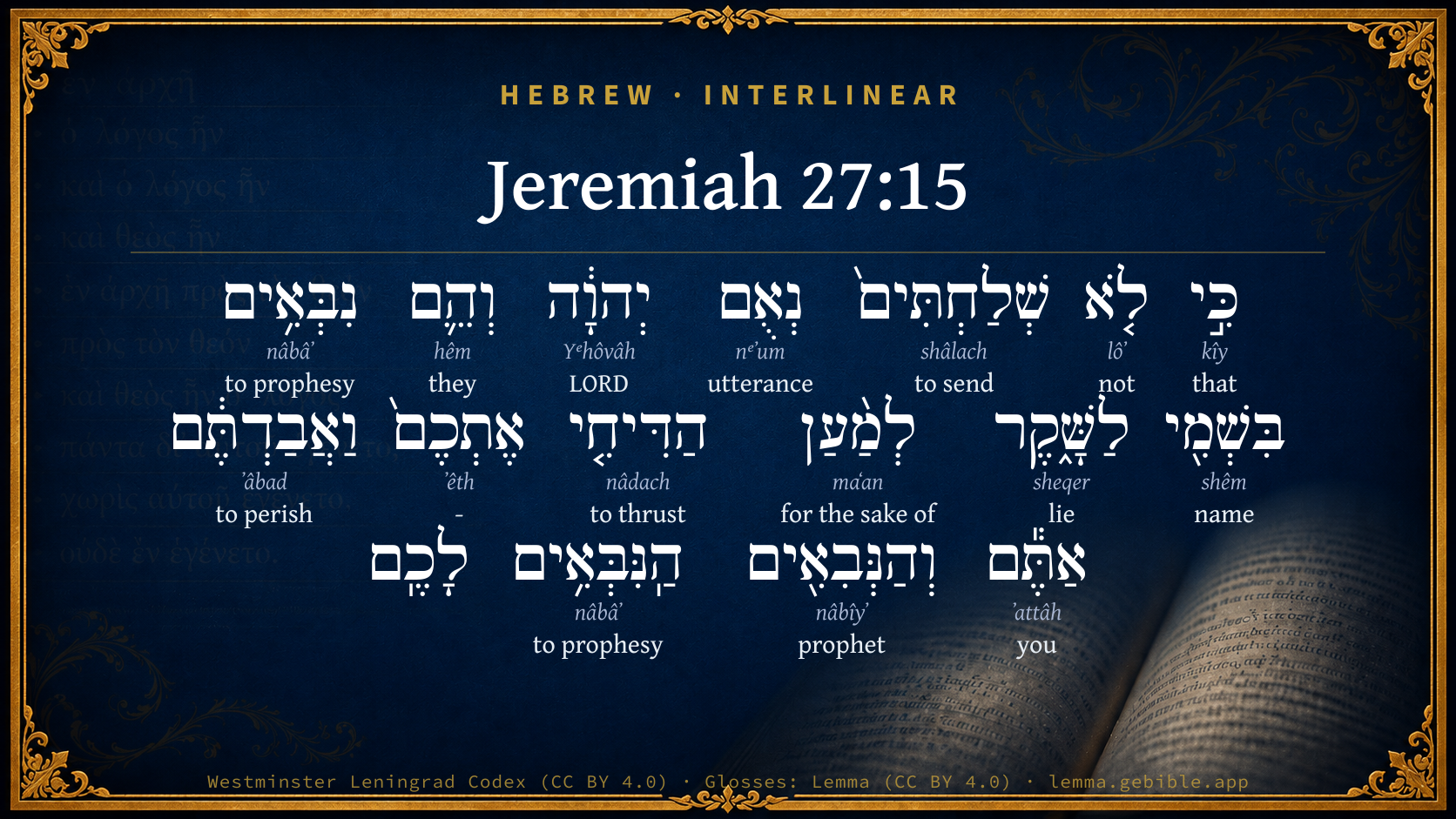
Jeremiah 27:15

Hebrew (Westminster Leningrad Codex) Jeremiah 27:15 appears in the Hebrew Old Testament. The text above is from the Westminster Leningrad Codex. Each word links to its Strong’s number, a concise gloss, and parsing drawn from the Open Scriptures Hebrew Bible morphology. Click any word for its full Brown-Driver-Briggs (BDB) entry.
Download image
Cite this verse

Jeremiah 27:15 (World English Bible). Public Domain. Lemma interlinear Bible study tool, https://lemma.gebible.app/v/jeremiah/27/15.

Show BibTeX & RIS
BibTeX
RIS
English Translation
For I have not sent them, says Yahweh, but they prophesy falsely in my name; that I may drive you out, and that you may perish, you, and the prophets who prophesy to you.
World English Bible · Public Domain
Download a study sheet

One document with this verse’s original text, its word-by-word gloss line, the meaning frame, cross-references with their text, attributed commentary, and full source and license credits — printable, and it pastes into notes with its structure intact.

This verse Autodidact and up

Study sheet (.html) Plain text (.txt)

A passage Seminary Student

Up to 50 verses in one chapter. A passage sheet keeps up to 6 commentary sources and 12 cross-references per verse, in the order this page ranks them, and says so on the sheet whenever that leaves anything out. Ask for a single verse and you get the Autodidact verse sheet above.

Everything on this page stays free to read, with no account — the sheet is a download of what is already on screen, not access to it.

Want to remove ads? Support Godless Engineer
Compare translations 3

The same verse in 3 English versions, stacked beneath the original-language interlinear above. Click any original word for its lexicon entry.

Each is an independent rendering of the whole verse — the interlinear is not word-aligned to these translations.

Highlighted words mark where these versions differ — a whole-verse word diff, not a word-by-word alignment.

  • World English Bible Public Domain
    For I have not sent them, says Yahweh, but they prophesy falsely in my name; that I may drive you out, and that you may perish, you, and the prophets who prophesy to you.
  • King James Version Public Domain
    For I have not sent them, saith the LORD, yet they prophesy a lie in my name; that I might drive you out, and that ye might perish, ye, and the prophets that prophesy unto you.
  • unfoldingWord Literal Text CC BY-SA 4.0
    For I have not sent them”—the declaration of Yahweh—“and they are prophesying in my name for falsehood, so that I will drive you out, and you will perish, you and the prophets who are prophesying to you.”

unfoldingWord Literal Text — © unfoldingWord, licensed CC BY-SA 4.0. Word-aligned USFM3 via Door43 (git.door43.org/unfoldingWord/en_ult).

Versions to compare (up to 4)

3 of 4 selected

Show all 18 translations

Every available English version of this verse, each an independent rendering of the whole verse.

  • World English Bible Public Domain
    For I have not sent them, says Yahweh, but they prophesy falsely in my name; that I may drive you out, and that you may perish, you, and the prophets who prophesy to you.
  • Berean Standard Bible Public Domain
    For I have not sent them, declares the LORD, and yet they are prophesying falsely in My name; therefore I will banish you, and you will perish—you and the prophets who prophesy to you.”
  • Majority Standard Bible Public Domain
    For I have not sent them, declares the LORD, and yet they are prophesying falsely in My name; therefore I will banish you, and you will perish—you and the prophets who prophesy to you.”
  • King James Version Public Domain
    For I have not sent them, saith the LORD, yet they prophesy a lie in my name; that I might drive you out, and that ye might perish, ye, and the prophets that prophesy unto you.
  • American Standard Version (1901) Public Domain
    For I have not sent them, saith Jehovah, but they prophesy falsely in my name; that I may drive you out, and that ye may perish, ye, and the prophets that prophesy unto you.
  • Revised Version (1885) Public Domain
    For I have not sent them, saith the LORD, but they prophesy falsely in my name; that I might drive you out, and that ye might perish, ye, and the prophets that prophesy unto you.
  • Geneva Bible (1599) Public Domain
    For I haue not sent them, saith the Lord, yet they prophecie a lie in my name, that I might cast you out, and that ye might perish, both you, and the prophets that prophecie vnto you.
  • Douay-Rheims (1899) Public Domain
    For I have not sent them, saith the Lord: and they prophesy in my name falsely: to drive you out, and that you may perish, both you, and the prophets that prophesy to you.
  • Young's Literal Translation Public Domain
    For I have not sent them -- an affirmation of Jehovah -- and they are prophesying in My name falsely, so as to drive you out, and ye have perished, ye, and the prophets who are prophesying to you.'
  • Literal Standard Version CC BY-SA 4.0
    For I have not sent them—a declaration of YHWH—and they are prophesying falsely in My Name, so as to drive you out, and you have perished, you and the prophets who are prophesying to you.”
  • Unlocked Literal Bible CC BY-SA 4.0
    'For I have not sent them out—this is Yahweh's declaration—for they are prophesying deceit in my name so that I will drive you out and you will perish, both you and the prophets who are prophesying to you.'”
  • unfoldingWord Literal Text CC BY-SA 4.0
    For I have not sent them”—the declaration of Yahweh—“and they are prophesying in my name for falsehood, so that I will drive you out, and you will perish, you and the prophets who are prophesying to you.”
  • Darby Bible Public Domain
    For I have not sent them, saith Jehovah, yet they prophesy falsely in my name; in order that I should drive you out, and that ye should perish, ye, and the prophets who prophesy unto you.
  • World Messianic Bible Public Domain
    For I have not sent them,” says the LORD, “but they prophesy falsely in my name; that I may drive you out, and that you may perish, you, and the prophets who prophesy to you.”
  • Webster's Bible Public Domain
    For I have not sent them, saith the LORD, yet they prophesy a lie in my name; that I might drive you out, and that ye might perish, ye, and the prophets that prophesy to you.
  • Free Bible Version CC BY-SA 4.0
    I didn't send them, declares the Lord, and yet they are giving false prophecies in my name. So I will expel you and you will die—you and the prophets who prophesy to you.
  • Bible in Basic English Public Domain
    For I have not sent them, says the Lord, but they are saying what is false in my name, so that I might send you out by force, causing destruction to come on you and on your prophets.
  • JPS Tanakh (1917) Public Domain
    For I have not sent them, saith the LORD, and they prophesy falsely in My name; that I might drive you out, and that ye might perish, ye, and the prophets that prophesy unto you.'

Literal Standard Version (2020), Covenant Press — licensed CC BY-SA 4.0. Text via the HelloAO Bible API (eBible.org). Unlocked Literal Bible (unfoldingWord) — licensed CC BY-SA 4.0. Text via the HelloAO Bible API (eBible.org). unfoldingWord Literal Text — © unfoldingWord, licensed CC BY-SA 4.0. Word-aligned USFM3 via Door43 (git.door43.org/unfoldingWord/en_ult). Free Bible Version, Dr. Jonathan Gallagher — licensed CC BY-SA 4.0. Text via the HelloAO Bible API (eBible.org).

Word by word

More ways to search: Search by grammar → Find every occurrence → Compare this word →

Practice this passage: Drill this verse → Learn its vocabulary →

הַדִּיחִ֤י
nâdach
H5080
“to thrust · me”
Verb, Hiphil, Infinitive Construct + Suffix, Personal, 1st Person, Common, Singular
Part of Speech
Verb
Stem
Hiphil
Form
Infinitive Construct
Full BDB Definition

Origin: a primitive root

TWOT: 1304

to impel, thrust, drive away, banish - (Qal) - to impel - to thrust away, banish - (Niphal) - to be impelled - to be thrust out, be banished - banished, outcast (participle) - to be driven away - to be thrust away, thrust aside - (Pual) to be thrust into - thrust (participle) - (Hiphil) - to thrust, move, impel - to thrust out, banish - to thrust away, thrust aside - (Hophal) to be chased, be hunted - chased, hunted (participle)
  1. כִּ֣י kîy H3588 “that” Conjunction
  2. לֹ֤א lôʼ H3808 “not” Particle, Negative
  3. שְׁלַחְתִּים֙ shâlach H7971 “to send · them” Verb, Qal, Perfect, 1st Person, Common, Singular + Suffix, Personal, 3rd Person, Masculine, Plural
  4. נְאֻם nᵉʼum H5002 “utterance of” Noun, Common, Masculine, Singular, Construct
  5. יְהוָ֔ה Yᵉhôvâh H3068 “LORD” Noun, Proper
  6. וְהֵ֛ם hêm H1992 “and · they” Conjunction + Pronoun, Personal, 3rd Person, Masculine, Plural
  7. נִבְּאִ֥ים nâbâʼ H5012 “prophesying” Verb, Niphal, Participle Active, Masculine, Plural, Absolute
  8. בִּשְׁמִ֖י shêm H8034 “in/at · name · my” Preposition + Noun, Common, Masculine, Singular, Construct + Suffix, Personal, 1st Person, Common, Singular
  9. לַשָּׁ֑קֶר sheqer H8267 “to/for the · lie” Preposition, Determined + Noun, Common, Masculine, Singular, Absolute
  10. לְמַ֨עַן maʻan H4616 “for the sake of” Preposition
  11. אֶתְכֶם֙ ʼêth H853 “- · you” Particle, Direct Object + Suffix, Personal, 2nd Person, Masculine, Plural
  12. וַאֲבַדְתֶּ֔ם ʼâbad H6 “and · to perish” Conjunction + Verb, Qal, Sequential Perfect, 2nd Person, Masculine, Plural
  13. אַתֶּ֕ם ʼattâh H859 “you” Pronoun, Personal, 2nd Person, Masculine, Plural
  14. וְהַנְּבִאִ֖ים nâbîyʼ H5030 “and · the · prophets” Conjunction + Particle, Definite Article + Noun, Common, Masculine, Plural, Absolute
  15. הַֽנִּבְּאִ֥ים nâbâʼ H5012 “the · prophesying” Particle, Definite Article + Verb, Niphal, Participle Active, Masculine, Plural, Absolute

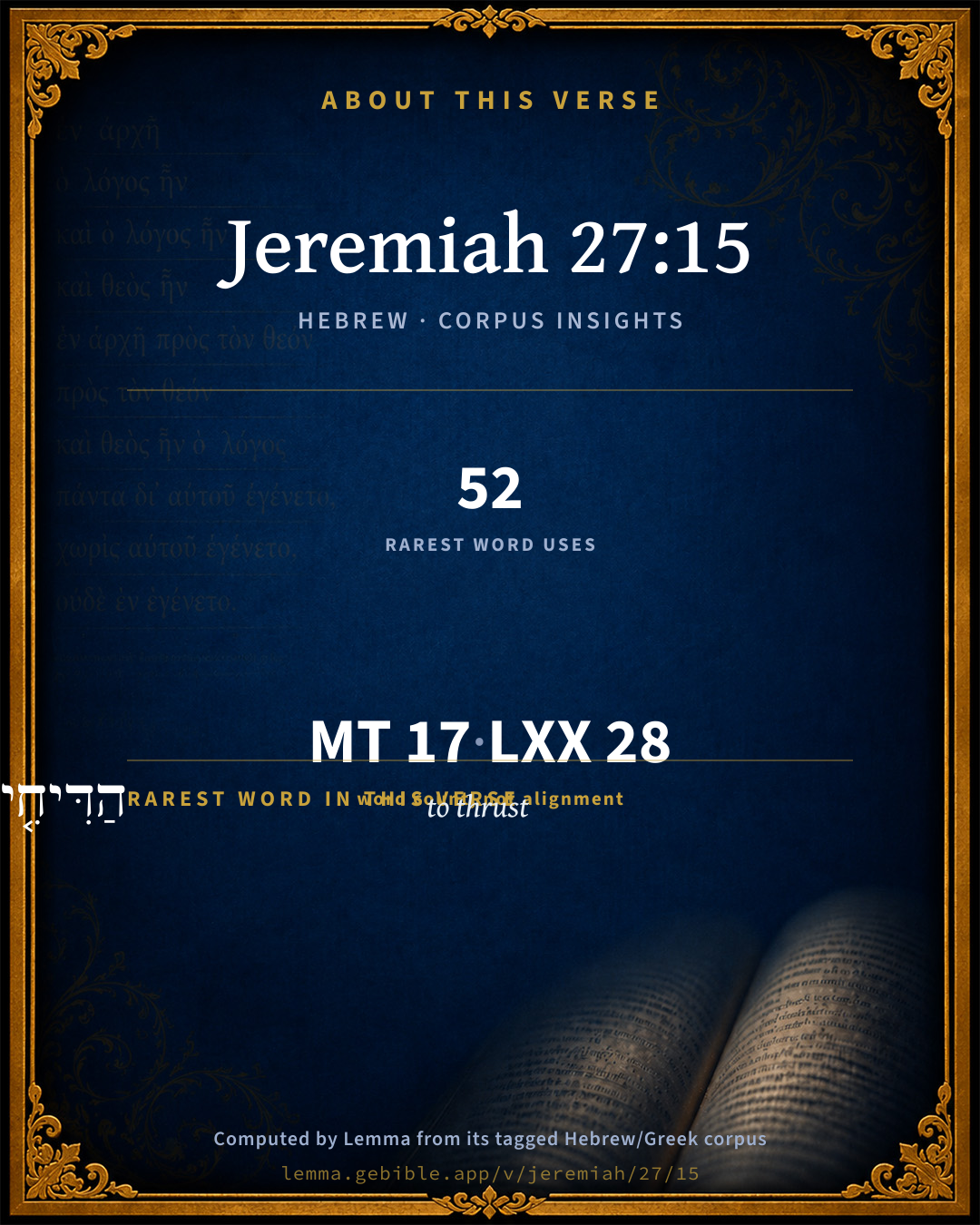
About this verse

These counts appear in no published source. They are computed here, from the morphology-tagged text and Lemma’s own curated glosses. What Lemma adds →

17
words
15
distinct lemmas
Prophets
section

Shared distinctive vocabulary

הַדִּיחִ֤י to thrust H5080 occurs in 51 verses of the Hebrew Bible. Also found in:

Grammatical profile

  • 5 verbs
  • 5 nouns
  • 2 pronouns
  • 2 prepositions
  • 1 conjunction
  • 2 particles

Verb forms

  • שְׁלַחְתִּים֙ Qal · Perfect
  • נִבְּאִ֥ים Niphal · Participle Active
  • הַדִּיחִ֤י Hiphil · Infinitive Construct
  • וַאֲבַדְתֶּ֔ם Qal · Sequential Perfect
  • הַֽנִּבְּאִ֥ים Niphal · Participle Active

Repetition

A word recurs within this verse — often emphatic in Hebrew:

  • נִבְּאִ֥ים to prophesy H5012 ×2

Hebrew & Septuagint length

In the original languages it is 17 Hebrew tokens and 28 Greek tokens — but the two are counted differently (Hebrew bundles its prefixes and suffixes into one token; the Greek is in lemma form), so that isn’t a like-for-like length.

Cross-references

23

Topical passages linked to Jeremiah 27:15 in the Treasury of Scripture Knowledge — connected by theme and wording, ordered by reader-vote popularity; previews shown in the World English Bible.

  • Jeremiah 27:10 for they prophesy a lie to you, to remove you far from your land, and that I should drive you out, and you should perish.
  • 2 Chronicles 25:16 It happened, as he talked with him, that [the king] said to him, Have we made you of the king's counsel? Stop! Why should you be struck down? Then the prophet stopped, and said, I know that God has determined to destroy you, because you have done this, and have not listened to my counsel.
  • Jeremiah 6:13–15 For from the least of them even to the greatest of them everyone is given to covetousness; and from the prophet even to the priest everyone deals falsely.
  • Jeremiah 14:15–16 Therefore thus says Yahweh concerning the prophets who prophesy in my name, and I didn't send them, yet they say, Sword and famine shall not be in this land: By sword and famine shall those prophets be consumed.
  • 2 Chronicles 18:17–22 The king of Israel said to Jehoshaphat, Didn't I tell you that he would not prophesy good concerning me, but evil?
  • Jeremiah 8:10–12 Therefore will I give their wives to others, and their fields to those who shall possess them: for everyone from the least even to the greatest is given to covetousness; from the prophet even to the priest every one deals falsely.
  • Jeremiah 20:6 You, Pashhur, and all who dwell in your house shall go into captivity; and you shall come to Babylon, and there you shall die, and there shall you be buried, you, and all your friends, to whom you have prophesied falsely.
  • Jeremiah 23:15 Therefore thus says Yahweh of Hosts concerning the prophets: Behold, I will feed them with wormwood, and make them drink the water of gall; for from the prophets of Jerusalem is ungodliness gone forth into all the land.
  • Jeremiah 23:21 I sent not these prophets, yet they ran: I didn't speak to them, yet they prophesied.
  • Jeremiah 28:16–17 Therefore thus says Yahweh, Behold, I will send you away from off the surface of the earth: this year you shall die, because you have spoken rebellion against Yahweh.
  • Jeremiah 29:9 For they prophesy falsely to you in my name: I have not sent them, says Yahweh.
  • Jeremiah 29:22–23 and of them shall be taken up a curse by all the captives of Judah who are in Babylon, saying, Yahweh make you like Zedekiah and like Ahab, whom the king of Babylon roasted in the fire;
  • Jeremiah 29:31–32 Send to all them of the captivity, saying, Thus says Yahweh concerning Shemaiah the Nehelamite: Because Shemaiah has prophesied to you, and I didn't send him, and he has caused you to trust in a lie;
  • Ezekiel 14:3–10 Son of man, these men have taken their idols into their heart, and put the stumbling block of their iniquity before their face: should I be inquired of at all by them?
  • Micah 3:5–7 Thus says Yahweh concerning the prophets who lead my people astray; for those who feed their teeth, they proclaim, "Peace!" and whoever doesn't provide for their mouths, they prepare war against him:
  • Matthew 15:14 Leave them alone. They are blind guides of the blind. If the blind guide the blind, both will fall into a pit."
  • Matthew 24:24 For there will arise false christs, and false prophets, and they will show great signs and wonders, so as to lead astray, if possible, even the chosen ones.
  • 2 Thessalonians 2:9–12 even he whose coming is according to the working of Satan with all power and signs and lying wonders,
  • 2 Timothy 2:17–19 and their word will consume like gangrene, of whom is Hymenaeus and Philetus;
  • 2 Timothy 4:3–4 For the time will come when they will not listen to the sound doctrine, but, having itching ears, will heap up for themselves teachers after their own lusts;
  • Revelation 13:7–8 It was given to him to make war with the saints, and to overcome them. Authority over every tribe, people, language, and nation was given to him.
  • Revelation 19:20 The beast was taken, and with him the false prophet who worked the signs in his sight, with which he deceived those who had received the mark of the beast and those who worshiped his image. These two were thrown alive into the lake of fire that burns with sulfur.
  • Revelation 13:12–14 He exercises all the authority of the first beast in his presence. He makes the earth and those who dwell in it to worship the first beast, whose fatal wound was healed.

Cross-references courtesy of OpenBible.info (CC BY 4.0).

Hebrew and Greek witnesses Masoretic Hebrew ↔ Greek Septuagint

The same verse in the two great witnesses to the Old Testament, shown verse-for-verse.

These are two independent witnesses, not word-aligned to each other, and the Septuagint is shown in lemma (dictionary) form.

Hebrew Jeremiah 27:15 Masoretic · Westminster Leningrad Codex

כִּ֣י לֹ֤א שְׁלַחְתִּים֙ נְאֻם יְהוָ֔ה וְהֵ֛ם נִבְּאִ֥ים בִּשְׁמִ֖י לַשָּׁ֑קֶר לְמַ֨עַן הַדִּיחִ֤י אֶתְכֶם֙ וַאֲבַדְתֶּ֔ם אַתֶּ֕ם וְהַנְּבִאִ֖ים הַֽנִּבְּאִ֥ים לָכֶֽם

For I have not sent them, says Yahweh, but they prophesy falsely in my name; that I may drive you out, and that you may perish, you, and the prophets who prophesy to you.

World English Bible · Public Domain

Greek LXX Structure differs

In the Septuagint, Jeremiah is about an eighth shorter than the Hebrew and arranges its material differently — the Oracles Against the Nations (Hebrew chapters 46–51) appear in the middle of the Greek book, after 25:13. Because the chapter and verse boundaries do not line up, a verse-for-verse comparison with the Hebrew is not shown.

A verse-for-verse comparison isn’t shown here because the chapters and verses don’t line up. Switch to the LXX edition with the MT / LXX toggle above to read the Greek directly.

Hebrew: Westminster Leningrad Codex (CC BY 4.0). Greek: Septuagint (public domain); English from a public-domain English Septuagint. How the Septuagint differs from the Hebrew →

Targum (Aramaic paraphrase)

1

The Targum is the ancient Jewish Aramaic paraphrase of the Hebrew Scriptures — an interpretive translation, not the Hebrew text itself. Onkelos (literal) and Pseudo-Jonathan (expansive) render the Torah, and Jonathan the Prophets. Coverage is partial: where no permissively-licensed English translation exists for a verse, only the Aramaic is shown. This is verse-level text, not a word-by-word alignment to the Hebrew.

  1. Targum Jonathan Prophets (Joshua–Malachi)
    אֲרֵי לָא שְׁלַחְתִּינוּן אֲמַר יְיָ וְאִינוּן מִתְנַבָּן בִּשְׁמִי שִׁקְרָא בְּדִיל דֶאֱטַלְטֵיל יַתְכוֹן וְתֵיבְדוּן אַתּוּן וּנְבִיֵי שִׁקְרָא דְמִתְנַבָּן לְכוֹן:

    (no public-domain English translation for this verse)

    Targum Jonathan — Aramaic: “Mikraot Gedolot” (public domain). English: “Sefaria Community Translation” (CC0 1.0 (public-domain dedication)); “London "Chaldee Paraphrase," 1871” (public domain). Text via Sefaria.

Commentary

Notes on Jeremiah 27:15 from classic Christian and Jewish commentators (each source and its license shown beneath its notes). The classic Christian expositions comment on the surrounding passage and are grouped to its opening verse, so a note may address several verses; the Jewish commentaries on the Tanakh (Rashi and others) are per-verse, so they appear only where the commentator wrote on this verse.

Lemma curates 59 commentaries, every one of them public domain or Creative Commons licensed, each selected and text-cleaned for this edition rather than reprinted as found. About our sources →

Jamieson, Fausset & Brown

Robert Jamieson, A. R. Fausset & David Brown

in my name--The devil often makes God's name the plea for lies (Mat 4:6; Mat 7:22-23; Jer 27:15-20, the test whereby to know false prophets).

Jamieson, Fausset & Brown — Commentary Critical and Explanatory on the Whole Bible (1871) — public domain (CC PDM 1.0). Text via the HelloAO Bible API.

Trapp's Complete Commentary

John Trapp

Jer 27:15 For I have not sent them, saith the LORD, yet they prophesy a lie in my name; that I might drive you out, and that ye might perish, ye, and the prophets that prophesy unto you.

Ver. 15. For they prophesy a lie.] When they speak a lie, they speak of their own, as it is said of their father the devil. {Joh 8:44 Jer 23:21-22}

John Trapp, A Commentary or Exposition upon All the Books of the Old and New Testament (1647–1656) — public domain. Text from a community e-Sword module.

John Calvin's Commentaries

He confirms what he had said, that they had not been sent by God. The object is to shew the Jews, that they were not to receive thoughtlessly everything presented to them under God’s name, but that they were to exercise discrimination and judgment. This is a passage worthy of special notice, for the devil has ever falsely assumed God’s name; and for all the errors and delusions which have ever prevailed in the world, he has not obtained credit otherwise than by this false pretense. And at this day we see that many are wilfully blind, because they think they are excused before God if they can pretend ignorance, and they say that they are not wickedly credulous, but they dare not make curious inquiries. As then there are many who wilfully put on nooses and also wish to be deceived, we ought to notice what the Prophet says here, that we ought to distinguish the true from false prophets; for what purpose? even that we may receive them only, and depend on their words who have been sent by the Lord.

It may be here asked, how comes this difference? It was formerly necessary for prophets to be raised in a special manner, for it was a special gift to predict future and hidden events, hence the prophetic was not an ordinary office like the sacerdotal. That promise indeed ever continued in force,

“A prophet will I raise to thee from the midst of thy brethren.” (Deuteronomy 18:18.)

But though this was a perpetual favor conferred by God on the Israelites, yet the prophets were ever called in a special manner; no one was to take this office except endued with an extraordinary gift. Though Jeremiah was a priest, yet he was not on that account a prophet; but God, as we have seen, made him a prophet. But with regard to us, the matter is different, for God does not at this day predict hidden events; but he would have us to be satisfied with his Gospel, for in it is made known to us the perfection of wisdom. As then we live in “the fullness of time,” God does not reveal prophecies so as to point out this or that thing to us in particular. We may now obtain certainty as to the truth, if we form our judgment according to the Law, and the Prophets, and the Gospel. There is indeed need of the spirit of discernment; but we shall never go astray, if we depend on the mouth of God, and follow the example of the Bereans, of whom Luke speaks in the Acts, who says, that they carefully read the Scriptures, and searched whether things were as they were taught by Paul. (Acts 17:11.) No wrong was done to Paul, when the disciples, in order to confirm their faith, inquired whether his preaching was agreeable to the Law and to the Prophets. So also now, all doctrines ought to be examined by us; and if we follow this rule, we shall never go astray.

As to the ancient people, they could not, as it was said yesterday, be deceived, for the prophets were only interpreters of the Law. With regard to future things, this or that was never predicted by the prophets, unless connected with doctrine, which was as it were the seasoning, and gave a relish to the prophecies; for when they promised what was cheering, it was founded on the eternal covenant of God; and when they threatened the people, they pointed out their sins, so that it was necessary for God to execute his vengeance when their wickedness was incurable. Ever to be borne in mind then is that which is said in Deuteronomy, that God tried his people whenever he gave loose reins to false prophets, (Deuteronomy 13:3,) for every one who sincerely and undissemblingly loves him shall be guided by his Spirit. This then is the sure trial which God makes as to his faithful people, according to what Paul also says, who refers to this testimony of Moses, that heresies arise in order that they who are the faithful and sincere servants of God, might thereby shew what they really are, (1 Corinthians 11:19;) for they do not fluctuate at every wind of doctrine, but remain firm and constant in the pure obedience of faith. Rightly then does Jeremiah say, that they who gave hope of impunity to the people, had not been sent by the Lord; for every one had his own conscience as his judge.

He adds, They prophesy falsely in my name We see how sedulously and prudently we ought to take heed lest the devil should fascinate us by his charms, especially when the name of God is pretended. It is then not enough for us to hear, “Thus has God spoken,” unless we are fully persuaded that those who use such a preface have been called by him, and that they also afford a sure evidence of their call, so that we may be certain that they are as it were the instruments of the Spirit. Ungodly men will find here an occasion for clamoring, because God does in a manner make a mock of the anxiety of men, for he might send angels from heaven, he might himself speak; but when he employs men, and permits false prophets to boast of this word and of that, while they wholly dissemble, he seems in this way as though he designedly bewildered miserable men. But there is nothing better for us than to acknowledge that our obedience is tried by God, when he addresses us by men; for we know that nothing is more contrary to faith than pride, as also humility is the true principle of faith and the real entrance into God’s kingdom. This then is the reason why God makes use of men.

In the meantime, when impostors creep in and boast that they are true legitimate prophets, it is indeed a grievous trial, and much to be feared; yet. God, as I have said, will ever relieve us, provided we trust not to our own judgment, and assume not to ourselves more than what is just and right, but look to him as the judge, and submit ourselves to his word; and further, if we suffer ourselves to be ruled by his Spirit, he will ever give us wisdom, which will enable us to distinguish between true and false prophets. However this may be, we clearly see that it is no new thing for Satan’s ministers to prophesy in God’s name, that is, falsely to assume his name, when in reality and truth they are vain pretenders.

He afterwards adds, that I might drive you out, and that ye might perish, as well as they. Here Jeremiah reminded them, that the prophets who promised impunity could not at length escape, but that they would have to suffer punishment not only for their presumption, but also for those sins by which they, together with the whole people, had already provoked the wrath of God; for their crime was twofold: despising God, they had promised all liberty to indulge in sin; and they had also dared to come forth and to pretend God’s name, though they had not been called, nor did they bring, as we have said, any message from God. But the Prophet again repeated, that such prophets were instigated by the devil’s artifice, in order to aggravate God’s judgment; for the people, inebriated with joy, added sins to sins, as security is wont to lead men to all kinds of wickedness. There is therefore nothing more ruinous than for false teachers to flatter sinners, and so to cajole and wheedle them as to make them to think that they have nothing to do with God; for the devil rules then indeed, when men’s consciences are thus asleep in a deadly lethargy. He afterwards adds, —

John Calvin's Commentaries (1540-1563) — public domain. Text from the Calvin Translation Society English edition (1840s-50s) via the Christian Classics Ethereal Library (ccel.org). Calvin's coverage is partial (roughly two-thirds of the Bible); uncommented books and verses are honest gaps, never fabricated. The 19th-century editor's footnotes and remarks are omitted so the notes are faithfully Calvin's own voice.

John Gill's Exposition

For I have not sent them, saith the Lord,.... See Jer 23:21; yet they prophesy a lie in my name; to deliver out a lie was a very wicked thing, sinful in them, and fatal to others; but to make use of the name of the Lord, and cover it with that, and back it with his authority, was much more wicked and abominable:

that I might drive you out, and that ye might perish; being driven out of their own land, perish in another; which, though the false prophets did not intend by their prophesying, yet such would be, and was, the issue of it:

ye, and the prophets that prophesy unto you; for it would end in the ruin and destruction of them both; both of the false prophets, as the Targum here again calls them, and those that listened to their prophecies; both would fall into the same ditch.

John Gill's Exposition of the Whole Bible (1746–1763) — public domain (CC PDM 1.0). Text via the HelloAO Bible API.

Matthew Poole's English Annotations

They make use of my name, and pretend to say what they say by commission from me, saith the Lord; but there is no such thing, I never gave them authority to speak any such things. And though possibly they do not design your ruin by these practices, for none can be thought to design their own ruin, yet that will be the end of it; for by this means your hearts are hardened against the revelations of my will, by which I shall be provoked to give you up to ruin; nor shall they escape, for they shall be ruined with you.

Matthew Poole's English Annotations on the Holy Bible (1683–1685) — public domain. Text from a community e-Sword/MySword module.

Whedon's Commentary on the Bible

Daniel D. Whedon

15. In my name — Thus making God’s name “a plea for lies.” MESSAGE TO THE PRIESTS AND PEOPLE, 16-22.

Daniel D. Whedon (gen. ed.), Commentary on the Old and New Testaments (1874–1909) — public domain. Text from a community e-Sword module.

Lesson kit

Teaching starters — assembled from the data on this page, not authored interpretation. Every prompt links to the verse data it draws on. Edit before teaching.

Jeremiah, in the Prophets, opens this verse with 17 words (15 distinct Hebrew lemmas). Its most distinctive word is nâdach (“to thrust”). A historical commentator’s framing appears above. Read the whole chapter for the surrounding context.

Discussion questions

  1. The word nâdach carries the sense “to thrust.” How does it shape the verse?
  2. Deuteronomy 4:19 shares the word «to thrust» with this verse. How do the two illuminate each other?
  3. “to prophesy” occurs 2× in this one verse. What is the effect of the repetition?
  4. These translations render this verse differently; the difference is in the English rendering, not the original. What questions does that raise?
  5. The verb «שְׁלַחְתִּים֙» is Qal Perfect. How does its form color the action?
  6. Reading how Jamieson, Fausset & Brown and Trapp's Complete Commentary read this verse, where do the two commentators agree and where do they part?

Things to notice

Reading settings

Reading text

Shown beneath each verse's original-language words.

Old Testament
Old Testament edition

Read the OT as the Masoretic Hebrew (MT) or the Greek Septuagint (LXX).

English shown for the Greek Septuagint (in the Hebrew ↔ Greek comparison).

Comparing translations? Open the Compare panel on any verse page to stack up to four side by side.