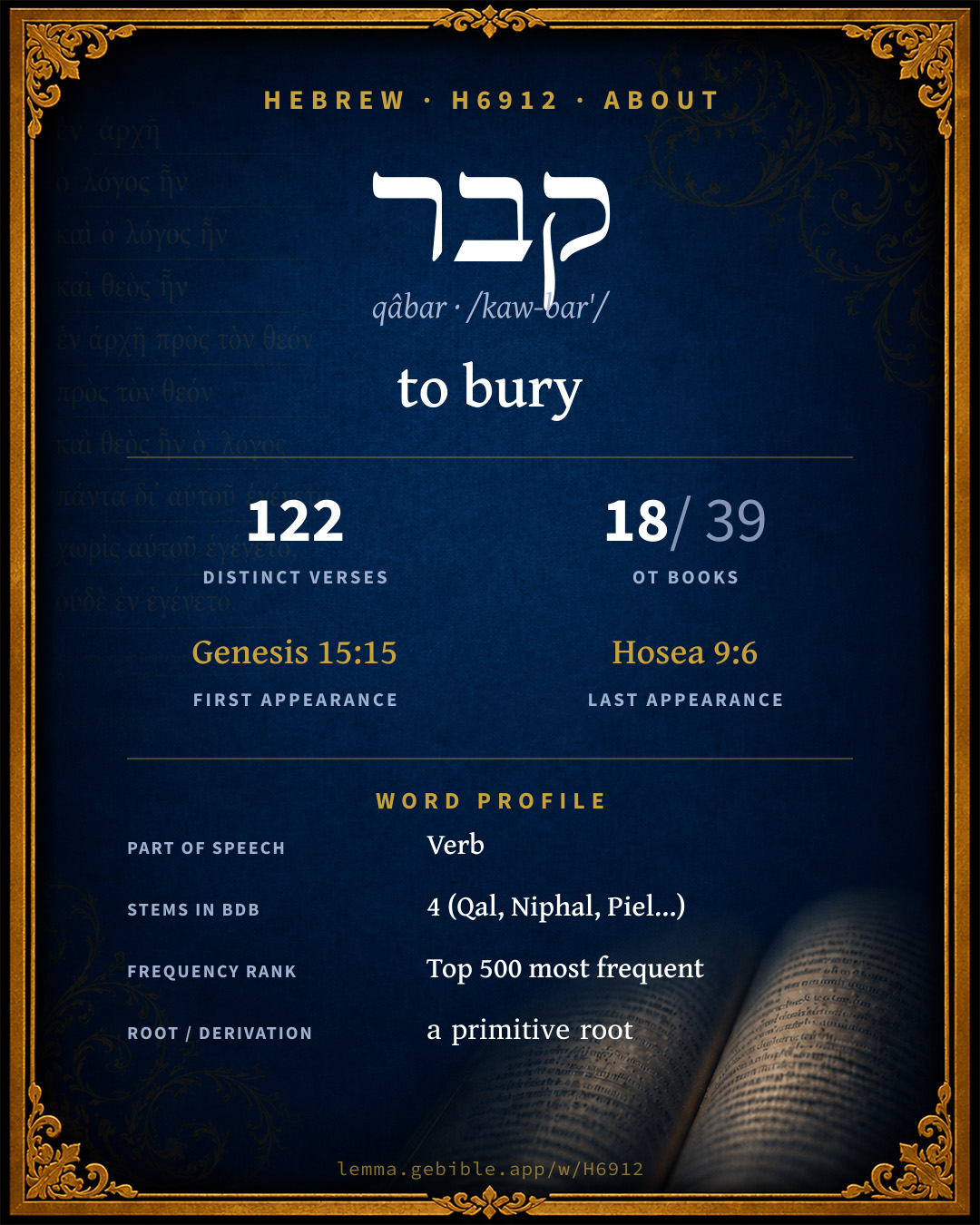
קָבַר
to bury
‘to bury’ is one of 5 main senses fuller range ↓
Full lexicon entry — Brown-Driver-Briggs (BDB)
From Brown-Driver-Briggs (BDB)
Where this word appears
See every Qal verb in the Hebrew Bible →
Grammar key — what these labels mean
Part of speech
- Verb
- An action or state-of-being word.
Stem
- Niphal
- Usually the simple passive or reflexive of the Qal (“he was written”).
- Qal
- The basic, simple active stem — the plain form of the verb (“he wrote”).
- Piel
- An intensive or resultative active stem. Here: ‘bury’
- Pual
- The passive counterpart of the Piel.
Form
- Sequential Imperfect
- An imperfect with prefixed waw — the standard past-narrative form (waw-consecutive imperfect).
- Perfect
- A completed action or state — Hebrew marks aspect (completeness) more than strict tense (“he wrote”).
- Infinitive Construct
- A bound verbal noun, frequently with prepositions (“to write / in writing”).
- Imperfect
- An incomplete, ongoing, or future action (“he will / would write”).
- Cohortative
- A first-person volitional form expressing wish or resolve (“let me / let us write”).
- Sequential Perfect
- A perfect with prefixed waw continuing a preceding imperfect or command (waw-consecutive perfect).
- Imperative
- A direct command (“write!”).
- Participle Active
- A verbal adjective expressing ongoing or characteristic action (“writing / one who writes”).
- Infinitive Absolute
- An unbound verbal noun, often intensifying or standing in for a finite verb.
- Jussive
- A third- or second-person volitional form expressing wish or command (“let him write”).
- Participle Passive
- A verbal adjective expressing action received (“written”).
State
- Absolute
- The independent form of a noun, not bound to a following word.
Person
- 3rd Person
- The one spoken about (“he / she / it / they”).
- 1st Person
- The speaker (“I / we”).
- 2nd Person
- The one addressed (“you”).
Gender
- Masculine
- Grammatically masculine.
- Common
- Either gender — not distinguished for this form.
- Feminine
- Grammatically feminine.
Number
- Singular
- One.
- Plural
- More than one (in Hebrew, generally three or more).
Grammatical forms 33 distinct
- Verb, Qal, Sequential Imperfect, 3rd Person, Masculine, Plural 38 times (29%)
- Verb, Niphal, Sequential Imperfect, 3rd Person, Masculine, Singular 27 times (20%)
- Verb, Qal, Infinitive Construct 9 times (7%)
- Verb, Qal, Perfect, 3rd Person, Common, Plural 8 times (6%)
- Verb, Niphal, Imperfect, 3rd Person, Masculine, Plural 5 times (4%)
- Verb, Qal, Imperative, 2nd Person, Masculine, Singular 5 times (4%)
- Verb, Qal, Sequential Perfect, 3rd Person, Common, Plural 4 times (3%)
- Verb, Niphal, Sequential Imperfect, 3rd Person, Feminine, Singular 3 times (2%)
+25 more forms (34 occurrences)
Parsed forms decoded from the imported morphology (morphhb / Westminster Leningrad Codex — WLC text public domain, morphhb tagging CC BY 4.0), counted across 133 parsed occurrences — not distinct verses.
Every verse where H6912 appears — 122 distinct verses across 18 books. Click any verse to open its interlinear word-by-word view. Verse text shown in the World English Bible for context — . Each verse’s Hebrew form is shown with its reference; the English is not keyword-highlighted, since the data carries no word-level English alignment. Use “Compare translations” on any verse to read it across multiple English versions. This concordance covers the Hebrew Bible; Septuagint (Greek Old Testament) occurrences are not indexed here.
Genesis 23 verses
- Genesis 15:15 תִּקָּבֵ֖ר Niphal impf 2ms But you will go to your fathers in peace. You will be buried in a good old age.
- Genesis 23:4 וְ/אֶקְבְּרָ֥ה conj + Qal coh 1cs "I am a stranger and a foreigner living with you. Give me a possession of a burying-place with you, that I may bury my dead out of my sight."
- Genesis 23:6 קְבֹ֖ר מִ/קְּבֹ֥ר Qal impv 2ms prep + Qal inf.cs "Hear us, my lord. You are a prince of God among us. In the choice of our tombs bury your dead. None of us will withhold from you his tomb, but that you may bury your dead."
- Genesis 23:8 לִ/קְבֹּ֤ר prep + Qal inf.cs He talked with them, saying, "If it be your mind that I should bury my dead out of my sight, hear me, and entreat for me to Ephron the son of Zohar,
- Genesis 23:11 קְבֹ֥ר Qal impv 2ms "No, my lord, hear me. I give you the field, and I give you the cave that is in it. In the presence of the children of my people I give it to you. Bury your dead."
- Genesis 23:13 וְ/אֶקְבְּרָ֥ה conj + Qal coh 1cs He spoke to Ephron in the audience of the people of the land, saying, "But if you will, please hear me. I will give the price of the field. Take it from me, and I will bury my dead there."
- Genesis 23:15 קְבֹֽר Qal impv 2ms "My lord, listen to me. What is a piece of land worth four hundred shekels of silver between me and you? Therefore bury your dead."
- Genesis 23:19 קָבַ֨ר Qal pf 3ms After this, Abraham buried Sarah his wife in the cave of the field of Machpelah before Mamre (the same is Hebron), in the land of Canaan.
- Genesis 25:9 וַ/יִּקְבְּר֨וּ conj + Qal wimpf 3mp Isaac and Ishmael, his sons, buried him in the cave of Machpelah, in the field of Ephron, the son of Zohar the Hittite, which is before Mamre,
- Genesis 25:10 קֻבַּ֥ר Pual pf 3ms the field which Abraham purchased of the children of Heth. There was Abraham buried, with Sarah his wife.
- Genesis 35:8 וַ/תִּקָּבֵ֛ר conj + Niphal wimpf 3fs Deborah, Rebekah's nurse, died, and she was buried below Bethel under the oak; and the name of it was called Allon Bacuth.
- Genesis 35:19 וַ/תִּקָּבֵר֙ conj + Niphal wimpf 3fs Rachel died, and was buried in the way to Ephrath (the same is Bethlehem).
- Genesis 35:29 וַ/יִּקְבְּר֣וּ conj + Qal wimpf 3mp Isaac gave up the spirit, and died, and was gathered to his people, old and full of days. Esau and Jacob, his sons, buried him.
- Genesis 47:29 תִקְבְּרֵ֖/נִי Qal juss 2ms + sfx pers 1cs The time drew near that Israel must die, and he called his son Joseph, and said to him, "If now I have found favor in your sight, please put your hand under my thigh, and deal kindly and truly with me. Please don't bury me in Egypt,
- Genesis 47:30 וּ/קְבַרְתַּ֖/נִי conj + Qal wpf 2ms + sfx pers 1cs but when I sleep with my fathers, you shall carry me out of Egypt, and bury me in their burying place." He said, "I will do as you have said."
- Genesis 48:7 וָ/אֶקְבְּרֶ֤/הָ conj + Qal wimpf 1cs + sfx pers 3fs As for me, when I came from Paddan, Rachel died by me in the land of Canaan in the way, when there was still some distance to come to Ephrath, and I buried her there in the way to Ephrath (the same is Bethlehem)."
- Genesis 49:29 קִבְר֥וּ Qal impv 2mp He charged them, and said to them, "I am to be gathered to my people. Bury me with my fathers in the cave that is in the field of Ephron the Hittite,
- Genesis 49:31 קָֽבְר֞וּ קָבְר֣וּ קָבַ֖רְתִּי Qal pf 3cp Qal pf 3cp Qal pf 1cs There they buried Abraham and Sarah, his wife. There they buried Isaac and Rebekah, his wife, and there I buried Leah:
- Genesis 50:5 תִּקְבְּרֵ֑/נִי וְ/אֶקְבְּרָ֥ה Qal impv 2ms + sfx pers 1cs conj + Qal coh 1cs 'My father made me swear, saying, "Behold, I am dying. Bury me in my grave which I have dug for myself in the land of Canaan." Now therefore, please let me go up and bury my father, and I will come again.'"
- Genesis 50:6 וּ/קְבֹ֥ר conj + Qal impv 2ms Pharaoh said, "Go up, and bury your father, just like he made you swear."
- Genesis 50:7 לִ/קְבֹּ֣ר prep + Qal inf.cs Joseph went up to bury his father; and with him went up all the servants of Pharaoh, the elders of his house, all the elders of the land of Egypt,
- Genesis 50:13 וַ/יִּקְבְּר֣וּ conj + Qal wimpf 3mp for his sons carried him into the land of Canaan, and buried him in the cave of the field of Machpelah, which Abraham bought with the field, for a possession of a burying-place, from Ephron the Hittite, before Mamre.
- Genesis 50:14 לִ/קְבֹּ֣ר קָבְר֥/וֹ prep + Qal inf.cs Qal inf.cs + sfx pers 3ms Joseph returned into Egypt--he, and his brothers, and all that went up with him to bury his father, after he had buried his father.
Numbers 3 verses
- Numbers 11:34 קָֽבְר֔וּ Qal pf 3cp The name of that place was called Kibrothhattaavah, because there they buried the people who lusted.
- Numbers 20:1 וַ/תִּקָּבֵ֖ר conj + Niphal wimpf 3fs The children of Israel, even the whole congregation, came into the wilderness of Zin in the first month: and the people abode in Kadesh; and Miriam died there, and was buried there.
- Numbers 33:4 מְקַבְּרִ֗ים Piel ptcp.act mp while the Egyptians were burying all their firstborn, whom Yahweh had struck among them: on their gods also Yahweh executed judgments.
Deuteronomy 3 verses
- Deuteronomy 10:6 וַ/יִּקָּבֵ֣ר conj + Niphal wimpf 3ms (The children of Israel traveled from Beeroth Bene Jaakan to Moserah. There Aaron died, and there he was buried; and Eleazar his son ministered in the priest's office in his place.
- Deuteronomy 21:23 קָב֤וֹר תִּקְבְּרֶ֨/נּוּ֙ Qal inf.abs Qal impf 2ms + sfx pers 3ms his body shall not remain all night on the tree, but you shall surely bury him the same day; for he who is hanged is accursed of God; that you don't defile your land which Yahweh your God gives you for an inheritance.
- Deuteronomy 34:6 וַ/יִּקְבֹּ֨ר conj + Qal wimpf 3ms He buried him in the valley in the land of Moab over against Beth Peor: but no man knows of his tomb to this day.
Joshua 3 verses
- Joshua 24:30 וַ/יִּקְבְּר֤וּ conj + Qal wimpf 3mp They buried him in the border of his inheritance in Timnathserah, which is in the hill-country of Ephraim, on the north of the mountain of Gaash.
- Joshua 24:32 קָבְר֣וּ Qal pf 3cp The bones of Joseph, which the children of Israel brought up out of Egypt, buried they in Shechem, in the parcel of ground which Jacob bought of the sons of Hamor the father of Shechem for a hundred pieces of money: and they became the inheritance of the children of Joseph.
- Joshua 24:33 וַ/יִּקְבְּר֣וּ conj + Qal wimpf 3mp Eleazar the son of Aaron died; and they buried him in the hill of Phinehas his son, which was given him in the hill-country of Ephraim.
Judges 9 verses
- Judges 2:9 וַ/יִּקְבְּר֤וּ conj + Qal wimpf 3mp They buried him in the border of his inheritance in Timnath Heres, in the hill country of Ephraim, on the north of the mountain of Gaash.
- Judges 8:32 וַ/יִּקָּבֵ֗ר conj + Niphal wimpf 3ms Gideon the son of Joash died in a good old age, and was buried in the tomb of Joash his father, in Ophrah of the Abiezrites.
- Judges 10:2 וַ/יִּקָּבֵ֥ר conj + Niphal wimpf 3ms He judged Israel twenty-three years, and died, and was buried in Shamir.
- Judges 10:5 וַ/יִּקָּבֵ֖ר conj + Niphal wimpf 3ms Jair died, and was buried in Kamon.
- Judges 12:7 וַ/יִּקָּבֵ֖ר conj + Niphal wimpf 3ms Jephthah judged Israel six years. Then died Jephthah the Gileadite, and was buried in [one of] the cities of Gilead.
- Judges 12:10 וַ/יִּקָּבֵ֖ר conj + Niphal wimpf 3ms Ibzan died, and was buried at Bethlehem.
- Judges 12:12 וַ/יִּקָּבֵ֥ר conj + Niphal wimpf 3ms Elon the Zebulunite died, and was buried in Aijalon in the land of Zebulun.
- Judges 12:15 וַ/יִּקָּבֵ֤ר conj + Niphal wimpf 3ms Abdon the son of Hillel the Pirathonite died, and was buried in Pirathon in the land of Ephraim, in the hill-country of the Amalekites.
- Judges 16:31 וַ/יִּקְבְּר֣וּ conj + Qal wimpf 3mp Then his brothers and all the house of his father came down, and took him, and brought him up, and buried him between Zorah and Eshtaol in the burying-place of Manoah his father. He judged Israel twenty years.
Ruth 1 verse
1 Samuel 3 verses
- 1 Samuel 25:1 וַ/יִּקְבְּרֻ֥/הוּ conj + Qal wimpf 3mp + sfx pers 3ms Samuel died; and all Israel gathered themselves together, and lamented him, and buried him in his house at Ramah. David arose, and went down to the wilderness of Paran.
- 1 Samuel 28:3 וַ/יִּקְבְּרֻ֥/הוּ conj + Qal wimpf 3mp + sfx pers 3ms Now Samuel was dead, and all Israel had lamented him, and buried him in Ramah, even in his own city. Saul had put away those who had familiar spirits, and the wizards, out of the land.
- 1 Samuel 31:13 וַ/יִּקְבְּר֥וּ conj + Qal wimpf 3mp They took their bones, and buried them under the tamarisk tree in Jabesh, and fasted seven days.
2 Samuel 7 verses
- 2 Samuel 2:4 קָבְר֖וּ Qal pf 3cp The men of Judah came, and there they anointed David king over the house of Judah. They told David, saying, The men of Jabesh Gilead were those who buried Saul.
- 2 Samuel 2:5 וַֽ/תִּקְבְּר֖וּ conj + Qal wimpf 2mp David sent messengers to the men of Jabesh Gilead, and said to them, Blessed be you of Yahweh, that you have shown this kindness to your lord, even to Saul, and have buried him.
- 2 Samuel 2:32 וַֽ/יִּקְבְּרֻ֨/הוּ֙ conj + Qal wimpf 3mp + sfx pers 3ms They took up Asahel, and buried him in the tomb of his father, which was in Bethlehem. Joab and his men went all night, and the day broke on them at Hebron.
- 2 Samuel 3:32 וַ/יִּקְבְּר֥וּ conj + Qal wimpf 3mp They buried Abner in Hebron: and the king lifted up his voice, and wept at the grave of Abner; and all the people wept.
- 2 Samuel 4:12 וַ/יִּקְבְּר֥וּ conj + Qal wimpf 3mp David commanded his young men, and they killed them, and cut off their hands and their feet, and hanged them up beside the pool in Hebron. But they took the head of Ish-bosheth, and buried it in the grave of Abner in Hebron.
- 2 Samuel 17:23 וַ/יִּקָּבֵ֖ר conj + Niphal wimpf 3ms When Ahithophel saw that his counsel was not followed, he saddled his donkey, and arose, and got him home, to his city, and set his house in order, and hanged himself; and he died, and was buried in the tomb of his father.
- 2 Samuel 21:14 וַ/יִּקְבְּר֣וּ conj + Qal wimpf 3mp They buried the bones of Saul and Jonathan his son in the country of Benjamin in Zela, in the tomb of Kish his father: and they performed all that the king commanded. After that God was entreated for the land.
1 Kings 16 verses
- 1 Kings 2:10 וַ/יִּקָּבֵ֖ר conj + Niphal wimpf 3ms David slept with his fathers, and was buried in the city of David.
- 1 Kings 2:31 וּ/קְבַרְתּ֑/וֹ conj + Qal wpf 2ms + sfx pers 3ms The king said to him, Do as he has said, and fall on him, and bury him; that you may take away the blood, which Joab shed without cause, from me and from my father's house.
- 1 Kings 2:34 וַ/יִּקָּבֵ֥ר conj + Niphal wimpf 3ms Then Benaiah the son of Jehoiada went up, and fell on him, and killed him; and he was buried in his own house in the wilderness.
- 1 Kings 11:15 לְ/קַבֵּ֖ר prep + Piel inf.cs For it happened, when David was in Edom, and Joab the captain of the host was gone up to bury the slain, and had struck every male in Edom
- 1 Kings 11:43 וַ/יִּ֨קָּבֵ֔ר conj + Niphal wimpf 3ms Solomon slept with his fathers, and was buried in the city of David his father: and Rehoboam his son reigned in his place.
- 1 Kings 13:29 וּ/לְ/קָבְרֽ/וֹ conj + prep + Qal inf.cs + sfx pers 3ms The prophet took up the body of the man of God, and laid it on the donkey, and brought it back; and he came to the city of the old prophet, to mourn, and to bury him.
- 1 Kings 13:31 קָבְר֣/וֹ וּ/קְבַרְתֶּ֣ם קָב֣וּר Qal inf.cs + sfx pers 3ms conj + Qal pf 2mp Qal ptcp.pass ms It happened, after he had buried him, that he spoke to his sons, saying, When I am dead, then bury me in the tomb in which the man of God is buried; lay my bones beside his bones.
- 1 Kings 14:13 וְ/קָבְר֣וּ conj + Qal pf 3cp All Israel shall mourn for him, and bury him; for he only of Jeroboam shall come to the grave, because in him there is found some good thing toward Yahweh, the God of Israel, in the house of Jeroboam.
- 1 Kings 14:18 וַ/יִּקְבְּר֥וּ conj + Qal wimpf 3mp All Israel buried him, and mourned for him, according to the word of Yahweh, which he spoke by his servant Ahijah the prophet.
- 1 Kings 14:31 וַ/יִּקָּבֵ֤ר conj + Niphal wimpf 3ms Rehoboam slept with his fathers, and was buried with his fathers in the city of David: and his mother's name was Naamah the Ammonitess. Abijam his son reigned in his place.
- 1 Kings 15:8 וַ/יִּקְבְּר֥וּ conj + Qal wimpf 3mp Abijam slept with his fathers; and they buried him in the city of David: and Asa his son reigned in his place.
- 1 Kings 15:24 וַ/יִּקָּבֵר֙ conj + Niphal wimpf 3ms Asa slept with his fathers, and was buried with his fathers in the city of David his father; and Jehoshaphat his son reigned in his place.
- 1 Kings 16:6 וַ/יִּקָּבֵ֖ר conj + Niphal wimpf 3ms Baasha slept with his fathers, and was buried in Tirzah; and Elah his son reigned in his place.
- 1 Kings 16:28 וַ/יִּקָּבֵ֖ר conj + Niphal wimpf 3ms So Omri slept with his fathers, and was buried in Samaria; and Ahab his son reigned in his place.
- 1 Kings 22:37 וַ/יִּקְבְּר֥וּ conj + Qal wimpf 3mp So the king died, and was brought to Samaria; and they buried the king in Samaria.
- 1 Kings 22:50 וַ/יִּקָּבֵר֙ conj + Niphal wimpf 3ms Jehoshaphat slept with his fathers, and was buried with his fathers in the city of David his father; Jehoram his son reigned in his place.
2 Kings 19 verses
- 2 Kings 8:24 וַ/יִּקָּבֵ֥ר conj + Niphal wimpf 3ms Joram slept with his fathers, and was buried with his fathers in the city of David; and Ahaziah his son reigned in his place.
- 2 Kings 9:10 קֹבֵ֑ר Qal ptcp.act ms The dogs shall eat Jezebel in the portion of Jezreel, and there shall be none to bury her. He opened the door, and fled.
- 2 Kings 9:28 וַ/יִּקְבְּר֨וּ conj + Qal wimpf 3mp His servants carried him in a chariot to Jerusalem, and buried him in his tomb with his fathers in the city of David.
- 2 Kings 9:34 וְ/קִבְר֔וּ/הָ conj + Qal impv 2mp + sfx pers 3fs When he was come in, he ate and drink; and he said, See now to this cursed woman, and bury her; for she is a king's daughter.
- 2 Kings 9:35 לְ/קָבְרָ֑/הּ prep + Qal inf.cs + sfx pers 3fs They went to bury her; but they found no more of her than the skull, and the feet, and the palms of her hands.
- 2 Kings 10:35 וַ/יִּקְבְּר֥וּ conj + Qal wimpf 3mp Jehu slept with his fathers; and they buried him in Samaria. Jehoahaz his son reigned in his place.
- 2 Kings 12:21 וַ/יִּקְבְּר֥וּ conj + Qal wimpf 3mp For Jozacar the son of Shimeath, and Jehozabad the son of Shomer, his servants, struck him, and he died; and they buried him with his fathers in the city of David: and Amaziah his son reigned in his place.
- 2 Kings 13:9 וַֽ/יִּקְבְּרֻ֖/הוּ conj + Qal wimpf 3mp + sfx pers 3ms Jehoahaz slept with his fathers; and they buried him in Samaria: and Joash his son reigned in his place.
- 2 Kings 13:13 וַ/יִּקָּבֵ֤ר conj + Niphal wimpf 3ms Joash slept with his fathers; and Jeroboam sat on his throne: and Joash was buried in Samaria with the kings of Israel.
- 2 Kings 13:20 וַֽ/יִּקְבְּרֻ֑/הוּ conj + Qal wimpf 3mp + sfx pers 3ms Elisha died, and they buried him. Now the bands of the Moabites invaded the land at the coming in of the year.
- 2 Kings 13:21 קֹבְרִ֣ים Qal ptcp.act mp It happened, as they were burying a man, that behold, they spied a band; and they cast the man into the tomb of Elisha: and as soon as the man touched the bones of Elisha, he revived, and stood up on his feet.
- 2 Kings 14:16 וַ/יִּקָּבֵר֙ conj + Niphal wimpf 3ms Jehoash slept with his fathers, and was buried in Samaria with the kings of Israel; and Jeroboam his son reigned in his place.
- 2 Kings 14:20 וַ/יִּקָּבֵ֧ר conj + Niphal wimpf 3ms They brought him on horses; and he was buried at Jerusalem with his fathers in the city of David.
- 2 Kings 15:7 וַ/יִּקְבְּר֥וּ conj + Qal wimpf 3mp Azariah slept with his fathers; and they buried him with his fathers in the city of David: and Jotham his son reigned in his place.
- 2 Kings 15:38 וַ/יִּקָּבֵר֙ conj + Niphal wimpf 3ms Jotham slept with his fathers, and was buried with his fathers in the city of David his father: and Ahaz his son reigned in his place.
- 2 Kings 16:20 וַ/יִּקָּבֵ֥ר conj + Niphal wimpf 3ms Ahaz slept with his fathers, and was buried with his fathers in the city of David: and Hezekiah his son reigned in his place.
- 2 Kings 21:18 וַ/יִּקָּבֵ֥ר conj + Niphal wimpf 3ms Manasseh slept with his fathers, and was buried in the garden of his own house, in the garden of Uzza: and Amon his son reigned in his place.
- 2 Kings 21:26 וַ/יִּקְבְֹּ֥ר conj + Qal wimpf 3ms He was buried in his tomb in the garden of Uzza: and Josiah his son reigned in his place.
- 2 Kings 23:30 וַֽ/יִּקְבְּרֻ֖/הוּ conj + Qal wimpf 3mp + sfx pers 3ms His servants carried him in a chariot dead from Megiddo, and brought him to Jerusalem, and buried him in his own tomb. The people of the land took Jehoahaz the son of Josiah, and anointed him, and made him king in his father's place.
1 Chronicles 1 verse
2 Chronicles 16 verses
- 2 Chronicles 9:31 וַֽ/יִּקְבְּרֻ֔/הוּ conj + Qal wimpf 3mp + sfx pers 3ms Solomon slept with his fathers, and he was buried in the city of David his father: and Rehoboam his son reigned in his place.
- 2 Chronicles 12:16 וַ/יִּקָּבֵ֖ר conj + Niphal wimpf 3ms Rehoboam slept with his fathers, and was buried in the city of David: and Abijah his son reigned in his place.
- 2 Chronicles 14:1 וַ/יִּקְבְּר֤וּ conj + Qal wimpf 3mp So Abijah slept with his fathers, and they buried him in the city of David; and Asa his son reigned in his place. In his days the land was quiet ten years.
- 2 Chronicles 16:14 וַ/יִּקְבְּרֻ֣/הוּ conj + Qal wimpf 3mp + sfx pers 3ms They buried him in his own tombs, which he had hewn out for himself in the city of David, and laid him in the bed which was filled with sweet odors and various kinds [of spices] prepared by the perfumers' are: and they made a very great burning for him.
- 2 Chronicles 21:1 וַ/יִּקָּבֵ֥ר conj + Niphal wimpf 3ms Jehoshaphat slept with his fathers, and was buried with his fathers in the city of David: and Jehoram his son reigned in his place.
- 2 Chronicles 21:20 וַֽ/יִּקְבְּרֻ֨/הוּ֙ conj + Qal wimpf 3mp + sfx pers 3ms Thirty-two years old was he when he began to reign, and he reigned in Jerusalem eight years: and he departed without being desired; and they buried him in the city of David, but not in the tombs of the kings.
- 2 Chronicles 22:9 וַֽ/יִּקְבְּרֻ֔/הוּ conj + Qal wimpf 3mp + sfx pers 3ms He sought Ahaziah, and they caught him (now he was hiding in Samaria), and they brought him to Jehu, and killed him; and they buried him, for they said, He is the son of Jehoshaphat, who sought Yahweh with all his heart. The house of Ahaziah had no power to hold the kingdom.
- 2 Chronicles 24:16 וַ/יִּקְבְּרֻ֥/הוּ conj + Qal wimpf 3mp + sfx pers 3ms They buried him in the city of David among the kings, because he had done good in Israel, and toward God and his house.
- 2 Chronicles 24:25 וַֽ/יִּקְבְּרֻ֨/הוּ֙ קְבָרֻ֖/הוּ conj + Qal wimpf 3mp + sfx pers 3ms Qal pf 3cp + sfx pers 3ms When they were departed for him (for they left him very sick), his own servants conspired against him for the blood of the sons of Jehoiada the priest, and killed him on his bed, and he died; and they buried him in the city of David, but they didn't bury him in the tombs of the kings.
- 2 Chronicles 25:28 וַֽ/יִּקְבְּר֥וּ conj + Qal wimpf 3mp They brought him on horses, and buried him with his fathers in the city of Judah.
- 2 Chronicles 26:23 וַ/יִּקְבְּר֨וּ conj + Qal wimpf 3mp So Uzziah slept with his fathers; and they buried him with his fathers in the field of burial which belonged to the kings; for they said, He is a leper: and Jotham his son reigned in his place.
- 2 Chronicles 27:9 וַ/יִּקְבְּר֥וּ conj + Qal wimpf 3mp Jotham slept with his fathers, and they buried him in the city of David: and Ahaz his son reigned in his place.
- 2 Chronicles 28:27 וַֽ/יִּקְבְּרֻ֤/הוּ conj + Qal wimpf 3mp + sfx pers 3ms Ahaz slept with his fathers, and they buried him in the city, even in Jerusalem; for they didn't bring him into the tombs of the kings of Israel: and Hezekiah his son reigned in his place.
- 2 Chronicles 32:33 וַֽ/יִּקְבְּרֻ/הוּ֮ conj + Qal wimpf 3mp + sfx pers 3ms Hezekiah slept with his fathers, and they buried him in the ascent of the tombs of the sons of David: and all Judah and the inhabitants of Jerusalem did him honor at his death. Manasseh his son reigned in his place.
- 2 Chronicles 33:20 וַֽ/יִּקְבְּרֻ֖/הוּ conj + Qal wimpf 3mp + sfx pers 3ms So Manasseh slept with his fathers, and they buried him in his own house: and Amon his son reigned in his place.
- 2 Chronicles 35:24 וַ/יִּקָּבֵ֖ר conj + Niphal wimpf 3ms So his servants took him out of the chariot, and put him in the second chariot that he had, and brought him to Jerusalem; and he died, and was buried in the tombs of his fathers. All Judah and Jerusalem mourned for Josiah.
Job 1 verse
Psalms 1 verse
Ecclesiastes 1 verse
Jeremiah 9 verses
- Jeremiah 7:32 וְ/קָבְר֥וּ conj + Qal wpf 3cp Therefore, behold, the days come, says Yahweh, that it shall no more be called Topheth, nor The valley of the son of Hinnom, but The valley of Slaughter: for they shall bury in Topheth, until there be no place [to bury].
- Jeremiah 8:2 יִקָּבֵ֔רוּ Niphal impf 3mp and they shall spread them before the sun, and the moon, and all the host of the sky, which they have loved, and which they have served, and after which they have walked, and which they have sought, and which they have worshiped: they shall not be gathered, nor be buried, they shall be for dung on the surface of the earth.
- Jeremiah 14:16 מְקַבֵּר֙ Piel ptcp.act ms The people to whom they prophesy shall be cast out in the streets of Jerusalem because of the famine and the sword; and they shall have none to bury them-them, their wives, nor their sons, nor their daughters: for I will pour their wickedness on them.
- Jeremiah 16:4 יִקָּבֵ֔רוּ Niphal impf 3mp They shall die grievous deaths: they shall not be lamented, neither shall they be buried; they shall be as dung on the surface of the ground; and they shall be consumed by the sword, and by famine; and their dead bodies shall be food for the birds of the sky, and for the animals of the earth.
- Jeremiah 16:6 יִקָּבֵ֑רוּ Niphal impf 3mp Both great and small shall die in this land; they shall not be buried, neither shall men lament for them, nor cut themselves, nor make themselves bald for them;
- Jeremiah 19:11 יִקְבְּר֔וּ לִ/קְבּֽוֹר Qal impf 3mp prep + Qal inf.cs and shall tell them, Thus says Yahweh of Hosts: Even so will I break this people and this city, as one breaks a potter's vessel, that can't be made whole again; and they shall bury in Topheth, until there be no place to bury.
- Jeremiah 20:6 תִּקָּבֵ֔ר Niphal impf 2ms You, Pashhur, and all who dwell in your house shall go into captivity; and you shall come to Babylon, and there you shall die, and there shall you be buried, you, and all your friends, to whom you have prophesied falsely.
- Jeremiah 22:19 יִקָּבֵ֑ר Niphal impf 3ms He shall be buried with the burial of a donkey, drawn and cast forth beyond the gates of Jerusalem.
- Jeremiah 25:33 יִקָּבֵ֔רוּ Niphal impf 3mp The slain of Yahweh shall be at that day from one end of the earth even to the other end of the earth: they shall not be lamented, neither gathered, nor buried; they shall be dung on the surface of the ground.
Ezekiel 5 verses
- Ezekiel 39:11 וְ/קָ֣בְרוּ conj + Qal wpf 3cp It shall happen in that day, that I will give to Gog a place for burial in Israel, the valley of those who pass through on the east of the sea; and it shall stop those who pass through: and there shall they bury Gog and all his multitude; and they shall call it The valley of Hamon Gog.
- Ezekiel 39:12 וּ/קְבָרוּ/ם֙ conj + Qal wpf 3cp + sfx pers 3mp Seven months shall the house of Israel be burying them, that they may cleanse the land.
- Ezekiel 39:13 וְ/קָֽבְרוּ֙ conj + Qal wpf 3cp Yes, all the people of the land shall bury them; and it shall be to them a renown in the day that I shall be glorified, says the Lord Yahweh.
- Ezekiel 39:14 מְקַבְּרִ֣ים Piel ptcp.act mp They shall set apart men of continual employment, who shall pass through the land, and, with those who pass through, those who bury those who remain on the surface of the land, to cleanse it: after the end of seven months shall they search.
- Ezekiel 39:15 קָבְר֤וּ הַֽ/מְקַבְּרִ֔ים Qal pf 3cp ptcl def.art + Piel ptcp.act mp Those who pass through the land shall pass through; and when any sees a man's bone, then shall he set up a sign by it, until the undertakers have buried it in the valley of Hamon Gog.
Hosea 1 verse
About this entry
At a glance — auto-summarized from this page’s data, not written by a person. Every figure links to its source below. This summary describes the numbers; it doesn’t interpret them.
At its core, קבר (qâbar) means “to bury.” The verb spans 4 stems, from Qal to Niphal. Spanning 122 verses in 18 books, it ranks among the common words of the Hebrew Bible. It first appears in Genesis 15:15. Sharing its root, it stands alongside קבורה and קבר. Dig into 122-verse concordance and the renderings breakdown below.
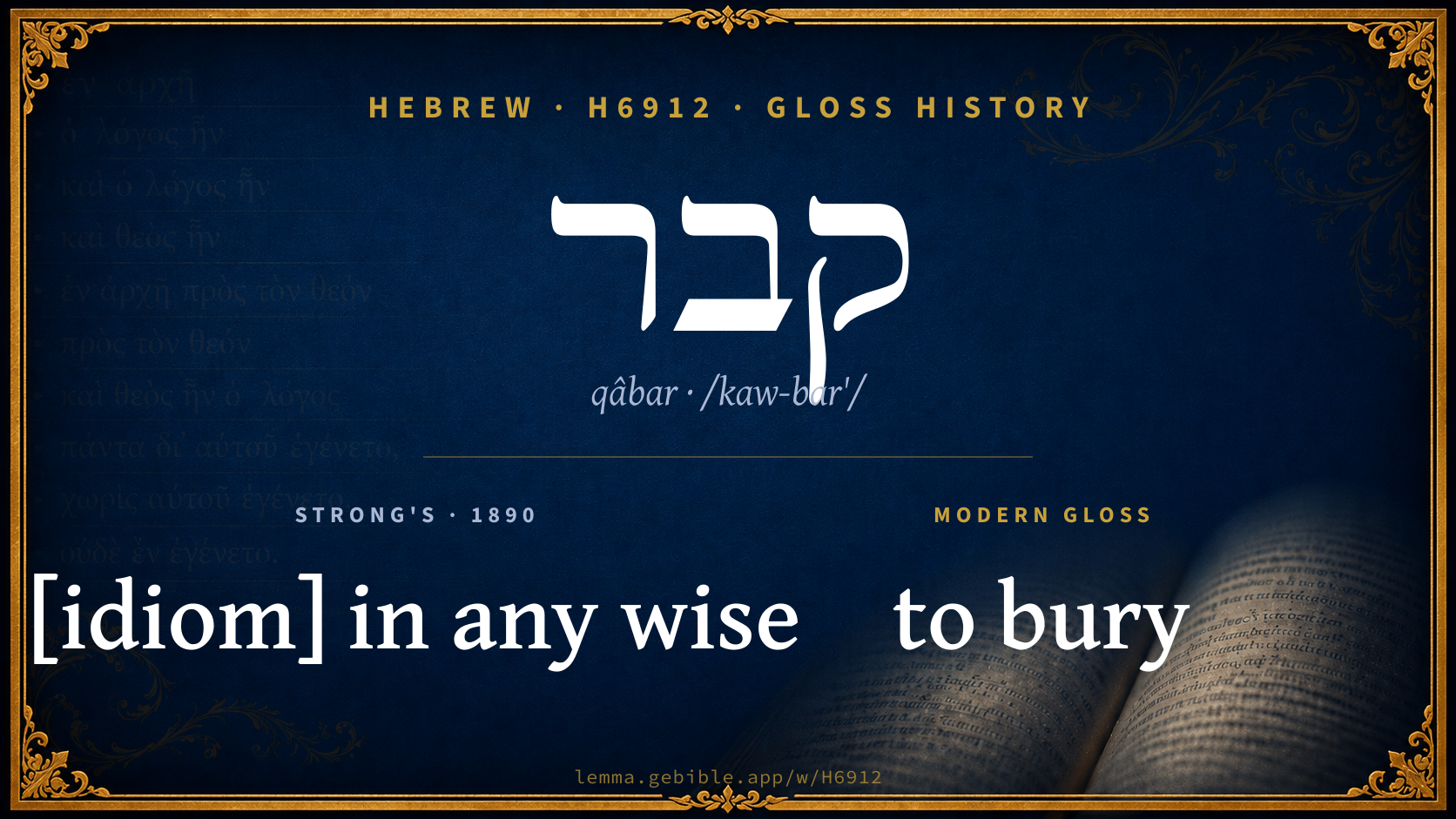
Gloss history
Strong's 1890 vs modern scholarship
About this word
Strong's H6912 catalogs a Hebrew word from the Hebrew Old Testament.
These counts are not copied from any lexicon or concordance. They are computed here, from the morphology-tagged Hebrew Old Testament. What Lemma adds →
- 122
- distinct verses
- The word appears in 122 distinct verses.
- 18 / 39
- OT books
- The word appears in 18 of 39 Old Testament books.
- #339
- by frequency
- Top 500 most frequent Hebrew words (rank 339 of 8,640 Hebrew words by occurrence).
View all 122 occurrences in the concordance →
By section of the Old Testament
By traditional corpus
Conventional, traditional groupings — biblical authorship is debated, so this is a traditional corpus grouping, not an authorship claim. Each share is this word’s portion of its verses in that division of the Hebrew canon. Each figure is a share of the word’s 122 distinct verses.
- Prophets (Nevi'im) 72 verses · 59%
- Torah (Pentateuch) 29 verses · 24%
- Writings (Ketuvim) 21 verses · 17%
How translations render this word
Counts come from each version’s own published word-to-Strong’s tagging or interlinear alignment — an approximate guide to how each version renders this word, not a word-level alignment the data otherwise carries. Because each total is that version’s own tagged count, the per-version totals vary from one another and need not match the appearance or distinct-verse counts above. These counts may also differ from a printed concordance because Lemma counts each distinctly tagged rendering and does not collapse phrase taggings into a single head-word total. This is a fixed set of word-tagged versions (KJV, ASV, BSB, ULT) and does not change with the reading translation you choose elsewhere. Each version’s license is shown beside its name below (and on Sources).
- King James Version: They buried 26×, Was buried 26×, Buried 20×
- American Standard Version: They buried 25×, Was buried 24×, Buried 15×
- Berean Standard Bible: Was buried 38×, Bury 13×, They buried 10×
- unfoldingWord Literal Text: They buried 22×, He was buried 20×, They buried him 14×
King James Version Public Domain
Renders H6912 across 133 tagged occurrences — most commonly:
Plus 32 renderings that appear only once — usually multi-word phrases or single function words the recovered tagging swept in, not distinct renderings.
American Standard Version Public Domain
Renders H6912 across 133 tagged occurrences — most commonly:
Plus 43 renderings that appear only once — usually multi-word phrases or single function words the recovered tagging swept in, not distinct renderings.
Berean Standard Bible Public Domain
Renders H6912 across 130 tagged occurrences — most commonly:
Plus other, less common renderings. Plus 23 renderings that appear only once — usually multi-word phrases or single function words the recovered tagging swept in, not distinct renderings. Not rendered by a distinct English word in 3 further occurrences.
unfoldingWord Literal Text CC BY-SA 4.0
Renders H6912 across 145 tagged occurrences — most commonly:
Plus other, less common renderings. Plus 26 renderings that appear only once — usually multi-word phrases or single function words the recovered tagging swept in, not distinct renderings.
Senses in the full BDB
Hebrew verbs can shift meaning by stem (binyan): Qal is the basic action, Niphal is often passive or reflexive, Piel often intensifies or makes it factitive, and Hiphil is typically causative. The senses below are grouped under the stem BDB assigns to each. This entry also uses Pual (the passive of Piel).
What do BDB’s symbols mean?
BDB uses these scholarly abbreviations:
| Symbol | Meaning |
|---|---|
| 𝔊 | the Septuagint (the ancient Greek translation, LXX) |
| 𝔙 | the Vulgate (the Latin translation) |
| 𝔖 | the Syriac version (the Peshitta) |
| 𝔗 | the Targum (the Aramaic translation) |
| ψ | the Psalms |
| √ | root (the underlying root or stem) |
| ‖ | parallel passage (a synonymous or contrasted parallel) |
| † | the dagger: every passage where the word occurs is cited |
The 4 senses and sub-senses the full Brown-Driver-Briggs lexicon distinguishes for this word, in lexicon order (not ranked by frequency), with BDB’s own verbatim wording and sub-sense lettering. Shown in Hebrew script with BDB’s own scholarly abbreviations. The condensed entry is in the Lexicon Entry tab. See also the Forms in the corpus table below.
Qal
- Pf. 3 ms. ק׳ Gn 23:19; 2 ms. sf. consec. וּקְבַרִתַּנְי 47:30, etc.; Impf. 3 ms. וַיִּקְבֹּר Dt 34:6; 2 K 21:26, etc.; Imv. קְבֹר Gn 23:6 +, etc.; Inf. abs. קָבוֹר Dt 21:23; cstr. לִקְבּוֹר Je 19:11 +, etc.; Pt. act. קֹבֵר 2 K 9:10 +, etc.; pass. קָבוּר 1 K 13:31, pl. קְבֻרִים Ec 8:10 bury, acc. pers., bones, etc., usually c. ב loc., 2 S 2:32; 1 K 13:31(×2) Gn 23:6 Jos 24:30, 32(×2) Ju 2:9 + 33 times; c. בֵּיתוֹ loc. 2 Ch 33:20 (בְּגַן־בֵּיתוֹ ‖ 2 K 21:18, also בְּבֵיתוֹ 1 S 25:1; 1 K 2:34); c. שָׁם Nu 11:34, תַּחַת 1 S 31:13 = 1 Ch 10:12; pregn. c. אֶל loc. Gn 23:19; 25:9; Ez 39:15; אֶל־אֲבֹתָ֑י Gn 49:29; cf. עִם־אֲבוֹתָיו 2 K 12:22; 15:7; 2 Ch 25:28; 26:23 (v. also Niph., and תָּבוֹא אֶל־אֲבֹתֶיךָ Gn 15:15); c. שָׁ֫מָּה Gn 23:13; 49:31(×3); 50:5; c. acc. pers. alone 2 S 2:4, 5 + 22 times; + מִלְּפָנַי Gn 23:4, 8; pass. Ec 8:10; acc. om. 2 K 9:10 + 3 times + (c. ב) 2 S 4:12. e.g. Genesis 23:19
Niphal
- Impf. 3 ms. יִקָּבֵר Je 22:19, etc.;—be buried Gn 15:15 Je 8:2; 16:4, 6; 25:33 (+ אסף), as read perhaps Ez 29:5 for תִּקָּבֵץ (+ id.); קְבֻרַת חֲמוֹר יִקּ׳ Je 22:19; usually c. ב loc. Gn 35:19 Ju 8:32 + 6 times Ju, 2 S 17:23; 1 K 2:10, 34 + 16 times K Ch (+ עִם־אֲבוֹתַיו 1 K 14:31; 15:24 + 6 times; עִם־מַלְכֵי יִשְׂר׳ 2 K 13:13; 14:16); c. שָׁם Nu 20:1 + 3 times; c. תַּחַת, מִתַּחַת Gn 35:8. e.g. Jeremiah 22:19
Piel
- bury (in masses), c. acc.: Impf. 3 fs. sf. תְּקַבְּרֵם Ho 9:6; Inf. cstr. לְקַבֵּר 1 K 11:15; Pt. pl. מְקַבְרִים Nu 33:4 Ez 39:14; as n. intens., of office, burier, sg. מְקַבֵּר Je 14:16, pl. הַמּ׳ Ez 39:15. e.g. Hosea 9:6
Pual
- Pf. 3 ms. שָׁ֫מַּה קֻבַּר אַבְרָהָם Gn 25:10. e.g. Genesis 25:10
Senses from the full Brown-Driver-Briggs lexicon (Brown, Driver, Briggs; Oxford 1906 — public domain), digitized via Sefaria, supplemented by the OpenScriptures HebrewLexicon (CC BY 4.0). Full attribution on Sources.
Word origin
vb. bury (NH id.; Ph. קבר, bury, קבר tomb; Arabic قَبَرَ, Assyrian ḳibîru, Aramaic קְבַר, ܩܒܰܪ, Nab. קבר, all bury; Palm. Nab. קברא tomb, so Sab. קבר HomChrest. 126 Liḥy. קבר bury; DHMEpigr. Denkm. No. 35, 2, 3, cf. מקבר(הם) burial-place CISiv, No. 20, 1, 2, 4);—
— Brown-Driver-Briggs (Oxford 1906, public domain), digitized via Sefaria, supplemented by the OpenScriptures HebrewLexicon (CC BY 4.0). See Sources.
Origin: a primitive root
Jastrow Dictionary
A second Hebrew/Aramaic lexicon for comparison, covering Aramaic and post-biblical (Talmudic, Targumic, Midrashic) usage that the biblical-Hebrew BDB does not. Matched by lemma rather than by Strong’s number, so a lemma may carry more than one Jastrow headword (shown separately below), and the entries cover usage well beyond the Bible.
קָבַר
- (b. h.) [to cave out; to arch,] to bury. Snh. 52ᵃ הנראה מי קוֹבֵר את מי (Ms. M. הא נראה) we shall see, which will cover which (which will die first). Sot. 14ᵃ הקב"ה ק׳ … קְבוֹר מתים the Lord buried the dead, … thou, too, bury the dead (consider attending to the dead a religious duty). Nidd. 24ᵇ קובר מתים הייתי I used to be a grave-digger. B. Bath. 15ᵇ לא … לִקְבּוֹר וכ׳ he had no place where to bury Sarah; Ex. R. s. 6. Treat. S’maḥ. ch. XII קָבְרֵנִי תחלה וכ׳ first bury me in the valley, and then collect my bones. Ib. קִבְרוּ אותי תחת וכ׳ bury me at the feet of my father. Sabb. 114ᵃ אל תִּקְבְּרוּנִי לא וכ׳ bury me neither in white clothes nor in black &c.; a. fr.—Part. pass. קָבוּר; f. קְבוּרָה. Keth. 111ᵃ כל הק׳ בא"י כאילו ק׳ וכ׳ he that is buried in Palestine is as though buried under the altar. Ber. 18ᵇ שאני ק׳ במחצלת וכ׳ for I am buried in a reed mat. Gitt. 56ᵇ (ref. to Koh. VIII, 10) קְבוּרִים ממש וכ׳ it really means buried things, for even hidden things were discovered by them, v. קָבַץ; a. fr. e.g. Ecclesiastes 8:10
- to be buried. Snh. 47ᵃ לא נספד ולא נ׳ if a body has been neither lamented over (v. סָפַד) nor buried. Ib.ᵇ לא יִקָּבֵר בו וכ׳ he must never be buried in that place; a. fr.
- to bury (one after the other). Ib. 113ᵃ היה מְקַבֵּר והולך וכ׳ he successively buried (his children) beginning with Abiham &c.
קְבַר
- 1. same, to bury. Targ. Gen. XXIII, 4. Targ. Ps. LXXIX, 3; a. fr.—Part. pass. קְבִיר; f. קְבִירָא &c. Targ. O. Deut. XXXIII, 21 (Y. קָבוּר, Hebr. form). Targ. Ruth I, 17. Targ. Job XXVII, 15; a. fr.—Snh. 46ᵇ לא בעינא דלִיקְבְּרוּהָ וכ׳ I do not want them to bury this man (I want not to be buried when I am dead). Ib. מדקַבְרֵיה וכ׳ because the Lord buried Moses. Sabb. 151ᵇ וקביר, v. חֲפִיר; a. fr.—Ab. Zar. 38ᵃ וק׳ ביה ישראל וכ׳ after an Israelite had hidden a pumpkin in it (the oven).
- 2. (of tide) to overflow, inundate. Gen. R. s. 13; Koh. R. to I, 7 דמרבי וקָבֵר which grows and floods, v. קַבְרִיאֵל.
- as preced. Pi. Targ. Num. XXXIII, 4; a. e.
- to be buried. Targ. Gen. XV, 15. Targ. Jer. VIII, 2; a. fr.—Snh. l. c. מדאִיקְּבוּר צדיקי since righteous men are buried (it would seem that burial is not for the sake of purging the dead from sin). Ib. הנך נמי לִיקַּבְּרוּ וכ׳ they (the other members of the house of Jeroboam) ought also to have been buried for the sake of atonement. Ib. 104ᵃ קברה ולא אִיקְבְּרָא וכ׳ he buried it (Joiakim’s skull), and it would not remain under ground, buried it again &c.; a. e.
קֶבֶר
- preced.) grave. Snh. 47ᵇ ק׳ חדש a fresh grave (that has been dug but not used). Ib. ק׳ בנין a grave on which something has been built, i.e. an arched grave (not flat). Ib. שלשה קברות הן ק׳ הנמצא there are three kinds of graves (with reference to law): a grave that has been discovered (a fresh grave in which somebody was buried without the consent of the owner of the ground); ק׳ הידוע a known grave (in which one was buried with the owner’s consent); ק׳ המזיק את הרבים a grave which interferes with public comfort (made in a thoroughfare). Y. Naz. IX, 57ᵈ top., v. תְּהוֹם. Ohol. XVII, 1 החורש את הק׳ if one passes the plough over a grave. Koh. R. to VII, 8 וכיון שקברוהו … את קִבְרוֹ when they had buried him (Elisha-Aḥer), a fire came to burn his grave; a. v. fr.—Pl. קְבָרִים, קְבָרוֹת. Taan. 25ᵇ תקנתם ק׳ וכ׳ have you prepared graves for yourselves (are you ready to die)? Ib. 22ᵇ שלא יהא בתיהם קִבְרֵיהֶם that their houses may not become their graves (that their dwellings may not fall down from excessive rains); Y. Yoma V, 42ᶜ top שלא יעשו … קִבְרֵיהֶן. Ḥag. 22ᵇ נשתטח על קִבְרֵי וכ׳ he prostrated himself over the graves of &c. Yeb. 47ᵇ שני ק׳ נמסרו וכ׳ the court has charge of two burial places (for culprits). Snh. VI, 5 ולא היו קוברין אותו בקִבְרוֹת אבותיו they did not bury him (the culprit) in the burial place of their ancestors; a. fr.—בֵּית הקברות (abbr. בה"ק) cemetery; pl. בָּתֵּי ק׳. Ber. 18ᵇ הלך ולן בב"הק he went and spent the night in the cemetery. Snh. l. c. (46ᵇ) שני בתי ק׳ וכ׳ two burial grounds were at the disposal of the courts, one for those put to death by the sword, and one &c.; a. fr.—Trnsf. uterus (containing an embryo). Nidd. 21ᵃ באיפשר לפתיחת הק׳ וכ׳ they differ as to whether the uterus can open (to pass the embryo) without discharging blood. Sabb. 129ᵃ חיה כל זמן שהק׳ פתוח וכ׳ for a woman in confinement you must violate the Sabbath laws as long as the uterus is open, whether she says that she needs it or that she needs it not. Ib. מאימתי פתיחת הק׳ when does the opening of the womb begin (in regard to Sabbath laws)?; עד מתי … הק׳ how long is it considered open? Ohol. VII, 4 אין לנפלים פ׳ הק׳ וכ׳ in the case of abortions the laws of levitical cleanness connected with the opening of the womb do not apply, unless &c., v. פִּיקָא I; Tosef. ib. VIII, 8; a. fr.
A Dictionary of the Targumim, the Talmud Babli and Yerushalmi, and the Midrashic Literature (Marcus Jastrow; London, Luzac, 1903) — Public Domain. Digitized via Sefaria. Digitized via Sefaria. Full attribution on Sources.
Forms in the corpus
The 82 distinct written forms H6912 takes in the Hebrew Bible, most frequent first — each parse links to that stem’s occurrences in the concordance. Hebrew forms include their vowel points and cantillation, so a single lemma takes many written forms.
The 60 most common forms are shown; 22 rarer forms follow in the full concordance.
Same root — word family
Other BDB entries built from the same root as H6912, grouped by Strong’s listed origin. These share a root / origin per the lexicon — not necessarily a shared meaning. Each links to that word’s own entry.
Derived from this word
Compare all same-root words → They share a root, not necessarily a meaning.
Septuagint verse parallels
This word appears in 116 verses that also exist in the Greek Old Testament (Septuagint), out of the 122 Hebrew verses it occurs in. You can read those verses in Greek by switching the Old Testament edition to the Septuagint.
Read these verses in the Septuagint
- Genesis 15:15
- Numbers 11:34
- Deuteronomy 10:6
- Joshua 24:30
- Judges 2:9
- Ruth 1:17
- 1 Samuel 25:1
- 2 Samuel 2:4
- 1 Kings 2:10
- 2 Kings 8:24
- 1 Chronicles 10:12
- 2 Chronicles 9:31
This is a verse-level parallel only — the same verses exist in both the Hebrew and Greek Old Testaments. No word-level Hebrew↔Greek correspondence is claimed: the data carries no such alignment, so no Greek word is shown as this Hebrew word’s translation. Coverage is not total — the Septuagint omits the deuterocanon and renumbers the Psalms, so some Hebrew verses have no direct Greek parallel.