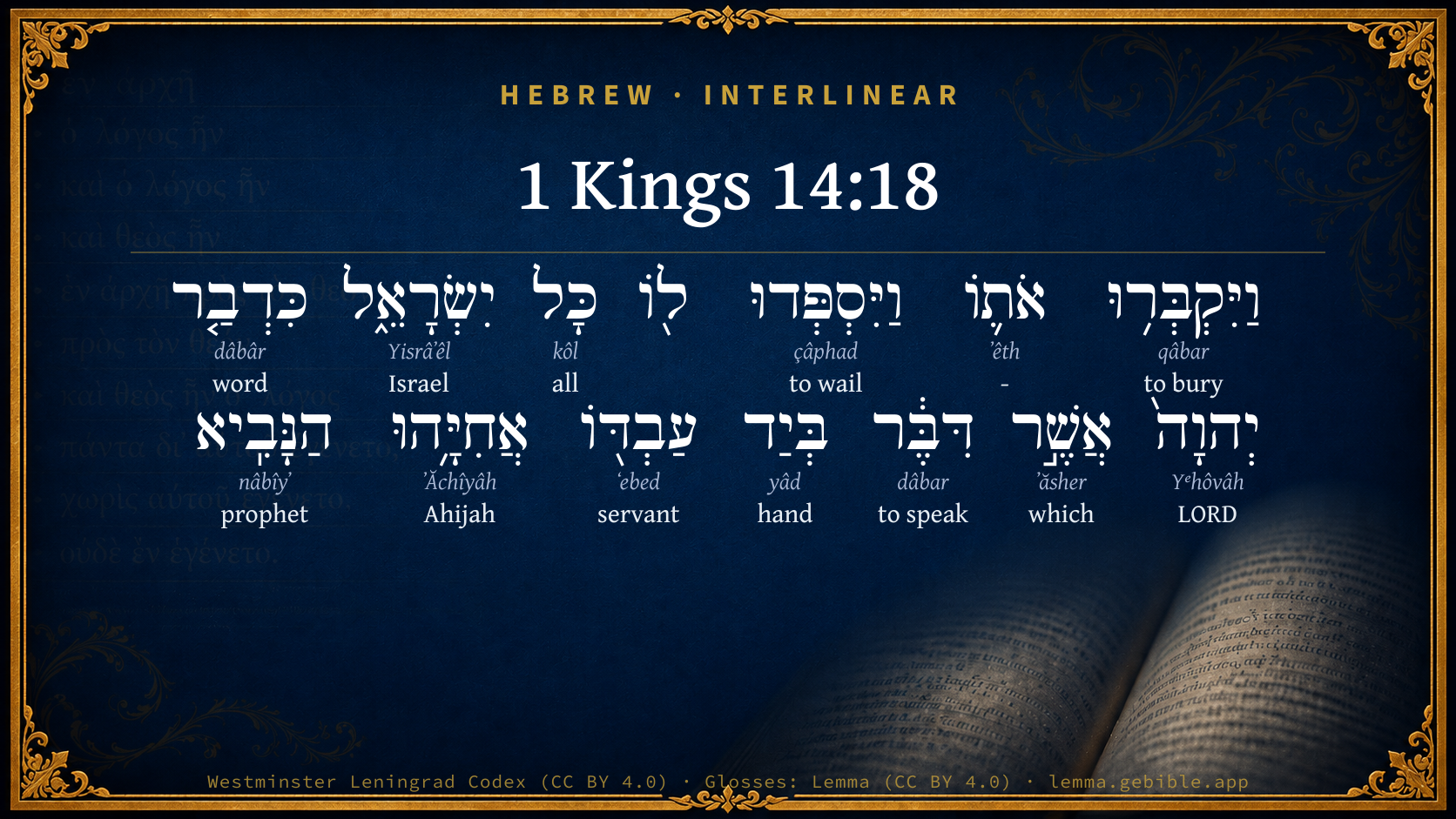
1 Kings 14:18

Hebrew (Westminster Leningrad Codex) 1 Kings 14:18 appears in the Hebrew Old Testament. The text above is from the Westminster Leningrad Codex. Each word links to its Strong’s number, a concise gloss, and parsing drawn from the Open Scriptures Hebrew Bible morphology. Click any word for its full Brown-Driver-Briggs (BDB) entry.
Download image
Cite this verse

1 Kings 14:18 (World English Bible). Public Domain. Lemma interlinear Bible study tool, https://lemma.gebible.app/v/1-kings/14/18.

Show BibTeX & RIS
BibTeX
RIS
English Translation
All Israel buried him, and mourned for him, according to the word of Yahweh, which he spoke by his servant Ahijah the prophet.
World English Bible · Public Domain
Download a study sheet

One document with this verse’s original text, its word-by-word gloss line, the meaning frame, cross-references with their text, attributed commentary, and full source and license credits — printable, and it pastes into notes with its structure intact.

This verse Autodidact and up

Study sheet (.html) Plain text (.txt)

A passage Seminary Student

Up to 50 verses in one chapter. A passage sheet keeps up to 6 commentary sources and 12 cross-references per verse, in the order this page ranks them, and says so on the sheet whenever that leaves anything out. Ask for a single verse and you get the Autodidact verse sheet above.

Everything on this page stays free to read, with no account — the sheet is a download of what is already on screen, not access to it.

Want to remove ads? Support Godless Engineer
Compare translations 3

The same verse in 3 English versions, stacked beneath the original-language interlinear above. Click any original word for its lexicon entry.

Each is an independent rendering of the whole verse — the interlinear is not word-aligned to these translations.

Highlighted words mark where these versions differ — a whole-verse word diff, not a word-by-word alignment.

  • World English Bible Public Domain
    All Israel buried him, and mourned for him, according to the word of Yahweh, which he spoke by his servant Ahijah the prophet.
  • King James Version Public Domain
    And they buried him; and all Israel mourned for him, according to the word of the LORD, which he spake by the hand of his servant Ahijah the prophet.
  • unfoldingWord Literal Text CC BY-SA 4.0
    And they buried him, and all of Israel mourned for him, according to the word of Yahweh that he had spoken by the hand of his servant Ahijah the prophet.

unfoldingWord Literal Text — © unfoldingWord, licensed CC BY-SA 4.0. Word-aligned USFM3 via Door43 (git.door43.org/unfoldingWord/en_ult).

Versions to compare (up to 4)

3 of 4 selected

Show all 18 translations

Every available English version of this verse, each an independent rendering of the whole verse.

  • World English Bible Public Domain
    All Israel buried him, and mourned for him, according to the word of Yahweh, which he spoke by his servant Ahijah the prophet.
  • Berean Standard Bible Public Domain
    And they buried him, and all Israel mourned for him, according to the word that the LORD had spoken through His servant Ahijah the prophet.
  • Majority Standard Bible Public Domain
    And they buried him, and all Israel mourned for him, according to the word that the LORD had spoken through His servant Ahijah the prophet.
  • King James Version Public Domain
    And they buried him; and all Israel mourned for him, according to the word of the LORD, which he spake by the hand of his servant Ahijah the prophet.
  • American Standard Version (1901) Public Domain
    And all Israel buried him, and mourned for him, according to the word of Jehovah, which he spake by his servant Ahijah the prophet.
  • Revised Version (1885) Public Domain
    And all Israel buried him, and mourned for him; according to the word of the LORD, which he spake by the hand of his servant Ahijah the prophet.
  • Geneva Bible (1599) Public Domain
    And they buried him, and all Israel lamented him; according to the word of the Lord, which hee spake by the hand of his seruant Ahiiah the Prophet.
  • Douay-Rheims (1899) Public Domain
    And they buried him. And all Israel mourned for him according to the word of the Lord, which he spoke by the hand of his servant Ahias the prophet.
  • Young's Literal Translation Public Domain
    and they bury him, and mourn for him do all Israel, according to the word of Jehovah, that he spake by the hand of His servant Ahijah the prophet.
  • Literal Standard Version CC BY-SA 4.0
    and they bury him, and all Israel mourns for him, according to the word of YHWH that he spoke by the hand of His servant Ahijah the prophet.
  • Unlocked Literal Bible CC BY-SA 4.0
    All Israel buried him and mourned for him, just as it was told to them by the word of Yahweh which he had spoken by his servant Ahijah the prophet.
  • unfoldingWord Literal Text CC BY-SA 4.0
    And they buried him, and all of Israel mourned for him, according to the word of Yahweh that he had spoken by the hand of his servant Ahijah the prophet.
  • Darby Bible Public Domain
    And they buried him; and all Israel mourned for him, according to the word of Jehovah, which he spoke through his servant Ahijah the prophet.
  • World Messianic Bible Public Domain
    All Israel buried him and mourned for him, according to the LORD’s word, which he spoke by his servant Ahijah the prophet.
  • Webster's Bible Public Domain
    And they buried him; and all Israel mourned for him, according to the word of the LORD, which he spoke by the hand of his servant Ahijah the prophet.
  • Free Bible Version CC BY-SA 4.0
    All of Israel buried him and mourned for him, just as the Lord had said through his servant Ahijah the prophet.
  • Bible in Basic English Public Domain
    And all Israel put his body to rest, weeping over him, as the Lord had said by his servant Ahijah the prophet.
  • JPS Tanakh (1917) Public Domain
    And all Israel buried him, and made lamentation for him; according to the word of the LORD, which He spoke by the hand of His servant Ahijah the prophet.

Literal Standard Version (2020), Covenant Press — licensed CC BY-SA 4.0. Text via the HelloAO Bible API (eBible.org). Unlocked Literal Bible (unfoldingWord) — licensed CC BY-SA 4.0. Text via the HelloAO Bible API (eBible.org). unfoldingWord Literal Text — © unfoldingWord, licensed CC BY-SA 4.0. Word-aligned USFM3 via Door43 (git.door43.org/unfoldingWord/en_ult). Free Bible Version, Dr. Jonathan Gallagher — licensed CC BY-SA 4.0. Text via the HelloAO Bible API (eBible.org).

Word by word

More ways to search: Search by grammar → Find every occurrence → Compare this word →

Practice this passage: Drill this verse → Learn its vocabulary →

אֲחִיָּ֥הוּ
ʼĂchîyâh
H281
“Ahijah”
Noun, Proper
Part of Speech
Noun
Type
Proper
Full BDB Definition

Origin: from H251 and H3050

TWOT: None

Ahiah or Ahijah = "brother of Jehovah (Yahu)" - grandson of Phinehas - scribe of Solomon - a prophet who predicted the revolt of the Northern tribes - father of Baasha, who usurped the Northern throne - grandson of Hezron (or mother of 1-4 above) - a Benjamite, son of Ehud - one of David's heroes - a Levite during David's time - a chief man under Nehemiah
  1. וַיִּקְבְּר֥וּ qâbar H6912 “and · to bury” Conjunction + Verb, Qal, Sequential Imperfect, 3rd Person, Masculine, Plural
  2. אֹת֛וֹ ʼêth H853 “- · him” Particle, Direct Object + Suffix, Personal, 3rd Person, Masculine, Singular
  3. וַיִּסְפְּדוּ çâphad H5594 “and · to wail” Conjunction + Verb, Qal, Sequential Imperfect, 3rd Person, Masculine, Plural
  4. כָּל kôl H3605 “all of” Noun, Common, Masculine, Singular, Construct
  5. יִשְׂרָאֵ֑ל Yisrâʼêl H3478 “Israel” Noun, Proper
  6. כִּדְבַ֤ר dâbâr H1697 “like/as · word of” Preposition + Noun, Common, Masculine, Singular, Construct
  7. יְהוָה֙ Yᵉhôvâh H3068 “LORD” Noun, Proper
  8. אֲשֶׁ֣ר ʼăsher H834 “which” Particle, Relative
  9. דִּבֶּ֔ר dâbar H1696 “to speak” Verb, Piel, Perfect, 3rd Person, Masculine, Singular
  10. בְּיַד yâd H3027 “in/at · hand of” Preposition + Noun, Common, Both, Singular, Construct
  11. עַבְדּ֖וֹ ʻebed H5650 “servant · his” Noun, Common, Masculine, Singular, Construct + Suffix, Personal, 3rd Person, Masculine, Singular
  12. הַנָּבִֽיא nâbîyʼ H5030 “the · prophet” Particle, Definite Article + Noun, Common, Masculine, Singular, Absolute

About this verse

These counts appear in no published source. They are computed here, from the morphology-tagged text and Lemma’s own curated glosses. What Lemma adds →

14
words
13
distinct lemmas
Historical
section

Notable vocabulary

The rarest word here is אֲחִיָּ֥הוּ Ahijah H281 — appearing just 24 times in the whole Hebrew Bible.

Shared distinctive vocabulary

אֲחִיָּ֥הוּ Ahijah H281 occurs in 23 verses of the Hebrew Bible. Also found in:

Grammatical profile

  • 3 verbs
  • 8 nouns
  • 1 preposition
  • 2 particles

Verb forms

  • וַיִּקְבְּר֥וּ Qal · Sequential Imperfect
  • וַיִּסְפְּדוּ Qal · Sequential Imperfect
  • דִּבֶּ֔ר Piel · Perfect

Cross-references

1

Topical passages linked to 1 Kings 14:18 in the Treasury of Scripture Knowledge — connected by theme and wording, ordered by reader-vote popularity; previews shown in the World English Bible.

  • 1 Kings 14:13 All Israel shall mourn for him, and bury him; for he only of Jeroboam shall come to the grave, because in him there is found some good thing toward Yahweh, the God of Israel, in the house of Jeroboam.

Cross-references courtesy of OpenBible.info (CC BY 4.0).

Hebrew and Greek witnesses Masoretic Hebrew ↔ Greek Septuagint

The same verse in the two great witnesses to the Old Testament, shown verse-for-verse.

These are two independent witnesses, not word-aligned to each other, and the Septuagint is shown in lemma (dictionary) form.

Hebrew 1 Kings 14:18 Masoretic · Westminster Leningrad Codex

וַיִּקְבְּר֥וּ אֹת֛וֹ וַיִּסְפְּדוּ ל֖וֹ כָּל יִשְׂרָאֵ֑ל כִּדְבַ֤ר יְהוָה֙ אֲשֶׁ֣ר דִּבֶּ֔ר בְּיַד עַבְדּ֖וֹ אֲחִיָּ֥הוּ הַנָּבִֽיא

All Israel buried him, and mourned for him, according to the word of Yahweh, which he spoke by his servant Ahijah the prophet.

World English Bible · Public Domain

Hebrew: Westminster Leningrad Codex (CC BY 4.0). Greek: Septuagint (public domain); English from a public-domain English Septuagint. How the Septuagint differs from the Hebrew →

Targum (Aramaic paraphrase)

1

The Targum is the ancient Jewish Aramaic paraphrase of the Hebrew Scriptures — an interpretive translation, not the Hebrew text itself. Onkelos (literal) and Pseudo-Jonathan (expansive) render the Torah, and Jonathan the Prophets. Coverage is partial: where no permissively-licensed English translation exists for a verse, only the Aramaic is shown. This is verse-level text, not a word-by-word alignment to the Hebrew.

  1. Targum Jonathan Prophets (Joshua–Malachi)
    וּקְבָרוּ יָתֵיהּ וּסְפָדוּ עֲלוֹהִי כָּל יִשְׂרָאֵל כְּפִתְגָמָא דַייָ דְמַלֵיל בְּיַד עַבְדֵיהּ אֲחִיָה נְבִיָא:

    (no public-domain English translation for this verse)

    Targum Jonathan — Aramaic: “Mikraot Gedolot” (public domain). English: “Sefaria Community Translation” (CC0 1.0 (public-domain dedication)); “London "Chaldee Paraphrase," 1871” (public domain). Text via Sefaria.

Commentary

Notes on 1 Kings 14:18 from classic Christian and Jewish commentators (each source and its license shown beneath its notes). The classic Christian expositions comment on the surrounding passage and are grouped to its opening verse, so a note may address several verses; the Jewish commentaries on the Tanakh (Rashi and others) are per-verse, so they appear only where the commentator wrote on this verse.

Lemma curates 59 commentaries, every one of them public domain or Creative Commons licensed, each selected and text-cleaned for this edition rather than reprinted as found. About our sources →

Trapp's Complete Commentary

John Trapp

1Ki 14:18 And they buried him; and all Israel mourned for him, according to the word of the LORD, which he spake by the hand of his servant Ahijah the prophet.

Ver. 18. And all Israel mourned.] See 1Ki 14:13.

John Trapp, A Commentary or Exposition upon All the Books of the Old and New Testament (1647–1656) — public domain. Text from a community e-Sword module.

Joseph Benson's Commentary

1Ki 14:18. All Israel mourned for him — And justly: not only for the loss of a hopeful prince, but because his death plucked up the flood-gates at which an inundation of judgments broke in. According to the word of the Lord by Ahijah — Thus by accomplishing the predictions of his prophet concerning the death and burial of the child, and the lamentation which the people made for him, God confirmed all the rest of his threatenings against the house of Jeroboam and the people of Israel.

Joseph Benson's Commentary on the Old and New Testaments (1811–1818) — public domain. Text from a community e-Sword module.

The Cambridge Bible for Schools and Colleges

gen. ed. J. J. S. Perowne

18. and they buried him] The R.V. transposes ‘all Israel,’ putting it before ‘buried,’ and thus the sentence assumes an English form. The Hebrew puts ‘all Israel’ at the end of the clause.

by the hand of] A common Hebrew form for the simple ‘by.’ Cf. 1Ki_8:53 above.

The Cambridge Bible for Schools and Colleges (gen. ed. J. J. S. Perowne; Cambridge University Press, 1878–1918) — public domain. Text from a community e-Sword module.

John Gill's Exposition

And the rest of the acts of Jeroboam, how he warred,.... As he did with Rehoboam, Kg1 14:30, and with Abijam his son, who was an more than a match for him, see Ch2 13:1.

and how he reigned; over the people of Israel, whether wisely, and justly, and in clemency, or not:

behold, they are written in the book of the chronicles of the kings of Israel; not in that canonical book of Scripture, so called, for in that there is very little account of the reign of Jeroboam; but in the annals and diaries of the kings of Israel, written by persons appointed for that purpose, and out of which it is generally thought that inspired writers, by divine direction, took what was thought proper to be transmitted to future times. So with the Romans, from their very beginning to the times of Mutius, all the events of every year were committed to writing by the order of the Pontifex Maximus, and lay open to be read by the people in common; and these, as Tully (l) says, were what are called annals.

(l) De Oratore, l. 2. c. 34.

John Gill's Exposition of the Whole Bible (1746–1763) — public domain (CC PDM 1.0). Text via the HelloAO Bible API.

The Pulpit Commentary

And they buried him see on ver. 13; and all Israel mourned for him, according to the word of the Lord, which he spake by the hand (see on 1Ki_2:25) of his servant Ahijah the prophet, it was a token of the righteous judgment of God that the same prophet who announced Jeroboam"s exaltation predicted his fall.

The Pulpit Commentary (1880–1919), ed. H.D.M. Spence-Jones & Joseph S. Exell — public domain. Text from a community e-Sword module.

John Wesley's Explanatory Notes

Mourned - And justly: not only for the loss of an hopeful prince, but because his death plucked up the floodgates, at which an inundation of judgments broke in.

John Wesley, Explanatory Notes Upon the Whole Bible (1754–1765) — public domain. Text via the GEBible commentary corpus.

Lesson kit

Teaching starters — assembled from the data on this page, not authored interpretation. Every prompt links to the verse data it draws on. Edit before teaching.

1 Kings, in the Historical, opens this verse with 14 words (13 distinct Hebrew lemmas). Its most distinctive word is ʼĂchîyâh (“Ahijah”). A historical commentator’s framing appears above. Read the whole chapter for the surrounding context.

Discussion questions

  1. The word ʼĂchîyâh carries the sense “Ahijah.” How does it shape the verse?
  2. How does 1 Samuel 14:3, which shares the word «Ahijah», read alongside this verse?
  3. These translations render this verse differently; the difference is in the English rendering, not the original. What questions does that raise?
  4. «וַיִּקְבְּר֥וּ» is a Qal Sequential Imperfect verb. How does that grammatical form shape the action described?
  5. Compare how Trapp's Complete Commentary and Joseph Benson's Commentary read this verse. Where do they agree or differ?

Things to notice

Reading settings

Reading text

Shown beneath each verse's original-language words.

Old Testament
Old Testament edition

Read the OT as the Masoretic Hebrew (MT) or the Greek Septuagint (LXX).

English shown for the Greek Septuagint (in the Hebrew ↔ Greek comparison).

Comparing translations? Open the Compare panel on any verse page to stack up to four side by side.