Genesis 49:31

Hebrew (Westminster Leningrad Codex) Genesis 49:31 appears in the Hebrew Old Testament. The text above is from the Westminster Leningrad Codex. Each word links to its Strong’s number, a concise gloss, and parsing drawn from the Open Scriptures Hebrew Bible morphology. Click any word for its full Brown-Driver-Briggs (BDB) entry.
Download image
Cite this verse

Genesis 49:31 (World English Bible). Public Domain. Lemma interlinear Bible study tool, https://lemma.gebible.app/v/genesis/49/31.

Show BibTeX & RIS
BibTeX
RIS
English Translation
There they buried Abraham and Sarah, his wife. There they buried Isaac and Rebekah, his wife, and there I buried Leah:
World English Bible · Public Domain
Download a study sheet

One document with this verse’s original text, its word-by-word gloss line, the meaning frame, cross-references with their text, attributed commentary, and full source and license credits — printable, and it pastes into notes with its structure intact.

This verse Autodidact and up

Study sheet (.html) Plain text (.txt)

A passage Seminary Student

Up to 50 verses in one chapter. A passage sheet keeps up to 6 commentary sources and 12 cross-references per verse, in the order this page ranks them, and says so on the sheet whenever that leaves anything out. Ask for a single verse and you get the Autodidact verse sheet above.

Everything on this page stays free to read, with no account — the sheet is a download of what is already on screen, not access to it.

Want to remove ads? Support Godless Engineer
Compare translations 3

The same verse in 3 English versions, stacked beneath the original-language interlinear above. Click any original word for its lexicon entry.

Each is an independent rendering of the whole verse — the interlinear is not word-aligned to these translations.

Highlighted words mark where these versions differ — a whole-verse word diff, not a word-by-word alignment.

  • World English Bible Public Domain
    There they buried Abraham and Sarah, his wife. There they buried Isaac and Rebekah, his wife, and there I buried Leah:
  • King James Version Public Domain
    There they buried Abraham and Sarah his wife; there they buried Isaac and Rebekah his wife; and there I buried Leah.
  • unfoldingWord Literal Text CC BY-SA 4.0
    There they buried Abraham and Sarah his wife, there they buried Isaac and Rebekah his wife, and there I buried Leah.

unfoldingWord Literal Text — © unfoldingWord, licensed CC BY-SA 4.0. Word-aligned USFM3 via Door43 (git.door43.org/unfoldingWord/en_ult).

Versions to compare (up to 4)

3 of 4 selected

Show all 18 translations

Every available English version of this verse, each an independent rendering of the whole verse.

  • World English Bible Public Domain
    There they buried Abraham and Sarah, his wife. There they buried Isaac and Rebekah, his wife, and there I buried Leah:
  • Berean Standard Bible Public Domain
    There Abraham and his wife Sarah are buried, there Isaac and his wife Rebekah are buried, and there I buried Leah.
  • Majority Standard Bible Public Domain
    There Abraham and his wife Sarah are buried, there Isaac and his wife Rebekah are buried, and there I buried Leah.
  • King James Version Public Domain
    There they buried Abraham and Sarah his wife; there they buried Isaac and Rebekah his wife; and there I buried Leah.
  • American Standard Version (1901) Public Domain
    there they buried Abraham and Sarah his wife; there they buried Isaac and Rebekah his wife; and there I buried Leah:
  • Revised Version (1885) Public Domain
    there they buried Abraham and Sarah his wife; there they buried Isaac and Rebekah his wife; and there I buried Leah:
  • Geneva Bible (1599) Public Domain
    There they buried Abraham and Sarah his wife: there they buryed Izhak and Rebekah his wife: and there I buried Leah.
  • Douay-Rheims (1899) Public Domain
    Benjamin a ravenous wolf, in the morning shall eat the prey, and in the evening shall divide the spoil.
  • Young's Literal Translation Public Domain
    (there they buried Abraham and Sarah his wife; there they buried Isaac and Rebekah his wife; and there I buried Leah);
  • Literal Standard Version CC BY-SA 4.0
    (there they buried Abraham and his wife Sarah; there they buried Isaac and his wife Rebekah; and there I buried Leah);
  • Unlocked Literal Bible CC BY-SA 4.0
    There they buried Abraham and Sarah his wife; there they buried Isaac and Rebekah his wife; and there I buried Leah.
  • unfoldingWord Literal Text CC BY-SA 4.0
    There they buried Abraham and Sarah his wife, there they buried Isaac and Rebekah his wife, and there I buried Leah.
  • Darby Bible Public Domain
    There they buried Abraham and Sarah his wife; there they buried Isaac and Rebecca his wife; and there I buried Leah.
  • World Messianic Bible Public Domain
    There they buried Abraham and Sarah, his wife. There they buried Isaac and Rebekah, his wife, and there I buried Leah:
  • Webster's Bible Public Domain
    (There they buried Abraham and Sarah his wife; there they buried Isaac and Rebekah his wife; and there I buried Leah,)
  • Free Bible Version CC BY-SA 4.0
    Abraham and his wife Sarah were buried there, Isaac and his wife Rebekah were buried there, and I buried Leah there.
  • Bible in Basic English Public Domain
    There Abraham and Sarah his wife were put to rest, and there they put Isaac and Rebekah his wife, and there I put Leah to rest.
  • JPS Tanakh (1917) Public Domain
    There they buried Abraham and Sarah his wife; there they buried Isaac and Rebekah his wife; and there I buried Leah.

Literal Standard Version (2020), Covenant Press — licensed CC BY-SA 4.0. Text via the HelloAO Bible API (eBible.org). Unlocked Literal Bible (unfoldingWord) — licensed CC BY-SA 4.0. Text via the HelloAO Bible API (eBible.org). unfoldingWord Literal Text — © unfoldingWord, licensed CC BY-SA 4.0. Word-aligned USFM3 via Door43 (git.door43.org/unfoldingWord/en_ult). Free Bible Version, Dr. Jonathan Gallagher — licensed CC BY-SA 4.0. Text via the HelloAO Bible API (eBible.org).

Word by word

More ways to search: Search by grammar → Find every occurrence → Compare this word →

Practice this passage: Drill this verse → Learn its vocabulary →

רִבְקָ֣ה
Ribqâh
H7259
“Rebekah”
Noun, Proper
Part of Speech
Noun
Type
Proper
Full BDB Definition

Origin: from an unused root probably meaning to clog by tying up the fetlock

TWOT: None

Rebekah = "ensnarer" - daughter of Bethuel, sister of Laban, wife of Isaac, and mother of Esau and Jacob
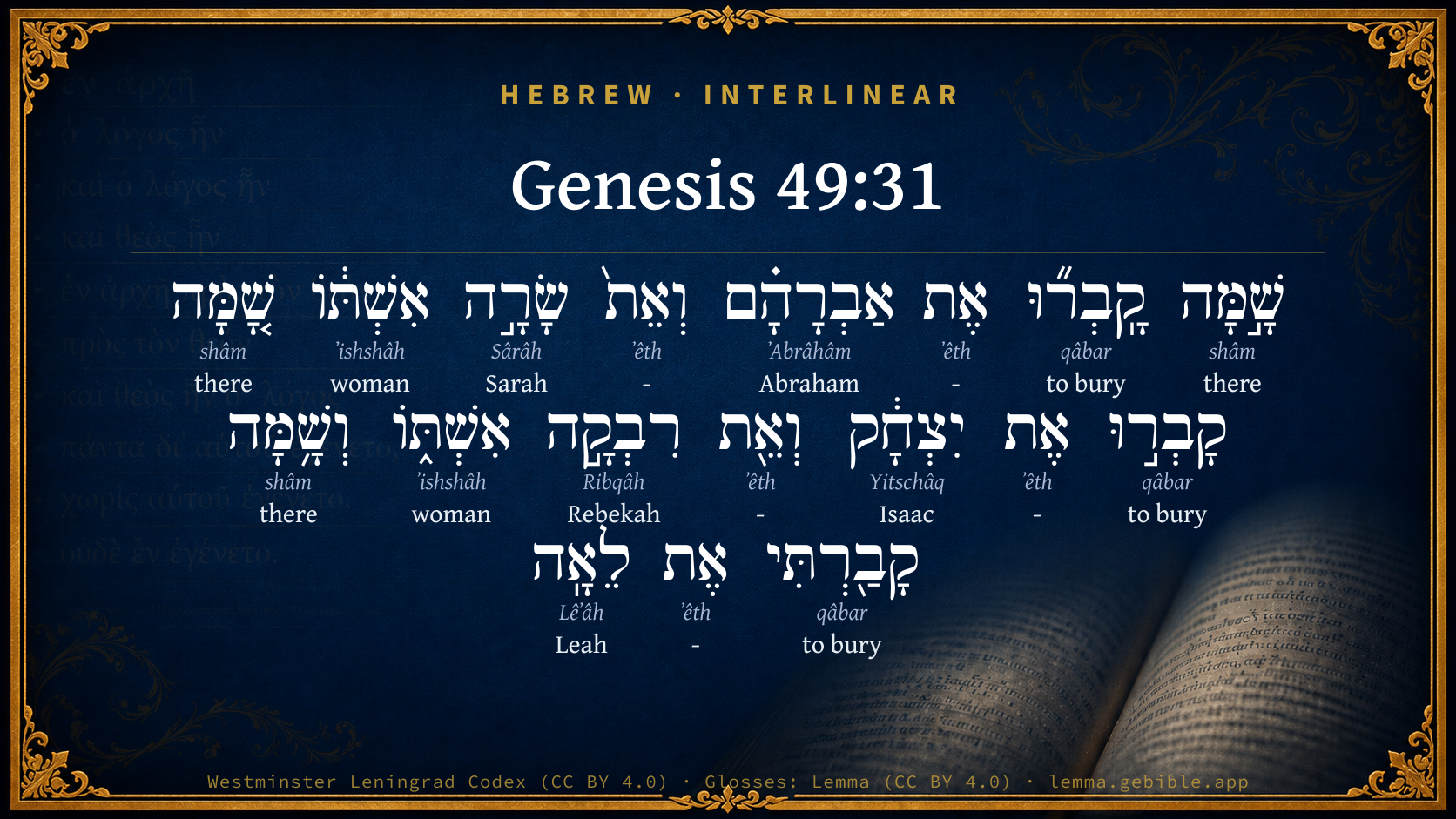
  1. שָׁ֣מָּה shâm H8033 “there · toward” Adverb + Suffix, Demonstrative
  2. קָֽבְר֞וּ qâbar H6912 “to bury” Verb, Qal, Perfect, 3rd Person, Common, Plural
  3. אֶת ʼêth H853 “-” Particle, Direct Object
  4. אַבְרָהָ֗ם ʼAbrâhâm H85 “Abraham” Noun, Proper
  5. וְאֵת֙ ʼêth H853 “and · -” Conjunction + Particle, Direct Object
  6. שָׂרָ֣ה Sârâh H8283 “Sarah” Noun, Proper
  7. אִשְׁתּ֔וֹ ʼishshâh H802 “woman · his” Noun, Common, Feminine, Singular, Construct + Suffix, Personal, 3rd Person, Masculine, Singular
  8. שָׁ֚מָּה shâm H8033 “there · toward” Adverb + Suffix, Demonstrative
  9. קָבְר֣וּ qâbar H6912 “to bury” Verb, Qal, Perfect, 3rd Person, Common, Plural
  10. אֶת ʼêth H853 “-” Particle, Direct Object
  11. יִצְחָ֔ק Yitschâq H3327 “Isaac” Noun, Proper
  12. וְאֵ֖ת ʼêth H853 “and · -” Conjunction + Particle, Direct Object
  13. אִשְׁתּ֑וֹ ʼishshâh H802 “woman · his” Noun, Common, Feminine, Singular, Construct + Suffix, Personal, 3rd Person, Masculine, Singular
  14. וְשָׁ֥מָּה shâm H8033 “and · there · toward” Conjunction + Adverb + Suffix, Demonstrative
  15. קָבַ֖רְתִּי qâbar H6912 “to bury” Verb, Qal, Perfect, 1st Person, Common, Singular
  16. אֶת ʼêth H853 “-” Particle, Direct Object
  17. לֵאָֽה Lêʼâh H3812 “Leah” Noun, Proper

About this verse

These counts appear in no published source. They are computed here, from the morphology-tagged text and Lemma’s own curated glosses. What Lemma adds →

18
words
9
distinct lemmas
Pentateuch
section

Shared distinctive vocabulary

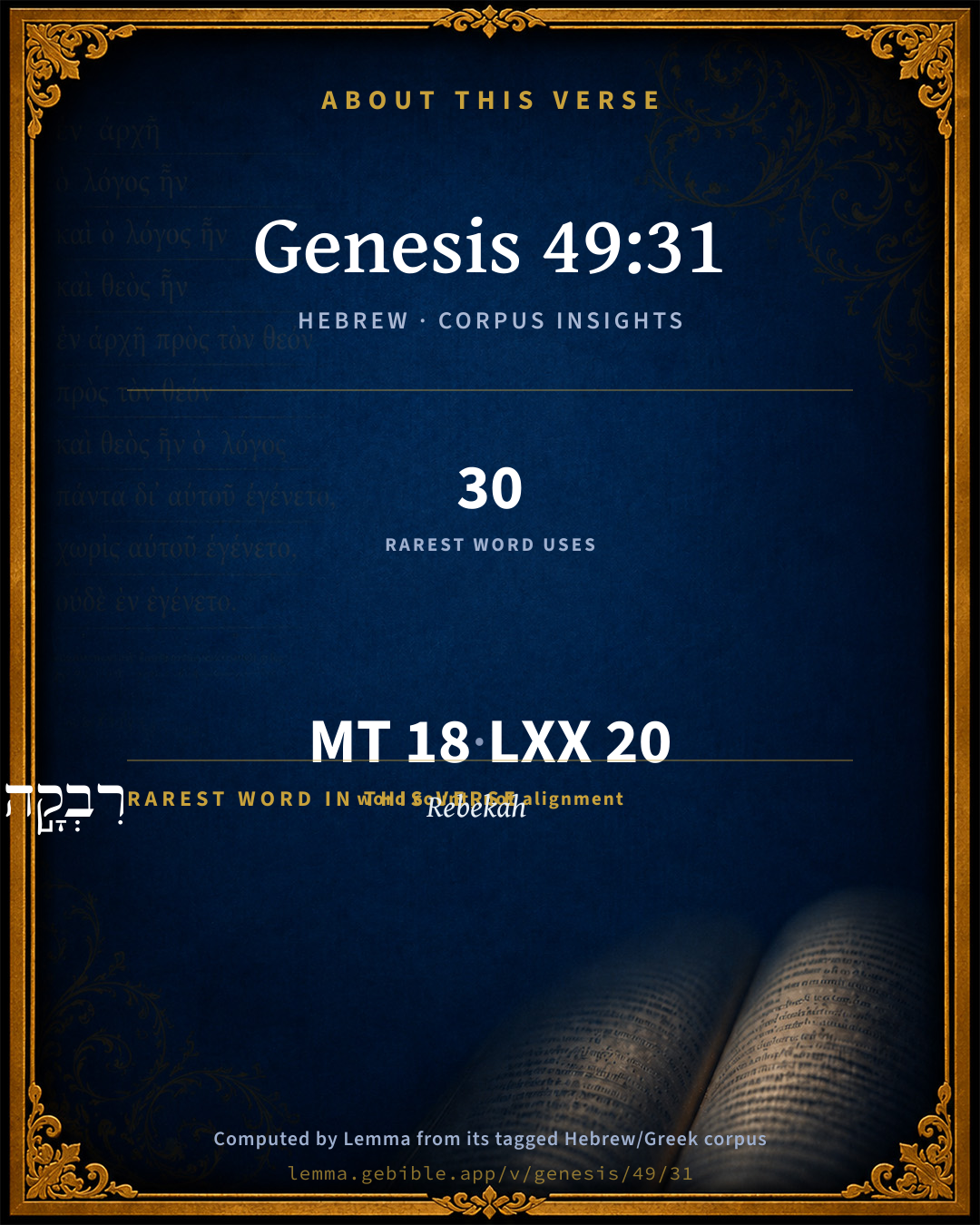
רִבְקָ֣ה Rebekah H7259 occurs in 29 verses of the Hebrew Bible. Also found in:

Grammatical profile

  • 3 verbs
  • 7 nouns
  • 3 adverbs
  • 5 particles

Verb forms

  • קָֽבְר֞וּ Qal · Perfect
  • קָבְר֣וּ Qal · Perfect
  • קָבַ֖רְתִּי Qal · Perfect

Repetition

Words recur within this verse — often emphatic in Hebrew:

  • שָׁ֣מָּה there H8033 ×3
  • קָֽבְר֞וּ to bury H6912 ×3
  • אִשְׁתּ֔וֹ woman H802 ×2

Hebrew & Septuagint length

In English translation the verse runs 21 words from the Hebrew and 20 from the Septuagint (LXX English) — closely comparable.

A rough comparison of the two English renderings, which tokenize alike — not a word-level alignment.

Word counts can differ between the Hebrew and the Greek without any difference in meaning — e.g. the Hebrew direct-object marker אֵת has no separate Greek word, and Greek often adds the article ὁ.

In the original languages it is 18 Hebrew tokens and 20 Greek tokens — but the two are counted differently (Hebrew bundles its prefixes and suffixes into one token; the Greek is in lemma form), so that isn’t a like-for-like length.

Cross-references

7

Topical passages linked to Genesis 49:31 in the Treasury of Scripture Knowledge — connected by theme and wording, ordered by reader-vote popularity; previews shown in the World English Bible.

  • Genesis 25:9 Isaac and Ishmael, his sons, buried him in the cave of Machpelah, in the field of Ephron, the son of Zohar the Hittite, which is before Mamre,
  • Genesis 35:29 Isaac gave up the spirit, and died, and was gathered to his people, old and full of days. Esau and Jacob, his sons, buried him.
  • Genesis 23:3 Abraham rose up from before his dead, and spoke to the children of Heth, saying,
  • Genesis 23:16–20 Abraham listened to Ephron. Abraham weighed to Ephron the silver which he had named in the audience of the children of Heth, four hundred shekels of silver, according to the current merchants' standard.
  • Genesis 47:30 but when I sleep with my fathers, you shall carry me out of Egypt, and bury me in their burying place." He said, "I will do as you have said."
  • Genesis 50:13 for his sons carried him into the land of Canaan, and buried him in the cave of the field of Machpelah, which Abraham bought with the field, for a possession of a burying-place, from Ephron the Hittite, before Mamre.
  • Acts 7:16 and they were brought back to Shechem, and laid in the tomb that Abraham bought for a price in silver from the children of Hamor of Shechem.

Cross-references courtesy of OpenBible.info (CC BY 4.0).

Hebrew and Greek witnesses Masoretic Hebrew ↔ Greek Septuagint

The same verse in the two great witnesses to the Old Testament, shown verse-for-verse.

These are two independent witnesses, not word-aligned to each other, and the Septuagint is shown in lemma (dictionary) form.

Hebrew Genesis 49:31 Masoretic · Westminster Leningrad Codex

שָׁ֣מָּה קָֽבְר֞וּ אֶת אַבְרָהָ֗ם וְאֵת֙ שָׂרָ֣ה אִשְׁתּ֔וֹ שָׁ֚מָּה קָבְר֣וּ אֶת יִצְחָ֔ק וְאֵ֖ת רִבְקָ֣ה אִשְׁתּ֑וֹ וְשָׁ֥מָּה קָבַ֖רְתִּי אֶת לֵאָֽה

There they buried Abraham and Sarah, his wife. There they buried Isaac and Rebekah, his wife, and there I buried Leah:

World English Bible · Public Domain

Greek LXX Genesis 49:31 Septuagint · lemma form

ἐκεῖ θάπτω αβρααμ καί σαρρα ὁ γυνή αὐτός ἐκεῖ θάπτω ισαακ καί ρεβεκκα ὁ γυνή αὐτός καί ἐκεῖ θάπτω λεια

There they buried Abraam and Sarrha his wife; there they buried Isaac, and Rebecca his wife; there they buried Lea;

LXX2012 (modern English Septuagint) · Public Domain

Hebrew: Westminster Leningrad Codex (CC BY 4.0). Greek: Septuagint (public domain); English from LXX2012 (modern English Septuagint) (Public Domain). How the Septuagint differs from the Hebrew →

Targum (Aramaic paraphrase)

2

The Targum is the ancient Jewish Aramaic paraphrase of the Hebrew Scriptures — an interpretive translation, not the Hebrew text itself. Onkelos (literal) and Pseudo-Jonathan (expansive) render the Torah, and Jonathan the Prophets. Coverage is partial: where no permissively-licensed English translation exists for a verse, only the Aramaic is shown. This is verse-level text, not a word-by-word alignment to the Hebrew.

  1. Targum Onkelos Torah (Genesis–Deuteronomy)
    תַּמָּן קְבָרוּ יָת אַבְרָהָם וְיָת שָׂרָה אִתְּתֵהּ תַּמָּן קְבָרוּ יָת יִצְחָק וְיָת רִבְקָה אִתְּתֵהּ וְתַמָּן קְבָרִית יָת לֵאָה

    (no public-domain English translation for this verse)

    Targum Onkelos — Aramaic: “Onkelos Genesis” (public domain); “Onkelos Exodus” (public domain); “Onkelos Leviticus” (public domain); “Onkelos Numbers” (public domain); “Onkelos Deuteronomy” (public domain). English: “Sefaria Community Translation” (CC0 1.0 (public-domain dedication)); “J.W. Etheridge. The Targums of Onkelos and Jonathan Ben Uzziel on the Pentateuch. London: Longmans, Green, 1862” (public domain). Text via Sefaria.

  2. Targum Pseudo-Jonathan Torah (Genesis–Deuteronomy)
    תַּמָן קְבָרוּ יַת אַבְרָהָם וְיַת שָרָה אִנְתְּתֵיהּ תַּמָן קָבְרוּ יַת יִצְחָק וְיַת רִבְקָה אִנְתְּתֵיהּ וְתַּמָן קְבָרִית יַת לֵאָה

    There they buried Abraham, and Sarah his wife; there they buried Izhak, and Rivekah his wife; and there I buried Leah:

    Targum Pseudo-Jonathan — Aramaic: “Targum Jonathan on Genesis” (public domain); “Targum Jonathan on Exodus” (public domain); “Targum Jonathan on Leviticus” (public domain); “Targum Jonathan on Numbers” (public domain); “Targum Jonathan on Deuteronomy” (public domain). English: “The Targum of Jonathan ben Uzziel, trans. J. W. Etheridge, London, 1862” (public domain). Text via Sefaria.

Commentary

Notes on Genesis 49:31 from classic Christian and Jewish commentators (each source and its license shown beneath its notes). The classic Christian expositions comment on the surrounding passage and are grouped to its opening verse, so a note may address several verses; the Jewish commentaries on the Tanakh (Rashi and others) are per-verse, so they appear only where the commentator wrote on this verse.

Lemma curates 59 commentaries, every one of them public domain or Creative Commons licensed, each selected and text-cleaned for this edition rather than reprinted as found. About our sources →

Trapp's Complete Commentary

John Trapp

Gen 49:31 There they buried Abraham and Sarah his wife; there they buried Isaac and Rebekah his wife; and there I buried Leah.

Ver. 31. There they buried Abraham and Sarah, &c.] It is observed by an interpreter, that these here mentioned, and Jacob himself the sixth, buried in one grove, the first letters of all their names are contained in that one name, Israel. Whether these here buried were those that rose with our Saviour Christ, were seen in the holy city, and accompanied him to heaven at his ascension, I have not to say, though some have held it.

John Trapp, A Commentary or Exposition upon All the Books of the Old and New Testament (1647–1656) — public domain. Text from a community e-Sword module.

The Cambridge Bible for Schools and Colleges

gen. ed. J. J. S. Perowne

31. there they buried, &c.] See, for the burial of Sarah, Gen_23:19; of Abraham, Gen_25:9-10; of Isaac, Gen_35:29. The burials of Rebekah and Leah are not recorded.

The Cambridge Bible for Schools and Colleges (gen. ed. J. J. S. Perowne; Cambridge University Press, 1878–1918) — public domain. Text from a community e-Sword module.

unfoldingWord translationNotes

Door43 World Missions Community

General Information:

Jacob continues speaking to his sons.

in it were purchased

The purchase can be made explicit. AT: "in it were purchased by Abraham" (See: Assumed Knowledge and Implicit Information)

from the people of Heth

"from the Hittites"

finished these instructions to his sons

"finished instructing his sons" or "finished commanding his sons"

he pulled his feet into the bed

Jacob was sitting on the bed. Now, Jacob turns and puts his feet in the bed so he can lie down.

breathed his last

This is a polite way of saying a person died. (See: Euphemism)

went to his people

After Jacob died, his inner man went to the same place as his relatives who died before him. (See: Euphemism and Idiom)

translationWords

bury

Abraham

Sarah

Isaac

Rebekah

Leah

Jacob

people group

unfoldingWord translationNotes — © Distant Shores Media and the Door43 World Missions Community, licensed CC BY-SA 4.0. Source: git.door43.org/Door43/en_tn.

Ramban (Nachmanides)

Rabbi Moshe ben Nachman (Ramban / Nachmanides)

THERE THEY BURIED ISAAC AND REBEKAH. The reason for saying this rather than saying, “I buried,” was that Esau was with him at the burial of their father, and he did not wish to mention him now. Furthermore, [he did not mention Esau’s name] as he would have been forced to extend the account, saying, “there we buried Isaac, and there they buried his wife Rebekah,” since Jacob was not present at the burial of his mother.Now in his testament, Jacob mentioned the cave and those who were buried in it to his children on account of the eminence of the place so that they make a zealous effort to bury him there.Which Abraham bought with the field… for a possession of a burying-place. He said this in order to let it be known that Abraham commanded that that place be their burial ground as an everlasting possession. However, further on, when it says, And they buried him in the cave of the field of Machpelah, which Abraham bought with the field for a burying-place, the intent of the verse is to allude that the intention of the righteous one [Abraham] was completed with Jacob’s being buried there as he had bought it for the three of them, and no other person was to be buried there. It is for this reason that Joseph did not command that they bury him in the cave with his fathers.Now I have seen in the Mechilta of Rabbi Shimon ben Yochai 19. See also Midrash Hagadol, ed. Shechter, end of Vayechi 25, and Notes. — The Mechilta is a Midrash on the Book of Exodus, the standard Mechilta is that of Rabbi Yishmael. Ramban here refers to another Mechilta, namely, that of Rabbi Shimon ben Yochai. That is why he specifies it by name. that Joseph said to them: “And when you bring me up to the land of Canaan bury me anywhere you wish. I have received a tradition that I will not be buried with my fathers for no one is permitted there for burial except the three patriarchs and the three matriarchs, as it is said, There they buried Abraham, etc., and it further says, In my burying-place which I digged for me, as he [Jacob] terminated [the group of people who are to be buried there].”It is possible that by saying, And there I buried Leah, Jacob hinted to them that he had already taken possession of the cave. This he said with respect to Esau, lest he and his children protest his [Jacob’s] being buried there by claiming that the cave is his as he was the firstborn and he is deserving of being buried with his ancestors. Now even though Esau had already left for another country, his sons might transport him from there, just as Jacob’s sons carried him. Jacob longed to be buried with his sacred ancestors and to be united with them in burial, and if Esau were to be buried there, Jacob could not be buried there for one burial-place does not serve two families. This is also the purport of his words, In my burying-place which I digged for me, meaning that he had already dug the grave in order to take possession of it. This is also the reason that it says, And there went up with him both chariots and horsemen, as Joseph knew the presumptuousness of Esau and his sons.This is actually what occurred. We find in the Book of Chronicles of Joseph ben Gorion and in other books of ancient history that Zepho the son of Eliphaz the son of Esau came and quarrelled with the children of Jacob concerning this burial, with the result that they waged war. But the power of Joseph prevailed, and they captured him together with his choice army, and they brought them to Egypt. There, Zepho remained in prison all the days of Joseph, but upon his death he escaped from there and went to the land of Compagna [in Italy] and there he ruled over the Caetheans in Rome, and ultimately was crowned [ruler] over the land of Italy. It was he who first reigned over Rome, and it was he who built the first and largest palace ever built in Rome.Our Rabbis also mentioned this matter of the quarrel with Esau at the cave. The verse which states here, And Joseph returned into Egypt, he and his brethren, and all that went up with him to bury his father, after he had buried his father, alludes to the fact that not one of them died in the war or on the way, as the merit of the prophet Jacob and the merit of Joseph stood by those who went up with him.Joseph did not command that he be carried and buried now in the Land as his father had commanded, for the house of Pharaoh would not permit it since he was a source of honor to them. Furthermore, if his brothers and his father’s house were to accompany him, the people of the Land would rob and steal whatever they had, and it would not be respectful behavior for others to transport him there.

AND JOSEPH SAID TO HIS BRETHREN, I DIE. All of his brothers were still alive for they all survived him, as you see in the case of Levi. And Joseph made the children of Israel swear. Upon seeing that his brothers were old, he made their children and all his father’s household swear that they too would command their children’s children [to take up his bones with them] at the moment of redemption, as they all knew of the impending exile.

Ramban (Nachmanides) on the Tanakh — English translation: “Commentary on the Torah by Ramban (Nachmanides). Translated and annotated by Charles B. Chavel. New York, Shilo Pub. House, 1971-1976” (CC BY 4.0). Text via Sefaria.

Radak

Rabbi David Kimhi (Radak)

שמה קברו, Yitzchok and Ishmael.

קברו את יצחק, the reason why Yaakov did not say “we buried,” but “they buried,” although the Torah had testified that he and Esau had buried their father, was that he did not want to even be mentioned in the same breath as his brother who was a wicked person.

Radak on the Tanakh — English translations: “Sefaria Community Translation” (CC0 1.0 (public-domain dedication)); “Eliyahu Munk, HaChut Hameshulash” (CC BY 4.0); “Rabbi Mike Feuer, Jerusalem Anthology” (CC BY 4.0); and “R. David Kimhi on the first book of Psalms, Translated by R.G. Finch, London, 1919” (public domain). Text via Sefaria.

Lesson kit

Teaching starters — assembled from the data on this page, not authored interpretation. Every prompt links to the verse data it draws on. Edit before teaching.

Genesis, in the Pentateuch, opens this verse with 18 words (9 distinct Hebrew lemmas). Its most distinctive word is Ribqâh (“Rebekah”). A historical commentator’s framing appears above. Read the whole chapter for the surrounding context.

Discussion questions

  1. The word Ribqâh carries the sense “Rebekah.” How does it shape the verse?
  2. How does Genesis 22:23, which shares the word «Rebekah», read alongside this verse?
  3. What does the repetition of “there” (3× in this one verse) do in this verse?
  4. «קָֽבְר֞וּ» is a Qal Perfect verb. How does that grammatical form shape the action described?
  5. Compare how Trapp's Complete Commentary and The Cambridge Bible for Schools and Colleges read this verse. Where do they agree or differ?

Things to notice

Reading settings

Reading text

Shown beneath each verse's original-language words.

Old Testament
Old Testament edition

Read the OT as the Masoretic Hebrew (MT) or the Greek Septuagint (LXX).

English shown for the Greek Septuagint (in the Hebrew ↔ Greek comparison).

Comparing translations? Open the Compare panel on any verse page to stack up to four side by side.