
Jeremiah 7:32

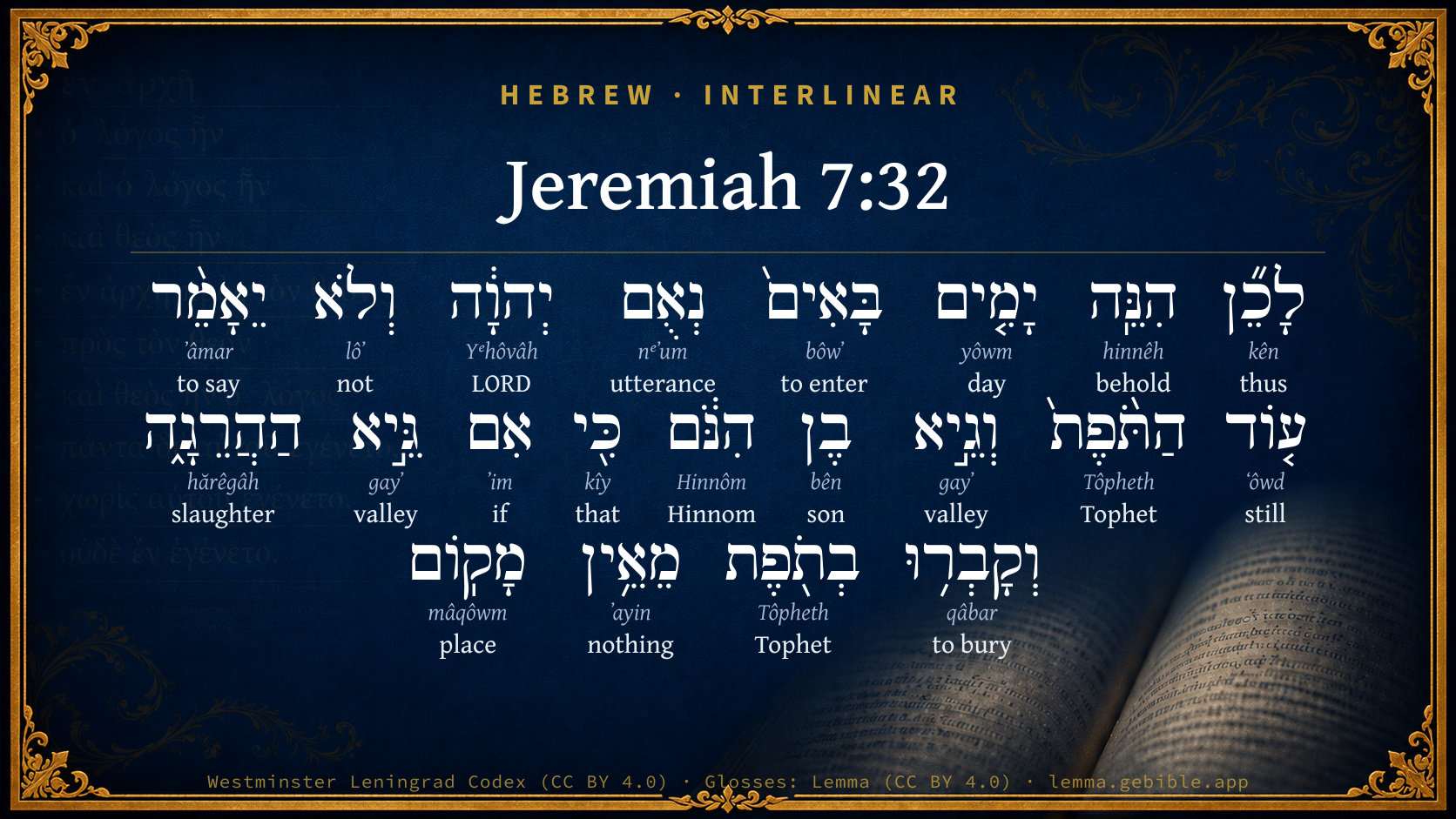
Hebrew (Westminster Leningrad Codex) Jeremiah 7:32 appears in the Hebrew Old Testament. The text above is from the Westminster Leningrad Codex. Each word links to its Strong’s number, a concise gloss, and parsing drawn from the Open Scriptures Hebrew Bible morphology. Click any word for its full Brown-Driver-Briggs (BDB) entry.
Download image
Cite this verse

Jeremiah 7:32 (World English Bible). Public Domain. Lemma interlinear Bible study tool, https://lemma.gebible.app/v/jeremiah/7/32.

Show BibTeX & RIS
BibTeX
RIS
English Translation
Therefore, behold, the days come, says Yahweh, that it shall no more be called Topheth, nor The valley of the son of Hinnom, but The valley of Slaughter: for they shall bury in Topheth, until there be no place [to bury].
World English Bible · Public Domain
Highlights
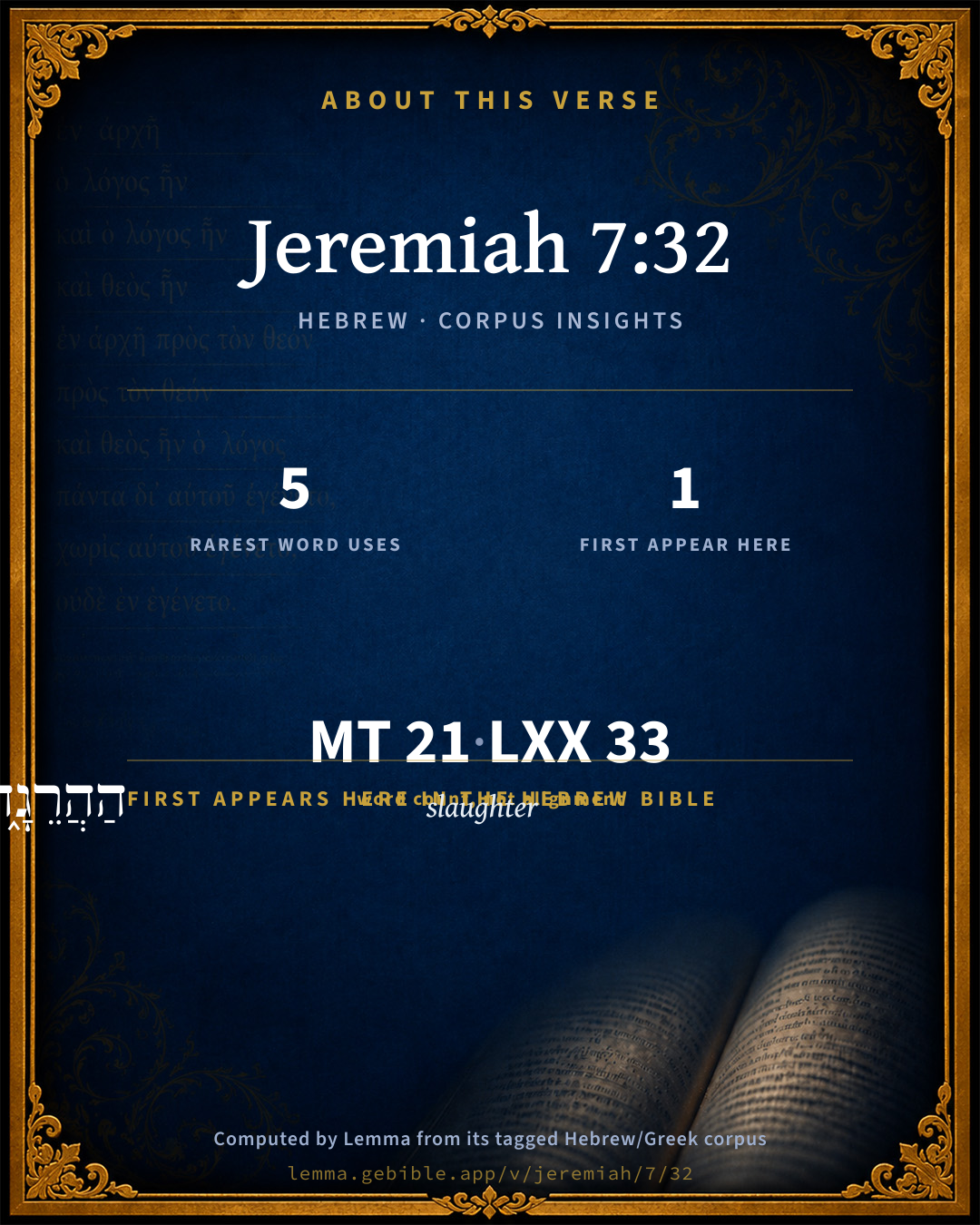
  • 1 first appearance in the Hebrew Bible
Full analysis ↓
Download a study sheet

One document with this verse’s original text, its word-by-word gloss line, the meaning frame, cross-references with their text, attributed commentary, and full source and license credits — printable, and it pastes into notes with its structure intact.

This verse Autodidact and up

Study sheet (.html) Plain text (.txt)

A passage Seminary Student

Up to 50 verses in one chapter. A passage sheet keeps up to 6 commentary sources and 12 cross-references per verse, in the order this page ranks them, and says so on the sheet whenever that leaves anything out. Ask for a single verse and you get the Autodidact verse sheet above.

Everything on this page stays free to read, with no account — the sheet is a download of what is already on screen, not access to it.

Want to remove ads? Support Godless Engineer
Compare translations 3

The same verse in 3 English versions, stacked beneath the original-language interlinear above. Click any original word for its lexicon entry.

Each is an independent rendering of the whole verse — the interlinear is not word-aligned to these translations.

Highlighted words mark where these versions differ — a whole-verse word diff, not a word-by-word alignment.

  • World English Bible Public Domain
    Therefore, behold, the days come, says Yahweh, that it shall no more be called Topheth, nor The valley of the son of Hinnom, but The valley of Slaughter: for they shall bury in Topheth, until there be no place [to bury].
  • King James Version Public Domain
    Therefore, behold, the days come, saith the LORD, that it shall no more be called Tophet, nor the valley of the son of Hinnom, but the valley of slaughter: for they shall bury in Tophet, till there be no place.
  • unfoldingWord Literal Text CC BY-SA 4.0
    Therefore behold, days are coming”—the declaration of Yahweh—“and it will no longer be called Topheth or the Valley of the Son of Hinnom, instead, the Valley of Slaughter. And they will bury in Topheth because there is no room.

unfoldingWord Literal Text — © unfoldingWord, licensed CC BY-SA 4.0. Word-aligned USFM3 via Door43 (git.door43.org/unfoldingWord/en_ult).

Versions to compare (up to 4)

3 of 4 selected

Show all 18 translations

Every available English version of this verse, each an independent rendering of the whole verse.

  • World English Bible Public Domain
    Therefore, behold, the days come, says Yahweh, that it shall no more be called Topheth, nor The valley of the son of Hinnom, but The valley of Slaughter: for they shall bury in Topheth, until there be no place [to bury].
  • Berean Standard Bible Public Domain
    So behold, the days are coming, declares the LORD, when this place will no longer be called Topheth and the Valley of Hinnom, but the Valley of Slaughter. For they will bury the dead in Topheth until there is no more room.
  • Majority Standard Bible Public Domain
    So behold, the days are coming, declares the LORD, when this place will no longer be called Topheth and the Valley of Ben-hinnom, but the Valley of Slaughter. For they will bury the dead in Topheth until there is no more room.
  • King James Version Public Domain
    Therefore, behold, the days come, saith the LORD, that it shall no more be called Tophet, nor the valley of the son of Hinnom, but the valley of slaughter: for they shall bury in Tophet, till there be no place.
  • American Standard Version (1901) Public Domain
    Therefore, behold, the days come, saith Jehovah, that it shall no more be called Topheth, nor The valley of the son of Hinnom, but The valley of Slaughter: for they shall bury in Topheth, till there be no place `to bury'.
  • Revised Version (1885) Public Domain
    Therefore, behold, the days come, saith the LORD, that it shall no more be called Topheth, nor The valley of the son of Hinnom, but The valley of Slaughter: for they shall bury in Topheth, till there be no place to bury.
  • Geneva Bible (1599) Public Domain
    Therefore beholde, the dayes come, sayeth the Lord, that it shall no more be called Topheth, nor the valley of Ben-Hinnom, but the valley of slaughter: for they shall burie in Topheth til there be no place.
  • Douay-Rheims (1899) Public Domain
    Therefore behold the days shall come, saith the Lord, and it shall no more be called Topeth, nor the valley of the son of Ennom: but the valley of slaughter, and they shall bury in Topeth, because there is no place.
  • Young's Literal Translation Public Domain
    Therefore, lo, days are coming, An affirmation of Jehovah, And it is not said any more, `The Tophet,' And `Valley of the son of Hinnom,' But `Valley of the slaughter,' And they have buried in Tophet -- without place.
  • Literal Standard Version CC BY-SA 4.0
    Therefore, behold, days are coming,” || A declaration of YHWH, || “And it is no longer said, The Tophet, || And, Valley of the Son of Hinnom, || But, Valley of the Slaughter, || And they have buried in Tophet—without place.
  • Unlocked Literal Bible CC BY-SA 4.0
    So see, days are coming—this is Yahweh's declaration—when it will no longer be called Topheth or Valley of Ben Hinnom. It will be the Valley of Slaughter; they will bury bodies in Topheth until there is no room left.
  • unfoldingWord Literal Text CC BY-SA 4.0
    Therefore behold, days are coming”—the declaration of Yahweh—“and it will no longer be called Topheth or the Valley of the Son of Hinnom, instead, the Valley of Slaughter. And they will bury in Topheth because there is no room.
  • Darby Bible Public Domain
    Therefore, behold, days are coming, saith Jehovah, when it shall no more be said, Topheth, and Valley of the son of Hinnom, but the valley of slaughter; for they shall bury in Topheth, till there be no place.
  • World Messianic Bible Public Domain
    Therefore behold, the days come”, says the LORD, “that it will no more be called ‘Topheth’ or ‘The valley of the son of Hinnom’, but ‘The valley of Slaughter’; for they will bury in Topheth until there is no place to bury.
  • Webster's Bible Public Domain
    Therefore, behold, the days come, saith the LORD, that it shall no more be called Tophet, nor the valley of the son of Hinnom, but the valley of slaughter: for they shall bury in Tophet, till there shall be no place.
  • Free Bible Version CC BY-SA 4.0
    So watch out! The time is coming, declares the Lord, when instead of Topheth and the Valley of Hinnom this place will be called the Valley of Killing. People will bury their dead in Topheth until it's full.
  • Bible in Basic English Public Domain
    For this cause, the days are coming, says the Lord, when it will no longer be named Topheth, or, The valley of the son of Hinnom, but, The valley of Death: for they will put the dead into the earth in Topheth till there is no more room.
  • JPS Tanakh (1917) Public Domain
    Therefore, behold, the days come, saith the LORD, that it shall no more be called Topheth, nor The valley of the son of Hinnom, but The valley of slaughter; for they shall bury in Topheth, for lack of room.

Literal Standard Version (2020), Covenant Press — licensed CC BY-SA 4.0. Text via the HelloAO Bible API (eBible.org). Unlocked Literal Bible (unfoldingWord) — licensed CC BY-SA 4.0. Text via the HelloAO Bible API (eBible.org). unfoldingWord Literal Text — © unfoldingWord, licensed CC BY-SA 4.0. Word-aligned USFM3 via Door43 (git.door43.org/unfoldingWord/en_ult). Free Bible Version, Dr. Jonathan Gallagher — licensed CC BY-SA 4.0. Text via the HelloAO Bible API (eBible.org).

Word by word

More ways to search: Search by grammar → Find every occurrence → Compare this word →

Practice this passage: Drill this verse → Learn its vocabulary →

הַהֲרֵגָ֑ה
hărêgâh
H2028
“the · slaughter”
Particle, Definite Article + Noun, Common, Feminine, Singular, Absolute
Part of Speech
Particle + Noun
Type
Common
Gender
Feminine
Number
Singular
State
Absolute
Full BDB Definition

Origin: from H2027

TWOT: 514b

a killing, slaughter
  1. לָכֵ֞ן kên H3651 “to/for · thus” Preposition + Adverb
  2. הִנֵּֽה hinnêh H2009 “behold” Particle, Demonstrative
  3. יָמִ֤ים yôwm H3117 “days” Noun, Common, Masculine, Plural, Absolute
  4. בָּאִים֙ bôwʼ H935 “entering” Verb, Qal, Participle Active, Masculine, Plural, Absolute
  5. נְאֻם nᵉʼum H5002 “utterance of” Noun, Common, Masculine, Singular, Construct
  6. יְהוָ֔ה Yᵉhôvâh H3068 “LORD” Noun, Proper
  7. וְלֹא lôʼ H3808 “and · not” Conjunction + Particle, Negative
  8. יֵאָמֵ֨ר ʼâmar H559 “to say” Verb, Niphal, Imperfect, 3rd Person, Masculine, Singular
  9. ע֤וֹד ʻôwd H5750 “still” Adverb
  10. הַתֹּ֨פֶת֙ Tôpheth H8612 “the · Tophet” Particle, Definite Article + Noun, Proper
  11. וְגֵ֣יא gayʼ H1516 “and · valley of” Conjunction + Noun, Common, Both, Singular, Construct
  12. בֶן bên H1121 “son” Noun, Proper
  13. הִנֹּ֔ם Hinnôm H2011 “Hinnom” Noun, Proper
  14. כִּ֖י kîy H3588 “that” Conjunction
  15. אִם ʼim H518 “if” Conjunction
  16. גֵּ֣יא gayʼ H1516 “valley of” Noun, Common, Both, Singular, Construct
  17. וְקָבְר֥וּ qâbar H6912 “and · to bury” Conjunction + Verb, Qal, Sequential Perfect, 3rd Person, Common, Plural
  18. בְתֹ֖פֶת Tôpheth H8612 “in/at · Tophet” Preposition + Noun, Proper
  19. מֵאֵ֥ין ʼayin H369 “from · nothing” Preposition + Particle, Negative
  20. מָקֽוֹם mâqôwm H4725 “place” Noun, Common, Masculine, Singular, Absolute

About this verse

These counts appear in no published source. They are computed here, from the morphology-tagged text and Lemma’s own curated glosses. What Lemma adds →

21
words
19
distinct lemmas
Prophets
section

Notable vocabulary

The rarest word here is הַהֲרֵגָ֑ה slaughter H2028 — appearing just 5 times in the whole Hebrew Bible.

First appearance in Scripture

This word makes its first canonical appearance in the Hebrew Bible here:

  • הַהֲרֵגָ֑ה slaughter H2028

Shared distinctive vocabulary

הַהֲרֵגָ֑ה slaughter H2028 occurs in 5 verses of the Hebrew Bible. Also found in:

Grammatical profile

  • 3 verbs
  • 11 nouns
  • 2 conjunctions
  • 2 adverbs
  • 3 particles

Verb forms

  • בָּאִים֙ Qal · Participle Active
  • יֵאָמֵ֨ר Niphal · Imperfect
  • וְקָבְר֥וּ Qal · Sequential Perfect

Repetition

Words recur within this verse — often emphatic in Hebrew:

  • הַתֹּ֨פֶת֙ Tophet H8612 ×2
  • וְגֵ֣יא valley H1516 ×2

Hebrew & Septuagint length

In the original languages it is 21 Hebrew tokens and 33 Greek tokens — but the two are counted differently (Hebrew bundles its prefixes and suffixes into one token; the Greek is in lemma form), so that isn’t a like-for-like length.

Cross-references

7

Topical passages linked to Jeremiah 7:32 in the Treasury of Scripture Knowledge — connected by theme and wording, ordered by reader-vote popularity; previews shown in the World English Bible.

  • Jeremiah 19:11 and shall tell them, Thus says Yahweh of Hosts: Even so will I break this people and this city, as one breaks a potter's vessel, that can't be made whole again; and they shall bury in Topheth, until there be no place to bury.
  • Jeremiah 19:6 therefore, behold, the days come, says Yahweh, that this place shall no more be called Topheth, nor The valley of the son of Hinnom, but The valley of Slaughter.
  • 2 Kings 23:10 He defiled Topheth, which is in the valley of the children of Hinnom, that no man might make his son or his daughter to pass through the fire to Molech.
  • Leviticus 26:30 I will destroy your high places, and cut down your incense altars, and cast your dead bodies upon the bodies of your idols; and my soul will abhor you.
  • Jeremiah 7:31 They have built the high places of Topheth, which is in the valley of the son of Hinnom, to burn their sons and their daughters in the fire; which I didn't command, neither came it into my mind.
  • Jeremiah 19:13 and the houses of Jerusalem, and the houses of the kings of Judah, which are defiled, shall be as the place of Topheth, even all the houses on whose roofs they have burned incense to all the host of the sky, and have poured out drink-offerings to other gods.
  • Ezekiel 6:5–7 I will lay the dead bodies of the children of Israel before their idols; and I will scatter your bones round about your altars.

Cross-references courtesy of OpenBible.info (CC BY 4.0).

Hebrew and Greek witnesses Masoretic Hebrew ↔ Greek Septuagint

The same verse in the two great witnesses to the Old Testament, shown verse-for-verse.

These are two independent witnesses, not word-aligned to each other, and the Septuagint is shown in lemma (dictionary) form.

Hebrew Jeremiah 7:32 Masoretic · Westminster Leningrad Codex

לָכֵ֞ן הִנֵּֽה יָמִ֤ים בָּאִים֙ נְאֻם יְהוָ֔ה וְלֹא יֵאָמֵ֨ר ע֤וֹד הַתֹּ֨פֶת֙ וְגֵ֣יא בֶן הִנֹּ֔ם כִּ֖י אִם גֵּ֣יא הַהֲרֵגָ֑ה וְקָבְר֥וּ בְתֹ֖פֶת מֵאֵ֥ין מָקֽוֹם

Therefore, behold, the days come, says Yahweh, that it shall no more be called Topheth, nor The valley of the son of Hinnom, but The valley of Slaughter: for they shall bury in Topheth, until there be no place [to bury].

World English Bible · Public Domain

Greek LXX Structure differs

In the Septuagint, Jeremiah is about an eighth shorter than the Hebrew and arranges its material differently — the Oracles Against the Nations (Hebrew chapters 46–51) appear in the middle of the Greek book, after 25:13. Because the chapter and verse boundaries do not line up, a verse-for-verse comparison with the Hebrew is not shown.

A verse-for-verse comparison isn’t shown here because the chapters and verses don’t line up. Switch to the LXX edition with the MT / LXX toggle above to read the Greek directly.

On this verse, The Cambridge Bible for Schools and Colleges discusses the Septuagint’s reading. Read the note in Commentary ↓

Hebrew: Westminster Leningrad Codex (CC BY 4.0). Greek: Septuagint (public domain); English from a public-domain English Septuagint. How the Septuagint differs from the Hebrew →

Targum (Aramaic paraphrase)

1

The Targum is the ancient Jewish Aramaic paraphrase of the Hebrew Scriptures — an interpretive translation, not the Hebrew text itself. Onkelos (literal) and Pseudo-Jonathan (expansive) render the Torah, and Jonathan the Prophets. Coverage is partial: where no permissively-licensed English translation exists for a verse, only the Aramaic is shown. This is verse-level text, not a word-by-word alignment to the Hebrew.

  1. Targum Jonathan Prophets (Joshua–Malachi)
    בְּכֵן הָא יוֹמַיָא אָתָן אֲמַר יְיָ וְלָא יִתְאַמָר עוֹד תּוֹפֶת וְחֵילַת בַּר הִנוֹם אֱלָהֵין חֵילַת קְטִילַיָא וִיקַבְּרוּן בְּתוֹפֶת מִבְּלִי אֲתַר:

    (no public-domain English translation for this verse)

    Targum Jonathan — Aramaic: “Mikraot Gedolot” (public domain). English: “Sefaria Community Translation” (CC0 1.0 (public-domain dedication)); “London "Chaldee Paraphrase," 1871” (public domain). Text via Sefaria.

Commentary

Notes on Jeremiah 7:32 from classic Christian and Jewish commentators (each source and its license shown beneath its notes). The classic Christian expositions comment on the surrounding passage and are grouped to its opening verse, so a note may address several verses; the Jewish commentaries on the Tanakh (Rashi and others) are per-verse, so they appear only where the commentator wrote on this verse.

Lemma curates 59 commentaries, every one of them public domain or Creative Commons licensed, each selected and text-cleaned for this edition rather than reprinted as found. About our sources →

Trapp's Complete Commentary

John Trapp

Jer 7:32 Therefore, behold, the days come, saith the LORD, that it shall no more be called Tophet, nor the valley of the son of Hinnom, but the valley of slaughter: for they shall bury in Tophet, till there be no place.

Ver. 32. It shall no more be called Tophet.] Unless it be quasi Mophet, i.e., Portentum.

Nor the valley of the son of Hinnom.] As it had been called from Joshua’s days. {Jos 15:8}

But the valley of slaughter.] Or, Gehaharegah; for the great slaughter that the Chaldees shall make there. Ecce congrua poena peccato, saith Oecolampadius.

For they shall bury in Tophet.] It shall become a polyandrion, or common burial place, till there be no place or room left.

John Trapp, A Commentary or Exposition upon All the Books of the Old and New Testament (1647–1656) — public domain. Text from a community e-Sword module.

Joseph Benson's Commentary

Jer 7:32-34. It shall be no more called Tophet, but The valley of Slaughter — King Josiah first of all defiled this place, as the text speaks, 2Ki 23:10; that is, polluted it by burying dead bodies in it, by casting filth into it, and scattering there the dust and ashes of the idols which he had broken to pieces and burned. And afterward, when great numbers died in the siege of Jerusalem, and the famine that followed upon it, it became a common burying-place of the Jews: see Jer 19:6. Whereby was fulfilled that prophecy of Eze 6:5, I will lay the dead carcasses of the children of Israel before their idols. They shall bury in Tophet till there be no place — Till it be entirely filled, and there be no vacant place left. The Vulgate reads this clause, “They shall be buried in Tophet, because there shall be no place,” which reading Houbigant approves. “The time shall come when there shall be so great a slaughter in Jerusalem, that, the graves being insufficient to bury the dead, they shall be forced to throw them into Tophet, and leave them without interment. This prediction received its last and perfect completion in the war of Nebuchadnezzar against the Jews, and that of the Romans against the same people. Josephus informs us, that in this latter war an infinite number of dead bodies were thrown over the walls, and left in the valleys round the city; insomuch, that Titus himself, beholding this spectacle, could not help lifting up his hands to heaven, and calling God to witness that he had no part in these inhuman practices.” In chap. 19., Jeremiah “repeats the same threatenings with more latitude and force; declaring that Tophet shall become the lay-stall of Jerusalem, and that Jerusalem herself shall be reduced to the condition of Tophet; that is to say, polluted and filled with dead bodies.” And in Jer 31:40, he calls it the valley of the dead bodies. Then will I cause to cease the voice of mirth, &c. — All kinds and degrees of mirth shall cease, all places shall be filled with lamentation and wo, their singing shall be turned into sighing, and they shall lay aside all things that are for the comfort of human society. The voice of the bridegroom, and the voice of the bride — Persons will have no encouragement to marry when they see nothing but ruin and desolation before their eyes.

Joseph Benson's Commentary on the Old and New Testaments (1811–1818) — public domain. Text from a community e-Sword module.

Jamieson, Fausset & Brown

Robert Jamieson, A. R. Fausset & David Brown

valley of slaughter--so named because of the great slaughter of the Jews about to take place at Jerusalem: a just retribution of their sin in slaying their children to Moloch in Tophet.

no place--no room, namely, to bury in, so many shall be those slain by the Chaldeans (Jer 19:11; Eze 6:5).

Jamieson, Fausset & Brown — Commentary Critical and Explanatory on the Whole Bible (1871) — public domain (CC PDM 1.0). Text via the HelloAO Bible API.

Adam Clarke's Commentary

Verse 32. The valley of slaughter] The place where the slaughtered thousands of this rebellious people shall be cast, in order to their being burnt, or becoming food for the beasts of the field and the fowls of the air, Jer 7:33. These words are repeated, and their meaning more particularly explained, Jer 19:6-15.

Adam Clarke's Commentary on the Bible (1810–1826) — public domain. Text from a community e-Sword/MySword module.

John Calvin's Commentaries

The Prophet denounces a punishment, though the Jews thought that they deserved a reward. The case is the same with the Papists at this day, who thoughtlessly boast, when they heap together many abominations; for they think that God is bound as it were by a law, not to overlook so much diligence. But the Prophet shews how grossly deceived they are who worship God superstitiously, without the authority of his word; for he threatens them here with the heaviest judgment, — Called no more, he says, shall it be Tophet, nor The valley of the son of Hinnom; but The valley of slaughter shall it be called; for the whole land was to be filled with slaughters.

He adds, Bury shall they there, for elsewhere there will be no place He intimates that so great would be the slaughters, that Jerusalem would not contain the dead: hence, he says, graves will be made in Tophet; and many also will be slain there. A dead body, we know, was unclean by the Law; and it was not lawful to offer sacrifices to God near graves. (Numbers 19:11, 16.) The Prophet then shows, that when the Jews foolishly consecrated that place to God, they committed a dreadful profanation, for that place was to be wholly filled with dead bodies, and polluted also by the slaughter of men. We hence see what the superstitious do when they follow their own devices — that they provoke God’s wrath; for by the grievousness of the punishment we may form a judgment as to the degree in which God abominates all false modes of worship, which men devise without the warrant of his law; for we must ever remember this principle, I commanded it not, nor hath it ever come to my mind It follows —

John Calvin's Commentaries (1540-1563) — public domain. Text from the Calvin Translation Society English edition (1840s-50s) via the Christian Classics Ethereal Library (ccel.org). Calvin's coverage is partial (roughly two-thirds of the Bible); uncommented books and verses are honest gaps, never fabricated. The 19th-century editor's footnotes and remarks are omitted so the notes are faithfully Calvin's own voice.

Ellicott's Commentary for English Readers

(32) Till there be no place.—Better, because there is no room—i.e., for want of space the dead should be buried even in the spot which the worshippers of Molech looked on as sacred, and the worshippers of Jehovah as accursed, and which both therefore would willingly avoid using as a place of sepulture.

A Bible Commentary for English Readers, edited by Charles John Ellicott (1878–1897) — public domain. Text from a community e-Sword module.

The Cambridge Bible for Schools and Colleges

gen. ed. J. J. S. Perowne

32. “Where they have butchered their children, they shall themselves be butchered, hence the name Valley of Slaughter will replace the older name.” Pe.

till there be no place to bury] mg. because there shall be no place else, is the clear meaning of the MT. (and LXX agrees). But, under the circumstances the scene of the slaughter would be the natural place for burial. Possibly the MT. does not give the original form of the clause. Du. omits it, but it recurs in Jer_19:11. To be left unburied was much dreaded. Cp. Deu_28:26; Isa_18:6.

The Cambridge Bible for Schools and Colleges (gen. ed. J. J. S. Perowne; Cambridge University Press, 1878–1918) — public domain. Text from a community e-Sword module.

John Gill's Exposition

Therefore, behold, the days come, saith the Lord,.... And they were coming on apace; a little longer, and they would be come; for it was but a few years after this ere Jerusalem was besieged and taken by the army of the Chaldeans, and the slaughter made after mentioned:

that it shall no more be called Tophet: no more be used for such barbarous and idolatrous worship; and no more have its name from such a shocking circumstance:

nor the valley of the son of Hinnom; as it had been from the times of Joshua:

but the valley of slaughter: or, "of the slain"; as the Targum, Septuagint, Syriac, and Arabic versions; because of the multitude of men that should be killed there, or brought there to be buried; as follows:

for they shall bury in Tophet till there be no place: till there be no more room to bury there; or, "because there was no place" (a) elsewhere; the number of the slain being so many: this was in righteous judgment, that where they had sacrificed their children, there they should be slain, at least buried.

(a) "quod, vel eo quod nullus (alius. sit) locus", Munster; "ideo quod non (erie) locus", Schmidt.

John Gill's Exposition of the Whole Bible (1746–1763) — public domain (CC PDM 1.0). Text via the HelloAO Bible API.

Haydock's Catholic Bible Commentary

Place, elsewhere. (Haydock) --- This was verified when Nabuchodonosor and Titus besieged the city. (Calmet) --- The latter was quite shocked. (Josephus, Jewish Wars vi. 14.) See chap. xix., and xxxi. 40.

George Leo Haydock (1774–1849), Haydock's Catholic Family Bible and Commentary, 1859 edition — public domain. Excludes Psalms (Douay-Rheims chapter numbering differs from Protestant) and Deuterocanonical books (Catholic canon only).

Matthew Poole's English Annotations

It shall no more be called Tophet, nor the valley of the son of Hinnom: they were called so after this, and are known by those names to this day; but the meaning is, they shall acquire a name from another occasion, that shall suit them as well, viz. for the great slaughter that shall be made there, or rather thereabouts, in and about Jerusalem, and therefore called

the valley of slaughter, from the effect of slaughter; as Judas’s field was called Aceldama, Act 1:19, being a place for burying of the slain, as the next words show.

They shall bury in Tophet, till there be no place; either there shall be so great a slaughter made upon that spot by the Chaldeans, that they shall bury as many as the place will contain, and the rest of the carcasses they shall throw on heaps, to rot above ground; for to lie unburied is frequently used as a curse on such, the burying of the dead being accounted as a thing sacred, and a significant symbol of the resurrection: or those that are slain in and about Jerusalem, at the siege and taking of it, shall be carried thither to be buried, either because there shall be no burying-places left about Jerusalem, or that valley shall be filled till there be no place for more, that hereby it may be so polluted, that no thoughts of holiness may remain in it; for a dead carcass under the law was unclean; and that which before was a valley of pleasure and great delight, and they had dedicated to God, shall now be a valley of slaughter.

Matthew Poole's English Annotations on the Holy Bible (1683–1685) — public domain. Text from a community e-Sword/MySword module.

Whedon's Commentary on the Bible

Daniel D. Whedon

32. Valley of slaughter — Where they sinned they shall die. Where they slaughtered their own children, in blasphemous and cruel idolatry, shall they be slaughtered. This slaughter shall be so fearful that the dead shall remain unburied, and the solitude and desolation shall be so perfect that not even shall the passers by scare away the vultures from the carcasses.

Daniel D. Whedon (gen. ed.), Commentary on the Old and New Testaments (1874–1909) — public domain. Text from a community e-Sword module.

The Pulpit Commentary

The valley of slaughter; with reference to the great slaughter reserved for the unbelieving Jews. The scene of their sin shall be that of their punishment. Till there be no place; rather, for want of room (elsewhere).

Ver. 32-Rom_6:23)

2. Shame. The corpses are to be unburied and exposed to the ravages of unclean animals for the Jew a fearful degradation. Sin exposed, confounded, defeated, will reflect burning shame on the sinner.

3. Anguish. "The voice of mirth," etc., will cease; men will prefer death to. (Jer_8:3)

4. A peculiar relation of penalty to offence. Tophet, the scene of horrible wickedness, shall be the spot for retributive slaughter. Where wretched men immolated their children their own dead bodies shall be cast. The sun and moon and stars which they worshipped shall look down on their bones bleaching out in the open.

III THERE ARE TIMES WHEN IT IS NECESSARY TO MAKE MEN THINK OF THE HORRORS OF RETRIBUTION. The language of Jeremiah is explicit and graphic.

1. Details of future retribution should not take the chief place in instruction. They lose their effect by too frequent repetition. By themselves they are not able to produce a better life, but may result in hardness, unbelief, and disgust. The love of God in Christ is the great power to lead to holiness.

2. Nevertheless we must not shun to declare "the whole counsel of God." Thoughts of retribution may be powerful means for rousing convictions of sin, if they are accompanied by appeals to conscience which make men feel the due proportion of guilt to punishment.

The Pulpit Commentary (1880–1919), ed. H.D.M. Spence-Jones & Joseph S. Exell — public domain. Text from a community e-Sword module.

Lesson kit

Teaching starters — assembled from the data on this page, not authored interpretation. Every prompt links to the verse data it draws on. Edit before teaching.

Jeremiah, in the Prophets, opens this verse with 21 words (19 distinct Hebrew lemmas). Its most distinctive word is hărêgâh (“slaughter”). A historical commentator’s framing appears above. Read the whole chapter for the surrounding context.

Discussion questions

  1. How does “slaughter” (hărêgâh) shape what this verse is saying?
  2. This is the first place “slaughter” appears in Scripture (first appears here). What does its debut here establish?
  3. How does Jeremiah 12:3, which shares the word «slaughter», read alongside this verse?
  4. What does the repetition of “Tophet” (2× in this one verse) do in this verse?
  5. These translations render this verse differently. What is at stake in choosing one wording over another?
  6. «בָּאִים֙» is a Qal Participle Active verb. How does that grammatical form shape the action described?
  7. Compare how Trapp's Complete Commentary and Joseph Benson's Commentary read this verse. Where do they agree or differ?

Things to notice

Reading settings

Reading text

Shown beneath each verse's original-language words.

Old Testament
Old Testament edition

Read the OT as the Masoretic Hebrew (MT) or the Greek Septuagint (LXX).

English shown for the Greek Septuagint (in the Hebrew ↔ Greek comparison).

Comparing translations? Open the Compare panel on any verse page to stack up to four side by side.