Numbers 11:34

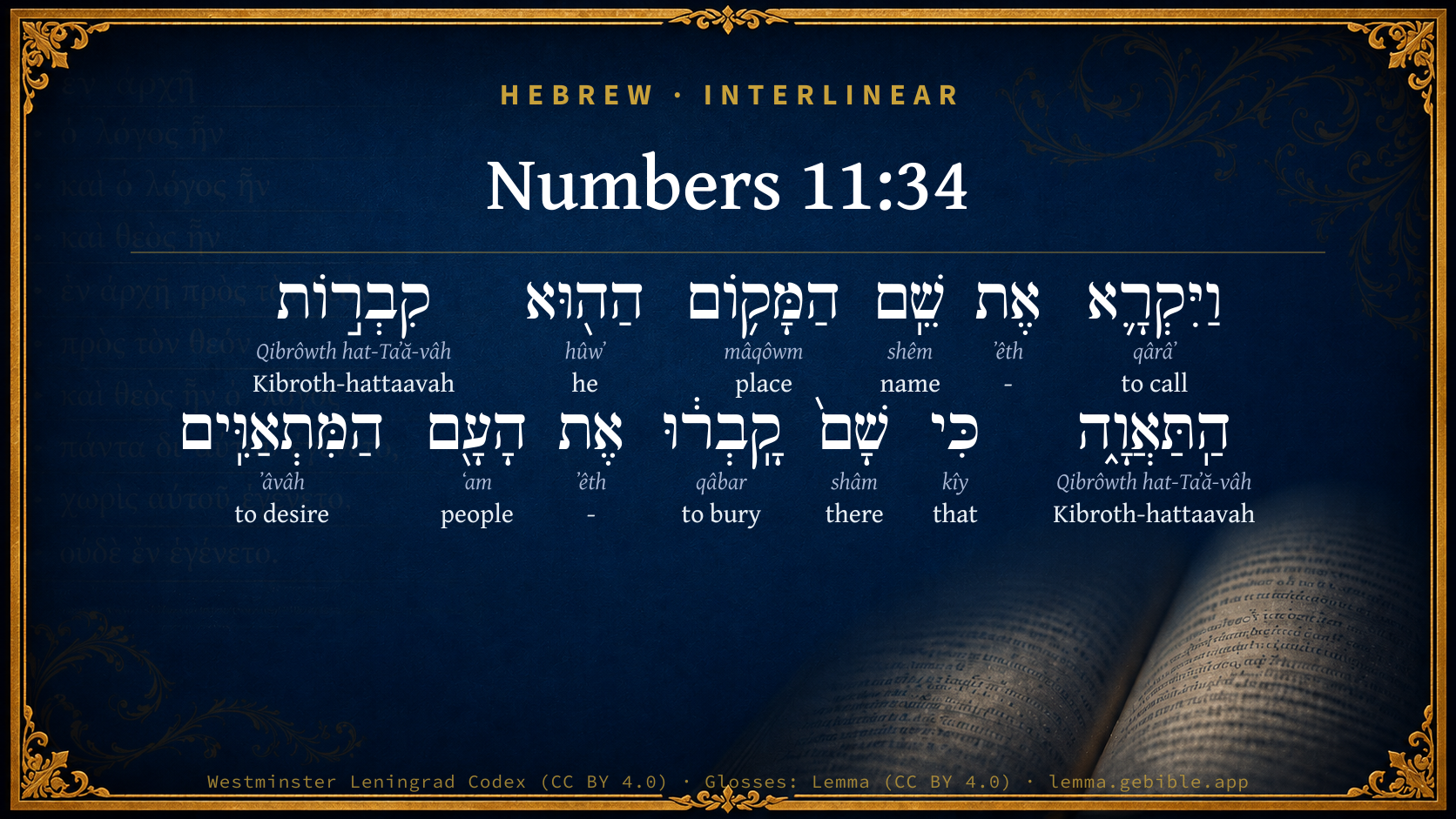
Hebrew (Westminster Leningrad Codex) Numbers 11:34 appears in the Hebrew Old Testament. The text above is from the Westminster Leningrad Codex. Each word links to its Strong’s number, a concise gloss, and parsing drawn from the Open Scriptures Hebrew Bible morphology. Click any word for its full Brown-Driver-Briggs (BDB) entry.
Download image
Cite this verse

Numbers 11:34 (World English Bible). Public Domain. Lemma interlinear Bible study tool, https://lemma.gebible.app/v/numbers/11/34.

Show BibTeX & RIS
BibTeX
RIS
English Translation
The name of that place was called Kibrothhattaavah, because there they buried the people who lusted.
World English Bible · Public Domain
Highlights
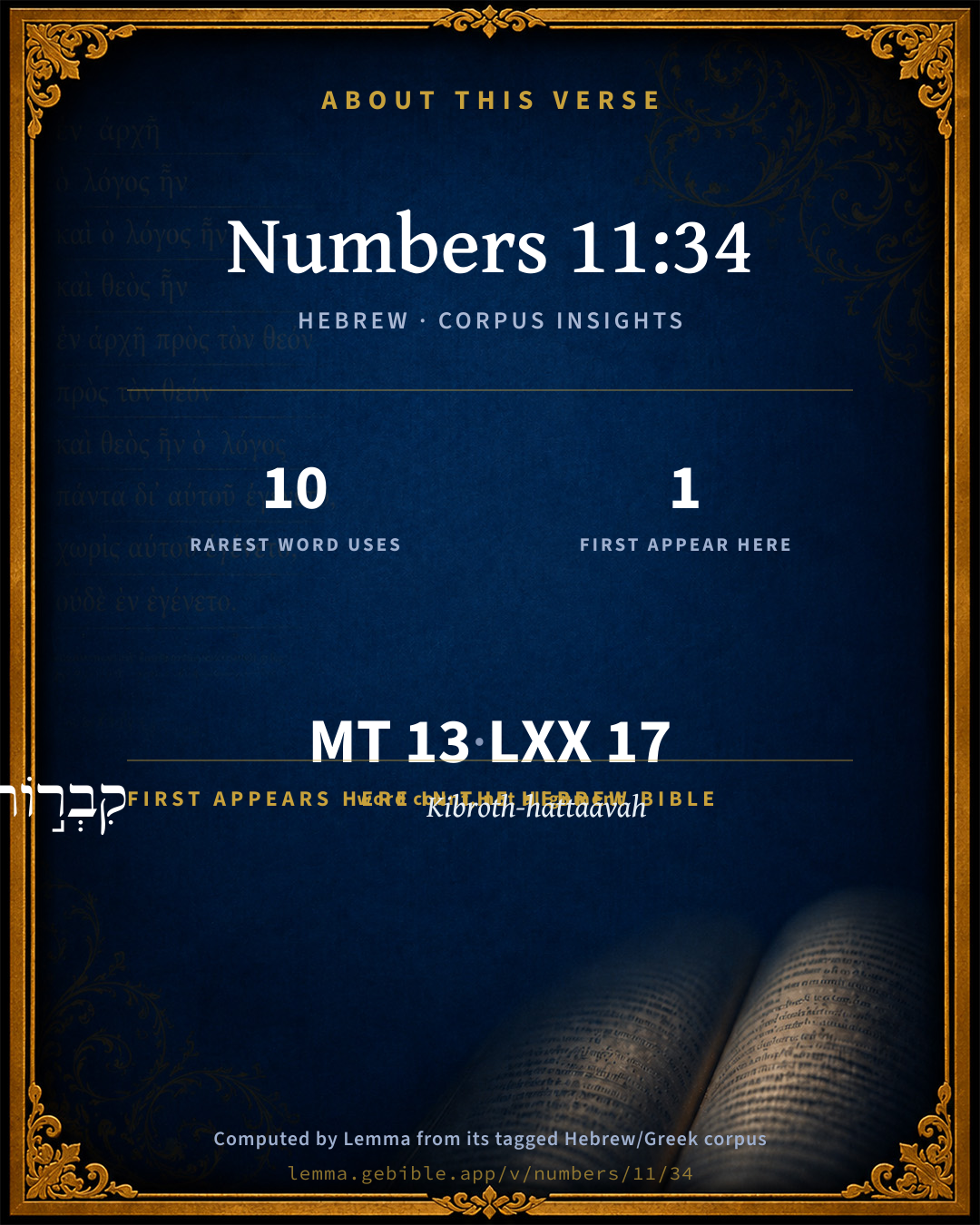
  • 1 first appearance in the Hebrew Bible
Full analysis ↓
Download a study sheet

One document with this verse’s original text, its word-by-word gloss line, the meaning frame, cross-references with their text, attributed commentary, and full source and license credits — printable, and it pastes into notes with its structure intact.

This verse Autodidact and up

Study sheet (.html) Plain text (.txt)

A passage Seminary Student

Up to 50 verses in one chapter. A passage sheet keeps up to 6 commentary sources and 12 cross-references per verse, in the order this page ranks them, and says so on the sheet whenever that leaves anything out. Ask for a single verse and you get the Autodidact verse sheet above.

Everything on this page stays free to read, with no account — the sheet is a download of what is already on screen, not access to it.

Want to remove ads? Support Godless Engineer
Compare translations 3

The same verse in 3 English versions, stacked beneath the original-language interlinear above. Click any original word for its lexicon entry.

Each is an independent rendering of the whole verse — the interlinear is not word-aligned to these translations.

Highlighted words mark where these versions differ — a whole-verse word diff, not a word-by-word alignment.

  • World English Bible Public Domain
    The name of that place was called Kibrothhattaavah, because there they buried the people who lusted.
  • King James Version Public Domain
    And he called the name of that place Kibrothhattaavah: because there they buried the people that lusted.
  • unfoldingWord Literal Text CC BY-SA 4.0
    and he called the name of that place Kibroth Hattaavah, because there they buried the people who had desired.

unfoldingWord Literal Text — © unfoldingWord, licensed CC BY-SA 4.0. Word-aligned USFM3 via Door43 (git.door43.org/unfoldingWord/en_ult).

Versions to compare (up to 4)

3 of 4 selected

Show all 18 translations

Every available English version of this verse, each an independent rendering of the whole verse.

  • World English Bible Public Domain
    The name of that place was called Kibrothhattaavah, because there they buried the people who lusted.
  • Berean Standard Bible Public Domain
    So they called that place Kibroth-hattaavah, because there they buried the people who had craved other food.
  • Majority Standard Bible Public Domain
    So they called that place Kibroth-hattaavah, because there they buried the people who had craved other food.
  • King James Version Public Domain
    And he called the name of that place Kibrothhattaavah: because there they buried the people that lusted.
  • American Standard Version (1901) Public Domain
    And the name of that place was called Kibrothhattaavah, because there they buried the people that lusted.
  • Revised Version (1885) Public Domain
    And the name of that place was called Kibroth-hattaavah: because there they buried the people that lusted.
  • Geneva Bible (1599) Public Domain
    So the name of the place was called, Kibroth-hattaauah: for there they buried the people that fell a lusting.
  • Douay-Rheims (1899) Public Domain
    And that place was called, The graves of lust: for there they buried the people that had lusted. And departing from the graves of lust, they came unto Haseroth, and abode there.
  • Young's Literal Translation Public Domain
    and `one' calleth the name of that place Kibroth-Hattaavah, for there they have buried the people who lust.
  • Literal Standard Version CC BY-SA 4.0
    and [one] calls the name of that place Kibroth-Hattaavah, for there they have buried the people who lust.
  • Unlocked Literal Bible CC BY-SA 4.0
    That place was named Kibroth Hattaavah, because there they buried the people who had craved meat.
  • unfoldingWord Literal Text CC BY-SA 4.0
    and he called the name of that place Kibroth Hattaavah, because there they buried the people who had desired.
  • Darby Bible Public Domain
    And they called the name of that place Kibroth-hattaavah; because there they buried the people who lusted.
  • World Messianic Bible Public Domain
    The name of that place was called Kibroth Hattaavah, because there they buried the people who lusted.
  • Webster's Bible Public Domain
    And he called the name of that place Kibroth-hattaavah: because there they buried the people that lusted.
  • Free Bible Version CC BY-SA 4.0
    They named that place Kibroth-hattaavah, because that was where they buried the people who had these intense food cravings.
  • Bible in Basic English Public Domain
    So that place was named Kibroth-hattaavah; because there they put in the earth the bodies of the people who had given way to their desires.
  • JPS Tanakh (1917) Public Domain
    And the name of that place was called Kibroth-hattaavah, because there they buried the people that lusted.

Literal Standard Version (2020), Covenant Press — licensed CC BY-SA 4.0. Text via the HelloAO Bible API (eBible.org). Unlocked Literal Bible (unfoldingWord) — licensed CC BY-SA 4.0. Text via the HelloAO Bible API (eBible.org). unfoldingWord Literal Text — © unfoldingWord, licensed CC BY-SA 4.0. Word-aligned USFM3 via Door43 (git.door43.org/unfoldingWord/en_ult). Free Bible Version, Dr. Jonathan Gallagher — licensed CC BY-SA 4.0. Text via the HelloAO Bible API (eBible.org).

Word by word

More ways to search: Search by grammar → Find every occurrence → Compare this word →

Practice this passage: Drill this verse → Learn its vocabulary →

קִבְר֣וֹת
Qibrôwth hat-Taʼă-vâh
H6914
“Kibroth-hattaavah”
Noun, Proper
Part of Speech
Noun
Type
Proper
Full BDB Definition

Origin: from the fem. pl. of H6913 and H8378 with the article interposed

TWOT: None

Kibroth-hattaavah = "graves of lust" - a station of Israel in the wilderness 3 campsites away from Sinai near the gulf of Akabah
  1. וַיִּקְרָ֛א qârâʼ H7121 “and · to call” Conjunction + Verb, Qal, Sequential Imperfect, 3rd Person, Masculine, Singular
  2. אֶת ʼêth H853 “-” Particle, Direct Object
  3. שֵֽׁם shêm H8034 “name of” Noun, Common, Masculine, Singular, Construct
  4. הַמָּק֥וֹם mâqôwm H4725 “the · place” Particle, Definite Article + Noun, Common, Masculine, Singular, Absolute
  5. הַה֖וּא hûwʼ H1931 “the · he” Particle, Definite Article + Pronoun, Personal, 3rd Person, Masculine, Singular
  6. הַֽתַּאֲוָ֑ה Qibrôwth hat-Taʼă-vâh H6914 “Kibroth-hattaavah” Noun, Proper
  7. כִּי kîy H3588 “that” Conjunction
  8. שָׁם֙ shâm H8033 “there” Adverb
  9. קָֽבְר֔וּ qâbar H6912 “to bury” Verb, Qal, Perfect, 3rd Person, Common, Plural
  10. אֶת ʼêth H853 “-” Particle, Direct Object
  11. הָעָ֖ם ʻam H5971 “the · people” Particle, Definite Article + Noun, Common, Masculine, Singular, Absolute
  12. הַמִּתְאַוִּֽים ʼâvâh H183 “the · desiring” Particle, Definite Article + Verb, Hithpael, Participle Active, Masculine, Plural, Absolute

About this verse

These counts appear in no published source. They are computed here, from the morphology-tagged text and Lemma’s own curated glosses. What Lemma adds →

13
words
11
distinct lemmas
Pentateuch
section

Notable vocabulary

The rarest word here is קִבְר֣וֹת Kibroth-hattaavah H6914 — appearing just 10 times in the whole Hebrew Bible.

First appearance in Scripture

This word makes its first canonical appearance in the Hebrew Bible here:

  • קִבְר֣וֹת Kibroth-hattaavah H6914

Shared distinctive vocabulary

קִבְר֣וֹת Kibroth-hattaavah H6914 occurs in 5 verses of the Hebrew Bible. Also found in:

Grammatical profile

  • 3 verbs
  • 5 nouns
  • 1 pronoun
  • 1 conjunction
  • 1 adverb
  • 2 particles

Verb forms

  • וַיִּקְרָ֛א Qal · Sequential Imperfect
  • קָֽבְר֔וּ Qal · Perfect
  • הַמִּתְאַוִּֽים Hithpael · Participle Active

Repetition

A word recurs within this verse — often emphatic in Hebrew:

  • קִבְר֣וֹת Kibroth-hattaavah H6914 ×2

Hebrew & Septuagint length

In English translation the verse runs 16 words from the Hebrew and 20 from the Septuagint (LXX English) — closely comparable.

A rough comparison of the two English renderings, which tokenize alike — not a word-level alignment.

Word counts can differ between the Hebrew and the Greek without any difference in meaning — e.g. the Hebrew direct-object marker אֵת has no separate Greek word, and Greek often adds the article ὁ.

In the original languages it is 13 Hebrew tokens and 17 Greek tokens — but the two are counted differently (Hebrew bundles its prefixes and suffixes into one token; the Greek is in lemma form), so that isn’t a like-for-like length.

Cross-references

3

Topical passages linked to Numbers 11:34 in the Treasury of Scripture Knowledge — connected by theme and wording, ordered by reader-vote popularity; previews shown in the World English Bible.

  • Deuteronomy 9:22 At Taberah, and at Massah, and at Kibroth-hattaavah, you provoked Yahweh to wrath.
  • 1 Corinthians 10:6 Now these things were our examples, to the intent we should not lust after evil things, as they also lusted.
  • Numbers 33:16 They traveled from the wilderness of Sinai, and encamped in Kibroth-hattaavah.

Cross-references courtesy of OpenBible.info (CC BY 4.0).

Hebrew and Greek witnesses Masoretic Hebrew ↔ Greek Septuagint

The same verse in the two great witnesses to the Old Testament, shown verse-for-verse.

These are two independent witnesses, not word-aligned to each other, and the Septuagint is shown in lemma (dictionary) form.

Hebrew Numbers 11:34 Masoretic · Westminster Leningrad Codex

וַיִּקְרָ֛א אֶת שֵֽׁם הַמָּק֥וֹם הַה֖וּא קִבְר֣וֹת הַֽתַּאֲוָ֑ה כִּי שָׁם֙ קָֽבְר֔וּ אֶת הָעָ֖ם הַמִּתְאַוִּֽים

The name of that place was called Kibrothhattaavah, because there they buried the people who lusted.

World English Bible · Public Domain

Greek LXX Numbers 11:34 Septuagint · lemma form

καί καλέω ὁ ὄνομα ὁ τόπος ἐκεῖνος μνῆμα ὁ ἐπιθυμία ὅτι ἐκεῖ θάπτω ὁ λαός ὁ ἐπιθυμητής

And the name of that place was called the Graves of Lust; for there they buried the people that lusted.

LXX2012 (modern English Septuagint) · Public Domain

On this verse, The Pulpit Commentary discusses the Septuagint’s reading. Read the note in Commentary ↓

Hebrew: Westminster Leningrad Codex (CC BY 4.0). Greek: Septuagint (public domain); English from LXX2012 (modern English Septuagint) (Public Domain). How the Septuagint differs from the Hebrew →

Targum (Aramaic paraphrase)

2

The Targum is the ancient Jewish Aramaic paraphrase of the Hebrew Scriptures — an interpretive translation, not the Hebrew text itself. Onkelos (literal) and Pseudo-Jonathan (expansive) render the Torah, and Jonathan the Prophets. Coverage is partial: where no permissively-licensed English translation exists for a verse, only the Aramaic is shown. This is verse-level text, not a word-by-word alignment to the Hebrew.

  1. Targum Onkelos Torah (Genesis–Deuteronomy)
    וּקְרָא יָת שְׁמָא דְאַתְרָא הַהוּא קִבְרֵי דִמְשַׁאֲלֵי אֲרֵי תַמָן קְבָרוּ יָת עַמָא דְשָׁאִילוּ

    (no public-domain English translation for this verse)

    Targum Onkelos — Aramaic: “Onkelos Genesis” (public domain); “Onkelos Exodus” (public domain); “Onkelos Leviticus” (public domain); “Onkelos Numbers” (public domain); “Onkelos Deuteronomy” (public domain). English: “Sefaria Community Translation” (CC0 1.0 (public-domain dedication)); “J.W. Etheridge. The Targums of Onkelos and Jonathan Ben Uzziel on the Pentateuch. London: Longmans, Green, 1862” (public domain). Text via Sefaria.

  2. Targum Pseudo-Jonathan Torah (Genesis–Deuteronomy)
    וּקְרָא יַת שׁוּם אַתְרָא הַהוּא קִבְרֵי דִמְשַׁיְילֵי בִּישְרָא אֲרוּם תַּמָן קְבָרוּ יַת עַמָא דְשַׁיְילוּ בִּישְרָא

    And he called the name of that place, The Graves of the Desirers of Flesh; for there they buried the people who had desired flesh.

    Targum Pseudo-Jonathan — Aramaic: “Targum Jonathan on Genesis” (public domain); “Targum Jonathan on Exodus” (public domain); “Targum Jonathan on Leviticus” (public domain); “Targum Jonathan on Numbers” (public domain); “Targum Jonathan on Deuteronomy” (public domain). English: “The Targum of Jonathan ben Uzziel, trans. J. W. Etheridge, London, 1862” (public domain). Text via Sefaria.

Commentary

Notes on Numbers 11:34 from classic Christian and Jewish commentators (each source and its license shown beneath its notes). The classic Christian expositions comment on the surrounding passage and are grouped to its opening verse, so a note may address several verses; the Jewish commentaries on the Tanakh (Rashi and others) are per-verse, so they appear only where the commentator wrote on this verse.

Lemma curates 59 commentaries, every one of them public domain or Creative Commons licensed, each selected and text-cleaned for this edition rather than reprinted as found. About our sources →

Trapp's Complete Commentary

John Trapp

Num 11:34 And he called the name of that place Kibrothhattaavah: because there they buried the people that lusted.

Ver. 34. They buried the people.] Who, by a hasty testament, bequeathed this new name to the place they lay buried in.

John Trapp, A Commentary or Exposition upon All the Books of the Old and New Testament (1647–1656) — public domain. Text from a community e-Sword module.

Tyndale Open Study Notes

Tyndale Open Resources

11:34-35 The precise locations of Kibroth-hattaavah and Hazeroth are unknown.

Tyndale Open Study Notes — © Tyndale Open Resources, licensed CC BY-SA 4.0. Text via the HelloAO Bible API.

Geneva Bible (1599)

Geneva Bible translators

Or, graves of lust.

Geneva Bible (1599) marginal notes — public domain. Text via Bolls.life.

Jamieson, Fausset & Brown

Robert Jamieson, A. R. Fausset & David Brown

called the name of that place Kibrothhattaavah--literally, "The graves of lust," or "Those that lusted"; so that the name of the place proves that the mortality was confined to those who had indulged inordinately.

Jamieson, Fausset & Brown — Commentary Critical and Explanatory on the Whole Bible (1871) — public domain (CC PDM 1.0). Text via the HelloAO Bible API.

Adam Clarke's Commentary

Verse 34. Kibroth-hattaavah] The graves of lust; and thus their scandalous crime was perpetuated by the name of the place.

1. St. JUDE speaks of persons who were murmurers and complainers, walking after their own lusts, Jude 1:16, and seems to have this people particularly in view, whom the sacred text calls μεμψιμοιροι, complainers of their lot. They could never be satisfied; even God himself could not please them, because they were ever preferring their own wisdom to his. God will save us in his own way, or not at all; because that way, being the plan of infinite wisdom, it is impossible that we can be saved in any other. How often have we professed to pray, "Thy will be done!" And how seldom, very seldom, have our hearts and lips corresponded! How careful should we be in all our prayers to ask nothing but what is perfectly consistent with the will of God! Many times our prayers and desires are such that, were they answered, our ruin would be inevitable. "THY will be done!" is the greatest of all prayers; and he who would pray safely and successfully, must at least have the spirit of these words in all his petitions. The Israelites asked flesh when they should not have asked for it; God yields to their murmuring, and the death of multitudes of these murmurers was the consequence! We hear of such punishments, and yet walk in the same way, presuming on God's mercy, while we continue to provoke his justice. Let us settle it in our minds as an indisputable truth, that God is better acquainted with our wants than we are ourselves; that he knows infinitely better what we need; and that he is ever more ready to hear than we are to pray, and is wont to give more than we can desire or deserve.

2. In no case has God at any time withheld from his meanest followers any of the spiritual or temporal mercies they needed. Were he to call us to travel through a wilderness, he would send us bread from heaven, or cause the wilderness to smile and blossom as the rose. How strange is it that we will neither believe that God has worked, or will work, unless we see him working!

Adam Clarke's Commentary on the Bible (1810–1826) — public domain. Text from a community e-Sword/MySword module.

Ellicott's Commentary for English Readers

(34) Kibroth-hattaavah—i.e., the graves of lust ‘or, desire). In Num_33:16, Kibroth-hattaavah is mentioned as the first station after the departure from Sinai, whereas it is obvious that there must have been an encampment at Taberah. Taberah may have been the name given to a part of Kibroth-hattaavah, or the two names may have belonged to the same place.

A Bible Commentary for English Readers, edited by Charles John Ellicott (1878–1897) — public domain. Text from a community e-Sword module.

John Gill's Exposition

And he called the name of that place Kibrothhattaavah,.... That is, Moses called it so, or it was called by the children of Israel, and by others in later times, by this name, which signifies "the graves of lust"; dug by lust, or which lust was the cause and occasion of, and where those that indulged it were buried, as follows:

because there they buried the people that lusted; not all that lusted, for the lusting was pretty general; but all that died through their gluttony and intemperance, and the judgment of God on them; or who were the most inordinate in their lust, and encouraged others in it, and were the ringleaders in the murmur and mutiny.

John Gill's Exposition of the Whole Bible (1746–1763) — public domain (CC PDM 1.0). Text via the HelloAO Bible API.

Haydock's Catholic Bible Commentary

The graves of lust; or the sepulchres of concupiscence: so called from their irregular desire of flesh. In Hebrew Kibroth Hattaavah. (Challoner) --- Hence St. Augustine observes that, "it is not a matter of so much moment to be heard by God. For some he hears in his wrath, granting their requests, while he refuses to comply with some petitions of his friends." (Du Hamel)

George Leo Haydock (1774–1849), Haydock's Catholic Family Bible and Commentary, 1859 edition — public domain. Excludes Psalms (Douay-Rheims chapter numbering differs from Protestant) and Deuterocanonical books (Catholic canon only).

Matthew Poole's English Annotations

Kibroth-hattaavah, Heb. The graves of lust, i.e. of the men that lusted, as it here follows. The abstract for the concrete, which is frequent; as poverty, 2Ki 24:14, pride, Psa 36:11, deceit, sins, Pro 13:6, &c., dreams, Jer 27:9, are put for men who are poor, or proud, or deceitful, or sinful, or dreamers. And it notes that this plague did not seize upon all that did eat of the quails, for then all had been destroyed, but only upon those who were inordinate both in the desire and use of them.

Matthew Poole's English Annotations on the Holy Bible (1683–1685) — public domain. Text from a community e-Sword/MySword module.

Whedon's Commentary on the Bible

Daniel D. Whedon

34. Kibroth-hattaavah — This word, signifying the graves of lust, is to the dead murmurers an epitaph, and to the living a warning against yielding to the clamours of unbridled appetite. If Huderah is ancient Hazeroth, “the graves of lust” may be a day’s journey thence in the direction of Sinai, and would lie within fifteen miles of the Gulf of Akabah. Here at Erweis el Ebeirig, a piece of elevated ground which forms a watershed, E.H. Palmer recently found the remains of a large encampment miles in extent, such as stone hearths and bits of charcoal found beneath the surface of the ground. “Just outside of the camp were an immense number of stone heaps, which, from their shape and position could be nothing else but graves.” These Professor Palmer identifies with the scene of this dreadful pestilence.

Daniel D. Whedon (gen. ed.), Commentary on the Old and New Testaments (1874–1909) — public domain. Text from a community e-Sword module.

The Pulpit Commentary

Kibroth-Hattaavah. The graves of greediness. Septuagint, Mnhmata thv epiyumiav . This name, like Tabeerah, was given to the place by the Israelites themselves in connection with their own history; the name, therefore, like the sad memory it enshrined, lived only in the sacred record. It is utterly uncertain where it lay, except that it was apparently the terminus of a three days" journey from Sinai, and in the desert of Paran. How long they stayed at Kibroth-Hattaavah is also quite uncertain. If the plague followed hard upon the coming of the quails, a few days would suffice for all the events recorded in this chapter, and we may well believe that the people would be only too glad to receive the signal of departure as soon as they had buried their unhappy brethren.

The Pulpit Commentary (1880–1919), ed. H.D.M. Spence-Jones & Joseph S. Exell — public domain. Text from a community e-Sword module.

John Wesley's Explanatory Notes

Kibroth-hattaavah - Hebrew. the graves of lust, that is, of the men that lusted, as it here follows. And it notes that the plague did not seize upon all that eat of the quails, for then all had been destroyed, but only upon those who were inordinate both in the desire and use of them.

John Wesley, Explanatory Notes Upon the Whole Bible (1754–1765) — public domain. Text via the GEBible commentary corpus.

Keil & Delitzsch

C. F. Keil & F. Delitzsch

From this judgment the place of encampment received the name Kibroth-hattaavah, i.e., graves of greediness, because there the people found their graves while giving vent to their greedy desires.

Keil & Delitzsch — Biblical Commentary on the Old Testament (1861–1891) — public domain (CC PDM 1.0). Text via the HelloAO Bible API. (Old Testament only.)

Lesson kit

Teaching starters — assembled from the data on this page, not authored interpretation. Every prompt links to the verse data it draws on. Edit before teaching.

Numbers, in the Pentateuch, opens this verse with 13 words (11 distinct Hebrew lemmas). Its most distinctive word is Qibrôwth hat-Taʼă-vâh (“Kibroth-hattaavah”). A historical commentator’s framing appears above. Read the whole chapter for the surrounding context.

Discussion questions

  1. How does “Kibroth-hattaavah” (Qibrôwth hat-Taʼă-vâh) shape what this verse is saying?
  2. This is the first place “Kibroth-hattaavah” appears in Scripture (first appears here). What does its debut here establish?
  3. How does Numbers 11:35, which shares the word «Kibroth-hattaavah», read alongside this verse?
  4. What does the repetition of “Kibroth-hattaavah” (2× in this one verse) do in this verse?
  5. These translations render this verse differently. What is at stake in choosing one wording over another?
  6. «וַיִּקְרָ֛א» is a Qal Sequential Imperfect verb. How does that grammatical form shape the action described?
  7. Compare how Trapp's Complete Commentary and Tyndale Open Study Notes read this verse. Where do they agree or differ?

Things to notice

Reading settings

Reading text

Shown beneath each verse's original-language words.

Old Testament
Old Testament edition

Read the OT as the Masoretic Hebrew (MT) or the Greek Septuagint (LXX).

English shown for the Greek Septuagint (in the Hebrew ↔ Greek comparison).

Comparing translations? Open the Compare panel on any verse page to stack up to four side by side.