
1 Kings 22:37

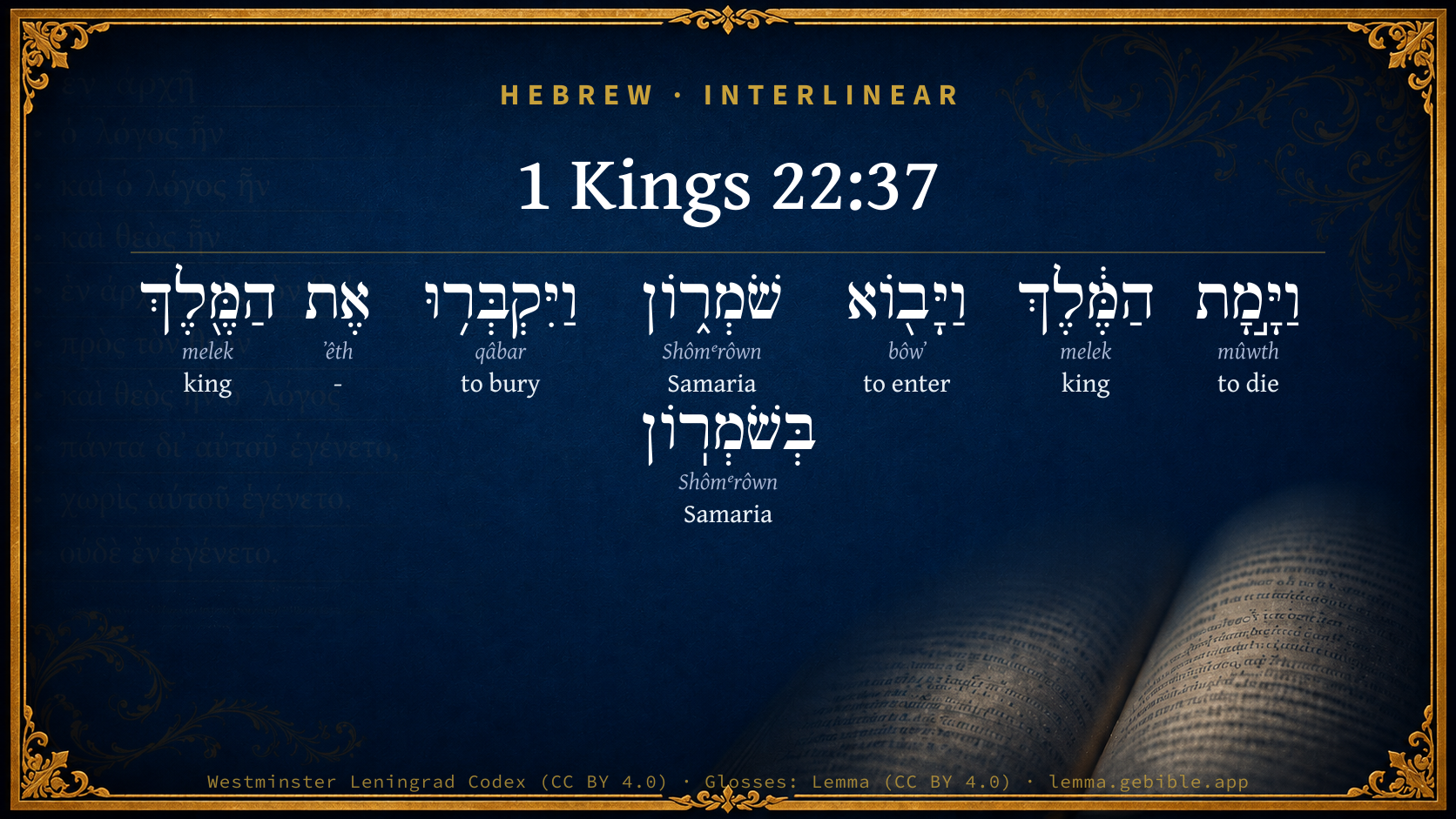
Hebrew (Westminster Leningrad Codex) 1 Kings 22:37 appears in the Hebrew Old Testament. The text above is from the Westminster Leningrad Codex. Each word links to its Strong’s number, a concise gloss, and parsing drawn from the Open Scriptures Hebrew Bible morphology. Click any word for its full Brown-Driver-Briggs (BDB) entry.
Download image
Cite this verse

1 Kings 22:37 (World English Bible). Public Domain. Lemma interlinear Bible study tool, https://lemma.gebible.app/v/1-kings/22/37.

Show BibTeX & RIS
BibTeX
RIS
English Translation
So the king died, and was brought to Samaria; and they buried the king in Samaria.
World English Bible · Public Domain
Download a study sheet

One document with this verse’s original text, its word-by-word gloss line, the meaning frame, cross-references with their text, attributed commentary, and full source and license credits — printable, and it pastes into notes with its structure intact.

This verse Autodidact and up

Study sheet (.html) Plain text (.txt)

A passage Seminary Student

Up to 50 verses in one chapter. A passage sheet keeps up to 6 commentary sources and 12 cross-references per verse, in the order this page ranks them, and says so on the sheet whenever that leaves anything out. Ask for a single verse and you get the Autodidact verse sheet above.

Everything on this page stays free to read, with no account — the sheet is a download of what is already on screen, not access to it.

Want to remove ads? Support Godless Engineer
Compare translations 3

The same verse in 3 English versions, stacked beneath the original-language interlinear above. Click any original word for its lexicon entry.

Each is an independent rendering of the whole verse — the interlinear is not word-aligned to these translations.

Highlighted words mark where these versions differ — a whole-verse word diff, not a word-by-word alignment.

  • World English Bible Public Domain
    So the king died, and was brought to Samaria; and they buried the king in Samaria.
  • King James Version Public Domain
    So the king died, and was brought to Samaria; and they buried the king in Samaria.
  • unfoldingWord Literal Text CC BY-SA 4.0
    And the king died, and he came to Samaria. And they buried the king in Samaria.

unfoldingWord Literal Text — © unfoldingWord, licensed CC BY-SA 4.0. Word-aligned USFM3 via Door43 (git.door43.org/unfoldingWord/en_ult).

Versions to compare (up to 4)

3 of 4 selected

Show all 18 translations

Every available English version of this verse, each an independent rendering of the whole verse.

  • World English Bible Public Domain
    So the king died, and was brought to Samaria; and they buried the king in Samaria.
  • Berean Standard Bible Public Domain
    So the king died and was brought to Samaria, where they buried him.
  • Majority Standard Bible Public Domain
    So the king died and was brought to Samaria, where they buried him.
  • King James Version Public Domain
    So the king died, and was brought to Samaria; and they buried the king in Samaria.
  • American Standard Version (1901) Public Domain
    So the king died, and was brought to Samaria; and they buried the king in Samaria.
  • Revised Version (1885) Public Domain
    So the king died, and was brought to Samaria; and they buried the king in Samaria.
  • Geneva Bible (1599) Public Domain
    So the King died, and was brought to Samaria, and they buried the King in Samaria.
  • Douay-Rheims (1899) Public Domain
    And the king died, b and was carried into Samaria: and they buried the king in Samaria.
  • Young's Literal Translation Public Domain
    And the king dieth, and cometh into Samaria, and they bury the king in Samaria;
  • Literal Standard Version CC BY-SA 4.0
    And the king dies, and comes into Samaria, and they bury the king in Samaria;
  • Unlocked Literal Bible CC BY-SA 4.0
    So King Ahab died and was brought to Samaria, and they buried him in Samaria.
  • unfoldingWord Literal Text CC BY-SA 4.0
    And the king died, and he came to Samaria. And they buried the king in Samaria.
  • Darby Bible Public Domain
    And the king died, and was brought to Samaria; and they buried the king in Samaria.
  • World Messianic Bible Public Domain
    So the king died, and was brought to Samaria; and they buried the king in Samaria.
  • Webster's Bible Public Domain
    So the king died, and was brought to Samaria; and they buried the king in Samaria.
  • Free Bible Version CC BY-SA 4.0
    So the king died. He was taken back to Samaria where they buried him.
  • Bible in Basic English Public Domain
    And they came to Samaria, and put the king's body to rest in Samaria.
  • JPS Tanakh (1917) Public Domain
    So the king died, and was brought to Samaria; and they buried the king in Samaria.

Literal Standard Version (2020), Covenant Press — licensed CC BY-SA 4.0. Text via the HelloAO Bible API (eBible.org). Unlocked Literal Bible (unfoldingWord) — licensed CC BY-SA 4.0. Text via the HelloAO Bible API (eBible.org). unfoldingWord Literal Text — © unfoldingWord, licensed CC BY-SA 4.0. Word-aligned USFM3 via Door43 (git.door43.org/unfoldingWord/en_ult). Free Bible Version, Dr. Jonathan Gallagher — licensed CC BY-SA 4.0. Text via the HelloAO Bible API (eBible.org).

Word by word

More ways to search: Search by grammar → Find every occurrence → Compare this word →

Practice this passage: Drill this verse → Learn its vocabulary →

שֹׁמְר֑וֹן
Shômᵉrôwn
H8111
“Samaria”
Noun, Proper
Part of Speech
Noun
Type
Proper
Full BDB Definition

Origin: from the act part of H8104

TWOT: 2414d

Samaria = "watch mountain" - the region of northern Palestine associated with the northern kingdom of the 10 tribes of Israel which split from the kingdom after the death of Solomon during the reign of his son Rehoboam and were ruled by Jeroboam - the capital city of the northern kingdom of Israel located 30 miles (50 kilometers) north of Jerusalem and 6 miles (10 kilometers) northwest of Shechem
  1. וַיָּ֣מָת mûwth H4191 “and · to die” Conjunction + Verb, Qal, Sequential Imperfect, 3rd Person, Masculine, Singular
  2. הַמֶּ֔לֶךְ melek H4428 “the · king” Particle, Definite Article + Noun, Common, Masculine, Singular, Absolute
  3. וַיָּב֖וֹא bôwʼ H935 “and · to enter” Conjunction + Verb, Qal, Sequential Imperfect, 3rd Person, Masculine, Singular
  4. וַיִּקְבְּר֥וּ qâbar H6912 “and · to bury” Conjunction + Verb, Qal, Sequential Imperfect, 3rd Person, Masculine, Plural
  5. אֶת ʼêth H853 “-” Particle, Direct Object
  6. הַמֶּ֖לֶךְ melek H4428 “the · king” Particle, Definite Article + Noun, Common, Masculine, Singular, Absolute
  7. בְּשֹׁמְרֽוֹן Shômᵉrôwn H8111 “in/at · Samaria” Preposition + Noun, Proper

About this verse

These counts appear in no published source. They are computed here, from the morphology-tagged text and Lemma’s own curated glosses. What Lemma adds →

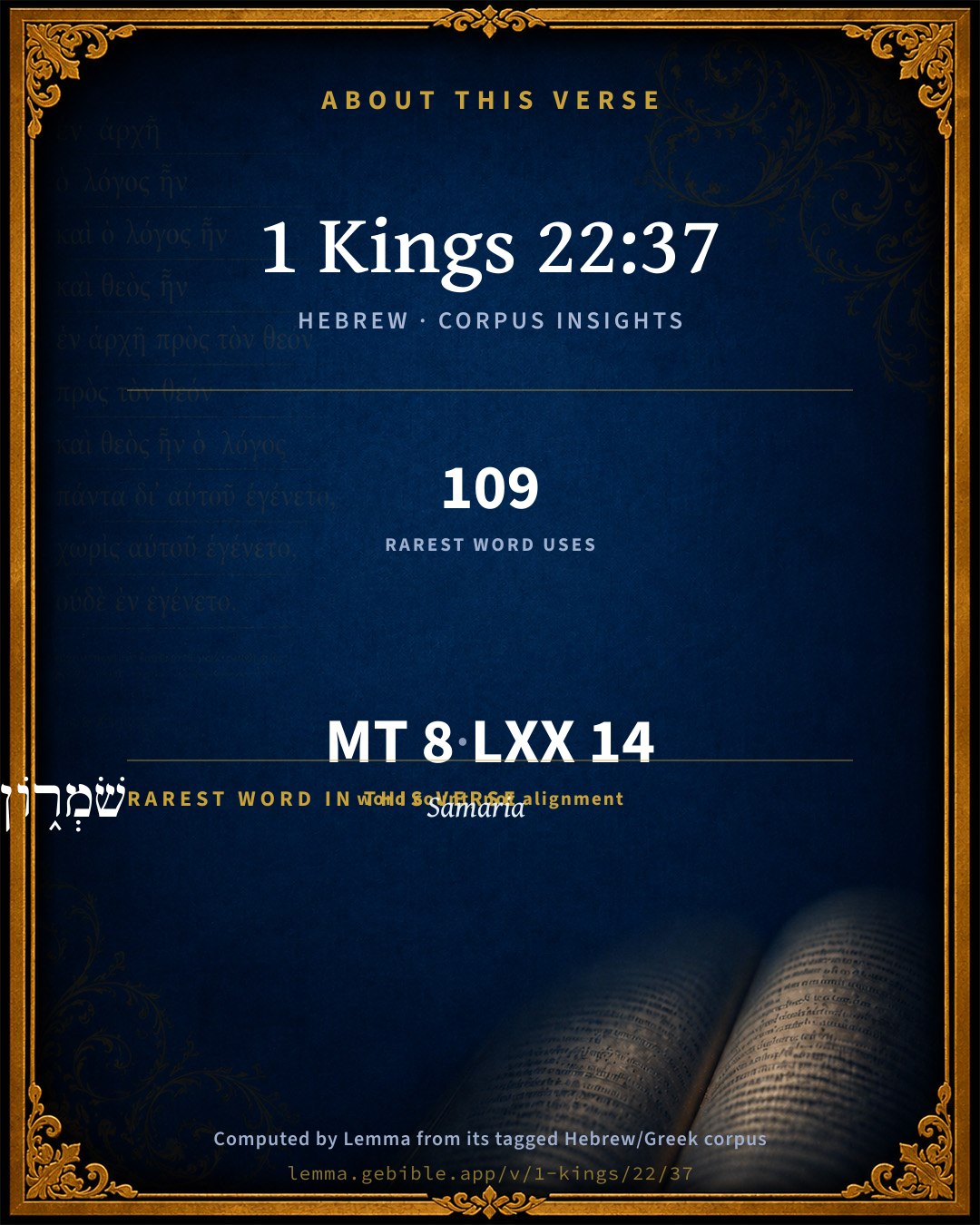
8
words
6
distinct lemmas
Historical
section

Grammatical profile

  • 3 verbs
  • 4 nouns
  • 1 particle

Verb forms

  • וַיָּ֣מָת Qal · Sequential Imperfect
  • וַיָּב֖וֹא Qal · Sequential Imperfect
  • וַיִּקְבְּר֥וּ Qal · Sequential Imperfect

Repetition

Words recur within this verse — often emphatic in Hebrew:

  • הַמֶּ֔לֶךְ king H4428 ×2
  • שֹׁמְר֑וֹן Samaria H8111 ×2

Hebrew & Septuagint length

In English translation the verse runs 16 words from the Hebrew and 16 from the Septuagint (LXX English) — the same length.

A rough comparison of the two English renderings, which tokenize alike — not a word-level alignment.

Word counts can differ between the Hebrew and the Greek without any difference in meaning — e.g. the Hebrew direct-object marker אֵת has no separate Greek word, and Greek often adds the article ὁ.

In the original languages it is 8 Hebrew tokens and 14 Greek tokens — but the two are counted differently (Hebrew bundles its prefixes and suffixes into one token; the Greek is in lemma form), so that isn’t a like-for-like length.

Hebrew and Greek witnesses Masoretic Hebrew ↔ Greek Septuagint

The same verse in the two great witnesses to the Old Testament, shown verse-for-verse.

These are two independent witnesses, not word-aligned to each other, and the Septuagint is shown in lemma (dictionary) form.

Hebrew 1 Kings 22:37 Masoretic · Westminster Leningrad Codex

וַיָּ֣מָת הַמֶּ֔לֶךְ וַיָּב֖וֹא שֹׁמְר֑וֹן וַיִּקְבְּר֥וּ אֶת הַמֶּ֖לֶךְ בְּשֹׁמְרֽוֹן

So the king died, and was brought to Samaria; and they buried the king in Samaria.

World English Bible · Public Domain

Greek LXX 1 Kings 22:37 Septuagint · lemma form

ὅτι θνήσκω ὁ βασιλεύς καί ἔρχομαι εἰς σαμαρεία καί θάπτω ὁ βασιλεύς ἐν σαμαρεία

for the king is dead. And they came to Samaria, and buried the king in Samaria.

LXX2012 (modern English Septuagint) · Public Domain

On this verse, The Pulpit Commentary discusses the Septuagint’s reading. Read the note in Commentary ↓

Hebrew: Westminster Leningrad Codex (CC BY 4.0). Greek: Septuagint (public domain); English from LXX2012 (modern English Septuagint) (Public Domain). How the Septuagint differs from the Hebrew →

Targum (Aramaic paraphrase)

1

The Targum is the ancient Jewish Aramaic paraphrase of the Hebrew Scriptures — an interpretive translation, not the Hebrew text itself. Onkelos (literal) and Pseudo-Jonathan (expansive) render the Torah, and Jonathan the Prophets. Coverage is partial: where no permissively-licensed English translation exists for a verse, only the Aramaic is shown. This is verse-level text, not a word-by-word alignment to the Hebrew.

  1. Targum Jonathan Prophets (Joshua–Malachi)
    וּמִית מַלְכָּא וַאֲתָא לְשֹׁמְרוֹן וּקְבַרוּ יַת מַלְכָּא בְּשֹׁמְרוֹן:

    (no public-domain English translation for this verse)

    Targum Jonathan — Aramaic: “Mikraot Gedolot” (public domain). English: “Sefaria Community Translation” (CC0 1.0 (public-domain dedication)); “London "Chaldee Paraphrase," 1871” (public domain). Text via Sefaria.

Commentary

Notes on 1 Kings 22:37 from classic Christian and Jewish commentators (each source and its license shown beneath its notes). The classic Christian expositions comment on the surrounding passage and are grouped to its opening verse, so a note may address several verses; the Jewish commentaries on the Tanakh (Rashi and others) are per-verse, so they appear only where the commentator wrote on this verse.

Lemma curates 59 commentaries, every one of them public domain or Creative Commons licensed, each selected and text-cleaned for this edition rather than reprinted as found. About our sources →

Trapp's Complete Commentary

John Trapp

1Ki 22:37 So the king died, and was brought to Samaria; and they buried the king in Samaria.

Ver. 37. So the king died.] And now God was even with him for his idolatry, persecution of the prophets, cruelty to Naboth, who now was in far better condition likely. The wicked, saith a reverend man, {a} are like hawks, of great esteem whilst living, but after, nothing worth. The godly are compared to tamer fowls, which are hushed forth and little heeded whilst living; but after death, are brought into the parlour. Then, there is as much difference as between the falcon and the capon, the hawk and the hen.

{a} Dr Harris.

John Trapp, A Commentary or Exposition upon All the Books of the Old and New Testament (1647–1656) — public domain. Text from a community e-Sword module.

The Biblical Illustrator

Joseph S. Exell

1Ki_22:37

So the king died.

The end of Ahab

1. Observe the madness of Ahabs policy, and note how often it is the policy which we ourselves are tempted to pursue. We suppose that if we do not consult the Bible we may take licence to do what seems good in our own eyes, and we imagine that by ignoring the Bible we have divested it of authority. We flatter ourselves that if we do not listen to an exposition of the Divine Word we shall be judged according to the light we have, forgetting the solemn law that it is not according to the light we have that we are to be judged, but according to the light we might have if we put ourselves in right relations to the opportunities created for us by Divine providence. What is this ostrich policy, but one that ought to be condemned by our sense as well as shrunk from by our piety? Our duty under all critical circumstances is to go to the truth-teller, and to get at the reality of things at all costs. Where the truth-teller disturbs our peace and disappoints our ambition, we ought to learn that it is precisely at that point that we have to become self-rectifying. The truth-teller is only powerful in proportion as he tells the truth; officially, he is nothing; his power is simply the measure of his righteousness.

2. Is it possible that there can be found any solitary man who dare oppose such unanimous testimony and complete enthusiasm? The messenger who was sent to call Micaiah was evidently a man of considerate feeling who wished the prophet well. Seeing that the words of the prophets had all declared good unto the king with one mouth, the messenger wished that Micaiah should for once agree with the other prophets and please the king by leaving undisturbed their emphatic and unanimous counsel. Thus the voice of persuasion was brought to bear upon Micaiah, and that voice is always the most difficult to resist. Micaiah lived in God, for God, and had nothing of his own to calculate or consider. Until preachers realise this same spiritual independence, they will be attempting to accommodate themselves to the spirit of the times, and even the strongest of them may be betrayed into connivances and compromises fatal to personal integrity and to the claims of truth.

3. Now came the critical moment. Now it was to be seen whether Micaiah was to be promoted to honour, or thrust away in contempt and wrath. It is easy to read of the recurrence of such moments, but difficult to realise them in their agony. The martyrs must never be forgotten. Dark will be the day in the history of any nation when the men who shed their blood that truth might be told and honour might be vindicated, are no longer held in remembrance. In vain do we bring forth from our hidden treasure the coins of ancient times, the robes worn in high antiquity by kings and priests, the rusty armour of warriors, if there is no longer in our heart the tenderest recollection of the men who wandered about in sheepskins and goatskins, being destitute, afflicted, tormented, that they might save the torch of truth from extinction and the standard of honour from overthrow.

4. Away the kings have gone, and instead of relying upon the word of the Lord, or taking refuge in the sanctuary of great principles, they invent little tricks for the surprise and dismay of the enemy. The King of Israel disguised himself, and Jehoshaphat made himself as the King of Israel, but all their inventions came to nothing. So will perish all the enemies of the Lord. Differences of merely accidental detail there will always be, but no honour can mark the death of those who have gone contrary to the will of heaven, and taken counsel of their own imagination. How long shall the lesson of history be wasted upon us? How long will men delude themselves with the mad infatuation that they can fight against God and prosper? (J. Parker, D. D.)

The Biblical Illustrator, edited by Joseph S. Exell (c. 1880s–1900s) — public domain. Text from a community e-Sword module.

Tyndale Open Study Notes

Tyndale Open Resources

22:37-38 Elijah’s prophecy that dogs would lick the blood of Ahab’s fallen body (21:19) was fulfilled.

Tyndale Open Study Notes — © Tyndale Open Resources, licensed CC BY-SA 4.0. Text via the HelloAO Bible API.

John Gill's Exposition

Jehoshaphat was thirty five years old when he began to reign, and he reigned twenty and five years in Jerusalem,.... So that he must be sixty years of age when he died:

and his mother's name was Azubah, the daughter of Shilhi; but of what family they were is not said.

John Gill's Exposition of the Whole Bible (1746–1763) — public domain (CC PDM 1.0). Text via the HelloAO Bible API.

The Pulpit Commentary

So the king died The LXX makes this to be a part of the proclamation ekastov eijv thqnhken oJ basileuv, which involves a very slight change in the Hebrew text, lmh tm yk instead of lmh tmyw and gives a better sense. It has already been stated that the king died. Such repetitions however are common in Hebrew, and this reading has almost the look of an emendation and was brought Heb. came. The A.V is against the grammar. As "came" would be a strange word to use of a dead man, it is highly probable that instead of azbyw we should read wawbyw with the LXX kai hlqon to Samaria; and they buried the king in Samaria "with his father,". (1Ki_16:28)

The Pulpit Commentary (1880–1919), ed. H.D.M. Spence-Jones & Joseph S. Exell — public domain. Text from a community e-Sword module.

John Wesley's Explanatory Notes

Died - Finding too late the truth of Micaiah's words; and Zedekiah's horns of iron, pushing not the Syrians, but himself, into destruction.

John Wesley, Explanatory Notes Upon the Whole Bible (1754–1765) — public domain. Text via the GEBible commentary corpus.

unfoldingWord translationNotes

Door43 World Missions Community

was brought to Samaria

This can be stated in active form. AT: "his soldiers brought his body to Samaria" (See: Active or Passive)

they buried him

"people buried him"

just as the word of Yahweh had declared

Here "the word of Yahweh" represents Yahweh himself. AT: "just as Yahweh had declared" (See: Metonymy)

translationWords

Ahab

Samaria

bury

chariot

prostitute

word of God

declare

unfoldingWord translationNotes — © Distant Shores Media and the Door43 World Missions Community, licensed CC BY-SA 4.0. Source: git.door43.org/Door43/en_tn.

Lesson kit

Teaching starters — assembled from the data on this page, not authored interpretation. Every prompt links to the verse data it draws on. Edit before teaching.

1 Kings, in the Historical, opens this verse with 8 words (6 distinct Hebrew lemmas). Its most distinctive word is Shômᵉrôwn (“Samaria”). A historical commentator’s framing appears above. Read the whole chapter for the surrounding context.

Discussion questions

  1. What does “Samaria” (Shômᵉrôwn) contribute to the verse as a whole?
  2. What does the repetition of “king” (2× in this one verse) do in this verse?
  3. These translations render this verse differently. What is at stake in choosing one wording over another?
  4. «וַיָּ֣מָת» is a Qal Sequential Imperfect verb. How does that grammatical form shape the action described?
  5. Compare how Trapp's Complete Commentary and The Biblical Illustrator read this verse. Where do they agree or differ?

Things to notice

Reading settings

Reading text

Shown beneath each verse's original-language words.

Old Testament
Old Testament edition

Read the OT as the Masoretic Hebrew (MT) or the Greek Septuagint (LXX).

English shown for the Greek Septuagint (in the Hebrew ↔ Greek comparison).

Comparing translations? Open the Compare panel on any verse page to stack up to four side by side.