Numbers 33:4

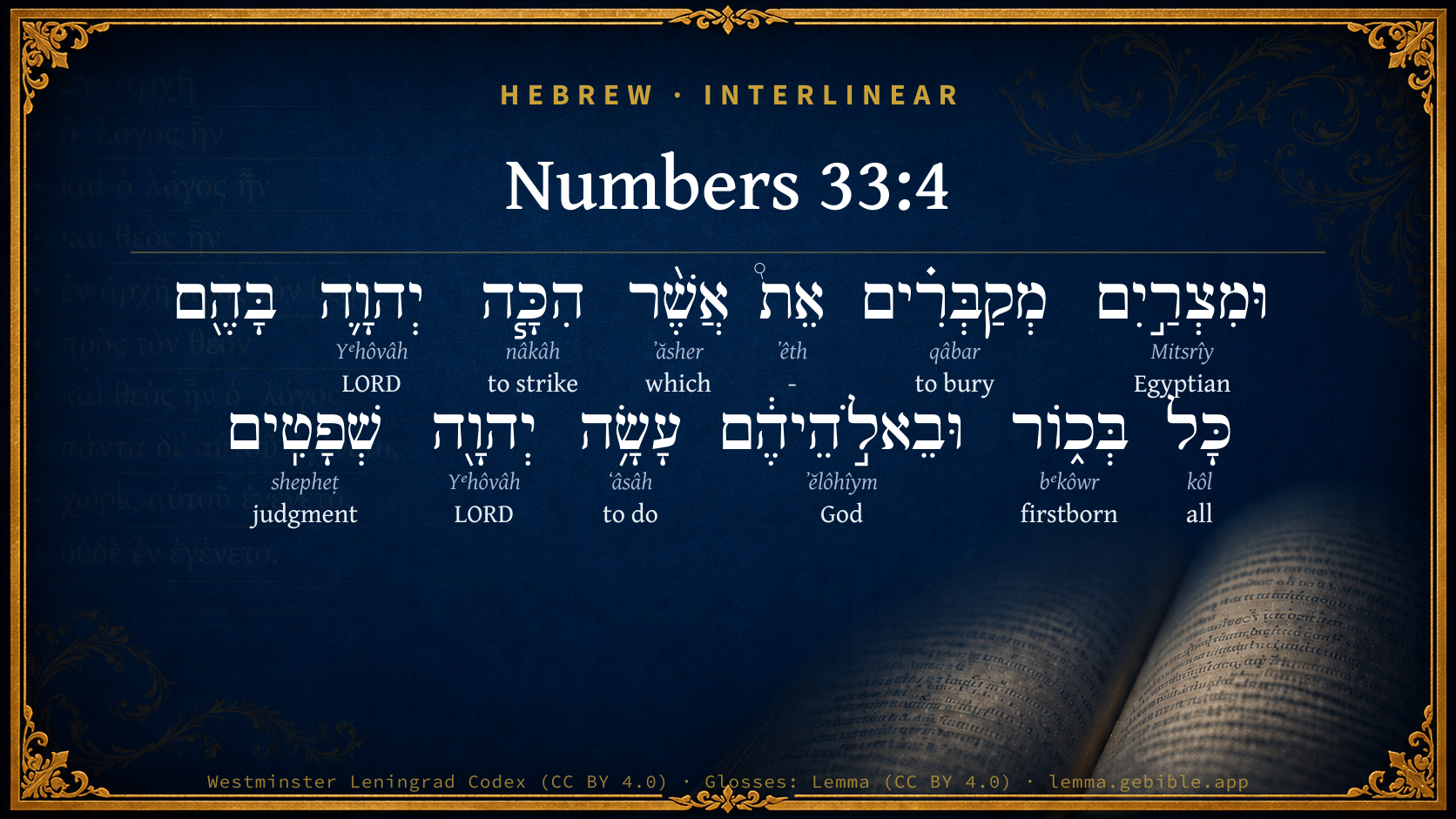
Hebrew (Westminster Leningrad Codex) Numbers 33:4 appears in the Hebrew Old Testament. The text above is from the Westminster Leningrad Codex. Each word links to its Strong’s number, a concise gloss, and parsing drawn from the Open Scriptures Hebrew Bible morphology. Click any word for its full Brown-Driver-Briggs (BDB) entry.
Download image
Cite this verse

Numbers 33:4 (World English Bible). Public Domain. Lemma interlinear Bible study tool, https://lemma.gebible.app/v/numbers/33/4.

Show BibTeX & RIS
BibTeX
RIS
English Translation
while the Egyptians were burying all their firstborn, whom Yahweh had struck among them: on their gods also Yahweh executed judgments.
World English Bible · Public Domain
Download a study sheet

One document with this verse’s original text, its word-by-word gloss line, the meaning frame, cross-references with their text, attributed commentary, and full source and license credits — printable, and it pastes into notes with its structure intact.

This verse Autodidact and up

Study sheet (.html) Plain text (.txt)

A passage Seminary Student

Up to 50 verses in one chapter. A passage sheet keeps up to 6 commentary sources and 12 cross-references per verse, in the order this page ranks them, and says so on the sheet whenever that leaves anything out. Ask for a single verse and you get the Autodidact verse sheet above.

Everything on this page stays free to read, with no account — the sheet is a download of what is already on screen, not access to it.

Want to remove ads? Support Godless Engineer
Compare translations 3

The same verse in 3 English versions, stacked beneath the original-language interlinear above. Click any original word for its lexicon entry.

Each is an independent rendering of the whole verse — the interlinear is not word-aligned to these translations.

Highlighted words mark where these versions differ — a whole-verse word diff, not a word-by-word alignment.

  • World English Bible Public Domain
    while the Egyptians were burying all their firstborn, whom Yahweh had struck among them: on their gods also Yahweh executed judgments.
  • King James Version Public Domain
    For the Egyptians buried all their firstborn, which the LORD had smitten among them: upon their gods also the LORD executed judgments.
  • unfoldingWord Literal Text CC BY-SA 4.0
    And the Egyptians were burying those whom Yahweh had struck down, all the firstborn. And Yahweh enacted judgment against their gods.

unfoldingWord Literal Text — © unfoldingWord, licensed CC BY-SA 4.0. Word-aligned USFM3 via Door43 (git.door43.org/unfoldingWord/en_ult).

Versions to compare (up to 4)

3 of 4 selected

Show all 18 translations

Every available English version of this verse, each an independent rendering of the whole verse.

  • World English Bible Public Domain
    while the Egyptians were burying all their firstborn, whom Yahweh had struck among them: on their gods also Yahweh executed judgments.
  • Berean Standard Bible Public Domain
    who were burying all their firstborn, whom the LORD had struck down among them; for the LORD had executed judgment against their gods.
  • Majority Standard Bible Public Domain
    who were burying all their firstborn, whom the LORD had struck down among them; for the LORD had executed judgment against their gods.
  • King James Version Public Domain
    For the Egyptians buried all their firstborn, which the LORD had smitten among them: upon their gods also the LORD executed judgments.
  • American Standard Version (1901) Public Domain
    while the Egyptians were burying all their first-born, whom Jehovah had smitten among them: upon their gods also Jehovah executed judgments.
  • Revised Version (1885) Public Domain
    while the Egyptians were burying all their firstborn, which the LORD had smitten among them: upon their gods also the LORD executed judgments.
  • Geneva Bible (1599) Public Domain
    (For the Egyptians buried all their first borne, which the Lord had smitten among them: vpon their gods also the Lord did execution.)
  • Douay-Rheims (1899) Public Domain
    Who were burying their firstborn, whom the Lord had slain (upon their gods also he had executed vengeance,)
  • Young's Literal Translation Public Domain
    and the Egyptians are burying those whom Jehovah hath smitten among them, every first-born, and on their gods hath Jehovah done judgments --
  • Literal Standard Version CC BY-SA 4.0
    and the Egyptians are burying those whom YHWH has struck among them, every firstborn, and YHWH has done judgments on their gods.
  • Unlocked Literal Bible CC BY-SA 4.0
    This happened while the Egyptians were burying all their firstborn, those whom Yahweh had killed among them, for he also inflicted punishment on their gods.
  • unfoldingWord Literal Text CC BY-SA 4.0
    And the Egyptians were burying those whom Yahweh had struck down, all the firstborn. And Yahweh enacted judgment against their gods.
  • Darby Bible Public Domain
    And the Egyptians buried those whom Jehovah had smitten among them, all the firstborn; and upon their gods Jehovah executed judgments.
  • World Messianic Bible Public Domain
    while the Egyptians were burying all their firstborn, whom the LORD had struck among them. The LORD also executed judgments on their gods.
  • Webster's Bible Public Domain
    For the Egyptians buried all their first-born, whom the LORD had smitten among them: upon their gods also the LORD executed judgments.
  • Free Bible Version CC BY-SA 4.0
    The Egyptians were burying all their firstborn that the Lord had killed, for the Lord had brought down his judgments on their gods.
  • Bible in Basic English Public Domain
    While the Egyptians were placing in the earth the bodies of their sons on whom the Lord had sent destruction: and their gods had been judged by him.
  • JPS Tanakh (1917) Public Domain
    while the Egyptians were burying them that the LORD had smitten among them, even all their first-born; upon their gods also the LORD executed judgments.

Literal Standard Version (2020), Covenant Press — licensed CC BY-SA 4.0. Text via the HelloAO Bible API (eBible.org). Unlocked Literal Bible (unfoldingWord) — licensed CC BY-SA 4.0. Text via the HelloAO Bible API (eBible.org). unfoldingWord Literal Text — © unfoldingWord, licensed CC BY-SA 4.0. Word-aligned USFM3 via Door43 (git.door43.org/unfoldingWord/en_ult). Free Bible Version, Dr. Jonathan Gallagher — licensed CC BY-SA 4.0. Text via the HelloAO Bible API (eBible.org).

Word by word

More ways to search: Search by grammar → Find every occurrence → Compare this word →

Practice this passage: Drill this verse → Learn its vocabulary →

שְׁפָטִֽים
shepheṭ
H8201
“judgments”
Noun, Common, Masculine, Plural, Absolute
Part of Speech
Noun
Type
Common
Gender
Masculine
Number
Plural
State
Absolute
Full BDB Definition

Origin: from H8199

TWOT: 2443a

judgment, act of judgment
  1. וּמִצְרַ֣יִם Mitsrîy H4713 “and · Egyptian” Conjunction + Noun, Proper
  2. מְקַבְּרִ֗ים qâbar H6912 “burying” Verb, Piel, Participle Active, Masculine, Plural, Absolute
  3. אֵת֩ ʼêth H853 “-” Particle, Direct Object
  4. אֲשֶׁ֨ר ʼăsher H834 “which” Particle, Relative
  5. הִכָּ֧ה nâkâh H5221 “to strike” Verb, Hiphil, Perfect, 3rd Person, Masculine, Singular
  6. יְהוָ֛ה Yᵉhôvâh H3068 “LORD” Noun, Proper
  7. כָּל kôl H3605 “all of” Noun, Common, Masculine, Singular, Construct
  8. בְּכ֑וֹר bᵉkôwr H1060 “firstborn” Noun, Common, Masculine, Singular, Absolute
  9. וּבֵאלֹ֣הֵיהֶ֔ם ʼĕlôhîym H430 “and · in/at · God(s) · their” Conjunction + Preposition + Noun, Common, Masculine, Plural, Construct + Suffix, Personal, 3rd Person, Masculine, Plural
  10. עָשָׂ֥ה ʻâsâh H6213 “to do” Verb, Qal, Perfect, 3rd Person, Masculine, Singular
  11. יְהוָ֖ה Yᵉhôvâh H3068 “LORD” Noun, Proper

About this verse

These counts appear in no published source. They are computed here, from the morphology-tagged text and Lemma’s own curated glosses. What Lemma adds →

13
words
11
distinct lemmas
Pentateuch
section

Notable vocabulary

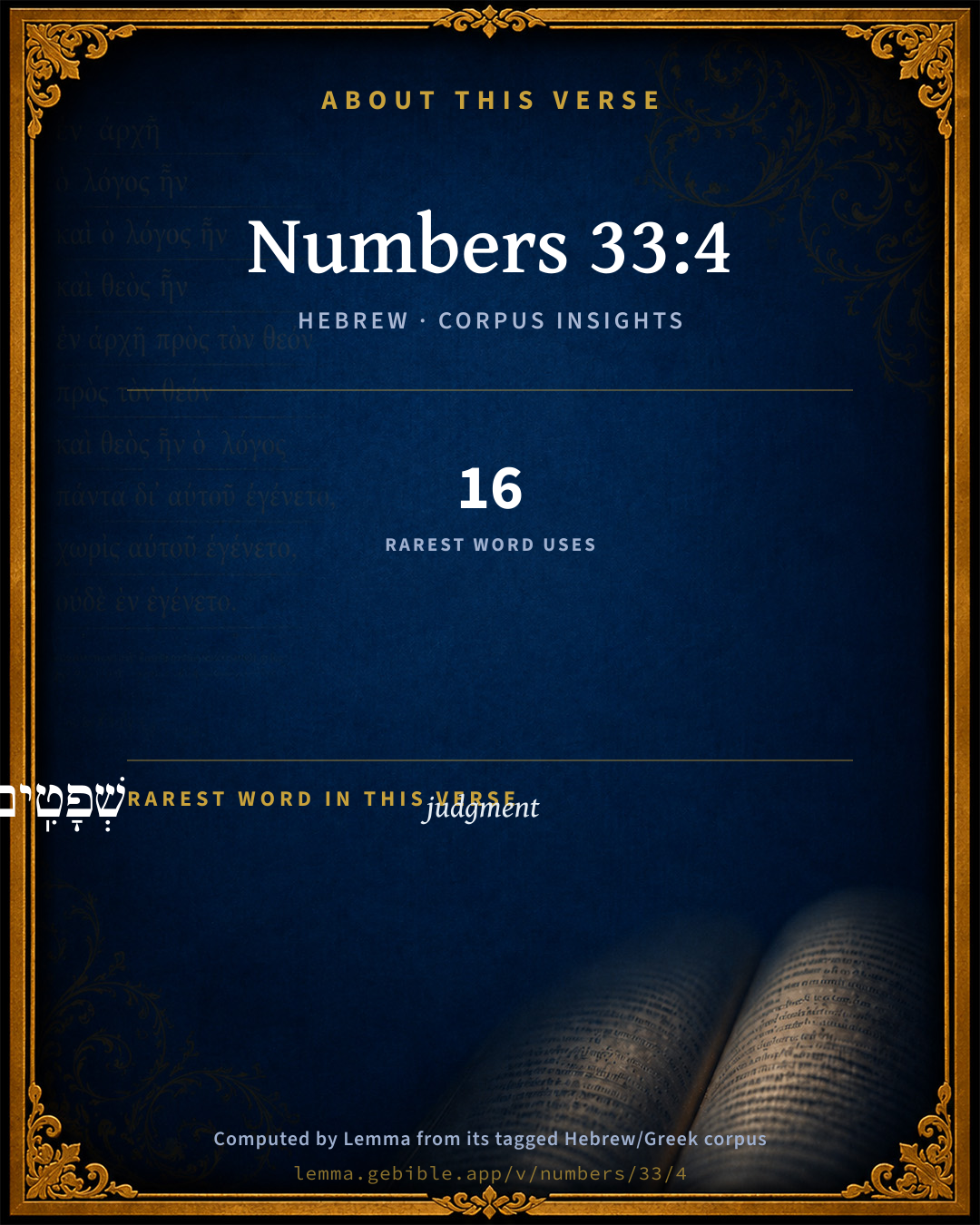
The rarest word here is שְׁפָטִֽים judgment H8201 — appearing just 16 times in the whole Hebrew Bible.

Shared distinctive vocabulary

שְׁפָטִֽים judgment H8201 occurs in 16 verses of the Hebrew Bible. Also found in:

Grammatical profile

  • 3 verbs
  • 7 nouns
  • 1 preposition
  • 2 particles

Verb forms

  • מְקַבְּרִ֗ים Piel · Participle Active
  • הִכָּ֧ה Hiphil · Perfect
  • עָשָׂ֥ה Qal · Perfect

Repetition

A word recurs within this verse — often emphatic in Hebrew:

  • יְהוָ֛ה LORD H3068 ×2

Hebrew & Septuagint length

In English translation the verse runs 21 words from the Hebrew and 30 from the Septuagint (LXX English) — the Septuagint runs noticeably longer here. See the side-by-side →

A rough comparison of the two English renderings, which tokenize alike — not a word-level alignment.

Word counts can differ between the Hebrew and the Greek without any difference in meaning — e.g. the Hebrew direct-object marker אֵת has no separate Greek word, and Greek often adds the article ὁ.

Cross-references

7

Topical passages linked to Numbers 33:4 in the Treasury of Scripture Knowledge — connected by theme and wording, ordered by reader-vote popularity; previews shown in the World English Bible.

  • Exodus 12:12 For I will go through the land of Egypt in that night, and will strike all the firstborn in the land of Egypt, both man and animal. Against all the gods of Egypt I will execute judgments: I am Yahweh.
  • Isaiah 19:1 The burden of Egypt. Behold, Yahweh rides on a swift cloud, and comes to Egypt: and the idols of Egypt shall tremble at his presence; and the heart of Egypt shall melt in the midst of it.
  • Zephaniah 2:11 Yahweh will be awesome to them, for he will famish all the gods of the land. Men will worship him, everyone from his place, even all the shores of the nations.
  • Exodus 18:11 Now I know that Yahweh is greater than all gods because of the thing in which they dealt arrogantly against them."
  • Revelation 12:7–9 There was war in the sky. Michael and his angels made war on the dragon. The dragon and his angels made war.
  • Exodus 12:29–30 It happened at midnight, that Yahweh struck all the firstborn in the land of Egypt, from the firstborn of Pharaoh who sat on his throne to the firstborn of the captive who was in the dungeon; and all the firstborn of cattle.
  • Psalms 105:36 He struck also all the firstborn in their land, The first fruits of all their manhood.

Cross-references courtesy of OpenBible.info (CC BY 4.0).

Hebrew and Greek witnesses Masoretic Hebrew ↔ Greek Septuagint

The same verse in the two great witnesses to the Old Testament, shown verse-for-verse.

Here the Septuagint runs noticeably longer than the Hebrew — LXX2012 (modern English Septuagint) 30 words vs World English Bible 21. A rough length comparison of the two English translations, not a word-level alignment — read both below.

These are two independent witnesses, not word-aligned to each other, and the Septuagint is shown in lemma (dictionary) form.

Hebrew Numbers 33:4 Masoretic · Westminster Leningrad Codex

וּמִצְרַ֣יִם מְקַבְּרִ֗ים אֵת֩ אֲשֶׁ֨ר הִכָּ֧ה יְהוָ֛ה בָּהֶ֖ם כָּל בְּכ֑וֹר וּבֵאלֹ֣הֵיהֶ֔ם עָשָׂ֥ה יְהוָ֖ה שְׁפָטִֽים

while the Egyptians were burying all their firstborn, whom Yahweh had struck among them: on their gods also Yahweh executed judgments.

World English Bible · Public Domain

Greek LXX Numbers 33:4 Septuagint · lemma form

καί ὁ αἰγύπτιος θάπτω ἐκ ἑαυτοῦ ὁ θνήσκω πᾶς ὅς πατάσσω κύριος πᾶς πρωτότοκος ἐν γῆ αἴγυπτος καί ἐν ὁ θεός αὐτός ποιέω ὁ ἐκδίκησις κύριος

And the Egyptians buried those that died of them, even all that the Lord struck, every firstborn in the land of Egypt; also the Lord executed vengeance on their gods.

LXX2012 (modern English Septuagint) · Public Domain

On this verse, The Pulpit Commentary discusses the Septuagint’s reading. Read the note in Commentary ↓

Hebrew: Westminster Leningrad Codex (CC BY 4.0). Greek: Septuagint (public domain); English from LXX2012 (modern English Septuagint) (Public Domain). How the Septuagint differs from the Hebrew →

Targum (Aramaic paraphrase)

2

The Targum is the ancient Jewish Aramaic paraphrase of the Hebrew Scriptures — an interpretive translation, not the Hebrew text itself. Onkelos (literal) and Pseudo-Jonathan (expansive) render the Torah, and Jonathan the Prophets. Coverage is partial: where no permissively-licensed English translation exists for a verse, only the Aramaic is shown. This is verse-level text, not a word-by-word alignment to the Hebrew.

  1. Targum Onkelos Torah (Genesis–Deuteronomy)
    וּמִצְרָאֵי מְקַבְּרִין יָת דִי קְטַל יְיָ בְּהוֹן כָּל בּוּכְרָא וּבְטַעֲוַתְהוֹן עָבַד יְיָ דִינִין

    (no public-domain English translation for this verse)

    Targum Onkelos — Aramaic: “Onkelos Genesis” (public domain); “Onkelos Exodus” (public domain); “Onkelos Leviticus” (public domain); “Onkelos Numbers” (public domain); “Onkelos Deuteronomy” (public domain). English: “Sefaria Community Translation” (CC0 1.0 (public-domain dedication)); “J.W. Etheridge. The Targums of Onkelos and Jonathan Ben Uzziel on the Pentateuch. London: Longmans, Green, 1862” (public domain). Text via Sefaria.

  2. Targum Pseudo-Jonathan Torah (Genesis–Deuteronomy)
    וּמִצְרָאֵי מְקַבְּרִין יַת דְקָטַל יְיָ בְּהוֹן כָּל בּוּכְרָא וּבְטַעֲוַותְהוֹן עָבַד מֵימַר דַיְיָ דִינִין טַעֲוַות מַתְּכָא הֲווֹ מִתְרַכְּכִין טַעֲוַות אַבְנָא מִתְגַדְעִין טַעֲוַות פַּחְרָא מִתְעַבְּדִין בְּקִיקִין טַעֲוִוין דְעָא מִתְעַבְּדִין קְטוֹם וְדִבְעִירֵי מַיְיתוּן

    And the Mizraee buried those whom the Lord had killed among them, even all the first-born; and upon their idols did the Word of the Lord do judgments; their molten idols were dissolved, their idols of stone were mutilated, their idols of earthenware broken in pieces, their wooden idols turned to ashes, and their cattle gods were slain with death.

    Targum Pseudo-Jonathan — Aramaic: “Targum Jonathan on Genesis” (public domain); “Targum Jonathan on Exodus” (public domain); “Targum Jonathan on Leviticus” (public domain); “Targum Jonathan on Numbers” (public domain); “Targum Jonathan on Deuteronomy” (public domain). English: “The Targum of Jonathan ben Uzziel, trans. J. W. Etheridge, London, 1862” (public domain). Text via Sefaria.

Commentary

Notes on Numbers 33:4 from classic Christian and Jewish commentators (each source and its license shown beneath its notes). The classic Christian expositions comment on the surrounding passage and are grouped to its opening verse, so a note may address several verses; the Jewish commentaries on the Tanakh (Rashi and others) are per-verse, so they appear only where the commentator wrote on this verse.

Lemma curates 59 commentaries, every one of them public domain or Creative Commons licensed, each selected and text-cleaned for this edition rather than reprinted as found. About our sources →

Trapp's Complete Commentary

John Trapp

Num 33:4 For the Egyptians buried all [their] firstborn, which the LORD had smitten among them: upon their gods also the LORD executed judgments.

Ver. 4. For the Egyptians buried.] As iron is very soft and malleable while in the fire, but soon after returns to its former hardness, so was it with these Egyptians. Affliction meekeneth men: hence affliction and meekness grow upon the same Hebrew root.

John Trapp, A Commentary or Exposition upon All the Books of the Old and New Testament (1647–1656) — public domain. Text from a community e-Sword module.

Tyndale Open Study Notes

Tyndale Open Resources

33:4 defeated the gods of Egypt: See Exod 6:6; 12:12. This historical review draws attention to those special events that forced Pharaoh to allow the Israelite exodus from Egypt.

Tyndale Open Study Notes — © Tyndale Open Resources, licensed CC BY-SA 4.0. Text via the HelloAO Bible API.

Geneva Bible (1599)

Geneva Bible translators

Either meaning their idols, or their men of authority.

Geneva Bible (1599) marginal notes — public domain. Text via Bolls.life.

Jamieson, Fausset & Brown

Robert Jamieson, A. R. Fausset & David Brown

upon their gods--used either according to Scripture phraseology to denote their rulers (the first-born of the king and his princes) or the idolatrous objects of Egyptian worship.

Jamieson, Fausset & Brown — Commentary Critical and Explanatory on the Whole Bible (1871) — public domain (CC PDM 1.0). Text via the HelloAO Bible API.

John Gill's Exposition

For the Egyptians buried all their firstborn, which the Lord had smitten among them,.... Which contributed much to the more easy and safe deliverance of the children of Israel; for their hearts were heavy with sorrow, and their hands were full, and they had other work to do, namely, to bury their dead, than to molest Israel; and besides, they knew it was for detaining them this stroke came upon them:

upon their gods also the Lord executed judgments; they were moved at the presence, and by the power of God, and fell and were dashed to pieces, as the idols of the same land were in later times, see Isa 19:1 and this still the more intimidated and frightened the Egyptians, that they dared not attempt to hinder the departure of the Israelites from them. The Targum of Jonathan says, the Word of the Lord did this; and adds, their molten idols became soft, their strong idols were mutilated, their earthen idols were diminished, their wooden idols became ashes, and those of beasts died.

John Gill's Exposition of the Whole Bible (1746–1763) — public domain (CC PDM 1.0). Text via the HelloAO Bible API.

Haydock's Catholic Bible Commentary

Gods. Their idols were thrown down. (St. Jerome, ep. 127.) See Exodus xii. 12. (Menochius)

George Leo Haydock (1774–1849), Haydock's Catholic Family Bible and Commentary, 1859 edition — public domain. Excludes Psalms (Douay-Rheims chapter numbering differs from Protestant) and Deuterocanonical books (Catholic canon only).

Matthew Poole's English Annotations

Upon their gods; either,

1. Their princes and rulers, who are sometimes called gods in Scripture; and so this is added by way of amplification, God slew their first-born; not only of the meaner sort, but even of their king and princes. Or,

2. Their false gods, to wit, those beasts which the brutish Egyptians worshipped as gods, which were killed with the rest, for the first-born both of men and beasts were then killed, Exo 13:5. See Poole "Exo 12:12"; See Poole "Exo 18:11".

Matthew Poole's English Annotations on the Holy Bible (1683–1685) — public domain. Text from a community e-Sword/MySword module.

Whedon's Commentary on the Bible

Daniel D. Whedon

4. Egyptians buried all their firstborn — Exo_12:29-30, note.

Upon their gods… judgments — See Introduction to the history of the plagues. Exo_7:8.

Daniel D. Whedon (gen. ed.), Commentary on the Old and New Testaments (1874–1909) — public domain. Text from a community e-Sword module.

The Pulpit Commentary

Buried all their first-born, which the Lord had smitten among them. Literally, "were burying (Septuagint, eyapton ) those whom the Lord had smitten among them, viz., all the first-born." The fact that the Egyptians were so universally employed about the funeral rites of their first-born rites to which they paid such extreme attention seems to be mentioned here as supplying one reason at least why the Israelites began their outward march without opposition. It is in perfect accordance with what we know of the Egyptians, that all other passions and interests should give place for the time to the necessary care for the departed. Upon their gods also the Lord executed judgments. See on Exo_12:12, and cf. Isa_19:1. The false deities of Egypt, having no existence except in the imaginations of men, could only be affected within the sphere of those imaginations, i.e., by being made contemptible in the eyes of those who feared them.

The Pulpit Commentary (1880–1919), ed. H.D.M. Spence-Jones & Joseph S. Exell — public domain. Text from a community e-Sword module.

John Wesley's Explanatory Notes

On their gods - Their false gods, namely those beasts which the brutish Egyptians worshipped as gods, which were killed with the rest, for the first-born both of men and beasts were then killed. Probably their images likewise were thrown down, as Dagon afterward before the ark.

John Wesley, Explanatory Notes Upon the Whole Bible (1754–1765) — public domain. Text via the GEBible commentary corpus.

Rashi

Rabbi Shlomo Yitzchaki (Rashi)

ומצרים מקברים AND THIS EGYPTIANS WERE BURYING [ALL THEIR FIRSTBORN] — they were busily occupied in their mourning.

Rashi on the Tanakh — English translations: “The Judaica Press complete Tanach with Rashi, translated by A. J. Rosenberg” (CC BY 4.0); “Pentateuch with Rashi's commentary by M. Rosenbaum and A.M. Silbermann, 1929-1934” (public domain); “The Metsudah Tanach series, Lakewood, N.J” (CC BY 4.0); and “The Book of Joshua, Metsudah Publications, 1997” (CC BY 4.0). Text via Sefaria.

Lesson kit

Teaching starters — assembled from the data on this page, not authored interpretation. Every prompt links to the verse data it draws on. Edit before teaching.

Numbers, in the Pentateuch, opens this verse with 13 words (11 distinct Hebrew lemmas). Its most distinctive word is shepheṭ (“judgment”). The Greek Septuagint runs longer here. A historical commentator’s framing appears above. Read the whole chapter for the surrounding context.

Discussion questions

  1. How does “judgment” (shepheṭ) shape what this verse is saying?
  2. Exodus 6:6 shares the word «judgment» with this verse. How do the two illuminate each other?
  3. “LORD” occurs 2× in this one verse. What is the effect of the repetition?
  4. Compared with the Hebrew, the Septuagint runs longer here. What questions does that raise?
  5. These translations render this verse differently. What is at stake in choosing one wording over another?
  6. The verb «מְקַבְּרִ֗ים» is Piel Participle Active. How does its form color the action?
  7. Reading how Trapp's Complete Commentary and Tyndale Open Study Notes read this verse, where do the two commentators agree and where do they part?

Things to notice

Reading settings

Reading text

Shown beneath each verse's original-language words.

Old Testament
Old Testament edition

Read the OT as the Masoretic Hebrew (MT) or the Greek Septuagint (LXX).

English shown for the Greek Septuagint (in the Hebrew ↔ Greek comparison).

Comparing translations? Open the Compare panel on any verse page to stack up to four side by side.