Ezekiel 39:13

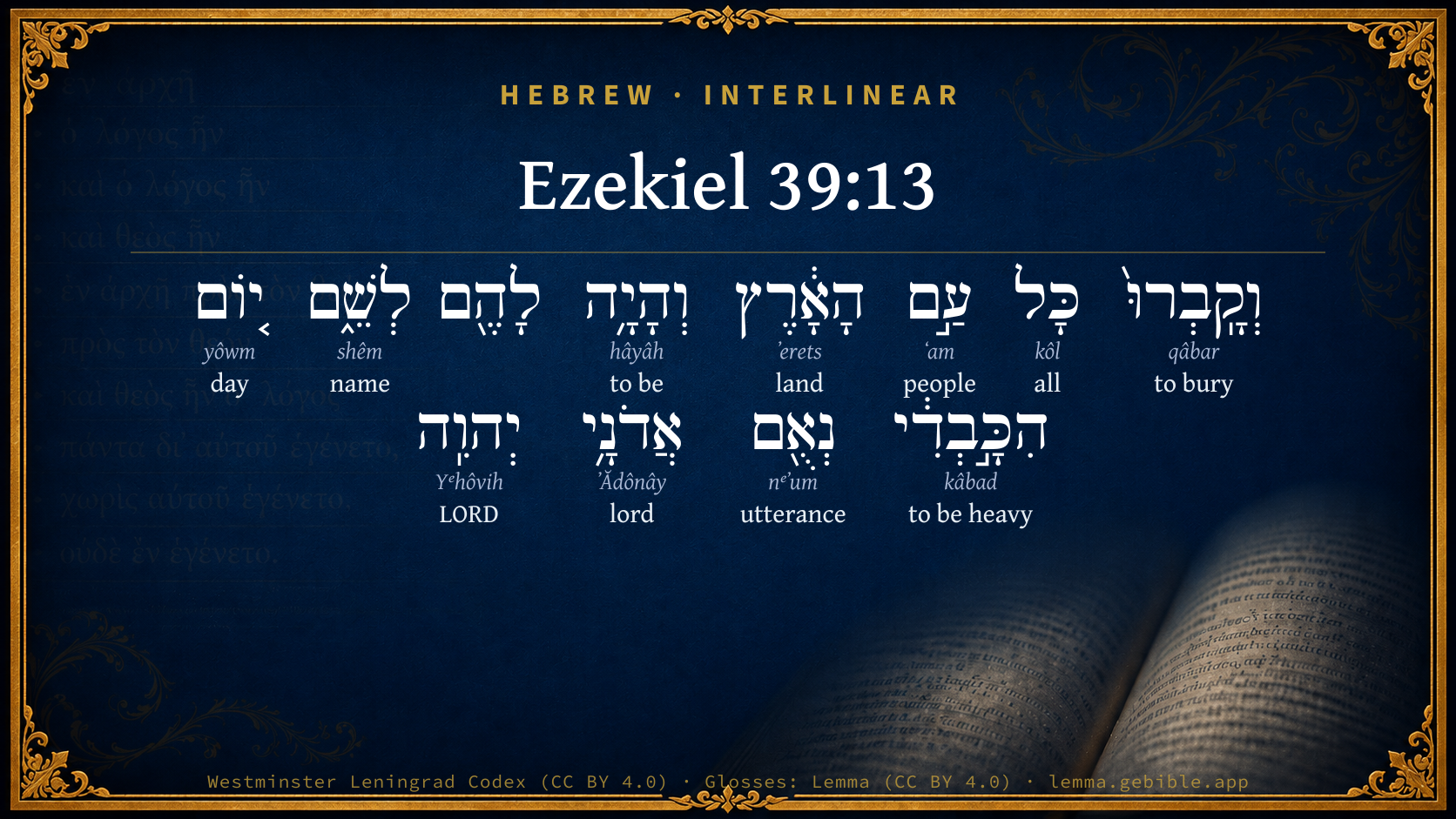
Hebrew (Westminster Leningrad Codex) Ezekiel 39:13 appears in the Hebrew Old Testament. The text above is from the Westminster Leningrad Codex. Each word links to its Strong’s number, a concise gloss, and parsing drawn from the Open Scriptures Hebrew Bible morphology. Click any word for its full Brown-Driver-Briggs (BDB) entry.
Download image
Cite this verse

Ezekiel 39:13 (World English Bible). Public Domain. Lemma interlinear Bible study tool, https://lemma.gebible.app/v/ezekiel/39/13.

Show BibTeX & RIS
BibTeX
RIS
English Translation
Yes, all the people of the land shall bury them; and it shall be to them a renown in the day that I shall be glorified, says the Lord Yahweh.
World English Bible · Public Domain
Download a study sheet

One document with this verse’s original text, its word-by-word gloss line, the meaning frame, cross-references with their text, attributed commentary, and full source and license credits — printable, and it pastes into notes with its structure intact.

This verse Autodidact and up

Study sheet (.html) Plain text (.txt)

A passage Seminary Student

Up to 50 verses in one chapter. A passage sheet keeps up to 6 commentary sources and 12 cross-references per verse, in the order this page ranks them, and says so on the sheet whenever that leaves anything out. Ask for a single verse and you get the Autodidact verse sheet above.

Everything on this page stays free to read, with no account — the sheet is a download of what is already on screen, not access to it.

Want to remove ads? Support Godless Engineer
Compare translations 3

The same verse in 3 English versions, stacked beneath the original-language interlinear above. Click any original word for its lexicon entry.

Each is an independent rendering of the whole verse — the interlinear is not word-aligned to these translations.

Highlighted words mark where these versions differ — a whole-verse word diff, not a word-by-word alignment.

  • World English Bible Public Domain
    Yes, all the people of the land shall bury them; and it shall be to them a renown in the day that I shall be glorified, says the Lord Yahweh.
  • King James Version Public Domain
    Yea, all the people of the land shall bury them; and it shall be to them a renown the day that I shall be glorified, saith the Lord GOD.
  • unfoldingWord Literal Text CC BY-SA 4.0
    For all the people of the land will bury them; it will be a memorable day for them when I am glorified—this is the Lord Yahweh’s declaration.

unfoldingWord Literal Text — © unfoldingWord, licensed CC BY-SA 4.0. Word-aligned USFM3 via Door43 (git.door43.org/unfoldingWord/en_ult).

Versions to compare (up to 4)

3 of 4 selected

Show all 18 translations

Every available English version of this verse, each an independent rendering of the whole verse.

  • World English Bible Public Domain
    Yes, all the people of the land shall bury them; and it shall be to them a renown in the day that I shall be glorified, says the Lord Yahweh.
  • Berean Standard Bible Public Domain
    All the people of the land will bury them, and it will bring them renown on the day I display My glory, declares the Lord GOD.
  • Majority Standard Bible Public Domain
    All the people of the land will bury them, and it will bring them renown on the day I display My glory, declares the Lord GOD.
  • King James Version Public Domain
    Yea, all the people of the land shall bury them; and it shall be to them a renown the day that I shall be glorified, saith the Lord GOD.
  • American Standard Version (1901) Public Domain
    Yea, all the people of the land shall bury them; and it shall be to them a renown in the day that I shall be glorified, saith the Lord Jehovah.
  • Revised Version (1885) Public Domain
    Yea, all the people of the land shall bury them; and it shall be to them a renown, in the day that I shall be glorified, saith the Lord GOD.
  • Geneva Bible (1599) Public Domain
    Yea, all the people of the lande shall burie them, and they shall haue a name when I shall be glorified, saith the Lord God.
  • Douay-Rheims (1899) Public Domain
    And all the people of the land shall bury him, and it shall be unto them a noted day, wherein I was glorified, saith the Lord God.
  • Young's Literal Translation Public Domain
    Yea, all the people of the land have buried them, and it hath been to them for a name -- the day of My being honoured -- an affirmation of the Lord Jehovah.
  • Literal Standard Version CC BY-SA 4.0
    Indeed, all the people of the land have buried them, and it has been to them for a name—the day of My being honored—a declaration of Lord YHWH.
  • Unlocked Literal Bible CC BY-SA 4.0
    For all the people of the land will bury them; it will be a memorable day for them when I am glorified—this is the Lord Yahweh's declaration.
  • unfoldingWord Literal Text CC BY-SA 4.0
    For all the people of the land will bury them; it will be a memorable day for them when I am glorified—this is the Lord Yahweh’s declaration.
  • Darby Bible Public Domain
    and all the people of the land shall bury [them]; and it shall be to them for renown in the day that I shall be glorified, saith the Lord Jehovah.
  • World Messianic Bible Public Domain
    Yes, all the people of the land will bury them; and they will become famous in the day that I will be glorified,” says the Lord GOD.
  • Webster's Bible Public Domain
    Yes, all the people of the land shall bury them: and it shall be to them a renown in the day that I shall be glorified, saith the Lord GOD.
  • Free Bible Version CC BY-SA 4.0
    Everyone in the country will be involved in burying them, and this will give them a good reputation when I reveal my glory, declares the Lord God.
  • Bible in Basic English Public Domain
    And all the people of the land will put them in the earth; and it will be to their honour in the day when I let my glory be seen, says the Lord.
  • JPS Tanakh (1917) Public Domain
    Yea, all the people of the land shall bury them, and it shall be to them a renown; in the day that I shall be glorified, saith the Lord GOD.

Literal Standard Version (2020), Covenant Press — licensed CC BY-SA 4.0. Text via the HelloAO Bible API (eBible.org). Unlocked Literal Bible (unfoldingWord) — licensed CC BY-SA 4.0. Text via the HelloAO Bible API (eBible.org). unfoldingWord Literal Text — © unfoldingWord, licensed CC BY-SA 4.0. Word-aligned USFM3 via Door43 (git.door43.org/unfoldingWord/en_ult). Free Bible Version, Dr. Jonathan Gallagher — licensed CC BY-SA 4.0. Text via the HelloAO Bible API (eBible.org).

Word by word

More ways to search: Search by grammar → Find every occurrence → Compare this word →

Practice this passage: Drill this verse → Learn its vocabulary →

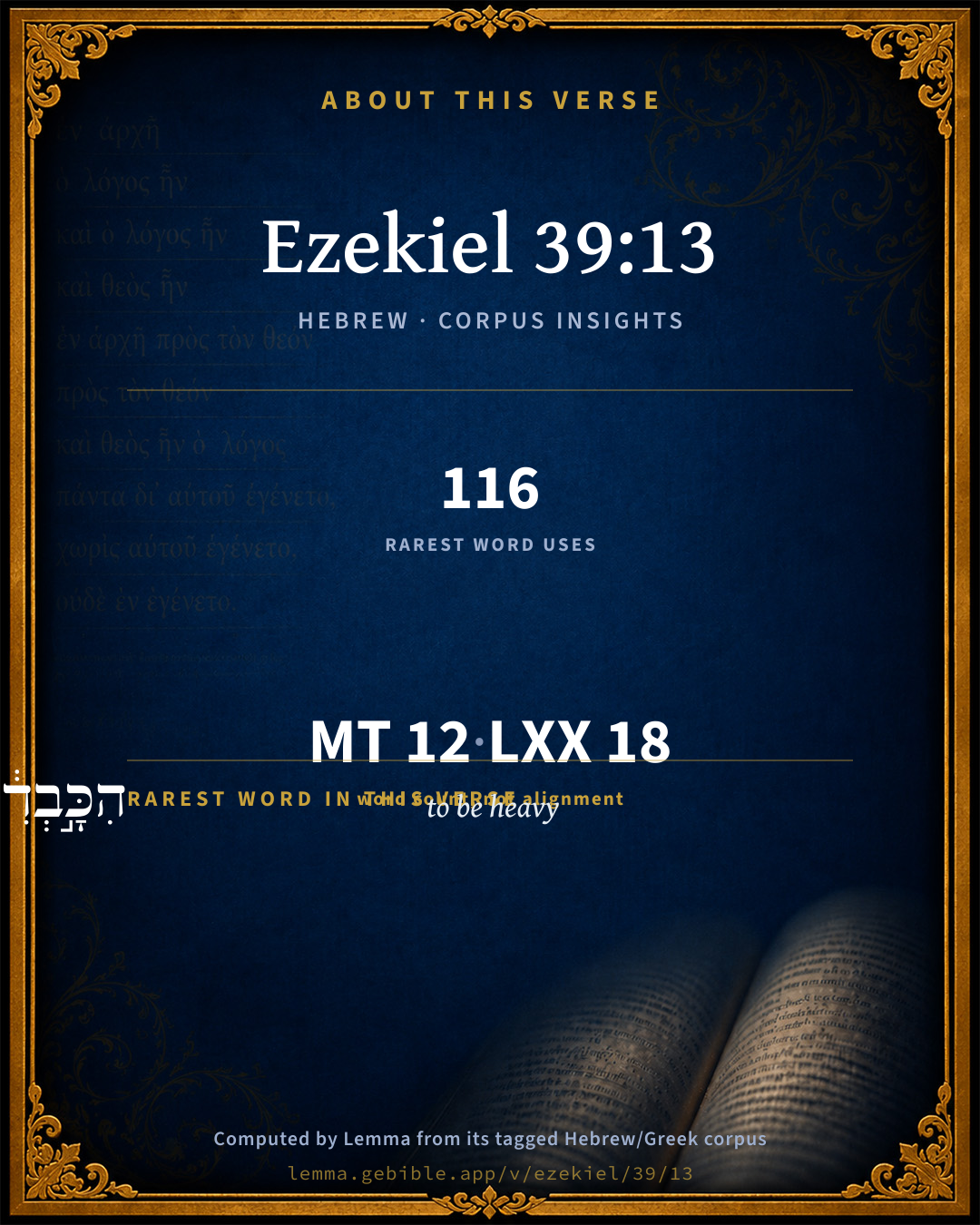
הִכָּ֣בְדִ֔י
kâbad
H3513
“to be heavy · me”
Verb, Niphal, Infinitive Construct + Suffix, Personal, 1st Person, Common, Singular
Part of Speech
Verb
Stem
Niphal
Form
Infinitive Construct
Full BDB Definition

Origin: a primitive root

TWOT: 943

to be heavy, be weighty, be grievous, be hard, be rich, be honourable, be glorious, be burdensome, be honoured - (Qal) - to be heavy - to be heavy, be insensible, be dull - to be honoured - (Niphal) - to be made heavy, be honoured, enjoy honour, be made abundant - to get oneself glory or honour, gain glory - (Piel) - to make heavy, make dull, make insensible - to make honourable, honour, glorify - (Pual) to be made honourable, be honoured - (Hiphil) - to make heavy - to make heavy, make dull, make unresponsive - to cause to be honoured - (Hithpael) - to make oneself heavy, make oneself dense, make oneself numerous - to honour oneself

  1. וְקָֽבְרוּ֙ qâbar H6912 “and · to bury” Conjunction + Verb, Qal, Sequential Perfect, 3rd Person, Common, Plural
  2. כָּל kôl H3605 “all of” Noun, Common, Masculine, Singular, Construct
  3. עַ֣ם ʻam H5971 “people of” Noun, Common, Masculine, Singular, Construct
  4. הָאָ֔רֶץ ʼerets H776 “the · land” Particle, Definite Article + Noun, Common, Both, Singular, Absolute
  5. וְהָיָ֥ה hâyâh H1961 “and · to be” Conjunction + Verb, Qal, Sequential Perfect, 3rd Person, Masculine, Singular
  6. לְשֵׁ֑ם shêm H8034 “to/for · name” Preposition + Noun, Common, Masculine, Singular, Absolute
  7. י֚וֹם yôwm H3117 “day of” Noun, Common, Masculine, Singular, Construct
  8. נְאֻ֖ם nᵉʼum H5002 “utterance of” Noun, Common, Masculine, Singular, Construct
  9. אֲדֹנָ֥י ʼĂdônây H136 “Lord · my” Noun, Common, Masculine, Plural, Construct + Suffix, Personal, 1st Person, Common, Singular
  10. יְהוִֽה Yᵉhôvih H3069 “LORD” Noun, Proper

About this verse

These counts appear in no published source. They are computed here, from the morphology-tagged text and Lemma’s own curated glosses. What Lemma adds →

12
words
11
distinct lemmas
Prophets
section

Grammatical profile

  • 3 verbs
  • 8 nouns
  • 1 preposition

Verb forms

  • וְקָֽבְרוּ֙ Qal · Sequential Perfect
  • וְהָיָ֥ה Qal · Sequential Perfect
  • הִכָּ֣בְדִ֔י Niphal · Infinitive Construct

Hebrew & Septuagint length

In English translation the verse runs 30 words from the Hebrew and 30 from the Septuagint (LXX English) — the same length.

A rough comparison of the two English renderings, which tokenize alike — not a word-level alignment.

Word counts can differ between the Hebrew and the Greek without any difference in meaning — e.g. the Hebrew direct-object marker אֵת has no separate Greek word, and Greek often adds the article ὁ.

In the original languages it is 12 Hebrew tokens and 18 Greek tokens — but the two are counted differently (Hebrew bundles its prefixes and suffixes into one token; the Greek is in lemma form), so that isn’t a like-for-like length.

Cross-references

8

Topical passages linked to Ezekiel 39:13 in the Treasury of Scripture Knowledge — connected by theme and wording, ordered by reader-vote popularity; previews shown in the World English Bible.

  • Ezekiel 28:22 and say, Thus says the Lord Yahweh: Behold, I am against you, Sidon; and I will be glorified in the midst of you; and they shall know that I am Yahweh, when I shall have executed judgments in her, and shall be sanctified in her.
  • Zephaniah 3:19–20 Behold, at that time I will deal with all those who afflict you, and I will save those who are lame, and gather those who were driven away. I will give them praise and honor, whose shame has been in all the earth.
  • Jeremiah 33:9 [This city] shall be to me for a name of joy, for a praise and for a glory, before all the nations of the earth, which shall hear all the good that I do to them, and shall fear and tremble for all the good and for all the peace that I procure to it.
  • Deuteronomy 26:19 and to make you high above all nations that he has made, in praise, and in name, and in honor; and that you may be a holy people to Yahweh your God, as he has spoken.
  • Psalms 126:2–3 Then our mouth was filled with laughter, And our tongue with singing. Then they said among the nations, "Yahweh has done great things for them."
  • Psalms 149:6–9 May the high praises of God be in their mouths, And a two-edged sword in their hand;
  • Ezekiel 39:21–22 I will set my glory among the nations; and all the nations shall see my judgment that I have executed, and my hand that I have laid on them.
  • 1 Peter 1:7 that the proof of your faith, which is more precious than gold that perishes even though it is tested by fire, may be found to result in praise, glory, and honor at the revelation of Jesus Christ--

Cross-references courtesy of OpenBible.info (CC BY 4.0).

Hebrew and Greek witnesses Masoretic Hebrew ↔ Greek Septuagint

The same verse in the two great witnesses to the Old Testament, shown verse-for-verse.

These are two independent witnesses, not word-aligned to each other, and the Septuagint is shown in lemma (dictionary) form.

Hebrew Ezekiel 39:13 Masoretic · Westminster Leningrad Codex

וְקָֽבְרוּ֙ כָּל עַ֣ם הָאָ֔רֶץ וְהָיָ֥ה לָהֶ֖ם לְשֵׁ֑ם י֚וֹם הִכָּ֣בְדִ֔י נְאֻ֖ם אֲדֹנָ֥י יְהוִֽה

Yes, all the people of the land shall bury them; and it shall be to them a renown in the day that I shall be glorified, says the Lord Yahweh.

World English Bible · Public Domain

Greek LXX Ezekiel 39:13 Septuagint · lemma form

καί καταὀρύσσω αὐτός πᾶς ὁ λαός ὁ γῆ καί εἰμί αὐτός εἰς ὀνομαστός ὅς ἡμέρα δοξάζω λέγω κύριος

Yes, all the people of the land shall bury them; and it shall be to them a place of renown in the day wherein it was glorified, says the Lord.

LXX2012 (modern English Septuagint) · Public Domain

Hebrew: Westminster Leningrad Codex (CC BY 4.0). Greek: Septuagint (public domain); English from LXX2012 (modern English Septuagint) (Public Domain). How the Septuagint differs from the Hebrew →

Targum (Aramaic paraphrase)

1

The Targum is the ancient Jewish Aramaic paraphrase of the Hebrew Scriptures — an interpretive translation, not the Hebrew text itself. Onkelos (literal) and Pseudo-Jonathan (expansive) render the Torah, and Jonathan the Prophets. Coverage is partial: where no permissively-licensed English translation exists for a verse, only the Aramaic is shown. This is verse-level text, not a word-by-word alignment to the Hebrew.

  1. Targum Jonathan Prophets (Joshua–Malachi)
    וְיִקְבְּרוּן כָּל עַמָא דְאַרְעָא וִיהֵי לְהוֹן לְשׁוּם יוֹם אִתְיַקְרוּתִי אֲמַר יְיָ אֱלֹהִים:

    (no public-domain English translation for this verse)

    Targum Jonathan — Aramaic: “Mikraot Gedolot” (public domain). English: “Sefaria Community Translation” (CC0 1.0 (public-domain dedication)); “London "Chaldee Paraphrase," 1871” (public domain). Text via Sefaria.

Commentary

Notes on Ezekiel 39:13 from classic Christian and Jewish commentators (each source and its license shown beneath its notes). The classic Christian expositions comment on the surrounding passage and are grouped to its opening verse, so a note may address several verses; the Jewish commentaries on the Tanakh (Rashi and others) are per-verse, so they appear only where the commentator wrote on this verse.

Lemma curates 59 commentaries, every one of them public domain or Creative Commons licensed, each selected and text-cleaned for this edition rather than reprinted as found. About our sources →

Trapp's Complete Commentary

John Trapp

Eze 39:13 Yea, all the people of the land shall bury [them]; and it shall be to them a renown the day that I shall be glorified, saith the Lord GOD.

Ver. 13. And it shall be to them a renown.] A monument or trophy of their triumph. When the Switzers, A.D. 1443, had vanquished the Thuricenses in battle, they banqueted in the place where they won the victory, using the dead bodies of their adversaries instead of stools and tables. {a}

{a} Lanquet Chron., p. 263.

John Trapp, A Commentary or Exposition upon All the Books of the Old and New Testament (1647–1656) — public domain. Text from a community e-Sword module.

Jamieson, Fausset & Brown

Robert Jamieson, A. R. Fausset & David Brown

I . . . glorified--in destroying the foe (Eze 28:22).

Jamieson, Fausset & Brown — Commentary Critical and Explanatory on the Whole Bible (1871) — public domain (CC PDM 1.0). Text via the HelloAO Bible API.

Ellicott's Commentary for English Readers

(13) All the people of the land.—“It would be but a very moderate allowance, on the literal supposition, to say that a million of men would be thus engaged, and that on an average each would consign to the tomb two corpses in one day; which, for the 180 working days of the seven months, would make an aggregate of 360,000,000 of corpses !” (Fairbairn.)

A Bible Commentary for English Readers, edited by Charles John Ellicott (1878–1897) — public domain. Text from a community e-Sword module.

The Cambridge Bible for Schools and Colleges

gen. ed. J. J. S. Perowne

13. a renown) Or, a glory (lit. a name), viz. that they have seen their last enemy destroyed by their God. The triumph is theirs, being his, Psa_149:9.

the day that … glorified] i.e. on the day (at the time) when I shall be glorified (or, glorify myself).

The Cambridge Bible for Schools and Colleges (gen. ed. J. J. S. Perowne; Cambridge University Press, 1878–1918) — public domain. Text from a community e-Sword module.

John Gill's Exposition

Yea, all the people of the land shall bury them,.... That is, a great number of the common people of the land of Israel, especially of those that dwell near the field of battle, shall be employed in burying the slain; and which they will be very ready to do, for the reasons above mentioned:

and it shall be to them a renown; or, "for a name" (g); they shall be commended for their humanity to their enemies, and shall be spoken of with honour, as being the peculiar people of God, whom he has so remarkably appeared for, protected, and defended:

the day that I shall be glorified, saith the Lord God; the day that will be renown to them will be to the glory of God; whose greatness, goodness, power, and wisdom, will be seen in saving his people, and destroying their enemies.

(g) "in nomen", Pagninus, Montanus, Piscator, Cocceius, Starckius.

John Gill's Exposition of the Whole Bible (1746–1763) — public domain (CC PDM 1.0). Text via the HelloAO Bible API.

Haydock's Catholic Bible Commentary

Day. It does not occur in the calendar. Yet Comestor and [Denis] the Carthusian mentions Cambysa, the day when Bethulia was delivered, Judith xvi. 31. The history of Judith may perhaps relate to the defeat of this prince. The embellishments will not injure the truth. The Jews immediately after his death recommence the building of the temple, (1 Esdras iv.; Aggeus i. 14.) which they are forced to discontinue, till Hystaspes confirmed the decree of Cyrus. This was the grand object of their desires, and therefore the day when Cambyses fell was ever memorable to them. (Calmet, Diss.) --- So will that be for Christians, when Antichrist shall be no more. (Menochius)

George Leo Haydock (1774–1849), Haydock's Catholic Family Bible and Commentary, 1859 edition — public domain. Excludes Psalms (Douay-Rheims chapter numbering differs from Protestant) and Deuterocanonical books (Catholic canon only).

Matthew Poole's English Annotations

All that dwell thereabout, or all that came out to resist and fight with this army.

It shall be to them, the house of Israel,

a renown; a commendation, matter of praise, that did, like men, bury the dead, who otherwise must have been all dung on the face of the earth, and the swelling hill rising from their buried bones shall be a monument to the praise of Israel’s courtesy. Or else thus, the day of my being glorified shall be a renown to Israel: as indeed it is an honour to be owned of God, so when God shows he owneth such, he gives them honour among all that observe it.

Glorified, in the deliverance of Israel, and in the destruction of Gog by my wonderful power, in my just zeal against mine enemies, and for my people.

Matthew Poole's English Annotations on the Holy Bible (1683–1685) — public domain. Text from a community e-Sword/MySword module.

John Wesley's Explanatory Notes

Glorified - The day of my being glorified shall be a renown to Israel.

John Wesley, Explanatory Notes Upon the Whole Bible (1754–1765) — public domain. Text via the GEBible commentary corpus.

Rashi

Rabbi Shlomo Yitzchaki (Rashi)

They will bury all the people of the land because they died there.

and they will be renowned All the nations will speak their name as praise and as a sign of kindness: “There are no nations as compassionate as this one; do you find a man who buries his enemy who rose up against him to kill him?”

Rashi on the Tanakh — English translations: “The Judaica Press complete Tanach with Rashi, translated by A. J. Rosenberg” (CC BY 4.0); “Pentateuch with Rashi's commentary by M. Rosenbaum and A.M. Silbermann, 1929-1934” (public domain); “The Metsudah Tanach series, Lakewood, N.J” (CC BY 4.0); and “The Book of Joshua, Metsudah Publications, 1997” (CC BY 4.0). Text via Sefaria.

Lesson kit

Teaching starters — assembled from the data on this page, not authored interpretation. Every prompt links to the verse data it draws on. Edit before teaching.

Ezekiel, in the Prophets, opens this verse with 12 words (11 distinct Hebrew lemmas). Its most distinctive word is kâbad (“to be heavy”). A historical commentator’s framing appears above. Read the whole chapter for the surrounding context.

Discussion questions

  1. How does “to be heavy” (kâbad) shape what this verse is saying?
  2. How does Ezekiel 28:22, which shares this passage’s theme, read alongside this verse?
  3. These translations render this verse differently. What is at stake in choosing one wording over another?
  4. «וְקָֽבְרוּ֙» is a Qal Sequential Perfect verb. How does that grammatical form shape the action described?
  5. Compare how Trapp's Complete Commentary and Jamieson, Fausset & Brown read this verse. Where do they agree or differ?

Things to notice

Reading settings

Reading text

Shown beneath each verse's original-language words.

Old Testament
Old Testament edition

Read the OT as the Masoretic Hebrew (MT) or the Greek Septuagint (LXX).

English shown for the Greek Septuagint (in the Hebrew ↔ Greek comparison).

Comparing translations? Open the Compare panel on any verse page to stack up to four side by side.