Judges 8:32

Hebrew (Westminster Leningrad Codex) Judges 8:32 appears in the Hebrew Old Testament. The text above is from the Westminster Leningrad Codex. Each word links to its Strong’s number, a concise gloss, and parsing drawn from the Open Scriptures Hebrew Bible morphology. Click any word for its full Brown-Driver-Briggs (BDB) entry.
Download image
Cite this verse

Judges 8:32 (World English Bible). Public Domain. Lemma interlinear Bible study tool, https://lemma.gebible.app/v/judges/8/32.

Show BibTeX & RIS
BibTeX
RIS
English Translation
Gideon the son of Joash died in a good old age, and was buried in the tomb of Joash his father, in Ophrah of the Abiezrites.
World English Bible · Public Domain
Download a study sheet

One document with this verse’s original text, its word-by-word gloss line, the meaning frame, cross-references with their text, attributed commentary, and full source and license credits — printable, and it pastes into notes with its structure intact.

This verse Autodidact and up

Study sheet (.html) Plain text (.txt)

A passage Seminary Student

Up to 50 verses in one chapter. A passage sheet keeps up to 6 commentary sources and 12 cross-references per verse, in the order this page ranks them, and says so on the sheet whenever that leaves anything out. Ask for a single verse and you get the Autodidact verse sheet above.

Everything on this page stays free to read, with no account — the sheet is a download of what is already on screen, not access to it.

Want to remove ads? Support Godless Engineer
Compare translations 3

The same verse in 3 English versions, stacked beneath the original-language interlinear above. Click any original word for its lexicon entry.

Each is an independent rendering of the whole verse — the interlinear is not word-aligned to these translations.

Highlighted words mark where these versions differ — a whole-verse word diff, not a word-by-word alignment.

  • World English Bible Public Domain
    Gideon the son of Joash died in a good old age, and was buried in the tomb of Joash his father, in Ophrah of the Abiezrites.
  • King James Version Public Domain
    And Gideon the son of Joash died in a good old age, and was buried in the sepulchre of Joash his father, in Ophrah of the Abiezrites.
  • unfoldingWord Literal Text CC BY-SA 4.0
    And Gideon, the son of Joash, died in good old age, and he was buried in the tomb of Joash his father at Ophrah of the Abiezerite.

unfoldingWord Literal Text — © unfoldingWord, licensed CC BY-SA 4.0. Word-aligned USFM3 via Door43 (git.door43.org/unfoldingWord/en_ult).

Versions to compare (up to 4)

3 of 4 selected

Show all 18 translations

Every available English version of this verse, each an independent rendering of the whole verse.

  • World English Bible Public Domain
    Gideon the son of Joash died in a good old age, and was buried in the tomb of Joash his father, in Ophrah of the Abiezrites.
  • Berean Standard Bible Public Domain
    Later, Gideon son of Joash died at a ripe old age and was buried in the tomb of his father Joash in Ophrah of the Abiezrites.
  • Majority Standard Bible Public Domain
    Later, Gideon son of Joash died at a ripe old age and was buried in the tomb of his father Joash in Ophrah of the Abiezrites.
  • King James Version Public Domain
    And Gideon the son of Joash died in a good old age, and was buried in the sepulchre of Joash his father, in Ophrah of the Abiezrites.
  • American Standard Version (1901) Public Domain
    And Gideon the son of Joash died in a good old age, and was buried in the sepulchre of Joash his father, in Ophrah of the Abiezrites.
  • Revised Version (1885) Public Domain
    And Gideon the son of Joash died in a good old age, and was buried in the sepulchre of Joash his father, in Ophrah of the Abiezrites.
  • Geneva Bible (1599) Public Domain
    So Gideon the sonne of Ioash dyed in a good age, and was buried in the sepulchre of Ioash his father in Ophrah, of the father of ye Ezrites.
  • Douay-Rheims (1899) Public Domain
    And Gedeon the son of Joas died in a good old age, and was buried in the sepulchre of his father in Ephra of the family of Ezri.
  • Young's Literal Translation Public Domain
    And Gideon son of Joash dieth, in a good old age, and is buried in the burying-place of Joash his father, in Ophrah of the Abi-Ezrite.
  • Literal Standard Version CC BY-SA 4.0
    And Gideon son of Joash dies, in a good old age, and is buried in the burying-place of his father Joash, in Ophrah of the Abi-Ezrite.
  • Unlocked Literal Bible CC BY-SA 4.0
    Gideon, son of Joash, died at a good old age and was buried in the tomb of Joash his father, at Ophrah of the clan of Abiezer.
  • unfoldingWord Literal Text CC BY-SA 4.0
    And Gideon, the son of Joash, died in good old age, and he was buried in the tomb of Joash his father at Ophrah of the Abiezerite.
  • Darby Bible Public Domain
    And Gideon the son of Jo'ash died in a good old age, and was buried in the tomb of Jo'ash his father, at Ophrah of the Abiez'rites.
  • World Messianic Bible Public Domain
    Gideon the son of Joash died in a good old age, and was buried in the tomb of Joash his father, in Ophrah of the Abiezrites.
  • Webster's Bible Public Domain
    And Gideon the son of Joash died in a good old age, and was buried in the sepulcher of Joash his father, in Ophrah of the Abi-ezrites.
  • Free Bible Version CC BY-SA 4.0
    Gideon, son of Joash, died at a good old age and was buried in the tomb of his father Joash, in Ophrah of the Abiezrites.
  • Bible in Basic English Public Domain
    And Gideon, the son of Joash, came to his end when he was very old, and his body was put in the resting-place of Joash his father, in Ophrah of the Abiezrites.
  • JPS Tanakh (1917) Public Domain
    And Gideon the son of Joash died in a good old age, and was buried in the sepulchre of Joash his father, in Ophrah of the Abiezrites.

Literal Standard Version (2020), Covenant Press — licensed CC BY-SA 4.0. Text via the HelloAO Bible API (eBible.org). Unlocked Literal Bible (unfoldingWord) — licensed CC BY-SA 4.0. Text via the HelloAO Bible API (eBible.org). unfoldingWord Literal Text — © unfoldingWord, licensed CC BY-SA 4.0. Word-aligned USFM3 via Door43 (git.door43.org/unfoldingWord/en_ult). Free Bible Version, Dr. Jonathan Gallagher — licensed CC BY-SA 4.0. Text via the HelloAO Bible API (eBible.org).

Word by word

More ways to search: Search by grammar → Find every occurrence → Compare this word →

Practice this passage: Drill this verse → Learn its vocabulary →

אֲבִ֥י
ʼĂbîy hâ-ʻEzrîy
H33
“Abiezrite”
Noun, Proper
Part of Speech
Noun
Type
Proper
Full BDB Definition

Origin: from H44 with the article inserted

TWOT: None

Abiezrite = "my father is help" - one of the family of Abiezer, a descendant of Joseph's son, Manasseh
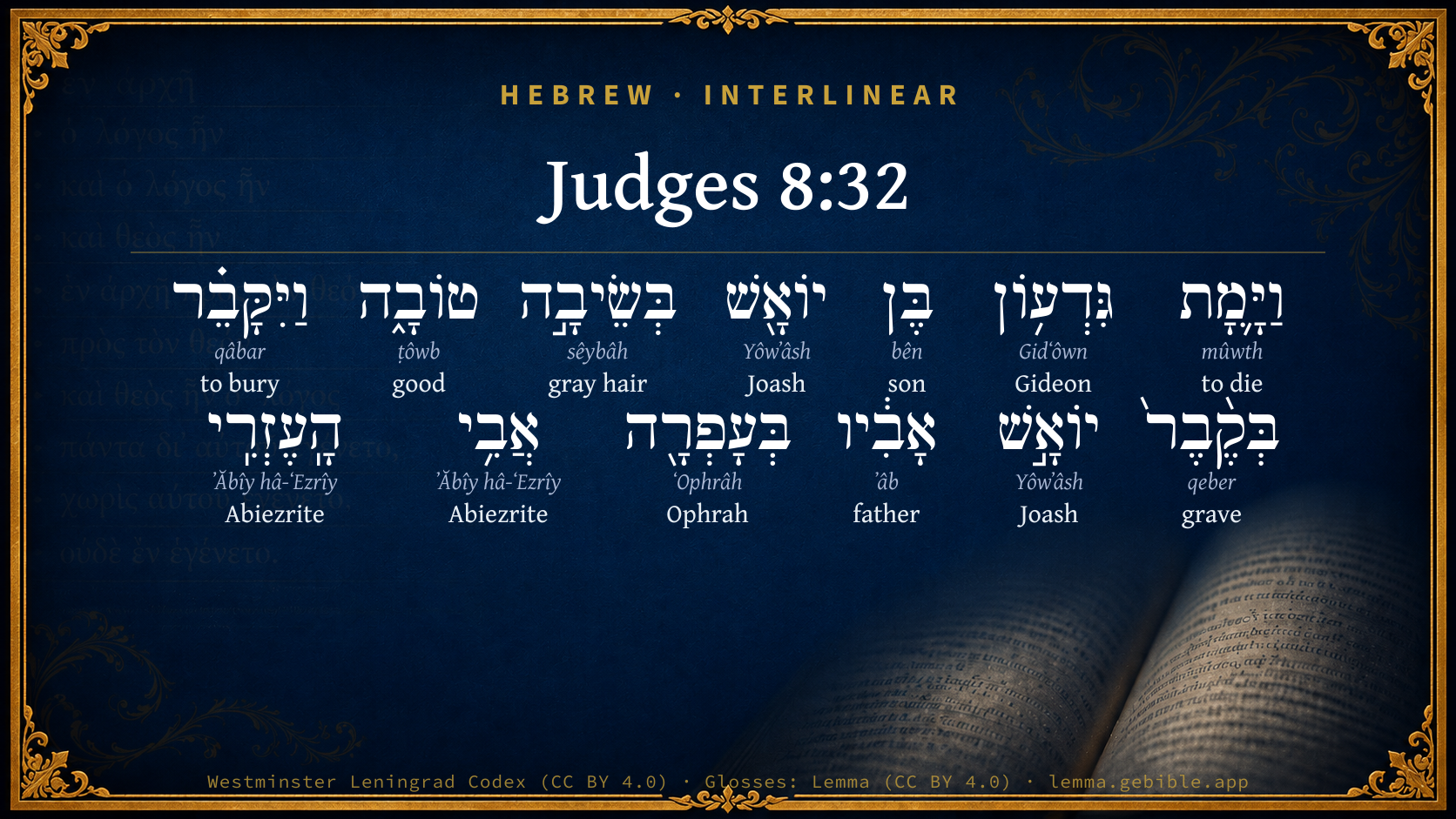
  1. וַיָּ֛מָת mûwth H4191 “and · to die” Conjunction + Verb, Qal, Sequential Imperfect, 3rd Person, Masculine, Singular
  2. גִּדְע֥וֹן Gidʻôwn H1439 “Gideon” Noun, Proper
  3. בֶּן bên H1121 “son of” Noun, Common, Masculine, Singular, Construct
  4. יוֹאָ֖שׁ Yôwʼâsh H3101 “Joash” Noun, Proper
  5. בְּשֵׂיבָ֣ה sêybâh H7872 “in/at · gray hair” Preposition + Noun, Common, Feminine, Singular, Absolute
  6. טוֹבָ֑ה ṭôwb H2896 “good” Adjective, Adjective, Feminine, Singular, Absolute
  7. וַיִּקָּבֵ֗ר qâbar H6912 “and · to bury” Conjunction + Verb, Niphal, Sequential Imperfect, 3rd Person, Masculine, Singular
  8. בְּקֶ֨בֶר֙ qeber H6913 “in/at · grave of” Preposition + Noun, Common, Masculine, Singular, Construct
  9. יוֹאָ֣שׁ Yôwʼâsh H3101 “Joash” Noun, Proper
  10. אָבִ֔יו ʼâb H1 “father · his” Noun, Common, Masculine, Singular, Construct + Suffix, Personal, 3rd Person, Masculine, Singular
  11. בְּעָפְרָ֖ה ʻOphrâh H6084 “in/at · Ophrah” Preposition + Noun, Proper
  12. הָֽעֶזְרִֽי ʼĂbîy hâ-ʻEzrîy H33 “Abiezrite” Noun, Proper

About this verse

These counts appear in no published source. They are computed here, from the morphology-tagged text and Lemma’s own curated glosses. What Lemma adds →

13
words
11
distinct lemmas
Historical
section

Notable vocabulary

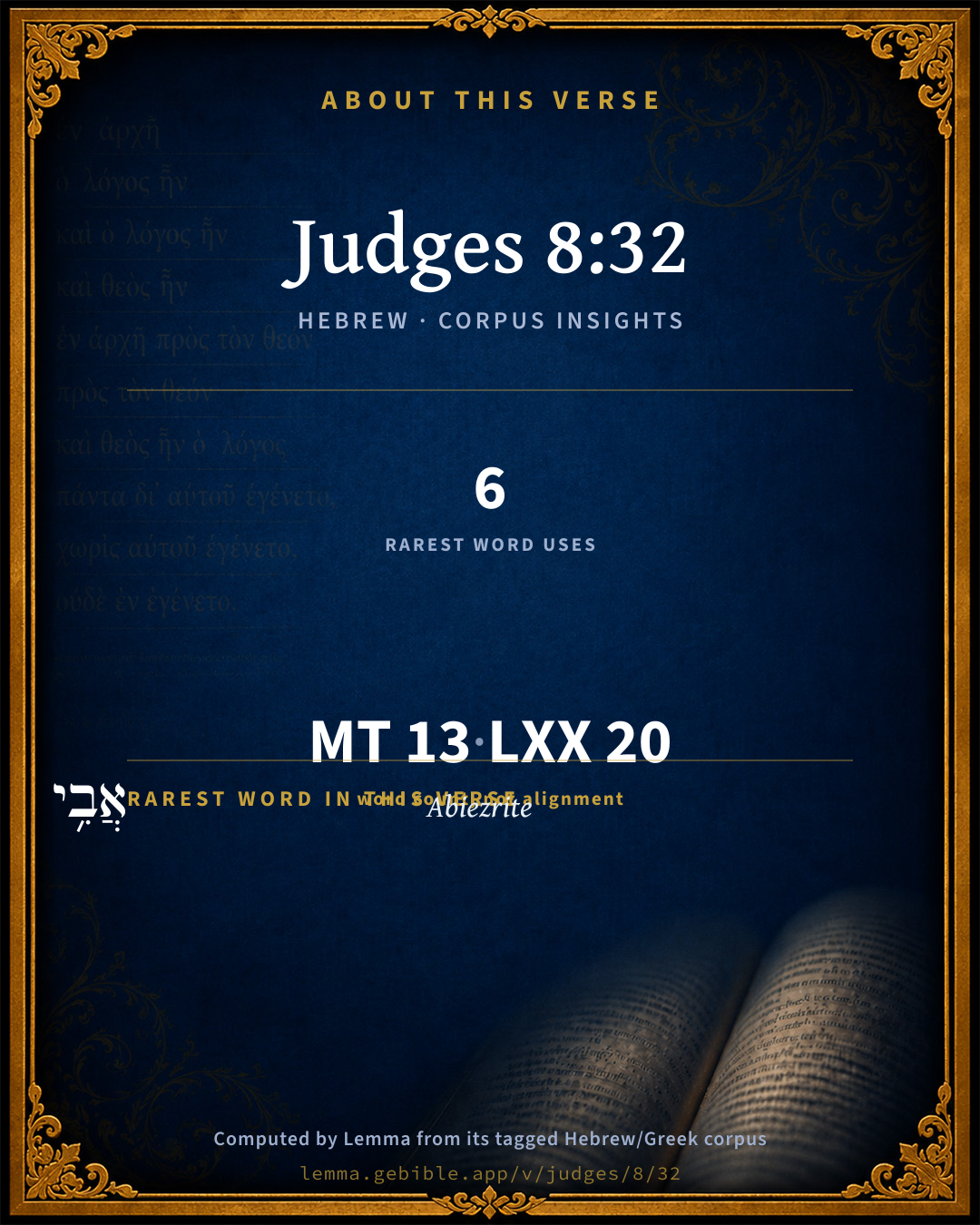
The rarest word here is אֲבִ֥י Abiezrite H33 — appearing just 6 times in the whole Hebrew Bible.

Shared distinctive vocabulary

אֲבִ֥י Abiezrite H33 occurs in 3 verses of the Hebrew Bible. Also found in:

Grammatical profile

  • 2 verbs
  • 10 nouns
  • 1 adjective

Verb forms

  • וַיָּ֛מָת Qal · Sequential Imperfect
  • וַיִּקָּבֵ֗ר Niphal · Sequential Imperfect

Repetition

Words recur within this verse — often emphatic in Hebrew:

  • יוֹאָ֖שׁ Joash H3101 ×2
  • אֲבִ֥י Abiezrite H33 ×2

Hebrew & Septuagint length

In English translation the verse runs 26 words from the Hebrew and 24 from the Septuagint (LXX English) — closely comparable.

A rough comparison of the two English renderings, which tokenize alike — not a word-level alignment.

Word counts can differ between the Hebrew and the Greek without any difference in meaning — e.g. the Hebrew direct-object marker אֵת has no separate Greek word, and Greek often adds the article ὁ.

In the original languages it is 13 Hebrew tokens and 20 Greek tokens — but the two are counted differently (Hebrew bundles its prefixes and suffixes into one token; the Greek is in lemma form), so that isn’t a like-for-like length.

Cross-references

7

Topical passages linked to Judges 8:32 in the Treasury of Scripture Knowledge — connected by theme and wording, ordered by reader-vote popularity; previews shown in the World English Bible.

  • Genesis 25:8 Abraham gave up the spirit, and died in a good old age, an old man, and full of years, and was gathered to his people.
  • Genesis 15:15 But you will go to your fathers in peace. You will be buried in a good old age.
  • Judges 6:24 Then Gideon built an altar there to Yahweh, and called it Yahweh-shalom: to this day it is yet in Ophrah of the Abiezrites.
  • Job 5:26 You shall come to your grave in a full age, Like a shock of grain comes in its season.
  • Job 42:17 So Job died, being old and full of days.
  • Joshua 24:29–30 It happened after these things, that Joshua the son of Nun, the servant of Yahweh, died, being one hundred ten years old.
  • Judges 8:27 Gideon made an ephod of it, and put it in his city, even in Ophrah: and all Israel played the prostitute after it there; and it became a snare to Gideon, and to his house.

Cross-references courtesy of OpenBible.info (CC BY 4.0).

Hebrew and Greek witnesses Masoretic Hebrew ↔ Greek Septuagint

The same verse in the two great witnesses to the Old Testament, shown verse-for-verse.

These are two independent witnesses, not word-aligned to each other, and the Septuagint is shown in lemma (dictionary) form.

Hebrew Judges 8:32 Masoretic · Westminster Leningrad Codex

וַיָּ֛מָת גִּדְע֥וֹן בֶּן יוֹאָ֖שׁ בְּשֵׂיבָ֣ה טוֹבָ֑ה וַיִּקָּבֵ֗ר בְּקֶ֨בֶר֙ יוֹאָ֣שׁ אָבִ֔יו בְּעָפְרָ֖ה אֲבִ֥י הָֽעֶזְרִֽי

Gideon the son of Joash died in a good old age, and was buried in the tomb of Joash his father, in Ophrah of the Abiezrites.

World English Bible · Public Domain

Greek LXX Judges 8:32 Septuagint · lemma form

καί ἀποθνήσκω γεδεων υἱός ιωας ἐν πόλις αὐτός καί θάπτω ἐν ὁ τάφος ιωας ὁ πατήρ αὐτός ἐν εφραθα αβιεσδρι

And Gedeon son of Joas died in his city, and he was buried in the sepulchre of Joas his father in Ephratha of Abi-Esdri.

LXX2012 (modern English Septuagint) · Public Domain

On this verse, John Gill's Exposition discusses the Septuagint’s reading. Read the note in Commentary ↓

Hebrew: Westminster Leningrad Codex (CC BY 4.0). Greek: Septuagint (public domain); English from LXX2012 (modern English Septuagint) (Public Domain). How the Septuagint differs from the Hebrew →

Targum (Aramaic paraphrase)

1

The Targum is the ancient Jewish Aramaic paraphrase of the Hebrew Scriptures — an interpretive translation, not the Hebrew text itself. Onkelos (literal) and Pseudo-Jonathan (expansive) render the Torah, and Jonathan the Prophets. Coverage is partial: where no permissively-licensed English translation exists for a verse, only the Aramaic is shown. This is verse-level text, not a word-by-word alignment to the Hebrew.

  1. Targum Jonathan Prophets (Joshua–Malachi)
    וּמִית גִדְעוֹן בַּר יוֹאָשׁ בְּסֵיבוּ טָבָא וְאִתְקְבַר בְּקִבְרָא דְיוֹאָשׁ אֲבוּהִי בְּעָפְרָה דַאֲבוּהִי דְעָזֶר:

    (no public-domain English translation for this verse)

    Targum Jonathan — Aramaic: “Mikraot Gedolot” (public domain). English: “Sefaria Community Translation” (CC0 1.0 (public-domain dedication)); “London "Chaldee Paraphrase," 1871” (public domain). Text via Sefaria.

Commentary

Notes on Judges 8:32 from classic Christian and Jewish commentators (each source and its license shown beneath its notes). The classic Christian expositions comment on the surrounding passage and are grouped to its opening verse, so a note may address several verses; the Jewish commentaries on the Tanakh (Rashi and others) are per-verse, so they appear only where the commentator wrote on this verse.

Lemma curates 59 commentaries, every one of them public domain or Creative Commons licensed, each selected and text-cleaned for this edition rather than reprinted as found. About our sources →

Trapp's Complete Commentary

John Trapp

Jdg 8:32 And Gideon the son of Joash died in a good old age, and was buried in the sepulchre of Joash his father, in Ophrah of the Abiezrites.

Ver. 32. In a good old age.] Heb., With a good hoar head, notwithstanding his last evil act which God overlooked, though it were some spot to his white head.

John Trapp, A Commentary or Exposition upon All the Books of the Old and New Testament (1647–1656) — public domain. Text from a community e-Sword module.

Geneva Bible (1599)

Geneva Bible translators

Which city belonged to the family of the Abiezrites.

Geneva Bible (1599) marginal notes — public domain. Text via Bolls.life.

Adam Clarke's Commentary

Verse 32. Gideon - died in a good old age] Supposed to have been A.M. 2799; B.C. 1205.

Adam Clarke's Commentary on the Bible (1810–1826) — public domain. Text from a community e-Sword/MySword module.

Ellicott's Commentary for English Readers

(32) And Gideon . . . died.—Gideon died in peace and prosperity (Gen_15:15; Gen_49:29, &c), in a good old age (Job_5:26), but the evil seed which he had sown bore bitter fruit in the next generation.

A Bible Commentary for English Readers, edited by Charles John Ellicott (1878–1897) — public domain. Text from a community e-Sword module.

The Cambridge Bible for Schools and Colleges

gen. ed. J. J. S. Perowne

32. in a good old age] Again in Gen_15:15 JE, Gen_25:8 P, 1Ch_29:28.

Jdg_8:33-35 originally followed Jdg_8:28, according to the usual scheme. These verses are made up of the customary phrases of the Dtc. editor, with the addition of particulars derived from ch. 9; cf. Jdg_2:14; Jdg_2:18 f., Jdg_3:7; Jdg_3:12, Jdg_4:1, Jdg_6:9 and Jdg_9:4; Jdg_9:16; Jdg_9:19. Most probably, then, these verses were intended to form not an introduction to ch. 9, but a substitute for it. Ch. 9 did not fit into Rd’s scheme, so he laid it aside, and wrote Jdg_8:33-35 to take its place. A later editor, however, thought fit to incorporate the discarded chapter, and by way of an introduction he wrote Jdg_8:30-32, which, as noticed above, contain several expressions found elsewhere in writings later than the Dtc. age. Budde was the first to propose this explanation, and it has been generally accepted; Richt. u. Sam. (1890), p. 119 ff.

The Cambridge Bible for Schools and Colleges (gen. ed. J. J. S. Perowne; Cambridge University Press, 1878–1918) — public domain. Text from a community e-Sword module.

John Gill's Exposition

And it came to pass, as soon as Gideon was dead, that the children of Israel turned again,.... from God, and the pure worship of him, to idolatry:

and went a whoring after Baalim; the gods of the Phoenicians and Canaanites, the several Baals of other nations, the lords many which they served; these they committed spiritual whoredom with; that is, idolatry: particularly

and made Baalberith their god; which was the idol of the Shechemites, as appears from a temple being built at Shechem for it, Jdg 9:4 and had its name either from Berytus, a city of Phoenicia, of which Mela (n) and Pliny (o) make mention, and where this Baal might be first worshipped; it was fifty miles from Sidon, and was in later times a seat of learning (p); of this city was Sanchoniatho, a Phoenician historian, who is said to receive many things he writes about the Jews from Jerombalus, supposed to be Jerubbaal, or Gideon; See Gill on Jdg 6:32 and who tells (q) us, that Cronus or Ham gave this city to Neptune and the Cabiri, and who also relates (r) that Beruth is the name of a Phoenician deity. Though it may be rather this idol had its name from its supposed concern in covenants, the word "Berith" signifying a covenant; and so the Targum and Syriac version call him the lord of covenant; and the Septuagint and Vulgate Latin versions are,"and they made a covenant with Baal, that he should be their god;''as if he had his name from hence; though rather from his presiding over covenants, as Janus is said (s) to do, and from his avenging the breach of them, and rewarding those that kept them; the same with Jupiter Fidius Ultor, and Sponsor (t) with the Romans, and Horcius (u) with the Greeks.

(n) De Situ Orbis, l. 1. c. 12. (o) Nat. Hist. l. 5. c. 20. (p) Eunapius in Vita Proaeresii, p. 117. (q) Apud Euseb. Evangel. Praepar. l. 1. p. 38. (r) Apud Euseb. Evangel. Praepar. l. 1. p. 36. (s) Servius in Virgil. Aeneid. l. 12. "Latonaeque genus", &c. Vid. Liv. Hist. l. 8. c. 5, 6. (t) Vid. Kipping. Antiqu. Roman. l. 1. c. 1. p. 48. (u) Pausan. Eliac. 1. sive. l. 5. p. 336. Sophocles in Philoctete, prope finem.

John Gill's Exposition of the Whole Bible (1746–1763) — public domain (CC PDM 1.0). Text via the HelloAO Bible API.

Haydock's Catholic Bible Commentary

Good. He left an excellent reputation, and died in God’s friendship. (Menochius)

George Leo Haydock (1774–1849), Haydock's Catholic Family Bible and Commentary, 1859 edition — public domain. Excludes Psalms (Douay-Rheims chapter numbering differs from Protestant) and Deuterocanonical books (Catholic canon only).

Matthew Poole's English Annotations

In a good old age; his long life being crowned with the continuance of his honour, tranquility, and happiness.

Matthew Poole's English Annotations on the Holy Bible (1683–1685) — public domain. Text from a community e-Sword/MySword module.

John Wesley's Explanatory Notes

A good old age - His long life being crowned with the continuance of honour, tranquility, and happiness.

John Wesley, Explanatory Notes Upon the Whole Bible (1754–1765) — public domain. Text via the GEBible commentary corpus.

unfoldingWord translationNotes

Door43 World Missions Community

a good old age

This is an idiom. AT: "when he was very old" (See: Idiom)

was buried

This can be stated in active form. AT: "they buried him" (See: Active or Passive)

Ophrah

Translate the name of this city as you did in Judges 6:11.

the clan of Abiezer

Translate the name of this people group as you did in Judges 6:11.

It came about

This phrase is used here to mark the beginning of a new part of the story. If your language has a way for doing this, you could consider using it here.

turned again

The people rejecting Yahweh is spoken of as if they physically turned away from him. AT: "they stopped worshiping Yahwheh" (See: Metaphor)

prostituted themselves by worshiping the Baals

This speaks of worshiping false gods as if it were prostitution. AT: "they sinned against Yahweh by worshiping the Baals" (See: Metaphor)

Baal-Berith

This is the name of a false god. (See: How to Translate Names)

translationWords

Gideon

Joash

die

grave

Israel

turn

prostitute

worship

Baal

false god

unfoldingWord translationNotes — © Distant Shores Media and the Door43 World Missions Community, licensed CC BY-SA 4.0. Source: git.door43.org/Door43/en_tn.

Lesson kit

Teaching starters — assembled from the data on this page, not authored interpretation. Every prompt links to the verse data it draws on. Edit before teaching.

Judges, in the Historical, opens this verse with 13 words (11 distinct Hebrew lemmas). Its most distinctive word is ʼĂbîy hâ-ʻEzrîy (“Abiezrite”). A historical commentator’s framing appears above. Read the whole chapter for the surrounding context.

Discussion questions

  1. How does “Abiezrite” (ʼĂbîy hâ-ʻEzrîy) shape what this verse is saying?
  2. How does Judges 6:11, which shares the word «Abiezrite», read alongside this verse?
  3. What does the repetition of “Joash” (2× in this one verse) do in this verse?
  4. The translations on this page render this verse differently — a whole-verse word diff, not a word-by-word alignment. What might account for the different wordings?
  5. «וַיָּ֛מָת» is a Qal Sequential Imperfect verb. How does that grammatical form shape the action described?
  6. Compare how Trapp's Complete Commentary and Geneva Bible (1599) read this verse. Where do they agree or differ?

Things to notice

Reading settings

Reading text

Shown beneath each verse's original-language words.

Old Testament
Old Testament edition

Read the OT as the Masoretic Hebrew (MT) or the Greek Septuagint (LXX).

English shown for the Greek Septuagint (in the Hebrew ↔ Greek comparison).

Comparing translations? Open the Compare panel on any verse page to stack up to four side by side.