
Jeremiah 16:6

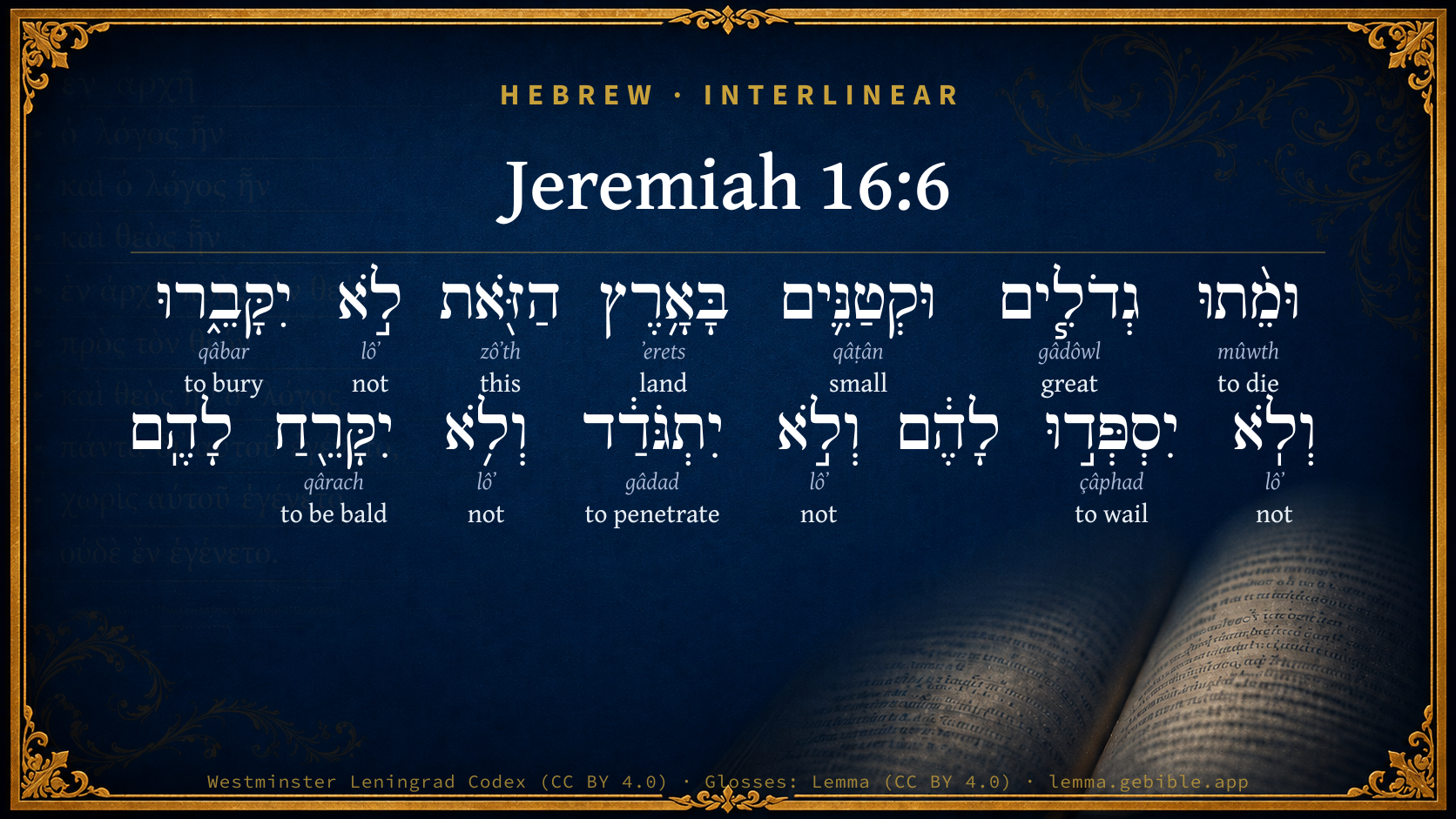
Hebrew (Westminster Leningrad Codex) Jeremiah 16:6 appears in the Hebrew Old Testament. The text above is from the Westminster Leningrad Codex. Each word links to its Strong’s number, a concise gloss, and parsing drawn from the Open Scriptures Hebrew Bible morphology. Click any word for its full Brown-Driver-Briggs (BDB) entry.
Download image
Cite this verse

Jeremiah 16:6 (World English Bible). Public Domain. Lemma interlinear Bible study tool, https://lemma.gebible.app/v/jeremiah/16/6.

Show BibTeX & RIS
BibTeX
RIS
English Translation
Both great and small shall die in this land; they shall not be buried, neither shall men lament for them, nor cut themselves, nor make themselves bald for them;
World English Bible · Public Domain
Download a study sheet

One document with this verse’s original text, its word-by-word gloss line, the meaning frame, cross-references with their text, attributed commentary, and full source and license credits — printable, and it pastes into notes with its structure intact.

This verse Autodidact and up

Study sheet (.html) Plain text (.txt)

A passage Seminary Student

Up to 50 verses in one chapter. A passage sheet keeps up to 6 commentary sources and 12 cross-references per verse, in the order this page ranks them, and says so on the sheet whenever that leaves anything out. Ask for a single verse and you get the Autodidact verse sheet above.

Everything on this page stays free to read, with no account — the sheet is a download of what is already on screen, not access to it.

Want to remove ads? Support Godless Engineer
Compare translations 3

The same verse in 3 English versions, stacked beneath the original-language interlinear above. Click any original word for its lexicon entry.

Each is an independent rendering of the whole verse — the interlinear is not word-aligned to these translations.

Highlighted words mark where these versions differ — a whole-verse word diff, not a word-by-word alignment.

  • World English Bible Public Domain
    Both great and small shall die in this land; they shall not be buried, neither shall men lament for them, nor cut themselves, nor make themselves bald for them;
  • King James Version Public Domain
    Both the great and the small shall die in this land: they shall not be buried, neither shall men lament for them, nor cut themselves, nor make themselves bald for them:
  • unfoldingWord Literal Text CC BY-SA 4.0
    And great and small shall die in this land. They shall not be buried, and they shall not lament for them and he shall not cut himself and he shall not be bald for them.

unfoldingWord Literal Text — © unfoldingWord, licensed CC BY-SA 4.0. Word-aligned USFM3 via Door43 (git.door43.org/unfoldingWord/en_ult).

Versions to compare (up to 4)

3 of 4 selected

Show all 18 translations

Every available English version of this verse, each an independent rendering of the whole verse.

  • World English Bible Public Domain
    Both great and small shall die in this land; they shall not be buried, neither shall men lament for them, nor cut themselves, nor make themselves bald for them;
  • Berean Standard Bible Public Domain
    “Both great and small will die in this land. They will not be buried or mourned, nor will anyone cut himself or shave his head for them.
  • Majority Standard Bible Public Domain
    “Both great and small will die in this land. They will not be buried or mourned, nor will anyone cut himself or shave his head for them.
  • King James Version Public Domain
    Both the great and the small shall die in this land: they shall not be buried, neither shall men lament for them, nor cut themselves, nor make themselves bald for them:
  • American Standard Version (1901) Public Domain
    Both great and small shall die in this land; they shall not be buried, neither shall men lament for them, nor cut themselves, nor make themselves bald for them;
  • Revised Version (1885) Public Domain
    Both great and small shall die in this land: they shall not be buried, neither shall men lament for them, nor cut themselves, nor make themselves bald for them:
  • Geneva Bible (1599) Public Domain
    Both the great, and the small shall die in this land: they shall not be buried, neither shall men lament for them nor cut themselues, nor make themselues balde for them.
  • Douay-Rheims (1899) Public Domain
    Both the great and the little shall die in the land: they shall not be buried nor lamented, and men shall not cut themselves, nor make themselves bald for them.
  • Young's Literal Translation Public Domain
    And died have great and small in this land, They are not buried, and none lament for them, Nor doth any cut himself, nor become bald for them.
  • Literal Standard Version CC BY-SA 4.0
    And great and small have died in this land, || They are not buried, and none lament for them, || Nor does any cut himself, nor become bald for them.
  • Unlocked Literal Bible CC BY-SA 4.0
    Both the great and the small will die in this land. They will not be buried, and no one will mourn for them or cut themselves or shave their heads for them.
  • unfoldingWord Literal Text CC BY-SA 4.0
    And great and small shall die in this land. They shall not be buried, and they shall not lament for them and he shall not cut himself and he shall not be bald for them.
  • Darby Bible Public Domain
    Both great and small shall die in this land: they shall not be buried; and none shall lament for them, or cut themselves, nor make themselves bald for them.
  • World Messianic Bible Public Domain
    Both great and small will die in this land. They will not be buried. Men won’t lament for them, cut themselves, or make themselves bald for them.
  • Webster's Bible Public Domain
    Both the great and the small shall die in this land: they shall not be buried, neither shall men lament for them, nor cut themselves, nor make themselves bald for them:
  • Free Bible Version CC BY-SA 4.0
    Everyone, from the most important to the least, will die in this country. They will not be buried or mourned; there will be no rites for the dead such as cutting oneself or shaving of heads.
  • Bible in Basic English Public Domain
    Death will overtake great as well as small in the land: their bodies will not be put in a resting-place, and no one will be weeping for them or wounding themselves or cutting off their hair for them:
  • JPS Tanakh (1917) Public Domain
    Both the great and the small shall die in this land; they shall not be buried; neither shall men lament for them, nor cut themselves, nor make themselves bald for them;

Literal Standard Version (2020), Covenant Press — licensed CC BY-SA 4.0. Text via the HelloAO Bible API (eBible.org). Unlocked Literal Bible (unfoldingWord) — licensed CC BY-SA 4.0. Text via the HelloAO Bible API (eBible.org). unfoldingWord Literal Text — © unfoldingWord, licensed CC BY-SA 4.0. Word-aligned USFM3 via Door43 (git.door43.org/unfoldingWord/en_ult). Free Bible Version, Dr. Jonathan Gallagher — licensed CC BY-SA 4.0. Text via the HelloAO Bible API (eBible.org).

Word by word

More ways to search: Search by grammar → Find every occurrence → Compare this word →

Practice this passage: Drill this verse → Learn its vocabulary →

יִקָּרֵ֖חַ
qârach
H7139
“to be bald”
Verb, Niphal, Imperfect, 3rd Person, Masculine, Singular
Part of Speech
Verb
Stem
Niphal
Form
Imperfect
Person
3rd Person
Gender
Masculine
Number
Singular
Full BDB Definition

Origin: a primitive root

TWOT: 2069

to be bald, make bald - (Qal) to make bald, make a baldness - (Niphal) to make oneself bald - (Hiphil) to make oneself bald - (Hophal) to make bald
  1. וּמֵ֨תוּ mûwth H4191 “and · to die” Conjunction + Verb, Qal, Sequential Perfect, 3rd Person, Common, Plural
  2. גְדֹלִ֧ים gâdôwl H1419 “great” Adjective, Adjective, Masculine, Plural, Absolute
  3. וּקְטַנִּ֛ים qâṭân H6996 “and · small” Conjunction + Adjective, Adjective, Masculine, Plural, Absolute
  4. בָּאָ֥רֶץ ʼerets H776 “in/at the · land” Preposition, Determined + Noun, Common, Both, Singular, Absolute
  5. הַזֹּ֖את zôʼth H2063 “the · this” Particle, Definite Article + Pronoun, Demonstrative, Feminine, Singular
  6. לֹ֣א lôʼ H3808 “not” Particle, Negative
  7. יִקָּבֵ֑רוּ qâbar H6912 “to bury” Verb, Niphal, Imperfect, 3rd Person, Masculine, Plural
  8. וְלֹֽא lôʼ H3808 “and · not” Conjunction + Particle, Negative
  9. יִסְפְּד֣וּ çâphad H5594 “to wail” Verb, Qal, Imperfect, 3rd Person, Masculine, Plural
  10. וְלֹ֣א lôʼ H3808 “and · not” Conjunction + Particle, Negative
  11. יִתְגֹּדַ֔ד gâdad H1413 “to penetrate” Verb, Hithpolel, Imperfect, 3rd Person, Masculine, Singular
  12. וְלֹ֥א lôʼ H3808 “and · not” Conjunction + Particle, Negative

About this verse

These counts appear in no published source. They are computed here, from the morphology-tagged text and Lemma’s own curated glosses. What Lemma adds →

15
words
10
distinct lemmas
Prophets
section

Notable vocabulary

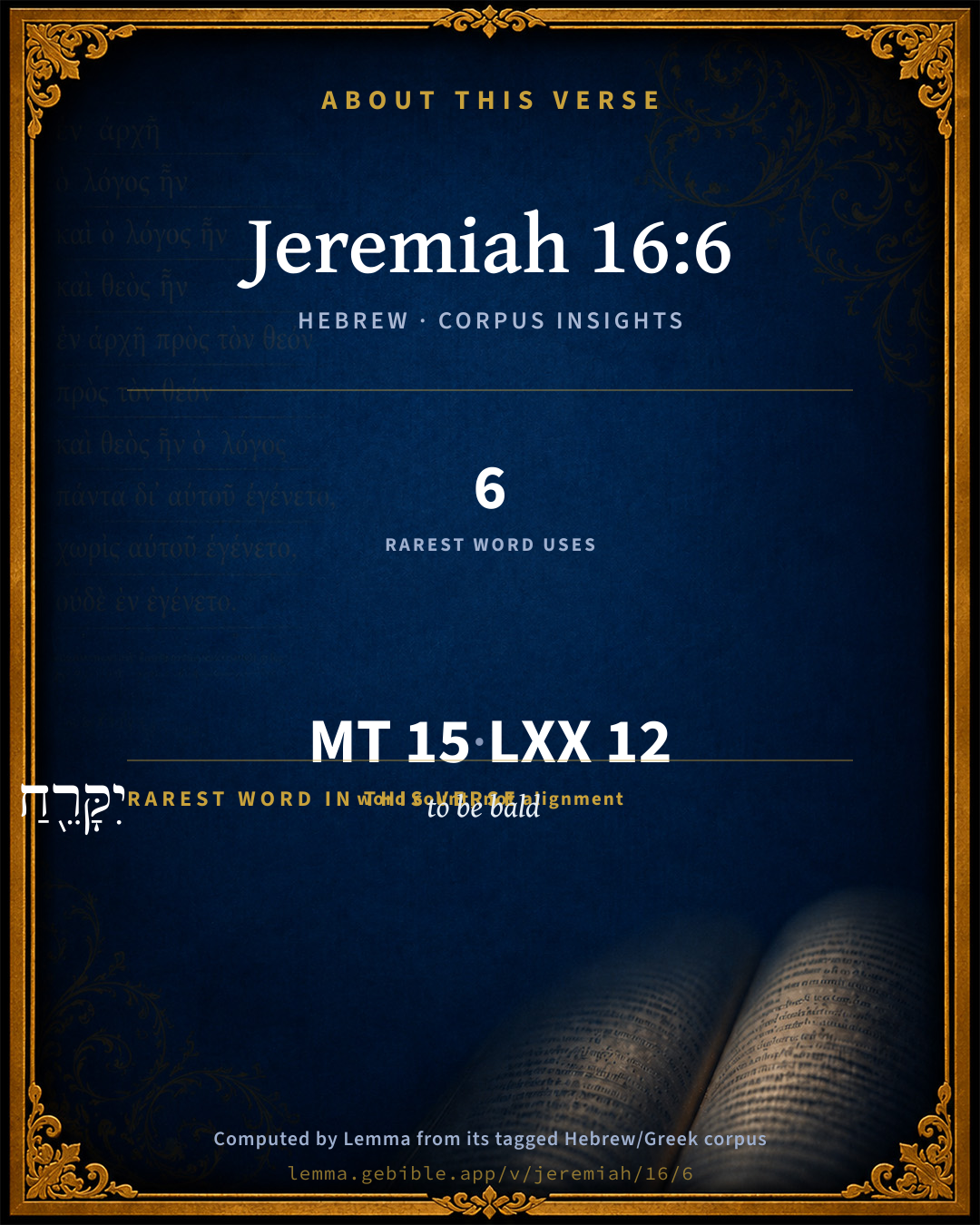
The rarest word here is יִקָּרֵ֖חַ to be bald H7139 — appearing just 6 times in the whole Hebrew Bible.

Shared distinctive vocabulary

יִקָּרֵ֖חַ to be bald H7139 occurs in 5 verses of the Hebrew Bible. Also found in:

Grammatical profile

  • 5 verbs
  • 1 noun
  • 2 adjectives
  • 1 pronoun
  • 2 prepositions
  • 4 particles

Verb forms

  • וּמֵ֨תוּ Qal · Sequential Perfect
  • יִקָּבֵ֑רוּ Niphal · Imperfect
  • יִסְפְּד֣וּ Qal · Imperfect
  • יִתְגֹּדַ֔ד Hithpolel · Imperfect
  • יִקָּרֵ֖חַ Niphal · Imperfect

Repetition

A word recurs within this verse — often emphatic in Hebrew:

Hebrew & Septuagint length

In the original languages it is 15 Hebrew tokens and 12 Greek tokens — but the two are counted differently (Hebrew bundles its prefixes and suffixes into one token; the Greek is in lemma form), so that isn’t a like-for-like length.

Cross-references

16

Topical passages linked to Jeremiah 16:6 in the Treasury of Scripture Knowledge — connected by theme and wording, ordered by reader-vote popularity; previews shown in the World English Bible.

  • Deuteronomy 14:1 You are the children of Yahweh your God: you shall not cut yourselves, nor make any baldness between your eyes for the dead.
  • Jeremiah 41:5 that there came men from Shechem, from Shiloh, and from Samaria, even eighty men, having their beards shaved and their clothes torn, and having cut themselves, with meal-offerings and frankincense in their hand, to bring them to the house of Yahweh.
  • Jeremiah 47:5 Baldness is come on Gaza; Ashkelon is brought to nothing, the remnant of their valley: how long will you cut yourself?
  • Leviticus 19:28 "'You shall not make any cuttings in your flesh for the dead, nor tattoo any marks on you. I am Yahweh.
  • Isaiah 22:12 In that day did the Lord, Yahweh of Hosts, call to weeping, and to mourning, and to baldness, and to girding with sackcloth:
  • Jeremiah 48:37 For every head is bald, and every beard clipped: on all the hands are cuttings, and on the loins sackcloth.
  • Isaiah 9:14–17 Therefore Yahweh will cut off from Israel head and tail, palm-branch and rush, in one day.
  • Isaiah 24:2 It shall be, as with the people, so with the priest; as with the servant, so with his master; as with the maid, so with her mistress; as with the buyer, so with the seller; as with the creditor, so with the debtor; as with the taker of interest, so with the giver of interest to him.
  • Jeremiah 7:29 Cut off your hair, [Jerusalem], and cast it away, and take up a lamentation on the bare heights; for Yahweh has rejected and forsaken the generation of his wrath.
  • Jeremiah 13:13 Then shall you tell them, Thus says Yahweh, Behold, I will fill all the inhabitants of this land, even the kings who sit on David's throne, and the priests, and the prophets, and all the inhabitants of Jerusalem, with drunkenness.
  • Jeremiah 16:4 They shall die grievous deaths: they shall not be lamented, neither shall they be buried; they shall be as dung on the surface of the ground; and they shall be consumed by the sword, and by famine; and their dead bodies shall be food for the birds of the sky, and for the animals of the earth.
  • Jeremiah 22:18–19 Therefore thus says Yahweh concerning Jehoiakim the son of Josiah, king of Judah: they shall not lament for him, [saying], Ah my brother! or, Ah sister! They shall not lament for him, [saying] Ah lord! or, Ah his glory!
  • Ezekiel 9:5–6 To the others he said in my hearing, Go you through the city after him, and strike: don't let your eye spare, neither have you pity;
  • Revelation 6:15 The kings of the earth, the princes, the commanding officers, the rich, the strong, and every slave and free person, hid themselves in the caves and in the rocks of the mountains.
  • Amos 6:11 "For, behold, Yahweh commands, and the great house will be smashed to pieces, And the little house into bits.
  • Revelation 20:12 I saw the dead, the great and the small, standing before the throne, and they opened books. Another book was opened, which is the book of life. The dead were judged out of the things which were written in the books, according to their works.

Cross-references courtesy of OpenBible.info (CC BY 4.0).

Hebrew and Greek witnesses Masoretic Hebrew ↔ Greek Septuagint

The same verse in the two great witnesses to the Old Testament, shown verse-for-verse.

These are two independent witnesses, not word-aligned to each other, and the Septuagint is shown in lemma (dictionary) form.

Hebrew Jeremiah 16:6 Masoretic · Westminster Leningrad Codex

וּמֵ֨תוּ גְדֹלִ֧ים וּקְטַנִּ֛ים בָּאָ֥רֶץ הַזֹּ֖את לֹ֣א יִקָּבֵ֑רוּ וְלֹֽא יִסְפְּד֣וּ לָהֶ֔ם וְלֹ֣א יִתְגֹּדַ֔ד וְלֹ֥א יִקָּרֵ֖חַ לָהֶֽם

Both great and small shall die in this land; they shall not be buried, neither shall men lament for them, nor cut themselves, nor make themselves bald for them;

World English Bible · Public Domain

Greek LXX Structure differs

In the Septuagint, Jeremiah is about an eighth shorter than the Hebrew and arranges its material differently — the Oracles Against the Nations (Hebrew chapters 46–51) appear in the middle of the Greek book, after 25:13. Because the chapter and verse boundaries do not line up, a verse-for-verse comparison with the Hebrew is not shown.

A verse-for-verse comparison isn’t shown here because the chapters and verses don’t line up. Switch to the LXX edition with the MT / LXX toggle above to read the Greek directly.

On this verse, John Gill's Exposition discusses the Septuagint’s reading. Read the note in Commentary ↓

Hebrew: Westminster Leningrad Codex (CC BY 4.0). Greek: Septuagint (public domain); English from a public-domain English Septuagint. How the Septuagint differs from the Hebrew →

Targum (Aramaic paraphrase)

1

The Targum is the ancient Jewish Aramaic paraphrase of the Hebrew Scriptures — an interpretive translation, not the Hebrew text itself. Onkelos (literal) and Pseudo-Jonathan (expansive) render the Torah, and Jonathan the Prophets. Coverage is partial: where no permissively-licensed English translation exists for a verse, only the Aramaic is shown. This is verse-level text, not a word-by-word alignment to the Hebrew.

  1. Targum Jonathan Prophets (Joshua–Malachi)
    וִימוּתוּן רַבְרְבִין וְדַעְדְקִין בְּאַרְעָא הָדָא לָא יִתְקַבְּרוּן וְלָא יִסְפְּדוּן לְהוֹן וְלָא יִתְחַמְמוּן וְלָא יְמִרְטוּן לְהוֹן:

    (no public-domain English translation for this verse)

    Targum Jonathan — Aramaic: “Mikraot Gedolot” (public domain). English: “Sefaria Community Translation” (CC0 1.0 (public-domain dedication)); “London "Chaldee Paraphrase," 1871” (public domain). Text via Sefaria.

Commentary

Notes on Jeremiah 16:6 from classic Christian and Jewish commentators (each source and its license shown beneath its notes). The classic Christian expositions comment on the surrounding passage and are grouped to its opening verse, so a note may address several verses; the Jewish commentaries on the Tanakh (Rashi and others) are per-verse, so they appear only where the commentator wrote on this verse.

Lemma curates 59 commentaries, every one of them public domain or Creative Commons licensed, each selected and text-cleaned for this edition rather than reprinted as found. About our sources →

Trapp's Complete Commentary

John Trapp

Jer 16:6 Both the great and the small shall die in this land: they shall not be buried, neither shall [men] lament for them, nor cut themselves, nor make themselves bald for them:

Ver. 6. Both the great and the small shall die.] Princes and peasants, lords and lowlies together.

Nor cut themselves, nor make themselves bald.] Neque caedetur neque calvabitur. This they had learned of the heathen, and would needs use it, though flatly forbidden them. {Lev 19:27-28 Deu 14:1} Now they were told that they should have little either lust or leisure to do any such matter.

John Trapp, A Commentary or Exposition upon All the Books of the Old and New Testament (1647–1656) — public domain. Text from a community e-Sword module.

Geneva Bible (1599)

Geneva Bible translators

That is, should not rent their clothes in sign of mourning.

Geneva Bible (1599) marginal notes — public domain. Text via Bolls.life.

Jamieson, Fausset & Brown

Robert Jamieson, A. R. Fausset & David Brown

cut themselves--indicating extravagant grief (Jer 41:5; Jer 47:5), prohibited by the law (Lev 19:28).

bald-- (Jer 7:29; Isa 22:12).

Jamieson, Fausset & Brown — Commentary Critical and Explanatory on the Whole Bible (1871) — public domain (CC PDM 1.0). Text via the HelloAO Bible API.

Adam Clarke's Commentary

Verse 6. Nor cut themselves] A custom of the heathen forbidden to the Jews, Le 19:28; De 14:1, and which appears now to have prevailed among them; because, having become idolaters, they conformed to all the customs of the heathen. They tore their hair, rent their garments, cut their hands, arms, and faces. These were not only signs of sorrow, but were even supposed to give ease to the dead, and appease the angry deities. The Hindoos, on the death of a relation, express their grief by loud lamentations, and not unfrequently bruise themselves in an agony of grief with whatever they can lay hold on.

Adam Clarke's Commentary on the Bible (1810–1826) — public domain. Text from a community e-Sword/MySword module.

John Calvin's Commentaries

He pursues the same subject: he says that all would die indiscriminately, the common people as well as the chief men, that none would be exempt from destruction; for God would make a great slaughter, both of the lower orders and also of the higher, who excelled in wealth, in honor, and dignity; Die shall the great and the small. It often happens in changes that the great are punished; and sometimes the case is that the common people perish, while the nobles are spared: but God declares, that such would be the destruction, that their enemies would make no difference between the common people and the higher ranks, and that if they escaped the hands of their enemies, the pestilence or the famine would prove their ruin.

He adds, They shall not bury them, nor beat their breast for them; and then, they shall not eat themselves, nor make themselves bald for them This is not mentioned by the Prophet to commend what the people did; nor did he consider that in this respect they observed the command of the law; for God had forbidden them to imitate the corrupt customs of the heathens. (Leviticus 21:1) We have already said, that the orientals were much given to external ceremonies, so that there was no moderation in their lamentations: therefore God intended to correct this excess. But the Prophet here has no respect to the command, that the Jews were to moderate their grief, — what then? He meant to shew, as I have already reminded you, that the slaughters would be so great, that they — would cause hardness and insensibility, being so immense as to stun the feelings of men. When any one dies, friends and neighbors meet, and shew respect to his memory; but when pestilence prevails, or when all perish by famine, the greater part become hardened and unmindful of themselves and others, and the offices of humanity are no longer observed. God then shews, that such would be the devastation of the land, that the Jews, as though callous and hardened, would no longer lament for one another. In short, he shews, that together with these dreadful slaughters, such insensibility and hardness would prevail among the Jews, that no husband would think of his wife, and no father of his children; but that all of them would be so astonied by their own evils as to become like the wild beasts.

He says further, They shall not cut themselves nor pull off their hairs, as they had used to do. These things are mentioned, as they were commonly done; it cannot be hence concluded, that they were approved by God; for God’s design was not to pronounce a judgment on their lamentation, on the tearing off of the hair, or on their incisions. It is indeed certain that these practices proceeded from the impetuous feelings of men, and were tokens of impatience; but as I have said, God does not speak here of what was lawful, but of what men were wont to do.

As to that part, where he says, that he had taken away his kindness and his mercies, he does not mean that he had changed his nature, but his object was to cut off occasion from all who might complain; for men, we know, whenever God’s hand presses hard on them, to make them to deplore rightly their miseries, are stifficiently ready to say, that God visits them with too much severity. He therefore shews that they were unworthy of kindness and mercies. At the same time he reminded them that there was no reason for hypocrites to entertain any hope, because Scripture so often commends the kindness of God and his mercy; for since they accumulated sins on sins, God could not do otherwise than come to an extremity with them.

John Calvin's Commentaries (1540-1563) — public domain. Text from the Calvin Translation Society English edition (1840s-50s) via the Christian Classics Ethereal Library (ccel.org). Calvin's coverage is partial (roughly two-thirds of the Bible); uncommented books and verses are honest gaps, never fabricated. The 19th-century editor's footnotes and remarks are omitted so the notes are faithfully Calvin's own voice.

Ellicott's Commentary for English Readers

(6) Nor cut themselves, nor make themselves bald.—Both practices were forbidden by the Law (Lev_19:28; Lev_21:5; Deu_14:1), probably in order to draw a line of demarcation between Israel and the nations round, among whom such practices prevailed (1Ki_18:28). Both, however, seem to have been common, and probably had gained in frequency under Ahaz and Manasseh (Jer_7:29; Jer_41:5; Eze_7:18; Amo_8:10; Mic_1:16). The “baldness” (i.e., shaving the crown of the head) seems to have been the more common of the two.

A Bible Commentary for English Readers, edited by Charles John Ellicott (1878–1897) — public domain. Text from a community e-Sword module.

The Cambridge Bible for Schools and Colleges

gen. ed. J. J. S. Perowne

6. nor cut themselves, nor make themselves bald] practices common among semi-civilized races. For both together, as here, cp. Jer_47:5; for the former, Jer_41:5, and perhaps (see C.B.) Hos_7:14; for the latter, Isa_3:24; Isa_15:2; Isa_22:12; Eze_7:18; Amo_8:10; Mic_1:16. They are forbidden Lev_19:28; Lev_21:5; Deu_14:1. The former of these practices represented the custom of human sacrifices as a propitiation to the spirit of the departed. Herodotus (IV. 71) describes the funeral rites of a Scythian king as requiring no less than six human victims.

The Cambridge Bible for Schools and Colleges (gen. ed. J. J. S. Perowne; Cambridge University Press, 1878–1918) — public domain. Text from a community e-Sword module.

John Gill's Exposition

Neither shall men tear themselves,.... Either their flesh, or their clothes: or, "stretch out" (y); that is, their hands, and clap them together, and wring them, as persons in great distress do: or "divide", or "break", or "deal unto them" (z); that is, bread, as at their funeral feasts. Thus the Septuagint version, neither shall bread be broken in their mourning; and to the same sense the Targum; so the word is used in Isa 63:7, a practice that obtained among the Heathens; see Deu 26:14 and now with the Jews, as it seems: which they did

for them in mourning, to comfort them for the dead; they used to carry or send food to the surviving relations, and went and ate with them, in order to comfort them for the loss of their friends; but this now would not be done, not because an Heathenish custom, but because they would have no heart nor leisure for it: see Eze 24:17.

Neither shall men give them the cup of consolation to drink for their father or for their mother: not give them a cup of good liquor to comfort and cheer their spirits, overwhelmed with sorrow, on account of the death of a father or mother; which was wont to be done, but now should be omitted; the calamity would be so great, and so universal, that there would be none to do such offices as these; see Pro 31:6.

(y) "et non expandent, sub. manus suas", Vatablus, Montanus; "extendent", Pagninus, Calvin. So Kimchi and Ben Melech. (z) "Non divident", Tigurine version; "neque impertientur, sub. cibum", Junius & Tremellius; "partientur panem", Piscator; "neque cibum dabunt", Schmidt. So Jarchi, Joseph Kimchi, and Abarbinel.

John Gill's Exposition of the Whole Bible (1746–1763) — public domain (CC PDM 1.0). Text via the HelloAO Bible API.

Albert Barnes' Notes on the Bible

Cut themselves ... make themselves bald - Both these practices were strictly forbidden in the Law (marginal references) probably as being pagan customs, but they seem to have remained in common use. By “making bald” is meant shaving a bare patch on the front of the head.

Albert Barnes' Notes on the Bible (1834–1885) — public domain. Text from a community e-Sword/MySword module.

Haydock's Catholic Bible Commentary

Cut. Moses prohibited this being done in honour of Adonis, Leviticus xix. 27., Deuteronomy xiv. 1., and Ezechiel xxvii. 31. "The custom of cutting the arms and hair still subsists in Judea," says St. Jerome; and in other countries. (Plut.[Plutarch?] Herodotus iv. 71.)

George Leo Haydock (1774–1849), Haydock's Catholic Family Bible and Commentary, 1859 edition — public domain. Excludes Psalms (Douay-Rheims chapter numbering differs from Protestant) and Deuterocanonical books (Catholic canon only).

Matthew Poole's English Annotations

There shall so many of all ranks and sizes die in this land, that men shall have no time to bury them, or there shall not be enough left living to bury the dead; nor shall men, for their own miseries, have leisure to lament for the miseries of other men. Cutting themselves in their flesh, and cutting off their hair, were pagan customs, which God forbade his own people; but yet it should seem they practised these barbarous customs; but saith God, I will put an end to that practice, men shall die so fast and in such multitudes, as they shall have no leisure to cut themselves for such as are dead, they shall not have such solemn mournings as they have had.

Matthew Poole's English Annotations on the Holy Bible (1683–1685) — public domain. Text from a community e-Sword/MySword module.

Whedon's Commentary on the Bible

Daniel D. Whedon

6. Nor cut themselves… make themselves bald — Forms of mourning strictly forbidden in the law, (see Lev_19:28; Lev_21:5; Deu_14:1,) but, as it would seem, much practised. See Jer_7:29; Jer_41:5; Isa_22:12; Eze_7:18, etc., etc.

Daniel D. Whedon (gen. ed.), Commentary on the Old and New Testaments (1874–1909) — public domain. Text from a community e-Sword module.

The Pulpit Commentary

Nor cut themselves, nor make themselves bald. Both practices are forbidden in the Law, (Deu_14:1 Lev_19:28 Lev_21:5) but the prohibition was at any rate unknown to the masses. (see, for the former, Jer_41:5 Jer_47:5; and for the latter, Jer_47:5 Isa_22:12, "The Lord Jehovah called... to baldness;" Amo_8:10 Mic_1:16 Eze_7:18) St. Jerome remarks, and incidentally gives a valuable evidence of the tenacity of primitive customs, "Mos hic fuit apud veteres, et usque hodie in quibusdam permanet Judaerum, ut in luctibus incidant lacertos," etc.

The Pulpit Commentary (1880–1919), ed. H.D.M. Spence-Jones & Joseph S. Exell — public domain. Text from a community e-Sword module.

John Wesley's Explanatory Notes

Nor cut - Cutting themselves and cutting off their hair, were Pagan customs, which God forbad his own people; but yet it seemed they practiced them: but saith God, Men shall die so fast that they shall have no leisure to cut themselves.

John Wesley, Explanatory Notes Upon the Whole Bible (1754–1765) — public domain. Text via the GEBible commentary corpus.

Rashi

Rabbi Shlomo Yitzchaki (Rashi)

And large and small shall die And since everyone will die, why should you lament?

and they shall not cut their flesh nor shall they tear their hair for them It is the custom of mourners to cut and tear their flesh and to tear their hair our of their head. In any case, it is forbidden for Jews, but he mentions it here only as an example of mourning.

Rashi on the Tanakh — English translations: “The Judaica Press complete Tanach with Rashi, translated by A. J. Rosenberg” (CC BY 4.0); “Pentateuch with Rashi's commentary by M. Rosenbaum and A.M. Silbermann, 1929-1934” (public domain); “The Metsudah Tanach series, Lakewood, N.J” (CC BY 4.0); and “The Book of Joshua, Metsudah Publications, 1997” (CC BY 4.0). Text via Sefaria.

Lesson kit

Teaching starters — assembled from the data on this page, not authored interpretation. Every prompt links to the verse data it draws on. Edit before teaching.

Jeremiah, in the Prophets, opens this verse with 15 words (10 distinct Hebrew lemmas). Its most distinctive word is qârach (“to be bald”). A historical commentator’s framing appears above. Read the whole chapter for the surrounding context.

Discussion questions

  1. What does “to be bald” (qârach) contribute to the verse as a whole?
  2. Leviticus 21:5 shares the word «to be bald» with this verse. How do the two illuminate each other?
  3. “not” occurs 4× in this one verse. What is the effect of the repetition?
  4. These translations render this verse differently; the difference is in the English rendering, not the original. What questions does that raise?
  5. The verb «וּמֵ֨תוּ» is Qal Sequential Perfect. How does its form color the action?
  6. Reading how Trapp's Complete Commentary and Geneva Bible (1599) read this verse, where do the two commentators agree and where do they part?

Things to notice

Reading settings

Reading text

Shown beneath each verse's original-language words.

Old Testament
Old Testament edition

Read the OT as the Masoretic Hebrew (MT) or the Greek Septuagint (LXX).

English shown for the Greek Septuagint (in the Hebrew ↔ Greek comparison).

Comparing translations? Open the Compare panel on any verse page to stack up to four side by side.