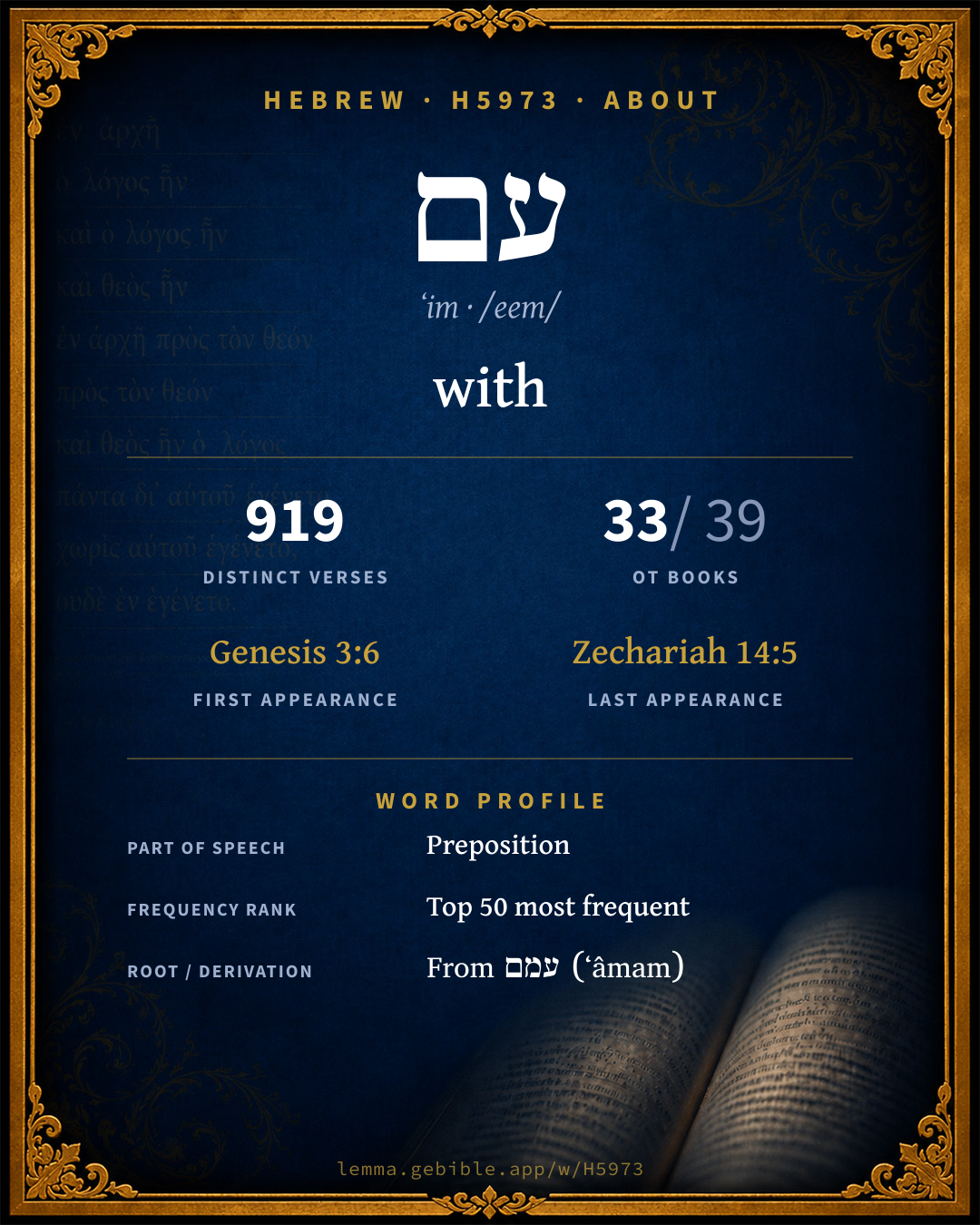
עִם
with
‘with’ is one of 6 main senses fuller range ↓
Full lexicon entry — Brown-Driver-Briggs (BDB)
From Brown-Driver-Briggs (BDB)
Where this word appears
Grammar key — what these labels mean
Part of speech
- Preposition
- A relational word (e.g. “in,” “to,” “from”) governing a noun.
Every verse where H5973 appears in the Book of Exodus — 46 distinct verses. Click any verse to open its interlinear word-by-word view. Verse text shown in the World English Bible for context — . Each verse’s Hebrew form is shown with its reference; the English is not keyword-highlighted, since the data carries no word-level English alignment. Use “Compare translations” on any verse to read it across multiple English versions. This concordance covers the Hebrew Bible; Septuagint (Greek Old Testament) occurrences are not indexed here.
Exodus
- Exodus 3:12 עִמָּ֔/ךְ prep + sfx pers 2fs He said, "Certainly I will be with you. This will be the token to you, that I have sent you: when you have brought forth the people out of Egypt, you shall serve God on this mountain."
- Exodus 4:12 עִם prep Now therefore go, and I will be with your mouth, and teach you what you shall speak."
- Exodus 4:15 עִם וְ/עִם prep conj + prep You shall speak to him, and put the words in his mouth. I will be with your mouth, and with his mouth, and will teach you what you shall do.
- Exodus 8:12 מֵ/עִ֣ם prep + prep Moses and Aaron went out from Pharaoh, and Moses cried to Yahweh concerning the frogs which he had brought on Pharaoh.
- Exodus 8:29 מֵֽ/עִמָּ/ךְ֙ prep + prep + sfx pers 2fs Moses said, "Behold, I go out from you, and I will pray to Yahweh that the swarms of flies may depart from Pharaoh, from his servants, and from his people, tomorrow; only don't let Pharaoh deal deceitfully any more in not letting the people go to sacrifice to Yahweh."
- Exodus 8:30 מֵ/עִ֣ם prep + prep Moses went out from Pharaoh, and prayed to Yahweh.
- Exodus 9:33 מֵ/עִ֤ם prep + prep Moses went out of the city from Pharaoh, and spread abroad his hands to Yahweh; and the thunders and hail ceased, and the rain was not poured on the earth.
- Exodus 10:6 מֵ/עִ֥ם prep + prep Your houses shall be filled, and the houses of all your servants, and the houses of all the Egyptians; as neither your fathers nor your fathers' fathers have seen, since the day that they were on the earth to this day.'" He turned, and went out from Pharaoh.
- Exodus 10:10 עִמָּ/כֶ֔ם prep + sfx pers 2mp He said to them, "Yahweh be with you if I will let you go with your little ones! See, evil is clearly before your faces.
- Exodus 10:18 מֵ/עִ֣ם prep + prep He went out from Pharaoh, and prayed to Yahweh.
- Exodus 10:24 עִמָּ/כֶֽם prep + sfx pers 2mp Pharaoh called to Moses, and said, "Go, serve Yahweh. Only let your flocks and your herds stay behind. Let your little ones also go with you."
- Exodus 10:26 עִמָּ֗/נוּ prep + sfx pers 1cp Our cattle also shall go with us. There shall not a hoof be left behind, for of it we must take to serve Yahweh our God; and we don't know with what we must serve Yahweh, until we come there."
- Exodus 11:8 מֵֽ/עִם prep + prep All these your servants shall come down to me, and bow down themselves to me, saying, 'Get out, and all the people who follow you; and after that I will go out.'" He went out from Pharaoh in hot anger.
- Exodus 13:19 עִמּ֑/וֹ prep + sfx pers 3ms Moses took the bones of Joseph with him, for he had made the children of Israel swear, saying, "God will surely visit you, and you shall carry up my bones away from here with you."
- Exodus 14:6 עִמּֽ/וֹ prep + sfx pers 3ms He made ready his chariot, and took his army with him;
- Exodus 17:2 עִם prep Therefore the people quarreled with Moses, and said, "Give us water to drink." Moses said to them, "Why do you quarrel with me? Why do you test Yahweh?"
- Exodus 17:8 עִם prep Then Amalek came and fought with Israel in Rephidim.
- Exodus 18:6 עִמָּֽ/הּ prep + sfx pers 3fs He said to Moses, I, your father-in-law Jethro, have come to you with your wife, and her two sons with her.
- Exodus 18:12 עִם prep Jethro, Moses' father-in-law, took a burnt offering and sacrifices for God. Aaron came with all of the elders of Israel, to eat bread with Moses' father-in-law before God.
- Exodus 18:18 עִמָּ֑/ךְ prep + sfx pers 2fs You will surely wear away, both you, and this people that is with you; for the thing is too heavy for you. You are not able to perform it yourself alone.
- Exodus 18:19 עִמָּ֑/ךְ prep + sfx pers 2fs Listen now to my voice. I will give you counsel, and God be with you. You represent the people before God, and bring the causes to God.
- Exodus 19:9 עִמָּ֔/ךְ prep + sfx pers 2fs Yahweh said to Moses, "Behold, I come to you in a thick cloud, that the people may hear when I speak with you, and may also believe you forever." Moses told the words of the people to Yahweh.
- Exodus 19:24 עִמָּ֑/ךְ prep + sfx pers 2fs Yahweh said to him, "Go down and you shall bring Aaron up with you, but don't let the priests and the people break through to come up to Yahweh, lest he break forth on them."
- Exodus 20:19 עִמָּ֖/נוּ עִמָּ֛/נוּ prep + sfx pers 1cp prep + sfx pers 1cp They said to Moses, "Speak with us yourself, and we will listen; but don't let God speak with us, lest we die."
- Exodus 20:22 עִמָּ/כֶֽם prep + sfx pers 2mp Yahweh said to Moses, "This is what you shall tell the children of Israel: 'You yourselves have seen that I have talked with you from heaven.
- Exodus 21:3 עִמּֽ/וֹ prep + sfx pers 3ms If he comes in by himself, he shall go out by himself. If he is married, then his wife shall go out with him.
- Exodus 21:14 מֵ/עִ֣ם prep + prep If a man schemes and comes presumptuously on his neighbor to kill him, you shall take him from my altar, that he may die.
- Exodus 22:12 מֵ/עִמּ֑/וֹ prep + prep + sfx pers 3ms But if it is stolen from him, he shall make restitution to the owner of it.
- Exodus 22:14 מֵ/עִ֥ם עִמּ֖/וֹ prep + prep prep + sfx pers 3ms "If a man borrows anything of his neighbor's, and it is injured, or dies, the owner of it not being with it, he shall surely make restitution.
- Exodus 22:15 עִמּ֖/וֹ prep + sfx pers 3ms If the owner of it is with it, he shall not make it good. If it is a leased thing, it came for its lease.
- Exodus 22:16 עִמָּ֑/הּ prep + sfx pers 3fs "If a man entices a virgin who isn't pledged to be married, and lies with her, he shall surely pay a dowry for her to be his wife.
- Exodus 22:19 עִם prep "Whoever has sex with an animal shall surely be put to death.
- Exodus 22:25 עִמָּ֔/ךְ prep + sfx pers 2fs "If you lend money to any of my people with you who is poor, you shall not be to him as a creditor; neither shall you charge him interest.
- Exodus 22:30 עִם prep You shall do likewise with your oxen and with your sheep. Seven days it shall be with its mother, then on the eighth day you shall give it me.
- Exodus 23:1 עִם prep "You shall not spread a false report. Don't join your hand with the wicked to be a malicious witness.
- Exodus 23:5 עִמּֽ/וֹ prep + sfx pers 3ms If you see the donkey of him who hates you fallen down under his burden, don't leave him, you shall surely help him with it.
- Exodus 24:2 עִמּֽ/וֹ prep + sfx pers 3ms Moses alone shall come near to Yahweh, but they shall not come near, neither shall the people go up with him."
- Exodus 24:8 עִמָּ/כֶ֔ם prep + sfx pers 2mp Moses took the blood, and sprinkled it on the people, and said, "Look, this is the blood of the covenant, which Yahweh has made with you concerning all these words."
- Exodus 24:14 עִמָּ/כֶ֔ם prep + sfx pers 2mp He said to the elders, "Wait here for us, until we come again to you. Behold, Aaron and Hur are with you. Whoever is involved in a dispute can go to them."
- Exodus 33:9 עִם prep It happened, when Moses entered into the Tent, that the pillar of cloud descended, stood at the door of the Tent, and spoke with Moses.
- Exodus 33:12 עִמִּ֑/י prep + sfx pers 1cs Moses said to Yahweh, "Behold, you tell me, 'Bring up this people:' and you haven't let me know whom you will send with me. Yet you have said, 'I know you by name, and you have also found favor in my sight.'
- Exodus 33:16 עִמָּ֑/נוּ prep + sfx pers 1cp For how would people know that I have found favor in your sight, I and your people? Isn't it in that you go with us, so that we are separated, I and your people, from all the people who are on the surface of the earth?"
- Exodus 34:3 עִמָּ֔/ךְ prep + sfx pers 2fs No one shall come up with you; neither let anyone be seen throughout all the mountain; neither let the flocks nor herds feed before that mountain."
- Exodus 34:5 עִמּ֖/וֹ prep + sfx pers 3ms Yahweh descended in the cloud, and stood with him there, and proclaimed the name of Yahweh.
- Exodus 34:10 עִמָּֽ/ךְ prep + sfx pers 2fs He said, "Behold, I make a covenant: before all your people I will do marvels, such as have not been worked in all the earth, nor in any nation; and all the people among which you are shall see the work of Yahweh; for it is an awesome thing that I do with you.
- Exodus 34:28 עִם prep He was there with Yahweh forty days and forty nights; he neither ate bread, nor drank water. He wrote on the tablets the words of the covenant, the ten commandments.
About this entry
At a glance — auto-summarized from this page’s data, not written by a person. Every figure links to its source below. This summary describes the numbers; it doesn’t interpret them.
At its core, עם (ʻim) means “with.” Not a single-sense word: explore its full sense range. It turns up in 919 verses across 33 books, one of the most common footprint. It first appears in Genesis 3:6. It clusters with עמם, עם and עמה under a shared root. Dig into 919-verse concordance and the renderings breakdown below.
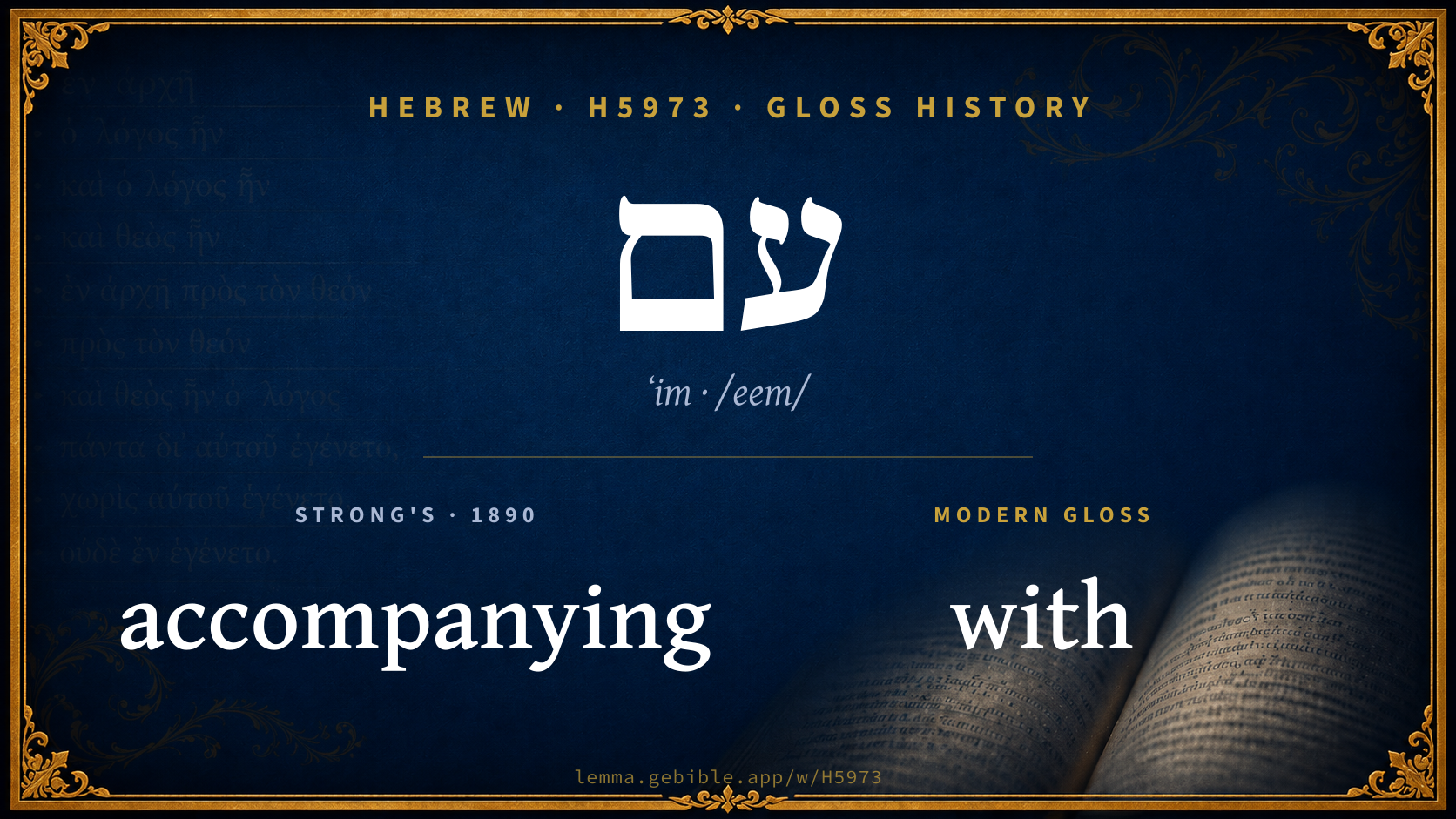
Gloss history
Strong's 1890 vs modern scholarship
About this word
Strong's H5973 catalogs a Hebrew word from the Hebrew Old Testament.
These counts are not copied from any lexicon or concordance. They are computed here, from the morphology-tagged Hebrew Old Testament. What Lemma adds →
- 919
- distinct verses
- The word appears in 919 distinct verses.
- 33 / 39
- OT books
- The word appears in 33 of 39 Old Testament books.
- #41
- by frequency
- Top 50 most frequent Hebrew words (rank 41 of 8,640 Hebrew words by occurrence).
View all 919 occurrences in the concordance →
Most concentrated in
- 2 Chronicles 96 verses 10%
- 1 Samuel 79 verses 9%
- Genesis 74 verses 8%
By section of the Old Testament
By traditional corpus
Conventional, traditional groupings — biblical authorship is debated, so this is a traditional corpus grouping, not an authorship claim. Each share is this word’s portion of its verses in that division of the Hebrew canon. Each figure is a share of the word’s 919 distinct verses.
- Prophets (Nevi'im) 362 verses · 39%
- Writings (Ketuvim) 343 verses · 37%
- Torah (Pentateuch) 214 verses · 23%
How translations render this word
Counts come from each version’s own published word-to-Strong’s tagging or interlinear alignment — an approximate guide to how each version renders this word, not a word-level alignment the data otherwise carries. Because each total is that version’s own tagged count, the per-version totals vary from one another and need not match the appearance or distinct-verse counts above. These counts may also differ from a printed concordance because Lemma counts each distinctly tagged rendering and does not collapse phrase taggings into a single head-word total. This is a fixed set of word-tagged versions (KJV, ASV, BSB, ULT) and does not change with the reading translation you choose elsewhere. Each version’s license is shown beside its name below (and on Sources).
BDB lists this Strong’s number as 2 distinct words (homographs). Each count above pools all of them and is not split by sense — see the Senses section below. A low-frequency rendering may belong to a different one of those words, not the primary meaning.
- King James Version†: Among 2×, By 2×, Unto 2×
- American Standard Version†: Among 2×, By 2×, Unto 2×
- Berean Standard Bible†: With 253×, You 108×, Him 88×
- unfoldingWord Literal Text†: With 432×, You 153×, Him 132×
King James Version Public Domain
Renders H5973 across 25† tagged occurrences — most commonly:
Plus 19 renderings that appear only once — usually multi-word phrases or single function words the recovered tagging swept in, not distinct renderings. Not rendered by a distinct English word in 1 further occurrence.
American Standard Version Public Domain
Renders H5973 across 25† tagged occurrences — most commonly:
Plus 17 renderings that appear only once — usually multi-word phrases or single function words the recovered tagging swept in, not distinct renderings.
Berean Standard Bible Public Domain
Renders H5973 across 939† tagged occurrences — most commonly:
Plus other, less common renderings. Plus 98 renderings that appear only once — usually multi-word phrases or single function words the recovered tagging swept in, not distinct renderings. Not rendered by a distinct English word in 109 further occurrences.
unfoldingWord Literal Text CC BY-SA 4.0
Renders H5973 across 1,069† tagged occurrences — most commonly:
Plus other, less common renderings. Plus 47 renderings that appear only once — usually multi-word phrases or single function words the recovered tagging swept in, not distinct renderings.
19 senses and sub-senses in the full BDB
What do BDB’s symbols mean?
BDB uses these scholarly abbreviations:
| Symbol | Meaning |
|---|---|
| 𝔊 | the Septuagint (the ancient Greek translation, LXX) |
| 𝔙 | the Vulgate (the Latin translation) |
| 𝔖 | the Syriac version (the Peshitta) |
| 𝔗 | the Targum (the Aramaic translation) |
| ψ | the Psalms |
| √ | root (the underlying root or stem) |
| ‖ | parallel passage (a synonymous or contrasted parallel) |
| † | the dagger: every passage where the word occurs is cited |
The 19 senses and sub-senses the full Brown-Driver-Briggs lexicon distinguishes for this word, in lexicon order (not ranked by frequency), with BDB’s own verbatim wording and sub-sense lettering. Shown in Hebrew script with BDB’s own scholarly abbreviations. The condensed entry is in the Lexicon Entry tab. See also the Forms in the corpus table below.
- 1. of fellowship and companionship (Lat. cum), as Gn 13:1 ולוט עמו and Lot with him, 18:16; 19:30; 24:54 הוא והאנשׁים אשׁר עמו, וכל ישׂראל עמו Jos 7:24 al.; + often Peculiar to Ch Ezr are clauses introd. by ועמהם … 1 Ch 12:34; 13:2; 15:18 +, Ezr 8:13, 14 (Aramaic 5:2) +; so ועמו … 1 Ch 12:28; 2 Ch 17:14–18; 26:17; Ezr 8:3–12, 33. Coupling substantives, together with, chiefly in poetry: Dt 12:23 לא תאכל הנפשׁ עם הבשׂר, Jos 11:21; Ju 16:3; Ec 7:11; 2 S 1:24 שָׁנִי עִם עֲדָנִים, Dt 32:14 עִם חֵלֶב כרים, v 14, 24, 25 Am 4:10; Is 25:11; 34:7; Je 6:11; 51:40; Na 3:12 ψ 66:15 אעשׂה בקר עם עתודים, 81:3; 83:8; 87:4; 89:14; 104:25 +, Ct 1:11; 4:13(×2) כפרים עם נרדים, v 14(×2); 5:1(×3). Unusually, Est 9:25 אמר עם הספר he ordered in conjunction with writing, in a written order. Poet. or late uses: ψ 42:9 ובלילה שִׁירֹה עמי, ψ 89:22 אשׁר יָדִי תִּכּוֹן עמו, v 25; in Jb of the companionship of sufferings or prosperity, 6:4 חִצֵּי שַׁדַּי עמדי, 17:2 אם לא הֲתֻלִים עמדי, 29:6 וְצוּר יָצוּק עמדי פלגי שׁמן, v 20 כבודי חָדָשׁ עמדי, 2 Ch 14:5 ואין עמו מלחמה, 16:9 ישׁ עמך מלחמות, 28:10 עִמָּכֶם אֲשָׁמוֹת. Hence, in partic. e.g. Genesis 13:1
- a. of aid, Ex 23:5 Dt 22:4; 1 Ch 12:19; especially of God, Gn 21:22 אלהים עמך, 26:3 ואהיה עמך, v 33; 31:3, 5; Ex 3:12; Jos 1:5; Is 8:10 כ׳ עמנו אל ψ 23:4; 46:8, 12; Jb 29:5 + often (cf. אֵת, Gn 39:2, 3, 21, 23; Is 43:5 +): so הִתְחַזַּק עם 1 Ch 11:10; 2 Ch 16:9; Dn 10:21, עָזַר עם 1 Ch 12:21, כי גם ידם עם דוד 1 S 22:17; 2 S 3:12; 1 Ch 4:10 (cf. Ex 23:1, and II. אֵת 1 a) With the help of (= Gk. σύν), 1 S 14:45 כי עם אלהים עשׂה היום הזה, Dn 11:39 (rare). e.g. Exodus 23:5
- b. Of actions done jointly with another, as ירשׁ עם inherit with, Gn 21:10, כרת ברית עם 26:28 + often, עם (חִלֵּק) חָלַק to share with Jos 22:8; Is 53:12 +; cf. Dt 10:9 חֵלֶק וְנַחֲלָה עִם אֶחָיו, 18:1. e.g. Genesis 21:10
- c. If the common action be of the nature of a contest or combat, עִם is with in the sense of against: so often with נִלְחַם to fight, נִשְׁפַּט to dispute, נֶאֱבַק to wrestle, רִיב to strive (see these verbs), Gn 26:20; 30:8; 32:29; בּא בְּמִשְׁפָּט עם to enter into judgment with Is 3:14 +, Jb 14:3 (הֵבִיא), רִיב לי׳ עִם Hos 4:1 +; hence, without a verb expressing the idea explicitly, ψ 94:16 מי יקום לי עִם מְרֵעִים in the struggle with evil-doers? v b 55:19 כי בְרַבִּים היו עמדי for as many are they in combat with me, Jb 9:14 אָבְחֲרָה דְבָרַי עמו in the contest with him, 10:17b; 16:21; perhaps צָדַק עִם 9:2; 25:4 (cf. 4 b end). e.g. Genesis 26:20
- d. Of dealing with a person, or of the relation in which one stands with, or towards, another: as עשׂה חסד עם to do kindness with Gn 24:12 + often (in 1 pers. observe that in this phr. עמדי, not עמי, is regul. used, Gn 19:19; 20:13; 40:14; 1 S 20:14; 2 S 10:2 [‖ 1 Ch 19:2 עמי: here only], al.), עשׂה טוב עם Gn 26:29 +, v. also 20:9; 31:29; Dt 33:21; Ju 15:3; Jb 10:12; 13:20; 42:8 ψ 86:17 (cf. אִתְּכֶם Dt 1:30; 10:21; and Aramaic Dn 3:32), 119:124; 126:2 (1 S 12:24), Jb 33:29; הֵיטִיב עם Gn 32:10, 13 +, הֵרַע עִם 31:7; רָצָה עם be well pleased with ψ 50:18; Jb 34:9; דִּבֶּר עם to speak with (subj. usually God) Ex 19:9 + (v. דִּבֶּר 3 e), hence דָּבָר עִם Ju 18:7, 28; 2 S 3:17; 1 K 1:7; Jb 15:11 דָּבָר לָאַט עמך a word (spoken) gently with thee, cf. 11:5 ויפתח שׂפתיו עמך; יֵאָמֵן עם 2 Ch 1:9: and with adjj. תמים עם perfect with (i.e. toward) Dt 18:13 ψ 18:24, שָׁלֵם עם 1 K 8:61 +; cf. וְלִבָּם לֹא נָכוֹן עִמּוֹ ψ 78:37; 2 S 21:4; 23:5; 1 K 3:6 (עמך), Mi 6:8 הַצְנֵעַ לֶכֶת עִם אֱלֹהָיו, ψ 73:22 toward thee, 1 Ch 19:6; Hos 12:1 (?); also הָלַךְ קְרִי עִם Lv 26:21 ff. (7 times), מַמְרִים הֱיִיתֶם עם Dt 9:7, 24; 31:27; 2 Ch 16:10; 26:19 ψ 85:5; Jb 10:17 a. e.g. Genesis 24:12
- e. Of a common lot, Gn 18:23 האף תספה צדיק עם רשׁע together with the wicked, v 25 Jb 3:14, 15; Is 38:11 ψ 26:9 אל תאסף עם חטּאים נפשׁי, v b; 28:3(×2), 69:29; Jb 30:1; 1 Ch 24:5; hence like, ψ 73:5 ועם אדם לא יְנֻגָּ֑עוּ with (i.e. like) men (in general), 106:6 חטאנו עם אבותינו, Ec 2:16 ואיך ימות הֶחָכָם עם הכסיל i.e. like the fool. e.g. Genesis 18:23
- f. Of equality or resemblance generally (poet.), Jb 9:26 חָֽלְפוּ עִם אֳנִיּוֹת אֵבֶה they pass by with, i.e. as swiftly as, skiffs of reed, 37:18 תרקיע עמו שׁחקים i.e. like him, 40:15 אשׁר עשׂיתי עמך; so נִמְשַׁל עִם ψ 28:1; 143:7, נֶחְשַׁב עִם 88:5, cf. Ec 7:11. e.g. Job 9:26
- g. Of time, = as long as, ψ 72:5 יִירָאוּךָ עם שׁמשׁ as long as the sun endureth (cf. Aramaic Dn 3:33; 4:31; also Ovid. Am. i. 15, 16 cum sole et luna semper Aratus erit); at the time of (?) 2 Ch 21:19 (but read perhaps מֵחָלְיוֹ); and c. inf. (late), Ezr 1:11 עִם הֵעָלוֹת הַגּוֹלָה (cf. ἅμα τῷ sq. inf. Ju 3:21; 9:33; also עִם Ecclus 40:14). e.g. Psalms 72:5
- 2. Of a locality, close to, beside: †Gn 25:11 וישׁב יצחק עם באר לחי ראי beside the well of, etc., 35:4 תַּחַת הָאֵלָה אשׁר עם שׁכם (so, after אשׁר, Jos 7:2; Ju 9:6; 18:22 2 S 13:23), Jos 19:46 (?), Ju 18:3 הֵמָּה עִם בֵּית מִיכָה (so 19:11; 2 S 20:8), 1 S 10:2; 2 S 6:7 וַיָּ֫מָת שָׁם עִם אֲרוֹן הא׳, 19:38; 24:16; 1 K 1:9; 1 Ch 13:14 by the house of O., in its own house (v. Be), 21:15 (2 S 24:16), 26:16 (cf. אֵת 2). By a person, Dt 5:28 וְאַתָּה עֲמֹד פֹּח עמדי by me, 1 S 1:26 הַנִּצֶּבֶת עִמְּכָה +; of one living near another, Ex 22:24; Lv 25:35, 36, 39, 47. e.g. Genesis 25:11
- 3. Of persons, עִם is spec.
- a. in the house or family or service of (apud, chez): Gn 23:4 גֵּר וְתוֹשָׁב עמך (fig. of י׳ Lv 25:23 ψ 39:13), 27:44; 29:14 וַיֵּשֶׁב עִמּוֹ, v 25 עבדתי עמך I have served with thee (so v 30, cf. Dt 15:16), 31:38; Lv 25:6, 40(×2), 50, 53; Dt 22:2; 23:17; Ju 17:10; 2 S 19:34; 1 K 11:22; cf. 1 S 2:21 עם י׳ i.e. at his sanctuary. e.g. Genesis 23:4
- b. In the possession of (Lat. penes): Gn 24:25 straw, etc., is עִמָּנוּ, 31:32 Dt 17:19 והיתה עמו with him, at his side, 29:16; Jb 28:14 וְיָם אָמַר אֵין עִמָּדִי; = stored up with, Dt 32:34 כָּמֻם עִמָּדִי, Jb 27:13 (but read here prob. מֵאֵל; cf. 20:29); of ethical or mental attributes, 1 S 25:25 וּנְבָלָה עִמּוֹ, Jb 12:13 עִמּוֹ חָכְמָה וּגְבוּרָה, v 16; 25:2 ψ 130:7; 2 Ch 19:3, 7. cf. fig. ψ 36:10 כי עמך מְקוֹר חַיִּים. e.g. Genesis 24:25
- c. In the custody or care of, 1 S 9:23 שִׂים אֹתָהּ עִמָּ֑ךְ; 22:23 כִּי מִשְׁמֶרֶת אַתָּה עִמָּדִי: cf. Jb 17:3 עָרְבֵנִי עִמָּ֑ךְ be surety for me with thyself. e.g. 1 Samuel 9:23
- d. Beside = except, Dt 32:39 אֵין אלהים עִמָּדִי, ψ 73:25 ועמך לא חפצתי בארץ and beside thee I delight not (in aught that is) upon earth (al. in comparison of thee, 1 f), 2 Ch 14:10 וְאֵין עִמְּךָ לַעֲזֹר there is none beside thee to help, 20:6; perhaps Hos 9:8 (Hi Ke; but very dub., v. Comm.). cf. אֵת 1 b. e.g. Deuteronomy 32:39
- e. With = friendly with, Gn 31:2 כי איננו עמי (syn. v 5 אֶל towards), 2 K 10:15 לְבָבִי עִם לְבָֽבְךָ, Pr 23:7 וְלִבּוֹ בַל עִמָּ֑ךְ. e.g. Genesis 31:2
- 4. Idiom. of a thought or purpose present with one:—
- a. עִם לְבַב פ׳, especially in Dt. and the later Deut. style, Dt 8:5 וְיָדַעְתָּ עִם לְבָבְךָ thou shalt know with thy heart, 15:9 פן יהיה דבר עם לבבך בליעל a wicked thought with thy heart, Jos 14:7 I brought back word כאשׁר עם לבבי; היה עם לְבַב פ׳, especially of a purpose, 1 K 8:17 ויהי עם לבב דוד לִבְנוֹת וגו׳ i.e. it was David’s purpose to build, etc., v 18(×2); 1 K 10:2 (= 2 Ch 6:7, 8(×2); 9:1), 1 Ch 22:7; 28:2 (both based on 1 K 8:17, etc.), 2 Ch 1:11; 24:4; 29:10; rather differently, to muse or talk with one’s heart, ψ 77:7; Ec 1:16. e.g. Deuteronomy 8:5
- b. עִם alone, = in one’s consciousness, whether of knowledge or memory or purpose (cf. אֵת 3 b; عِنْدَ WAG ii. § 66): Nu 14:24 עֵקֶב הָֽיְתָה רוּחַ אַחֶרֶת עִמּוֹ i.e. operating in his mind, 1 K 11:11 יען אשׁר היתה זאת עמך, 1 Ch 28:12 the pattern of all אשׁר היה בָרוּחַ עמו that was in spirit (i.e. mentally) with him, ψ 50:11 וְזִיז שָׂדַי עִמָּדִי is with me (i.e. is known to me; ‖ ידעתי), prob. also 73:23; 139:18 (= in thy thought and care); Jb 9:35 לא כן אנכי עמדי not so am I with myself (my consciousness—or conscience—does not tell me that I need dread him), 10:13 ידעתי כי זאת עמך i.e. that this was thy purpose (‖ אֵלֶּה צָפַנְתָּ בִּלְבָבֶ֑ךָ), 15:9 ולא עמנו הוא and is not with us (= in our knowledge; ‖ וְלֹא נֵדָ֑ע), 23:10 כי ידע דרך עמדי the way of which I am conscious (De; Ew Di the way attending me, my usual way), v 14 וְכָהֵנָּה רַבּוֹת עמו i.e. he has many such purposes, 27:11 אֲשֶׁר עִם שַׁדָּי לֹא אֲכַחֵד i.e. his purposes or principles of action. Also sometimes in the judgment or estimation of, 1 S 2:26 טוֹב עִם, 2 S 6:22 נִכְבַּד עִם, perhaps צָדַק עִם Jb 9:2; 25:4 (Ges Bu; but Ew as 1 c, Hi De beside, in comparison of). e.g. Numbers 14:24
- 5. Metaph. together with = in spite of, notwithstanding Ne 5:18 וְעִם זֶה (cf. مَعَ WAG ii. § 57; in Heb. בְּ is the more usual syn.).—In 1 S 16:12 אַדְמֹנִי עִם יְפֵה עֵינַיִם (cf. 17:42 עִם יְפֵה מַרְאֶה), if text correct, יפה must be a neuter subst., with beauty of eyes; but read prob. (Gr Bu) עֶלֶם a youth (17:56; 20:22) for עם (v. HPS; Che Expos. Times x. 521 אַדְמֹנִי עֶצֶם, cf. La 4:7). e.g. Nehemiah 5:18
Senses from the full Brown-Driver-Briggs lexicon (Brown, Driver, Briggs; Oxford 1906 — public domain), digitized via Sefaria, supplemented by the OpenScriptures HebrewLexicon (CC BY 4.0). Full attribution on Sources.
Word origin
prep. with (Aramaic עִם, ܥܰܡ, Sab. עם DHMEpigr. Denkm. 12 HomChrest. 51; cf. Arabic مَعَ, مَعْ (but v. PrätBAS. i. 26)), sf. עִמִּי46 and עִמָּדִי45 (prob. akin to Arabic عِنْدٌ side, عِنْدَ beside: cf. √ ענד), without difference of meaning (עמי in Pent. Gn 31:31; 39:7, 12, 14; Ex 33:12 Lv 26:21, 23, 27, 40 [H] Nu 22:19; Jos-K. 13 times; ψ 42:9; 86:17; Jb 10:17; Ru 1:11; Est 7:8; in Dn 7 times, Ezr Ne Ch 11 times: עמדי in Pent. Gn [JE] 14 times, Ex 17:2; Lv 25:23; Dt 5:28; 32:34, 39; Ju S 7 times; ψ 23:4; 50:11; 50:19; 101:6; Jb 14 times, Ru 1:8); עִמְּךָ, †עִמְּכָה 1 S 1:26, עִמָּ֑ךְ; עִמּוֹ, עִמָּהּ; עִמָּ֫נוּ; עִמָּכֶם; עִמָּם27 (Gn 18:16, etc.: Gn-K 20 times; Ne 13:25; not Ezr Ch), and עִמָּהֶם23 (chiefly late: Nu 22:12; Dt 29:16 (v 24 עמם), Jon 1:3; Jb 1:4, and 19 times Ne Ezr Ch):
— Brown-Driver-Briggs (Oxford 1906, public domain), digitized via Sefaria, supplemented by the OpenScriptures HebrewLexicon (CC BY 4.0). See Sources.
Derived from עמם (ʻâmam) (H6004) — to darken.
Jastrow Dictionary
A second Hebrew/Aramaic lexicon for comparison, covering Aramaic and post-biblical (Talmudic, Targumic, Midrashic) usage that the biblical-Hebrew BDB does not. Matched by lemma rather than by Strong’s number, so a lemma may carry more than one Jastrow headword (shown separately below), and the entries cover usage well beyond the Bible.
עִם
- v. עַם) junction; (prep.) with, near. Sabb. I, 8 עם השמש with the sun, i.e. as long as the sun shines, before sunset. Ib. II, 7 עם חשיכה, v. חֲשֵׁיכָה. Ber. 7ᵃ ותתנהג עם בניך וכ׳ and deal with thy children mercifully. Snh. 23ᵃ מי חותם עִמָּהֶן who is to sign as witness with them; a. fr.
עִם ²
- Targ. O. Gen. XXV, 11. Targ. Ps. LIV, 2 עִימָּנָא Ms. (ed. גַּבָּן). Targ. Job XXXII, 6 עִימְּכוֹן Ms. (ed. יַתְכוֹן); a. fr.
עַם
- עמם to press, crowd, join) gathering, crowd, people. Snh. 94ᵇ, v. עָיֵף. Men. 53ᵇ יבא זח … לעם זו let ‘this one’ (Moses) come and receive ‘this’ (the Law) … for ‘this people’ (Israel); a. fr.—עם הארץ, v. אֶרֶץ.—Pl. עַמִּים gentiles. Sabb. 14ᵇ, a. fr. על ארץ הע׳ concerning (importations from) heathen countries. Y. Shebi. VI, 36ᵇ bot.; a. fr.—V. עֲמָם.
עַם ²
- Targ. Gen. XII, 2. Targ. Ez. XLV, 16. Targ. Cant. VI, 5; a. v. fr.—Erub. 14ᵇ, a. e. מאי ע׳ דבר, v. דְּבַר. Y. Kil. V, 29ᵈ bot. כל ע׳; Y. Yeb. XIII, beg. 13ᵇ כל עַמָּה, a. fr., v. כּוֹל. Sot. IX, 15 ע׳ דארעא = עם הארץ, ignorant people; a. fr.—Pl., v. עֲמַם II.
A Dictionary of the Targumim, the Talmud Babli and Yerushalmi, and the Midrashic Literature (Marcus Jastrow; London, Luzac, 1903) — Public Domain. Digitized via Sefaria. Digitized via Sefaria. Full attribution on Sources.
Forms in the corpus
The 152 distinct written forms H5973 takes in the Hebrew Bible, most frequent first — each parse links to that state’s occurrences in the concordance. Hebrew forms include their vowel points and cantillation, so a single lemma takes many written forms.
| Form | Parsing | Example | Uses |
|---|---|---|---|
| עִם | Preposition | Daniel 1:13 | 393 |
| עִמּ֔/וֹ | Preposition | Deuteronomy 17:19 | 38 |
| עִמָּֽ/ךְ | Preposition | Deuteronomy 14:27 | 37 |
| עִמּֽ/וֹ | Preposition | Deuteronomy 22:4 | 33 |
| עִ֖ם | Preposition | Amos 4:10 | 26 |
| עִמּ֑/וֹ | Preposition | Exodus 13:19 | 26 |
| וְ/עִם | Preposition | Exodus 4:15 | 24 |
| עִמּ֖/וֹ | Preposition | Amos 2:3 | 23 |
| עִמָּ֔/ךְ | Preposition | Deuteronomy 2:7 | 21 |
| עִמָּ֑/ךְ | Preposition | Exodus 18:18 | 19 |
| מֵ/עִ֣ם | Preposition | Exodus 8:12 | 16 |
| עִמִּ֖/י | Preposition | Esther 7:8 | 12 |
| מֵ/עִ֥ם | Preposition | Deuteronomy 23:15 | 11 |
| עִֽם | Preposition | Ecclesiastes 2:16 | 11 |
| עִמְּ/ךָ֖ | Preposition | Deuteronomy 20:12 | 11 |
| עִמִּ֔/י | Preposition | Daniel 8:18 | 11 |
| עִמָּ/כֶ֔ם | Preposition | Exodus 10:10 | 11 |
| עִמָּ/כֶֽם | Preposition | Exodus 10:24 | 10 |
| עִמּ֛/וֹ | Preposition | 1 Chronicles 19:14 | 9 |
| וְ/עִמּ֕/וֹ | Preposition | Ezra 8:5 | 8 |
| עִמָּ֑/נוּ | Preposition | Exodus 33:16 | 8 |
| עִמּ/וֹ֙ | Preposition | Daniel 11:40 | 7 |
| עִמָּ/כֶם֙ | Preposition | Hosea 14:2 | 7 |
| וְ/עִמּ֖/וֹ | Preposition | Ezra 8:4 | 6 |
| עִמְּ/ךָ֙ | Preposition | Genesis 21:23 | 6 |
| עִמִּ/י֙ | Preposition | Daniel 10:19 | 6 |
| עִמִּ֑/י | Preposition | Daniel 9:22 | 6 |
| עִמִּֽ/י | Preposition | Ezra 7:28 | 6 |
| עִמָּ/כֶ֑ם | Preposition | Deuteronomy 4:23 | 6 |
| עִמָּ/כֶ֖ם | Preposition | Genesis 31:29 | 6 |
| עִמָּ֔/נוּ | Preposition | 1 Kings 8:57 | 6 |
| וְ/עִמּ֛/וֹ | Preposition | Ezra 8:3 | 5 |
| מֵ/עִמּֽ/וֹ | Preposition | Deuteronomy 18:19 | 5 |
| עִ֚ם | Preposition | Ecclesiastes 4:15 | 5 |
| עִמְּ/ךָ֗ | Preposition | Deuteronomy 22:2 | 5 |
| עִמָּ/ם֙ | Preposition | 2 Samuel 15:36 | 5 |
| עִמָּ֑/הּ | Preposition | Deuteronomy 22:25 | 5 |
| עִמָּ֑/ם | Preposition | Genesis 29:9 | 5 |
| עִמָּ֔/ם | Preposition | Deuteronomy 29:25 | 5 |
| עִמָּֽ/הּ | Preposition | Deuteronomy 22:23 | 5 |
| מֵ/עִ֖ם | Preposition | 2 Samuel 3:15 | 4 |
| מֵ/עִ֤ם | Preposition | Exodus 9:33 | 4 |
| עִמָּ֖/הּ | Preposition | Deuteronomy 22:25 | 4 |
| עִמָּ֖/ךְ | Preposition | Amos 6:10 | 4 |
| עִמָּ֖/ם | Preposition | Genesis 18:16 | 4 |
| עִמָּ֖/נוּ | Preposition | Exodus 20:19 | 4 |
| עִמָּ֗/ךְ | Preposition | Deuteronomy 14:29 | 4 |
| עִמָּ֨/נוּ֙ | Preposition | Deuteronomy 29:15 | 4 |
| עִמָּֽ/נוּ | Preposition | Hosea 12:4 | 4 |
| וְ/עִ֥ם | Preposition | 2 Chronicles 24:16 | 3 |
| וְ/עִמָּ/הֶ֛ם | Preposition | Ezra 10:14 | 3 |
| מֵ/עִמָּ֑/ךְ | Preposition | Deuteronomy 10:12 | 3 |
| מֵֽ/עִמָּ֔/ךְ | Preposition | Deuteronomy 15:18 | 3 |
| עִ֝֗ם | Preposition | Psalms 113:8 | 3 |
| עִ֥ם | Preposition | Ecclesiastes 1:11 | 3 |
| עִ֭מּ/וֹ | Preposition | Job 12:13 | 3 |
| עִמּ/וֹ֮ | Preposition | 1 Samuel 17:26 | 3 |
| עִמּ֧/וֹ | Preposition | 1 Chronicles 11:10 | 3 |
| עִמָּ֔/הּ | Preposition | Esther 2:13 | 3 |
| עִמָּ֥/נוּ | Preposition | Deuteronomy 29:15 | 3 |
The 60 most common forms are shown; 92 rarer forms follow in the full concordance.
Same root — word family
Other BDB entries built from the same root as H5973, grouped by Strong’s listed origin. These share a root / origin per the lexicon — not necessarily a shared meaning. Each links to that word’s own entry.
Derives from
Shares the same root
Derived from this word
Proper names from this root
People and places named from this root — a name, not an additional meaning of the word.
Compare all same-root words → Showing 4 of 7 — not the complete family. 1 of the same-root words is a proper name (a person or place). They share a root, not necessarily a meaning.
Septuagint verse parallels
This word appears in 867 verses that also exist in the Greek Old Testament (Septuagint), out of the 919 Hebrew verses it occurs in. You can read those verses in Greek by switching the Old Testament edition to the Septuagint.
Read these verses in the Septuagint
- Genesis 3:6
- Exodus 3:12
- Leviticus 15:33
- Numbers 10:32
- Deuteronomy 2:7
- Joshua 1:5
- Judges 1:22
- Ruth 1:7
- 1 Samuel 1:17
- 2 Samuel 1:2
- 1 Kings 1:7
- 2 Kings 2:9
This is a verse-level parallel only — the same verses exist in both the Hebrew and Greek Old Testaments. No word-level Hebrew↔Greek correspondence is claimed: the data carries no such alignment, so no Greek word is shown as this Hebrew word’s translation. Coverage is not total — the Septuagint omits the deuterocanon and renumbers the Psalms, so some Hebrew verses have no direct Greek parallel.