Numbers 10:32

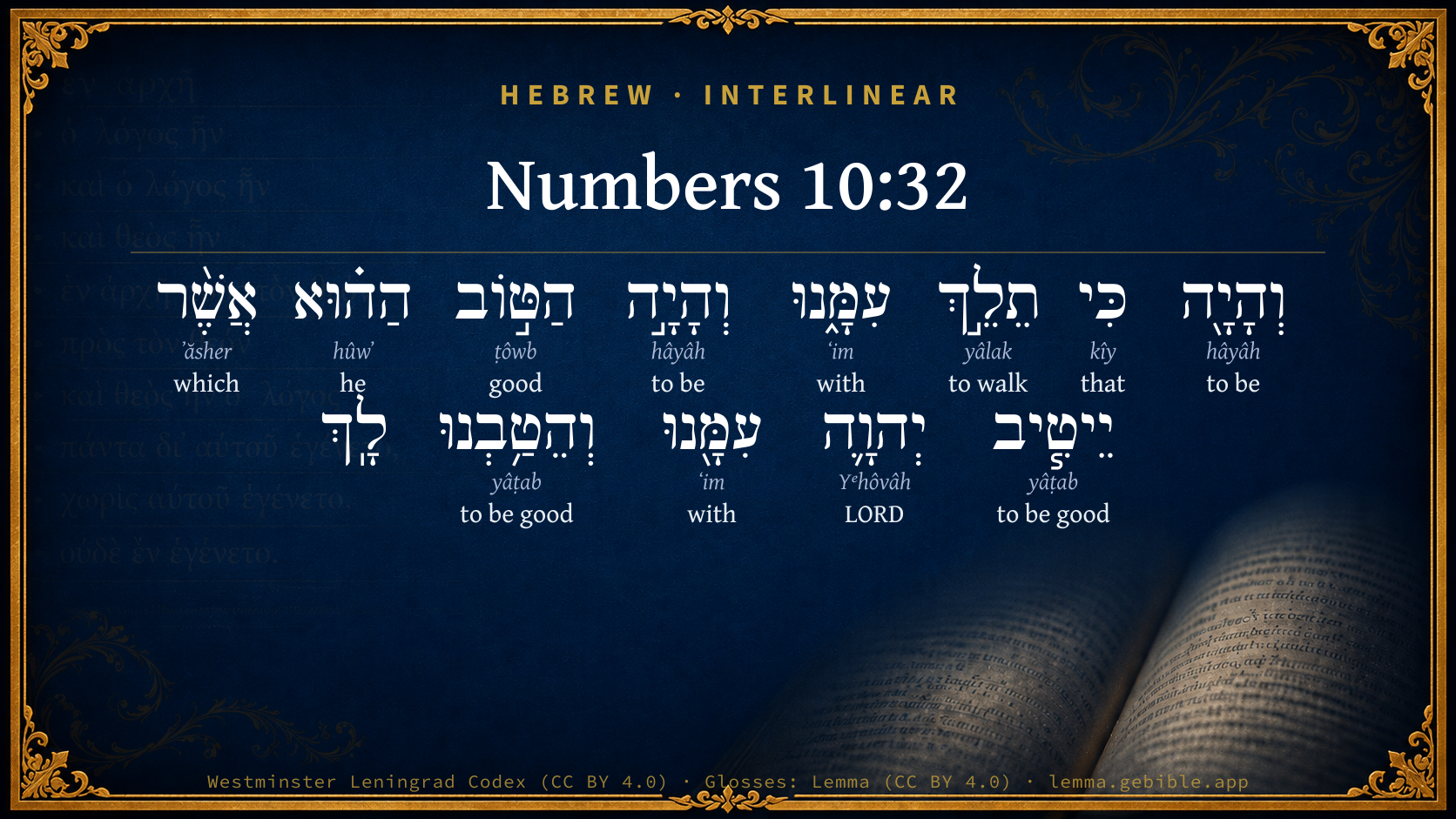
Hebrew (Westminster Leningrad Codex) Numbers 10:32 appears in the Hebrew Old Testament. The text above is from the Westminster Leningrad Codex. Each word links to its Strong’s number, a concise gloss, and parsing drawn from the Open Scriptures Hebrew Bible morphology. Click any word for its full Brown-Driver-Briggs (BDB) entry.
Download image
Cite this verse

Numbers 10:32 (World English Bible). Public Domain. Lemma interlinear Bible study tool, https://lemma.gebible.app/v/numbers/10/32.

Show BibTeX & RIS
BibTeX
RIS
English Translation
It shall be, if you go with us, yes, it shall be, that whatever good Yahweh shall do to us, the same will we do to you.
World English Bible · Public Domain
Download a study sheet

One document with this verse’s original text, its word-by-word gloss line, the meaning frame, cross-references with their text, attributed commentary, and full source and license credits — printable, and it pastes into notes with its structure intact.

This verse Autodidact and up

Study sheet (.html) Plain text (.txt)

A passage Seminary Student

Up to 50 verses in one chapter. A passage sheet keeps up to 6 commentary sources and 12 cross-references per verse, in the order this page ranks them, and says so on the sheet whenever that leaves anything out. Ask for a single verse and you get the Autodidact verse sheet above.

Everything on this page stays free to read, with no account — the sheet is a download of what is already on screen, not access to it.

Want to remove ads? Support Godless Engineer
Compare translations 3

The same verse in 3 English versions, stacked beneath the original-language interlinear above. Click any original word for its lexicon entry.

Each is an independent rendering of the whole verse — the interlinear is not word-aligned to these translations.

Highlighted words mark where these versions differ — a whole-verse word diff, not a word-by-word alignment.

  • World English Bible Public Domain
    It shall be, if you go with us, yes, it shall be, that whatever good Yahweh shall do to us, the same will we do to you.
  • King James Version Public Domain
    And it shall be, if thou go with us, yea, it shall be, that what goodness the LORD shall do unto us, the same will we do unto thee.
  • unfoldingWord Literal Text CC BY-SA 4.0
    And it shall be that when you go with us, then it will happen that that good that Yahweh shall do good with us, also we shall do good to you.”

unfoldingWord Literal Text — © unfoldingWord, licensed CC BY-SA 4.0. Word-aligned USFM3 via Door43 (git.door43.org/unfoldingWord/en_ult).

Versions to compare (up to 4)

3 of 4 selected

Show all 18 translations

Every available English version of this verse, each an independent rendering of the whole verse.

  • World English Bible Public Domain
    It shall be, if you go with us, yes, it shall be, that whatever good Yahweh shall do to us, the same will we do to you.
  • Berean Standard Bible Public Domain
    If you come with us, we will share with you whatever good things the LORD gives us.”
  • Majority Standard Bible Public Domain
    If you come with us, we will share with you whatever good things the LORD gives us.”
  • King James Version Public Domain
    And it shall be, if thou go with us, yea, it shall be, that what goodness the LORD shall do unto us, the same will we do unto thee.
  • American Standard Version (1901) Public Domain
    And it shall be, if thou go with us, yea, it shall be, that what good soever Jehovah shall do unto us, the same will we do unto thee.
  • Revised Version (1885) Public Domain
    And it shall be, if thou go with us, yea, it shall be, that what good soever the LORD shall do unto us, the same will we do unto thee.
  • Geneva Bible (1599) Public Domain
    And if thou go with vs, what goodnes the Lord shall shew vnto vs, the same will we shewe vnto thee.
  • Douay-Rheims (1899) Public Domain
    And if thou comest with us, we will give thee what is the best of the riches which the Lord shall deliver to us.
  • Young's Literal Translation Public Domain
    and it hath come to pass when thou goest with us, yea, it hath come to pass -- that good which Jehovah doth kindly with us -- it we have done kindly to thee.'
  • Literal Standard Version CC BY-SA 4.0
    and it has come to pass, when you go with us—indeed, it has come to pass—that good which YHWH does kindly with us, we have done it kindly to you.”
  • Unlocked Literal Bible CC BY-SA 4.0
    If you go with us, we will do for you the same good that Yahweh does to us.”
  • unfoldingWord Literal Text CC BY-SA 4.0
    And it shall be that when you go with us, then it will happen that that good that Yahweh shall do good with us, also we shall do good to you.”
  • Darby Bible Public Domain
    And it shall be, if thou come with us, that whatever good Jehovah doeth unto us, so will we do to thee.
  • World Messianic Bible Public Domain
    It shall be, if you go with us—yes, it shall be—that whatever good the LORD does to us, we will do the same to you.”
  • Webster's Bible Public Domain
    And it shall be, if thou wilt go with us, yea, it shall be, that what goodness the LORD shall do to us, the same will we do to thee.
  • Free Bible Version CC BY-SA 4.0
    If you come with us, whatever good things the Lord blesses us with we'll share with you.”
  • Bible in Basic English Public Domain
    And if you come with us, we will give you a part in whatever good the Lord does for us.
  • JPS Tanakh (1917) Public Domain
    And it shall be, if thou go with us, yea, it shall be, that what good soever the LORD shall do unto us, the same will we do unto thee.'

Literal Standard Version (2020), Covenant Press — licensed CC BY-SA 4.0. Text via the HelloAO Bible API (eBible.org). Unlocked Literal Bible (unfoldingWord) — licensed CC BY-SA 4.0. Text via the HelloAO Bible API (eBible.org). unfoldingWord Literal Text — © unfoldingWord, licensed CC BY-SA 4.0. Word-aligned USFM3 via Door43 (git.door43.org/unfoldingWord/en_ult). Free Bible Version, Dr. Jonathan Gallagher — licensed CC BY-SA 4.0. Text via the HelloAO Bible API (eBible.org).

Word by word

More ways to search: Search by grammar → Find every occurrence → Compare this word →

Practice this passage: Drill this verse → Learn its vocabulary →

יֵיטִ֧יב
yâṭab
H3190
“to be good”
Verb, Hiphil, Imperfect, 3rd Person, Masculine, Singular
Part of Speech
Verb
Stem
Hiphil
Form
Imperfect
Person
3rd Person
Gender
Masculine
Number
Singular
Full BDB Definition

Origin: a primitive root

TWOT: 863

to be good, be pleasing, be well, be glad - (Qal) - to be glad, be joyful - to be well placed - to be well for, be well with, go well with - to be pleasing, be pleasing to - (Hiphil) - to make glad, rejoice - to do good to, deal well with - to do well, do thoroughly - to make a thing good or right or beautiful - to do well, do right
  1. וְהָיָ֖ה hâyâh H1961 “and · to be” Conjunction + Verb, Qal, Sequential Perfect, 3rd Person, Masculine, Singular
  2. כִּי kîy H3588 “that” Conjunction
  3. תֵלֵ֣ךְ yâlak H3212 “to walk” Verb, Qal, Imperfect, 2nd Person, Masculine, Singular
  4. עִמָּ֑נוּ ʻim H5973 “with · us” Preposition + Suffix, Personal, 1st Person, Common, Plural
  5. וְהָיָ֣ה hâyâh H1961 “and · to be” Conjunction + Verb, Qal, Sequential Perfect, 3rd Person, Masculine, Singular
  6. הַטּ֣וֹב ṭôwb H2896 “the · good” Particle, Definite Article + Adjective, Adjective, Masculine, Singular, Absolute
  7. הַה֗וּא hûwʼ H1931 “the · he” Particle, Definite Article + Pronoun, Personal, 3rd Person, Masculine, Singular
  8. אֲשֶׁ֨ר ʼăsher H834 “which” Particle, Relative
  9. יְהוָ֛ה Yᵉhôvâh H3068 “LORD” Noun, Proper
  10. עִמָּ֖נוּ ʻim H5973 “with · us” Preposition + Suffix, Personal, 1st Person, Common, Plural
  11. וְהֵטַ֥בְנוּ yâṭab H3190 “and · to be good” Conjunction + Verb, Hiphil, Sequential Perfect, 1st Person, Common, Plural

About this verse

These counts appear in no published source. They are computed here, from the morphology-tagged text and Lemma’s own curated glosses. What Lemma adds →

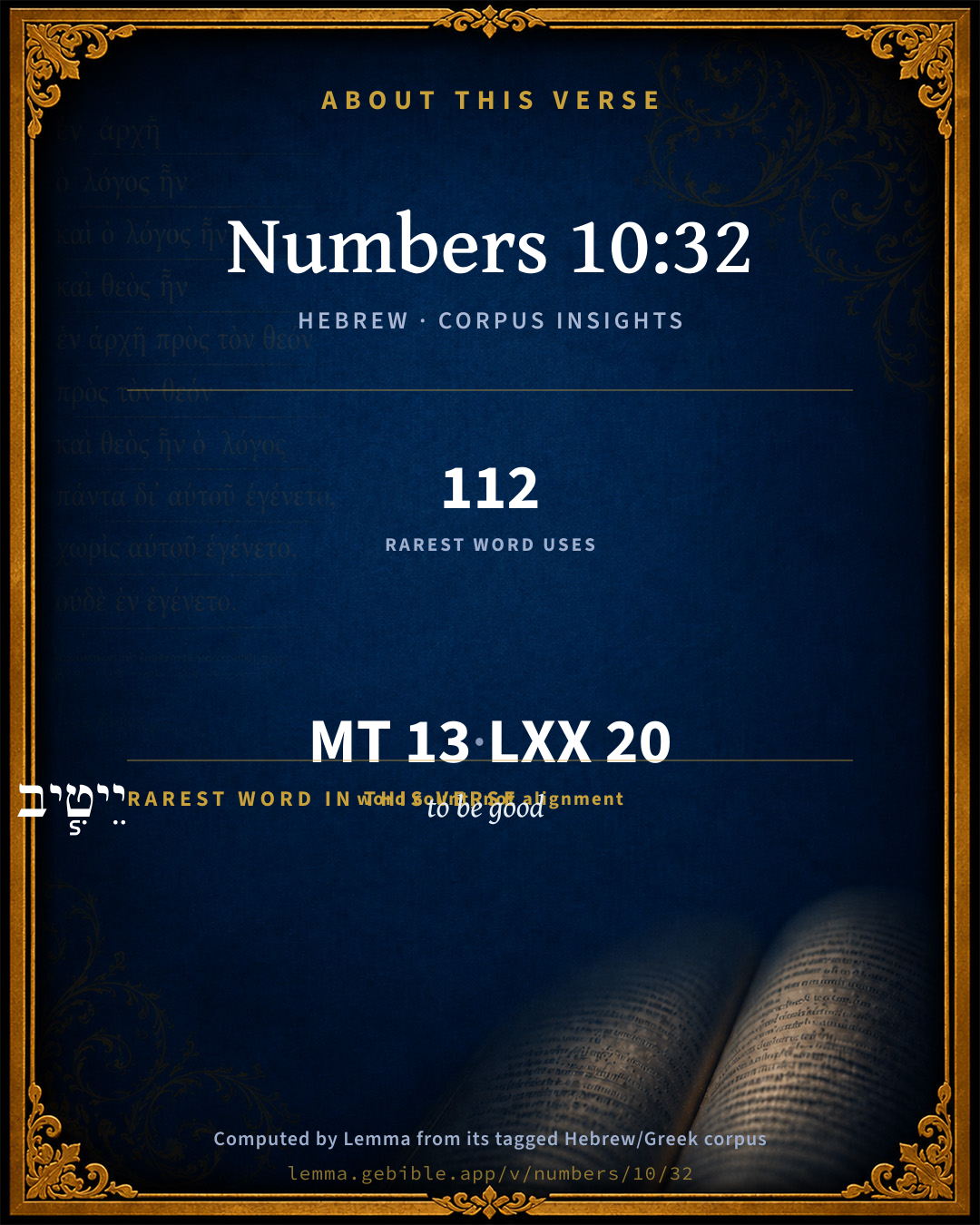
13
words
9
distinct lemmas
Pentateuch
section

Grammatical profile

  • 5 verbs
  • 1 noun
  • 1 adjective
  • 1 pronoun
  • 3 prepositions
  • 1 conjunction
  • 1 particle

Verb forms

  • וְהָיָ֖ה Qal · Sequential Perfect
  • תֵלֵ֣ךְ Qal · Imperfect
  • וְהָיָ֣ה Qal · Sequential Perfect
  • יֵיטִ֧יב Hiphil · Imperfect
  • וְהֵטַ֥בְנוּ Hiphil · Sequential Perfect

Repetition

Words recur within this verse — often emphatic in Hebrew:

  • וְהָיָ֖ה to be H1961 ×2
  • יֵיטִ֧יב to be good H3190 ×2
  • עִמָּ֑נוּ with H5973 ×2

Hebrew & Septuagint length

In English translation the verse runs 27 words from the Hebrew and 34 from the Septuagint (LXX English) — closely comparable.

A rough comparison of the two English renderings, which tokenize alike — not a word-level alignment.

Word counts can differ between the Hebrew and the Greek without any difference in meaning — e.g. the Hebrew direct-object marker אֵת has no separate Greek word, and Greek often adds the article ὁ.

In the original languages it is 13 Hebrew tokens and 20 Greek tokens — but the two are counted differently (Hebrew bundles its prefixes and suffixes into one token; the Greek is in lemma form), so that isn’t a like-for-like length.

Cross-references

6

Topical passages linked to Numbers 10:32 in the Treasury of Scripture Knowledge — connected by theme and wording, ordered by reader-vote popularity; previews shown in the World English Bible.

  • Judges 1:16 The children of the Kenite, Moses' brother-in-law, went up out of the city of palm trees with the children of Judah into the wilderness of Judah, which is in the south of Arad; and they went and lived with the people.
  • Deuteronomy 10:18 He does execute justice for the fatherless and widow, and loves the foreigner, in giving him food and clothing.
  • Psalms 22:27–31 All the ends of the earth shall remember and turn to Yahweh. All the relatives of the nations shall worship before you.
  • Psalms 67:5–7 Let the peoples praise you, God. Let all the peoples praise you.
  • 1 John 1:3 that which we have seen and heard we declare to you, that you also may have fellowship with us. Yes, and our fellowship is with the Father, and with his Son, Jesus Christ.
  • Judges 4:11 Now Heber the Kenite had separated himself from the Kenites, even from the children of Hobab the brother-in-law of Moses, and had pitched his tent as far as the oak in Zaanannim, which is by Kedesh.

Cross-references courtesy of OpenBible.info (CC BY 4.0).

Hebrew and Greek witnesses Masoretic Hebrew ↔ Greek Septuagint

The same verse in the two great witnesses to the Old Testament, shown verse-for-verse.

These are two independent witnesses, not word-aligned to each other, and the Septuagint is shown in lemma (dictionary) form.

Hebrew Numbers 10:32 Masoretic · Westminster Leningrad Codex

וְהָיָ֖ה כִּי תֵלֵ֣ךְ עִמָּ֑נוּ וְהָיָ֣ה הַטּ֣וֹב הַה֗וּא אֲשֶׁ֨ר יֵיטִ֧יב יְהוָ֛ה עִמָּ֖נוּ וְהֵטַ֥בְנוּ לָֽךְ

It shall be, if you go with us, yes, it shall be, that whatever good Yahweh shall do to us, the same will we do to you.

World English Bible · Public Domain

Greek LXX Numbers 10:32 Septuagint · lemma form

καί εἰμί ἐάν πορεύομαι μετά ἐγώ καί εἰμί ὁ ἀγαθός ἐκεῖνος ὅσος ἐάν ἀγαθοποιέω κύριος ἐγώ καί εὖ σύ ποιέω

And it shall come to pass if you will go with us, it shall even come to pass that in whatever things the Lord shall do us good, we will also do you good.

LXX2012 (modern English Septuagint) · Public Domain

Hebrew: Westminster Leningrad Codex (CC BY 4.0). Greek: Septuagint (public domain); English from LXX2012 (modern English Septuagint) (Public Domain). How the Septuagint differs from the Hebrew →

Targum (Aramaic paraphrase)

2

The Targum is the ancient Jewish Aramaic paraphrase of the Hebrew Scriptures — an interpretive translation, not the Hebrew text itself. Onkelos (literal) and Pseudo-Jonathan (expansive) render the Torah, and Jonathan the Prophets. Coverage is partial: where no permissively-licensed English translation exists for a verse, only the Aramaic is shown. This is verse-level text, not a word-by-word alignment to the Hebrew.

  1. Targum Onkelos Torah (Genesis–Deuteronomy)
    וִיהֵי אֲרֵי תֵזִל עִמָנָא וִיהֵי טָבָא הַהוּא דִי יוֹטִיב יְיָ עִמָנָא וְנוֹטִיב לָךְ

    (no public-domain English translation for this verse)

    Targum Onkelos — Aramaic: “Onkelos Genesis” (public domain); “Onkelos Exodus” (public domain); “Onkelos Leviticus” (public domain); “Onkelos Numbers” (public domain); “Onkelos Deuteronomy” (public domain). English: “Sefaria Community Translation” (CC0 1.0 (public-domain dedication)); “J.W. Etheridge. The Targums of Onkelos and Jonathan Ben Uzziel on the Pentateuch. London: Longmans, Green, 1862” (public domain). Text via Sefaria.

  2. Targum Pseudo-Jonathan Torah (Genesis–Deuteronomy)
    וִיהֵי אֲרוּם תֵזִיל עִמָנָא וִיהֵי טָבָא הַהוּא דְיוֹטֵב יְיָ עִמָנָא וְנוֹטִיב לָךְ בְּפִלוּג אַרְעָא

    And it shall be that if thou wilt go on with us, with the good that the Lord shall benefit us will we benefit thee, in the division of the land.

    Targum Pseudo-Jonathan — Aramaic: “Targum Jonathan on Genesis” (public domain); “Targum Jonathan on Exodus” (public domain); “Targum Jonathan on Leviticus” (public domain); “Targum Jonathan on Numbers” (public domain); “Targum Jonathan on Deuteronomy” (public domain). English: “The Targum of Jonathan ben Uzziel, trans. J. W. Etheridge, London, 1862” (public domain). Text via Sefaria.

Commentary

Notes on Numbers 10:32 from classic Christian and Jewish commentators (each source and its license shown beneath its notes). The classic Christian expositions comment on the surrounding passage and are grouped to its opening verse, so a note may address several verses; the Jewish commentaries on the Tanakh (Rashi and others) are per-verse, so they appear only where the commentator wrote on this verse.

Lemma curates 59 commentaries, every one of them public domain or Creative Commons licensed, each selected and text-cleaned for this edition rather than reprinted as found. About our sources →

Jamieson, Fausset & Brown

Robert Jamieson, A. R. Fausset & David Brown

if thou go with us . . . what goodness the Lord will show unto us, the same will we do unto thee--A strong inducement is here held out; but it seems not to have changed the young man's purpose, for he departed and settled in his own district. (See on Jdg 1:16 and Sa1 15:6).

Jamieson, Fausset & Brown — Commentary Critical and Explanatory on the Whole Bible (1871) — public domain (CC PDM 1.0). Text via the HelloAO Bible API.

John Gill's Exposition

And when it passed,.... The ark, and the cloud over it:

he said; Moses stood and prayed, as before, according to the above Targums, in the following manner:

return, O Lord, unto the many thousands of Israel; who were six hundred thousand footmen, besides women and children, Num 11:21; the import of this petition is, that upon the resting of the ark God would take up his abode with them, grant them his presence, and manifest his love, grace, mercy, and goodness unto them; or, as it may be rendered, that he would "return the many thousands of Israel"; that is, to the land which he had sworn to their fathers, as Ben Gersom interprets it; and who observes that the word "return" is used, because of the holy fathers who dwelt in the land of Israel; or else, as the same writer further observes, the sense of the petition is, that it might be the will of God to turn the thousands of Israel into myriads, or increase and multiply them ten times more than they were; and so the Targum of Jerusalem is,"bless the myriads, and multiply the thousands of the children of Israel.''Perhaps Moses, under a spirit of prophecy, might have a further view, even to the conversion of the Jews in the latter day, when they shall return and seek the true Messiah, and be turned to him, and when all Israel shall be saved.

Next: Numbers Chapter 11

John Gill's Exposition of the Whole Bible (1746–1763) — public domain (CC PDM 1.0). Text via the HelloAO Bible API.

The Pulpit Commentary

If thou go with us. From Jud_1:16 we learn that the sons of Hobab joined themselves to the sons of Judah, and dwelt amongst them on the southern border of the land. Here is an "undesigned coincidence," albeit a slight one. Judah led the way on the march from Sinai to Canaan, and Hobab"s duties as guide and scout would bring him more into contact with that tribe than with any other.

The Pulpit Commentary (1880–1919), ed. H.D.M. Spence-Jones & Joseph S. Exell — public domain. Text from a community e-Sword module.

Rashi

Rabbi Shlomo Yitzchaki (Rashi)

והיה הטוב ההוא AND IT SHALL BE THAT WHAT GOODNESS [THE LORD SHALL DO UNTO US, THE SAME WILL WE DO UNTO THEE] — What good did they actually bestow upon him (i.e. when did they redeem their promise)? They (our Sages) say: When the Israelites were parcelling out the Land the most fertile part of Jericho proved to extend over an area of 500 by 500 cubits; they left it unparcelled and said: He in whose portion of land the Sanctuary will be built shall take it as a substitute for giving up the land upon which the Temple was built. In the meantime, however, they gave it to the children of Jethro — to Jonadab the son of Rechab, [as it is said, (Judges 1:16) “And the children of the Kenite, Moses’ father-in-law, went up out of the city of the palm tree” (which is identical with Jericho; cf. Deuteronomy 34:3)] (Sifrei Bamidbar 81).

Rashi on the Tanakh — English translations: “The Judaica Press complete Tanach with Rashi, translated by A. J. Rosenberg” (CC BY 4.0); “Pentateuch with Rashi's commentary by M. Rosenbaum and A.M. Silbermann, 1929-1934” (public domain); “The Metsudah Tanach series, Lakewood, N.J” (CC BY 4.0); and “The Book of Joshua, Metsudah Publications, 1997” (CC BY 4.0). Text via Sefaria.

Lesson kit

Teaching starters — assembled from the data on this page, not authored interpretation. Every prompt links to the verse data it draws on. Edit before teaching.

Numbers, in the Pentateuch, opens this verse with 13 words (9 distinct Hebrew lemmas). Its most distinctive word is yâṭab (“to be good”). A historical commentator’s framing appears above. Read the whole chapter for the surrounding context.

Discussion questions

  1. The word yâṭab carries the sense “to be good.” How does it shape the verse?
  2. Judges 1:16 shares this passage’s theme. How do the two illuminate each other?
  3. “to be” occurs 2× in this one verse. What is the effect of the repetition?
  4. These translations render this verse differently. What is at stake in choosing one wording over another?
  5. The verb «וְהָיָ֖ה» is Qal Sequential Perfect. How does its form color the action?
  6. Reading how Jamieson, Fausset & Brown and John Gill's Exposition read this verse, where do the two commentators agree and where do they part?

Things to notice

Reading settings

Reading text

Shown beneath each verse's original-language words.

Old Testament
Old Testament edition

Read the OT as the Masoretic Hebrew (MT) or the Greek Septuagint (LXX).

English shown for the Greek Septuagint (in the Hebrew ↔ Greek comparison).

Comparing translations? Open the Compare panel on any verse page to stack up to four side by side.