
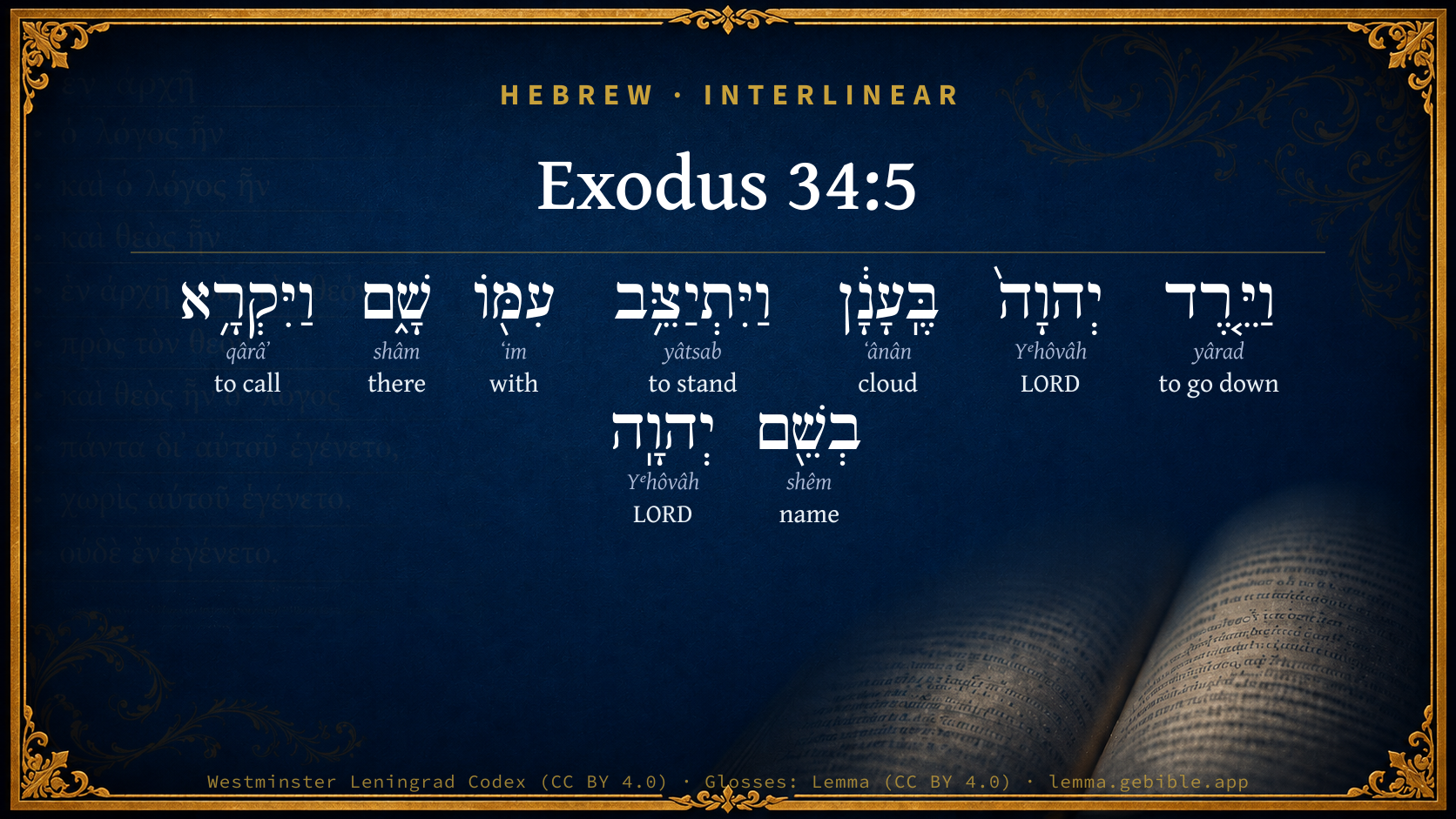
Exodus 34:5

Hebrew (Westminster Leningrad Codex) Exodus 34:5 appears in the Hebrew Old Testament. The text above is from the Westminster Leningrad Codex. Each word links to its Strong’s number, a concise gloss, and parsing drawn from the Open Scriptures Hebrew Bible morphology. Click any word for its full Brown-Driver-Briggs (BDB) entry.
Download image
Cite this verse

Exodus 34:5 (World English Bible). Public Domain. Lemma interlinear Bible study tool, https://lemma.gebible.app/v/exodus/34/5.

Show BibTeX & RIS
BibTeX
RIS
English Translation
Yahweh descended in the cloud, and stood with him there, and proclaimed the name of Yahweh.
World English Bible · Public Domain
Download a study sheet

One document with this verse’s original text, its word-by-word gloss line, the meaning frame, cross-references with their text, attributed commentary, and full source and license credits — printable, and it pastes into notes with its structure intact.

This verse Autodidact and up

Study sheet (.html) Plain text (.txt)

A passage Seminary Student

Up to 50 verses in one chapter. A passage sheet keeps up to 6 commentary sources and 12 cross-references per verse, in the order this page ranks them, and says so on the sheet whenever that leaves anything out. Ask for a single verse and you get the Autodidact verse sheet above.

Everything on this page stays free to read, with no account — the sheet is a download of what is already on screen, not access to it.

Want to remove ads? Support Godless Engineer
Compare translations 3

The same verse in 3 English versions, stacked beneath the original-language interlinear above. Click any original word for its lexicon entry.

Each is an independent rendering of the whole verse — the interlinear is not word-aligned to these translations.

Highlighted words mark where these versions differ — a whole-verse word diff, not a word-by-word alignment.

  • World English Bible Public Domain
    Yahweh descended in the cloud, and stood with him there, and proclaimed the name of Yahweh.
  • King James Version Public Domain
    And the LORD descended in the cloud, and stood with him there, and proclaimed the name of the LORD.
  • unfoldingWord Literal Text CC BY-SA 4.0
    And Yahweh came down in the cloud and stood with him there, and he pronounced in the name of Yahweh.

unfoldingWord Literal Text — © unfoldingWord, licensed CC BY-SA 4.0. Word-aligned USFM3 via Door43 (git.door43.org/unfoldingWord/en_ult).

Versions to compare (up to 4)

3 of 4 selected

Show all 18 translations

Every available English version of this verse, each an independent rendering of the whole verse.

  • World English Bible Public Domain
    Yahweh descended in the cloud, and stood with him there, and proclaimed the name of Yahweh.
  • Berean Standard Bible Public Domain
    And the LORD descended in a cloud, stood with him there, and proclaimed His name, the LORD.
  • Majority Standard Bible Public Domain
    And the LORD descended in a cloud, stood with him there, and proclaimed His name, the LORD.
  • King James Version Public Domain
    And the LORD descended in the cloud, and stood with him there, and proclaimed the name of the LORD.
  • American Standard Version (1901) Public Domain
    And Jehovah descended in the cloud, and stood with him there, and proclaimed the name of Jehovah.
  • Revised Version (1885) Public Domain
    And the LORD descended in the cloud, and stood with him there, and proclaimed the name of the LORD.
  • Geneva Bible (1599) Public Domain
    And the Lord descended in the cloude, and stoode with him there, and proclaimed the name of the Lord.
  • Douay-Rheims (1899) Public Domain
    And when the Lord was come down in a cloud, Moses stood with him, calling upon the name of the Lord.
  • Young's Literal Translation Public Domain
    And Jehovah cometh down in a cloud, and stationeth Himself with him there, and calleth in the Name of Jehovah,
  • Literal Standard Version CC BY-SA 4.0
    And YHWH comes down in a cloud, and stations Himself with him there, and calls in the Name of YHWH,
  • Unlocked Literal Bible CC BY-SA 4.0
    Yahweh came down in the cloud and stood with Moses there, and he pronounced the name “Yahweh.”
  • unfoldingWord Literal Text CC BY-SA 4.0
    And Yahweh came down in the cloud and stood with him there, and he pronounced in the name of Yahweh.
  • Darby Bible Public Domain
    And Jehovah came down in the cloud, and stood beside him there, and proclaimed the name of Jehovah.
  • World Messianic Bible Public Domain
    The LORD descended in the cloud, and stood with him there, and proclaimed the LORD’s name.
  • Webster's Bible Public Domain
    And the LORD descended in the cloud, and stood with him there, and proclaimed the name of the LORD.
  • Free Bible Version CC BY-SA 4.0
    The Lord descended in a cloud, stood there with him, and called out the name “Yahweh.”
  • Bible in Basic English Public Domain
    And the Lord came down in the cloud and took his place by the side of Moses, and Moses gave worship to the name of the Lord.
  • JPS Tanakh (1917) Public Domain
    And the LORD descended in the cloud, and stood with him there, and proclaimed the name of the LORD.

Literal Standard Version (2020), Covenant Press — licensed CC BY-SA 4.0. Text via the HelloAO Bible API (eBible.org). Unlocked Literal Bible (unfoldingWord) — licensed CC BY-SA 4.0. Text via the HelloAO Bible API (eBible.org). unfoldingWord Literal Text — © unfoldingWord, licensed CC BY-SA 4.0. Word-aligned USFM3 via Door43 (git.door43.org/unfoldingWord/en_ult). Free Bible Version, Dr. Jonathan Gallagher — licensed CC BY-SA 4.0. Text via the HelloAO Bible API (eBible.org).

Word by word

More ways to search: Search by grammar → Find every occurrence → Compare this word →

Practice this passage: Drill this verse → Learn its vocabulary →

וַיִּתְיַצֵּ֥ב
yâtsab
H3320
“and · to stand”
Conjunction + Verb, Hithpael, Sequential Imperfect, 3rd Person, Masculine, Singular
Part of Speech
Conjunction + Verb
Stem
Hithpael
Form
Sequential Imperfect
Person
3rd Person
Gender
Masculine
Number
Singular
Full BDB Definition

Origin: a primitive root

TWOT: 894

to place, set, stand, set or station oneself, present oneself - (Hithpael) to station oneself, take one's stand, stand, present oneself, stand with someone
  1. וַיֵּ֤רֶד yârad H3381 “and · to go down” Conjunction + Verb, Qal, Sequential Imperfect, 3rd Person, Masculine, Singular
  2. יְהוָה֙ Yᵉhôvâh H3068 “LORD” Noun, Proper
  3. בֶּֽעָנָ֔ן ʻânân H6051 “in/at the · cloud” Preposition, Determined + Noun, Common, Masculine, Singular, Absolute
  4. עִמּ֖וֹ ʻim H5973 “with · him” Preposition + Suffix, Personal, 3rd Person, Masculine, Singular
  5. שָׁ֑ם shâm H8033 “there” Adverb
  6. וַיִּקְרָ֥א qârâʼ H7121 “and · to call” Conjunction + Verb, Qal, Sequential Imperfect, 3rd Person, Masculine, Singular
  7. בְשֵׁ֖ם shêm H8034 “in/at · name of” Preposition + Noun, Common, Masculine, Singular, Construct
  8. יְהוָֽה Yᵉhôvâh H3068 “LORD” Noun, Proper

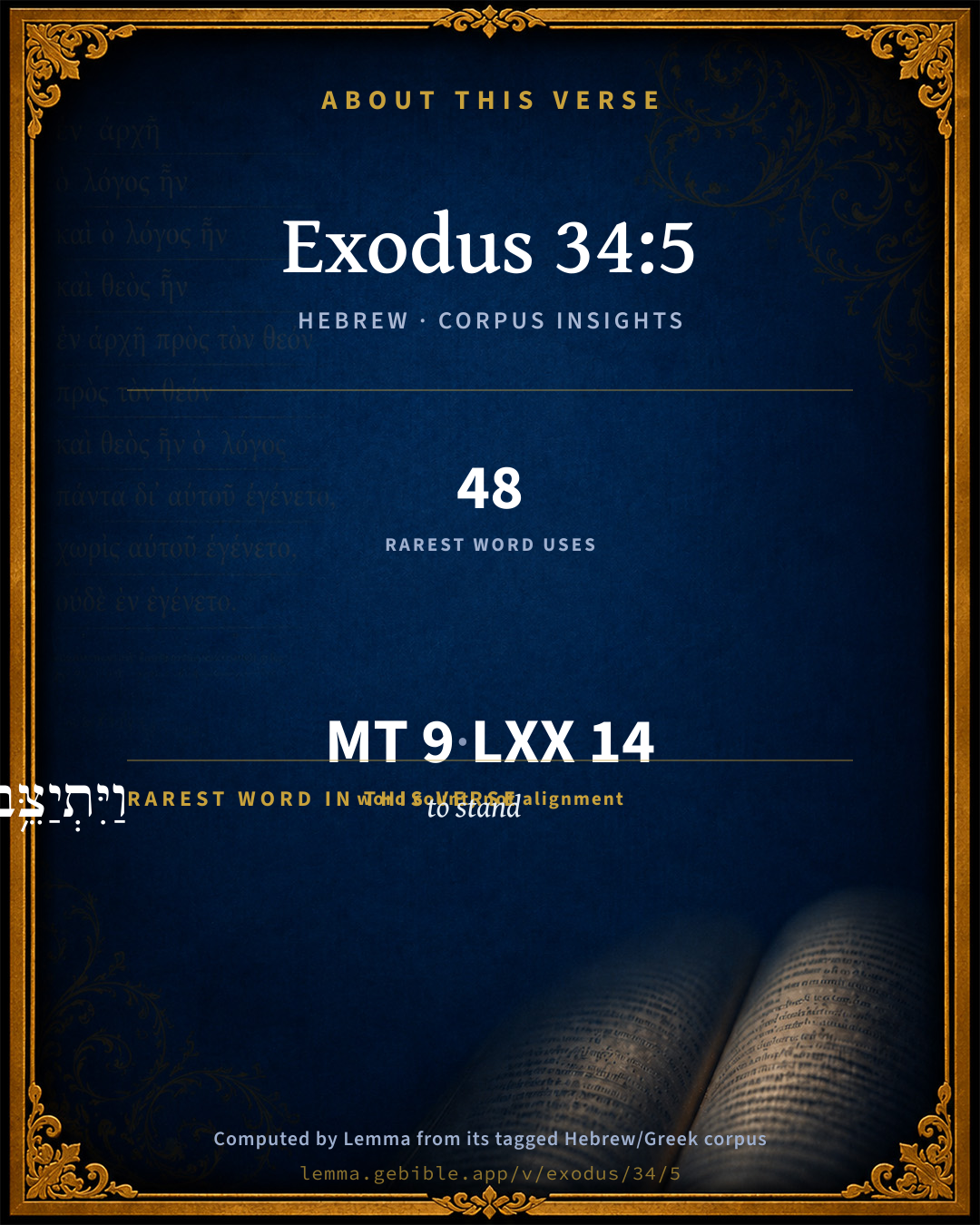
About this verse

These counts appear in no published source. They are computed here, from the morphology-tagged text and Lemma’s own curated glosses. What Lemma adds →

9
words
8
distinct lemmas
Pentateuch
section

Shared distinctive vocabulary

וַיִּתְיַצֵּ֥ב to stand H3320 occurs in 45 verses of the Hebrew Bible. Also found in:

Grammatical profile

  • 3 verbs
  • 4 nouns
  • 1 preposition
  • 1 adverb

Verb forms

  • וַיֵּ֤רֶד Qal · Sequential Imperfect
  • וַיִּתְיַצֵּ֥ב Hithpael · Sequential Imperfect
  • וַיִּקְרָ֥א Qal · Sequential Imperfect

Repetition

A word recurs within this verse — often emphatic in Hebrew:

  • יְהוָה֙ LORD H3068 ×2

Hebrew & Septuagint length

In English translation the verse runs 16 words from the Hebrew and 20 from the Septuagint (LXX English) — closely comparable.

A rough comparison of the two English renderings, which tokenize alike — not a word-level alignment.

Word counts can differ between the Hebrew and the Greek without any difference in meaning — e.g. the Hebrew direct-object marker אֵת has no separate Greek word, and Greek often adds the article ὁ.

In the original languages it is 9 Hebrew tokens and 14 Greek tokens — but the two are counted differently (Hebrew bundles its prefixes and suffixes into one token; the Greek is in lemma form), so that isn’t a like-for-like length.

Cross-references

12

Topical passages linked to Exodus 34:5 in the Treasury of Scripture Knowledge — connected by theme and wording, ordered by reader-vote popularity; previews shown in the World English Bible.

  • Exodus 33:19 He said, "I will make all my goodness pass before you, and will proclaim the name of Yahweh before you. I will be gracious to whom I will be gracious, and will show mercy on whom I will show mercy."
  • Exodus 33:9 It happened, when Moses entered into the Tent, that the pillar of cloud descended, stood at the door of the Tent, and spoke with Moses.
  • Numbers 11:25 Yahweh came down in the cloud, and spoke to him, and took of the Spirit that was on him, and put it on the seventy elders: and it happened that when the Spirit rested on them, they prophesied, but they did so no more.
  • Luke 9:34–35 While he said these things, a cloud came and overshadowed them, and they were afraid as they entered into the cloud.
  • Numbers 11:17 I will come down and talk with you there: and I will take of the Spirit which is on you, and will put it on them; and they shall bear the burden of the people with you, that you not bear it yourself alone.
  • Psalms 102:21 That men may declare the name of Yahweh in Zion, And his praise in Jerusalem;
  • Proverbs 18:10 The name of Yahweh is a strong tower: The righteous run to him, and are safe.
  • Exodus 19:18 Mount Sinai, the whole of it, smoked, because Yahweh descended on it in fire; and its smoke ascended like the smoke of a furnace, and the whole mountain quaked greatly.
  • Deuteronomy 32:3 For I will proclaim the name of Yahweh: Ascribe greatness to our God.
  • Isaiah 1:10 Hear the word of Yahweh, you rulers of Sodom! Listen to the law of our God, you people of Gomorrah!
  • Numbers 14:17 Now please let the power of the Lord be great, according as you have spoken, saying,
  • 1 Kings 8:10–12 It came to pass, when the priests were come out of the holy place, that the cloud filled the house of Yahweh,

Cross-references courtesy of OpenBible.info (CC BY 4.0).

Hebrew and Greek witnesses Masoretic Hebrew ↔ Greek Septuagint

The same verse in the two great witnesses to the Old Testament, shown verse-for-verse.

These are two independent witnesses, not word-aligned to each other, and the Septuagint is shown in lemma (dictionary) form.

Hebrew Exodus 34:5 Masoretic · Westminster Leningrad Codex

וַיֵּ֤רֶד יְהוָה֙ בֶּֽעָנָ֔ן וַיִּתְיַצֵּ֥ב עִמּ֖וֹ שָׁ֑ם וַיִּקְרָ֥א בְשֵׁ֖ם יְהוָֽה

Yahweh descended in the cloud, and stood with him there, and proclaimed the name of Yahweh.

World English Bible · Public Domain

Greek LXX Exodus 34:5 Septuagint · lemma form

καί καταβαίνω κύριος ἐν νεφέλη καί παραἵστημι αὐτός ἐκεῖ καί καλέω ὁ ὄνομα κύριος

And the Lord descended in a cloud, and stood near him there, and called by the name of the Lord.

LXX2012 (modern English Septuagint) · Public Domain

Hebrew: Westminster Leningrad Codex (CC BY 4.0). Greek: Septuagint (public domain); English from LXX2012 (modern English Septuagint) (Public Domain). How the Septuagint differs from the Hebrew →

Targum (Aramaic paraphrase)

2

The Targum is the ancient Jewish Aramaic paraphrase of the Hebrew Scriptures — an interpretive translation, not the Hebrew text itself. Onkelos (literal) and Pseudo-Jonathan (expansive) render the Torah, and Jonathan the Prophets. Coverage is partial: where no permissively-licensed English translation exists for a verse, only the Aramaic is shown. This is verse-level text, not a word-by-word alignment to the Hebrew.

  1. Targum Onkelos Torah (Genesis–Deuteronomy)
    וְאִתְגְלִי יְיָ בַּעֲנָנָא וְאִתְעַתַּד עִמֵהּ תַּמָן וּקְרָא בִשְׁמָא דַיְיָ:

    (no public-domain English translation for this verse)

    Targum Onkelos — Aramaic: “Onkelos Genesis” (public domain); “Onkelos Exodus” (public domain); “Onkelos Leviticus” (public domain); “Onkelos Numbers” (public domain); “Onkelos Deuteronomy” (public domain). English: “Sefaria Community Translation” (CC0 1.0 (public-domain dedication)); “J.W. Etheridge. The Targums of Onkelos and Jonathan Ben Uzziel on the Pentateuch. London: Longmans, Green, 1862” (public domain). Text via Sefaria.

  2. Targum Pseudo-Jonathan Torah (Genesis–Deuteronomy)
    וְאִתְגְּלֵי יְיָ בְּעַנָנֵי אִיקַר שְׁכִינְתֵּיהּ וְאִתְעַתַּד משֶׁה עִמֵּיהּ תַּמָּן וּקְרָא משֶׁה בְּשׁוּם מֵימְרָא דַיְיָ

    And the Lord revealed Himself in the cloud of the glory of His Shekinah, and Mosheh stood with Him there; and Mosheh called on the Name of the Word of the Lord.

    Targum Pseudo-Jonathan — Aramaic: “Targum Jonathan on Genesis” (public domain); “Targum Jonathan on Exodus” (public domain); “Targum Jonathan on Leviticus” (public domain); “Targum Jonathan on Numbers” (public domain); “Targum Jonathan on Deuteronomy” (public domain). English: “The Targum of Jonathan ben Uzziel, trans. J. W. Etheridge, London, 1862” (public domain). Text via Sefaria.

Commentary

Notes on Exodus 34:5 from classic Christian and Jewish commentators (each source and its license shown beneath its notes). The classic Christian expositions comment on the surrounding passage and are grouped to its opening verse, so a note may address several verses; the Jewish commentaries on the Tanakh (Rashi and others) are per-verse, so they appear only where the commentator wrote on this verse.

Lemma curates 59 commentaries, every one of them public domain or Creative Commons licensed, each selected and text-cleaned for this edition rather than reprinted as found. About our sources →

Matthew Henry's Commentary

No sooner had Moses got to the top of the mount than God gave him the meeting (Exo 34:5): The Lord descended, by some sensible token of his presence, and manifestation of his glory. His descending bespeaks his condescension; he humbles himself to take cognizance of those that humble themselves to walk with him. Psa 113:6, Lord, what is man, that he should be thus visited? He descended in the cloud, probably that pillar of cloud which had hitherto gone before Israel, and had the day before met Moses at the door of the tabernacle. This cloud was to strike an awe upon Moses, that the familiarity he was admitted to might not breed contempt. The disciples feared, when they entered the cloud. His making a cloud his pavilion intimated that, though he made known much of himself, yet there was much more concealed. Now observe,

I. How God proclaimed his name (Exo 33:6, Exo 33:7): he did it in transitu - as he passed by him. Fixed views of God are reserved for the future state; the best we have in this world are transient. God now was performing what he had promised Moses, the day before, that his glory should pass by, Exo 33:22. He proclaimed the name of the Lord, by which he would make himself known. He had made himself known to Moses in the glory of his self-existence and self-sufficiency when he proclaimed that name, I am that I am; now he makes himself known in the glory of his grace, and goodness, and all-sufficiency to us. Now that God is about to publish a second edition of the law he prefaces it with this proclamation; for it is God's grace or goodness that gives the law, especially the remedial law. The pardon of Israel's sin in worshipping the calf was now to pass the seals; and God, by this declaration, would let them know that he pardoned ex mero motu - merely out of his own good pleasure, not for their merits' sake, but from his own inclination to forgive. The proclaiming of it denotes the universal extent of God's mercy. He is not only good to Israel, but good to all; let all take notice of it. He that hath an ear, let him hear, and know, and believe,

1. That the God with whom we have to do is a great God. He is Jehovah, the Lord, who has his being of himself, and is the fountain of all being, Jehovah-El, the Lord, the strong God, a God of almighty power himself, and the original of all power This is prefixed before the display of his mercy, to teach us to think and to speak even of God's grace and goodness with great seriousness and a holy awe, and to encourage us to depend upon these mercies; they are not the mercies of a man, that is frail and feeble, false and fickle, but the mercies of the Lord, the Lord God; therefore sure mercies, and sovereign mercies, mercies that may be trusted, but not tempted.

2. That he is a good God. His greatness and goodness illustrate and set off each other. That the terror of his greatness may not make us afraid, we are told how good he is; and, that we may not presume upon his goodness, we are told how great he is. Many words are here heaped up, to acquaint us with, and convince us of, God's goodness, and to show how much his goodness is both his glory and his delight, yet without any tautology. (1.) He is merciful. This bespeaks his tender compassion, like that of a father to his children. This is put first, because it is the first wheel in all the instances of God's good-will to fallen man, whose misery makes him an object of pity, Jdg 10:16; Isa 63:9. Let us not then have either hard thoughts of God or hard hearts towards our brethren. (2.) He is gracious. This bespeaks both freeness and kindness; it intimates not only that he has a compassion to his creatures, but a complacency in them and in doing good to them, and this of his own good-will, and not for the sake of any thing in them. His mercy is grace, free grace; this teaches us to be not only pitiful, but courteous, Pe1 3:8. (3.) He is long-suffering. This is a branch of God's goodness which the wickedness of sinners gives occasion for; that of Israel had done so: they had tried his patience, and experienced it. He is long-suffering, that is, he is slow to anger, and delays the execution of his justice; he waits to be gracious, and lengthens out the offers of his mercy. (4.) He is abundant in goodness and truth. This bespeaks plentiful goodness, goodness abounding above our deserts, above our conception and expression. The springs of mercy are always full, the streams of mercy always flowing; there is mercy enough in God, enough for all, enough for each, enough for ever. It bespeaks promised goodness, goodness and truth put together, goodness engaged by promise, and his faithfulness pledged for the security of it. He not only does good, but by his promise he raises our expectation of it, and even binds himself to show mercy. (5.) He keepeth mercy for thousands. This denotes, [1.] Mercy extended to thousands of persons. When he gives to some, still he keeps for others, and is never exhausted; he has mercy enough for all the thousands of Israel, when they shall multiply as the sand. [2.] Mercy entailed upon thousands of generations, even those upon whom the ends of the world have come; nay, the line of it is drawn parallel with that of eternity itself. (6.) He forgiveth iniquity, transgression, and sin. Pardoning mercy is specified, because in this divine grace is most magnified, and because in this divine grace is most magnified, and because it is this which opens the door to all other gifts of his divine grace, and because of this he had lately given a very pregnant proof. He forgives offences of all sorts - iniquity, transgression, and sin, multiplies his pardons; and with him is plenteous redemption.

3. That he is a just and holy God. For, (1.) He will by no means clear the guilty. Some read it so as to express a mitigation of wrath, even when he does punish: When he empties, he will not make quite desolate; that is, "He does not proceed to the greatest extremity, till there be no remedy." As we read it, we must expound it that he will by no means connive at the guilty, as if he took no notice of their sin. Or, he will not clear the impenitently guilty, that go on still in their trespasses: he will not clear the guilty without some satisfaction to his justice, and necessary vindications of the honour of his government. (2.) He visits the iniquity of the fathers upon the children. He may justly do it, for all souls are his, and there is a malignity in sin that taints the blood. He sometimes will do it, especially for the punishment of idolaters. Thus he shows his hatred to sin, and displeasure against it; yet he keepeth not his anger for ever, but visits to the third and fourth generation only, while he keepeth his mercy for thousands. Well, this is God's name for ever, and this is his memorial unto all generations.

II. How Moses received this declaration which God made of himself, and of his grace and mercy. It should seem as if Moses accepted this as a sufficient answer to his request that God would show him his glory; for we read not that he went into the cleft of the rock, whence to gain a sight of God's back parts. Perhaps this satisfied him, and he desired no more; as we read not that Thomas did thrust his hand into Christ's side, though Christ invited him to do it. God having thus proclaimed his name, Moses says, "It is enough, I expect no more till I come to heaven;" at least he did not think fit to relate what he saw. Now we are here told,

1. What impression it made upon him: Moses made haste, and bowed his head, Exo 34:8. Thus he expressed, (1.) His humble reverence and adoration of God's glory, giving him the honour due to that name he had thus proclaimed. Even the goodness of God must be looked upon by us with a profound veneration and holy awe. (2.) His joy in this discovery which God had made of himself, and his thankfulness for it. We have reason gratefully to acknowledge God's goodness to us, not only in the real instances of it, but in the declarations he has made of it by his word; not only that he is, and will be, gracious to us, but that he is pleased to let us know it. (3.) His holy submission to the will of God, made known in this declaration, subscribing to his justice as well as mercy, and putting himself and his people Israel under the government and direction of such a God as Jehovah had now proclaimed himself to be. Let this God be our God for ever and ever.

2. What improvement he made of it. He immediately grounded a prayer upon it (Exo 34:9); and a more earnest affectionate prayer it is, (1.) For the presence of God with his people Israel in the wilderness: "I pray thee, go among us, for thy presence is all in all to our safety and success." (2.) For pardon of sin: "O pardon our iniquity and our sin, else we cannot expect thee to go among us." And, (3.) For the privileges of a peculiar people: "Take us for thy inheritance, which thou wilt have a particular eye to, and concern for, and delight in." These things God had already promised, and given Moses assurances of, and yet he prays for them, not as doubting the sincerity of God's grants, but as one solicitous for the ratification of them. God's promises are intended, not to supersede, but to direct and encourage, prayer. Those who have some good hopes, through grace, that their sins are pardoned, must yet continue to pray for pardon, for the renewing of their pardon, and the clearing of it more and more to their souls. The more we see of God's goodness the more ashamed we should be of our own sins, and the more earnest for an interest in it. God had said, in the close of the proclamation, that he would visit the iniquity upon the children; and Moses here deprecates that. "Lord, do not only pardon it to them, but to their children, and let our covenant-relation to thee be entailed upon our posterity, as an inheritance." Thus Moses, like a man of a truly public spirit, intercedes even for the children that should be born. But it is a strange plea he urges: For it is a stiff-necked people. God had given this as a reason why he would not go along with them, Exo 33:3. "Yea," says Moses, "the rather go along with us; for the worse they are the more need they have of thy presence and grace to make them better." Moses sees them so stiff-necked that, for his part, he has neither patience nor power enough to deal with them. "Therefore, Lord, do thou go among us, else they will never be kept in awe. Thou wilt spare, and bear with them, for thou art God, and not man," Hos 11:9.

Matthew Henry's Commentary on the Whole Bible (1708–1710) — public domain (CC PDM 1.0). Text via the HelloAO Bible API.

Ellicott's Commentary for English Readers

(5) The Lord descended in the cloud.—When Moses ceased to commune with God, the cloud removed from the door of the “Tent of Meeting,” and, as it would seem, disappeared. On Moses reaching the summit of Sinai it once more became visible, “descended” on the spot where Moses was, and “stood with him there.”

And proclaimed the name of the Lord.—Comp. Exo_33:19; and for the terms of the proclamation see Exo_34:6-7.

MOSES ALLOWED TO SEE GOD’S GLORY.

(5-8) The present ascent of Moses to the top of Sinai had two objects:—(1) The repair of the loss occasioned by his breaking the first tables; and (2) the accomplishment of the promise made to him that (under certain restrictions) he should “see God’s glory.” Combined with this promise were two minor ones—that God would make His “goodness” pass before him, and that He would reveal to him afresh His name. The revelation of the name is recorded in Exo_34:6-7, the manifestation of the glory in Exo_34:5. How Moses was enabled to see God’s goodness pass before him is not stated. (Comp. Note on Exo_33:19.)

A Bible Commentary for English Readers, edited by Charles John Ellicott (1878–1897) — public domain. Text from a community e-Sword module.

Trapp's Complete Commentary

John Trapp

Exo 34:5 And the LORD descended in the cloud, and stood with him there, and proclaimed the name of the LORD.

Ver. 5. And proclaimed the name of the Lord.] In answer to Moses’s prayer. {Exo 33:18-19}

John Trapp, A Commentary or Exposition upon All the Books of the Old and New Testament (1647–1656) — public domain. Text from a community e-Sword module.

Joseph Benson's Commentary

Exo 34:5. The Lord descended — By some sensible token of his presence, and manifestation of his glory. He descended in the cloud — Probably that pillar of cloud which had hitherto gone before Israel, and had the day before met Moses at the door of the tabernacle.

Joseph Benson's Commentary on the Old and New Testaments (1811–1818) — public domain. Text from a community e-Sword module.

The Preacher's Complete Homiletical Commentary

Joseph S. Exell (gen. ed.)

MAIN HOMILETICS OF THE PARAGRAPH.—Exo_34:5-7

THE PROCLAMATION OF THE DIVINE NAME

This was the second proclamation. The first, Exo_3:4, was delivered to Moses for his instruction and comfort on his special mission. This was delivered for the Jewish nation and the world. Let it be remembered that this God has revealed His law, and was about to take the people into covenant relationship with Him. It was necessary, therefore, that the people should know something definite about the Being to whom they were thus intimately related and whom they professed to serve. This was the first full revelation, the last is “like unto it.” “God is love,” and they are “enough” for faith and hope and work Notice—

I. The proclamation of the Divine name.

1. The Divine name was proclaimed absolutely. What God is in and o Himself is thus defined: “The Lord, the Lord God.” The self-existent, self sufficient, all-powerful One. Connected with the subjoined revelation of His goodness, this teaches—

(1.) That as His goodness is based upon His power man must not presume.

(2.) That as His power supports His goodness man need not despond.

2. The Divine name was proclaimed relatively. This relative proclamation may be viewed as revealing God’s goodness and God’s justice.

(1.) The Divine goodness. Merciful, first because man’s misery makes him first an object of pity (Jdg_10:16; Isa_63:19). Gracious, because unless God’s goodness was tree, spontaneous, and unconstrained, man could never enjoy it, as he has not the wherewith to purchase or deserve or draw it forth (2Co_8:9). Longsuffering, not good by spasm or effort, but patient and unwearied. “Slow to anger,” “Bears long,” even when the wrongs of His saints call for His vengeance (Luk_18:7). Stretches “out His hand all the day long,” and “waits to be gracious.” How forcibly does the history of Israel, and indeed of every individual life, bear witness to this! Abundant; to God’s goodness there is no limit. It is a fountain that ever flows and is never exhausted (Eph_3:16; Eph_3:21; Php_4:19). Certain. “Truth.” It is based upon the Divine immutability; “He cannot deny Himself.” Universal; “keeping mercy for thousands;” universal as regards space, universal as regards time. Active; “forgiving iniquity, transgression, and sin.”

(2.) The Divine justice is Inflexible. “That will by no means clear the guilty.” This inspires us with the confidence that right is the order of the universe. The guilty may be spared so that they may repent, but they will not be cleared. They may prosper for the time, but a heavy retribution awaits them. Once more the Divine justice operates through natural laws, “visiting the iniquity of the fathers,” &c. How? By the physical law of heredity. What a motive for parents! Beware how you break God’s laws; you not only entail punishment on yourself, but your poisoned blood will flow in the veins of your degenerate offspring!

II. The method of its proclamation.

1. The Divine name was proclaimed personally. “And the Lord passed by before him and proclaimed.”

(1.) God is not the discovery of the unaided intellect. It was no deduction of philosophy, no imposition of priestcraft, but the revelation of the Lord (Job_11:7; 1Co_1:21).

(2.) Not an inference from the phenomena of nature. If it is contended that it was, how is it that only Jews and Christians have arrived at this knowledge of the Divine name? Others have had the page of nature spread before them, and yet have been either atheists or idolaters. Much of what is boastfully called natural theology, and the revelation of God in the universe, are but facts read into nature from the Bible and by Bible men. True, God is revealed there (Rom_1:20); but the key is wanted to decipher the hieroglyphics, and that key is the “Scriptures which are given by inspiration of God.”

2. The Divine name was proclaimed condescendingly. Although a revelation of the Divine Being was necessary, yet one so full and gracious was surely the result of the beneficent condescension of God. Another revelation has been vouchsafed since, based upon the same condescension (Php_2:5-8).

This proclamation is of value—

i. Apologetically. This is the authorised revelation of the character of God. Unbelievers fight shy of it, and take certain doings or commands wrested from their context, and without examination as to the reason why. All such doings, &c., must be referred to and compared with “the glories” that here “compose God’s name.” This is the God we worship, not the fiction of a disordered fancy or a diseased mind, but “the Lord, the Lord God,” &c.

ii. To the afflicted. Can this God be unkind or unjust? Then trust that what He is now doing is for your good.

iii. To the sinner.

(1) God is good, therefore repent and come to Him; but

(2) just, and therefore cannot connive at sin.—J. W. Burn.

ILLUSTRATIONS

BY

REV. WILLIAM ADAMSON

Law-Lights! Exo_34:1-35. Pressense says, that whatever opinions men may hold as to the integrity of that primitive witness, all must own that it contains pages in which one beholds, as it were, the reflection of the lustre which caused Moses’s face to shine when he held converse with God. It has ever been the pious mind which has through the eyes beheld the chain of revelation and the long series of Divine manifestations gradually unwind themselves. Just as they that watch for the morning gaze out from the height of the tower, longing with inexpressible desire for the approach of dawn; so does religious consciousness cast glances of fire upon the horizon as she looks out for the Divine Sunrise. The whole of the Old Testament pants and throbs with this Divine yearning, and it also shows us the finger of God writing in the heart of man the great preparation for the Gospel. The angels ever

“Draw strength from gazing on its glance,

Though none its meaning fathom may;

The Word’s unwithered countenance

Is bright as at Mount Sinai’s day.”

—Goëthe.

Sun-Splendours! Exo_34:1-7. Countless and ceaseless as are the benefits which are imparted to us by the bright orb of day, the human eye cannot look upon his undimmed noonday face, without being blinded. We cannot look upon him in his full brightness; but when he is passing away, we can, as it were, enjoy and wonder at the beauty he has, or the splendour he leaves behind. A gorgeous canopy of clouds—glowing in every tint of gold, scarlet, and purple over the evening sky, alone remains to bear witness to the passing sun’s magnificence. As we enjoy the vanishing glory of the sun, so did Moses exult in the vision of the Divine glory. He could not look upon the face of God; but when the Lord had passed by then he could behold and delight in the shaded vision of Jehovah’s back parts. And what sweet beauties did his eyes descry—emblems of those invisible beauties which the soul in communion with God beholds—

“The vivid brilliant streaks

Of crimson disappear, but o’er the hills

A flush of orange hovers, softening up

Into harmonious union with the blue

That comes a-sweeping down.”

—Carrington.

Divine Character! Exo_34:6.

(1.) Simonides the philosopher, being requested to describe God, asked a week to think of it. After that, he besought a month; then a year. Even then, being still unable, he declined the task, declaring that the more he thought of God, the less was he able to describe Him.

(2.) Pagan artists depicted Jupiter with thunder in his right hand, and an eagle at his feet. Their highest conceptions were to clothe him with clouds, while the poets robed him in terrors. Woes and wonders were their sublimest ideal of God.

(3.) Revelation alone emblazons God in the full circle of His perfections. The name of the God of the Jews, who is also the God of the Christians, is “The Lord God, merciful and gracious.”

“Most glorious art Thou! when from Thy pavilion

Thou lookest forth at morning; flying wide

Those curtain-clouds of purple and vermilion.

Dispensing life and light on every side.”

—Barton.

Divine Glory! Exo_34:6. Amongst astronomers, remarks Hamilton, it is a favourite speculation that the sun himself is something else than a mere ball of fire, and that inside of his burning atmosphere there may be a mighty globe with cool meadows, seas of glass, rivers of crystal, and every conceivable provision for a vast and rejoicing population—the possible home of even the just made perfect. True or no, the speculation illustrates our thought. God’s glory is His goodness. The holiness of God is as a consuming fire to the guilty conscience; but within this light inaccessible—within this refulgent atmosphere of truth and sanctity, is a glory more intimate and essential still, the inmost perfection and divinest beauty of the Godhead. Coming from within that light inaccessible, the only-begotten Son from the bosom of the Father declared what was there—viz., love. And so on this occasion to the meek and wistful Moses preaching the Gospel, Jehovah expanded that one word of love into the name: “The Lord God, merciful and gracious, forgiving iniquity, transgression, and sin.”

“The sun has lost his rage; his downward orb

Shoots nothing more but animating warmth

And vital lustre; that, with various ray,

Lights up the clouds, those beauteous robes of heaven.”

—Thomson.

God-Goodness! Exo_34:6.

(1.) The child’s primer on geography is a very different thing from that which the child has in mature school-days. Very simple are the words and expressions; but how detailed. The word continent requires sentence after sentence of explanation to the child-mind; but when the child has become the youthful student, three words suffice to explain the same. Even so, in Exo_34:6, we have the lengthened explanation of the Divine glory; while in 1 John 4 there is the same and substance—the essence of all—in the three words, “God is Love.”

(2.) The savage who has never seen a rose, can only understand its nature when it is presented to him in full bloom; whereas he who knows what a rose is, realises its beauty and perfection when it is wrapped up in the bud. The petals, so to speak, of God’s goodness were set before Moses in full bloom in this verse; but in the New Testament it was sufficient to give the bud, “God is love.”

“I’ll sing it in the sinner’s ear,

I’ll tell it to the worldling,

And ask no other theme;

’Twill flow to soothe the mourner’s wail;

Children will hold the oft-told tale

Dearer than fiction’s dream.”

Grace-Revelations! Exo_34:6-7.

(1.) These verses, as Stock says, show that the revelation of God was not merely to the outward sight, but chiefly to the heart and mind of Moses. All the previous dealings of God with Israel had been successive revelations of His attributes, embraced in the name JEHOVAH. But Moses had never had a full and wonderful view of the “Mercy and Truth” therein; therefore he here obtains a glimpse into the Divine treasury, with its boundless, inexhaustible stores of mercy—mercy ready to meet and satisfy the demands of justice.

(2.) Filled with joyful boldness, he turns the very fact of Israel’s stiff-neckedness into a plea for the presence and favour of God. As Law says, this heart is mercy. As the sun abounds in sparkling rays, the sea in drops, the sky in glittering orbs; so God is one vast treasure-house of mercy. This is the brightest jewel of His crown—overtopping the heavens, outliving all times, outshining all perfections. It is the riches of His riches.

“God’s boundless mercy is to sinful man

Like to the ever wealthy ocean;

Which, though it sends forth thousand streams, ’tis ne’er

Known, or else seen, to be the emptier.”

—Herrick.

Boundless Mercy! Exo_34:7.

(1.) Hearken, says Law, to the melody of this sweet note. The thought may sometimes rise, that mercy visits but a favoured few, that the rare gift enriches but rare souls. Nay, mercy’s arms are very wide; mercy’s heart is very large; mercy’s mansions are very many. It has brought saving joy to countless multitudes. It has saving joy for countless yet. The doors stand open. Thousands have found mercy; but there are stores for thousands yet.

(2.) The atmosphere is sometimes terrible with thunder, and riven with lightning—impregnated with pestilence, and charged with destruction. But it is generally and chiefly a means of health, filled with beautiful sounds, fragrant with sweetest odours, the pathway of sunbeams, the source of sparkling dew, the parent of harvests and fountain of earthly life. Ay, God is indeed full of mercy’s flowers and fruits.

“O God, how beautiful the thought,

How merciful the bless’d decree,

That grace can e’er be found when sought,

And naught shut out the soul from Thee!”

—Cook.

The Preacher's Complete Homiletical Commentary (gen. ed. Joseph S. Exell; Funk & Wagnalls, c. 1892) — public domain (pre-1929). A full-Bible homiletical/sermon-outline anthology covering 65 of 66 books (2 John is absent from the source module). Text from a community e-Sword module.

Tyndale Open Study Notes

Tyndale Open Resources

34:5-9 Moses experienced God’s presence in a revelation of the name, or character, of God. As God had promised (33:19), he showed Moses the glory of his goodness.

34:5-6 Yahweh: Here God is emphasizing his personal name.

Tyndale Open Study Notes — © Tyndale Open Resources, licensed CC BY-SA 4.0. Text via the HelloAO Bible API.

Jamieson, Fausset & Brown

Robert Jamieson, A. R. Fausset & David Brown

the Lord descended in the cloud--After graciously hovering over the tabernacle, it seems to have resumed its usual position on the summit of the mount. It was the shadow of God manifest to the outward senses; and, at the same time, of God manifest in the flesh. The emblem of a cloud seems to have been chosen to signify that, although He was pleased to make known much about himself, there was more veiled from mortal view. It was to check presumption and engender awe and give a humble sense of human attainments in divine knowledge, as now man sees, but darkly.

Jamieson, Fausset & Brown — Commentary Critical and Explanatory on the Whole Bible (1871) — public domain (CC PDM 1.0). Text via the HelloAO Bible API.

The Cambridge Bible for Schools and Colleges

gen. ed. J. J. S. Perowne

5. and he (Moses) took his stand (cf. v. 2) with him there, and called upon the name of Jehovah] i.e. invoked Him in worship. The marg. must be followed: the subject of the verbs is Moses (see Exo_33:21). The sequel follows in v. 10. Called upon is lit. ‘called with,’ i.e. used the name in invocation: so Gen_4:26; Gen_12:8; Gen_13:4; Gen_21:33 al.

The Cambridge Bible for Schools and Colleges (gen. ed. J. J. S. Perowne; Cambridge University Press, 1878–1918) — public domain. Text from a community e-Sword module.

John Gill's Exposition

And the Lord descended in the cloud,.... The same with the cloudy pillar, which was now gone up from the door of the tabernacle, and was on high in the air over the mount, and on which the Lord now descended in it, as he had before, Exo 19:9,

and stood with him there; not Moses stood with the Lord, as the Vulgate Latin version; but the Lord, or the cloud in which the Lord was, stood near to Moses:

and proclaimed the name of the Lord: Jehovah declared with a loud voice out of the cloud, that the Lord was there; the Targum of Jonathan is,"and Moses called on or in the name of the Word of the Lord;''and so the Vulgate Latin version refers it to Moses, and renders the words, "calling on the name of the Lord"; but the following verse clearly shows that it must be understood of the Lord, and not of Moses.

John Gill's Exposition of the Whole Bible (1746–1763) — public domain (CC PDM 1.0). Text via the HelloAO Bible API.

Matthew Poole's English Annotations

In the cloud; in the cloudy pillar, which ordinarily stood up in the air above the mount, but came down to the top of it when God spake with Moses. See Exo 33:9; Num 11:17,25.

Stood with him there, to wit, in the mount, Exo 34:2,4, and the clift of a rock, Exo 33:22, which was in the mount, and near the top of it, as appears by comparing these places together.

Matthew Poole's English Annotations on the Holy Bible (1683–1685) — public domain. Text from a community e-Sword/MySword module.

Whedon's Commentary on the Bible

Daniel D. Whedon

5. Descended… stood… proclaimed — There was also, according to the next verse, a movement of the sublime theophany as of one passing by. This was the fulfilment of the promise recorded in Exo_33:19-23, and was, says Clarke, “the second revelation of the name of the God of Israel to Moses. The first revelation was of Jehovah as the Self-existent One, who purposed to deliver his people with a mighty hand, (Exo_3:14;) this was of the same Jehovah as a living Saviour, who was now forgiving their sins. The two ideas that mark these revelations are found combined, apart from their historical development, in the second commandment, (Exo_20:5-6,) where the divine unity is shown on its practical side, in its relation to human obligations. Both in the commandment and in this passage the divine love is associated with the divine justice; but in the former there is a transposition to serve the proper purpose of the commandments, and the justice stands before the love. This is strictly the legal arrangement, brought out in the completed system of the ceremonial law, in which the sin offering, in acknowledgment of the sentence of justice against sin, was offered before the burnt offering and the peace offering. But in this place the truth appears in its essential order; the retributive justice of Jehovah is subordinated to — rather, it is made a part of — his forgiving love.” — Speaker’s Commentary.

Daniel D. Whedon (gen. ed.), Commentary on the Old and New Testaments (1874–1909) — public domain. Text from a community e-Sword module.

The Pulpit Commentary

Vers. 5-8. THE FULFILMENT BY GOD OF HIS PROMISE TO MOSES. This section coheres closely with the last section of the preceding chapter, and must be regarded, as the historical account of how God fulfilled the promises there made by him to Moses. (Exo_33:19-23) The promises were mainly two

1. That he would proclaim his name to him afresh; and

2. That he would pass by him, and let him see, after he had passed, whatman might see of his glory. The fulfilment of the first promise appears in the long enumeration of attributes contained in vers. 6, 7; the fulfilment of the second is expressed with extreme brevity in the words ," And the Lord passed by before him" (ver. 6). Probably no further description could be given of that marvellous manifestation beyond those words in which it was promised. (Exo_33:21-23) Its effects were seen in that permanent reflection of God"s glory on the face of Moses, which thenceforth compelled him to wear a veil mostly when he showed himself to the people (vers. 33-35). The Lord descended in the cloud. The cloudy pillar, which had stood at the door of the Tent of Meeting, (Exo_33:10) was withdrawn while Moses ascended Sinai, and probably disappeared from men"s sight. When Moses reached the top, it descended once more from the sky, and stood with him there. Then a voice from the cloud proclaimed the name of the Lord in the manner more fully stated in the ensuing verses.

HOMILIES BY J. ORR Vers. 5-8. The "name.

Consider on this

I THE CONNECTION WITH THE NAME JEHOVAH. "Proclaimed the name of Jehovah" (ver. 5). Observe

1. The name Jehovah connotes moral attributes. The absolute being is, at the same time, the most perfect being. His excellence includes all possible perfection. This implies the possession of moral attributes. "That character," says Dean Graves, "from which the acutest reasoners have endeavoured demonstratively to deduce as from their source all the Divine attributes, is SELF-EXISTENCE. Is it not then highly remarkable that it is under this character the divinity is described, on his first manifestation to the Jewish lawgiver?

2. Former revelations implied moral attributes. The attributes on which, informer revelations, the main stress needed to be laid, were those to be illustrated in the events of the exodus power, freedom, supremacy, changelessness. (cf. on Exo_3:14 Exo_6:2, Exo_6:3) But that moral attributes the attributes of truth, mercy, goodness, justice, also belonged toJehovah was shown

(1) From the nature of his purpose.

(2) From the character of his actings.

(3) From the simple fact of his revealing himself.

3. The new revelation declares moral attributes. Formerly, the revelationwas in deeds, now it is in words. Formerly, God told Moses what, as Jehovah, he would do. Now he declares what, as Jehovah, he is. The name was first spelt, then pronounced. Cf. with law of ordinary historical progress

(1) action;

(2) reflection on what has been done, with generalisation of principles.

Or of scientific progress

(1) accumulation of facts;

(2) generalisation of law.

For this announcement of the name, the renewal of the covenant furnished an appropriate historical occasion.

II TEACHING OF THE NAME. The name exhibits the Divine character. It lays bare to us God"s very heart. It reveals his essence. Learn

1. There is justice in God. "That will by no means clear the guilty," etc. (ver. 7).

(1) This attribute is essential. Without it, God would not be God. Says the poet, "A God all mercy is a God unjust." We go further, and affirm that without justice, there would be no mercy left to exercise. See Homily on Exo_32:10. We have defined love in God as the perfect union of goodness and holiness. Mercy we would define as a mixed feeling of pity and resentment. See this point well illustrated in the chapters on "the Law of Mercy" in Ecce Homo.

(2) Justice cannot be laid aside. God "will by no means clear the guilty." See Homily on Exo_23:21. But if God cannot clear the guilty, cannot, i.e. call guilt other than what it is, or refuse to punish it, he can, on the ground of his Son"s atonement, which fulfils every condition of a perfect satisfaction to justice, forgive the guilty.

(3) Manifestation of justice. In his personal dealings with individuals not clearing the guilty. In his general government of the world the iniquity of the fathers," etc.. (cf. on Exo_20:5; Deu_5:9)

2. There is mercy in God. This side of the Divine character is exhibited with much greater fulness than the other. "Merciful and gracious, longsuffering, and abundant in goodness and truth, keeping mercy, forgiving iniquity, and transgression, and sin" (vers. 6, 7).

(1) God delights in mercy; he does not delight in judgment. Judgment is "his work, his strange work". (Isa_28:21) The visitation of sin is viewed as extending only "unto the third and fourth generation"; mercy is kept for "thousands" (cf. Psa_103:17)

(2) Mercy is "abundant." Cf. Isa_55:7 abundantly pardon." A wonderful utterance this from the standpoint of the Old Testament. Anticipates Paul sin abounded, grace did much more abound". (Rom_5:20)

(3) Mercy qualifies judgment. It leads to forbearance with the sinner (cf. Rom_2:4) It secures pardon on repentance iniquity," etc.

(4) It is yet exercised in strictest harmony with the requirements of justice. The mode of the reconciliation of these two sides of the Divine character, however, remains in the Old Testament a partially unsolved problem.

3. Mercy rules in the character of God. This is a fair inference

(1) from the preponderating place assigned to the attributes of mercy, and

(2) from the fact that the attributes of mercy stand before the attributes of justice. It is but an earlier expression of the truth which the Gospel has now made a great spiritual certainty to us is love". (1Jn_4:16) Not simply loves, but is love. But if God is love, and love constitutes his essence, then must love dominate, wield, work through his other perfections, using all for its own purposes, transmuting all into its own nature. There cannot be discord or division in the breast of the Eternal. What God is, he must ever.have been, must be at all times, through all ages, in all his works, under all forms of his manifestation. This is a conception so deep and far-reaching as to pass in its length and breadth beyond our grasp. Its lines prolong themselves to infinity. There lie in it possibilities which it is not given to man to fathom.

III THE NAME AS REVEALED.

1. We need a revelation. It is but a dumb, inarticulate revelation of this name which we have in nature. What is revealed relates more to God"s justice than to God"s love. If there is much in nature which supports, there is also much which seems to discredit, belief in the entire goodness of God.

2. Nature in particular, has no answer to give to the questions Can God forgive and restore sinners? Can he undo their evil? Can he turn back from its avenging course that terrible law of retribution which holds us in its grasp?

0. We may expect a revelation. If God loves men, we may expect him insome way personally to attest his love to them. "Gracious thoughts never revealed are not gracious thoughts at all. It is essential to the being of grace or love that it manifest itself. Love unrevealed is love unreal" (Dr. A. B. Bruce).

3. The revelation has been given.

(1) In deeds.

(2) In words.

(3) In the Son. J.O.

HOMILIES BY J. URQUHART Vers. 5-9. The Manifestation of God.

I GOD"S GLORY VEILED THAT IT MAY BE REVEALED. "The Lord descended in the cloud." The glory of Jesus was veiled by his humanity. There is but one avenue through which the knowledge of God can come the spirit; it cannot come by the senses. God reveals himself by a word, by one in whom he has put his name, and by the Spirit"s unveiling of the word in the heart.

II GOD"S NAME.

1. Faithfulness: he proclaimed "JEHOVAH." He changes not, his purposeabides, his word is fulfilled.

2. Faithfulness and might. "Jehovah, Elohim." God"s power waits upon his unchanging purpose.

3. "Merciful." He will not spurn need. He is moved by, and drawn to, it.

4. "Gracious." God is not merely a just master, bestowing rewards whichhave been earned. There is favour to be found with him, unmerited and free.

5. "Long-suffering." He is patient with blindness and weakness and sin. He waits to be gracious. The great husbandman waiteth for the precious fruit of the earth and "hath long patience for it.

6. "Abundant in goodness and truth." The ages have been unveiling theirfulness; but the story is not yet told. Eternity will never know all the length and breadth and depth and height.

7. The largeness of God"s mercy

(1) toward persons. "Keeping mercy for thousands,

(2) toward sins, "forgiving iniquity and transgression and sin.

8. The severity of God.

(1) He will not always leave sin unpunished.

(2) His mercy may save men from sin, but will not acquit them in sin. "Be not deceived.

(3) The father"s sins are visited upon the children. The inheritance of wrong is accompanied by an inheritance of wrath. What is punishment for the fathers may be mercy for the children.

III THE FRUITS OF THE KNOWLEDGE OF GOD.

1. Adoration. For deep and true worship the soul must know God in thereality of his existence and the glory of his nature.

2. Prayer for himself and his people. To Jesus the vision of God isintercession for his Church and the world.

(1) Prayer for God"s presence. "Let my Lord, I pray thee, go among us.

(2) That God may come in mercy, not in judgment. "Pardon our iniquity.

(3) The transforming power of the presence of God. "And (so) take us for thine inheritance. U.

The Pulpit Commentary (1880–1919), ed. H.D.M. Spence-Jones & Joseph S. Exell — public domain. Text from a community e-Sword module.

John Wesley's Explanatory Notes

The Lord descended - By some sensible token of his presence, and manifestation of his glory. He descended in the cloud - Probably that pillar of cloud which had hitherto gone before Israel, and had the day before met Moses at the door of the tabernacle.

John Wesley, Explanatory Notes Upon the Whole Bible (1754–1765) — public domain. Text via the GEBible commentary corpus.

unfoldingWord translationNotes

Door43 World Missions Community

stood with Moses there

"stood with Moses on the mountain"

he pronounced the name "Yahweh."

Possible meanings are 1) "he spoke the name 'Yahweh.'" or 2) "he proclaimed who Yahweh is." For the second meaning, "name" would represent who God is. (See: Metonymy)

Yahweh, Yahweh, God is merciful and gracious

God is speaking about himself. AT: "I, Yahweh, am God, and I am merciful and gracious" (See: First, Second, or Third Person)

abounding in covenant faithfulness and trustworthiness

"always showing covenant faithfulness and trustworthiness"

abounding in covenant faithfulness and trustworthiness

The abstract nouns "faithfulness" and "trustworthiness" can be stated as "faithful" and "trustworthy." AT: "always being faithful to my covenant and always being trustworthy" (See: Abstract Nouns)

keeping covenant faithfulness for thousands of generations

The abstract noun "faithfulness" can be stated as "faithfully" or "faithful." See how you translated a similar phrase in Exodus 20:6. AT: "faithfully loving thousands of generations" or "faithful to his covenant with thousands of generation" (See: Abstract Nouns)

But he will

Yahweh is speaking about himself. AT: "But I will" (See: First, Second, or Third Person)

he will by no means clear the guilty

Yahweh is speaking about himself. AT: "I will by no means clear the guilty" (See: First, Second, or Third Person)

will by no means clear the guilty

"will certainly not clear the guilty" or "will certainly not say that the guilty are innocent" or "will certainly not free guilty people"

He will bring the punishment for the fathers' sin on their children

Punishing people is spoken of as if punishment were an object that someone could bring on people. AT: "He will punish the children for their fathers' sin" (See: Metaphor)

their children

The word "children" represents descendants. AT: "their descendants" (See: Metonymy)

translationWords

Yahweh

Moses

name

preach

God

mercy

grace

anger

covenant faithfulness

trust

generation

forgive

iniquity

transgress

sin

guilt

punish

children

unfoldingWord translationNotes — © Distant Shores Media and the Door43 World Missions Community, licensed CC BY-SA 4.0. Source: git.door43.org/Door43/en_tn.

Rashi

Rabbi Shlomo Yitzchaki (Rashi)

ויקרא בשם ה׳ AND HE CALLED BY NAME, O LORD — We render this in the Targum by, 'ויקרא בשמא דה and he (Moses) called on the name of the Lord.

Rashi on the Tanakh — English translations: “The Judaica Press complete Tanach with Rashi, translated by A. J. Rosenberg” (CC BY 4.0); “Pentateuch with Rashi's commentary by M. Rosenbaum and A.M. Silbermann, 1929-1934” (public domain); “The Metsudah Tanach series, Lakewood, N.J” (CC BY 4.0); and “The Book of Joshua, Metsudah Publications, 1997” (CC BY 4.0). Text via Sefaria.

Ramban (Nachmanides)

Rabbi Moshe ben Nachman (Ramban / Nachmanides)

AND HE STOOD WITH HIM THERE. That is, the Eternal stood — something like it is said, And the Eternal came, and stood — with Moses, meaning, that Moses entered into the cloud as he had done at first..

Ramban (Nachmanides) on the Tanakh — English translation: “Commentary on the Torah by Ramban (Nachmanides). Translated and annotated by Charles B. Chavel. New York, Shilo Pub. House, 1971-1976” (CC BY 4.0). Text via Sefaria.

Lesson kit

Teaching starters — assembled from the data on this page, not authored interpretation. Every prompt links to the verse data it draws on. Edit before teaching.

Exodus, in the Pentateuch, opens this verse with 9 words (8 distinct Hebrew lemmas). Its most distinctive word is yâtsab (“to stand”). A historical commentator’s framing appears above. Read the whole chapter for the surrounding context.

Discussion questions

  1. The word yâtsab carries the sense “to stand.” How does it shape the verse?
  2. Exodus 2:4 shares the word «to stand» with this verse. How do the two illuminate each other?
  3. “LORD” occurs 2× in this one verse. What is the effect of the repetition?
  4. These translations render this verse differently. What is at stake in choosing one wording over another?
  5. The verb «וַיֵּ֤רֶד» is Qal Sequential Imperfect. How does its form color the action?
  6. Reading how Matthew Henry's Commentary and Ellicott's Commentary for English Readers read this verse, where do the two commentators agree and where do they part?

Things to notice

Reading settings

Reading text

Shown beneath each verse's original-language words.

Old Testament
Old Testament edition

Read the OT as the Masoretic Hebrew (MT) or the Greek Septuagint (LXX).

English shown for the Greek Septuagint (in the Hebrew ↔ Greek comparison).

Comparing translations? Open the Compare panel on any verse page to stack up to four side by side.