

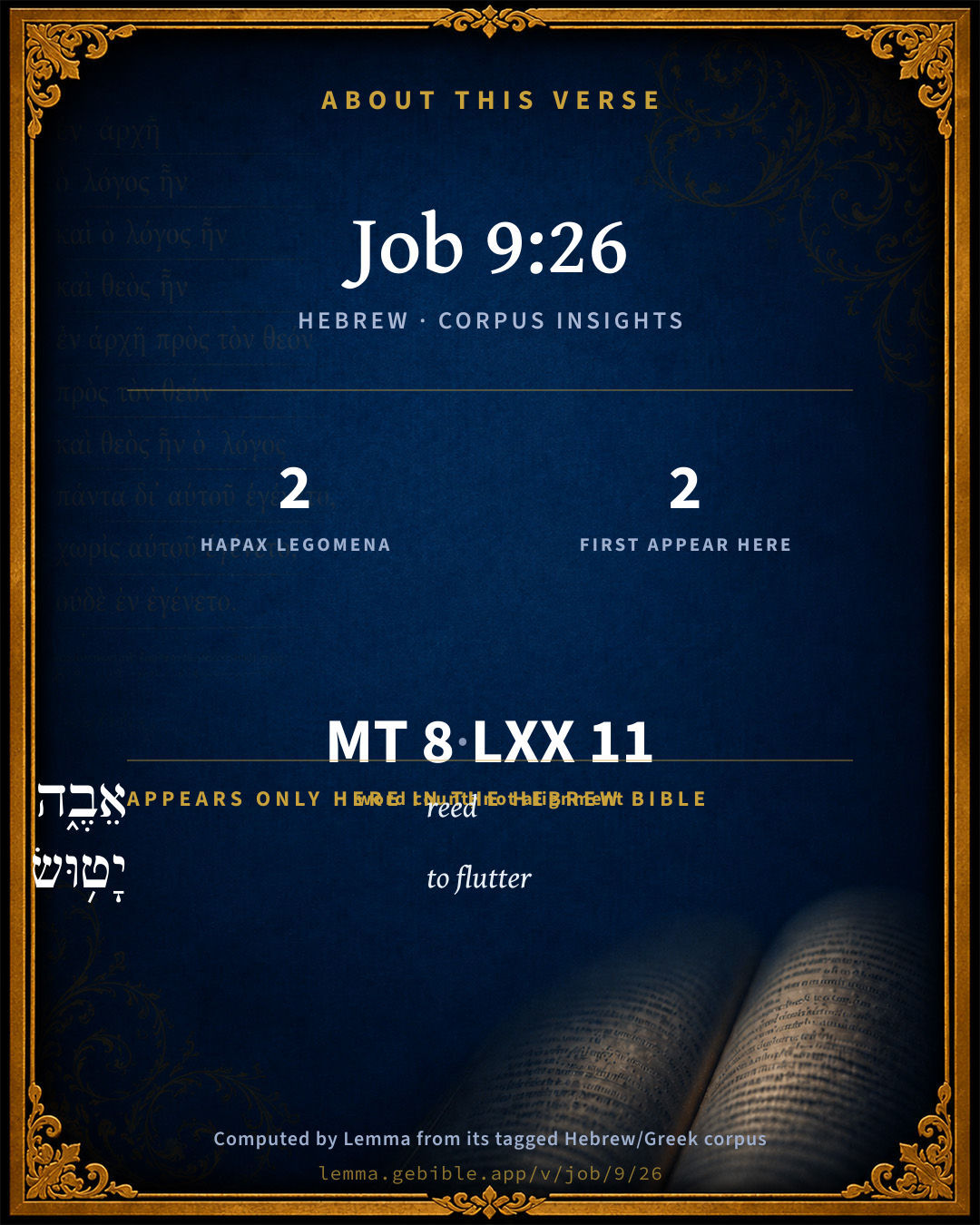
Job 9:26

Hebrew (Westminster Leningrad Codex) Job 9:26 appears in the Hebrew Old Testament. The text above is from the Westminster Leningrad Codex. Each word links to its Strong’s number, a concise gloss, and parsing drawn from the Open Scriptures Hebrew Bible morphology. Click any word for its full Brown-Driver-Briggs (BDB) entry.
Download image
Cite this verse

Job 9:26 (World English Bible). Public Domain. Lemma interlinear Bible study tool, https://lemma.gebible.app/v/job/9/26.

Show BibTeX & RIS
BibTeX
RIS
English Translation
They have passed away as the swift ships, As the eagle that swoops on the prey.
World English Bible · Public Domain
Highlights Full analysis ↓
Download a study sheet

One document with this verse’s original text, its word-by-word gloss line, the meaning frame, cross-references with their text, attributed commentary, and full source and license credits — printable, and it pastes into notes with its structure intact.

This verse Autodidact and up

Study sheet (.html) Plain text (.txt)

A passage Seminary Student

Up to 50 verses in one chapter. A passage sheet keeps up to 6 commentary sources and 12 cross-references per verse, in the order this page ranks them, and says so on the sheet whenever that leaves anything out. Ask for a single verse and you get the Autodidact verse sheet above.

Everything on this page stays free to read, with no account — the sheet is a download of what is already on screen, not access to it.

Want to remove ads? Support Godless Engineer
Compare translations 3

The same verse in 3 English versions, stacked beneath the original-language interlinear above. Click any original word for its lexicon entry.

Each is an independent rendering of the whole verse — the interlinear is not word-aligned to these translations.

Highlighted words mark where these versions differ — a whole-verse word diff, not a word-by-word alignment.

  • World English Bible Public Domain
    They have passed away as the swift ships, As the eagle that swoops on the prey.
  • King James Version Public Domain
    They are passed away as the swift ships: as the eagle that hasteth to the prey.
  • unfoldingWord Literal Text CC BY-SA 4.0
    They glide with boats of papyrus, as an eagle pounces on food.

unfoldingWord Literal Text — © unfoldingWord, licensed CC BY-SA 4.0. Word-aligned USFM3 via Door43 (git.door43.org/unfoldingWord/en_ult).

Versions to compare (up to 4)

3 of 4 selected

Show all 18 translations

Every available English version of this verse, each an independent rendering of the whole verse.

  • World English Bible Public Domain
    They have passed away as the swift ships, As the eagle that swoops on the prey.
  • Berean Standard Bible Public Domain
    They sweep by like boats of papyrus, like an eagle swooping down on its prey.
  • Majority Standard Bible Public Domain
    They sweep by like boats of papyrus, like an eagle swooping down on its prey.
  • King James Version Public Domain
    They are passed away as the swift ships: as the eagle that hasteth to the prey.
  • American Standard Version (1901) Public Domain
    They are passed away as the swift ships; As the eagle that swoopeth on the prey.
  • Revised Version (1885) Public Domain
    They are passed away as the swift ships: as the eagle that swoopeth on the prey.
  • Geneva Bible (1599) Public Domain
    They are passed as with the most swift ships, and as the eagle that flyeth to the pray.
  • Douay-Rheims (1899) Public Domain
    They have passed by as ships carrying fruits, as an eagle flying to the prey.
  • Young's Literal Translation Public Domain
    They have passed on with ships of reed, As an eagle darteth on food.
  • Literal Standard Version CC BY-SA 4.0
    They have passed on with ships of reed, || As an eagle darts on food.
  • Unlocked Literal Bible CC BY-SA 4.0
    They are as fast as papyrus reed boats, and as fast as the eagle that swoops down on its victim.
  • unfoldingWord Literal Text CC BY-SA 4.0
    They glide with boats of papyrus, as an eagle pounces on food.
  • Darby Bible Public Domain
    They pass by like skiffs of reed; as an eagle that swoops upon the prey.
  • World Messianic Bible Public Domain
    They have passed away as the swift ships, as the eagle that swoops on the prey.
  • Webster's Bible Public Domain
    They are passed away as the swift ships: as the eagle that hasteth to the prey.
  • Free Bible Version CC BY-SA 4.0
    They pass by like fast sailing ships, like an eagle swooping down on its prey.
  • Bible in Basic English Public Domain
    They go rushing on like reed-boats, like an eagle dropping suddenly on its food.
  • JPS Tanakh (1917) Public Domain
    They are passed away as the swift ships; as the vulture that swoopeth on the prey.

Literal Standard Version (2020), Covenant Press — licensed CC BY-SA 4.0. Text via the HelloAO Bible API (eBible.org). Unlocked Literal Bible (unfoldingWord) — licensed CC BY-SA 4.0. Text via the HelloAO Bible API (eBible.org). unfoldingWord Literal Text — © unfoldingWord, licensed CC BY-SA 4.0. Word-aligned USFM3 via Door43 (git.door43.org/unfoldingWord/en_ult). Free Bible Version, Dr. Jonathan Gallagher — licensed CC BY-SA 4.0. Text via the HelloAO Bible API (eBible.org).

Word by word

More ways to search: Search by grammar → Find every occurrence → Compare this word →

Practice this passage: Drill this verse → Learn its vocabulary →

About this verse

These counts appear in no published source. They are computed here, from the morphology-tagged text and Lemma’s own curated glosses. What Lemma adds →

8
words
8
distinct lemmas
Wisdom
section

Notable vocabulary

2 hapax legomena — words that appear only here in the entire Hebrew Bible:

  • אֵבֶ֑ה reed H16
  • יָט֥וּשׂ to flutter H2907

First appearance in Scripture

These words make their first canonical appearance in the Hebrew Bible here:

  • אֵבֶ֑ה reed H16
  • יָט֥וּשׂ to flutter H2907

Shared distinctive vocabulary

כְּ֝נֶ֗שֶׁר eagle H5404 occurs in 26 verses of the Hebrew Bible. Also found in:

Grammatical profile

  • 2 verbs
  • 4 nouns
  • 2 prepositions

Verb forms

  • חָ֭לְפוּ Qal · Perfect
  • יָט֥וּשׂ Qal · Imperfect

Hebrew & Septuagint length

In English translation the verse runs 16 words from the Hebrew and 25 from the Septuagint (LXX English) — the Septuagint runs noticeably longer here. See the side-by-side →

A rough comparison of the two English renderings, which tokenize alike — not a word-level alignment.

Word counts can differ between the Hebrew and the Greek without any difference in meaning — e.g. the Hebrew direct-object marker אֵת has no separate Greek word, and Greek often adds the article ὁ.

In the original languages it is 8 Hebrew tokens and 11 Greek tokens — but the two are counted differently (Hebrew bundles its prefixes and suffixes into one token; the Greek is in lemma form), so that isn’t a like-for-like length.

Cross-references

7

Topical passages linked to Job 9:26 in the Treasury of Scripture Knowledge — connected by theme and wording, ordered by reader-vote popularity; previews shown in the World English Bible.

  • Habakkuk 1:8 Their horses also are swifter than leopards, and are more fierce than the evening wolves. Their horsemen press proudly on. Yes, their horsemen come from afar. They fly as an eagle that hurries to devour.
  • Isaiah 18:2 that sends ambassadors by the sea, even in vessels of papyrus on the waters, [saying], Go, you swift messengers, to a nation tall and smooth, to a people awesome from their beginning onward, a nation that measures out and treads down, whose land the rivers divide!
  • 2 Samuel 1:23 Saul and Jonathan were lovely and pleasant in their lives, In their death they were not divided: They were swifter than eagles, They were stronger than lions.
  • Job 39:27–30 Is it at your command that the eagle mounts up, And makes his nest on high?
  • Proverbs 23:5 Why do you set your eyes on that which is not? For it certainly sprouts wings like an eagle and flies in the sky.
  • Jeremiah 4:13 Behold, he shall come up as clouds, and his chariots [shall be] as the whirlwind: his horses are swifter than eagles. Woe to us! for we are ruined.
  • Lamentations 4:19 Our pursuers were swifter than the eagles of the sky: They chased us on the mountains, they laid wait for us in the wilderness.

Cross-references courtesy of OpenBible.info (CC BY 4.0).

Hebrew and Greek witnesses Masoretic Hebrew ↔ Greek Septuagint

The same verse in the two great witnesses to the Old Testament, shown verse-for-verse.

Here the Septuagint runs noticeably longer than the Hebrew — LXX2012 (modern English Septuagint) 25 words vs World English Bible 16. A rough length comparison of the two English translations, not a word-level alignment — read both below.

These are two independent witnesses, not word-aligned to each other, and the Septuagint is shown in lemma (dictionary) form.

Hebrew Job 9:26 Masoretic · Westminster Leningrad Codex

חָ֭לְפוּ עִם אֳנִיּ֣וֹת אֵבֶ֑ה כְּ֝נֶ֗שֶׁר יָט֥וּשׂ עֲלֵי אֹֽכֶל

They have passed away as the swift ships, As the eagle that swoops on the prey.

World English Bible · Public Domain

Greek LXX Job 9:26 Septuagint · lemma form

ἦ καί εἰμί ναῦς ἴχνος ὁδός ἤ ἀετός πέτομαι ζητέω βορά

Or again, is there a trace of their path left by ships? or is there one of the flying eagle as it seeks its prey?

LXX2012 (modern English Septuagint) · Public Domain

On this verse, Albert Barnes' Notes on the Bible discusses the Septuagint’s reading. Read the note in Commentary ↓

Hebrew: Westminster Leningrad Codex (CC BY 4.0). Greek: Septuagint (public domain); English from LXX2012 (modern English Septuagint) (Public Domain). How the Septuagint differs from the Hebrew →

Commentary

Notes on Job 9:26 from classic Christian and Jewish commentators (each source and its license shown beneath its notes). The classic Christian expositions comment on the surrounding passage and are grouped to its opening verse, so a note may address several verses; the Jewish commentaries on the Tanakh (Rashi and others) are per-verse, so they appear only where the commentator wrote on this verse.

Lemma curates 59 commentaries, every one of them public domain or Creative Commons licensed, each selected and text-cleaned for this edition rather than reprinted as found. About our sources →

Trapp's Complete Commentary

John Trapp

Job 9:26 They are passed away as the swift ships: as the eagle [that] hasteth to the prey.

Ver. 26. They are passed away as the swift ships] Heb. They are changed (gliding away insensibly) as the ships of desire (so called, because they seem willing to be at the haven as soon as may be), or as the ships of Ebeh, a very swift river in Arabia, saith Rabbi Solomon; or as the pirate’s ships, so Broughton, such as are your nimble frigates, fly-boats, {A fast sailing vessel used chiefly in the sixteenth and seventeenth centuries: a. for rapid transport of goods, etc., esp. in the coasting trade} and catches, &c. Labitur uncta vadis abies (Virg.). Let our souls be like a ship which is made little and narrow downward; but more wide and broad upward. Let them be ships of desire, hastening heavenward; and then let our days pass away as they can, we shall but be the sooner at home; mortality shall appear to be no small mercy.

As the eagle that hasteth to the prey] When hunger addeth swiftness to her wings, and maketh her pour or souse down upon the prey like a thunderbolt; so transitory is our time: redeem it, therefore. It is reported of Ignatius, that when he heard a clock strike, he would say, Here is one hour more now past that I have to answer for.

John Trapp, A Commentary or Exposition upon All the Books of the Old and New Testament (1647–1656) — public domain. Text from a community e-Sword module.

Joseph Benson's Commentary

Job 9:26. As the swift ships — Hebrew, ships of desire; that is, such as are longed for, and long to be at their destined port, and crowd all the sail they can for that purpose. Or, as in the Chaldee paraphrase, ships loaded, pretiosis, with things of value; and are therefore named swift ships, because the more valuable the effects are, the more haste is made to return home for readier sale. The Hebrew may also be translated, ships of pleasure, which sail more swiftly than ships of burden. As the eagle that hasteth to the prey — Which generally flies most swiftly when hungry, and in sight of his prey. See here how swift the motion of time is! It is always upon the wing, hastening to its period. What little need have we of pastimes! What great need to redeem time, which runs out, runs on so fast toward eternity! And how vain are the enjoyments of time, which we may be deprived of, even while time continues. Our day may be longer than our sunshine: and when that is gone, it is as if it had never been.

Joseph Benson's Commentary on the Old and New Testaments (1811–1818) — public domain. Text from a community e-Sword module.

Jamieson, Fausset & Brown

Robert Jamieson, A. R. Fausset & David Brown

swift ships--rather, canoes of reeds or papyrus skiffs, used on the Nile, swift from their lightness (Isa 18:2).

Jamieson, Fausset & Brown — Commentary Critical and Explanatory on the Whole Bible (1871) — public domain (CC PDM 1.0). Text via the HelloAO Bible API.

Adam Clarke's Commentary

Verse 26. As the swift ships] אניות אבה oniyoth ebeh. Ships of desire, or ships of Ebeh, says our margin; perhaps more correctly, inflated ships, the sails bellying out with a fair brisk wind, tide favourable, and the vessels themselves lightly freighted.

The Vulgate has, Like ships freighted with apples. Ships laden with the best fruits. - TARGUM. Ships well adapted for sailing. - ARABIC. Shipes that be good under sale. - COVERDALE. Probably this relates to the light fast-sailing ships on the Nile, which were made of reeds or papyrus.

Perhaps the idea to be seized is not so much the swiftness of the passage, as their leaving no trace or track behind them. But instead of אבה ebeh, איבה eybah, hostile ships or the ships of enemies, is the reading of forty-seven of Kennicott's and De Rossi's MSS., and of the Syriac version. If this be the true reading what is its sense? My days are gone off like the light vessels of the pirates, having stripped me of my property, and carried all irrecoverably away, under the strongest press of sail, that they may effect their escape, and secure their booty.

The next words, As the eagle that hasteth to the prey, seem at least to countenance, if not confirm, the above reading: the idea of robbery and spoil, prompt attack and sudden retreat, is preserved in both images.

Adam Clarke's Commentary on the Bible (1810–1826) — public domain. Text from a community e-Sword/MySword module.

Ellicott's Commentary for English Readers

(26) Swift ships.—What is meant by the swift ships, or ships of Desire, no one knows. Literally, ships of Eveh, probably a proper name, and perhaps referring to a particular kind of boat in use on the Nile; if so, this is one instance out of many of Job’s acquaintance with Egypt. The Vulgate has, naves poma portantes. Job is a problem to himself; he is confident of his innocence, and yet he is confident that that very innocence will avail him nothing before God, he is sure that he must be condemned. Now, it is impossible to deny that this is the very attitude of the Gospel; it is, therefore, if we bear in mind the vast antiquity of the confession, both a witness to the truth of the Gospel and an anticipation of it that God alone could give. Indeed, it is hopelessly impossible to enter into the position of Job unless we are ourselves enlightened with the teaching of the Gospel, and able to look at it from the Gospel standpoint. While, therefore, admitting this fact, we are the better able to appreciate the wonderful confession Job is about to make in Job_9:32-33.

A Bible Commentary for English Readers, edited by Charles John Ellicott (1878–1897) — public domain. Text from a community e-Sword module.

The Cambridge Bible for Schools and Colleges

gen. ed. J. J. S. Perowne

26. the swift ships] the ships of reed. These skiffs, constructed of a wooden keel and the rest of reeds, are the “vessels of bulrushes” of Isa_18:2. They carried but one or two persons, and being light were extremely swift. The ancients were familiar with them; Plin. xiii. 11, ex ipso quidem papyro navigia texunt; and Lucan, Phars, iv. 36,

conseritur bibula Memphitis cymba papyro,

(quoted in Gesenius, Com. on Is. i. p. 577).

Job as usual heaps images together to picture out the brevity of his life, cf. ch. Job_7:6 seq. Here the images are new, a runner, a skiff of reed, an eagle swooping on his prey.

The Cambridge Bible for Schools and Colleges (gen. ed. J. J. S. Perowne; Cambridge University Press, 1878–1918) — public domain. Text from a community e-Sword module.

John Gill's Exposition

If I say, I will forget my complaint,.... The cause of it, the loss of his children, servants, substance, and health, and endeavour to think no more of these things, and cease complaining about them, and attempt to bury them in oblivion, and change his note:

I will leave off my heaviness; his melancholy thoughts, words, airs, and looks; or "forsake my face" (h), put on another countenance, a more pleasent and cheerful one; the Jewish commentators generally interpret it, "my anger", either at the dispensations of Providence, or at his friends:

and comfort myself; that things were not worse with him than they were; or strengthen (i) himself, as the word is rendered in Amo 5:9; against his fears, and troubles, and dejection of mind, determining to take heart, and be of good courage, and not sink, and succumb, and faint under his burdens: none but God, Father, Son, and Spirit, can give comfort to distressed ones, whether on temporal or spiritual accounts; but good men may make use of means for comfort, such as hearing the word, reading the Scriptures, prayer, meditation, and conversation with good men.

(h) "relinquam facies meas", Montanus, Bolducius, Schmidt. (i) "confirmabo vel roborabo cor meum", Mercerus; so R. R.

John Gill's Exposition of the Whole Bible (1746–1763) — public domain (CC PDM 1.0). Text via the HelloAO Bible API.

Albert Barnes' Notes on the Bible

They are passed away as the swift ships - Margin, Ships of desire; or ships of Ebeh. Hebrew אבה אניה 'onı̂yâh 'êbeh. Vulgate, Naves poma portantes. Septuagint, “Is there any track left by ships in their passage?” The Chaldee renders it as the Vulgate, “Ships bearing good fruit;” that is, as such fruit was perishable, haste was required in order to reach the place of destination. Our translators were evidently perplexed by the word אבה 'êbeh, as appears by their placing two different phrases in the margin. “Ships of desire,” denotes the value or desirableness of such ships; and the phrase, “Ships of Ebeh,” denotes their confession of ignorance as to the meaning of the word. Gesenius explains the word to mean reed, bulrush, or papyrus - from an Arabic use of the word, and supposes that the reference is to the light vessels made of the papyrus, which were used on the Nile; see the note at Isa 18:2. Such vessels would be distinguished for the ease with which they might be rowed, and the rapidity of their motion. Chardin supposes that the reference is to vessels that were made to go on the Euphrates or the Tigris, and that were borne along with the rapid current. The supposition of an allusion to any boat or vessel under full sail, will be in accordance with the language here, though the probability is, that the reference is to the light vessels, made of reeds, that might be propelled with so much fleetness. Sails were frequently used, also, for such vessels.

As the eagle that hasteth to the prey - A striking emblem of rapidity. Few things can be more rapid than the motion of the eagle, as he darts upon his victim.

Albert Barnes' Notes on the Bible (1834–1885) — public domain. Text from a community e-Sword/MySword module.

Haydock's Catholic Bible Commentary

Carrying. Hebrew literally, "of desire," belonging to one person, or full of goods, which he desires to carry quickly to market. (Menochius) --- Chaldean agrees with us. But most interpreters var. Pagnin retains the original, ebe; (Haydock) supposing the rive Abeh, or Avah, is meant. It certainly implies expedition; "they have hastened like (Calmet) the eagle to its prey." Septuagint, "Is there any trace of ships, or of an eagle flying in quest of food?" (Haydock)

George Leo Haydock (1774–1849), Haydock's Catholic Family Bible and Commentary, 1859 edition — public domain. Excludes Psalms (Douay-Rheims chapter numbering differs from Protestant) and Deuterocanonical books (Catholic canon only).

Matthew Poole's English Annotations

Swift ships, Heb. ships of desire; which make great haste, as if they longed for their desired haven, as it is called, Psa 107:30. Or, ships of pleasure; which sail more swiftly than ships of great burden.

As the eagle; which generally flies most swiftly, Deu 28:49; Jer 4:13; Lam 4:19, especially when its own hunger and the sight of its prey quickens its motion.

Matthew Poole's English Annotations on the Holy Bible (1683–1685) — public domain. Text from a community e-Sword/MySword module.

Whedon's Commentary on the Bible

Daniel D. Whedon

26. Passed away as — Literally, Glide along with. חלפו. See note on Job_9:11. The poet, in a figure finely conceived, links his passing days with the gliding of a river, whose silent, insensible current serves only to hasten the motion of the frail, swift craft its bosom bears. The frailty of the skiff Job speaks of images well the frail voyager of life, as he, too, glides among the stream of time.

Swift ships — אבה, ebeh, reed, or papyrus. Light in their structure, skiffs made of papyrus shot along the Nile with great swiftness. Compare Isa_18:2. Heliodorus (AEthiop., 10:460) speaks of such boats as having been exceedingly swift. Plutarch describes Isis going in search of the body of Osiris in a bark made of papyrus. The text illustrates the swiftness of time by figures drawn from objects that in Job’s days were swiftest on land, in the water, and in the air. The reader will mark the gradation.

Daniel D. Whedon (gen. ed.), Commentary on the Old and New Testaments (1874–1909) — public domain. Text from a community e-Sword module.

The Pulpit Commentary

They are passed away as the swift ships; literally, like the ships of reed. The allusion is probably to the frail reed vessels of the Egyptians, of which many ancient writers speak (see Theophrastus, "Hist. Plant.," 4:9; Pithy, "Hist. Nat.," 6:56; 13:11; Luean, "Pharsalis," 4:36, etc.). They were long, light canoes, formed generally of the papyrus plant, and propelled either by a single paddle or by a punting-pole. They were fiat-bottomed and broad, like punts, with a stem and stern rising considerably above the level of the water (see the authors "History of Ancient Egypt," vol. 1. pp. 507, 508). Isaiah speaks of them as "vessels of bulrushes," in which "swift messengers" were sent by the nations peopling the banks of the Nile. (Isa_18:1, Isa_18:2) The Euphrates boats described by Herodotus (1:194) were of an entirely different construction, and cannot be here intended. They consisted of a framework of wood, which was covered with skins, and then coated with bitumen, and resembled the Welsh "coracles." As the eagle that hasteth to the prey; or, as the eagle that swoopeth on the prey (Revised Version). Job"s observation presents to him three types of swiftness the trained runner upon the earth, the swift ships upon the waters, and the hungry eagle in the air. It seems to him that his life passes away as swiftly as any of these.

The Pulpit Commentary (1880–1919), ed. H.D.M. Spence-Jones & Joseph S. Exell — public domain. Text from a community e-Sword module.

John Wesley's Explanatory Notes

Eagle - Which flies swiftly, especially when in the sight of his prey. See here how swift the motion of time is! It is always upon the wing, hastening to its period. What little need have we of past- times! What great need to redeem time, which runs out, runs on so fast toward eternity! And how vain are the enjoyments of time, which we may be deprived of, even while time continues! Our day may be longer than our sunshine: and when that is gone, it is as if it had never been.

John Wesley, Explanatory Notes Upon the Whole Bible (1754–1765) — public domain. Text via the GEBible commentary corpus.

Rashi

Rabbi Shlomo Yitzchaki (Rashi)

Ebeh The name of a rushing river.

swoops Heb. יטוש, flies.

Rashi on the Tanakh — English translations: “The Judaica Press complete Tanach with Rashi, translated by A. J. Rosenberg” (CC BY 4.0); “Pentateuch with Rashi's commentary by M. Rosenbaum and A.M. Silbermann, 1929-1934” (public domain); “The Metsudah Tanach series, Lakewood, N.J” (CC BY 4.0); and “The Book of Joshua, Metsudah Publications, 1997” (CC BY 4.0). Text via Sefaria.

Lesson kit

Teaching starters — assembled from the data on this page, not authored interpretation. Every prompt links to the verse data it draws on. Edit before teaching.

Job, in the Wisdom, opens this verse with 8 words (8 distinct Hebrew lemmas). Its most distinctive word is ʼêbeh (“reed”). The Greek Septuagint runs longer here. A historical commentator’s framing appears above. Read the whole chapter for the surrounding context.

Discussion questions

  1. What does “reed” (ʼêbeh) contribute to the verse as a whole?
  2. This verse holds 2 words here found nowhere else in the Hebrew Bible. What might the rare words draw attention to?
  3. 2 words here appear for the first time in Scripture. What is being introduced at this debut?
  4. Exodus 19:4 shares the word «eagle» with this verse. How do the two illuminate each other?
  5. Compared with the Hebrew, the Septuagint runs longer here. What questions does that raise?
  6. These translations render this verse differently; the difference is in the English rendering, not the original. What questions does that raise?
  7. The verb «חָ֭לְפוּ» is Qal Perfect. How does its form color the action?
  8. Reading how Trapp's Complete Commentary and Joseph Benson's Commentary read this verse, where do the two commentators agree and where do they part?

Things to notice

Reading settings

Reading text

Shown beneath each verse's original-language words.

Old Testament
Old Testament edition

Read the OT as the Masoretic Hebrew (MT) or the Greek Septuagint (LXX).

English shown for the Greek Septuagint (in the Hebrew ↔ Greek comparison).

Comparing translations? Open the Compare panel on any verse page to stack up to four side by side.