1 Samuel 9:23

Hebrew (Westminster Leningrad Codex) 1 Samuel 9:23 appears in the Hebrew Old Testament. The text above is from the Westminster Leningrad Codex. Each word links to its Strong’s number, a concise gloss, and parsing drawn from the Open Scriptures Hebrew Bible morphology. Click any word for its full Brown-Driver-Briggs (BDB) entry.
Download image
Cite this verse

1 Samuel 9:23 (World English Bible). Public Domain. Lemma interlinear Bible study tool, https://lemma.gebible.app/v/1-samuel/9/23.

Show BibTeX & RIS
BibTeX
RIS
English Translation
Samuel said to the cook, Bring the portion which I gave you, of which I said to you, Set it by you.
World English Bible · Public Domain
Download a study sheet

One document with this verse’s original text, its word-by-word gloss line, the meaning frame, cross-references with their text, attributed commentary, and full source and license credits — printable, and it pastes into notes with its structure intact.

This verse Autodidact and up

Study sheet (.html) Plain text (.txt)

A passage Seminary Student

Up to 50 verses in one chapter. A passage sheet keeps up to 6 commentary sources and 12 cross-references per verse, in the order this page ranks them, and says so on the sheet whenever that leaves anything out. Ask for a single verse and you get the Autodidact verse sheet above.

Everything on this page stays free to read, with no account — the sheet is a download of what is already on screen, not access to it.

Want to remove ads? Support Godless Engineer
Compare translations 3

The same verse in 3 English versions, stacked beneath the original-language interlinear above. Click any original word for its lexicon entry.

Each is an independent rendering of the whole verse — the interlinear is not word-aligned to these translations.

Highlighted words mark where these versions differ — a whole-verse word diff, not a word-by-word alignment.

  • World English Bible Public Domain
    Samuel said to the cook, Bring the portion which I gave you, of which I said to you, Set it by you.
  • King James Version Public Domain
    And Samuel said unto the cook, Bring the portion which I gave thee, of which I said unto thee, Set it by thee.
  • unfoldingWord Literal Text CC BY-SA 4.0
    And Samuel said to the cook, “Give the portion that I gave to you, which I said to you, ‘Set it with you.’”

unfoldingWord Literal Text — © unfoldingWord, licensed CC BY-SA 4.0. Word-aligned USFM3 via Door43 (git.door43.org/unfoldingWord/en_ult).

Versions to compare (up to 4)

3 of 4 selected

Show all 18 translations

Every available English version of this verse, each an independent rendering of the whole verse.

  • World English Bible Public Domain
    Samuel said to the cook, Bring the portion which I gave you, of which I said to you, Set it by you.
  • Berean Standard Bible Public Domain
    And Samuel said to the cook, “Bring the portion I gave you and told you to set aside.”
  • Majority Standard Bible Public Domain
    And Samuel said to the cook, “Bring the portion I gave you and told you to set aside.”
  • King James Version Public Domain
    And Samuel said unto the cook, Bring the portion which I gave thee, of which I said unto thee, Set it by thee.
  • American Standard Version (1901) Public Domain
    And Samuel said unto the cook, Bring the portion which I gave thee, of which I said unto thee, Set it by thee.
  • Revised Version (1885) Public Domain
    And Samuel said unto the cook, Bring the portion which I gave thee, of which I said unto thee, Set it by thee.
  • Geneva Bible (1599) Public Domain
    And Samuel saide vnto the cooke, Bring foorth the portion which I gaue thee, and whereof I said vnto thee, Keepe it with thee.
  • Douay-Rheims (1899) Public Domain
    And Samuel said to the cook: Bring the portion, which I gave thee, and commanded thee to set it apart by thee.
  • Young's Literal Translation Public Domain
    And Samuel saith to the cook, `Give the portion which I gave to thee, of which I said unto thee, `Set it by thee?'
  • Literal Standard Version CC BY-SA 4.0
    And Samuel says to the cook, “Give the portion which I gave to you, of which I said to you, Set it by you.”
  • Unlocked Literal Bible CC BY-SA 4.0
    Samuel said to the cook, “Bring the portion which I gave to you, of which I said to you, 'Put it aside.'”
  • unfoldingWord Literal Text CC BY-SA 4.0
    And Samuel said to the cook, “Give the portion that I gave to you, which I said to you, ‘Set it with you.’”
  • Darby Bible Public Domain
    And Samuel said to the cook, Bring the portion that I gave thee, of which I said to thee, Set it by thee.
  • World Messianic Bible Public Domain
    Samuel said to the cook, “Bring the portion which I gave you, of which I said to you, ‘Set it aside.’”
  • Webster's Bible Public Domain
    And Samuel said to the cook, Bring the portion which I gave thee, of which I said to thee, Set it by thee.
  • Free Bible Version CC BY-SA 4.0
    Samuel told the cook, “Bring the special piece of meat I gave you and told you to keep to one side.”
  • Bible in Basic English Public Domain
    And Samuel said to the cook, Give me that part which I gave you orders to keep by you.
  • JPS Tanakh (1917) Public Domain
    And Samuel said unto the cook: 'Bring the portion which I gave thee, of which I said unto thee: Set it by thee.'

Literal Standard Version (2020), Covenant Press — licensed CC BY-SA 4.0. Text via the HelloAO Bible API (eBible.org). Unlocked Literal Bible (unfoldingWord) — licensed CC BY-SA 4.0. Text via the HelloAO Bible API (eBible.org). unfoldingWord Literal Text — © unfoldingWord, licensed CC BY-SA 4.0. Word-aligned USFM3 via Door43 (git.door43.org/unfoldingWord/en_ult). Free Bible Version, Dr. Jonathan Gallagher — licensed CC BY-SA 4.0. Text via the HelloAO Bible API (eBible.org).

Word by word

More ways to search: Search by grammar → Find every occurrence → Compare this word →

Practice this passage: Drill this verse → Learn its vocabulary →

הַמָּנָ֔ה
mânâh
H4490
“the · portion”
Particle, Definite Article + Noun, Common, Feminine, Singular, Absolute
Part of Speech
Particle + Noun
Type
Common
Gender
Feminine
Number
Singular
State
Absolute
Full BDB Definition

Origin: from H4487

TWOT: 1213a

part, portion
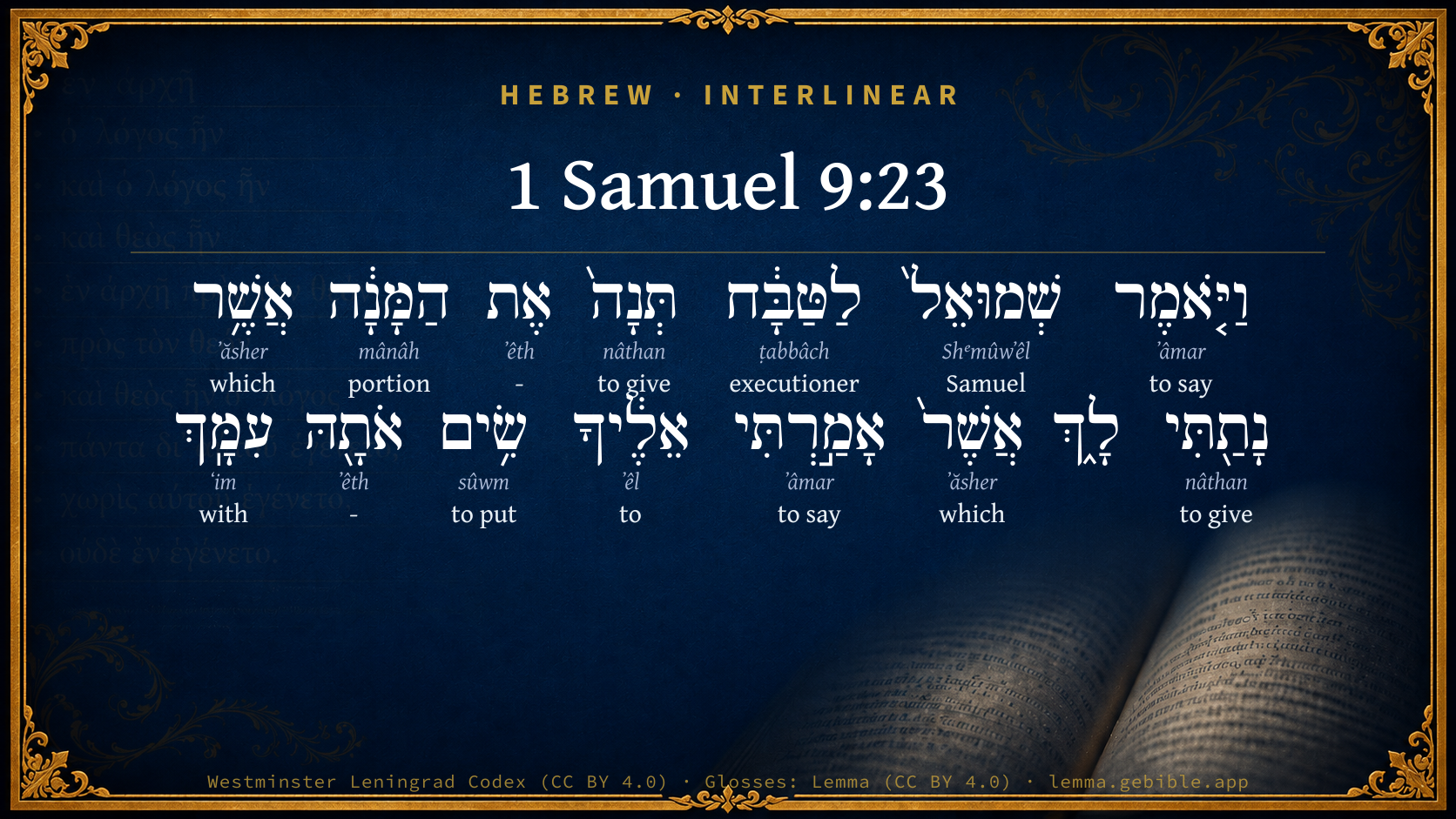
  1. וַיֹּ֤אמֶר ʼâmar H559 “and · to say” Conjunction + Verb, Qal, Sequential Imperfect, 3rd Person, Masculine, Singular
  2. שְׁמוּאֵל֙ Shᵉmûwʼêl H8050 “Samuel” Noun, Proper
  3. לַטַּבָּ֔ח ṭabbâch H2876 “to/for the · executioner” Preposition, Determined + Noun, Common, Masculine, Singular, Absolute
  4. תְּנָה֙ nâthan H5414 “give” Verb, Qal, Imperative, 2nd Person, Masculine, Singular + Suffix, h
  5. אֶת ʼêth H853 “-” Particle, Direct Object
  6. אֲשֶׁ֥ר ʼăsher H834 “which” Particle, Relative
  7. נָתַ֖תִּי nâthan H5414 “to give” Verb, Qal, Perfect, 1st Person, Common, Singular
  8. אֲשֶׁר֙ ʼăsher H834 “which” Particle, Relative
  9. אָמַ֣רְתִּי ʼâmar H559 “to say” Verb, Qal, Perfect, 1st Person, Common, Singular
  10. אֵלֶ֔יךָ ʼêl H413 “to · you” Preposition + Suffix, Personal, 2nd Person, Masculine, Singular
  11. שִׂ֥ים sûwm H7760 “put” Verb, Qal, Imperative, 2nd Person, Masculine, Singular
  12. אֹתָ֖הּ ʼêth H853 “- · her” Particle, Direct Object + Suffix, Personal, 3rd Person, Feminine, Singular
  13. עִמָּֽךְ ʻim H5973 “with · you” Preposition + Suffix, Personal, 2nd Person, Feminine, Singular

About this verse

These counts appear in no published source. They are computed here, from the morphology-tagged text and Lemma’s own curated glosses. What Lemma adds →

15
words
10
distinct lemmas
Historical
section

Notable vocabulary

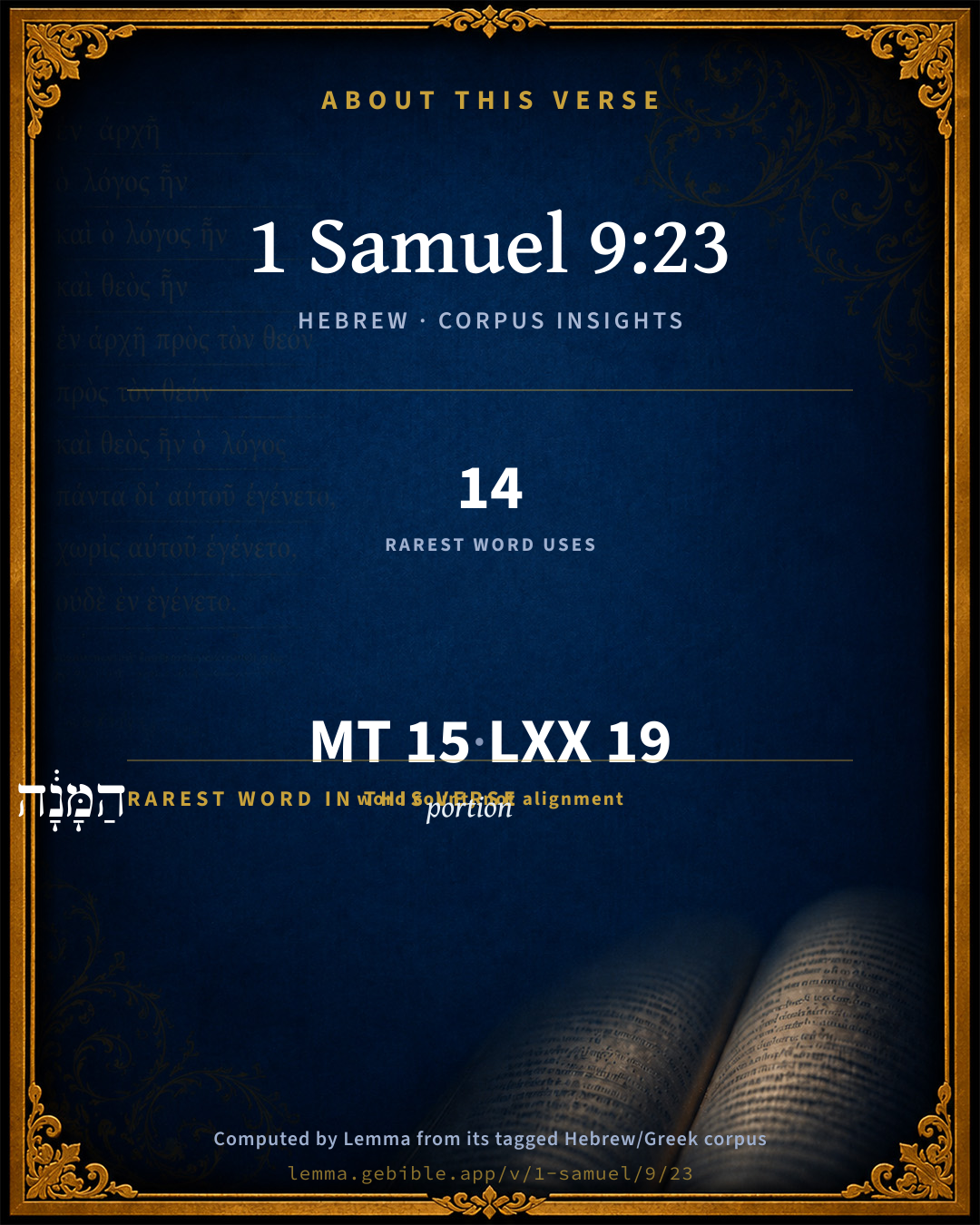
The rarest word here is הַמָּנָ֔ה portion H4490 — appearing just 14 times in the whole Hebrew Bible.

Shared distinctive vocabulary

הַמָּנָ֔ה portion H4490 occurs in 14 verses of the Hebrew Bible. Also found in:

Grammatical profile

  • 5 verbs
  • 3 nouns
  • 3 prepositions
  • 4 particles

Verb forms

  • וַיֹּ֤אמֶר Qal · Sequential Imperfect
  • תְּנָה֙ Qal · Imperative
  • נָתַ֖תִּי Qal · Perfect
  • אָמַ֣רְתִּי Qal · Perfect
  • שִׂ֥ים Qal · Imperative

Repetition

Words recur within this verse — often emphatic in Hebrew:

  • וַיֹּ֤אמֶר to say H559 ×2
  • תְּנָה֙ to give H5414 ×2
  • אֲשֶׁ֥ר which H834 ×2

Hebrew & Septuagint length

In English translation the verse runs 22 words from the Hebrew and 22 from the Septuagint (LXX English) — the same length.

A rough comparison of the two English renderings, which tokenize alike — not a word-level alignment.

Word counts can differ between the Hebrew and the Greek without any difference in meaning — e.g. the Hebrew direct-object marker אֵת has no separate Greek word, and Greek often adds the article ὁ.

In the original languages it is 15 Hebrew tokens and 19 Greek tokens — but the two are counted differently (Hebrew bundles its prefixes and suffixes into one token; the Greek is in lemma form), so that isn’t a like-for-like length.

Cross-references

2

Topical passages linked to 1 Samuel 9:23 in the Treasury of Scripture Knowledge — connected by theme and wording, ordered by reader-vote popularity; previews shown in the World English Bible.

  • Genesis 43:34 He sent portions to them from before him, but Benjamin's portion was five times as much as any of theirs. They drank, and were merry with him.
  • 1 Samuel 1:5 but to Hannah he gave a double portion; for he loved Hannah, but Yahweh had shut up her womb.

Cross-references courtesy of OpenBible.info (CC BY 4.0).

Hebrew and Greek witnesses Masoretic Hebrew ↔ Greek Septuagint

The same verse in the two great witnesses to the Old Testament, shown verse-for-verse.

These are two independent witnesses, not word-aligned to each other, and the Septuagint is shown in lemma (dictionary) form.

Hebrew 1 Samuel 9:23 Masoretic · Westminster Leningrad Codex

וַיֹּ֤אמֶר שְׁמוּאֵל֙ לַטַּבָּ֔ח תְּנָה֙ אֶת הַמָּנָ֔ה אֲשֶׁ֥ר נָתַ֖תִּי לָ֑ךְ אֲשֶׁר֙ אָמַ֣רְתִּי אֵלֶ֔יךָ שִׂ֥ים אֹתָ֖הּ עִמָּֽךְ

Samuel said to the cook, Bring the portion which I gave you, of which I said to you, Set it by you.

World English Bible · Public Domain

Greek LXX 1 Samuel 9:23 Septuagint · lemma form

καί εἶπον σαμουηλ ὁ μάγειρος δίδωμι ἐγώ ὁ μερίς ὅς δίδωμι σύ ὅς εἶπον σύ τίθημι αὐτός παρά σύ

And Samuel said to the cook, Give me the portion which I gave you, which I told you to set by you.

LXX2012 (modern English Septuagint) · Public Domain

Hebrew: Westminster Leningrad Codex (CC BY 4.0). Greek: Septuagint (public domain); English from LXX2012 (modern English Septuagint) (Public Domain). How the Septuagint differs from the Hebrew →

Targum (Aramaic paraphrase)

1

The Targum is the ancient Jewish Aramaic paraphrase of the Hebrew Scriptures — an interpretive translation, not the Hebrew text itself. Onkelos (literal) and Pseudo-Jonathan (expansive) render the Torah, and Jonathan the Prophets. Coverage is partial: where no permissively-licensed English translation exists for a verse, only the Aramaic is shown. This is verse-level text, not a word-by-word alignment to the Hebrew.

  1. Targum Jonathan Prophets (Joshua–Malachi)
    וַאֲמַר שְׁמוּאֵל לְטַבָּחָא הַב יַת מָנָתָא דִי יְהָבִית לָךְ דַאֲמָרִית לָךְ שַׁוִי יָתָהּ עִמָךְ:

    (no public-domain English translation for this verse)

    Targum Jonathan — Aramaic: “Mikraot Gedolot” (public domain). English: “Sefaria Community Translation” (CC0 1.0 (public-domain dedication)); “London "Chaldee Paraphrase," 1871” (public domain). Text via Sefaria.

Commentary

Notes on 1 Samuel 9:23 from classic Christian and Jewish commentators (each source and its license shown beneath its notes). The classic Christian expositions comment on the surrounding passage and are grouped to its opening verse, so a note may address several verses; the Jewish commentaries on the Tanakh (Rashi and others) are per-verse, so they appear only where the commentator wrote on this verse.

Lemma curates 59 commentaries, every one of them public domain or Creative Commons licensed, each selected and text-cleaned for this edition rather than reprinted as found. About our sources →

Trapp's Complete Commentary

John Trapp

1Sa 9:23 And Samuel said unto the cook, Bring the portion which I gave thee, of which I said unto thee, Set it by thee.

Ver. 23. Bring the portion which I gave thee.] A choice mess, that Saul might see by his cheer what his welcome was: and that the rest at table might take notice that Saul was no ordinary guest.

John Trapp, A Commentary or Exposition upon All the Books of the Old and New Testament (1647–1656) — public domain. Text from a community e-Sword module.

Joseph Benson's Commentary

1Sa 9:23-24. Bring the portion — The master of the house was wont to distribute to every one his portion. And Samuel had commanded the cook, before they sat down, not to set one dish upon the table, but to keep it till he called for it. And set it before Saul — As the principal place was given him at the feast, so the principal dish also was set before him, to express still the great regard he had to his person. Behold that which is left — Or rather, reserved. For unto this time it hath been kept, since I said, &c. — That is, when I first signified that I had invited the people to join with me in my sacrifice, and afterward to partake with me of the feast, I then ordered the cook to reserve this part for thy use.

Joseph Benson's Commentary on the Old and New Testaments (1811–1818) — public domain. Text from a community e-Sword module.

Adam Clarke's Commentary

Verse 23. Said unto the cook] טבח tabbach, here rendered cook; the singular of טבחות tabbachoth, female cooks, 1Sa 8:13, from the root tabach, to slay or butcher. Probably the butcher is here meant.

Adam Clarke's Commentary on the Bible (1810–1826) — public domain. Text from a community e-Sword/MySword module.

Ellicott's Commentary for English Readers

(23) And Samuel said unto the cook.—The meaning of this statement is simply this—all that took place in the meeting of the prophet and Saul at the sacrificial feast, and subsequently in Samuel’s house, was arranged for beforehand; every event was foreseen and provided for, even the trivial details—all was symbolical in this preparation for the great change in the constitution of Israel, which, under God’s providence, was fraught with such important consequences. The very piece of meat set before Samuel at the Ramah banquet was no chance piece, but one which, owing, no doubt, to its being considered the choicest, had been carefully set aside for him when the sacrificial feast was being prepared.

A Bible Commentary for English Readers, edited by Charles John Ellicott (1878–1897) — public domain. Text from a community e-Sword module.

The Cambridge Bible for Schools and Colleges

gen. ed. J. J. S. Perowne

23. the portion] Cp. 1Sa_1:4.

The Cambridge Bible for Schools and Colleges (gen. ed. J. J. S. Perowne; Cambridge University Press, 1878–1918) — public domain. Text from a community e-Sword module.

John Gill's Exposition

And Samuel said unto the cook,.... That dressed and prepared the food for the entertainment of the guests:

bring the portion which I gave thee; to dress; for part of the provisions of the feast was Samuel's, and the other part the people's that brought the peace offerings:

of which I said unto thee, set it by thee; do not bring it in with the rest, but keep it in the kitchen till called for.

John Gill's Exposition of the Whole Bible (1746–1763) — public domain (CC PDM 1.0). Text via the HelloAO Bible API.

Matthew Poole's English Annotations

Or, which I appointed or disposed to thee, i.e. which I bade the reserve for this use.

Matthew Poole's English Annotations on the Holy Bible (1683–1685) — public domain. Text from a community e-Sword/MySword module.

Whedon's Commentary on the Bible

Daniel D. Whedon

23. The cook — שׂבח, the slaughterer. He who had the whole charge of the preparation, not only of the cooking, but also of the butchering.

Daniel D. Whedon (gen. ed.), Commentary on the Old and New Testaments (1874–1909) — public domain. Text from a community e-Sword module.

unfoldingWord translationNotes

Door43 World Missions Community

what was on it

Possible meanings are 1) the other food that Saul was to eat along with the meat or 2) other parts of the bull.

Then Samuel said

In the original language it is not clear who is speaking. It is possible that the cook is speaking to Saul. AT: "Then the cook said"

translationWords

Samuel

sacrifice

Saul (OT)

appoint

unfoldingWord translationNotes — © Distant Shores Media and the Door43 World Missions Community, licensed CC BY-SA 4.0. Source: git.door43.org/Door43/en_tn.

Rashi

Rabbi Shlomo Yitzchaki (Rashi)

About which I told you. Because Shmuel knew that Shaul would come, he ordered to give him a fine portion for his benefit.

Rashi on the Tanakh — English translations: “The Judaica Press complete Tanach with Rashi, translated by A. J. Rosenberg” (CC BY 4.0); “Pentateuch with Rashi's commentary by M. Rosenbaum and A.M. Silbermann, 1929-1934” (public domain); “The Metsudah Tanach series, Lakewood, N.J” (CC BY 4.0); and “The Book of Joshua, Metsudah Publications, 1997” (CC BY 4.0). Text via Sefaria.

Lesson kit

Teaching starters — assembled from the data on this page, not authored interpretation. Every prompt links to the verse data it draws on. Edit before teaching.

1 Samuel, in the Historical, opens this verse with 15 words (10 distinct Hebrew lemmas). Its most distinctive word is mânâh (“portion”). A historical commentator’s framing appears above. Read the whole chapter for the surrounding context.

Discussion questions

  1. The word mânâh carries the sense “portion.” How does it shape the verse?
  2. Exodus 29:26 shares the word «portion» with this verse. How do the two illuminate each other?
  3. “to say” occurs 2× in this one verse. What is the effect of the repetition?
  4. These translations render this verse differently. What is at stake in choosing one wording over another?
  5. The verb «וַיֹּ֤אמֶר» is Qal Sequential Imperfect. How does its form color the action?
  6. Reading how Trapp's Complete Commentary and Joseph Benson's Commentary read this verse, where do the two commentators agree and where do they part?

Things to notice

Reading settings

Reading text

Shown beneath each verse's original-language words.

Old Testament
Old Testament edition

Read the OT as the Masoretic Hebrew (MT) or the Greek Septuagint (LXX).

English shown for the Greek Septuagint (in the Hebrew ↔ Greek comparison).

Comparing translations? Open the Compare panel on any verse page to stack up to four side by side.