Ezra 8:3

Hebrew (Westminster Leningrad Codex) Ezra 8:3 appears in the Hebrew Old Testament. The text above is from the Westminster Leningrad Codex. Each word links to its Strong’s number, a concise gloss, and parsing drawn from the Open Scriptures Hebrew Bible morphology. Click any word for its full Brown-Driver-Briggs (BDB) entry.
Download image
Cite this verse

Ezra 8:3 (World English Bible). Public Domain. Lemma interlinear Bible study tool, https://lemma.gebible.app/v/ezra/8/3.

Show BibTeX & RIS
BibTeX
RIS
English Translation
Of the sons of Shecaniah, of the sons of Parosh, Zechariah; and with him were reckoned by genealogy of the males one hundred fifty.
World English Bible · Public Domain
Download a study sheet

One document with this verse’s original text, its word-by-word gloss line, the meaning frame, cross-references with their text, attributed commentary, and full source and license credits — printable, and it pastes into notes with its structure intact.

This verse Autodidact and up

Study sheet (.html) Plain text (.txt)

A passage Seminary Student

Up to 50 verses in one chapter. A passage sheet keeps up to 6 commentary sources and 12 cross-references per verse, in the order this page ranks them, and says so on the sheet whenever that leaves anything out. Ask for a single verse and you get the Autodidact verse sheet above.

Everything on this page stays free to read, with no account — the sheet is a download of what is already on screen, not access to it.

Want to remove ads? Support Godless Engineer
Compare translations 3

The same verse in 3 English versions, stacked beneath the original-language interlinear above. Click any original word for its lexicon entry.

Each is an independent rendering of the whole verse — the interlinear is not word-aligned to these translations.

Highlighted words mark where these versions differ — a whole-verse word diff, not a word-by-word alignment.

  • World English Bible Public Domain
    Of the sons of Shecaniah, of the sons of Parosh, Zechariah; and with him were reckoned by genealogy of the males one hundred fifty.
  • King James Version Public Domain
    Of the sons of Shechaniah, of the sons of Pharosh; Zechariah: and with him were reckoned by genealogy of the males an hundred and fifty.
  • unfoldingWord Literal Text CC BY-SA 4.0
    from the sons of Shecaniah. From the sons of Parosh: Zechariah, and with him were 150 males enrolled by genealogy.

unfoldingWord Literal Text — © unfoldingWord, licensed CC BY-SA 4.0. Word-aligned USFM3 via Door43 (git.door43.org/unfoldingWord/en_ult).

Versions to compare (up to 4)

3 of 4 selected

Show all 18 translations

Every available English version of this verse, each an independent rendering of the whole verse.

  • World English Bible Public Domain
    Of the sons of Shecaniah, of the sons of Parosh, Zechariah; and with him were reckoned by genealogy of the males one hundred fifty.
  • Berean Standard Bible Public Domain
    of the descendants of Shecaniah; from the descendants of Parosh, Zechariah, and with him were registered 150 men;
  • Majority Standard Bible Public Domain
    of the descendants of Shecaniah; from the descendants of Parosh, Zechariah, and with him were registered 150 men;
  • King James Version Public Domain
    Of the sons of Shechaniah, of the sons of Pharosh; Zechariah: and with him were reckoned by genealogy of the males an hundred and fifty.
  • American Standard Version (1901) Public Domain
    Of the sons of Shecaniah, of the sons of Parosh, Zechariah; and with him were reckoned by genealogy of the males a hundred and fifty.
  • Revised Version (1885) Public Domain
    Of the sons of Shecaniah; of the sons of Parosh, Zechariah: and with him were reckoned by genealogy of the males an hundred and fifty.
  • Geneva Bible (1599) Public Domain
    Of the sonnes of Shechaniah, of the sonnes of Pharosh, Zechariah, and with him the count of the males, an hundreth and fiftie.
  • Douay-Rheims (1899) Public Domain
    Of the sons of Sechenias, the son of Pharos, Zacharias, and with him were numbered a hundred and fifty men.
  • Young's Literal Translation Public Domain
    from the sons of Shechaniah, from the sons of Pharosh: Zechariah, and with him, reckoning themselves by genealogy, of males a hundred and fifty.
  • Literal Standard Version CC BY-SA 4.0
    from the sons of Shechaniah, from the sons of Pharosh: Zechariah, and with him, reckoning themselves by genealogy, of males one hundred and fifty.
  • Unlocked Literal Bible CC BY-SA 4.0
    who was of the descendants of Shecaniah, who was from the descendants of Parosh; and Zechariah, and with him there were 150 males listed in the record of his genealogy.
  • unfoldingWord Literal Text CC BY-SA 4.0
    from the sons of Shecaniah. From the sons of Parosh: Zechariah, and with him were 150 males enrolled by genealogy.
  • Darby Bible Public Domain
    of the children of Shecaniah, of the children of Parosh, Zechariah, and with him were registered by genealogy of the males a hundred and fifty.
  • World Messianic Bible Public Domain
    Of the sons of Shecaniah, of the sons of Parosh, Zechariah; and with him were listed by genealogy of the males one hundred fifty.
  • Webster's Bible Public Domain
    Of the sons of Shechaniah, of the sons of Pharosh; Zechariah: and with him were reckoned by genealogy of the males a hundred and fifty.
  • Free Bible Version CC BY-SA 4.0
    son of Shecaniah. From the sons of Parosh, Zechariah, and with him 150 men were registered.
  • Bible in Basic English Public Domain
    Of the sons of Shecaniah; of the sons of Parosh, Zechariah; and with him were listed a hundred and fifty males.
  • JPS Tanakh (1917) Public Domain
    Of the sons of Shecaniah: of the sons of Parosh, Zechariah; and with him were reckoned by genealogy of the males a hundred and fifty.

Literal Standard Version (2020), Covenant Press — licensed CC BY-SA 4.0. Text via the HelloAO Bible API (eBible.org). Unlocked Literal Bible (unfoldingWord) — licensed CC BY-SA 4.0. Text via the HelloAO Bible API (eBible.org). unfoldingWord Literal Text — © unfoldingWord, licensed CC BY-SA 4.0. Word-aligned USFM3 via Door43 (git.door43.org/unfoldingWord/en_ult). Free Bible Version, Dr. Jonathan Gallagher — licensed CC BY-SA 4.0. Text via the HelloAO Bible API (eBible.org).

Word by word

More ways to search: Search by grammar → Find every occurrence → Compare this word →

Practice this passage: Drill this verse → Learn its vocabulary →

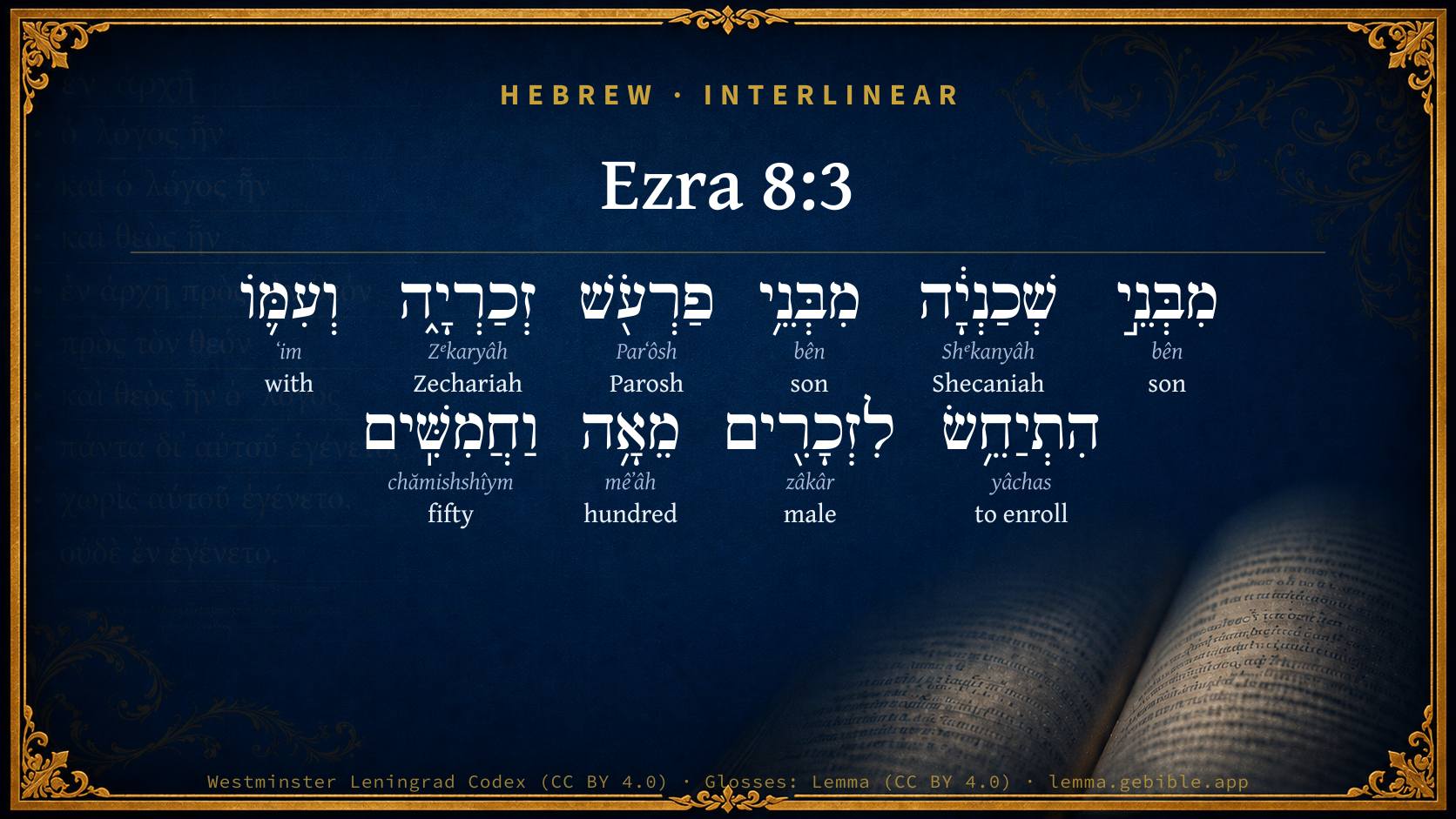
פַרְעֹ֖שׁ
Parʻôsh
H6551
“Parosh”
Noun, Proper
Part of Speech
Noun
Type
Proper
Full BDB Definition

Origin: the same as H6550

TWOT: None

Parosh or Pharosh = "flea" - ancestor of a family who returned from exile with Zerubbabel and a 2nd group who returned with Ezra - a leader of the people who signed the covenant with Nehemiah
  1. מִבְּנֵ֣י bên H1121 “from · sons of” Preposition + Noun, Common, Masculine, Plural, Construct
  2. שְׁכַנְיָ֔ה Shᵉkanyâh H7935 “Shecaniah” Noun, Proper
  3. מִבְּנֵ֥י bên H1121 “from · sons of” Preposition + Noun, Common, Masculine, Plural, Construct
  4. זְכַרְיָ֑ה Zᵉkaryâh H2148 “Zechariah” Noun, Proper
  5. וְעִמּ֛וֹ ʻim H5973 “and · with · him” Conjunction + Preposition + Suffix, Personal, 3rd Person, Masculine, Singular
  6. הִתְיַחֵ֥שׂ yâchas H3187 “to enroll” Verb, Hithpael, Infinitive Construct
  7. לִזְכָרִ֖ים zâkâr H2145 “to/for · males” Preposition + Noun, Common, Masculine, Plural, Absolute
  8. מֵאָ֥ה mêʼâh H3967 “hundred” Adjective, Cardinal number, Both, Singular, Absolute
  9. וַחֲמִשִּֽׁים chămishshîym H2572 “and · fifty” Conjunction + Adjective, Cardinal number, Both, Plural, Absolute

About this verse

These counts appear in no published source. They are computed here, from the morphology-tagged text and Lemma’s own curated glosses. What Lemma adds →

10
words
9
distinct lemmas
Historical
section

Notable vocabulary

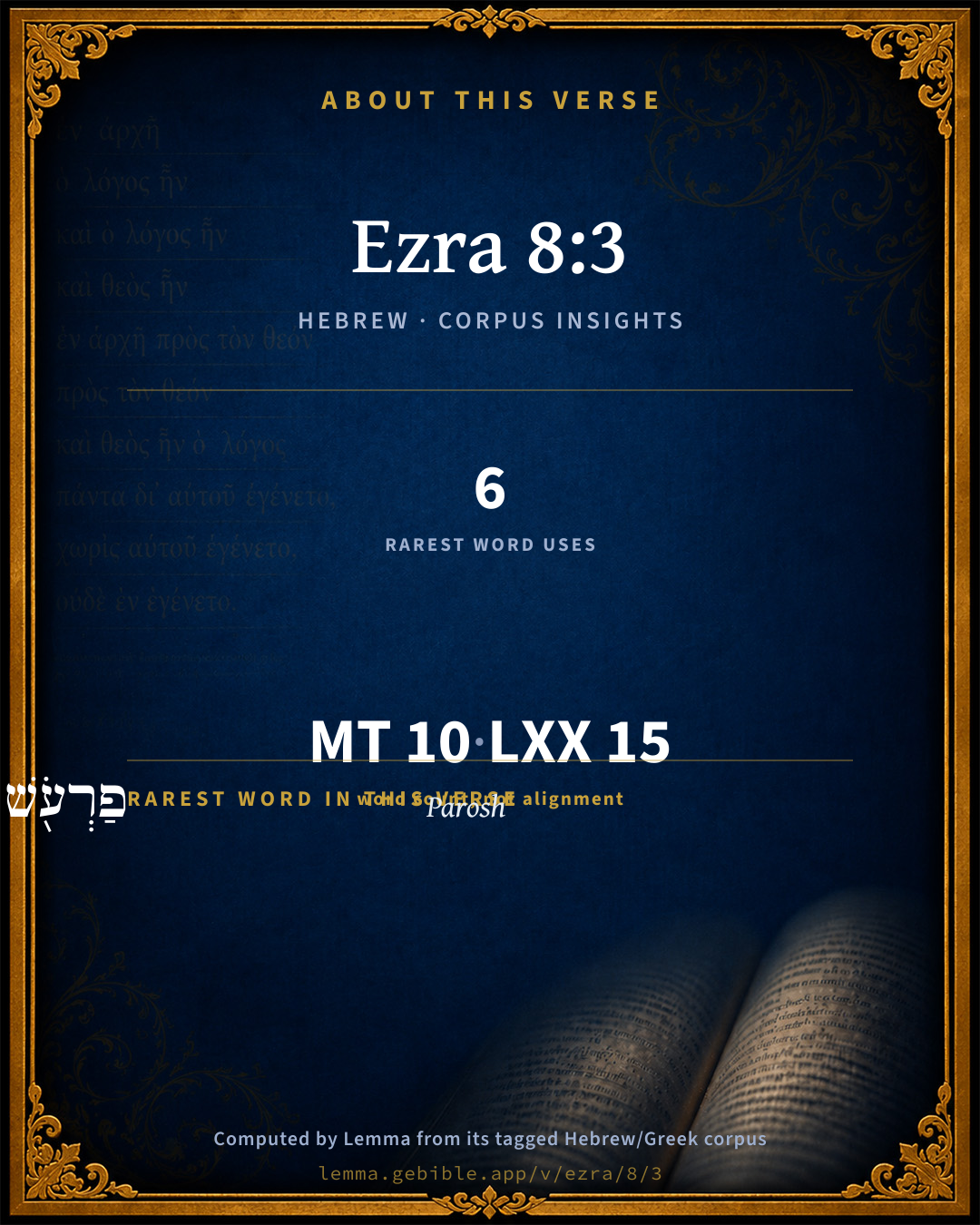
The rarest word here is פַרְעֹ֖שׁ Parosh H6551 — appearing just 6 times in the whole Hebrew Bible.

Shared distinctive vocabulary

פַרְעֹ֖שׁ Parosh H6551 occurs in 6 verses of the Hebrew Bible. Also found in:

Grammatical profile

  • 1 verb
  • 6 nouns
  • 2 adjectives
  • 1 preposition

Verb forms

  • הִתְיַחֵ֥שׂ Hithpael · Infinitive Construct

Repetition

A word recurs within this verse — often emphatic in Hebrew:

  • מִבְּנֵ֣י son H1121 ×2

Hebrew & Septuagint length

In English translation the verse runs 24 words from the Hebrew and 21 from the Septuagint (LXX English) — closely comparable.

A rough comparison of the two English renderings, which tokenize alike — not a word-level alignment.

Word counts can differ between the Hebrew and the Greek without any difference in meaning — e.g. the Hebrew direct-object marker אֵת has no separate Greek word, and Greek often adds the article ὁ.

In the original languages it is 10 Hebrew tokens and 15 Greek tokens — but the two are counted differently (Hebrew bundles its prefixes and suffixes into one token; the Greek is in lemma form), so that isn’t a like-for-like length.

Cross-references

3

Topical passages linked to Ezra 8:3 in the Treasury of Scripture Knowledge — connected by theme and wording, ordered by reader-vote popularity; previews shown in the World English Bible.

  • Ezra 2:3 The children of Parosh, two thousand one hundred seventy-two.
  • Nehemiah 7:8 The children of Parosh, two thousand one hundred seventy-two.
  • Nehemiah 10:14 The chiefs of the people: Parosh, Pahath-moab, Elam, Zattu, Bani,

Cross-references courtesy of OpenBible.info (CC BY 4.0).

Hebrew and Greek witnesses Masoretic Hebrew ↔ Greek Septuagint

The same verse in the two great witnesses to the Old Testament, shown verse-for-verse.

These are two independent witnesses, not word-aligned to each other, and the Septuagint is shown in lemma (dictionary) form.

Hebrew Ezra 8:3 Masoretic · Westminster Leningrad Codex

מִבְּנֵ֣י שְׁכַנְיָ֔ה מִבְּנֵ֥י פַרְעֹ֖שׁ זְכַרְיָ֑ה וְעִמּ֛וֹ הִתְיַחֵ֥שׂ לִזְכָרִ֖ים מֵאָ֥ה וַחֲמִשִּֽׁים

Of the sons of Shecaniah, of the sons of Parosh, Zechariah; and with him were reckoned by genealogy of the males one hundred fifty.

World English Bible · Public Domain

Greek LXX Ezra 8:3 Septuagint · lemma form

ἀπό υἱός σαχανια ἀπό υἱός φορος ζαχαριας καί μετά αὐτός ὁ σύστρεμμα ἑκατόν καί πεντήκοντα

Of the sons of Sachania, and the sons of Phoros; Zacharias: and with him a company of one hundred and fifty.

LXX2012 (modern English Septuagint) · Public Domain

In the Septuagint this is one book — Esdras B (2 Esdras): Ezra is chapters 1–10, Nehemiah 11–23.

Hebrew: Westminster Leningrad Codex (CC BY 4.0). Greek: Septuagint (public domain); English from LXX2012 (modern English Septuagint) (Public Domain). How the Septuagint differs from the Hebrew →

Commentary

Notes on Ezra 8:3 from classic Christian and Jewish commentators (each source and its license shown beneath its notes). The classic Christian expositions comment on the surrounding passage and are grouped to its opening verse, so a note may address several verses; the Jewish commentaries on the Tanakh (Rashi and others) are per-verse, so they appear only where the commentator wrote on this verse.

Lemma curates 59 commentaries, every one of them public domain or Creative Commons licensed, each selected and text-cleaned for this edition rather than reprinted as found. About our sources →

Trapp's Complete Commentary

John Trapp

Ezr 8:3 Of the sons of Shechaniah, of the sons of Pharosh; Zechariah: and with him were reckoned by genealogy of the males an hundred and fifty.

Ver. 3. Of the males an hundred and fifty] Great account was made of males under the law, more than of the females; and so there is to this day among the Jews, who hold women to be of a lower creation, made only for the propagation and pleasure of man, &c. (Blount’s Voyage). This their conceit is their folly, yet their posterity approve their sayings. He did better who styled woman the second edition of the epitome of the whole world. Sure it is, that souls have no sexes; and in Christ there is no respect had more to the male than female, Gal 3:28.

John Trapp, A Commentary or Exposition upon All the Books of the Old and New Testament (1647–1656) — public domain. Text from a community e-Sword module.

Joseph Benson's Commentary

Ezr 8:3. By genealogy of the males — Though the males only be expressed, yet doubtless they carried the women along with them, as they did the little ones, Ezr 8:21.

Joseph Benson's Commentary on the Old and New Testaments (1811–1818) — public domain. Text from a community e-Sword module.

Adam Clarke's Commentary

Verse 3. Of the sons of Shechaniah] There were three of this name; the second is mentioned Ezr 8:6, and the third Ezr 10:2. They were all different persons, as may be seen from their fathers' houses.

Adam Clarke's Commentary on the Bible (1810–1826) — public domain. Text from a community e-Sword/MySword module.

The Cambridge Bible for Schools and Colleges

gen. ed. J. J. S. Perowne

3. This verse should begin with ‘of the sons of Parosh’ (see note on Ezr_8:2).

‘by genealogy of the males’. The present list differs in this respect from that recorded in chap. 2. There the total numbers are given; here the number of the males only.

3–14. The register of the laity or “the men of the people of Israel” as in Ezr_2:2.

The names of these houses with the exception of Shechaniah (Ezr_8:5) and Shelomith (Ezr_8:10) appear also in chap. 2 and Nehemiah 7. But it is most probable that the text has in the case of both these exceptions suffered (see notes on the verses), and that the houses of Zattu and Bani (Ezr_2:8; Ezr_2:10) are represented by Shechaniah and Shelomith.

Twelve households are represented by their chiefs and the number of their males given. The number ‘twelve’ was perhaps designedly taken to symbolize the united Israel.

The parallel list in 1 Esdras does not contain many variations. The following table places them side by side.

Ezra

1Es_8:30 ff.

Of the sons of Parosh, Zechariah,

150

Of the sons of Pahath-Moab, Eliehoenai, the son of Zerahiah,

200

Of the sons of Shechaniah, the son of Jahaziel,

300

Of the sons of Zathoe, Sechenias, the son of Jezelus,

300

Of the sons of Adin, Ebed, the son of Jonathan,

50

Of the sons of Adin, Obeth, the son of Jonathan,

250

Of the sons of Elam, Jeshaiah the son of Athalian,

70

Of the sons of Elam, Josias, the son of Gotholias,

70

Of the sons of Shephatiah, Zebadiah, the son of Michael,

80

Of the sons of Saphatias, Zaraias, son of Michael,

70

Of the sons of Joab, Obadiah, the son of Jehiel,

218

Of the sons of Joab, Abadias, the son of Jezelus,

212

Of the sons of Shelomith, the son of Josiphiah,

160

Of the sons of Banid, Assalimoth, the son of Josaphias,

160

Of the sons of Bebai, Zechariah, the son of Bebai,

28

Of the sons of Astath, Johannes, the son of Acatan,

110

Of the sons of Azgad, Jonathan, the son of Hakkatan,

110

Of the sons of Adonikam, Eliphelet, Jeuel, Shemaiah,

60

Of the sons of Adonicam the last, … Eliphalet, Jeuel and Samaias,

70

Of the sons of Bigvai, Uthai and Zabbud,

70

Of the sons of Bago, Uthi, the son of Istalcurus,

70

The total numbers given in the Hebrew text are 1496, in 1 Esdr. 1690.

The Cambridge Bible for Schools and Colleges (gen. ed. J. J. S. Perowne; Cambridge University Press, 1878–1918) — public domain. Text from a community e-Sword module.

John Gill's Exposition

Of the sons of Shechaniah, of the sons of Pharosh,.... Who is so described, to distinguish him from another Shechaniah, Ezr 8:5,

Zechariah: and with him were reckoned by genealogy, of the males an hundred and fifty; males only were reckoned, not women and children; though that there were such that went up is clear from Ezr 8:21, from hence to the end of Ezr 8:14 an account is given of the number of the males that went up with Ezra, who were chiefly, if not altogether, sons of those that went up with Zerubbabel; such of them as were left there behind, and now returned, at least a great number of them, see Ezr 2:1, it is particularly remarked of the sons of Adonikam, Ezr 8:13, that they were the last of them; not that they were the last that came in to go with Ezra, or were backward and dilatory, but the last with respect to the first of his sons that were gone before, and seem with them to be the whole of his family; the number of all that went up under their respective heads amounts to 1496.

John Gill's Exposition of the Whole Bible (1746–1763) — public domain (CC PDM 1.0). Text via the HelloAO Bible API.

Matthew Poole's English Annotations

Of the sons of Pharosh, i.e. one of the sons of Pharosh; whereby he is differenced from the other Shechaniah, Ezr 8:5.

By genealogy of the males: though the males only be expressed here, and in the succeeding verses, yet it is more than probable they carried the women along with them, as they did carry little ones as it is expressed here, Ezr 8:21.

Matthew Poole's English Annotations on the Holy Bible (1683–1685) — public domain. Text from a community e-Sword/MySword module.

Whedon's Commentary on the Bible

Daniel D. Whedon

3. Of the sons of Shechaniah — These words seem rather to belong to the preceding verse, and to be connected with Hattush, a descendant of David. So we should read: Of the sons of David, Hattush of the sons of Shechaniah. Compare 1Ch_3:22, where Shechaniah and Hattush are both mentioned as descendants of David.

Pharosh — Probably the same as Parosh, Ezr_2:3. Zechariah is the first name in this list, which is immediately followed by the number of his father’s house who were with him among Ezra’s company.

Daniel D. Whedon (gen. ed.), Commentary on the Old and New Testaments (1874–1909) — public domain. Text from a community e-Sword module.

The Pulpit Commentary

Of the sons of Shechaniah. This clause should be attached to the preceding verse, since it refers to Hattush, who was Shechaniah"s grandson; and ver. 3 should begin with the words, "Of the sons of Pharosh, Zechariah."

The Pulpit Commentary (1880–1919), ed. H.D.M. Spence-Jones & Joseph S. Exell — public domain. Text from a community e-Sword module.

John Wesley's Explanatory Notes

Males - Though the males only be expressed yet doubtless they carried the women along with them, as they did the little ones.

John Wesley, Explanatory Notes Upon the Whole Bible (1754–1765) — public domain. Text via the GEBible commentary corpus.

Rashi

Rabbi Shlomo Yitzchaki (Rashi)

Of the sons of Shechaniah, of the sons of Parosh That is one family, and Zechariah was the head of the family.

and with him With his lineage, the males of his family traced their lineage.

Rashi on the Tanakh — English translations: “The Judaica Press complete Tanach with Rashi, translated by A. J. Rosenberg” (CC BY 4.0); “Pentateuch with Rashi's commentary by M. Rosenbaum and A.M. Silbermann, 1929-1934” (public domain); “The Metsudah Tanach series, Lakewood, N.J” (CC BY 4.0); and “The Book of Joshua, Metsudah Publications, 1997” (CC BY 4.0). Text via Sefaria.

Lesson kit

Teaching starters — assembled from the data on this page, not authored interpretation. Every prompt links to the verse data it draws on. Edit before teaching.

Ezra, in the Historical, opens this verse with 10 words (9 distinct Hebrew lemmas). Its most distinctive word is Parʻôsh (“Parosh”). A historical commentator’s framing appears above. Read the whole chapter for the surrounding context.

Discussion questions

  1. How does “Parosh” (Parʻôsh) shape what this verse is saying?
  2. How does Ezra 2:3, which shares the word «Parosh», read alongside this verse?
  3. What does the repetition of “son” (2× in this one verse) do in this verse?
  4. These translations render this verse differently. What is at stake in choosing one wording over another?
  5. «הִתְיַחֵ֥שׂ» is a Hithpael Infinitive Construct verb. How does that grammatical form shape the action described?
  6. Compare how Trapp's Complete Commentary and Joseph Benson's Commentary read this verse. Where do they agree or differ?

Things to notice

Reading settings

Reading text

Shown beneath each verse's original-language words.

Old Testament
Old Testament edition

Read the OT as the Masoretic Hebrew (MT) or the Greek Septuagint (LXX).

English shown for the Greek Septuagint (in the Hebrew ↔ Greek comparison).

Comparing translations? Open the Compare panel on any verse page to stack up to four side by side.