
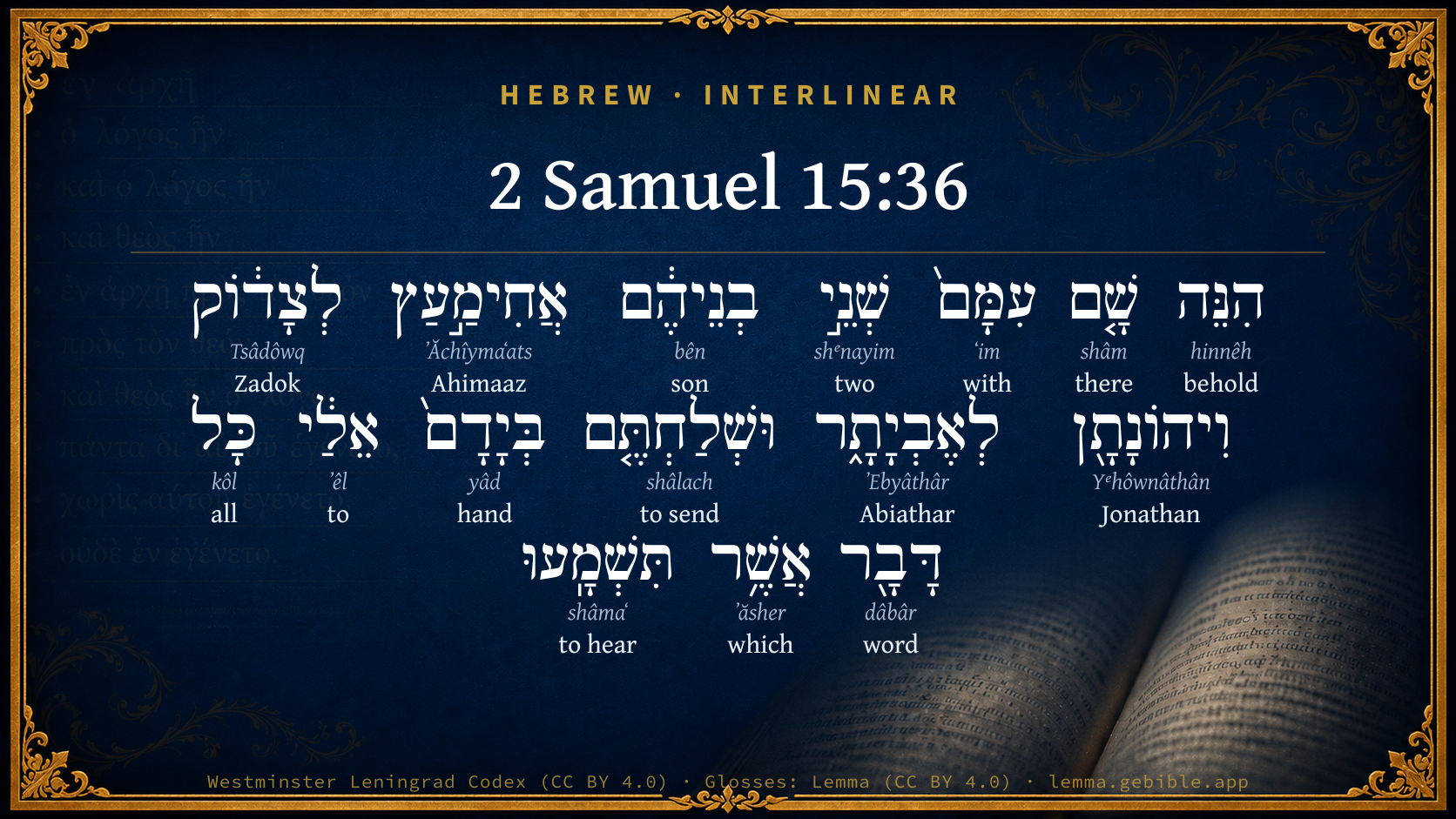
2 Samuel 15:36

Hebrew (Westminster Leningrad Codex) 2 Samuel 15:36 appears in the Hebrew Old Testament. The text above is from the Westminster Leningrad Codex. Each word links to its Strong’s number, a concise gloss, and parsing drawn from the Open Scriptures Hebrew Bible morphology. Click any word for its full Brown-Driver-Briggs (BDB) entry.
Download image
Cite this verse

2 Samuel 15:36 (World English Bible). Public Domain. Lemma interlinear Bible study tool, https://lemma.gebible.app/v/2-samuel/15/36.

Show BibTeX & RIS
BibTeX
RIS
English Translation
Behold, they have there with them their two sons, Ahimaaz, Zadok's son, and Jonathan, Abiathar's son; and by them you shall send to me everything that you shall hear.
World English Bible · Public Domain
Download a study sheet

One document with this verse’s original text, its word-by-word gloss line, the meaning frame, cross-references with their text, attributed commentary, and full source and license credits — printable, and it pastes into notes with its structure intact.

This verse Autodidact and up

Study sheet (.html) Plain text (.txt)

A passage Seminary Student

Up to 50 verses in one chapter. A passage sheet keeps up to 6 commentary sources and 12 cross-references per verse, in the order this page ranks them, and says so on the sheet whenever that leaves anything out. Ask for a single verse and you get the Autodidact verse sheet above.

Everything on this page stays free to read, with no account — the sheet is a download of what is already on screen, not access to it.

Want to remove ads? Support Godless Engineer
Compare translations 3

The same verse in 3 English versions, stacked beneath the original-language interlinear above. Click any original word for its lexicon entry.

Each is an independent rendering of the whole verse — the interlinear is not word-aligned to these translations.

Highlighted words mark where these versions differ — a whole-verse word diff, not a word-by-word alignment.

  • World English Bible Public Domain
    Behold, they have there with them their two sons, Ahimaaz, Zadok's son, and Jonathan, Abiathar's son; and by them you shall send to me everything that you shall hear.
  • King James Version Public Domain
    Behold, they have there with them their two sons, Ahimaaz Zadok's son, and Jonathan Abiathar's son; and by them ye shall send unto me every thing that ye can hear.
  • unfoldingWord Literal Text CC BY-SA 4.0
    Behold, with them there the two of their sons, Ahimaaz to Zadok and Jonathan to Abiathar. And you shall send to me by their hand every word that you hear.”

unfoldingWord Literal Text — © unfoldingWord, licensed CC BY-SA 4.0. Word-aligned USFM3 via Door43 (git.door43.org/unfoldingWord/en_ult).

Versions to compare (up to 4)

3 of 4 selected

Show all 18 translations

Every available English version of this verse, each an independent rendering of the whole verse.

  • World English Bible Public Domain
    Behold, they have there with them their two sons, Ahimaaz, Zadok's son, and Jonathan, Abiathar's son; and by them you shall send to me everything that you shall hear.
  • Berean Standard Bible Public Domain
    Indeed, their two sons, Ahimaaz son of Zadok and Jonathan son of Abiathar, are there with them. Send them to me with everything you hear.”
  • Majority Standard Bible Public Domain
    Indeed, their two sons, Ahimaaz son of Zadok and Jonathan son of Abiathar, are there with them. Send them to me with everything you hear.”
  • King James Version Public Domain
    Behold, they have there with them their two sons, Ahimaaz Zadok's son, and Jonathan Abiathar's son; and by them ye shall send unto me every thing that ye can hear.
  • American Standard Version (1901) Public Domain
    Behold, they have there with them their two sons, Ahimaaz, Zadok's son, and Jonathan, Abiathar's son; and by them ye shall send unto me everything that ye shall hear.
  • Revised Version (1885) Public Domain
    Behold, they have there with them their two sons, Ahimaaz Zadok’s son, and Jonathan Abiathar’s son; and by them ye shall send unto me every thing that ye shall hear.
  • Geneva Bible (1599) Public Domain
    Beholde, there are with them their two sonnes: Ahimaaz Zadoks sonne, and Ionathan Abiathars sonne: by them also shall ye send me euery thing that ye can heare.
  • Douay-Rheims (1899) Public Domain
    And there are with them their two sons Achimaas the son of Sadoc, and Jonathan the son of Abiathar: and you shall send by them to me every thing that you shall hear.
  • Young's Literal Translation Public Domain
    Lo, there with them `are' their two sons, Ahimaaz to Zadok, and Jonathan to Abiathar, and ye have sent by their hand unto me anything that ye hear.'
  • Literal Standard Version CC BY-SA 4.0
    Behold, their two sons [are] there with them: Ahimaaz to Zadok, and Jonathan to Abiathar, and you have sent to me by their hand anything that you hear.”
  • Unlocked Literal Bible CC BY-SA 4.0
    See that they have there with them their two sons, Ahimaaz, Zadok's son, and Jonathan, Abiathar's son. You must send to me by their hand everything that you hear.”
  • unfoldingWord Literal Text CC BY-SA 4.0
    Behold, with them there the two of their sons, Ahimaaz to Zadok and Jonathan to Abiathar. And you shall send to me by their hand every word that you hear.”
  • Darby Bible Public Domain
    Behold, they have there with them their two sons, Ahimaaz Zadok's [son], and Jonathan Abiathar's son; and by them ye shall send to me everything that ye shall hear.
  • World Messianic Bible Public Domain
    Behold, they have there with them their two sons, Ahimaaz, Zadok’s son, and Jonathan, Abiathar’s son. Send to me everything that you shall hear by them.”
  • Webster's Bible Public Domain
    Behold, they have there with them their two sons, Ahimaaz Zadok's son, and Jonathan Abiathar's son; and by them ye shall send to me every thing that ye can hear.
  • Free Bible Version CC BY-SA 4.0
    Their two sons, Ahimaaz and Jonathan, are there with them. Send them to me so they can tell me everything you hear.”
  • Bible in Basic English Public Domain
    See, they have with them their two sons, Ahimaaz, Zadok's son, and Jonathan, the son of Abiathar; by them you may send word to me of everything which comes to your ears.
  • JPS Tanakh (1917) Public Domain
    Behold, they have there with them their two sons, Ahimaaz Zadok's son, and Jonathan Abiathar's son; and by them ye shall send unto me every thing that ye shall hear.'

Literal Standard Version (2020), Covenant Press — licensed CC BY-SA 4.0. Text via the HelloAO Bible API (eBible.org). Unlocked Literal Bible (unfoldingWord) — licensed CC BY-SA 4.0. Text via the HelloAO Bible API (eBible.org). unfoldingWord Literal Text — © unfoldingWord, licensed CC BY-SA 4.0. Word-aligned USFM3 via Door43 (git.door43.org/unfoldingWord/en_ult). Free Bible Version, Dr. Jonathan Gallagher — licensed CC BY-SA 4.0. Text via the HelloAO Bible API (eBible.org).

Word by word

More ways to search: Search by grammar → Find every occurrence → Compare this word →

Practice this passage: Drill this verse → Learn its vocabulary →

אֲחִימַ֣עַץ
ʼĂchîymaʻats
H290
“Ahimaaz”
Noun, Proper
Part of Speech
Noun
Type
Proper
Full BDB Definition

Origin: from H251 and the equivalent of H4619

TWOT: None

Ahimaaz = "my brother is anger (wrath)" - father-in-law of Saul - Zadok's son who aided David during Absalom's rebellion - a supply officer of Solomon
  1. הִנֵּה hinnêh H2009 “behold” Particle, Demonstrative
  2. שָׁ֤ם shâm H8033 “there” Adverb
  3. עִמָּם֙ ʻim H5973 “with · them” Preposition + Suffix, Personal, 3rd Person, Masculine, Plural
  4. שְׁנֵ֣י shᵉnayim H8147 “two” Adjective, Cardinal number, Masculine, Dual, Construct
  5. בְנֵיהֶ֔ם bên H1121 “sons · their” Noun, Common, Masculine, Plural, Construct + Suffix, Personal, 3rd Person, Masculine, Plural
  6. לְצָד֔וֹק Tsâdôwq H6659 “to/for · Zadok” Preposition + Noun, Proper
  7. וִיהוֹנָתָ֖ן Yᵉhôwnâthân H3083 “and · Jonathan” Conjunction + Noun, Proper
  8. לְאֶבְיָתָ֑ר ʼEbyâthâr H54 “to/for · Abiathar” Preposition + Noun, Proper
  9. וּשְׁלַחְתֶּ֤ם shâlach H7971 “and · to send” Conjunction + Verb, Qal, Perfect, 2nd Person, Masculine, Plural
  10. בְּיָדָם֙ yâd H3027 “in/at · hand · their” Preposition + Noun, Common, Both, Singular, Construct + Suffix, Personal, 3rd Person, Masculine, Plural
  11. אֵלַ֔י ʼêl H413 “to · me” Preposition + Suffix, Personal, 1st Person, Common, Singular
  12. כָּל kôl H3605 “all of” Noun, Common, Masculine, Singular, Construct
  13. דָּבָ֖ר dâbâr H1697 “word” Noun, Common, Masculine, Singular, Absolute
  14. אֲשֶׁ֥ר ʼăsher H834 “which” Particle, Relative
  15. תִּשְׁמָֽעוּ shâmaʻ H8085 “to hear” Verb, Qal, Imperfect, 2nd Person, Masculine, Plural

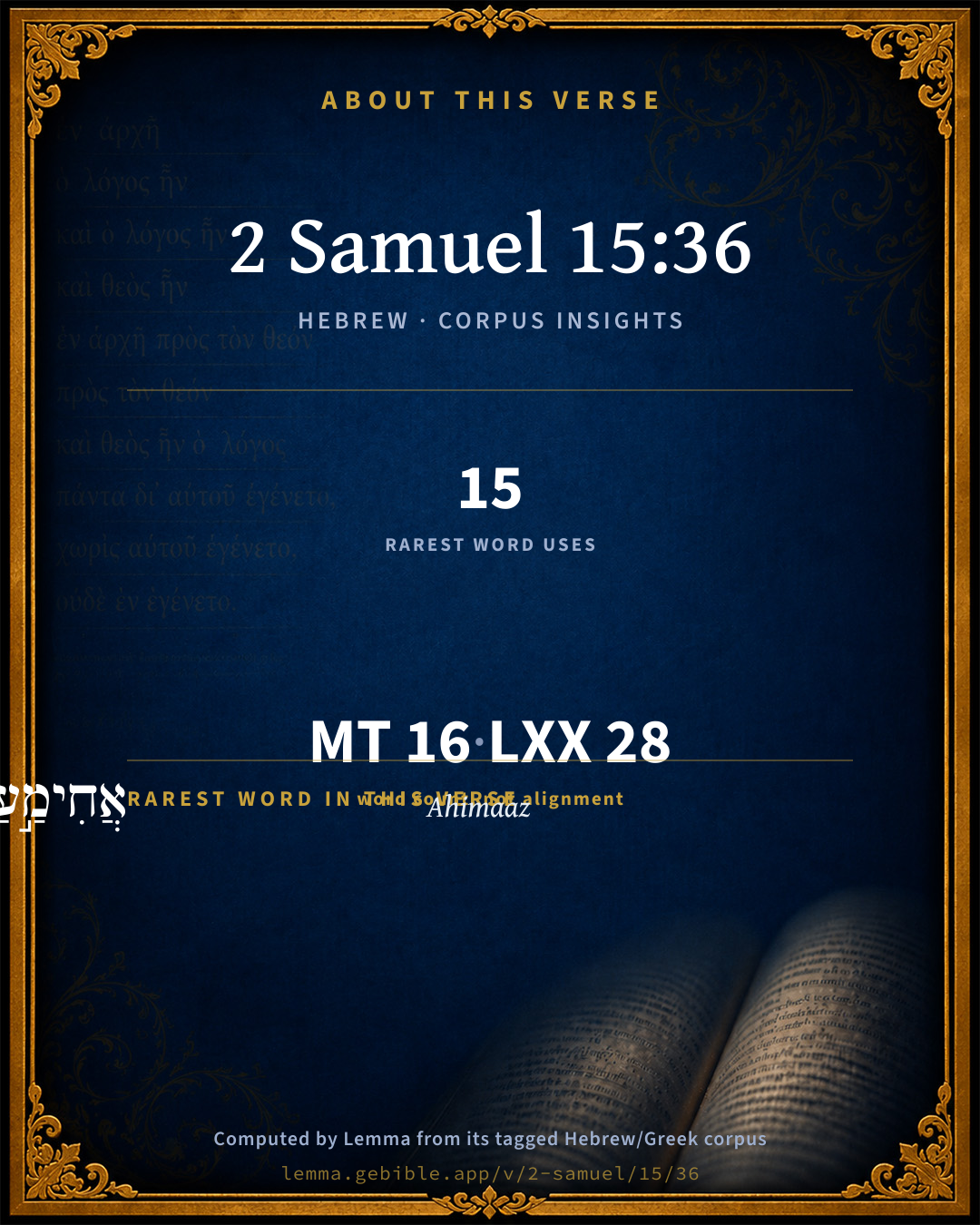
About this verse

These counts appear in no published source. They are computed here, from the morphology-tagged text and Lemma’s own curated glosses. What Lemma adds →

16
words
16
distinct lemmas
Historical
section

Notable vocabulary

The rarest word here is אֲחִימַ֣עַץ Ahimaaz H290 — appearing just 15 times in the whole Hebrew Bible.

Shared distinctive vocabulary

אֲחִימַ֣עַץ Ahimaaz H290 occurs in 15 verses of the Hebrew Bible. Also found in:

Grammatical profile

  • 2 verbs
  • 8 nouns
  • 1 adjective
  • 2 prepositions
  • 1 adverb
  • 2 particles

Verb forms

  • וּשְׁלַחְתֶּ֤ם Qal · Perfect
  • תִּשְׁמָֽעוּ Qal · Imperfect

Hebrew & Septuagint length

In English translation the verse runs 29 words from the Hebrew and 34 from the Septuagint (LXX English) — closely comparable.

A rough comparison of the two English renderings, which tokenize alike — not a word-level alignment.

Word counts can differ between the Hebrew and the Greek without any difference in meaning — e.g. the Hebrew direct-object marker אֵת has no separate Greek word, and Greek often adds the article ὁ.

In the original languages it is 16 Hebrew tokens and 28 Greek tokens — but the two are counted differently (Hebrew bundles its prefixes and suffixes into one token; the Greek is in lemma form), so that isn’t a like-for-like length.

Cross-references

3

Topical passages linked to 2 Samuel 15:36 in the Treasury of Scripture Knowledge — connected by theme and wording, ordered by reader-vote popularity; previews shown in the World English Bible.

  • 2 Samuel 17:17 Now Jonathan and Ahimaaz were staying by En Rogel; and a maid-servant used to go and tell them; and they went and told king David: for they might not be seen to come into the city.
  • 2 Samuel 15:27 The king said also to Zadok the priest, "Aren't you a seer? Return into the city in peace, and your two sons with you, Ahimaaz your son, and Jonathan the son of Abiathar.
  • 2 Samuel 18:19–33 Then said Ahimaaz the son of Zadok, Let me now run, and bear the king news, how that Yahweh has avenged him of his enemies.

Cross-references courtesy of OpenBible.info (CC BY 4.0).

Hebrew and Greek witnesses Masoretic Hebrew ↔ Greek Septuagint

The same verse in the two great witnesses to the Old Testament, shown verse-for-verse.

These are two independent witnesses, not word-aligned to each other, and the Septuagint is shown in lemma (dictionary) form.

Hebrew 2 Samuel 15:36 Masoretic · Westminster Leningrad Codex

הִנֵּה שָׁ֤ם עִמָּם֙ שְׁנֵ֣י בְנֵיהֶ֔ם אֲחִימַ֣עַץ לְצָד֔וֹק וִיהוֹנָתָ֖ן לְאֶבְיָתָ֑ר וּשְׁלַחְתֶּ֤ם בְּיָדָם֙ אֵלַ֔י כָּל דָּבָ֖ר אֲשֶׁ֥ר תִּשְׁמָֽעוּ

Behold, they have there with them their two sons, Ahimaaz, Zadok's son, and Jonathan, Abiathar's son; and by them you shall send to me everything that you shall hear.

World English Bible · Public Domain

Greek LXX 2 Samuel 15:36 Septuagint · lemma form

ὁράω ἐκεῖ μετά αὐτός δύο υἱός αὐτός αχιμαας υἱός ὁ σαδωκ καί ιωναθαν υἱός ὁ αβιαθαρ καί ἀποστέλλω ἐν χείρ αὐτός πρός ἐγώ πᾶς ῥῆμα ὅς ἐάν ἀκούω

Behold, there are there with them their two sons, Achimaas the son of Sadoc, and Jonathan the son of Abiathar; and by them you⌃ shall report to me every word which you⌃ shall hear.

LXX2012 (modern English Septuagint) · Public Domain

Hebrew: Westminster Leningrad Codex (CC BY 4.0). Greek: Septuagint (public domain); English from LXX2012 (modern English Septuagint) (Public Domain). How the Septuagint differs from the Hebrew →

Targum (Aramaic paraphrase)

1

The Targum is the ancient Jewish Aramaic paraphrase of the Hebrew Scriptures — an interpretive translation, not the Hebrew text itself. Onkelos (literal) and Pseudo-Jonathan (expansive) render the Torah, and Jonathan the Prophets. Coverage is partial: where no permissively-licensed English translation exists for a verse, only the Aramaic is shown. This is verse-level text, not a word-by-word alignment to the Hebrew.

  1. Targum Jonathan Prophets (Joshua–Malachi)
    הָא תַּמָן עִמְהוֹן תְּרֵין בְּנֵיהוֹן אֲחִימַעַץ לְצָדוֹק וִיהוֹנָתָן לְאֶבְיָתָר וְתִשְׁלְחוּן בִּידֵיהוֹן לְוָתִי כָּל מִדָעַם דְתִשְׁמְעוּן:

    (no public-domain English translation for this verse)

    Targum Jonathan — Aramaic: “Mikraot Gedolot” (public domain). English: “Sefaria Community Translation” (CC0 1.0 (public-domain dedication)); “London "Chaldee Paraphrase," 1871” (public domain). Text via Sefaria.

Commentary

Notes on 2 Samuel 15:36 from classic Christian and Jewish commentators (each source and its license shown beneath its notes). The classic Christian expositions comment on the surrounding passage and are grouped to its opening verse, so a note may address several verses; the Jewish commentaries on the Tanakh (Rashi and others) are per-verse, so they appear only where the commentator wrote on this verse.

Lemma curates 59 commentaries, every one of them public domain or Creative Commons licensed, each selected and text-cleaned for this edition rather than reprinted as found. About our sources →

Trapp's Complete Commentary

John Trapp

2Sa 15:36 Behold, [they have] there with them their two sons, Ahimaaz Zadok’s [son], and Jonathan Abiathar’s [son]; and by them ye shall send unto me every thing that ye can hear.

Ver. 36. And by them ye shall send unto me.] Good intelligence of the enemy’s counsels and motion in war, is of greatest consequence.

John Trapp, A Commentary or Exposition upon All the Books of the Old and New Testament (1647–1656) — public domain. Text from a community e-Sword module.

Joseph Benson's Commentary

2Sa 15:36-37. They have there with them their two sons — Not in Jerusalem, but in a place near it, to which they could easily send upon occasion. So Hushai came into the city — Where, it is likely, he waited for the coming of Absalom. And having got thither before him, he so ordered his affairs that it was not known to Absalom’s party that he had been with David to offer him his services. And Absalom came into Jerusalem — How soon do royal cries and royal palaces change their masters! But we look for a kingdom which cannot be moved.

Joseph Benson's Commentary on the Old and New Testaments (1811–1818) — public domain. Text from a community e-Sword module.

John Gill's Exposition

Behold, they have there with them two sons, Ahimaaz, Zadok's son, and Jonathan, Abiathar's son,.... As in Sa2 15:27; not that they were in the city with them, but they were near it, Sa2 17:17; with whom they had a communication:

and by whom ye shall send unto me everything that ye can hear; that is, by the sons of the priests; he telling the priests how things were at court, and they sending their sons with messages to David; which was a good scheme to get intelligence, and easy to be put into execution.

John Gill's Exposition of the Whole Bible (1746–1763) — public domain (CC PDM 1.0). Text via the HelloAO Bible API.

Matthew Poole's English Annotations

There with them; not in Jerusalem, but in a place near to it, to which they could easily send upon occasion. See 2Sa 17:17.

Matthew Poole's English Annotations on the Holy Bible (1683–1685) — public domain. Text from a community e-Sword/MySword module.

John Wesley's Explanatory Notes

There - Not in Jerusalem, but in a place near it, to which they could easily send upon occasion.

John Wesley, Explanatory Notes Upon the Whole Bible (1754–1765) — public domain. Text via the GEBible commentary corpus.

Lesson kit

Teaching starters — assembled from the data on this page, not authored interpretation. Every prompt links to the verse data it draws on. Edit before teaching.

2 Samuel, in the Historical, opens this verse with 16 words (16 distinct Hebrew lemmas). Its most distinctive word is ʼĂchîymaʻats (“Ahimaaz”). A historical commentator’s framing appears above. Read the whole chapter for the surrounding context.

Discussion questions

  1. How does “Ahimaaz” (ʼĂchîymaʻats) shape what this verse is saying?
  2. 1 Samuel 14:50 shares the word «Ahimaaz» with this verse. How do the two illuminate each other?
  3. These translations render this verse differently; the difference is in the English rendering, not the original. What questions does that raise?
  4. The verb «וּשְׁלַחְתֶּ֤ם» is Qal Perfect. How does its form color the action?
  5. Reading how Trapp's Complete Commentary and Joseph Benson's Commentary read this verse, where do the two commentators agree and where do they part?

Things to notice

Reading settings

Reading text

Shown beneath each verse's original-language words.

Old Testament
Old Testament edition

Read the OT as the Masoretic Hebrew (MT) or the Greek Septuagint (LXX).

English shown for the Greek Septuagint (in the Hebrew ↔ Greek comparison).

Comparing translations? Open the Compare panel on any verse page to stack up to four side by side.