
Psalms 72:5

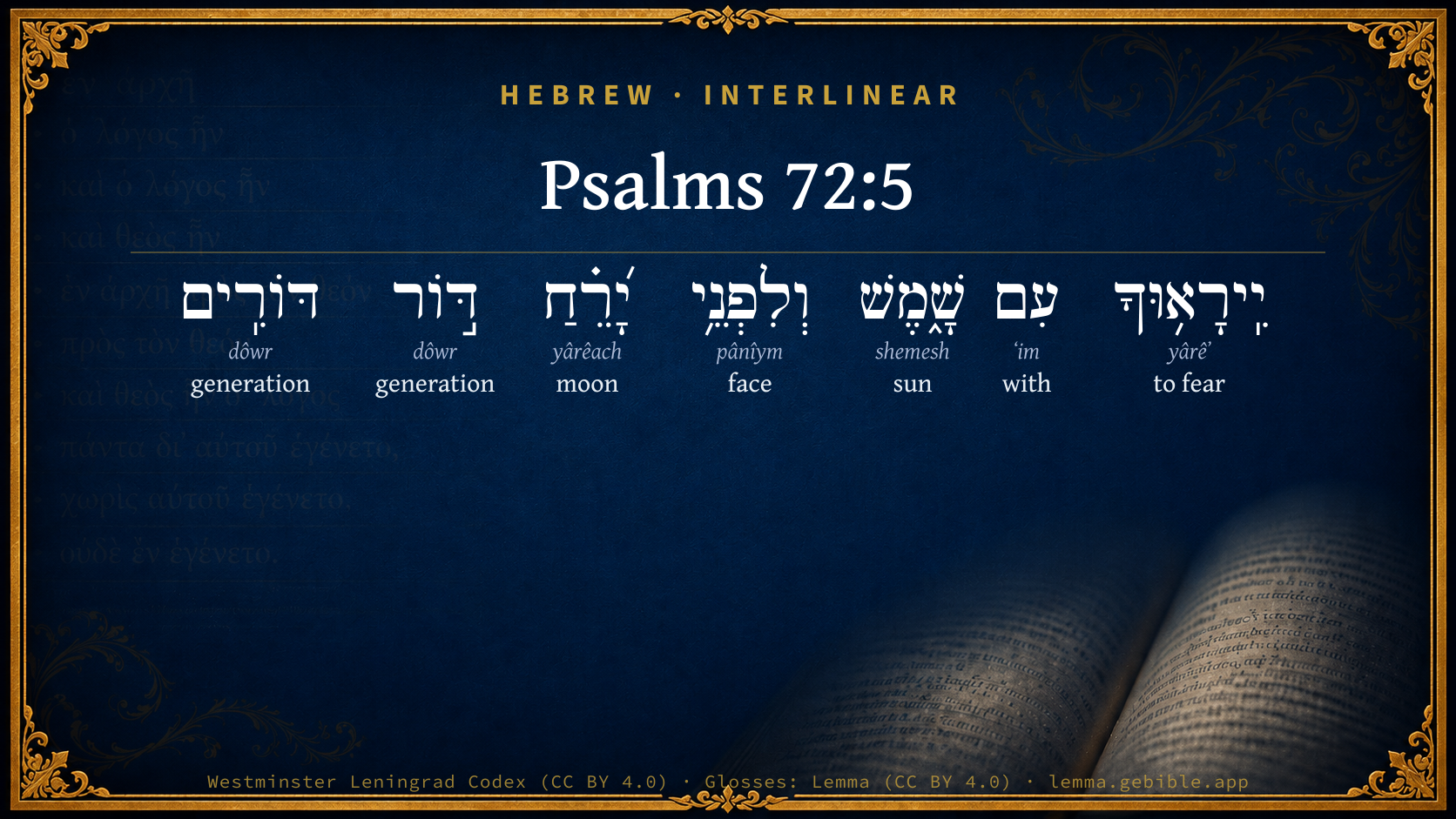
Hebrew (Westminster Leningrad Codex) Psalms 72:5 appears in the Hebrew Old Testament. The text above is from the Westminster Leningrad Codex. Each word links to its Strong’s number, a concise gloss, and parsing drawn from the Open Scriptures Hebrew Bible morphology. Click any word for its full Brown-Driver-Briggs (BDB) entry.
Download image
Cite this verse

Psalms 72:5 (World English Bible). Public Domain. Lemma interlinear Bible study tool, https://lemma.gebible.app/v/psalms/72/5.

Show BibTeX & RIS
BibTeX
RIS
English Translation
They shall fear you while the sun endures; And as long as the moon, throughout all generations.
World English Bible · Public Domain
Download a study sheet

One document with this verse’s original text, its word-by-word gloss line, the meaning frame, cross-references with their text, attributed commentary, and full source and license credits — printable, and it pastes into notes with its structure intact.

This verse Autodidact and up

Study sheet (.html) Plain text (.txt)

A passage Seminary Student

Up to 50 verses in one chapter. A passage sheet keeps up to 6 commentary sources and 12 cross-references per verse, in the order this page ranks them, and says so on the sheet whenever that leaves anything out. Ask for a single verse and you get the Autodidact verse sheet above.

Everything on this page stays free to read, with no account — the sheet is a download of what is already on screen, not access to it.

Want to remove ads? Support Godless Engineer
Compare translations 3

The same verse in 3 English versions, stacked beneath the original-language interlinear above. Click any original word for its lexicon entry.

Each is an independent rendering of the whole verse — the interlinear is not word-aligned to these translations.

Highlighted words mark where these versions differ — a whole-verse word diff, not a word-by-word alignment.

  • World English Bible Public Domain
    They shall fear you while the sun endures; And as long as the moon, throughout all generations.
  • King James Version Public Domain
    They shall fear thee as long as the sun and moon endure, throughout all generations.
  • unfoldingWord Literal Text CC BY-SA 4.0
    May they fear you with the sun and to the face of the moon, generation of generations.

unfoldingWord Literal Text — © unfoldingWord, licensed CC BY-SA 4.0. Word-aligned USFM3 via Door43 (git.door43.org/unfoldingWord/en_ult).

Versions to compare (up to 4)

3 of 4 selected

Show all 18 translations

Every available English version of this verse, each an independent rendering of the whole verse.

  • World English Bible Public Domain
    They shall fear you while the sun endures; And as long as the moon, throughout all generations.
  • Berean Standard Bible Public Domain
    May they fear him as long as the sun shines, as long as the moon remains, through all generations.
  • Majority Standard Bible Public Domain
    May they fear him as long as the sun shines, as long as the moon remains, through all generations.
  • King James Version Public Domain
    They shall fear thee as long as the sun and moon endure, throughout all generations.
  • American Standard Version (1901) Public Domain
    They shall fear thee while the sun endureth, And so long as the moon, throughout all generations.
  • Revised Version (1885) Public Domain
    They shall fear thee while the sun endureth, and so long as the moon, throughout all generations.
  • Geneva Bible (1599) Public Domain
    They shall feare thee as long as the sunne and moone endureth, from generatio to generation.
  • Douay-Rheims (1899) Public Domain
    And he shall continue with the sun, and before the moon, throughout all generations.
  • Young's Literal Translation Public Domain
    They fear Thee with the sun, and before the moon, Generation -- generations.
  • Literal Standard Version CC BY-SA 4.0
    They fear You with the sun, and before the moon, || Generation—generations.
  • Unlocked Literal Bible CC BY-SA 4.0
    May they honor you while the sun endures, and as long as the moon lasts throughout all generations.
  • unfoldingWord Literal Text CC BY-SA 4.0
    May they fear you with the sun and to the face of the moon, generation of generations.
  • Darby Bible Public Domain
    They shall fear thee as long as sun and moon endure, from generation to generation.
  • World Messianic Bible Public Domain
    They shall fear you while the sun endures; and as long as the moon, throughout all generations.
  • Webster's Bible Public Domain
    They shall fear thee as long as the sun and moon endure, throughout all generations.
  • Free Bible Version CC BY-SA 4.0
    May they respect him as long as the sun and the moon shine above, for all generations.
  • Bible in Basic English Public Domain
    May his life go on as long as the sun and moon, through all generations.
  • JPS Tanakh (1917) Public Domain
    They shall fear Thee while the sun endureth, and so long as the moon, throughout all generations.

Literal Standard Version (2020), Covenant Press — licensed CC BY-SA 4.0. Text via the HelloAO Bible API (eBible.org). Unlocked Literal Bible (unfoldingWord) — licensed CC BY-SA 4.0. Text via the HelloAO Bible API (eBible.org). unfoldingWord Literal Text — © unfoldingWord, licensed CC BY-SA 4.0. Word-aligned USFM3 via Door43 (git.door43.org/unfoldingWord/en_ult). Free Bible Version, Dr. Jonathan Gallagher — licensed CC BY-SA 4.0. Text via the HelloAO Bible API (eBible.org).

Word by word

More ways to search: Search by grammar → Find every occurrence → Compare this word →

Practice this passage: Drill this verse → Learn its vocabulary →

About this verse

These counts appear in no published source. They are computed here, from the morphology-tagged text and Lemma’s own curated glosses. What Lemma adds →

7
words
6
distinct lemmas
Wisdom
section

Shared distinctive vocabulary

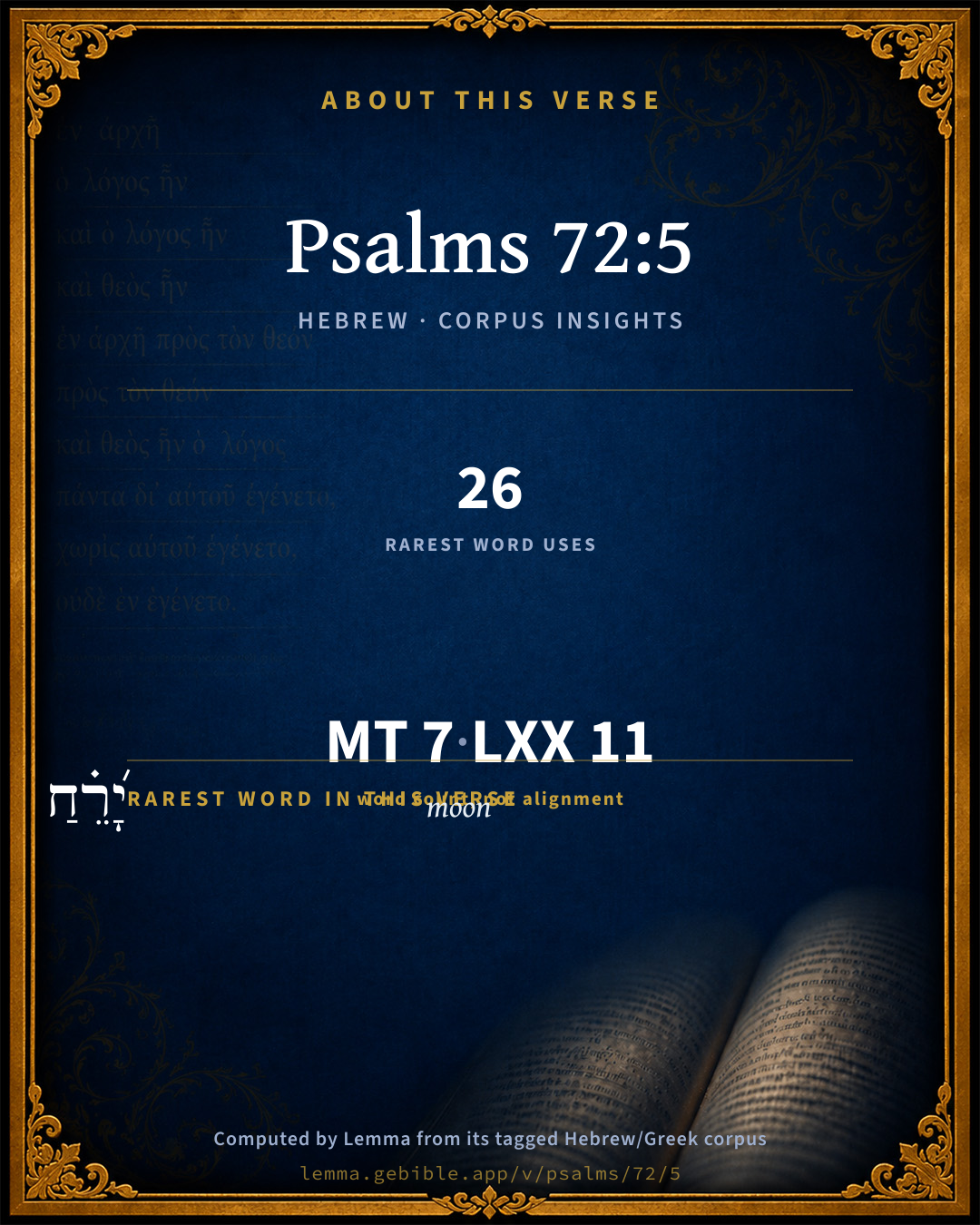
יָ֝רֵ֗חַ moon H3394 occurs in 26 verses of the Hebrew Bible. Also found in:

Grammatical profile

  • 1 verb
  • 5 nouns
  • 1 preposition

Verb forms

  • יִֽירָא֥וּךָ Qal · Imperfect

Repetition

A word recurs within this verse — often emphatic in Hebrew:

  • דּ֣וֹר generation H1755 ×2

Hebrew & Septuagint length

In English translation the verse runs 17 words from the Hebrew and 15 from the Septuagint (LXX English) — closely comparable.

A rough comparison of the two English renderings, which tokenize alike — not a word-level alignment.

Word counts can differ between the Hebrew and the Greek without any difference in meaning — e.g. the Hebrew direct-object marker אֵת has no separate Greek word, and Greek often adds the article ὁ.

In the original languages it is 7 Hebrew tokens and 11 Greek tokens — but the two are counted differently (Hebrew bundles its prefixes and suffixes into one token; the Greek is in lemma form), so that isn’t a like-for-like length.

Cross-references

14

Topical passages linked to Psalms 72:5 in the Treasury of Scripture Knowledge — connected by theme and wording, ordered by reader-vote popularity; previews shown in the World English Bible.

  • Psalms 89:36–37 His seed will endure forever, His throne like the sun before me.
  • Psalms 72:17 His name endures forever. His name continues as long as the sun. Men shall be blessed by him. All nations will call him blessed.
  • Daniel 7:14 There was given him dominion, and glory, and a kingdom, that all the peoples, nations, and languages should serve him: his dominion is an everlasting dominion, which shall not pass away, and his kingdom that which shall not be destroyed.
  • 1 Samuel 12:18 So Samuel called to Yahweh; and Yahweh sent thunder and rain that day: and all the people greatly feared Yahweh and Samuel.
  • 1 Kings 3:28 All Israel heard of the judgment which the king had judged; and they feared the king: for they saw that the wisdom of God was in him, to do justice.
  • Psalms 72:7 In his days, the righteous shall flourish, And abundance of peace, until the moon is no more.
  • Psalms 89:29 I will also make his seed endure forever, And his throne as the days of heaven.
  • Isaiah 9:7 Of the increase of his government and of peace there shall be no end, on the throne of David, and on his kingdom, to establish it, and to uphold it with justice and with righteousness from henceforth even forever. The zeal of Yahweh of Hosts will perform this.
  • Daniel 2:44 In the days of those kings shall the God of heaven set up a kingdom which shall never be destroyed, nor shall the sovereignty of it be left to another people; but it shall break in pieces and consume all these kingdoms, and it shall stand forever.
  • Daniel 7:27 The kingdom and the dominion, and the greatness of the kingdoms under the whole the sky, shall be given to the people of the saints of the Most High: his kingdom is an everlasting kingdom, and all dominions shall serve and obey him.
  • Luke 1:32–33 He will be great, and will be called the Son of the Most High. The Lord God will give him the throne of his father, David,
  • 1 Corinthians 15:24–25 Then the end comes, when he will deliver up the Kingdom to God, even the Father; when he will have abolished all rule and all authority and power.
  • Ephesians 3:21 to him be the glory in the assembly and in Christ Jesus to all generations forever and ever. Amen.
  • Revelation 11:15 The seventh angel sounded, and great voices in heaven followed, saying, "The kingdom of the world has become the Kingdom of our Lord, and of his Christ. He will reign forever and ever!"

Cross-references courtesy of OpenBible.info (CC BY 4.0).

Hebrew and Greek witnesses Masoretic Hebrew ↔ Greek Septuagint

The same verse in the two great witnesses to the Old Testament, shown verse-for-verse.

You’re reading Greek Psalm 71 (Hebrew Psalm 72). The Septuagint counts the superscription, so verse numbers can differ from the Hebrew — chapter-level alignment, not verse-by-verse. Numbering follows Rahlfs.

These are two independent witnesses, not word-aligned to each other, and the Septuagint is shown in lemma (dictionary) form.

Hebrew Psalms 72:5 Masoretic · Westminster Leningrad Codex

יִֽירָא֥וּךָ עִם שָׁ֑מֶשׁ וְלִפְנֵ֥י יָ֝רֵ֗חַ דּ֣וֹר דּוֹרִֽים

They shall fear you while the sun endures; And as long as the moon, throughout all generations.

World English Bible · Public Domain

Greek LXX Greek Psalm 71:5 Septuagint · lemma form

καί συν παραμένω ὁ ἥλιος καί πρό ὁ σελήνη γενεά γενεά

And he shall continue as long as the sun, and before the moon for ever.

LXX2012 (modern English Septuagint) · Public Domain

On this verse, The Cambridge Bible for Schools and Colleges discusses the Septuagint’s reading. Read the note in Commentary ↓

Hebrew: Westminster Leningrad Codex (CC BY 4.0). Greek: Septuagint (public domain); English from LXX2012 (modern English Septuagint) (Public Domain). How the Septuagint differs from the Hebrew →

Commentary

Notes on Psalms 72:5 from classic Christian and Jewish commentators (each source and its license shown beneath its notes). The classic Christian expositions comment on the surrounding passage and are grouped to its opening verse, so a note may address several verses; the Jewish commentaries on the Tanakh (Rashi and others) are per-verse, so they appear only where the commentator wrote on this verse.

Lemma curates 59 commentaries, every one of them public domain or Creative Commons licensed, each selected and text-cleaned for this edition rather than reprinted as found. About our sources →

Trapp's Complete Commentary

John Trapp

Psa 72:5 They shall fear thee as long as the sun and moon endure, throughout all generations.

Ver. 5. They shall fear thee] Who hast blessed them with so good a king; such as maketh it his main care to set up God, wherever he hath to do.

As long as the sun and moon endureth] The Lacedemonians publicly professed, Quoad sol eodem itinere meabit, quo nunc meat, eo usque nunquam societatem cum Xerxe coibimus, While the sun shall hold on his course we will never make a league with Xerxes.

John Trapp, A Commentary or Exposition upon All the Books of the Old and New Testament (1647–1656) — public domain. Text from a community e-Sword module.

The Biblical Illustrator

Joseph S. Exell

Psa_72:5

They shall fear Thee as long as the sun and moon endure, throughout all generations.

The perpetuity and imperishable nature of the religion of Christ

The grand doctrine brought before us in these words is the perpetuity of the Church of Christ upon the earth; or the imperishable and indestructible character of His religion. We conceive that the same doctrine that is taught in this text is taught in such passages of Scripture as the following: The gates of hell shall not prevail against the Church--one generation shall praise thy works to another, and shall declare thy mighty acts--of the increase of the government of the Messiah there shall be no end; my salvation shall be from generation to generation. And notwithstanding all the vicissitudes of the Church of Christ, that Church has been preserved through them all. In the reign of Solomon the Church in Israel seemed likely that men would always fear the Lord. But we know what apostasy began in his reign, and went on with scarcely an interruption till the days of the captivity. And then from the time of our Lord there have been seasons of decay, but revival has ever followed. All attempts to efface Christianity have failed, numerous, varied, and severe though they have been. We conclude, therefore, that the Church can never perish so long as time shall endure. (James Smith, M. A.)

The perpetuity and beneficence of Christs reign

Like the treacherous signal-boats that are sometimes stationed by the wreckers off an iron-bound coast, the shifting systems of false religion are continually changing their places. Like them, they attract only to bewilder, and allure only to destroy. The unwary mariner follows them with a trembling uncertainty, and only finds out where he is when he feels his ill-fated vessel crashing into a thousand fragments on the beach. But how different to these floating and delusive systems is that unchanging Gospel of Christ, which stands forth like the towering lighthouse of Eddystone, with its beacon blaze streaming far out over the midnight sea. It moves not, it trembles not, for it is founded upon a rock. Year by year the storm-stricken mariner looks out for its star-like light as he sweeps in through the British Channel. It is the first object that meets his eye as he returns on his homeward voyage; it is the last he beholds long after his native land has sunk beneath the evening wave. So is it with the unchanging Gospel of Christ. While other systems rise and fall, and pass into nothingness, this Gospel, like its immutable Author, is the same yesterday, to-day, and for ever. While other false and flashing lights are extinguished, this, the true light, ever shineth. (T. L. Cuyler, D. D.)

Christs perpetuity

Leslie Stephen says, It takes a very powerful voice and a very clear utterance to make a man audible to the fourth generation. That is very true, yet there is quite a galaxy of men who have spoken the clear utterance with a powerful voice, and have been heard through many centuries; but there is but one man, the man Christ Jesus, concerning whom it could be said, They shall fear Thee as long as the sun and moon endure, throughout all generations.

The Biblical Illustrator, edited by Joseph S. Exell (c. 1880s–1900s) — public domain. Text from a community e-Sword module.

Joseph Benson's Commentary

Psa 72:5. They shall fear thee, &c. — Most commentators consider the psalmist as suddenly turning his speech to Solomon here, and signifying that his wisdom and righteous administration of his government should redound to his everlasting honour, so that all posterity should continually esteem and revere him as the wisest and best of princes. They acknowledge, however, that in this he was a type of Christ, and that the words ultimately, and in their most sublime sense, are to be explained of him. But as fear or reverence is frequently put for strict and proper divine worship, (as Isa 29:13, compared with Mat 15:9, and frequently elsewhere,) which certainly was not due to Solomon, and could not be paid to him without idolatry; and as the psalmist never elsewhere, in any part of the Psalm, speaks of Solomon in the second person, but always in the third; many others consider him as addressing God in these words, to whom he had spoken before in the second person, Psa 72:1-2, as it is here. Thus Mr. Samuel Clark: “They shall worship and serve thee, O God, so that, with peace, true religion shall flourish.” “The sense is,” says Poole, “This shall be another blessed fruit of his righteous government, that, together with peace, true religion shall be established, and that throughout all generations, as it here follows. Which was begun in Solomon’s days, and continued, though not without much interruption, in the time of his successors, the kings of Judah, and afterward, until the coming of Christ, in and by whom this prediction and promise was,” in part, and shall, in the end, be “most fully accomplished.” And Henry interprets the words to the same purpose. As long as the sun and moon endure — Hebrew, With the sun, and before the moon, that is, while they continue in the heavens; or, as others expound it, Both day and night, as the twelve tribes are said to serve God, Act 26:7.

Joseph Benson's Commentary on the Old and New Testaments (1811–1818) — public domain. Text from a community e-Sword module.

Keil & Delitzsch

C. F. Keil & F. Delitzsch

The invocation of Psa 72:1 is continued in the form of a wish: may they fear Thee, Elohim, עם־שׁמשׁ, with the sun, i.e., during its whole duration (עם in the sense of contemporary existence, as in Dan. 3:33). לפני־ירח, in the moonlight (cf. Job 8:16, לפני־שׁמשׁ, in the sunshine), i.e., so long as the moon shines. דּור דּורים (accusative of the duration of time, cf. Psa 102:25), into the uttermost generation which outlasts the other generations (like שׁמי השּׁמים of the furthest heavens which surround the other heavens). The first two periphrastic expressions for unlimited time recur in Psa 89:37., a Psalm composed after the time of Solomon; cf. the unfigurative expression in Solomon's prayer at the dedication of the Temple in Kg1 8:40. The continuance of the kingship, from the operation of which such continuance of the fear of God is expected, is not asserted until Psa 72:17. It is capricious to refer the language of address in Psa 72:5 to the king (as Hupfeld and Hitzig do), who is not directly addressed either in Psa 72:4, or in Psa 72:6, or anywhere in the Psalm. With respect to God the desire is expressed that the righteous and benign rule of the king may result in the extension of the fear of God from generation to generation into endless ages. The poet in Psa 72:6 delights in a heaping up of synonyms in order to give intensity to the expression of the thoughts, just as in Psa 72:5; the last two expressions stand side by side one another without any bond of connection as in Psa 72:5. רביבים (from רבב, Arab. rbb, densum, spissum esse, and then, starting from this signification, sometimes multum and sometimes magnum esse) is the shower of rain pouring down in drops that are close together; nor is זרזיף a synonym of גּז, but (formed from זרף, Arab. ḏrf, to flow, by means of a rare reduplication of the first two letters of the root, Ew. 157, d) properly the water running from a roof (cf. B. Joma 87a: "when the maid above poured out water, זרזיפי דמיא came upon his head"). גּז, however, is not the meadow-shearing, equivalent to a shorn, mown meadow, any more than גּז, גּזּה, Arabic ǵizza, signifies a shorn hide, but, on the contrary, a hide with the wool or feathers (e.g., ostrich feathers) still upon it, rather a meadow, i.e., grassy plain, that is intended to be mown. The closing word ארץ (accus. loci as in Psa 147:15) unites itself with the opening word ירד: descendat in terram. In his last words (2 Sam. 23) David had compared the effects of the dominion of his successor, whom he beheld as by vision, to the fertilizing effects of the sun and of the rain upon the earth. The idea of Psa 72:6 is that Solomon's rule may prove itself thus beneficial for the country. The figure of the rain in Psa 72:7 gives birth to another: under his rule may the righteous blossom (expanding himself unhindered and under the most favourable circumsntaces), and (may there arise) salvation in all fulness עד־בּלי ירח, until there is no more moon (cf. the similar expression in Job 14:12). To this desire for the uninterrupted prosperity and happiness of the righteous under the reign of this king succeeds the desire for an unlimited extension of his dominion, Psa 72:8. The sea (the Mediterranean) and the river (the Euphrates) are geographically defined points of issue, whence the definition of boundary is extended into the unbounded. Solomon even at his accession ruled over all kingdoms from the Euphrates as far as the borders of Egypt; the wishes expressed here are of wider compass, and Zechariah repeats them predictively (Psa 9:10) with reference to the King Messiah.

Keil & Delitzsch — Biblical Commentary on the Old Testament (1861–1891) — public domain (CC PDM 1.0). Text via the HelloAO Bible API. (Old Testament only.)

J. A. Alexander on Psalms

Joseph Addison Alexander

Psa 72:5. They shall fear thee with the sun, and before the moon, generation of generations. The first verb may be construed with the sons of the needy, or taken indefinitely, men shall fear thee, which is nearly equivalent to saying, thou shalt be feared. The verb itself denotes religious reverence or awe, and is here put for worship. The object of address, here and throughout the psalm, is God, whose worship is described as one fruit of the righteous reign predicted. With the sun, as long as they have the sun with them, i.e. possess or enjoy him. Before the moon, in her presence, as long as she continues to be visible, or to afford them light. This is one of the scriptural expressions for perpetual duration, an idea which is also expressed by the idiomatic phrase, generation of generations, i.e. through all generations, or from one generation to another.

Joseph Addison Alexander, The Psalms Translated and Explained (1850) — public domain. Text from a community e-Sword module.

Tyndale Open Study Notes

Tyndale Open Resources

72:5 May they fear you: In Hebrew, this clause seems to be a response to the enforcement of justice. The Greek version reads May they endure, which makes this a prayer for longevity (21:4; 72:15, 17).

Tyndale Open Study Notes — © Tyndale Open Resources, licensed CC BY-SA 4.0. Text via the HelloAO Bible API.

Geneva Bible (1599)

Geneva Bible translators

The people shall embrace thy true religion, when thou givest a King that ruleth according to thy word.

Geneva Bible (1599) marginal notes — public domain. Text via Bolls.life.

Adam Clarke's Commentary

Verse 5. They shall fear thee] There is no sense in which this can be spoken of Solomon, nor indeed of any other man: it belongs to Jesus Christ, and to him alone. He is the Prince of peace, who shall be feared and reverenced "through all generations, and as long as the sun and moon endure."

Adam Clarke's Commentary on the Bible (1810–1826) — public domain. Text from a community e-Sword/MySword module.

John Calvin's Commentaries

5. They shall fear thee with the sun If this is read as an apostrophe, or change of person, it may be properly and without violence understood of the king; implying, that the ornaments or distinctions which chiefly secure to a sovereign reverence from his subjects are his impartially securing to every man the possession of his own rights, and his manifesting a spirit of humanity ready at all times to succor the poor and miserable, as well as a spirit determined rigorously to subdue the audacity of the wicked. But it will be more appropriate, without changing the person, to explain it of God himself. The preservation of mutual equity among men is an inestimable blessing; but the service of God is well worthy of being preferred even to this. David, therefore, very properly commends to us the blessed fruits of a holy and righteous government, by telling us that it will draw in its train true religion and the fear of God. And Paul, when enjoining us in 1 Timothy 2:2, to pray for kings, expressly mentions what we ought to have in view in our prayers, which is, “that we may lead a quiet and peaceable life in all godliness and honesty.” As there is no small danger, were civil government overthrown, of religion being destroyed, and the worship of God annihilated, David beseeches God to have respect to his own name and glory in preserving the king. By this argument he at once reminds kings of their duty, and stirs up the people to prayer; for we cannot be better employed than in directing all our desires and prayers to the advancement of the service and honor of God. When we come to Christ, this is far more truly applicable to him, true religion being established in his kingdom and nowhere else. And certainly David, in describing the worship or service of God as continuing to the end of the world, intimates by the way that he ascends in thought to that everlasting kingdom which God had promised: They shall fear thee with the sun; and generation of generations shall fear thee in the presence of the moon.

John Calvin's Commentaries (1540-1563) — public domain. Text from the Calvin Translation Society English edition (1840s-50s) via the Christian Classics Ethereal Library (ccel.org). Calvin's coverage is partial (roughly two-thirds of the Bible); uncommented books and verses are honest gaps, never fabricated. The 19th-century editor's footnotes and remarks are omitted so the notes are faithfully Calvin's own voice.

Ellicott's Commentary for English Readers

(5) They shall . . .—Literally, may they fear Thee (coevally) with the sun, and in the face of the moon, generation of generation. For the preposition, “coevally with,” see Dan. 3:33; (Hebrew) and comp. the Latin use of cum—

“Cum sole et luna semper Aratus erit.”

OVID: Amor., xv. 16.

The phrase “in the presence of the moon” (see the same expression, Psa_72:17, and compare Job_8:16), means, not by the moonlight, but as long as the moon shines. (Comp. Psa_72:7.) On the other hand, our phrase “under the moon” refers to space. With this passage Psa_89:36-37, alone in Hebrew poetry exactly compares, or may perhaps have been borrowed from here.

Whether God or the king is the object of the “fear” spoken of in this verse is a question that must remain unanswered.

A Bible Commentary for English Readers, edited by Charles John Ellicott (1878–1897) — public domain. Text from a community e-Sword module.

The Cambridge Bible for Schools and Colleges

gen. ed. J. J. S. Perowne

5. They shall fear thee while the sun endureth,

And so long as the moon doth shine, throughout all generations.

Who is addressed? Not the king, who is spoken of throughout in the third person, but God. The just administration of the king will promote reverence for God, Whose representative he is (cp. 1Ki_8:40; Mat_5:16), so long as the established course of nature lasts. For the order of nature as an emblem of permanence cp. Jer_31:35 ff; Jer_33:20 ff.

The LXX however represents a different reading: He shall endure as long as the sun, &c.: a reference to the promise of eternal dominion to the house of David, as in Psa_72:17 : cp. Psa_89:4; Psa_89:29; Psa_89:36-37; Psa_21:4. The word presumed by the LXX (יאריך) closely resembles that in the Massoretic Text (ייראוך), so far as the consonants are concerned, and it may have been the original reading: still, the text gives a good sense.

The Cambridge Bible for Schools and Colleges (gen. ed. J. J. S. Perowne; Cambridge University Press, 1878–1918) — public domain. Text from a community e-Sword module.

John Gill's Exposition

They shall fear thee,.... The King Messiah, the Judge of the poor, and the destroyer of the oppressor: either the tyrants and oppressors themselves shall fear him, and such who have been aiding and assisting to them; see Rev 11:11; or rather the people of God, the poor of the people, and children of the needy, judged and saved by Christ; who shall fear the Lord, both internally and externally, in the exercise of grace, and in the performance of religious worship; in all the parts of it, which are both included in the fear of the Lord; of which there will be many instances, both among Jews and Gentiles, in the latter day; see Hos 3:5; and this they shall do,

as long as the sun and moon endure, throughout all generations; or, "with the sun, and before the moon, generation of generations" (r); that is, to the end of the world, until sun and moon shall be no more: so long will Christ have a seed to serve him:; see Psa 89:36.

(r) Sic Eth. Syr. Arab. Apollinarius, Vatablus, & Cocceius.

John Gill's Exposition of the Whole Bible (1746–1763) — public domain (CC PDM 1.0). Text via the HelloAO Bible API.

Albert Barnes' Notes on the Bible

They shall fear thee - That is, “men” shall fear thee, or thou shalt be feared, or reverenced. The idea is, that his reign would continue, or that he would be obeyed during all the time mentioned here.

As long as the sun and moon endure - literally, “With the sun, and before the moon;” that is, as long as they have the sun with them, or have it to shine upon them, and as long as they are in the presence of the moon, or have its light. In other words, they would continue to the end of time; or to the end of the world. It does not denote “eternity,” for it is not assumed in the Bible that the sun and moon will continue forever; but the idea is, that as long as the sun shall continue to shine upon the earth - as long as people shall dwell upon the earth - the kingdom would be perpetual. There would be no change of dynasty; no new empire would arise to displace and to supersede this. This would be the dynasty under which the affairs of the world would be wound up; this the kingdom which would be found at the consummation of all things. The reign of the Messiah will be the “final” reign in the earth; that under which the affairs of earth will close.

Throughout all generations - While the generations of people dwell on the earth.

Albert Barnes' Notes on the Bible (1834–1885) — public domain. Text from a community e-Sword/MySword module.

Matthew Poole's English Annotations

Fear; or, reverence, or worship, as this word is used, Isa 29:13, compared with Mat 15:9, and elsewhere. Thee; either,

1. Thee, O king, to whom he suddenly turneth his speech. And so this is hyperbolically true of Solomon, but truly and literally of Christ. Or rather,

2. Thee, O God, of whom he had spoken before, and that in the second person, Psa 72:1,2, as it is here; whereas he never speaks of the king in the whole Psalm in the second person, but constantly in the third. And so the sense is, This shall be another blessed fruit of this righteous government, that together with peace true religion shall be established, and that

throughout all generations, as it here follows; which was begun in Solomon’s days, and continued, though not without interruption, in the time of his successors, the kings of Judah, and afterwards until Christ, in and by whom this prediction and promise was most fully accomplished.

As long as the sun and moon endure, Heb. with the sun and before the moon, i.e. whilst they continue in the heavens. Others expound it thus, both day and night, as the twelve tribes are said to serve God, Act 26:7. But the former interpretation seems more probable, by comparing this verse with Psa 72:17.

Matthew Poole's English Annotations on the Holy Bible (1683–1685) — public domain. Text from a community e-Sword/MySword module.

The Treasury of David

Charles H. Spurgeon

Ver. 5. They shall fear thee as long as the sun and moon endure. And well they may. Such righteousness wins the cheerful homage of the poor and the godly, and strikes dismay into the souls of unrighteous oppressors; so that all through the lands, both good and bad are filled with awe. Where Jesus reigns in power men must render obeisance of some sort. His kingdom, moreover, is no house of cards, or dynasty of days; it is as lasting as the lights of heaven; days and nights will cease before he abdicates his throne. Neither sun nor moon as yet manifest any failure in their radiance, nor are there any signs of decrepitude in the kingdom of Jesus; on the contrary, it is but in its youth, and is evidently the coming power, the rising sun. Would to God that fresh vigour were imparted to all its citizens to push at once the conquests of Immanuel to the uttermost ends of the earth.

Throughout all generations shall the throne of the Redeemer stand. Humanity shall not wear out the religion of the Incarnate God. No infidelity shall wither it away, nor superstition smother it; it shall rise immortal from what seemed its grave; as the true phoenix, it shall revive from its ashes! As long as there are men on earth Christ shall have a throne among them. Instead of the fathers shall be the children. Each generation shall have a regeneration in its midst, let Pope and Devil do what they may. Even at this hour we have before us the tokens of his eternal power; since he ascended to his throne, eighteen hundred years ago, his dominion has not been overturned, though the mightiest of empires have gone like visions of the night. We see on the shore of time the wrecks of the Caesars, the relics of the Moguls, and the last remnants of the Ottomans. Charlemagne, Maximilian, Napoleon, how they flit like shadows before us! They were and are not; but Jesus for ever is. As for the houses of Hohenzollern, Guelph, or Hapsburg, they have their hour; but the Son of David has all hours and ages as his own.

Ver. 5. --

The lofty glory of the Flavian family shall remain,

Enduring like the sun and stars. Martial. --Bk. 9. Epig. 7.

Ver. 5. The perpetuity of the gospel, reasons for it, things which threaten it, and lessons derived from it.

Psalms 72:6*

Charles H. Spurgeon's The Treasury of David (1869–1885) — public domain. Psalms only. Text from a community e-Sword/MySword module.

Whedon's Commentary on the Bible

Daniel D. Whedon

5. They shall fear thee—On account of thy righteous judgments. See Rev_15:4.

As long as the sun and moon endure—Literally, With the sun and before the moon: a proverbial expression for stability and perpetuity, equal to Isa_51:6; Isa_54:10; Mat_5:18.

Throughout all generations—Literally, generation of generations. The repetition of the same word is a Hebraic form for suggesting the idea of uninterrupted continuance and boundless duration, (Ewald,) here applicable only in the prophetic sense to Messiah’s kingdom, as in Dan_7:13-14; Psa_33:11; Deu_3:15

Daniel D. Whedon (gen. ed.), Commentary on the Old and New Testaments (1874–1909) — public domain. Text from a community e-Sword module.

The Pulpit Commentary

They shall fear thee (i.e. God) as long as the sun and moon endure, throughout all generations. The righteous government of the king shall spread abroad the "fear of God," and establish pure religion in the land, while the world continues. Here the psalm first becomes distinctly Messianic, passing on from the reigning monarch to the ideal king whom he typifies.

The Pulpit Commentary (1880–1919), ed. H.D.M. Spence-Jones & Joseph S. Exell — public domain. Text from a community e-Sword module.

John Wesley's Explanatory Notes

Thee - Thee, O God, this shall be another blessed fruit of this righteous government, that together with peace, true religion shall be established, and that throughout all generations, which was begun in Solomon's days, but not fully accomplished 'till Christ came.

John Wesley, Explanatory Notes Upon the Whole Bible (1754–1765) — public domain. Text via the GEBible commentary corpus.

Scofield Reference Notes

C. I. Scofield

fear

(See Scofield "Psa 19:9").

The Scofield Reference Bible (1917 edition), notes by C. I. Scofield — public domain. Text from a community e-Sword module.

Rashi

Rabbi Shlomo Yitzchaki (Rashi)

May they fear You in the presence of the sun All Israel will learn from him to fear You all the days of the sun and moon, generations upon generations.

and before the moon As long as the moon exists for generations, when they are before it [i.e., during its existence]. There are many such expressions in the language of the Mishnah. Before the Temple and not before the Temple [i.e., when the Temple existed and when it no longer exists].

Rashi on the Tanakh — English translations: “The Judaica Press complete Tanach with Rashi, translated by A. J. Rosenberg” (CC BY 4.0); “Pentateuch with Rashi's commentary by M. Rosenbaum and A.M. Silbermann, 1929-1934” (public domain); “The Metsudah Tanach series, Lakewood, N.J” (CC BY 4.0); and “The Book of Joshua, Metsudah Publications, 1997” (CC BY 4.0). Text via Sefaria.

Lesson kit

Teaching starters — assembled from the data on this page, not authored interpretation. Every prompt links to the verse data it draws on. Edit before teaching.

Psalms, in the Wisdom, opens this verse with 7 words (6 distinct Hebrew lemmas). Its most distinctive word is yârêach (“moon”). A historical commentator’s framing appears above. Read the whole chapter for the surrounding context.

Discussion questions

  1. The word yârêach carries the sense “moon.” How does it shape the verse?
  2. Genesis 37:9 shares the word «moon» with this verse. How do the two illuminate each other?
  3. “generation” occurs 2× in this one verse. What is the effect of the repetition?
  4. The translations on this page render this verse differently — a whole-verse word diff, not a word-by-word alignment. What might account for the different wordings?
  5. The verb «יִֽירָא֥וּךָ» is Qal Imperfect. How does its form color the action?
  6. Reading how Trapp's Complete Commentary and The Biblical Illustrator read this verse, where do the two commentators agree and where do they part?

Things to notice

Reading settings

Reading text

Shown beneath each verse's original-language words.

Old Testament
Old Testament edition

Read the OT as the Masoretic Hebrew (MT) or the Greek Septuagint (LXX).

English shown for the Greek Septuagint (in the Hebrew ↔ Greek comparison).

Comparing translations? Open the Compare panel on any verse page to stack up to four side by side.