
Exodus 10:18

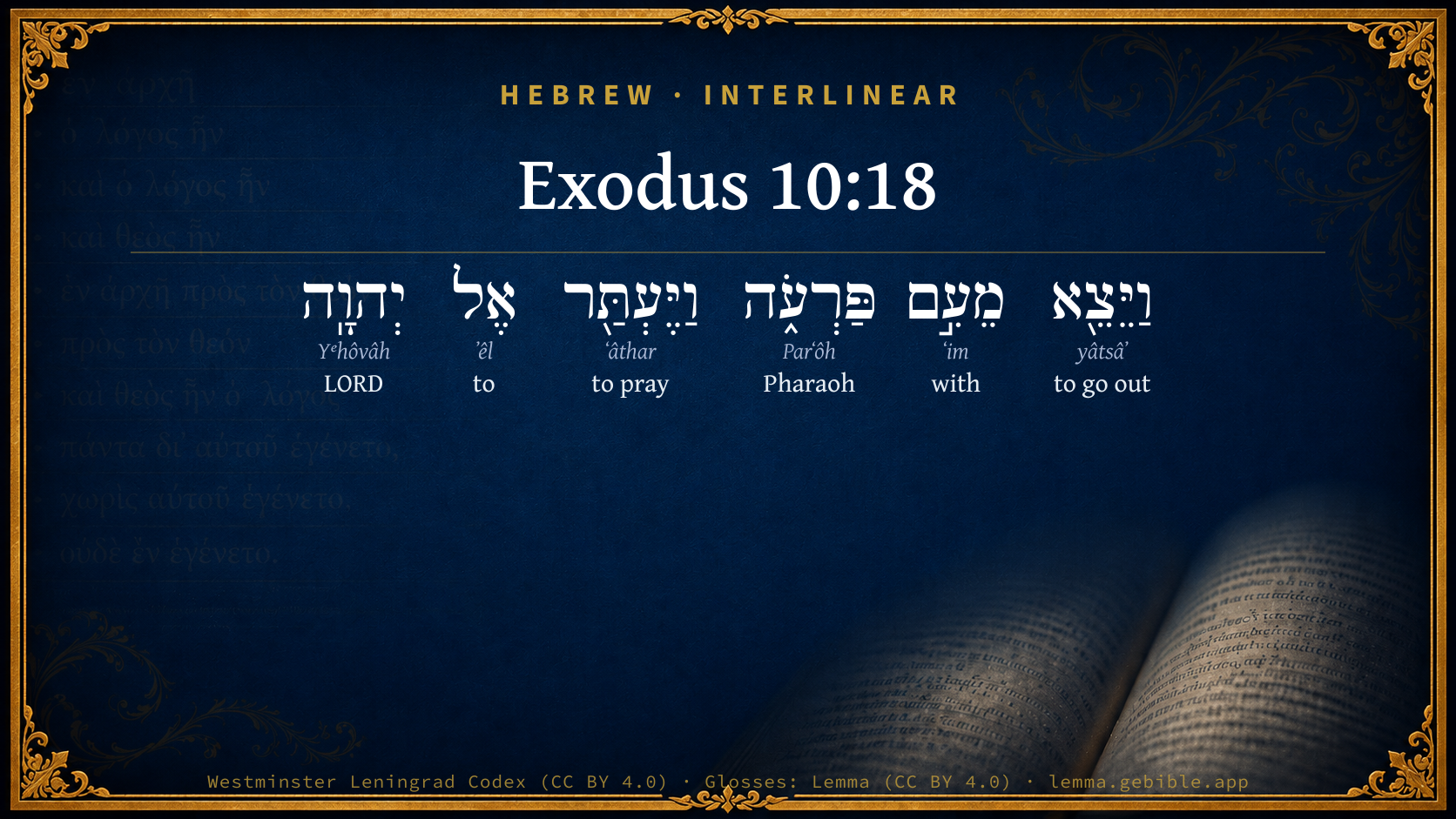
Hebrew (Westminster Leningrad Codex) Exodus 10:18 appears in the Hebrew Old Testament. The text above is from the Westminster Leningrad Codex. Each word links to its Strong’s number, a concise gloss, and parsing drawn from the Open Scriptures Hebrew Bible morphology. Click any word for its full Brown-Driver-Briggs (BDB) entry.
Download image
Cite this verse

Exodus 10:18 (World English Bible). Public Domain. Lemma interlinear Bible study tool, https://lemma.gebible.app/v/exodus/10/18.

Show BibTeX & RIS
BibTeX
RIS
English Translation
He went out from Pharaoh, and prayed to Yahweh.
World English Bible · Public Domain
Download a study sheet

One document with this verse’s original text, its word-by-word gloss line, the meaning frame, cross-references with their text, attributed commentary, and full source and license credits — printable, and it pastes into notes with its structure intact.

This verse Autodidact and up

Study sheet (.html) Plain text (.txt)

A passage Seminary Student

Up to 50 verses in one chapter. A passage sheet keeps up to 6 commentary sources and 12 cross-references per verse, in the order this page ranks them, and says so on the sheet whenever that leaves anything out. Ask for a single verse and you get the Autodidact verse sheet above.

Everything on this page stays free to read, with no account — the sheet is a download of what is already on screen, not access to it.

Want to remove ads? Support Godless Engineer
Compare translations 3

The same verse in 3 English versions, stacked beneath the original-language interlinear above. Click any original word for its lexicon entry.

Each is an independent rendering of the whole verse — the interlinear is not word-aligned to these translations.

Highlighted words mark where these versions differ — a whole-verse word diff, not a word-by-word alignment.

  • World English Bible Public Domain
    He went out from Pharaoh, and prayed to Yahweh.
  • King James Version Public Domain
    And he went out from Pharaoh, and entreated the LORD.
  • unfoldingWord Literal Text CC BY-SA 4.0
    And he went out from being with Pharaoh, and he prayed to Yahweh.

unfoldingWord Literal Text — © unfoldingWord, licensed CC BY-SA 4.0. Word-aligned USFM3 via Door43 (git.door43.org/unfoldingWord/en_ult).

Versions to compare (up to 4)

3 of 4 selected

Show all 18 translations

Every available English version of this verse, each an independent rendering of the whole verse.

  • World English Bible Public Domain
    He went out from Pharaoh, and prayed to Yahweh.
  • Berean Standard Bible Public Domain
    So Moses left Pharaoh’s presence and appealed to the LORD.
  • Majority Standard Bible Public Domain
    So Moses left Pharaoh’s presence and appealed to the LORD.
  • King James Version Public Domain
    And he went out from Pharaoh, and entreated the LORD.
  • American Standard Version (1901) Public Domain
    And he went out from Pharaoh, and entreated Jehovah.
  • Revised Version (1885) Public Domain
    And he went out from Pharaoh, and entreated the LORD.
  • Geneva Bible (1599) Public Domain
    Moses then went out from Pharaoh, and prayed vnto the Lord.
  • Douay-Rheims (1899) Public Domain
    And Moses going forth from the presence of Pharao, prayed to the Lord.
  • Young's Literal Translation Public Domain
    And he goeth out from Pharaoh, and maketh supplication unto Jehovah,
  • Literal Standard Version CC BY-SA 4.0
    And he goes out from Pharaoh, and makes supplication to YHWH,
  • Unlocked Literal Bible CC BY-SA 4.0
    So Moses went out from Pharaoh and prayed to Yahweh.
  • unfoldingWord Literal Text CC BY-SA 4.0
    And he went out from being with Pharaoh, and he prayed to Yahweh.
  • Darby Bible Public Domain
    And he went out from Pharaoh, and intreated Jehovah.
  • World Messianic Bible Public Domain
    Moses went out from Pharaoh, and prayed to the LORD.
  • Webster's Bible Public Domain
    And he went out from Pharaoh, and entreated the LORD.
  • Free Bible Version CC BY-SA 4.0
    Moses left Pharaoh and prayed to the Lord.
  • Bible in Basic English Public Domain
    So he went out from Pharaoh and made prayer to the Lord.
  • JPS Tanakh (1917) Public Domain
    And he went out from Pharaoh, and entreated the LORD.

Literal Standard Version (2020), Covenant Press — licensed CC BY-SA 4.0. Text via the HelloAO Bible API (eBible.org). Unlocked Literal Bible (unfoldingWord) — licensed CC BY-SA 4.0. Text via the HelloAO Bible API (eBible.org). unfoldingWord Literal Text — © unfoldingWord, licensed CC BY-SA 4.0. Word-aligned USFM3 via Door43 (git.door43.org/unfoldingWord/en_ult). Free Bible Version, Dr. Jonathan Gallagher — licensed CC BY-SA 4.0. Text via the HelloAO Bible API (eBible.org).

Word by word

More ways to search: Search by grammar → Find every occurrence → Compare this word →

Practice this passage: Drill this verse → Learn its vocabulary →

וַיֶּעְתַּ֖ר
ʻâthar
H6279
“and · to pray”
Conjunction + Verb, Qal, Sequential Imperfect, 3rd Person, Masculine, Singular
Part of Speech
Conjunction + Verb
Stem
Qal
Form
Sequential Imperfect
Person
3rd Person
Gender
Masculine
Number
Singular
Full BDB Definition

Origin: a primitive root [rather denominative from H6281 ]

TWOT: 1722

to pray, entreat, supplicate - (Qal) to pray, entreat - (Niphal) to be supplicated, be entreated - (Hiphil) to make supplication, plead
  1. וַיֵּצֵ֖א yâtsâʼ H3318 “and · to go out” Conjunction + Verb, Qal, Sequential Imperfect, 3rd Person, Masculine, Singular
  2. מֵעִ֣ם ʻim H5973 “from · with” Preposition + Preposition
  3. פַּרְעֹ֑ה Parʻôh H6547 “Pharaoh” Noun, Proper
  4. אֶל ʼêl H413 “to” Preposition
  5. יְהוָֽה Yᵉhôvâh H3068 “LORD” Noun, Proper

About this verse

These counts appear in no published source. They are computed here, from the morphology-tagged text and Lemma’s own curated glosses. What Lemma adds →

6
words
6
distinct lemmas
Pentateuch
section

Notable vocabulary

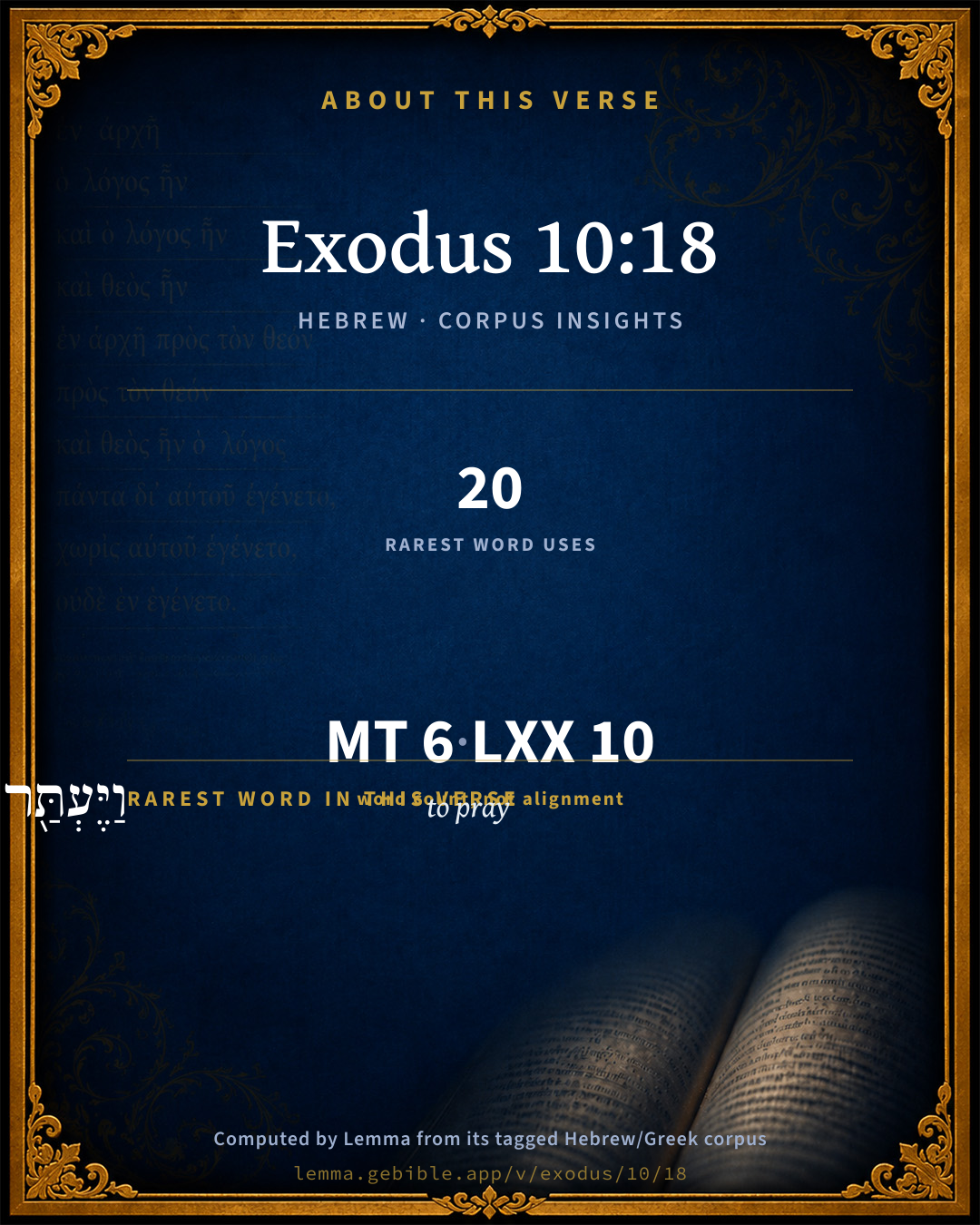
The rarest word here is וַיֶּעְתַּ֖ר to pray H6279 — appearing just 20 times in the whole Hebrew Bible.

Shared distinctive vocabulary

וַיֶּעְתַּ֖ר to pray H6279 occurs in 19 verses of the Hebrew Bible. Also found in:

Grammatical profile

  • 2 verbs
  • 2 nouns
  • 2 prepositions

Verb forms

  • וַיֵּצֵ֖א Qal · Sequential Imperfect
  • וַיֶּעְתַּ֖ר Qal · Sequential Imperfect

Hebrew & Septuagint length

In English translation the verse runs 9 words from the Hebrew and 10 from the Septuagint (LXX English) — closely comparable.

A rough comparison of the two English renderings, which tokenize alike — not a word-level alignment.

Word counts can differ between the Hebrew and the Greek without any difference in meaning — e.g. the Hebrew direct-object marker אֵת has no separate Greek word, and Greek often adds the article ὁ.

In the original languages it is 6 Hebrew tokens and 10 Greek tokens — but the two are counted differently (Hebrew bundles its prefixes and suffixes into one token; the Greek is in lemma form), so that isn’t a like-for-like length.

Cross-references

4

Topical passages linked to Exodus 10:18 in the Treasury of Scripture Knowledge — connected by theme and wording, ordered by reader-vote popularity; previews shown in the World English Bible.

  • Exodus 8:9 Moses said to Pharaoh, "I give you the honor of setting the time that I should pray for you, and for your servants, and for your people, that the frogs be destroyed from you and your houses, and remain in the river only."
  • Exodus 8:28–30 Pharaoh said, "I will let you go, that you may sacrifice to Yahweh your God in the wilderness, only you shall not go very far away. Pray for me."
  • Matthew 5:44 But I tell you, love your enemies, bless those who curse you, do good to those who hate you, and pray for those who mistreat you and persecute you,
  • Luke 6:28 bless those who curse you, and pray for those who mistreat you.

Cross-references courtesy of OpenBible.info (CC BY 4.0).

Hebrew and Greek witnesses Masoretic Hebrew ↔ Greek Septuagint

The same verse in the two great witnesses to the Old Testament, shown verse-for-verse.

These are two independent witnesses, not word-aligned to each other, and the Septuagint is shown in lemma (dictionary) form.

Hebrew Exodus 10:18 Masoretic · Westminster Leningrad Codex

וַיֵּצֵ֖א מֵעִ֣ם פַּרְעֹ֑ה וַיֶּעְתַּ֖ר אֶל יְהוָֽה

He went out from Pharaoh, and prayed to Yahweh.

World English Bible · Public Domain

Greek LXX Exodus 10:18 Septuagint · lemma form

ἐκἔρχομαι δέ μωυσῆς ἀπό φαραώ καί εὔχομαι πρός ὁ θεός

And Moses went forth from Pharao, and prayed to God.

LXX2012 (modern English Septuagint) · Public Domain

On this verse, Haydock's Catholic Bible Commentary discusses the Septuagint’s reading. Read the note in Commentary ↓

Hebrew: Westminster Leningrad Codex (CC BY 4.0). Greek: Septuagint (public domain); English from LXX2012 (modern English Septuagint) (Public Domain). How the Septuagint differs from the Hebrew →

Targum (Aramaic paraphrase)

2

The Targum is the ancient Jewish Aramaic paraphrase of the Hebrew Scriptures — an interpretive translation, not the Hebrew text itself. Onkelos (literal) and Pseudo-Jonathan (expansive) render the Torah, and Jonathan the Prophets. Coverage is partial: where no permissively-licensed English translation exists for a verse, only the Aramaic is shown. This is verse-level text, not a word-by-word alignment to the Hebrew.

  1. Targum Onkelos Torah (Genesis–Deuteronomy)
    וּנְפַק מִלְוָת פַּרְעֹה וְצַלִי קֳדָם יְיָ:

    (no public-domain English translation for this verse)

    Targum Onkelos — Aramaic: “Onkelos Genesis” (public domain); “Onkelos Exodus” (public domain); “Onkelos Leviticus” (public domain); “Onkelos Numbers” (public domain); “Onkelos Deuteronomy” (public domain). English: “Sefaria Community Translation” (CC0 1.0 (public-domain dedication)); “J.W. Etheridge. The Targums of Onkelos and Jonathan Ben Uzziel on the Pentateuch. London: Longmans, Green, 1862” (public domain). Text via Sefaria.

  2. Targum Pseudo-Jonathan Torah (Genesis–Deuteronomy)
    וּנְפַק מִלְוַת פַּרְעה וְצַלִּי קֳדָם יְיָ

    And he went out from Pharoh, and prayed before the Lord.

    Targum Pseudo-Jonathan — Aramaic: “Targum Jonathan on Genesis” (public domain); “Targum Jonathan on Exodus” (public domain); “Targum Jonathan on Leviticus” (public domain); “Targum Jonathan on Numbers” (public domain); “Targum Jonathan on Deuteronomy” (public domain). English: “The Targum of Jonathan ben Uzziel, trans. J. W. Etheridge, London, 1862” (public domain). Text via Sefaria.

Commentary

Notes on Exodus 10:18 from classic Christian and Jewish commentators (each source and its license shown beneath its notes). The classic Christian expositions comment on the surrounding passage and are grouped to its opening verse, so a note may address several verses; the Jewish commentaries on the Tanakh (Rashi and others) are per-verse, so they appear only where the commentator wrote on this verse.

Lemma curates 59 commentaries, every one of them public domain or Creative Commons licensed, each selected and text-cleaned for this edition rather than reprinted as found. About our sources →

Trapp's Complete Commentary

John Trapp

Exo 10:18 And he went out from Pharaoh, and intreated the LORD.

Ver. 18. And he went out.] The wisdom from above is "gentle, easy to be intreated," ready to every good work. {Jas 3:17} The devils are called Shegnirim, rough and rugged.

John Trapp, A Commentary or Exposition upon All the Books of the Old and New Testament (1647–1656) — public domain. Text from a community e-Sword module.

The Cambridge Bible for Schools and Colleges

gen. ed. J. J. S. Perowne

18, 19. At Moses’ entreaty, the locusts are removed.

The Cambridge Bible for Schools and Colleges (gen. ed. J. J. S. Perowne; Cambridge University Press, 1878–1918) — public domain. Text from a community e-Sword module.

John Gill's Exposition

And he went out from Pharaoh,.... Without the city, as he had been wont to do: and entreated the Lord; prayed to him that he would remove the plague of the locusts from the land.

And he went out from Pharaoh,.... Without the city, as he had been wont to do: and entreated the Lord; prayed to him that he would remove the plague of the locusts from the land.

Exodus 10:19

exo 10:19

exo 10:19

exo 10:19And the Lord turned a mighty strong west wind,.... He turned the wind the contrary way it before blew; it was an east wind that brought the locusts, but now it was changed into a west wind, or "a wind of the sea" (u), of the Mediterranean sea; a wind which blew from thence, which lay to the west of Egypt, as the Red sea did to the east of it, to which the locusts were carried by the wind as follows: which took away the locusts, and cast them into the Red sea; and as it is usual for locusts to be brought by winds, so to be carried away with them, and to be let fall into seas, lakes, and pools, and there perish. So Pliny says (w) of locusts, that being taken up and carried with the wind in flocks or swarms, they fell into seas and lakes; and Jerom observes (x) in his time, that they had seen swarms of locusts cover the land of Judea, which upon the wind rising have been driven into the first and last seas; that is, into the Dead sea, and into the Mediterranean sea; see Joe 2:20. This sea here called the Red sea is the same which is now called the Arabian gulf; in the original text it is the sea of Suph; that is, the sea of flags or rushes; as the word is rendered, Exo 2:3 from the great numbers of these growing on the banks of it, which are full of them, as Thevenot (y) says; or the "sea of weeds" (z), from the multitude of them in the bottom of it, or floating on it. So Columbus found in the Spanish West Indies, on the coast of Paria, a sea full of herbs, or weeds (a), which grew so thick, that they sometimes in a manner stopped the ships. Some render Yam Suph, the sea of bushes; and some late travellers (b) observe, that though, in the dreadful wilds along this lake, one sees neither tree, shrub, nor vegetable, except a kind of bramble, yet it is remarkable that they are found in the sea growing on its bottom, where we behold with astonishment whole groves of trees blossoming and bearing fruit, as if nature by these marine vegetables meant to compensate for the extreme sterility reigning in all the deserts of Arabia; and with this agrees the account that Pliny (c) gives of the Red sea, that in it olives and green fruit trees grow; yea, he says that that and all the Eastern ocean is full of woods; and adds, it is wonderful that in the Red sea woods live, especially the laurel, and the olive bearing berries. Hillerus (d) thinks this sea here has the name of the sea of Suph from a city of the same name near unto it. It is often called the Red sea in profane authors as here, not from the coral that grew in it, or the red sand at the bottom of it, or red mountains near it; though Thevenot (e) says, there are some mountains all over red on the sides of it; nor from the shade of those mountains upon it; nor from the appearance of it through the rays of the sun upon it; and much less from the natural colour of it; which, as Curtius (f) observes, does not differ from others; though a late traveller says (g), that"on several parts of this sea (the Red sea) we observed abundance of reddish spots made by a weed resembling "cargaco" (or Sargosso) rooted in the bottom, and floating in some places: upon strict examination, it proved to be that which we found the Ethiopians call Sufo (as here Suph), used up and down for dying their stuffs and clothes of a red colour,''but the Greeks called it so from Erythras or Erythrus, a king that reigned in those parts (h), whose name signifies red; and it is highly probable the same with Esau, who is called Edom, that is, red, from the red pottage he sold his birthright for to Jacob; and this sea washing his country, Idumea or Edom, was called the Red sea from thence; and here the locusts were cast by the wind, or "fixed" (i), as a tent is fixed, as the word signifies, and there continued, and never appeared more:

there remained not one locust in all the coasts of Egypt; so that the removal of them was as great a miracle as the bringing them at first: this was done about the nineth day of the month Abib.

(u) "venture maris", Montanus, Drusius. (w) Nat. Hist. l. 11. c. 29. (x) Comment. in Joel, ii. 20. (y) Travels into the Levant, B. 2. ch. 33. p. 175. (z) "in mare algosum", Junius & Tremellius, Piscator; "in mare carectosum", Tigurine version. (a) P. Martyr. de Angleria, Decad. 1. l. 6. Vide Decad. 3. 5. (b) Egmont and Heyman's Travels, vol. 2. p. 158. (c) Nat. Hist. l. 2. c. 103. l. 13. c. 25. (d) Onomastic. Sacr. p. 128. (e) Ut supra. (Travels into the Levant, B. 2. ch. 33. p. 175.) (f) Hist. l. 8. sect. 9. (g) Hieronymo Lobo's Observations, &c. in Ray's Travels, vol. 2. p. 489. (h) Curtius ut supra. (Hist. l. 8. sect. 9.). Mela de Situ Orbis, l. 3. c. 8. Strabo, l. 16. p. 535, 536. (i) "et fixit eam", Montanus; so Tigurine version, Junius & Tremellius, Piscator, Drusius, Ainsworth.

John Gill's Exposition of the Whole Bible (1746–1763) — public domain (CC PDM 1.0). Text via the HelloAO Bible API.

Haydock's Catholic Bible Commentary

Moses. The printed Hebrew and Chaldean do not read his name; but some manuscripts have it agreeably to the Septuagint and Syriac versions. (Kennicott)

George Leo Haydock (1774–1849), Haydock's Catholic Family Bible and Commentary, 1859 edition — public domain. Excludes Psalms (Douay-Rheims chapter numbering differs from Protestant) and Deuterocanonical books (Catholic canon only).

The Pulpit Commentary

He intreated the Lord. Moses complied, though Pharaoh had this time made no distinct promise of releasing the people. He had learnt that no dependence was to be placed on such promises, and that it was idle to exact them. If anything could have touched the dull and hard heart of the king, it would have been the gentleness and magnanimity shown by Moses in uttering no word of reproach, making no conditions, but simply granting his request as soon as it was made, and obtaining the removal of the plague.

The Pulpit Commentary (1880–1919), ed. H.D.M. Spence-Jones & Joseph S. Exell — public domain. Text from a community e-Sword module.

Keil & Delitzsch

C. F. Keil & F. Delitzsch

To show the hardened king the greatness of the divine long-suffering, Moses prayed to the Lord, and the Lord cast the locusts into the Red Sea by a strong west wind. The expression "Jehovah turned a very strong west wind" is a concise form, for "Jehovah turned the wind into a very strong west wind." The fact that locusts do perish in the sea is attested by many authorities. Gregatim sublatae vento in maria aut stagna decidunt (Pliny); many others are given by Bochart and Volney. ויּתקעהוּ: He thrust them, i.e., drove them with irresistible force, into the Red Sea. The Red Sea is called סוּף ים, according to the ordinary supposition, on account of the quantity of sea-weed which floats upon the water and lies upon the shore; but Knobel traces the name to a town which formerly stood at the head of the gulf, and derived its name from the weed, and supports his opinion by the omission of the article before Suph, though without being able to prove that any such town really existed in the earlier times of the Pharaohs.

Keil & Delitzsch — Biblical Commentary on the Old Testament (1861–1891) — public domain (CC PDM 1.0). Text via the HelloAO Bible API. (Old Testament only.)

Lesson kit

Teaching starters — assembled from the data on this page, not authored interpretation. Every prompt links to the verse data it draws on. Edit before teaching.

Exodus, in the Pentateuch, opens this verse with 6 words (6 distinct Hebrew lemmas). Its most distinctive word is ʻâthar (“to pray”). A historical commentator’s framing appears above. Read the whole chapter for the surrounding context.

Discussion questions

  1. How does “to pray” (ʻâthar) shape what this verse is saying?
  2. Genesis 25:21 shares the word «to pray» with this verse. How do the two illuminate each other?
  3. These translations render this verse differently. What is at stake in choosing one wording over another?
  4. The verb «וַיֵּצֵ֖א» is Qal Sequential Imperfect. How does its form color the action?
  5. Reading how Trapp's Complete Commentary and The Cambridge Bible for Schools and Colleges read this verse, where do the two commentators agree and where do they part?

Things to notice

Reading settings

Reading text

Shown beneath each verse's original-language words.

Old Testament
Old Testament edition

Read the OT as the Masoretic Hebrew (MT) or the Greek Septuagint (LXX).

English shown for the Greek Septuagint (in the Hebrew ↔ Greek comparison).

Comparing translations? Open the Compare panel on any verse page to stack up to four side by side.