1 Chronicles 19:14

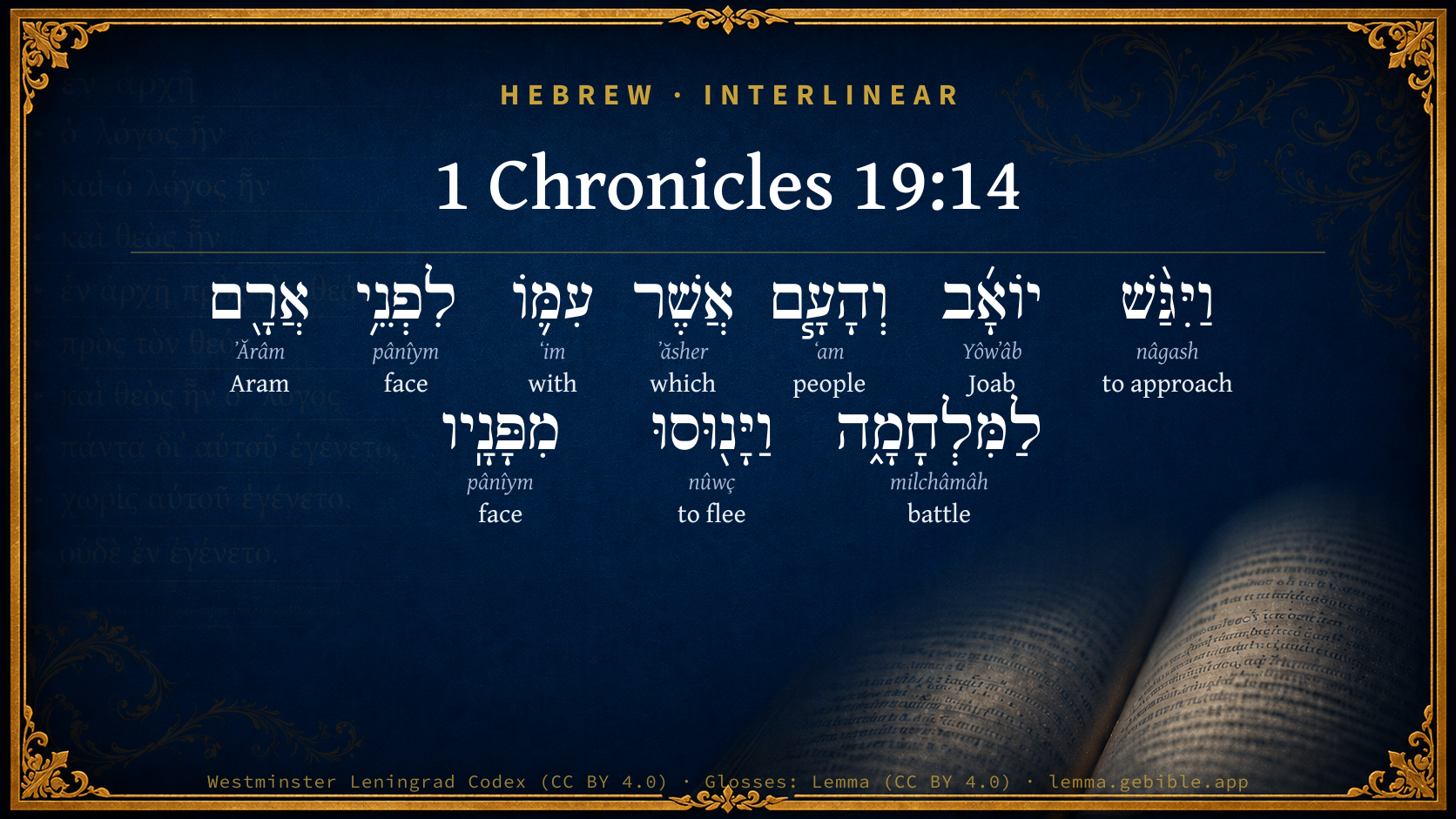
Hebrew (Westminster Leningrad Codex) 1 Chronicles 19:14 appears in the Hebrew Old Testament. The text above is from the Westminster Leningrad Codex. Each word links to its Strong’s number, a concise gloss, and parsing drawn from the Open Scriptures Hebrew Bible morphology. Click any word for its full Brown-Driver-Briggs (BDB) entry.
Download image
Cite this verse

1 Chronicles 19:14 (World English Bible). Public Domain. Lemma interlinear Bible study tool, https://lemma.gebible.app/v/1-chronicles/19/14.

Show BibTeX & RIS
BibTeX
RIS
English Translation
So Joab and the people who were with him drew near before the Syrians to the battle; and they fled before him.
World English Bible · Public Domain
Download a study sheet

One document with this verse’s original text, its word-by-word gloss line, the meaning frame, cross-references with their text, attributed commentary, and full source and license credits — printable, and it pastes into notes with its structure intact.

This verse Autodidact and up

Study sheet (.html) Plain text (.txt)

A passage Seminary Student

Up to 50 verses in one chapter. A passage sheet keeps up to 6 commentary sources and 12 cross-references per verse, in the order this page ranks them, and says so on the sheet whenever that leaves anything out. Ask for a single verse and you get the Autodidact verse sheet above.

Everything on this page stays free to read, with no account — the sheet is a download of what is already on screen, not access to it.

Want to remove ads? Support Godless Engineer
Compare translations 3

The same verse in 3 English versions, stacked beneath the original-language interlinear above. Click any original word for its lexicon entry.

Each is an independent rendering of the whole verse — the interlinear is not word-aligned to these translations.

Highlighted words mark where these versions differ — a whole-verse word diff, not a word-by-word alignment.

  • World English Bible Public Domain
    So Joab and the people who were with him drew near before the Syrians to the battle; and they fled before him.
  • King James Version Public Domain
    So Joab and the people that were with him drew nigh before the Syrians unto the battle; and they fled before him.
  • unfoldingWord Literal Text CC BY-SA 4.0
    Then Joab and the people who with him approached to the face of Aram for battle, and they fled from his face.

unfoldingWord Literal Text — © unfoldingWord, licensed CC BY-SA 4.0. Word-aligned USFM3 via Door43 (git.door43.org/unfoldingWord/en_ult).

Versions to compare (up to 4)

3 of 4 selected

Show all 18 translations

Every available English version of this verse, each an independent rendering of the whole verse.

  • World English Bible Public Domain
    So Joab and the people who were with him drew near before the Syrians to the battle; and they fled before him.
  • Berean Standard Bible Public Domain
    So Joab and his troops advanced to fight the Arameans, who fled before him.
  • Majority Standard Bible Public Domain
    So Joab and his troops advanced to fight the Arameans, who fled before him.
  • King James Version Public Domain
    So Joab and the people that were with him drew nigh before the Syrians unto the battle; and they fled before him.
  • American Standard Version (1901) Public Domain
    So Joab and the people that were with him drew nigh before the Syrians unto the battle; and they fled before him.
  • Revised Version (1885) Public Domain
    So Joab and the people that were with him drew nigh before the Syrians unto the battle; and they fled before him.
  • Geneva Bible (1599) Public Domain
    So Ioab and the people that was with him, came neere before the Aramites vnto the battel, and they fled before him.
  • Douay-Rheims (1899) Public Domain
    So Joab and the people that were with him, went against the Syrians to the battle: and he put them to flight.
  • Young's Literal Translation Public Domain
    And Joab draweth nigh, and the people who `are' with him, before Aram to battle, and they flee from his face;
  • Literal Standard Version CC BY-SA 4.0
    And Joab draws near, and the people who [are] with him, before Aram to battle, and they flee from his face;
  • Unlocked Literal Bible CC BY-SA 4.0
    So Joab and the soldiers of his army advanced to the battle against the Arameans, who were forced to flee before the army of Israel.
  • unfoldingWord Literal Text CC BY-SA 4.0
    Then Joab and the people who with him approached to the face of Aram for battle, and they fled from his face.
  • Darby Bible Public Domain
    And Joab and the people that were with him drew near in front of the Syrians to the battle; and they fled before him.
  • World Messianic Bible Public Domain
    So Joab and the people who were with him came near to the front of the Syrians to the battle; and they fled before him.
  • Webster's Bible Public Domain
    So Joab and the people that were with him drew nigh before the Syrians to the battle; and they fled before him.
  • Free Bible Version CC BY-SA 4.0
    Joab attacked the Arameans with his forces and they ran away from him.
  • Bible in Basic English Public Domain
    So Joab and the people who were with him went forward into the fight against the Aramaeans, and they went in flight before him.
  • JPS Tanakh (1917) Public Domain
    So Joab and the people that were with him drew nigh unto the battle to meet the Arameans; and they fled before him.

Literal Standard Version (2020), Covenant Press — licensed CC BY-SA 4.0. Text via the HelloAO Bible API (eBible.org). Unlocked Literal Bible (unfoldingWord) — licensed CC BY-SA 4.0. Text via the HelloAO Bible API (eBible.org). unfoldingWord Literal Text — © unfoldingWord, licensed CC BY-SA 4.0. Word-aligned USFM3 via Door43 (git.door43.org/unfoldingWord/en_ult). Free Bible Version, Dr. Jonathan Gallagher — licensed CC BY-SA 4.0. Text via the HelloAO Bible API (eBible.org).

Word by word

More ways to search: Search by grammar → Find every occurrence → Compare this word →

Practice this passage: Drill this verse → Learn its vocabulary →

וַיִּגַּ֨שׁ
nâgash
H5066
“and · to approach”
Conjunction + Verb, Qal, Sequential Imperfect, 3rd Person, Masculine, Singular
Part of Speech
Conjunction + Verb
Stem
Qal
Form
Sequential Imperfect
Person
3rd Person
Gender
Masculine
Number
Singular
Full BDB Definition

Origin: a primitive root

TWOT: 1297

to draw near, approach - (Qal) to draw or come near - of humans - of sexual intercourse - of inanimate subject - to approach one another - (Niphal) to draw near - (Hiphil) to cause to approach, bring near, bring - (Hophal) to be brought near - (Hithpael) to draw near
  1. יוֹאָ֜ב Yôwʼâb H3097 “Joab” Noun, Proper
  2. וְהָעָ֧ם ʻam H5971 “and · the · people” Conjunction + Particle, Definite Article + Noun, Common, Masculine, Singular, Absolute
  3. אֲשֶׁר ʼăsher H834 “which” Particle, Relative
  4. עִמּ֛וֹ ʻim H5973 “with · him” Preposition + Suffix, Personal, 3rd Person, Masculine, Singular
  5. לִפְנֵ֥י pânîym H6440 “to/for · face(s) of” Preposition + Noun, Common, Both, Plural, Construct
  6. אֲרָ֖ם ʼĂrâm H758 “Aram” Noun, Proper
  7. לַמִּלְחָמָ֑ה milchâmâh H4421 “to/for the · battle” Preposition, Determined + Noun, Common, Feminine, Singular, Absolute
  8. וַיָּנ֖וּסוּ nûwç H5127 “and · to flee” Conjunction + Verb, Qal, Sequential Imperfect, 3rd Person, Masculine, Plural
  9. מִפָּנָֽיו pânîym H6440 “from · face(s) · his” Preposition + Noun, Common, Both, Plural, Construct + Suffix, Personal, 3rd Person, Masculine, Singular

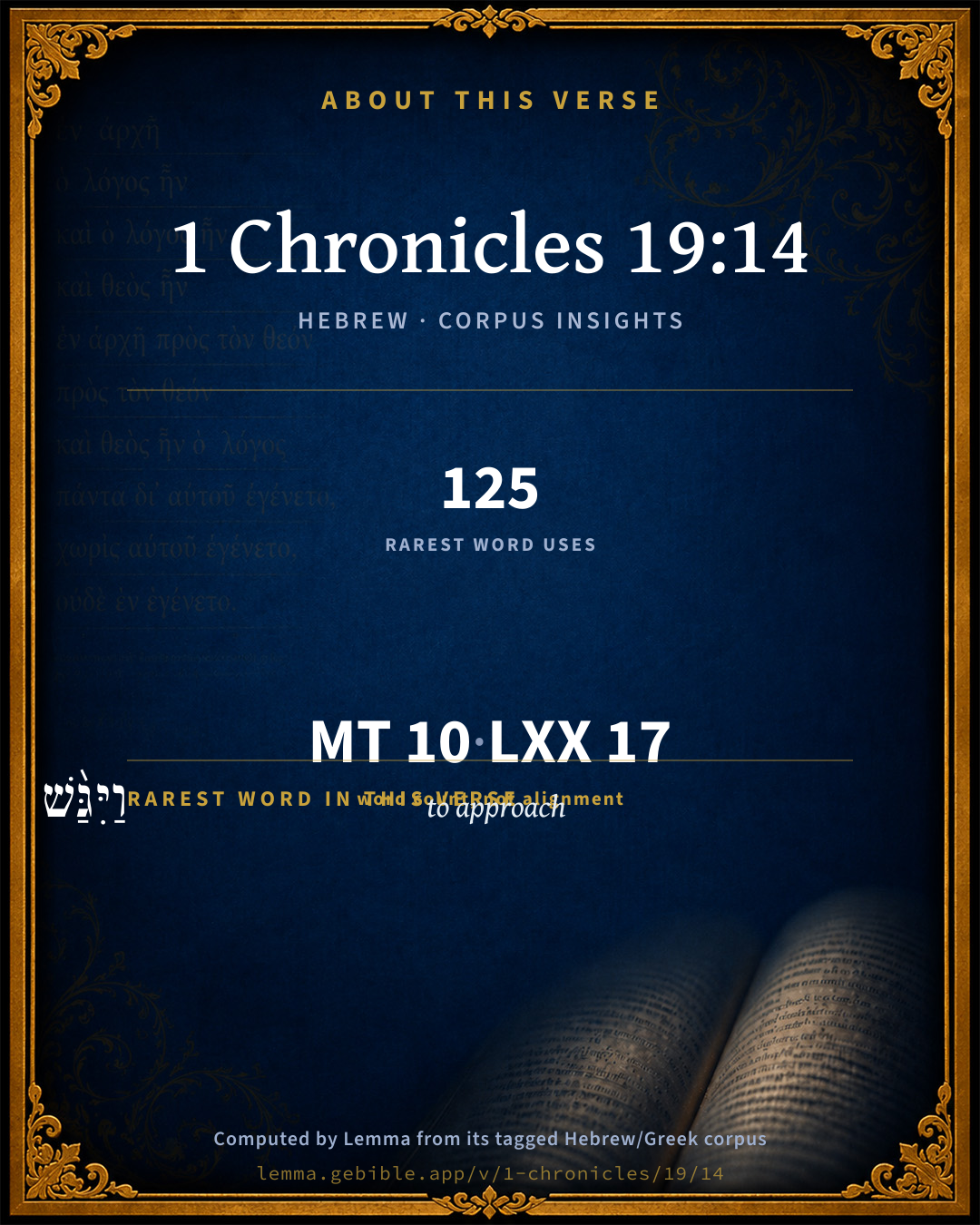
About this verse

These counts appear in no published source. They are computed here, from the morphology-tagged text and Lemma’s own curated glosses. What Lemma adds →

10
words
9
distinct lemmas
Historical
section

Grammatical profile

  • 2 verbs
  • 6 nouns
  • 1 preposition
  • 1 particle

Verb forms

  • וַיִּגַּ֨שׁ Qal · Sequential Imperfect
  • וַיָּנ֖וּסוּ Qal · Sequential Imperfect

Repetition

A word recurs within this verse — often emphatic in Hebrew:

  • לִפְנֵ֥י face H6440 ×2

Hebrew & Septuagint length

In English translation the verse runs 22 words from the Hebrew and 22 from the Septuagint (LXX English) — the same length.

A rough comparison of the two English renderings, which tokenize alike — not a word-level alignment.

Word counts can differ between the Hebrew and the Greek without any difference in meaning — e.g. the Hebrew direct-object marker אֵת has no separate Greek word, and Greek often adds the article ὁ.

In the original languages it is 10 Hebrew tokens and 17 Greek tokens — but the two are counted differently (Hebrew bundles its prefixes and suffixes into one token; the Greek is in lemma form), so that isn’t a like-for-like length.

Cross-references

5

Topical passages linked to 1 Chronicles 19:14 in the Treasury of Scripture Knowledge — connected by theme and wording, ordered by reader-vote popularity; previews shown in the World English Bible.

  • 1 Kings 20:13 Behold, a prophet came near to Ahab king of Israel, and said, Thus says Yahweh, Have you seen all this great multitude? behold, I will deliver it into your hand this day; and you shall know that I am Yahweh.
  • 1 Kings 20:19–21 So these went out of the city, the young men of the princes of the provinces, and the army which followed them.
  • 1 Kings 20:28–30 A man of God came near and spoke to the king of Israel, and said, Thus says Yahweh, Because the Syrians have said, Yahweh is a god of the hills, but he is not a god of the valleys; therefore will I deliver all this great multitude into your hand, and you shall know that I am Yahweh.
  • 2 Chronicles 13:5–16 Ought you not to know that Yahweh, the God of Israel, gave the kingdom over Israel to David forever, even to him and to his sons by a covenant of salt?
  • Jeremiah 46:15–16 Why are your strong ones swept away? they didn't stand, because Yahweh did drive them.

Cross-references courtesy of OpenBible.info (CC BY 4.0).

Hebrew and Greek witnesses Masoretic Hebrew ↔ Greek Septuagint

The same verse in the two great witnesses to the Old Testament, shown verse-for-verse.

These are two independent witnesses, not word-aligned to each other, and the Septuagint is shown in lemma (dictionary) form.

Hebrew 1 Chronicles 19:14 Masoretic · Westminster Leningrad Codex

וַיִּגַּ֨שׁ יוֹאָ֜ב וְהָעָ֧ם אֲשֶׁר עִמּ֛וֹ לִפְנֵ֥י אֲרָ֖ם לַמִּלְחָמָ֑ה וַיָּנ֖וּסוּ מִפָּנָֽיו

So Joab and the people who were with him drew near before the Syrians to the battle; and they fled before him.

World English Bible · Public Domain

Greek LXX 1 Chronicles 19:14 Septuagint · lemma form

καί παρατάσσω ιωαβ καί ὁ λαός ὁ μετά αὐτός κατέναντι σύρων εἰς πόλεμος καί φεύγω ἀπό αὐτός

So Joab and the people that were with him set themselves in battle array against the Syrians, and they fled from them.

LXX2012 (modern English Septuagint) · Public Domain

Hebrew: Westminster Leningrad Codex (CC BY 4.0). Greek: Septuagint (public domain); English from LXX2012 (modern English Septuagint) (Public Domain). How the Septuagint differs from the Hebrew →

Commentary

Notes on 1 Chronicles 19:14 from classic Christian and Jewish commentators (each source and its license shown beneath its notes). The classic Christian expositions comment on the surrounding passage and are grouped to its opening verse, so a note may address several verses; the Jewish commentaries on the Tanakh (Rashi and others) are per-verse, so they appear only where the commentator wrote on this verse.

Lemma curates 59 commentaries, every one of them public domain or Creative Commons licensed, each selected and text-cleaned for this edition rather than reprinted as found. About our sources →

Ellicott's Commentary for English Readers

(14) Before the Syrians.—Rather, against Aram; so Samuel, with the more classical construction. The preposition used here was rendered to meet (1Ch_12:17).

A Bible Commentary for English Readers, edited by Charles John Ellicott (1878–1897) — public domain. Text from a community e-Sword module.

The Cambridge Bible for Schools and Colleges

gen. ed. J. J. S. Perowne

14. drew nigh before the Syrians] Without fear for their own rear advanced against the Syrian front.

The Cambridge Bible for Schools and Colleges (gen. ed. J. J. S. Perowne; Cambridge University Press, 1878–1918) — public domain. Text from a community e-Sword module.

unfoldingWord translationNotes

Door43 World Missions Community

advanced to the battle

"moved forward to the battle" or "approached the enemy soldiers in the battle"

Then Joab returned ... and went back to Jerusalem

It does not appear that Joab and his soldiers continued to attack the Ammonites in their city. When the Ammonites went into their city, the battle ended and the Israelites returned home.

translationWords

Joab

Israel

Jerusalem

unfoldingWord translationNotes — © Distant Shores Media and the Door43 World Missions Community, licensed CC BY-SA 4.0. Source: git.door43.org/Door43/en_tn.

Lesson kit

Teaching starters — assembled from the data on this page, not authored interpretation. Every prompt links to the verse data it draws on. Edit before teaching.

1 Chronicles, in the Historical, opens this verse with 10 words (9 distinct Hebrew lemmas). Its most distinctive word is nâgash (“to approach”). A historical commentator’s framing appears above. Read the whole chapter for the surrounding context.

Discussion questions

  1. The word nâgash carries the sense “to approach.” How does it shape the verse?
  2. 1 Kings 20:13 shares this passage’s theme. How do the two illuminate each other?
  3. “face” occurs 2× in this one verse. What is the effect of the repetition?
  4. These translations render this verse differently; the difference is in the English rendering, not the original. What questions does that raise?
  5. The verb «וַיִּגַּ֨שׁ» is Qal Sequential Imperfect. How does its form color the action?
  6. Reading how Ellicott's Commentary for English Readers and The Cambridge Bible for Schools and Colleges read this verse, where do the two commentators agree and where do they part?

Things to notice

Reading settings

Reading text

Shown beneath each verse's original-language words.

Old Testament
Old Testament edition

Read the OT as the Masoretic Hebrew (MT) or the Greek Septuagint (LXX).

English shown for the Greek Septuagint (in the Hebrew ↔ Greek comparison).

Comparing translations? Open the Compare panel on any verse page to stack up to four side by side.