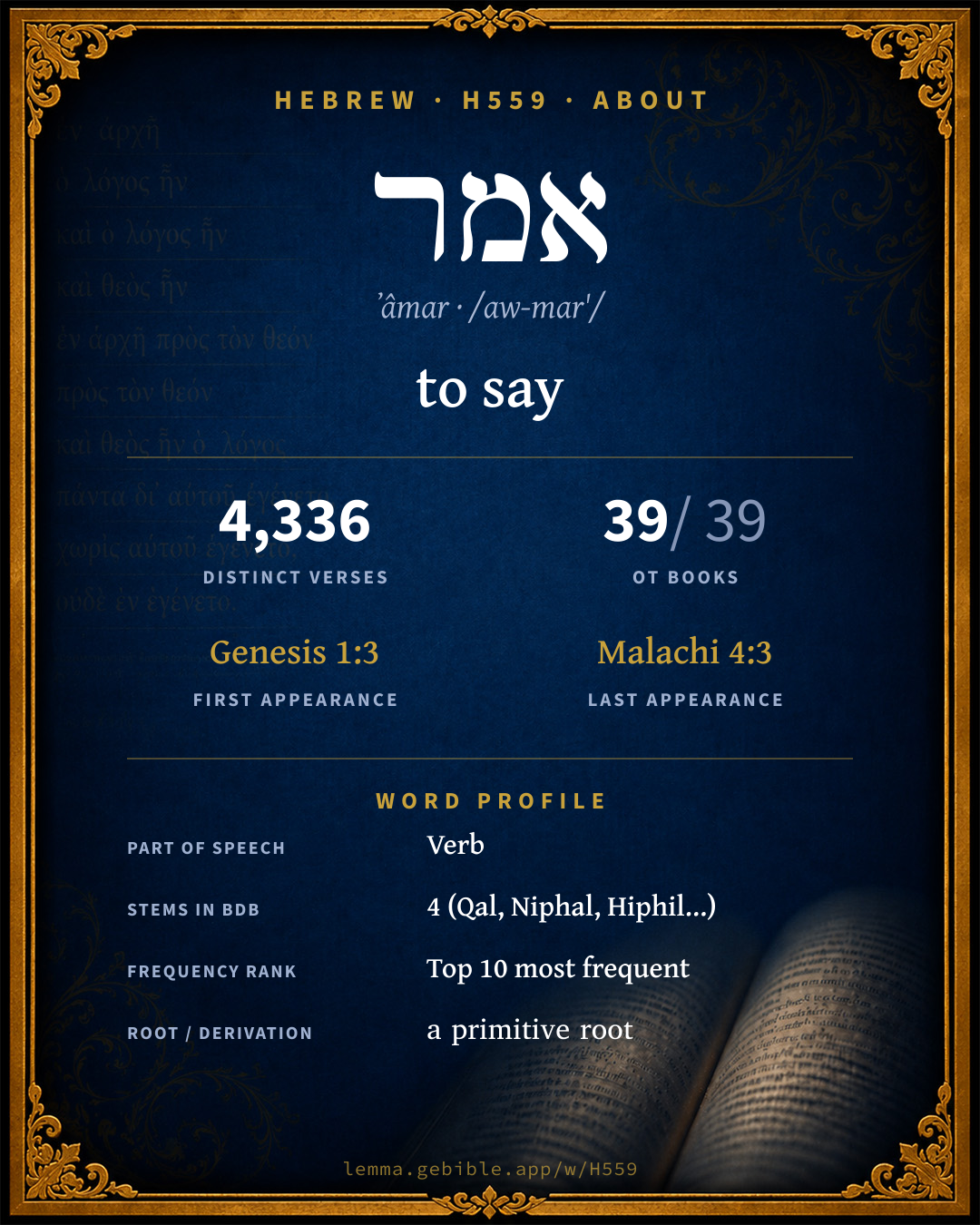
אָמַר
to say
also: speak, utter fuller range ↓
Full lexicon entry — Brown-Driver-Briggs (BDB)
From Brown-Driver-Briggs (BDB)
Where this word appears
Grammar key — what these labels mean
Part of speech
- Verb
- An action or state-of-being word.
Stem
- Qal
- The basic, simple active stem — the plain form of the verb (“he wrote”).
- Niphal
- Usually the simple passive or reflexive of the Qal (“he was written”).
- Hiphil
- The causative active stem (“he caused / brought about”). Here: ‘avow’
- Hithpael
- The reflexive or reciprocal stem (the subject acts on itself).
Form
- Sequential Imperfect
- An imperfect with prefixed waw — the standard past-narrative form (waw-consecutive imperfect).
- Infinitive Construct
- A bound verbal noun, frequently with prepositions (“to write / in writing”).
- Perfect
- A completed action or state — Hebrew marks aspect (completeness) more than strict tense (“he wrote”).
- Sequential Perfect
- A perfect with prefixed waw continuing a preceding imperfect or command (waw-consecutive perfect).
- Imperative
- A direct command (“write!”).
- Imperfect
- An incomplete, ongoing, or future action (“he will / would write”).
- Participle Active
- A verbal adjective expressing ongoing or characteristic action (“writing / one who writes”).
- Jussive
- A third- or second-person volitional form expressing wish or command (“let him write”).
- Infinitive Absolute
- An unbound verbal noun, often intensifying or standing in for a finite verb.
- Cohortative
- A first-person volitional form expressing wish or resolve (“let me / let us write”).
- Participle Passive
- A verbal adjective expressing action received (“written”).
State
- Absolute
- The independent form of a noun, not bound to a following word.
Person
- 3rd Person
- The one spoken about (“he / she / it / they”).
- 2nd Person
- The one addressed (“you”).
- 1st Person
- The speaker (“I / we”).
Gender
- Masculine
- Grammatically masculine.
- Feminine
- Grammatically feminine.
- Common
- Either gender — not distinguished for this form.
Number
- Singular
- One.
- Plural
- More than one (in Hebrew, generally three or more).
Page 2 of 2 — showing verses 201–258 of 258 distinct verses where H559 appears in the Book of 2 Samuel. Click any verse to open its interlinear word-by-word view. Verse text shown in the World English Bible for context — . Each verse’s Hebrew form is shown with its reference; the English is not keyword-highlighted, since the data carries no word-level English alignment. Use “Compare translations” on any verse to read it across multiple English versions. This concordance covers the Hebrew Bible; Septuagint (Greek Old Testament) occurrences are not indexed here.
2 Samuel
- 2 Samuel 18:32 וַ/יֹּ֤אמֶר וַ/יֹּ֣אמֶר conj + Qal wimpf 3ms conj + Qal wimpf 3ms The king said to the Cushite, Is it well with the young man Absalom? The Cushite answered, The enemies of my lord the king, and all who rise up against you to do you hurt, be as that young man is.
- 2 Samuel 18:33 אָמַ֣ר Qal pf 3ms The king was much moved, and went up to the chamber over the gate, and wept: and as he went, thus he said, my son Absalom, my son, my son Absalom! would I had died for you, Absalom, my son, my son!
- 2 Samuel 19:2 לֵ/אמֹ֔ר prep + Qal inf.cs The victory that day was turned into mourning to all the people; for the people heard say that day, The king grieves for his son.
- 2 Samuel 19:5 וַ/יֹּאמֶר֩ conj + Qal wimpf 3ms Joab came into the house to the king, and said, You have shamed this day the faces of all your servants, who this day have saved your life, and the lives of your sons and of your daughters, and the lives of your wives, and the lives of your concubines;
- 2 Samuel 19:8 לֵ/אמֹ֗ר prep + Qal inf.cs Then the king arose, and sat in the gate. They told to all the people, saying, Behold, the king is sitting in the gate: and all the people came before the king. Now Israel had fled every man to his tent.
- 2 Samuel 19:9 לֵ/אמֹ֑ר prep + Qal inf.cs All the people were at strife throughout all the tribes of Israel, saying, The king delivered us out of the hand of our enemies, and he saved us out of the hand of the Philistines; and now he is fled out of the land from Absalom.
- 2 Samuel 19:11 לֵ/אמֹר֒ לֵ/אמֹ֔ר prep + Qal inf.cs prep + Qal inf.cs King David sent to Zadok and to Abiathar the priests, saying, Speak to the elders of Judah, saying, Why are you the last to bring the king back to his house? seeing the speech of all Israel is come to the king, [to bring him] to his house.
- 2 Samuel 19:13 תֹּֽמְר֔וּ Qal impf 2mp Say you to Amasa, Aren't you my bone and my flesh? God do so to me, and more also, if you aren't captain of the host before me continually in the room of Joab.
- 2 Samuel 19:19 וַ/יֹּ֣אמֶר conj + Qal wimpf 3ms He said to the king, Don't let my lord impute iniquity to me, neither do you remember that which your servant did perversely the day that my lord the king went out of Jerusalem, that the king should take it to his heart.
- 2 Samuel 19:21 וַ/יֹּ֔אמֶר conj + Qal wimpf 3ms But Abishai the son of Zeruiah answered, Shall Shimei not be put to death for this, because he cursed Yahweh's anointed?
- 2 Samuel 19:22 וַ/יֹּ֣אמֶר conj + Qal wimpf 3ms David said, What have I to do with you, you sons of Zeruiah, that you should this day be adversaries to me? shall there any man be put to death this day in Israel? for don't I know that I am this day king over Israel?
- 2 Samuel 19:23 וַ/יֹּ֧אמֶר conj + Qal wimpf 3ms The king said to Shimei, You shall not die. The king swore to him.
- 2 Samuel 19:25 וַ/יֹּ֤אמֶר conj + Qal wimpf 3ms It happened, when he was come to Jerusalem to meet the king, that the king said to him, Why didn't you go with me, Mephibosheth?
- 2 Samuel 19:26 וַ/יֹּאמַ֕ר אָמַ֨ר conj + Qal wimpf 3ms Qal pf 3ms He answered, My lord, O king, my servant deceived me: for your servant said, I will saddle me a donkey, that I may ride thereon, and go with the king; because your servant is lame.
- 2 Samuel 19:29 וַ/יֹּ֤אמֶר אָמַ֕רְתִּי conj + Qal wimpf 3ms Qal pf 1cs The king said to him, Why speak you any more of your matters? I say, You and Ziba divide the land.
- 2 Samuel 19:30 וַ/יֹּ֤אמֶר conj + Qal wimpf 3ms Mephibosheth said to the king, yes, let him take all, because my lord the king is come in peace to his own house.
- 2 Samuel 19:33 וַ/יֹּ֥אמֶר conj + Qal wimpf 3ms The king said to Barzillai, Come you over with me, and I will sustain you with me in Jerusalem.
- 2 Samuel 19:34 וַ/יֹּ֥אמֶר conj + Qal wimpf 3ms Barzillai said to the king, How many are the days of the years of my life, that I should go up with the king to Jerusalem?
- 2 Samuel 19:38 וַ/יֹּ֣אמֶר conj + Qal wimpf 3ms The king answered, Chimham shall go over with me, and I will do to him that which shall seem good to you: and whatever you shall require of me, that will I do for you.
- 2 Samuel 19:41 וַ/יֹּאמְר֣וּ conj + Qal wimpf 3mp Behold, all the men of Israel came to the king, and said to the king, Why have our brothers the men of Judah stolen you away, and brought the king, and his household, over the Jordan, and all David's men with him?
- 2 Samuel 19:43 וַ/יֹּ֗אמֶר conj + Qal wimpf 3ms The men of Israel answered the men of Judah, and said, We have ten parts in the king, and we have also more [right] in David than you: why then did you despise us, that our advice should not be first had in bringing back our king? The words of the men of Judah were fiercer than the words of the men of Israel.
- 2 Samuel 20:1 וַ֠/יֹּאמֶר conj + Qal wimpf 3ms There happened to be there a base fellow, whose name was Sheba, the son of Bichri, a Benjamite: and he blew the trumpet, and said, We have no portion in David, neither have we inheritance in the son of Jesse: every man to his tents, Israel.
- 2 Samuel 20:4 וַ/יֹּ֤אמֶר conj + Qal wimpf 3ms Then said the king to Amasa, Call me the men of Judah together within three days, and be here present.
- 2 Samuel 20:6 וַ/יֹּ֤אמֶר conj + Qal wimpf 3ms David said to Abishai, Now will Sheba the son of Bichri do us more harm than did Absalom: take your lord's servants, and pursue after him, lest he get him fortified cities, and escape out of our sight.
- 2 Samuel 20:9 וַ/יֹּ֤אמֶר conj + Qal wimpf 3ms Joab said to Amasa, Is it well with you, my brother? Joab took Amasa by the beard with his right hand to kiss him.
- 2 Samuel 20:11 וַ/יֹּ֗אמֶר conj + Qal wimpf 3ms There stood by him one of Joab's young men, and said, He who favors Joab, and he who is for David, let him follow Joab.
- 2 Samuel 20:16 אִמְרוּ Qal impv 2mp Then cried a wise woman out of the city, "Hear, hear! Please say to Joab, 'Come near here, that I may speak with you.'"
- 2 Samuel 20:17 וַ/תֹּ֧אמֶר וַ/יֹּ֣אמֶר וַ/תֹּ֣אמֶר וַ/יֹּ֖אמֶר conj + Qal wimpf 3fs conj + Qal wimpf 3ms conj + Qal wimpf 3fs conj + Qal wimpf 3ms He came near to her; and the woman said, Are you Joab? He answered, I am. Then she said to him, Hear the words of your handmaid. He answered, I do hear.
- 2 Samuel 20:18 וַ/תֹּ֖אמֶר לֵ/אמֹ֑ר לֵ/אמֹ֔ר conj + Qal wimpf 3fs prep + Qal inf.cs prep + Qal inf.cs Then she spoke, saying, They were wont to speak in old time, saying, They shall surely ask [counsel] at Abel: and so they ended [the matter].
- 2 Samuel 20:20 וַ/יֹּאמַ֑ר conj + Qal wimpf 3ms Joab answered, Far be it, far be it from me, that I should swallow up or destroy.
- 2 Samuel 20:21 וַ/תֹּ֤אמֶר conj + Qal wimpf 3fs The matter is not so: but a man of the hill-country of Ephraim, Sheba the son of Bichri by name, has lifted up his hand against the king, even against David; deliver him only, and I will depart from the city. The woman said to Joab, Behold, his head shall be thrown to you over the wall.
- 2 Samuel 21:1 וַ/יֹּ֣אמֶר conj + Qal wimpf 3ms There was a famine in the days of David three years, year after year; and David sought the face of Yahweh. Yahweh said, It is for Saul, and for his bloody house, because he put to death the Gibeonites.
- 2 Samuel 21:2 וַ/יֹּ֣אמֶר conj + Qal wimpf 3ms The king called the Gibeonites, and said to them (now the Gibeonites were not of the children of Israel, but of the remnant of the Amorites; and the children of Israel had sworn to them: and Saul sought to kill them in his zeal for the children of Israel and Judah);
- 2 Samuel 21:3 וַ/יֹּ֤אמֶר conj + Qal wimpf 3ms and David said to the Gibeonites, What shall I do for you? And with what shall I make atonement, that you may bless the inheritance of Yahweh?
- 2 Samuel 21:4 וַ/יֹּ֧אמְרוּ וַ/יֹּ֛אמֶר אֹמְרִ֖ים conj + Qal wimpf 3mp conj + Qal wimpf 3ms Qal ptcp.act mp The Gibeonites said to him, It is no matter of silver or gold between us and Saul, or his house; neither is it for us to put any man to death in Israel. He said, What you shall say, that will I do for you.
- 2 Samuel 21:5 וַ/יֹּֽאמְרוּ֙ conj + Qal wimpf 3mp They said to the king, The man who consumed us, and who devised against us, [that] we should be destroyed from remaining in any of the borders of Israel,
- 2 Samuel 21:6 וַ/יֹּ֥אמֶר conj + Qal wimpf 3ms let seven men of his sons be delivered to us, and we will hang them up to Yahweh in Gibeah of Saul, the chosen of Yahweh. The king said, I will give them.
- 2 Samuel 21:16 וַ/יֹּ֖אמֶר conj + Qal wimpf 3ms and Ishbibenob, who was of the sons of the giant, the weight of whose spear was three hundred [shekels] of brass in weight, he being girded with a new [sword], thought to have slain David.
- 2 Samuel 21:17 לֵ/אמֹ֗ר prep + Qal inf.cs But Abishai the son of Zeruiah helped him, and struck the Philistine, and killed him. Then the men of David swore to him, saying, You shall go no more out with us to battle, that you don't quench the lamp of Israel.
- 2 Samuel 22:2 וַ/יֹּאמַ֑ר conj + Qal wimpf 3ms and he said, Yahweh is my rock, and my fortress, and my deliverer, even mine;
- 2 Samuel 23:3 אָמַר֙ Qal pf 3ms The God of Israel said, The Rock of Israel spoke to me: One who rules over men righteously, Who rules in the fear of God,
- 2 Samuel 23:15 וַ/יֹּאמַ֑ר conj + Qal wimpf 3ms David longed, and said, Oh that one would give me water to drink of the well of Bethlehem, which is by the gate!
- 2 Samuel 23:17 וַ/יֹּ֡אמֶר conj + Qal wimpf 3ms He said, Be it far from me, Yahweh, that I should do this: [shall I drink] the blood of the men who went in jeopardy of their lives? therefore he would not drink it. These things did the three mighty men.
- 2 Samuel 24:1 לֵ/אמֹ֔ר prep + Qal inf.cs Again the anger of Yahweh was kindled against Israel, and he moved David against them, saying, Go, number Israel and Judah.
- 2 Samuel 24:2 וַ/יֹּ֨אמֶר conj + Qal wimpf 3ms The king said to Joab the captain of the host, who was with him, Go now back and forth through all the tribes of Israel, from Dan even to Beersheba, and number you the people, that I may know the sum of the people.
- 2 Samuel 24:3 וַ/יֹּ֨אמֶר conj + Qal wimpf 3ms Joab said to the king, Now Yahweh your God add to the people, however many they may be, one hundred times; and may the eyes of my lord the king see it: but why does my lord the king delight in this thing?
- 2 Samuel 24:10 וַ/יֹּ֨אמֶר conj + Qal wimpf 3ms David's heart struck him after that he had numbered the people. David said to Yahweh, I have sinned greatly in that which I have done: but now, Yahweh, put away, I beg you, the iniquity of your servant; for I have done very foolishly.
- 2 Samuel 24:11 לֵ/אמֹֽר prep + Qal inf.cs When David rose up in the morning, the word of Yahweh came to the prophet Gad, David's seer, saying,
- 2 Samuel 24:12 אָמַ֣ר Qal pf 3ms Go and speak to David, Thus says Yahweh, I offer you three things: choose you one of them, that I may do it to you.
- 2 Samuel 24:13 וַ/יֹּ֣אמֶר conj + Qal wimpf 3ms So Gad came to David, and told him, and said to him, Shall seven years of famine come to you in your land? or will you flee three months before your foes while they pursue you? or shall there be three days' pestilence in your land? now advise you, and consider what answer I shall return to him who sent me.
- 2 Samuel 24:14 וַ/יֹּ֧אמֶר conj + Qal wimpf 3ms David said to Gad, I am in a great strait: let us fall now into the hand of Yahweh; for his mercies are great; and let me not fall into the hand of man.
- 2 Samuel 24:16 וַ֠/יֹּאמֶר conj + Qal wimpf 3ms When the angel stretched out his hand toward Jerusalem to destroy it, Yahweh repented him of the evil, and said to the angel who destroyed the people, It is enough; now stay your hand. The angel of Yahweh was by the threshing floor of Araunah the Jebusite.
- 2 Samuel 24:17 וַ/יֹּאמֶר֩ וַ/יֹּ֨אמֶר֙ conj + Qal wimpf 3ms conj + Qal wimpf 3ms David spoke to Yahweh when he saw the angel who struck the people, and said, Behold, I have sinned, and I have done perversely; but these sheep, what have they done? Please let your hand be against me, and against my father's house.
- 2 Samuel 24:18 וַ/יֹּ֣אמֶר conj + Qal wimpf 3ms Gad came that day to David, and said to him, Go up, rear an altar to Yahweh in the threshing floor of Araunah the Jebusite.
- 2 Samuel 24:21 וַ/יֹּ֣אמֶר וַ/יֹּ֨אמֶר conj + Qal wimpf 3ms conj + Qal wimpf 3ms Araunah said, Why is my lord the king come to his servant? David said, To buy the threshing floor of you, to build an altar to Yahweh, that the plague may be stayed from the people.
- 2 Samuel 24:22 וַ/יֹּ֤אמֶר conj + Qal wimpf 3ms Araunah said to David, Let my lord the king take and offer up what seems good to him: behold, the oxen for the burnt offering, and the threshing instruments and the yokes of the oxen for the wood:
- 2 Samuel 24:23 וַ/יֹּ֤אמֶר conj + Qal wimpf 3ms all this, king, does Araunah give to the king. Araunah said to the king, Yahweh your God accept you.
- 2 Samuel 24:24 וַ/יֹּ֨אמֶר conj + Qal wimpf 3ms The king said to Araunah, No; but I will most assuredly buy it of you at a price. Neither will I offer burnt-offerings to Yahweh my God which cost me nothing. So David bought the threshing floor and the oxen for fifty shekels of silver.
About this entry
At a glance — auto-summarized from this page’s data, not written by a person. Every figure links to its source below. This summary describes the numbers; it doesn’t interpret them.
The Hebrew verb אמר centers on the idea of “to say.” One archaism survives in the King James Version — “saith” — where modern Bibles read “said”; see the renderings breakdown. Spanning 4,336 verses in 39 books, it ranks among the most common words of the Hebrew Bible. Its earliest occurrence is Genesis 1:3. Different stems carry different senses — BDB groups them under 4 stems, among them Qal and Niphal. Dig into 4,336-verse concordance and the renderings breakdown below.
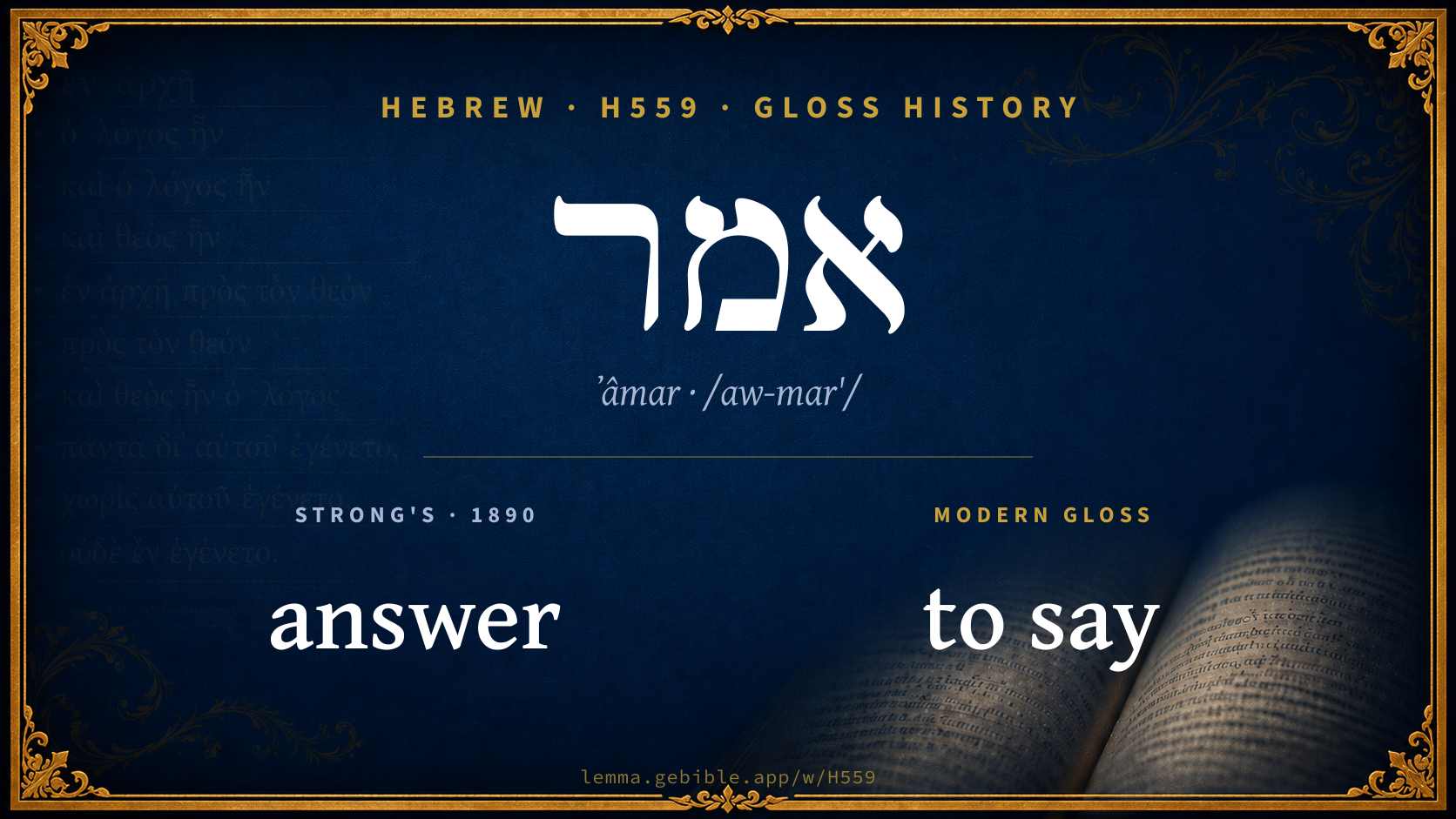
Gloss history
Strong's 1890 vs modern scholarship
About this word
Strong's H559 catalogs a Hebrew word from the Hebrew Old Testament.
These counts are not copied from any lexicon or concordance. They are computed here, from the morphology-tagged Hebrew Old Testament. What Lemma adds →
- 4,336
- distinct verses
- The word appears in 4,336 distinct verses.
- 39 / 39
- OT books
- The word appears in 39 of 39 Old Testament books.
- #7
- by frequency
- Top 10 most frequent Hebrew words (rank 7 of 8,640 Hebrew words by occurrence).
View all 4,336 occurrences in the concordance →
By section of the Old Testament
By traditional corpus
Conventional, traditional groupings — biblical authorship is debated, so this is a traditional corpus grouping, not an authorship claim. Each share is this word’s portion of its verses in that division of the Hebrew canon. Each figure is a share of the word’s 4,336 distinct verses.
- Prophets (Nevi'im) 2,521 verses · 58%
- Torah (Pentateuch) 1,175 verses · 27%
- Writings (Ketuvim) 640 verses · 15%
How translations render this word
Counts come from each version’s own published word-to-Strong’s tagging or interlinear alignment — an approximate guide to how each version renders this word, not a word-level alignment the data otherwise carries. Because each total is that version’s own tagged count, the per-version totals vary from one another and need not match the appearance or distinct-verse counts above. These counts may also differ from a printed concordance because Lemma counts each distinctly tagged rendering and does not collapse phrase taggings into a single head-word total. This is a fixed set of word-tagged versions (KJV, ASV, BSB, ULT) and does not change with the reading translation you choose elsewhere. Each version’s license is shown beside its name below (and on Sources).
- King James Version: Said 1,837×, Saying 793×, Saith 467×
- American Standard Version: Said 1,687×, Saying 689×, He said 416×
- Berean Standard Bible: Said 1,107×, Says 559×, Saying 313×
- unfoldingWord Literal Text: Said 1,617×, And 929×, Saying 867×
King James Version Public Domain
Renders H559 across 5,308 tagged occurrences — most commonly:
Plus other, less common renderings. Plus 365 renderings that appear only once — usually multi-word phrases or single function words the recovered tagging swept in, not distinct renderings.
American Standard Version Public Domain
Renders H559 across 5,297 tagged occurrences — most commonly:
Plus other, less common renderings. Plus 419 renderings that appear only once — usually multi-word phrases or single function words the recovered tagging swept in, not distinct renderings.
Berean Standard Bible Public Domain
Renders H559 across 4,549 tagged occurrences — most commonly:
Plus other, less common renderings. Plus 401 renderings that appear only once — usually multi-word phrases or single function words the recovered tagging swept in, not distinct renderings. Not rendered by a distinct English word in 754 further occurrences.
unfoldingWord Literal Text CC BY-SA 4.0
Renders H559 across 6,405 tagged occurrences — most commonly:
Plus other, less common renderings. Plus 130 renderings that appear only once — usually multi-word phrases or single function words the recovered tagging swept in, not distinct renderings.
8 senses and sub-senses in the full BDB
Hebrew verbs can shift meaning by stem (binyan): Qal is the basic action, Niphal is often passive or reflexive, Piel often intensifies or makes it factitive, and Hiphil is typically causative. The senses below are grouped under the stem BDB assigns to each. This entry also uses Hithpael (reflexive or reciprocal).
What do BDB’s symbols mean?
BDB uses these scholarly abbreviations:
| Symbol | Meaning |
|---|---|
| 𝔊 | the Septuagint (the ancient Greek translation, LXX) |
| 𝔙 | the Vulgate (the Latin translation) |
| 𝔖 | the Syriac version (the Peshitta) |
| 𝔗 | the Targum (the Aramaic translation) |
| ψ | the Psalms |
| √ | root (the underlying root or stem) |
| ‖ | parallel passage (a synonymous or contrasted parallel) |
| † | the dagger: every passage where the word occurs is cited |
The 8 senses and sub-senses the full Brown-Driver-Briggs lexicon distinguishes for this word, in lexicon order (not ranked by frequency), with BDB’s own verbatim wording and sub-sense lettering. Shown in Hebrew script with BDB’s own scholarly abbreviations. The condensed entry is in the Lexicon Entry tab. See also the Forms in the corpus table below.
Qal
- Pf. א׳ Gn 3:1 +, etc.; Impf. יֹאמַר Gn 31:8 +; וַיֹּא֫מֶר Gn 1:3 +; וַיֹּאמַ֑ר Gn 14:19 +; in Jb always וַיֹּא֑מַר Jb 3:2 +; 3 fs. תֹּאמַר Gn 21:12 +; תֹּאמֵ֑ר Pr 1:21; 1 s. אֹמַר Gn 22:2 +; אוֹמְרָה ψ 42:10; וָאֹמַר Gn 20:13 +; וָאוֹמַר Ne 2:7, 17, 20; 3 m. pl. יֹאמְרוּ Ex 4:1 + etc.; sf. יֹמְרוּךָ ψ 139:20; 2 mpl. תֹּמְרוּ 2 S 19:14 (cf. Köi. p. 385); Imv. אֱמֹר (אֱמָר־) Gn 45:17 +, etc.; Inf. abs. אָמוֹר Ex 21:5 +; cstr. אֱמֹר Ez 25:8 +; (הַ)אֲמֹר Jb 34:18 but read הָאֹמֵר 𝔊 𝔙 Di, or better הֶאָמֹר Inf. abs. c. ה interrog. cf. Ew§ 328 d; sf. אָמְרִי Jos 6:10 +; אֲמָרְכֶם Je 23:38; אֱמָרְכֶם Mal 1:7 +; לֵאמֹר Gn 1:22 +, etc.; Pt; act. אֹמֵר Gn 32:10 +, etc.; pass. הֶאָמוּר Mi 2:7, but this grammatically indefensible, read הֶאָמוֹר, Inf. abs. c. ה interrog., v. DrExpositor, April, 1887, 263. e.g. Genesis 3:1
- 1. Say (subj. God Gn 3:1 + or man 32:5, serpent 3:1, ass Nu 22:28, horse יֹאמַר הֶאָח Jb 39:25 etc.; inanimate things, personif. Jb 28:14 cf. v 22 etc.; so in allegory or fable Ju 9:8 2 K 14:9 etc.; especially in narrat., וַיֹּאמֶר etc., Gn 4:6 + very often): mostly sq. thing said, either subst. Je 14:17 (c. cl. app.) Dt 27:16 f. Ju 12:6; pronoun Gn 44:16 2 K 20:14 +; or (usually) clause Gn 1:3; 3:1; 37:20 + often (orat. recta); with adv. thus, so Gn 32:5 Nu 20:14 1 K 20:3, 5 +; especially כֹּה אָמַר י׳ Ex 5:1; 7:17, 26; 8:16; 1 Ch 17:4 + often; the person addressed usually introduced by אֶל Gn 3:1; 15:7; 22:7; Lv 21:1; 2 S 3:7; 1 K 12:5, 23, or לְ Gn 3:13; 4:15; 1 S 20:2; 2 S 2:21; 1 K 14:2 + often; rarer combinations are, א׳ בְּאָזְנֵי Is 49:20 (cf. 5:9 & vid. דבר); א׳ לִפְנֵי Ez 28:9; א׳ לְעֵינֵי Dt 31:7; Jos 10:12; Je 28:11; א׳ בְּ Jo 2:17 ψ 126:2, where בְּ local; in all cases usually sq. dir. obj. of words said, Ex 19:25; Ju 17:2 being singular; Gn 4:8 the object-clause has probably fallen out, cf. Vrss Di; = mention, name, designate Gn 22:2, 3; 43:27, 29 Ex 32:13; Nu 14:40; 1 S 10:16; 16:3; 2 S 6:22 Ne 6:19; cf. ψ 139:20 יֹמְרוּךָ לִמְזִמָּה speak of thee for falsehood (but many, as Hup Pe Dy Che, read יַמְרוּךָ); = tell, declare, proclaim (sq. dir. obj. only) ψ 40:11; Ez 13:7; in reply to question = answer Ex 12:27; Jos 4:7; 1 K 9:9; Je 5:19; 22:9. The obj. spoken of may be referred to by אֶל 2 K 19:32; Je 22:18; 27:19, or לְ Gn 20:13 אִמְרִי לִי say of me, etc. Dt 33:9; Ju 9:54; Is 5:20 ψ 3:3; 71:10, very rarely by a simple accus. Is 3:10 (where read prob. for אִמְרוּ, אַשְׁרֵי), except after אֲשֶׁר where the words used follow (cf. אֲשֶׁר 4 d) Gn 3:17; Nu 10:29; 14:31 Dt 28:68; Ju 7:4; 1 S 9:17, 23b; 1 K 8:29; La 4:20; cf. Nu 21:16; 2 K 17:12; 21:4, & (two extreme cases) Is 8:12; La 2:15 (v. DrSm i. 25, 5); הֶֽאָמוּר Mi 2:7 read inf. abs. c. ה interrog. הֶאָמוֹר (v. supr.) shall one say? shall it be said? After another vb. of saying, introducing thing said: Dt 21:7; 25:9; 27:15; Ct 2:10 +, even after אמר Gn 22:7; Lv 21:1; Je 34:2; Est 7:5 +; especially inf. לֵאמֹר, after דבר Gn 8:15, צוה 2:16; 3:17, ענה 41:16, ברך 1:22, נשׁבע 24:7, נדר 28:20, etc.; after אמר 2 S 3:18; 1 K 12:23; 1 Ch 21:18 +; after שׁלח 2 Ch 35:21 שׁוּב Gn 32:7; cf. also Gn 28:6 Ex 5:13; 9:5; 13:8; 17:4; Nu 11:20; Dt 1:28; 13:7; Ju 8:15; 1 S 23:2; 1 K 13:3; Je 32:3; 37:9; Ru 4:4 +; when subj. of לֵאמֹר differs from that of preceding clause Gn 31:1; 38:13, 24 etc.; after שׁמע Is 37:9 = 2 K 19:9. e.g. Genesis 3:1
- 2. Say in the heart (= think) א׳ בלבב Dt 8:17 cf. 1 K 12:26 ψ 10:6, 11, 13; 14:1; 35:25; Is 14:13; 47:8, 10; 49:21; Ec 2:1, 15; 3:17, 18; א׳ לִלְבָבָם Ho 7:2; א׳ אֶל־לִבּוֹ Gn 8:21 said unto his heart (to himself), subj. י׳, cf. 1 S 27:1; אָֽמְרָה נַפְשִׁי La 3:24; thence א׳ alone Gn 20:11; 26:9 Nu 24:11; Ru 4:4; 1 S 20:26; 2 S 5:6; 12:22; 2 K 5:11; Mal 1:7; with כִּי Ju 15:2; in particular = desire מַה־תֹּאמַר נַפְשְׁךָ 1 S 20:4 cf. Est 2:13; sq. inf. = purpose, Ex 2:14 thinkest thou to kill me, as thou killedst the Egyptian? Jos 22:33; 1 S 30:6; 1 K 5:19; 2 Ch 28:10, 13; expect 2 S 21:16 he expected to slay David 2 Ch 13:8; 32:1. e.g. Deuteronomy 8:17
- 3. Promise (sq. inf.) 1 Ch 27:23; 2 Ch 21:7; Est 4:7; (id. + ל of pers.) 2 K 8:19; Ne 9:15; (sq. acc. of dir. obj. + ל of pers. + inf. of purpose) Ne 9:23. e.g. 1 Chronicles 27:23
- 4. Command (especially late) sq. אֶל־ of person addressed, Nu 15:28; 1 Ch 21:18; sq. ל Jos 11:9; 2 S 16:11 2 K 4:24; Jb 9:7 ψ 106:24 (v. sub אֲשֶׁר 8 e); sq. inf. 1 S 24:11 1 Ch 21:17; 2 Ch 1:18; 29:27, 36; 31:11; 35:21 Est 1:17; 4:13, 15; 6:1; 9:14; inf. + ל of pers. 2 Ch 14:3; 29:21; 31:4; Ne 9:15; Est 1:10; sq. acc. dir. obj. 2 Ch 29:24 the king commanded the burnt-offering and the sin-offering, cf. 1 K 5:20; Est 2:15; sq. cl. with אשׁר = that Ne 13:19; id. + ל of pers. v 22; sq. cl. with כִּי Jb 36:10; abs. 1 S 16:16 (read however prob. יאמרו for יאמר, cf. Dr); also ψ 105:31, 34; 107:25; 1 Ch 14:12; 2 Ch 24:8; Ne 13:9, 19 (all sq. vb. consec.); command by leter א׳ עִם־הַסֵּפֶר Est 9:25 (sq. impf.); appoint, assign לֶחֶם א׳ לוֹ 1 K 11:18 = threaten sq. inf. Dt 9:25 ψ 106:23. e.g. Numbers 15:28
Niphal
- Pf. נֶאֱמַר Dn 8:26; Impf. יֵאָמֵר Gn 22:14 +; יֵאָ֫מֶר לוֹ Is 4:3; יֵאָמַ֑ר Gn 10:9 +; וַיֵּאָמַ֑ר Jos 2:2; be said, told Gn 10:9; 22:14 ψ 87:5; Je 4:11; 16:14 (all abs., indef. subj., of current saying); so said in a book Nu 21:14; be related, told, of vision Dn 8:26; said, told to (sq. ל ind. obj.) Jos 2:2; Ho 2:1(×2) Zp 3:16; either so, or told concerning Nu 23:23; Ez 13:12 (אֶל־); יֵאָמֵר לָכֶם = ye shall be called (it shall be said to you) Is 61:6 (‖ תִּקָּרֵ֔אוּ), cf. 4:3; 19:18; 32:5 (‖ יִקָּרֵא ל) 62:4(×2); hence be called, of Tophet לֹא־יֵאָמֵר עוֹד הַתֹּפֶת Je 7:32; subj. שֵׁם Gn 32:29; Jb 34:31 כִּי אֶל־אֵל חֶאָמַר, Rabb. (cf. AV) treat הֵאָמַר as Niph. Inf. for לְהֵאָמֵר, but against grammar; the form as it stands is Qal Pf., אֶל־אֵל being prefixed to the interrog. for emphasis (cf. Je 22:15; 23:26 Ne 13:27), v. Dr§ 9 Di al.; Hoffm., however, reads הֵאָמֵר inf. abs. = imv. ‘so must one speak (it be spoken) to God.’ e.g. Daniel 8:26
Hiphil
- Pf. avow, avouch Dt 26:17 אֶת־י׳ הֶאֱמַרְתָּ הַיּוֹם לִהְיוֹת לְךָ לֵאלֹהִים; v 18 וי׳ הֶאֱמִירְךָ היום להיות לוֹ לְעַם (lit. cause to declare, i.e. through agency of Moses; on this & other interpr. vid. Di). e.g. Deuteronomy 26:17
Hithpael
- Impf. יִתְאַמְּרוּ ψ 94:4 subj. כָּל־פֹּעֲלֵי אָ֑וֶן act proudly, boast (‖ יַבִּיעוּ יְדַבְּרוּ עָתָק); prob. also 2 mpl. תִּתְיַמָּ֑רוּ Is 61:6 (in good sense, sq. בְּ of thing gloried in) 𝔖 𝔙 𝔗 & cf. 𝔊; GesComm. so De Che Köi. 457 f. (from [ימר] exchange Thes Hi Kn Ew Di; but vid. ימר). e.g. Psalms 94:4
Senses from the full Brown-Driver-Briggs lexicon (Brown, Driver, Briggs; Oxford 1906 — public domain), digitized via Sefaria, supplemented by the OpenScriptures HebrewLexicon (CC BY 4.0). Full attribution on Sources.
Word origin
vb. utter, say (MI Ph. אמר, Aramaic אֲמַר, Ethiopic አመረ I. 2 shew, declare, Arabic أَمَرَ command; perhaps √ אמר orig. = be or make prominent, hence Hithp. infr., אָמִיר; Sab. אמר lofty, epith. of king JHMordtmZMG 1876, 37; cf. DlPr 28 who thinks orig. meaning hell, sichtbar sein, whence Assyrian amâru, see & shew, declare, say)—
— Brown-Driver-Briggs (Oxford 1906, public domain), digitized via Sefaria, supplemented by the OpenScriptures HebrewLexicon (CC BY 4.0). See Sources.
Origin: a primitive root
Jastrow Dictionary
A second Hebrew/Aramaic lexicon for comparison, covering Aramaic and post-biblical (Talmudic, Targumic, Midrashic) usage that the biblical-Hebrew BDB does not. Matched by lemma rather than by Strong’s number, so a lemma may carry more than one Jastrow headword (shown separately below), and the entries cover usage well beyond the Bible.
אָמַר I
- (a) to join, knot; to be knotted, thick; b) to heap up; c) transf. to join words, compose, cmp. דבר; d) to contract, bargain, exchange. [As to Assyr. to see, cmp. חמא.])
- 1. to speak, think, say, relate &c. … א׳ ר׳ … א׳ ר׳ Rabbi … related in the name of R. … Ber. 3ᵇ; a. v. fr.—Part. pass. אָמוּר expression. Yoma 70ᵇ, a. fr. הוא הא׳ וכ׳ it is the same expression (‘one ram’) used here and in the Book of Numbers. Sifré Deut. s. 334, a. fr. אֱמוֹר מעתה say from now, i.e. from this draw the conclusion. Gen. R. s. 39 תאמר שהבירה וכ׳ (usu. שמא תאמר) will you say (is it possible), this castle has no commander?—אֲמוּרִים דברים במה (abbr. בד׳'א) in what case are these words said? i.e. this applies only. Ḥull. 3ᵃ; a. fr.—זאת אוֹמֶרֶת this tells, i.e. this proves. Ber. 11ᵇ; a. fr.—אָמְרוּ it is said, told &c.; v. next w.—Inf. לוֹמַר = לֵאמֹר. Ḥag. 14ᵇ; a. fr.
- 2. to vow, devote. אָמוּר (לגבוה) devoted to the Lord. Succ. 55ᵇ; v. אֲמִירָה I, 3, a. אֵימוּרִים.
- (b. h.) to be said, to read … נא׳ כאן … ונ׳ להלן we read here … and we read there … (the same expression is used here and there in the Scriptural text). Ber. 9ᵃ; a. v. fr.—שֶׁנֶּאֱמַר (abbr. שנ׳, שנא׳) for it is said in the Scriptures (as evidence in favor of an opinion). Snh. X, 1; a. v. fr.; also כמה שנ׳ (כמו) as it is said.—מִשּׁוּם שנ׳ because it is said in the Scriptures, i.e. you may possibly be misled by a certain expression to think …, therefore another term is used in its stead in an analogous case, or added to the ambiguous word; v. שׁוּם.
אֲמַר
- 1) as preced. 1). Targ. Gen. I, 3; a. v. fr.—א׳ מר above you quoted an authority, or, it has been stated. Ber. 2ᵃ; a. fr.—א׳ קרא the Scripture says. Ib. 13ᵃ; a. fr.—Y. Orl. III, end, 63ᵇ, a. fr. אמרונה בשם … (in Bab. heb. אֲמָרוּהָ) they said it in behalf of … i.e. as a tradition.—Y. Ber. I, 2ᵈ מילתיה אמרה his word (statement, opinion &c.) proves.—הדא אמרה = זאת אומרת; v. preced.—אַמְרֵי (h. אָמְרוּ) they say, it is said. Sabb. 19ᵃ אמרו עליו על … ואמרי לה וכ׳ it is told about R. …, and another relation refers this to R.—; a. fr.—קאמר, קאמרי &c. = קא אמר &c. Ḥull. 85ᵃ; a. fr.—מנא תימרא whence dost thou prove? Sabb. 23ᵃ; a. fr.—Inf. מֵימַר, מֵימְרָא. סבר מ׳, סבר למ׳ originally he was of the opinion. Y. Sabb. VI, 8ᶜ top; Keth. 87ᵇ; a. v. fr.—לְמֵימְרָא does this mean to say? Sabb. 15ᵇ; a. fr. לא אמרן אלא … אבל … this has been said, i.e. this applies only to a case … but if … Ber. 43ᵇ; a. fr.—כְּלוֹמַר as if saying, meaning to say, viz; v. כִּילּוּ.—Y. Kil. IV, 32ᶜ bot. אימורין לבני וכ׳ say ye to &c.—מאי איכא למימר, v. אִיכָּא; Answ. אֵימוּר say … Sabb. 6ᵃ; a. fr.—Hor. 13ᵃ א׳ כולה who orders every thing (as an etymol. of אֲמַרְכָּל).—2) to praise, proclaim. Targ. Is. VIII, 13; a. fr.—Part. pass. אָמִיר q. v.
- , contr. אִתְּמַר, אִיתְּ׳ it is said, taught. Targ. Job XXXIV, 31.—Y. Yoma V, end, 43ᵃ אתאמרת, contr. אִתַּמְרַת it has been said with refer. to the opinion of …—אִתְּ׳, אִיתְּ׳ it has been said (above);we have been taught. Succ. 15ᵃ; a. fr.
- same. Targ. Gen. XXII, 14; a. e.
אָמַר II
- , v. אָמַר I, a) to be thick, strong.
- 1. to thrive; to boast, vaunt, be oppressive (cmp. Ps. XCIV, 4). Sot. IX, 15 (49ᵇ) יוקר יַאֲמִיר the nobility shall be oppressive (Snh. 97ᵃ יְעַוֵּת; Der. Er. Zut. X יעוות; Cant. R. to II, 13 הווה).—*[ e.g. Psalms 94:4
- 2. (denom. of מריא to fatten. Sabb. XXIV, 3 (155ᵇ) Bab. מַאֲמִירִין, Ms. Oxf., Mish. a. Y. מַמְרִים, מַמְרִין, v. מרי.]
אֵמֶר
- , v. אֵימַר a. אִמְרָה.
אִמַּר
- lamb, v. אִימַּר.
מְרַר
- same, to be bitter; to grieve, mourn. Perf. מַר, imperf. יֵימַר, יֵמַר. Targ. Is. XXIV, 9. Targ. I Sam. XXX, 6; a. fr.—Targ. Zech. XII, 10 ויֵימְרוּן, v. infra.
- to embitter, aggrieve. Targ. Ruth I, 13 תְמָרְרוּן (ed. Amst. תִמְרְ׳). Targ. Y. I Deut. XXXII, 32 מְמַרְרִין (some ed. מְמַרְרַן; Y. II מַרְרַן).
- 1. same. Targ. Ruth I, 20 (not same. Targ. Ruth I, 20 (not אֲמַרִ׳). Targ. Ex. I, 14; a. e.
- 2. to arrange mourning. Targ. Zech. XII, 10 ויימרון … כמא דמַמְרִין וכ׳ they shall arrange mourning for him, as is arranged for &c. (v. infra).—[אָמְרָרוּ, v. Ithpa.]
- to aggrieve. Targ. Prov. XVII, 25. Targ. Y. I Gen. XLIX, 23 ממרירו, read: מַרְמִירוּ; (Y. II אֲמָרוּ, read: אַמָּ׳ Af.).
- 1. to be enraged, fight. Targ. O. Gen. l. c. (Var. אָמְרָרוּ, v. Berl. Targ. O. II, p. 18; oth. ed. אַמְרָרוּ Af.).
- 2. to mourn. Targ. Zech. l. c. Var. (v. Lag. Proph. I, p. XLII).
A Dictionary of the Targumim, the Talmud Babli and Yerushalmi, and the Midrashic Literature (Marcus Jastrow; London, Luzac, 1903) — Public Domain. Digitized via Sefaria. Digitized via Sefaria. Full attribution on Sources.
Forms in the corpus
The 578 distinct written forms H559 takes in the Hebrew Bible, most frequent first — each parse links to that stem’s occurrences in the concordance. Hebrew forms include their vowel points and cantillation, so a single lemma takes many written forms.
The 60 most common forms are shown; 518 rarer forms follow in the full concordance.
Same root — word family
Other BDB entries built from the same root as H559, grouped by Strong’s listed origin. These share a root / origin per the lexicon — not necessarily a shared meaning. Each links to that word’s own entry.
Derived from this word
Proper names from this root
People and places named from this root — a name, not an additional meaning of the word.
Compare all same-root words → Showing 4 of 9 — not the complete family. 4 of the same-root words are proper names (people or places). They share a root, not necessarily a meaning.
Septuagint verse parallels
Most of the 4,336 Hebrew verses this word occurs in also exist in the Greek Old Testament (Septuagint), so the same passages can be read in Greek by switching the Old Testament edition to the Septuagint.
Read these verses in the Septuagint
- Genesis 1:3
- Exodus 1:9
- Leviticus 1:1
- Numbers 1:1
- Deuteronomy 1:5
- Joshua 1:1
- Judges 1:1
- Ruth 1:8
- 1 Samuel 1:8
- 2 Samuel 1:3
- 1 Kings 1:2
- 2 Kings 1:2
This is a verse-level parallel only — the same verses exist in both the Hebrew and Greek Old Testaments. No word-level Hebrew↔Greek correspondence is claimed: the data carries no such alignment, so no Greek word is shown as this Hebrew word’s translation. Coverage is not total — the Septuagint omits the deuterocanon and renumbers the Psalms, so some Hebrew verses have no direct Greek parallel.