2 Samuel 20:4

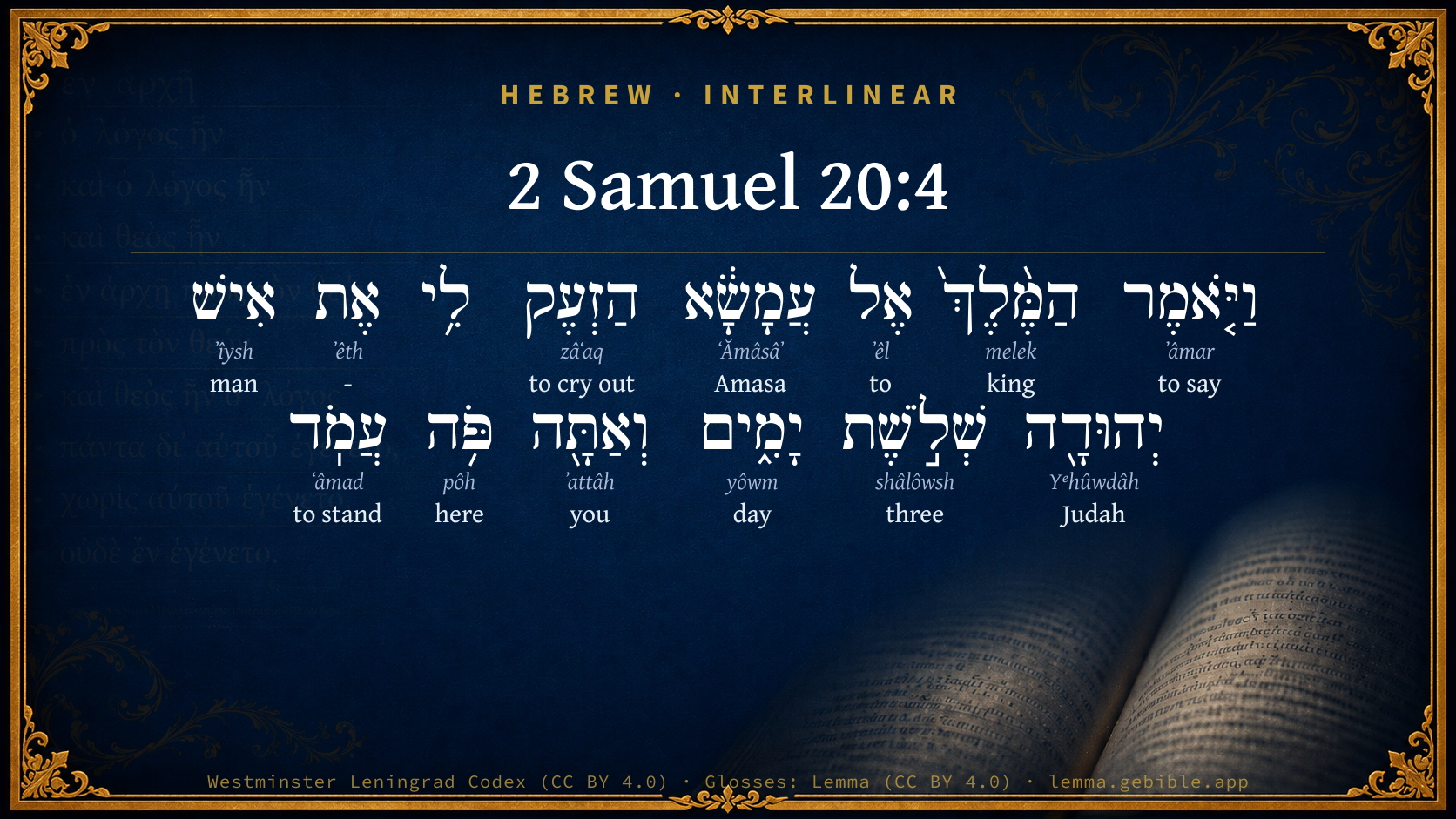
Hebrew (Westminster Leningrad Codex) 2 Samuel 20:4 appears in the Hebrew Old Testament. The text above is from the Westminster Leningrad Codex. Each word links to its Strong’s number, a concise gloss, and parsing drawn from the Open Scriptures Hebrew Bible morphology. Click any word for its full Brown-Driver-Briggs (BDB) entry.
Download image
Cite this verse

2 Samuel 20:4 (World English Bible). Public Domain. Lemma interlinear Bible study tool, https://lemma.gebible.app/v/2-samuel/20/4.

Show BibTeX & RIS
BibTeX
RIS
English Translation
Then said the king to Amasa, Call me the men of Judah together within three days, and be here present.
World English Bible · Public Domain
Download a study sheet

One document with this verse’s original text, its word-by-word gloss line, the meaning frame, cross-references with their text, attributed commentary, and full source and license credits — printable, and it pastes into notes with its structure intact.

This verse Autodidact and up

Study sheet (.html) Plain text (.txt)

A passage Seminary Student

Up to 50 verses in one chapter. A passage sheet keeps up to 6 commentary sources and 12 cross-references per verse, in the order this page ranks them, and says so on the sheet whenever that leaves anything out. Ask for a single verse and you get the Autodidact verse sheet above.

Everything on this page stays free to read, with no account — the sheet is a download of what is already on screen, not access to it.

Want to remove ads? Support Godless Engineer
Compare translations 3

The same verse in 3 English versions, stacked beneath the original-language interlinear above. Click any original word for its lexicon entry.

Each is an independent rendering of the whole verse — the interlinear is not word-aligned to these translations.

Highlighted words mark where these versions differ — a whole-verse word diff, not a word-by-word alignment.

  • World English Bible Public Domain
    Then said the king to Amasa, Call me the men of Judah together within three days, and be here present.
  • King James Version Public Domain
    Then said the king to Amasa, Assemble me the men of Judah within three days, and be thou here present.
  • unfoldingWord Literal Text CC BY-SA 4.0
    And the king said to Amasa, “Call up the men of Judah to me, three days. And you, stand here.”

unfoldingWord Literal Text — © unfoldingWord, licensed CC BY-SA 4.0. Word-aligned USFM3 via Door43 (git.door43.org/unfoldingWord/en_ult).

Versions to compare (up to 4)

3 of 4 selected

Show all 18 translations

Every available English version of this verse, each an independent rendering of the whole verse.

  • World English Bible Public Domain
    Then said the king to Amasa, Call me the men of Judah together within three days, and be here present.
  • Berean Standard Bible Public Domain
    Then the king said to Amasa, “Summon the men of Judah to come to me within three days, and be here yourself.”
  • Majority Standard Bible Public Domain
    Then the king said to Amasa, “Summon the men of Judah to come to me within three days, and be here yourself.”
  • King James Version Public Domain
    Then said the king to Amasa, Assemble me the men of Judah within three days, and be thou here present.
  • American Standard Version (1901) Public Domain
    Then said the king to Amasa, Call me the men of Judah together within three days, and be thou here present.
  • Revised Version (1885) Public Domain
    Then said the king to Amasa, Call me the men of Judah together within three days, and be thou here present.
  • Geneva Bible (1599) Public Domain
    Then sayde the King to Amasa, Assemble me the men of Iudah within three dayes, and be thou here present.
  • Douay-Rheims (1899) Public Domain
    And the king said to Amasa: Assemble to me all the men of Juda against the third day, and be thou here present.
  • Young's Literal Translation Public Domain
    And the king saith unto Amasa, `Call for me the men of Judah `in' three days, and thou, stand here,'
  • Literal Standard Version CC BY-SA 4.0
    And the king says to Amasa, “Call the men of Judah for me [within] three days, and you, stand here,”
  • Unlocked Literal Bible CC BY-SA 4.0
    Then the king said to Amasa, “Call the men of Judah together within three days; you must be here, too.”
  • unfoldingWord Literal Text CC BY-SA 4.0
    And the king said to Amasa, “Call up the men of Judah to me, three days. And you, stand here.”
  • Darby Bible Public Domain
    And the king said to Amasa, Call me the men of Judah together within three days, and do thou attend here.
  • World Messianic Bible Public Domain
    Then the king said to Amasa, “Call me the men of Judah together within three days, and be here present.”
  • Webster's Bible Public Domain
    Then said the king to Amasa, Assemble to me the men of Judah within three days, and be thou here present.
  • Free Bible Version CC BY-SA 4.0
    Then the king ordered Amasa, “Call up the army of Judah. Have them come to me within three days, and you come too.”
  • Bible in Basic English Public Domain
    Then the king said to Amasa, Get all the men of Judah together, and in three days be here yourself.
  • JPS Tanakh (1917) Public Domain
    Then said the king to Amasa: 'Call me the men of Judah together within three days, and be thou here present.'

Literal Standard Version (2020), Covenant Press — licensed CC BY-SA 4.0. Text via the HelloAO Bible API (eBible.org). Unlocked Literal Bible (unfoldingWord) — licensed CC BY-SA 4.0. Text via the HelloAO Bible API (eBible.org). unfoldingWord Literal Text — © unfoldingWord, licensed CC BY-SA 4.0. Word-aligned USFM3 via Door43 (git.door43.org/unfoldingWord/en_ult). Free Bible Version, Dr. Jonathan Gallagher — licensed CC BY-SA 4.0. Text via the HelloAO Bible API (eBible.org).

Word by word

More ways to search: Search by grammar → Find every occurrence → Compare this word →

Practice this passage: Drill this verse → Learn its vocabulary →

עֲמָשָׂ֔א
ʻĂmâsâʼ
H6021
“Amasa”
Noun, Proper
Part of Speech
Noun
Type
Proper
Full BDB Definition

Origin: from H6006

TWOT: None

Amasa = "burden" - son of Ithra or Jether by Abigail the sister of David and general of the army of Absalom - son of Hadlai and a prince of Ephraim in the reign of king Ahaz
  1. וַיֹּ֤אמֶר ʼâmar H559 “and · to say” Conjunction + Verb, Qal, Sequential Imperfect, 3rd Person, Masculine, Singular
  2. הַמֶּ֨לֶךְ֙ melek H4428 “the · king” Particle, Definite Article + Noun, Common, Masculine, Singular, Absolute
  3. אֶל ʼêl H413 “to” Preposition
  4. הַזְעֶק zâʻaq H2199 “cry out” Verb, Hiphil, Imperative, 2nd Person, Masculine, Singular
  5. אֶת ʼêth H853 “-” Particle, Direct Object
  6. אִישׁ ʼîysh H376 “man of” Noun, Common, Masculine, Singular, Construct
  7. יְהוּדָ֖ה Yᵉhûwdâh H3063 “Judah” Noun, Proper
  8. שְׁלֹ֣שֶׁת shâlôwsh H7969 “three” Adjective, Cardinal number, Masculine, Singular, Construct
  9. יָמִ֑ים yôwm H3117 “days” Noun, Common, Masculine, Plural, Absolute
  10. וְאַתָּ֖ה ʼattâh H859 “and · you” Conjunction + Pronoun, Personal, 2nd Person, Masculine, Singular
  11. פֹּ֥ה pôh H6311 “here” Adverb
  12. עֲמֹֽד ʻâmad H5975 “stand” Verb, Qal, Imperative, 2nd Person, Masculine, Singular

About this verse

These counts appear in no published source. They are computed here, from the morphology-tagged text and Lemma’s own curated glosses. What Lemma adds →

14
words
13
distinct lemmas
Historical
section

Notable vocabulary

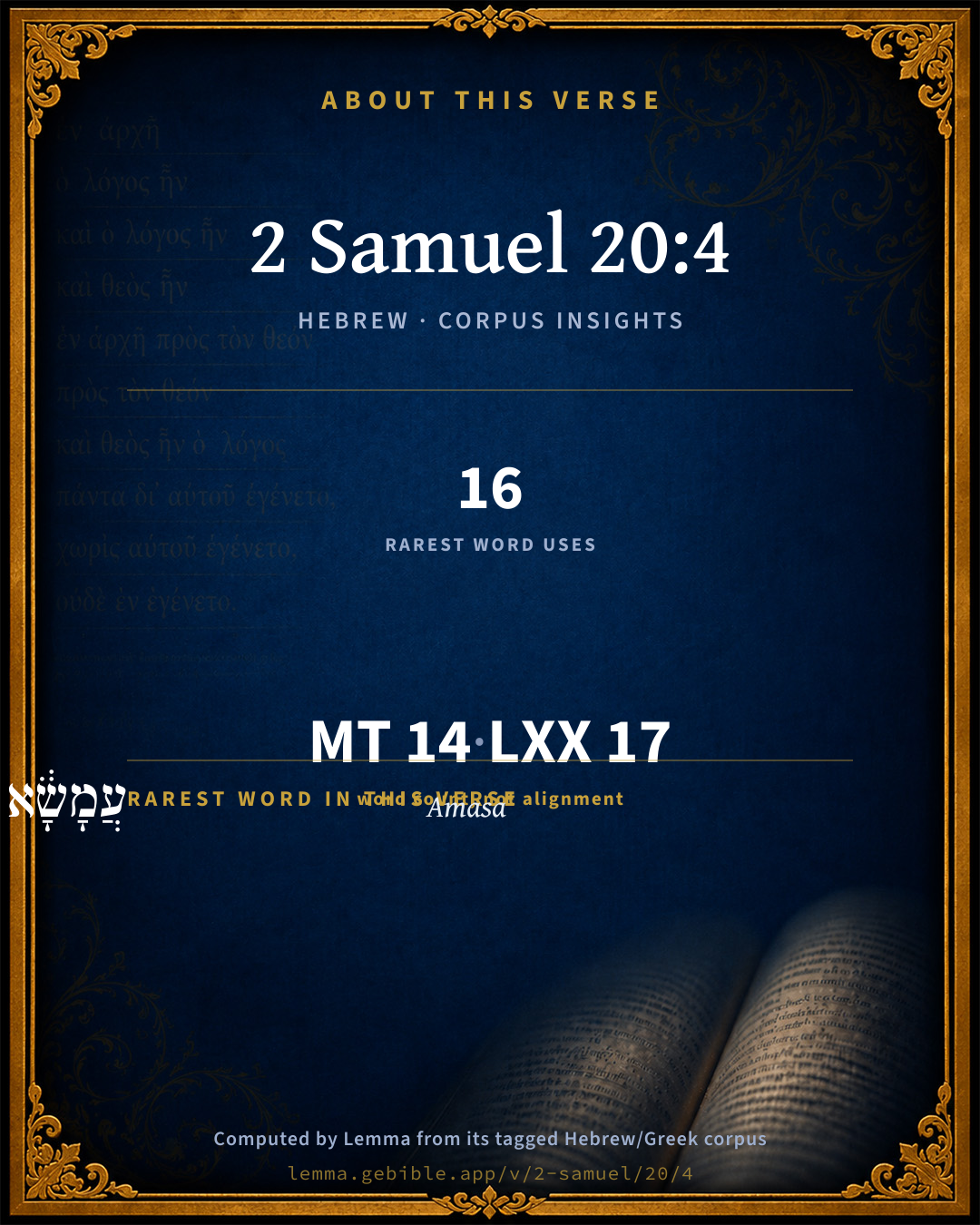
The rarest word here is עֲמָשָׂ֔א Amasa H6021 — appearing just 16 times in the whole Hebrew Bible.

Shared distinctive vocabulary

עֲמָשָׂ֔א Amasa H6021 occurs in 12 verses of the Hebrew Bible. Also found in:

Grammatical profile

  • 3 verbs
  • 5 nouns
  • 1 adjective
  • 1 pronoun
  • 2 prepositions
  • 1 adverb
  • 1 particle

Verb forms

  • וַיֹּ֤אמֶר Qal · Sequential Imperfect
  • הַזְעֶק Hiphil · Imperative
  • עֲמֹֽד Qal · Imperative

Hebrew & Septuagint length

In English translation the verse runs 20 words from the Hebrew and 22 from the Septuagint (LXX English) — closely comparable.

A rough comparison of the two English renderings, which tokenize alike — not a word-level alignment.

Word counts can differ between the Hebrew and the Greek without any difference in meaning — e.g. the Hebrew direct-object marker אֵת has no separate Greek word, and Greek often adds the article ὁ.

In the original languages it is 14 Hebrew tokens and 17 Greek tokens — but the two are counted differently (Hebrew bundles its prefixes and suffixes into one token; the Greek is in lemma form), so that isn’t a like-for-like length.

Cross-references

3

Topical passages linked to 2 Samuel 20:4 in the Treasury of Scripture Knowledge — connected by theme and wording, ordered by reader-vote popularity; previews shown in the World English Bible.

  • 2 Samuel 17:25 Absalom set Amasa over the host instead of Joab. Now Amasa was the son of a man, whose name was Ithra the Israelite, who went in to Abigail the daughter of Nahash, sister to Zeruiah, Joab's mother.
  • 2 Samuel 19:13 Say you to Amasa, Aren't you my bone and my flesh? God do so to me, and more also, if you aren't captain of the host before me continually in the room of Joab.
  • 1 Chronicles 2:17 Abigail bore Amasa; and the father of Amasa was Jether the Ishmaelite.

Cross-references courtesy of OpenBible.info (CC BY 4.0).

Hebrew and Greek witnesses Masoretic Hebrew ↔ Greek Septuagint

The same verse in the two great witnesses to the Old Testament, shown verse-for-verse.

These are two independent witnesses, not word-aligned to each other, and the Septuagint is shown in lemma (dictionary) form.

Hebrew 2 Samuel 20:4 Masoretic · Westminster Leningrad Codex

וַיֹּ֤אמֶר הַמֶּ֨לֶךְ֙ אֶל עֲמָשָׂ֔א הַזְעֶק לִ֥י אֶת אִישׁ יְהוּדָ֖ה שְׁלֹ֣שֶׁת יָמִ֑ים וְאַתָּ֖ה פֹּ֥ה עֲמֹֽד

Then said the king to Amasa, Call me the men of Judah together within three days, and be here present.

World English Bible · Public Domain

Greek LXX 2 Samuel 20:4 Septuagint · lemma form

καί εἶπον ὁ βασιλεύς πρός αμεσσαϊ βοάω ἐγώ ὁ ἀνήρ ιουδα τρεῖς ἡμέρα σύ δέ αὐτός ἵστημι

And the king said to Amessai, Call to me the men of Juda for three days, and do you be present here.

LXX2012 (modern English Septuagint) · Public Domain

Hebrew: Westminster Leningrad Codex (CC BY 4.0). Greek: Septuagint (public domain); English from LXX2012 (modern English Septuagint) (Public Domain). How the Septuagint differs from the Hebrew →

Targum (Aramaic paraphrase)

1

The Targum is the ancient Jewish Aramaic paraphrase of the Hebrew Scriptures — an interpretive translation, not the Hebrew text itself. Onkelos (literal) and Pseudo-Jonathan (expansive) render the Torah, and Jonathan the Prophets. Coverage is partial: where no permissively-licensed English translation exists for a verse, only the Aramaic is shown. This is verse-level text, not a word-by-word alignment to the Hebrew.

  1. Targum Jonathan Prophets (Joshua–Malachi)
    וַאֲמַר מַלְכָּא לַעֲמָשָׂא כְּנוֹשׁ קֳדָמַי יַת אֱנַשׁ יְהוּדָה תְּלָתָא יוֹמִין וְאַתְּ הָכָא קוּם:

    (no public-domain English translation for this verse)

    Targum Jonathan — Aramaic: “Mikraot Gedolot” (public domain). English: “Sefaria Community Translation” (CC0 1.0 (public-domain dedication)); “London "Chaldee Paraphrase," 1871” (public domain). Text via Sefaria.

Commentary

Notes on 2 Samuel 20:4 from classic Christian and Jewish commentators (each source and its license shown beneath its notes). The classic Christian expositions comment on the surrounding passage and are grouped to its opening verse, so a note may address several verses; the Jewish commentaries on the Tanakh (Rashi and others) are per-verse, so they appear only where the commentator wrote on this verse.

Lemma curates 59 commentaries, every one of them public domain or Creative Commons licensed, each selected and text-cleaned for this edition rather than reprinted as found. About our sources →

Matthew Henry's Commentary

We have here Amasa's fall just as he began to rise. He was nephew to David (Sa2 17:25), had been Absalom's general and commander-in-chief of his rebellious army, but, that being routed, he came over into David's interest, upon a promise that he should be general of his forces instead of Joab. Sheba's rebellion gives David an occasion to fulfil his promise sooner than he could wish, but Joab's envy and emulation rendered its fulfillment of ill consequence both to him and David.

I. Amasa has a commission to raise forces for the suppressing of Sheba's rebellion, and is ordered to raise them with all possible expedition, Sa2 20:4. It seems, the men of Judah, though forward to attend the king's triumphs, were backward enough to fight his battles; else, when they were all in a body attending him to Jerusalem, they might immediately have pursued Sheba, and have crushed that cockatrice in the egg. But most love a loyalty, as well as a religion, that is cheap and easy. Many boast of their being akin to Christ that yet are very loth to venture for him. Amasa is sent to assemble the men of Judah within three days; but he finds them so backward and unready that he cannot do it within the time appointed (Sa2 20:5), though the promotion of Amasa, who had been their general under Absalom, was very obliging to them, and a proof of the clemency of David's government.

II. Upon Amasa's delay, Abishai, the brother of Joab, is ordered to take the guards and standing forces, and with them to pursue Sheba (Sa2 20:6, Sa2 20:7), for nothing could be of more dangerous consequence than to give him time. David gives these orders to Abishai, because he resolves to mortify Joab, and degrade him, not so much, I doubt, for the blood of Abner, which he had shed basely, as for the blood of Absalom, which he had shed justly and honourably. "Now (says bishop Hall) Joab smarteth for a loyal disobedience. How slippery are the stations of earthly honours and subject to continual mutability! Happy are those who are in favour with him in whom there is no shadow of change." Joab, without orders, though in disgrace, goes along with his brother, knowing he might be serviceable to the public, or perhaps now meditating the removal of his rival.

III. Joab, near Gibeon, meets with Amasa, and barbarously murders him, Sa2 20:8-10. It should seem, the great stone in Gibeon was the place appointed for the general rendezvous. There the rivals met; and Amasa, relying upon his commission, went before, as general both of the new-raised forces which he had got together, and of the veteran troops which Abishai had brought in; but Joab there took an opportunity to kill him with his own hand; and, 1. He did it subtilely, and with contrivance, and not upon a sudden provocation. He girded his coat about him, that it might not hang in his way, and girded his belt upon his coat, that his sword might be the readier to his hand; he also put his sword in a sheath too big for it, that, whenever he pleased, it might, upon a little shake, fall out, as if it fell by accident, and so he might take it into his hand, unsuspected, as if he were going to return it into the scabbard, when he designed to sheath it in the bowels of Amasa. The more there is of plot in a sin the worse it is. 2. He did it treacherously, and under pretence of friendship, that Amasa might not be upon his guard. He called him brother, for they were own cousins, enquired of his welfare (Art thou in health?) and took him by the beard, as one he was free with, to kiss him, while with the drawn sword in his other hand he was aiming at his heart. Was this done like a gentleman, like a soldier, like a general? No, but like a villain, like a base coward. Just thus he slew Abner, and went unpunished for it, which encouraged him to do the like again. 3. He did it impudently, not in a corner, but at the head of his troops, and in their sight, as one that was neither ashamed nor afraid to do it, that was so hardened in blood and murders that he could neither blush nor tremble. 4. He did it at one blow, gave the fatal push with a good-will, as we say, so that he needed not strike him again; with such a strong and steady hand he gave this one stroke that it was fatal. 5. He did it in contempt and defiance of David and the commission he had given to Amasa; for that commission was the only ground of his quarrel with him, so that David was struck at through the side of Amasa, and was, in effect, told to his face that Joab would be general, in spite of him. 6. He did it very unseasonably, when they were going against a common enemy and were concerned to be unanimous. This ill-timed quarrel might have scattered their forces, or engaged them one against another, and so have made them all an easy prey to Sheba. So contentedly could Joab sacrifice the interest both of king and kingdom to his personal revenge.

IV. Joab immediately resumes his general's place, and takes care to lead the army on in pursuit of Sheba, that, if possible, he might prevent any prejudice to the common cause by what he had done. 1. He leaves one of his men to make proclamation to the forces that were coming up that they were still engaged in David's cause, but under Joab's command, Sa2 20:11. He knew what an interest he had in the soldiery, and how many favoured him rather than Amasa, who had been a traitor, was now a turn-coat, and had never been successful; on this he boldly relied, and called them all to follow him. What man of Judah would not be for his old king and his old general? But one would wonder with what face a murderer could pursue a traitor; and how, under such a heavy load of guilt, he had courage to enter upon danger. Surely his conscience was seared with a hot iron. 2. care is taken to remove the dead body out of the way, because at that they made a stand (as Sa2 2:23), and to cover it with a cloth, Sa2 20:12, Sa2 20:13. Wicked men think themselves safe in their wickedness if they can but conceal it from the eye of the world: if it be hidden, it is with them as if it were never done. But the covering of blood with a cloth cannot stop its cry in God's ear for vengeance, or make it the less loud. However, since this was no time to arraign Joab for what he had done, and the common safety called for expedition, it was prudent to remove that which retarded the march of the army; and then they all went on after Joab, while David, who no doubt had notice soon brought him of this tragedy, could not but reflect upon it with regret that he had not formerly done justice upon Joab for the death of Abner, and that he now had exposed Amasa by preferring him. And perhaps his conscience reminded him of his employing Joab in the murder of Uriah, which had helped to harden him in cruelty.

Matthew Henry's Commentary on the Whole Bible (1708–1710) — public domain (CC PDM 1.0). Text via the HelloAO Bible API.

Trapp's Complete Commentary

John Trapp

2Sa 20:4 Then said the king to Amasa, Assemble me the men of Judah within three days, and be thou here present.

Ver. 4. Within three days.] This task was long; the time short; but the necessity was pressing. Semper nocuit differre.

John Trapp, A Commentary or Exposition upon All the Books of the Old and New Testament (1647–1656) — public domain. Text from a community e-Sword module.

Joseph Benson's Commentary

2Sa 20:4-5. Assemble me the men of Judah — David here made good his promise to Amasa, which was a great encouragement to others in the tribe of Judah to adhere to him. And by this means also the seditious Israelites might be the sooner brought to reason, when they saw their old general in the field against them. He tarried longer than the set time — Finding some difficulty in the business, either because the people, being wearied out by the late war, were not forward to engage in another; or because the soldiers had more affection to Joab than to their new general.

Joseph Benson's Commentary on the Old and New Testaments (1811–1818) — public domain. Text from a community e-Sword module.

Tyndale Open Study Notes

Tyndale Open Resources

20:4-5 The king had installed Amasa in Joab’s place as commander of the armies (19:13-14). David apparently expected from Amasa the same efficiency and effectiveness as Joab had provided.

Tyndale Open Study Notes — © Tyndale Open Resources, licensed CC BY-SA 4.0. Text via the HelloAO Bible API.

Geneva Bible (1599)

Geneva Bible translators

Who was his chief captain in Joab’s room, 2 Sam. 19:13.

Geneva Bible (1599) marginal notes — public domain. Text via Bolls.life.

Jamieson, Fausset & Brown

Robert Jamieson, A. R. Fausset & David Brown

Then said the king to Amasa, Assemble me the men of Judah within three days--Amasa is now installed in the command which David had promised him. The revolt of the ten tribes, probably, hastened the public declaration of this appointment, which he hoped would be popular with them, and Amasa was ordered within three days to levy a force from Judah sufficient to put down the insurrection. The appointment was a blunder, and the king soon perceived his error. The specified time passed, but Amasa could not muster the men. Dreading the loss of time, the king gave the commission to Abishai, and not to Joab--a new affront, which, no doubt, wounded the pride of the stern and haughty old general. But he hastened with his attached soldiers to go as second to his brother, determined to take the first opportunity of wreaking his vengeance on his successful rival.

Jamieson, Fausset & Brown — Commentary Critical and Explanatory on the Whole Bible (1871) — public domain (CC PDM 1.0). Text via the HelloAO Bible API.

Adam Clarke's Commentary

Verse 4. Then said the king to Amasa] Thus he invests him with the command of the army, and sends him to collect the men of Judah, and to come back to receive his orders in relation to Sheba, in three days. It appears that Amasa found more difficulty in collecting his country-men than was at first supposed; and this detaining him beyond the three days, David, fearing that Sheba's rebellion would get head, sent Abishai, who it appears was accompanied by Joab, to pursue after Sheba.

Amasa, it seems, got up with them at Gibeon, 2Sa 20:8, where he was treacherously murdered by the execrable Joab.

Adam Clarke's Commentary on the Bible (1810–1826) — public domain. Text from a community e-Sword/MySword module.

Ellicott's Commentary for English Readers

(4) To Amasa.—Thus David begins the fulfilment of his promise of 2Sa_19:13. It proved an act of very doubtful expediency at this crisis.

A Bible Commentary for English Readers, edited by Charles John Ellicott (1878–1897) — public domain. Text from a community e-Sword module.

The Cambridge Bible for Schools and Colleges

gen. ed. J. J. S. Perowne

4–13. The pursuit of Sheba. Amasa murdered by Joab

4. to Amasa] The commission was given to Amasa in fulfilment of the promise privately made to him (ch. 2Sa_19:13).

Assemble me the men of Judah] Clearly then “the men of Judah” in 2Sa_20:2 were only a small body of representatives.

The Cambridge Bible for Schools and Colleges (gen. ed. J. J. S. Perowne; Cambridge University Press, 1878–1918) — public domain. Text from a community e-Sword module.

John Gill's Exposition

Then said the king to Amasa,.... Whom he had promised to make general of his army, Sa2 19:13; and by the following order declared him such:

assemble me the men of Judah within three days; which was done by the sound of the trumpet, or by the proclamation of a herald; it seems that the men of Judah, who attended David to Jerusalem, were gone to their respective cities and places of abode, or there would have been no occasion for such a summons; though it is strange they should, when the men of Israel appeared so inclinable to a new rebellion:

and be thou here present; to take the command of them.

John Gill's Exposition of the Whole Bible (1746–1763) — public domain (CC PDM 1.0). Text via the HelloAO Bible API.

Albert Barnes' Notes on the Bible

To Amasa ... - Evidently feeling his way toward fulfilling the promise to Amasa (marginal reference).

Albert Barnes' Notes on the Bible (1834–1885) — public domain. Text from a community e-Sword/MySword module.

Haydock's Catholic Bible Commentary

Here, to be invested with the command over the army, and to pursue Seba. (Menochius)

George Leo Haydock (1774–1849), Haydock's Catholic Family Bible and Commentary, 1859 edition — public domain. Excludes Psalms (Douay-Rheims chapter numbering differs from Protestant) and Deuterocanonical books (Catholic canon only).

Matthew Poole's English Annotations

Assemble me the men of Judah, and march in the head of them as their general, as I have promised thee, 2Sa 19:13.

Within three days; which he supposed Amasa, having been their late general, could easily do; and the business required haste.

Be thou here present within that time to receive orders and instructions from me.

Matthew Poole's English Annotations on the Holy Bible (1683–1685) — public domain. Text from a community e-Sword/MySword module.

Whedon's Commentary on the Bible

Daniel D. Whedon

4. Said the king to Amasa — So he speedily carried out his pledge to this man. See 2Sa_19:13. But this rash purpose, conceived in anger, proved to Amasa fatally abortive.

Daniel D. Whedon (gen. ed.), Commentary on the Old and New Testaments (1874–1909) — public domain. Text from a community e-Sword module.

The Pulpit Commentary

Then said the king to Amasa. David thus takes the first step towards depriving Joab of the command. (see 2Sa_19:13) This was a most unwise step, however guilty Joab may have been in slaying Absalom. With all his faults, Joab had always been faithful to David, and it was chiefly his skill in war and statesmanlike qualities which had raised the kingdom to a position of great power. Just now, too, he had crushed with smaller forces a rebellion in which Amasa had taken the lead. To cast him off and put Amasa in his place might please conspirators, and reconcile them to their defeat, but it would certainly offend all those who had been faithful to David in his troubles. Throughout David acts as one whose affections were stronger than his sense of duty, and his conduct goes far to justify Joab"s complaint, "This day I perceive, that if Absalom had lived, and all we had died this day, then it had pleased thee well". (2Sa_19:6) If David, in the administration of his kingdom, acted with as little forethought as in the slight he cast-upon the ten tribes in negotiating with Judah to be the first to restore him, as it had been the first tribe to rebel, instead of waiting for the rest, and doing his best to make the day of his return one of general concord and good will; or with as little justice as in the matter of Ziba and Mephibosheth; or with as little tact and good sense as in substituting at the end of a revolt the rebel general for the brave soldier who had "saved his life, and the lives of his sons and of his daughters, and the lives of his wives and of his concubines"; (2Sa_19:5) we cannot wonder that he had failed to secure the allegiance of a race so self-willed and stubborn as the Israelites. One cannot help half suspecting that Joab had used the power he had gained over the king by the part he had taken in the murder of Uriah tyrannically, and for cruel purposes, and that David groaned under the burden. But if so, it was his own sin that was finding him out.

Vers. 4-13. (GIBEON.)

The murder of Amasa.

"And Amasa took no heed to the sword that was in Joab"s hand" (ver. 10). Amasa (son of Abigail, David"s sister, and Jether an Ishmaelite, and first cousin of Joab, (2Sa_17:25) joined Absalom in his rebellion; and must have been a man of great ability, courage, and influence, from the fact that he was appointed by him "captain of the host instead of Joab," and afterwards promised by David the same post. (2Sa_19:13) This promise "involved no injustice to Joab himself, for he had long been notorious for too great severity in war, and had just acted with such direct disobedience to the royal command in Absalom"s case, that it was impossible to overlook his offence without endangering the royal prerogative" (Ewald). Whilst it was adapted to conciliate the men of Judah, it was, nevertheless, certain to give offence to Joab and cause future trouble. It does not appear that he was formally replaced by Amasa; but the commission given to the latter (ver. 4) "was intended as the commencement of the fulfilment of the promise" (Keil). And when he exhibited undue delay in its fulfilment (ver. 5), David, "wishing to have nothing to do with Joab," sent Abishai to pursue after Sheba (ver. 6). "And there went out after him Joab"s men" (ver. 7) under Joab (who deemed himself still commander-in-chief). At "the great stone which is in Gibeon" (2Sa_2:13 2Sa_21:1; 1Ch_21:29) he met Amasa returning with his military levies, and on saluting him with the kiss of peace, dealt him his death blow (vers. 8-10); passed on, followed (after a brief hesitation at the spectacle of their murdered captain) by "all the people;" finished the war, and returned to Jerusalem. In this tragedy notice:

1. The danger of holding a responsible position by one who is ill Qualified for it through want of natural ability, proper antecedents, timely appointment, public confidence, adequate zeal and energy. "The cause of Amasa"s delay is not stated. It may have been the unwillingness of the men of Judah to place themselves under the orders of Amasa (contrast vers. 13 and 14), or it may have been caused by a wavering or hesitation in the loyalty of Amasa himself. This last is evidently insinuated in ver. 11, and no doubt this was the pretext., whether grounded in fact or not, by which Joab justified the murder of Amasa before David" ("Speaker"s Commentary").

1. The tendency of repeated crimes to induce more daring criminality. This was Joab"s third murder, (2Sa_3:27 2Sa_18:14) in addition to his complicity in the death of Uriah; less excusable, more guileful, malicious, and reckless than any other; his motive being jealousy of a rival. "No life is safe that stands in his way, but from policy he never sacrifices the most insignificant life without a purpose". (2Sa_2:27-30 2Sa_18:16 2Sa_20:20) "By degrees men grow more and more bold and unfeeling in the commission of crimes of every kind; until they vindicate and glory in their villainies; and when such daring offenders are actuated by ambition or revenge, they will not be restrained by the ties of relationship or friendship; nay, they will employ the guise and language of love to obtain the

2. opportunity of perpetrating the most atrocious murders. The beginning of evil should therefore in everything be decisively resisted" (Scott).

3. The infliction of deserved punishment by an unauthorized and wicked hand. "Amasa is innocent of the crime of seeking Joab"s place, for which he is murdered by him, yet he is guilty before God for his siding with Absalom. Whereupon we collect that ofttimes men suffer innocently for some crimes that are laid to their charge, and in respect of the persons who are the pursuers; yet in God"s judgment they are justly punished for other sins, wherein either they have been spared or else have not been noted to the world; and as many at the hour of their death and execution, publicly have acknowledged" (Guild).

4. The commission of a great crime by one who possesses great abilities and renders great public services. Alas! that a man of such military skill, practical sagacity, and tried fidelity as Joab (now far advanced in life), should have been so "hardened by the deceitfulness of sin"! Once more he saved the monarchy; and once more David was compelled to bear with him. (2Sa_3:39 2Sa_19:13) "He probably felt obliged to show some indulgence to a man who was indispensable to him as a soldier, and who, notwithstanding his culpable ferocity, never lost sight of his master"s interests." His indulgence was doubtless also due, in part, to the consciousness of his own sin, (Psa_51:3) which made him unwilling to inflict the penalty of the law on one who had been his partner in guilt. But at length judgment overtakes the transgressor; the Law is vindicated; and the ways of God to men are justified. (1Ki_2:5, 1Ki_2:6, 1Ki_2:28-35) Near the very spot where his crowning act of perfidy was perpetrated, Joab received his death blow from the hand of Benaiah. (1Ch_16:39) D.

The Pulpit Commentary (1880–1919), ed. H.D.M. Spence-Jones & Joseph S. Exell — public domain. Text from a community e-Sword module.

unfoldingWord translationNotes

Door43 World Missions Community

Amasa

This is the commander of David's army. See how you translated this man's name in 2 Samuel 17:25. (See: How to Translate Names)

translationWords

king

call

Judah

day

command

unfoldingWord translationNotes — © Distant Shores Media and the Door43 World Missions Community, licensed CC BY-SA 4.0. Source: git.door43.org/Door43/en_tn.

Rashi

Rabbi Shlomo Yitzchaki (Rashi)

Rally the men of Yehudah. That they should be here within three days.

And then you be back here [to meet me]. After three days be sure to be back here before me because he [Dovid] wanted to chase after Shevah, the son of Bichri.

Rashi on the Tanakh — English translations: “The Judaica Press complete Tanach with Rashi, translated by A. J. Rosenberg” (CC BY 4.0); “Pentateuch with Rashi's commentary by M. Rosenbaum and A.M. Silbermann, 1929-1934” (public domain); “The Metsudah Tanach series, Lakewood, N.J” (CC BY 4.0); and “The Book of Joshua, Metsudah Publications, 1997” (CC BY 4.0). Text via Sefaria.

Lesson kit

Teaching starters — assembled from the data on this page, not authored interpretation. Every prompt links to the verse data it draws on. Edit before teaching.

2 Samuel, in the Historical, opens this verse with 14 words (13 distinct Hebrew lemmas). Its most distinctive word is ʻĂmâsâʼ (“Amasa”). A historical commentator’s framing appears above. Read the whole chapter for the surrounding context.

Discussion questions

  1. The word ʻĂmâsâʼ carries the sense “Amasa.” How does it shape the verse?
  2. How does 2 Samuel 17:25, which shares the word «Amasa», read alongside this verse?
  3. The translations on this page render this verse differently — a whole-verse word diff, not a word-by-word alignment. What might account for the different wordings?
  4. «וַיֹּ֤אמֶר» is a Qal Sequential Imperfect verb. How does that grammatical form shape the action described?
  5. Compare how Matthew Henry's Commentary and Trapp's Complete Commentary read this verse. Where do they agree or differ?

Things to notice

Reading settings

Reading text

Shown beneath each verse's original-language words.

Old Testament
Old Testament edition

Read the OT as the Masoretic Hebrew (MT) or the Greek Septuagint (LXX).

English shown for the Greek Septuagint (in the Hebrew ↔ Greek comparison).

Comparing translations? Open the Compare panel on any verse page to stack up to four side by side.