2 Samuel 19:21

Hebrew (Westminster Leningrad Codex) 2 Samuel 19:21 appears in the Hebrew Old Testament. The text above is from the Westminster Leningrad Codex. Each word links to its Strong’s number, a concise gloss, and parsing drawn from the Open Scriptures Hebrew Bible morphology. Click any word for its full Brown-Driver-Briggs (BDB) entry.
Download image
Cite this verse

2 Samuel 19:21 (World English Bible). Public Domain. Lemma interlinear Bible study tool, https://lemma.gebible.app/v/2-samuel/19/21.

Show BibTeX & RIS
BibTeX
RIS
English Translation
But Abishai the son of Zeruiah answered, Shall Shimei not be put to death for this, because he cursed Yahweh's anointed?
World English Bible · Public Domain
Download a study sheet

One document with this verse’s original text, its word-by-word gloss line, the meaning frame, cross-references with their text, attributed commentary, and full source and license credits — printable, and it pastes into notes with its structure intact.

This verse Autodidact and up

Study sheet (.html) Plain text (.txt)

A passage Seminary Student

Up to 50 verses in one chapter. A passage sheet keeps up to 6 commentary sources and 12 cross-references per verse, in the order this page ranks them, and says so on the sheet whenever that leaves anything out. Ask for a single verse and you get the Autodidact verse sheet above.

Everything on this page stays free to read, with no account — the sheet is a download of what is already on screen, not access to it.

Want to remove ads? Support Godless Engineer
Compare translations 3

The same verse in 3 English versions, stacked beneath the original-language interlinear above. Click any original word for its lexicon entry.

Each is an independent rendering of the whole verse — the interlinear is not word-aligned to these translations.

Highlighted words mark where these versions differ — a whole-verse word diff, not a word-by-word alignment.

  • World English Bible Public Domain
    But Abishai the son of Zeruiah answered, Shall Shimei not be put to death for this, because he cursed Yahweh's anointed?
  • King James Version Public Domain
    But Abishai the son of Zeruiah answered and said, Shall not Shimei be put to death for this, because he cursed the LORD's anointed?
  • unfoldingWord Literal Text CC BY-SA 4.0
    And Abishai, the son of Zeruiah, answered and said, “In place of this, shall not Shimei be killed? For he cursed the anointed of Yahweh.”

unfoldingWord Literal Text — © unfoldingWord, licensed CC BY-SA 4.0. Word-aligned USFM3 via Door43 (git.door43.org/unfoldingWord/en_ult).

Versions to compare (up to 4)

3 of 4 selected

Show all 18 translations

Every available English version of this verse, each an independent rendering of the whole verse.

  • World English Bible Public Domain
    But Abishai the son of Zeruiah answered, Shall Shimei not be put to death for this, because he cursed Yahweh's anointed?
  • Berean Standard Bible Public Domain
    But Abishai son of Zeruiah said, “Shouldn’t Shimei be put to death for this, because he cursed the LORD’s anointed?”
  • Majority Standard Bible Public Domain
    But Abishai son of Zeruiah said, “Shouldn’t Shimei be put to death for this, because he cursed the LORD’s anointed?”
  • King James Version Public Domain
    But Abishai the son of Zeruiah answered and said, Shall not Shimei be put to death for this, because he cursed the LORD's anointed?
  • American Standard Version (1901) Public Domain
    But Abishai the son of Zeruiah answered and said, Shall not Shimei be put to death for this, because he cursed Jehovah's anointed?
  • Revised Version (1885) Public Domain
    But Abishai the son of Zeruiah answered and said, Shall not Shimei be put to death for this, because he cursed the LORD’S anointed?
  • Geneva Bible (1599) Public Domain
    But Abishai the sonne of Zeruiah answered, and said, Shal not Shimei die for this, because he cursed the Lordes anoynted?
  • Douay-Rheims (1899) Public Domain
    But Abisai the son of Sarvia answering, said: Shall Semei for these words not be put to death, because he cursed the Lord's anointed?
  • Young's Literal Translation Public Domain
    And Abishai son of Zeruiah answereth and saith, `For this is not Shimei put to death -- because he reviled the anointed of Jehovah?'
  • Literal Standard Version CC BY-SA 4.0
    And Abishai son of Zeruiah answers and says, “Is Shimei not put to death for this—because he reviled the anointed of YHWH?”
  • Unlocked Literal Bible CC BY-SA 4.0
    But Abishai son of Zeruiah answered and said, “Should not Shimei be put to death for this, because he cursed Yahweh's anointed?”
  • unfoldingWord Literal Text CC BY-SA 4.0
    And Abishai, the son of Zeruiah, answered and said, “In place of this, shall not Shimei be killed? For he cursed the anointed of Yahweh.”
  • Darby Bible Public Domain
    And Abishai the son of Zeruiah answered and said, Should not Shimei be put to death for this, because he cursed Jehovah's anointed?
  • World Messianic Bible Public Domain
    But Abishai the son of Zeruiah answered, “Shouldn’t Shimei be put to death for this, because he cursed the LORD’s anointed?”
  • Webster's Bible Public Domain
    But Abishai the son of Zeruiah answered and said, Shall not Shimei be put to death for this, because he cursed the LORD'S anointed?
  • Free Bible Version CC BY-SA 4.0
    Abishai, son of Zeruiah, said, “Shouldn't Shimei be executed for this, because he cursed the Lord's anointed one?”
  • Bible in Basic English Public Domain
    But Abishai, the son of Zeruiah, said, Is not death the right fate for Shimei, because he has been cursing the one marked by the holy oil?
  • JPS Tanakh (1917) Public Domain
    (19-22) But Abishai the son of Zeruiah answered and said: 'Shall not Shimei be put to death for this, because he cursed the LORD'S anointed?'

Literal Standard Version (2020), Covenant Press — licensed CC BY-SA 4.0. Text via the HelloAO Bible API (eBible.org). Unlocked Literal Bible (unfoldingWord) — licensed CC BY-SA 4.0. Text via the HelloAO Bible API (eBible.org). unfoldingWord Literal Text — © unfoldingWord, licensed CC BY-SA 4.0. Word-aligned USFM3 via Door43 (git.door43.org/unfoldingWord/en_ult). Free Bible Version, Dr. Jonathan Gallagher — licensed CC BY-SA 4.0. Text via the HelloAO Bible API (eBible.org).

Word by word

More ways to search: Search by grammar → Find every occurrence → Compare this word →

Practice this passage: Drill this verse → Learn its vocabulary →

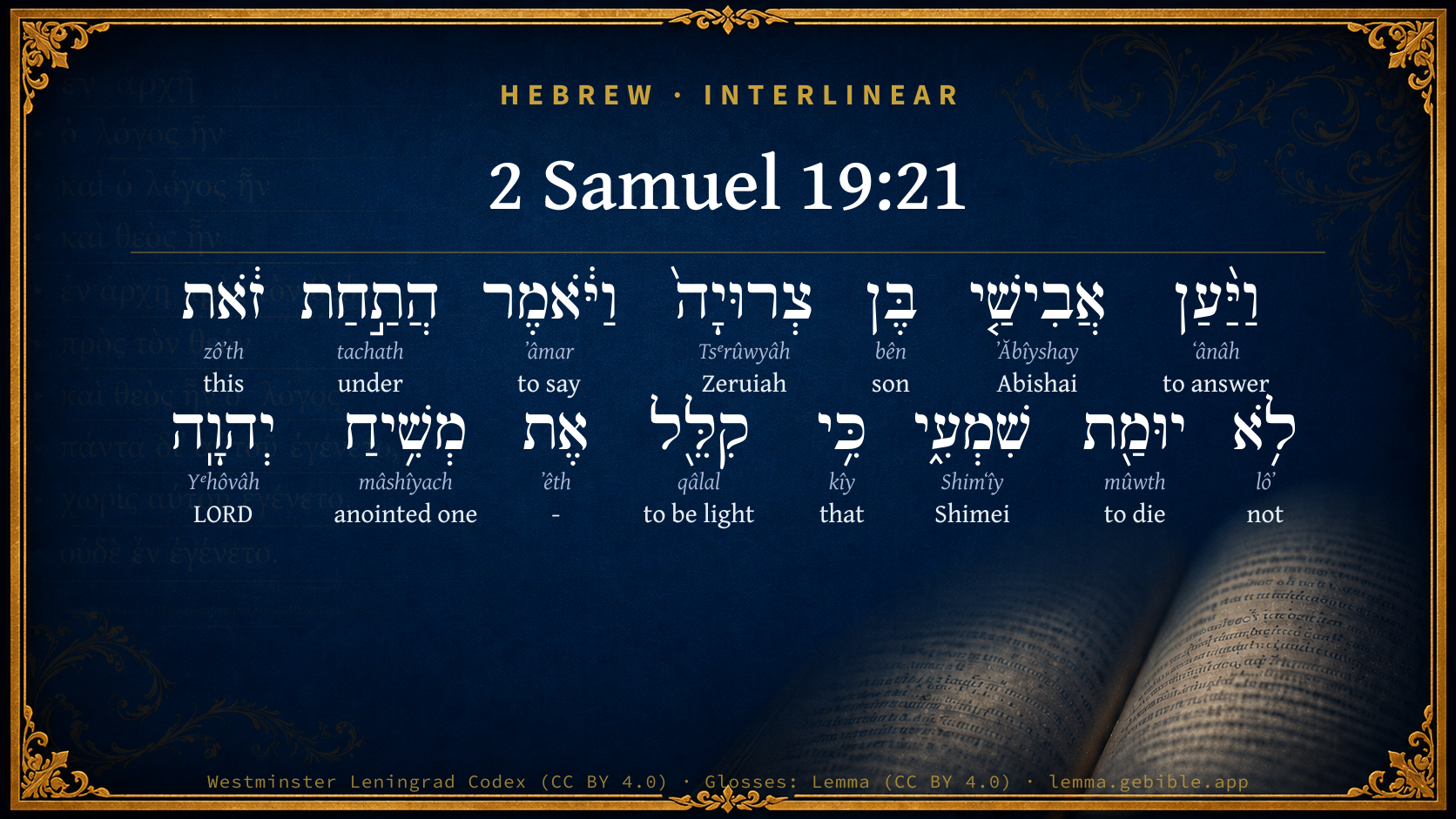
אֲבִישַׁ֤י
ʼĂbîyshay
H52
“Abishai”
Noun, Proper
Part of Speech
Noun
Type
Proper
Full BDB Definition

Origin: from H1 and H7862

TWOT: None

Abishai = "my father is Jesse" or " my father is a gift" - grandson of Jesse, nephew of David via his sister Zeruiah, brother of Joab
  1. וַיַּ֨עַן ʻânâh H6030 “and · to answer” Conjunction + Verb, Qal, Sequential Imperfect, 3rd Person, Masculine, Singular
  2. בֶּן bên H1121 “son of” Noun, Common, Masculine, Singular, Construct
  3. צְרוּיָה֙ Tsᵉrûwyâh H6870 “Zeruiah” Noun, Proper
  4. וַיֹּ֔אמֶר ʼâmar H559 “and · to say” Conjunction + Verb, Qal, Sequential Imperfect, 3rd Person, Masculine, Singular
  5. הֲתַ֣חַת tachath H8478 “under” Particle, Interrogative + Preposition
  6. זֹ֔את zôʼth H2063 “this” Pronoun, Demonstrative, Feminine, Singular
  7. לֹ֥א lôʼ H3808 “not” Particle, Negative
  8. יוּמַ֖ת mûwth H4191 “to die” Verb, Hophal, Imperfect, 3rd Person, Masculine, Singular
  9. שִׁמְעִ֑י Shimʻîy H8096 “Shimei” Noun, Proper
  10. כִּ֥י kîy H3588 “that” Conjunction
  11. קִלֵּ֖ל qâlal H7043 “to be light” Verb, Piel, Perfect, 3rd Person, Masculine, Singular
  12. אֶת ʼêth H853 “-” Particle, Direct Object
  13. מְשִׁ֥יחַ mâshîyach H4899 “anointed one of” Noun, Common, Masculine, Singular, Construct
  14. יְהוָֽה Yᵉhôvâh H3068 “LORD” Noun, Proper

About this verse

These counts appear in no published source. They are computed here, from the morphology-tagged text and Lemma’s own curated glosses. What Lemma adds →

15
words
15
distinct lemmas
Historical
section

Notable vocabulary

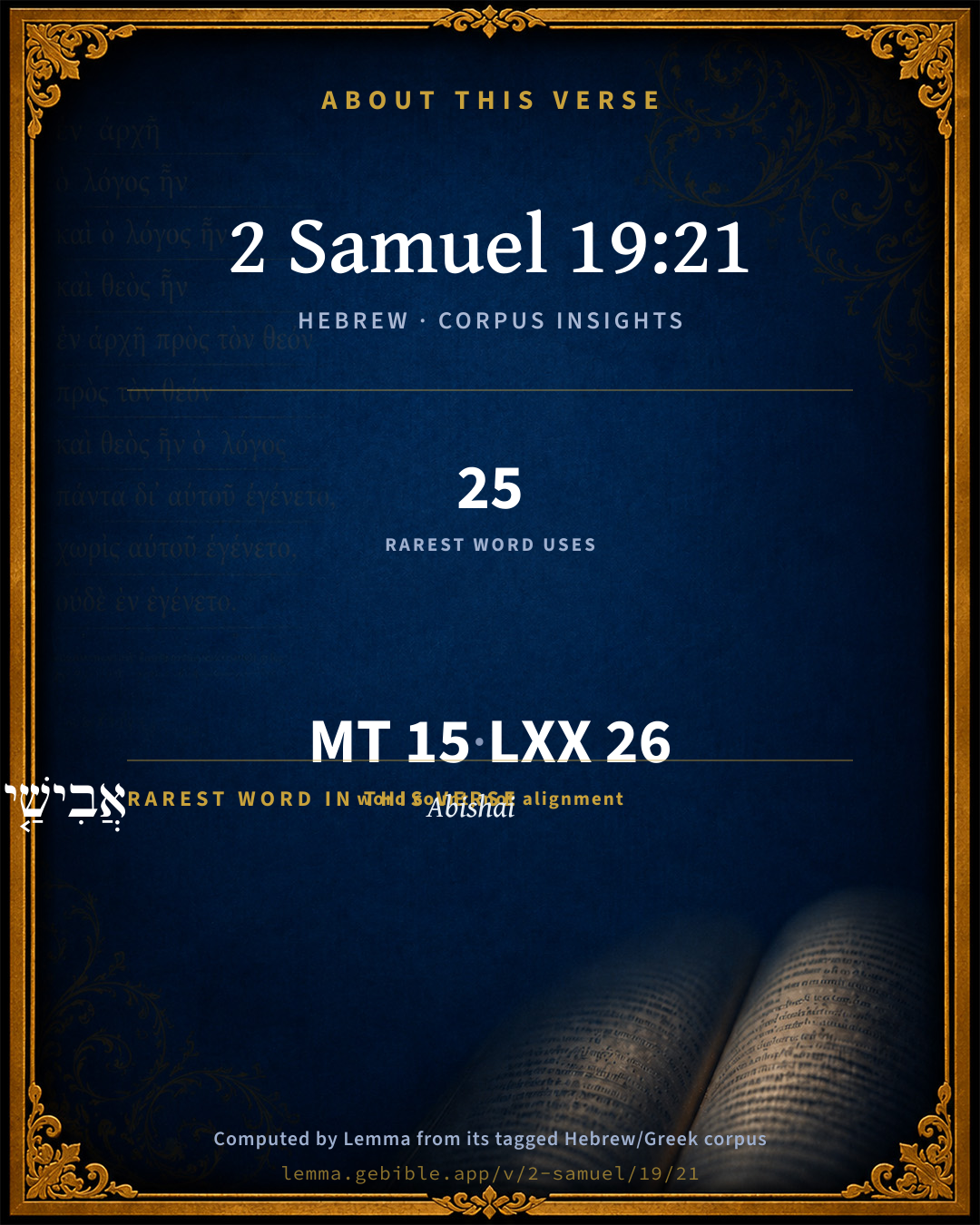
The rarest word here is אֲבִישַׁ֤י Abishai H52 — appearing just 25 times in the whole Hebrew Bible.

Shared distinctive vocabulary

אֲבִישַׁ֤י Abishai H52 occurs in 24 verses of the Hebrew Bible. Also found in:

Grammatical profile

  • 4 verbs
  • 6 nouns
  • 1 pronoun
  • 1 preposition
  • 1 conjunction
  • 2 particles

Verb forms

  • וַיַּ֨עַן Qal · Sequential Imperfect
  • וַיֹּ֔אמֶר Qal · Sequential Imperfect
  • יוּמַ֖ת Hophal · Imperfect
  • קִלֵּ֖ל Piel · Perfect

Hebrew & Septuagint length

In English translation the verse runs 21 words from the Hebrew and 23 from the Septuagint (LXX English) — closely comparable.

A rough comparison of the two English renderings, which tokenize alike — not a word-level alignment.

Word counts can differ between the Hebrew and the Greek without any difference in meaning — e.g. the Hebrew direct-object marker אֵת has no separate Greek word, and Greek often adds the article ὁ.

In the original languages it is 15 Hebrew tokens and 26 Greek tokens — but the two are counted differently (Hebrew bundles its prefixes and suffixes into one token; the Greek is in lemma form), so that isn’t a like-for-like length.

Cross-references

7

Topical passages linked to 2 Samuel 19:21 in the Treasury of Scripture Knowledge — connected by theme and wording, ordered by reader-vote popularity; previews shown in the World English Bible.

  • Exodus 22:28 "You shall not blaspheme God, nor curse a ruler of your people.
  • 1 Samuel 26:9 David said to Abishai, Don't destroy him; for who can put forth his hand against Yahweh's anointed, and be guiltless?
  • 1 Samuel 24:6 He said to his men, Yahweh forbid that I should do this thing to my lord, Yahweh's anointed, to put forth my hand against him, seeing he is Yahweh's anointed.
  • 2 Samuel 16:5 When king David came to Bahurim, behold, a man of the family of the house of Saul came out, whose name was Shimei, the son of Gera. He came out, and cursed still as he came.
  • 2 Samuel 16:7–8 Thus said Shimei when he cursed, Be gone, be gone, you man of blood, and base fellow:
  • 2 Samuel 16:13 So David and his men went by the way; and Shimei went along on the hill-side over against him, and cursed as he went, and threw stones at him, and cast dust.
  • 1 Kings 21:10–11 and set two men, base fellows, before him, and let them testify against him, saying, You did curse God and the king. Then carry him out, and stone him to death.

Cross-references courtesy of OpenBible.info (CC BY 4.0).

Hebrew and Greek witnesses Masoretic Hebrew ↔ Greek Septuagint

The same verse in the two great witnesses to the Old Testament, shown verse-for-verse.

These are two independent witnesses, not word-aligned to each other, and the Septuagint is shown in lemma (dictionary) form.

Hebrew 2 Samuel 19:21 Masoretic · Westminster Leningrad Codex

וַיַּ֨עַן אֲבִישַׁ֤י בֶּן צְרוּיָה֙ וַיֹּ֔אמֶר הֲתַ֣חַת זֹ֔את לֹ֥א יוּמַ֖ת שִׁמְעִ֑י כִּ֥י קִלֵּ֖ל אֶת מְשִׁ֥יחַ יְהוָֽה

But Abishai the son of Zeruiah answered, Shall Shimei not be put to death for this, because he cursed Yahweh's anointed?

World English Bible · Public Domain

Greek LXX 2 Samuel 19:21 Septuagint · lemma form

ὅτι γιγνώσκω ὁ δοῦλος σύ ὅτι ἐγώ ἁμαρτάνω καί ἰδού ἐγώ ἔρχομαι σήμερον πρότερος πᾶς οἶκος ιωσηφ ὁ καταβαίνω εἰς ἀπαντή ὁ κύριος ἐγώ ὁ βασιλεύς

And Abessai the son of Saruia answered and said, Shall not Semei therefore be put to death, because he cursed the Lord's anointed?

LXX2012 (modern English Septuagint) · Public Domain

Hebrew: Westminster Leningrad Codex (CC BY 4.0). Greek: Septuagint (public domain); English from LXX2012 (modern English Septuagint) (Public Domain). How the Septuagint differs from the Hebrew →

Targum (Aramaic paraphrase)

1

The Targum is the ancient Jewish Aramaic paraphrase of the Hebrew Scriptures — an interpretive translation, not the Hebrew text itself. Onkelos (literal) and Pseudo-Jonathan (expansive) render the Torah, and Jonathan the Prophets. Coverage is partial: where no permissively-licensed English translation exists for a verse, only the Aramaic is shown. This is verse-level text, not a word-by-word alignment to the Hebrew.

  1. Targum Jonathan Prophets (Joshua–Malachi)
    אֲרֵי יְדַע עַבְדָךְ אֲרֵי אֲנָא חָבִית וְהָא אָתִית יוֹמָא דֵין קַדְמָאִי לְכָל בֵּית יוֹסֵף לְמֵחַת לִקָדָמוּת רִבּוֹנִי מַלְכָּא:

    (no public-domain English translation for this verse)

    Targum Jonathan — Aramaic: “Mikraot Gedolot” (public domain). English: “Sefaria Community Translation” (CC0 1.0 (public-domain dedication)); “London "Chaldee Paraphrase," 1871” (public domain). Text via Sefaria.

Commentary

Notes on 2 Samuel 19:21 from classic Christian and Jewish commentators (each source and its license shown beneath its notes). The classic Christian expositions comment on the surrounding passage and are grouped to its opening verse, so a note may address several verses; the Jewish commentaries on the Tanakh (Rashi and others) are per-verse, so they appear only where the commentator wrote on this verse.

Lemma curates 59 commentaries, every one of them public domain or Creative Commons licensed, each selected and text-cleaned for this edition rather than reprinted as found. About our sources →

Trapp's Complete Commentary

John Trapp

2Sa 19:21 But Abishai the son of Zeruiah answered and said, Shall not Shimei be put to death for this, because he cursed the LORD’S anointed?

Ver. 21. Because he cursed the Lord’s anointed?] Or, Inasmuch as he cursed, &c. Shall he be therefore spared, because he hath acknowledged his fault after a sort, and now beggeth pardon? Let us show like zeal for God against blasphemers, as this noble captain doth for David.

John Trapp, A Commentary or Exposition upon All the Books of the Old and New Testament (1647–1656) — public domain. Text from a community e-Sword module.

Joseph Benson's Commentary

2Sa 19:21-23. Abishai said, Shall not Shimei be put to death? — Abishai had before highly resented Shimei’s vile treatment of David, and thought this a fit season for taking revenge. What have I to do with you, ye sons of Zeruiah? — It seems Joab joined with his brother, and together they thought to govern all the king’s motions as they pleased. But he bids them, in a disdainful manner, stand aside, and not intermeddle in this matter. That ye should this day be adversaries unto me? — Should hinder me from following my own inclinations, and set my people against me. For, by taking their advice, David might have alienated the hearts of all Israel from him, and made them fear the like punishment for their revolt. Shall any man be put to death this day in Israel? — In a time of universal joy, shall any family have cause for lamentation? It was undoubtedly David’s interest, at this time, to appease the people, and reconcile them to himself, and not give them any new distaste by acts of severity; which would have made others jealous, that he would watch an opportunity to be revenged on them. Do I not know that I am this day king over Israel? — And, therefore, have power to punish or to pardon as I please. Is not my kingdom, which was in a manner wholly lost, just now restored and assured to me? And when God hath been so merciful to me in forgiving my sin, shall I show myself revengeful to Shimei? Shall I sully the glory of this day with an act of such severity? Or, shall I alienate the hearts of my people from me, now they are returned to me? “He knew himself a king,” says Delaney, “not of one party, but of a whole people; and therefore wisely resolved that his fatherly affection should extend to them all. He knew himself a sovereign, and he knew that mercy and forgiveness were the noblest privileges of sovereignty.” He therefore turned to Shimei, pronounced his pardon, and confirmed it with an oath, that he should not die.

Joseph Benson's Commentary on the Old and New Testaments (1811–1818) — public domain. Text from a community e-Sword module.

Tyndale Open Study Notes

Tyndale Open Resources

19:21-22 Cp. 16:9-12. • Abishai: See study note on 16:9. • you sons of Zeruiah: See study notes on 2:18; 17:25. While it was Abishai who consistently wanted to kill those hostile to David (cp. 16:9; 1 Sam 26:8), David also expressed his frustration with Joab, Abishai’s brother (see 2 Sam 3:28-29, 39; 19:13; 1 Kgs 2:5-6).

Tyndale Open Study Notes — © Tyndale Open Resources, licensed CC BY-SA 4.0. Text via the HelloAO Bible API.

The Cambridge Bible for Schools and Colleges

gen. ed. J. J. S. Perowne

21. Abishai] True to his fierce, impetuous character. See ch. 2Sa_16:9.

cursed the Lord’s anointed] Since the king was Jehovah’s representative, to curse him was almost as heinous an offence as to curse Jehovah Himself. Exo_22:28; Lev_24:15; 1Ki_21:10.

The Cambridge Bible for Schools and Colleges (gen. ed. J. J. S. Perowne; Cambridge University Press, 1878–1918) — public domain. Text from a community e-Sword module.

John Gill's Exposition

But Abishai the son of Zeruiah answered and said,.... The same person that would have taken off the head of Shimei at the time he cursed David, if he would have given him leave, Sa2 16:9,

shall not Shimei be put to death for this? this humiliation and acknowledgment he has made, shall he be forgiven on that account? shall so small a matter as this atone for so great a crime he has been guilty of, as that he shall not die?

because or "though" (l).

he cursed the Lord's anointed; is asking pardon sufficient to expiate so foul an offence, for which according to the law he ought to die? or for this action which he has done, as the Arabic version, in cursing the Lord's anointed.

(l) "quamvis, vel cum tamen", Piscator.

John Gill's Exposition of the Whole Bible (1746–1763) — public domain (CC PDM 1.0). Text via the HelloAO Bible API.

Matthew Poole's English Annotations

i.e. The king. By this expression he minds David of his former zeal against those who offered any injury to Saul, because he was the Lord’s anointed, 1Sa 24:6; 26:9; and therefore demands the same justice against Shimei for his cursing of the king, which was so expressly forbidden, Exo 22:28, and by the analogy of that law, Exo 21:17, might seem punishable with death.

Matthew Poole's English Annotations on the Holy Bible (1683–1685) — public domain. Text from a community e-Sword/MySword module.

Whedon's Commentary on the Bible

Daniel D. Whedon

21. Abishai… said — He cherished yet his rage and indignation against this reviler of the king. See 2Sa_16:9.

Daniel D. Whedon (gen. ed.), Commentary on the Old and New Testaments (1874–1909) — public domain. Text from a community e-Sword module.

unfoldingWord translationNotes

Door43 World Missions Community

Abishai

See how you translated this man's name in 2 Samuel 2:18. (See: How to Translate Names)

Zeruiah

See how you translated this man's name in 2 Samuel 2:13. (See: How to Translate Names)

Should not Shimei be put to death for this, because he cursed Yahweh's anointed?

Abishai was angry at Shimei for cursing David and is suggesting that he should be killed. This question can be written as a statement. AT: "Shimei should be put to death because he cursed Yahweh's anointed." (See: Rhetorical Question)

Yahweh's anointed

This refers to David. It means that he is the man that Yahweh had anointed as king. AT: "the man that Yahweh has anointed as king" (See: Assumed Knowledge and Implicit Information)

What have I to do with you ... that you should today be adversaries to me?

David uses this rhetorical question to rebuke Abishai. This can be written as a statement. AT: "We have nothing in common with you, you sons of Zeruiah! You have no good reason to become my adversaries today." (See: Rhetorical Question)

Will any man be put to death today in Israel? For do I not know that today I am king over Israel?

David uses these rhetorical questions to continue rebuking Abishai. These questions can be written as statements. AT: "No person will be executed today in the nation of Israel, because today I am the one who is king over all of Israel." (See: Rhetorical Question)

Will any man be put to death

This phrase "put to death" means to be killed or executed. AT: "Will any man be killed" or "Will I order any man to die" (See: Idiom)

For do I not know that today I am king over Israel?

Possible meanings of this rhetorical question are 1) "I know that I am still king of Israel." or 2) "Today I am the one who is king over Israel!" (See: Rhetorical Question)

translationWords

curse

Yahweh

anoint

adversary

know

promise

oath

unfoldingWord translationNotes — © Distant Shores Media and the Door43 World Missions Community, licensed CC BY-SA 4.0. Source: git.door43.org/Door43/en_tn.

Rashi

Rabbi Shlomo Yitzchaki (Rashi)

First from among all the House of Yoseif. All of Yisroel wronged you, I more then everyone. I have come to ask you forgiveness, if you accept me then all of Yisroel will be confident that you will accept them but if you do not [accept me] they will be afraid to return to you.

Rashi on the Tanakh — English translations: “The Judaica Press complete Tanach with Rashi, translated by A. J. Rosenberg” (CC BY 4.0); “Pentateuch with Rashi's commentary by M. Rosenbaum and A.M. Silbermann, 1929-1934” (public domain); “The Metsudah Tanach series, Lakewood, N.J” (CC BY 4.0); and “The Book of Joshua, Metsudah Publications, 1997” (CC BY 4.0). Text via Sefaria.

Lesson kit

Teaching starters — assembled from the data on this page, not authored interpretation. Every prompt links to the verse data it draws on. Edit before teaching.

2 Samuel, in the Historical, opens this verse with 15 words (15 distinct Hebrew lemmas). Its most distinctive word is ʼĂbîyshay (“Abishai”). A historical commentator’s framing appears above. Read the whole chapter for the surrounding context.

Discussion questions

  1. How does “Abishai” (ʼĂbîyshay) shape what this verse is saying?
  2. 1 Samuel 26:6 shares the word «Abishai» with this verse. How do the two illuminate each other?
  3. The translations on this page render this verse differently — a whole-verse word diff, not a word-by-word alignment. What might account for the different wordings?
  4. The verb «וַיַּ֨עַן» is Qal Sequential Imperfect. How does its form color the action?
  5. Reading how Trapp's Complete Commentary and Joseph Benson's Commentary read this verse, where do the two commentators agree and where do they part?

Things to notice

Reading settings

Reading text

Shown beneath each verse's original-language words.

Old Testament
Old Testament edition

Read the OT as the Masoretic Hebrew (MT) or the Greek Septuagint (LXX).

English shown for the Greek Septuagint (in the Hebrew ↔ Greek comparison).

Comparing translations? Open the Compare panel on any verse page to stack up to four side by side.