
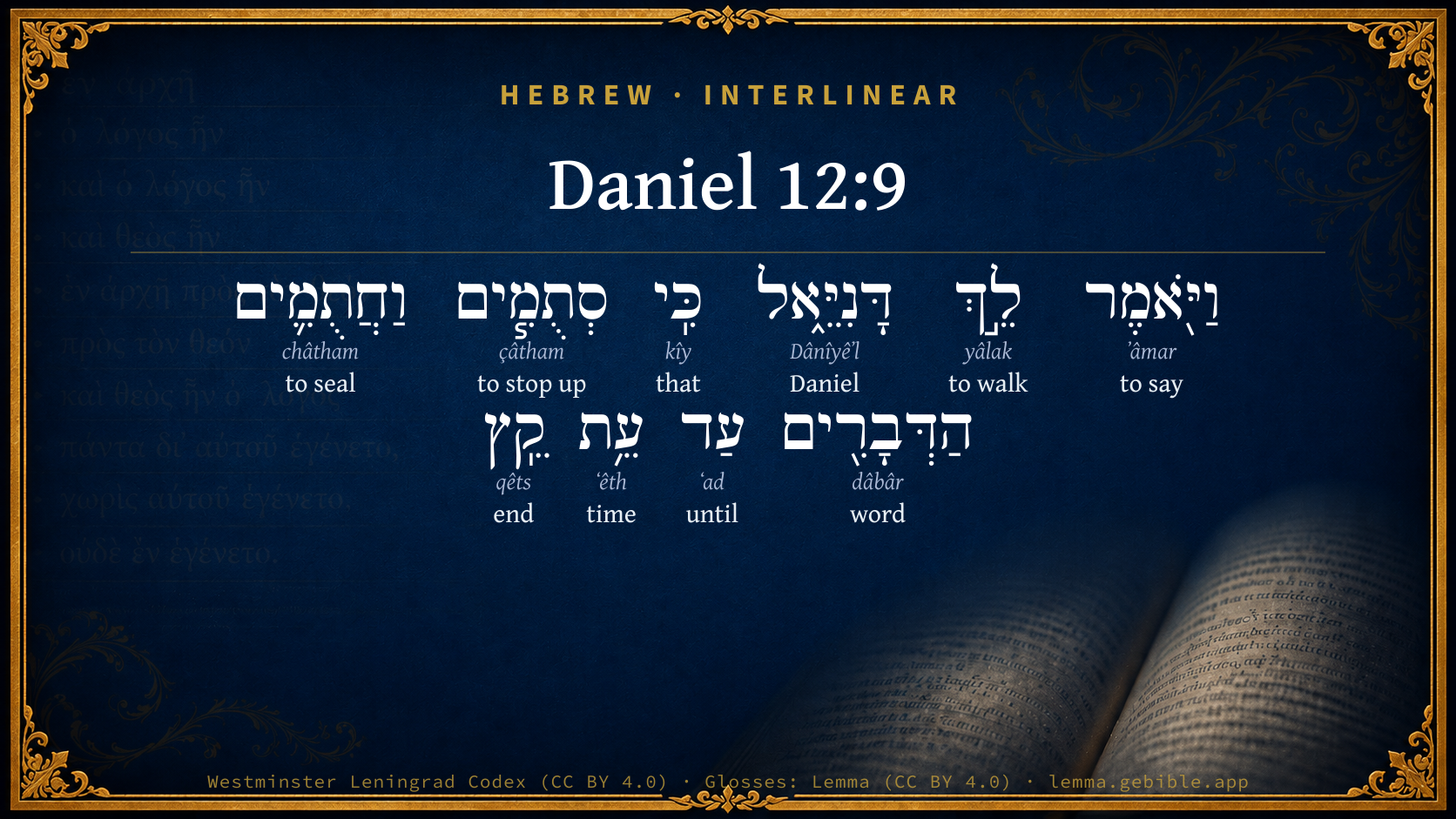
Daniel 12:9

Hebrew (Westminster Leningrad Codex) Daniel 12:9 appears in the Hebrew Old Testament. The text above is from the Westminster Leningrad Codex. Each word links to its Strong’s number, a concise gloss, and parsing drawn from the Open Scriptures Hebrew Bible morphology. Click any word for its full Brown-Driver-Briggs (BDB) entry.
Download image
Cite this verse

Daniel 12:9 (World English Bible). Public Domain. Lemma interlinear Bible study tool, https://lemma.gebible.app/v/daniel/12/9.

Show BibTeX & RIS
BibTeX
RIS
English Translation
He said, Go your way, Daniel; for the words are shut up and sealed until the time of the end.
World English Bible · Public Domain
Download a study sheet

One document with this verse’s original text, its word-by-word gloss line, the meaning frame, cross-references with their text, attributed commentary, and full source and license credits — printable, and it pastes into notes with its structure intact.

This verse Autodidact and up

Study sheet (.html) Plain text (.txt)

A passage Seminary Student

Up to 50 verses in one chapter. A passage sheet keeps up to 6 commentary sources and 12 cross-references per verse, in the order this page ranks them, and says so on the sheet whenever that leaves anything out. Ask for a single verse and you get the Autodidact verse sheet above.

Everything on this page stays free to read, with no account — the sheet is a download of what is already on screen, not access to it.

Want to remove ads? Support Godless Engineer
Compare translations 3

The same verse in 3 English versions, stacked beneath the original-language interlinear above. Click any original word for its lexicon entry.

Each is an independent rendering of the whole verse — the interlinear is not word-aligned to these translations.

Highlighted words mark where these versions differ — a whole-verse word diff, not a word-by-word alignment.

  • World English Bible Public Domain
    He said, Go your way, Daniel; for the words are shut up and sealed until the time of the end.
  • King James Version Public Domain
    And he said, Go thy way, Daniel: for the words are closed up and sealed till the time of the end.
  • unfoldingWord Literal Text CC BY-SA 4.0
    He said, “Go your way, Daniel, for the words are shut up and sealed until the time of the end.

unfoldingWord Literal Text — © unfoldingWord, licensed CC BY-SA 4.0. Word-aligned USFM3 via Door43 (git.door43.org/unfoldingWord/en_ult).

Versions to compare (up to 4)

3 of 4 selected

Show all 18 translations

Every available English version of this verse, each an independent rendering of the whole verse.

  • World English Bible Public Domain
    He said, Go your way, Daniel; for the words are shut up and sealed until the time of the end.
  • Berean Standard Bible Public Domain
    “Go on your way, Daniel,” he replied, “for the words are closed up and sealed until the time of the end.
  • Majority Standard Bible Public Domain
    “Go on your way, Daniel,” he replied, “for the words are closed up and sealed until the time of the end.
  • King James Version Public Domain
    And he said, Go thy way, Daniel: for the words are closed up and sealed till the time of the end.
  • American Standard Version (1901) Public Domain
    And he said, Go thy way, Daniel; for the words are shut up and sealed till the time of the end.
  • Revised Version (1885) Public Domain
    And he said, Go thy way, Daniel: for the words are shut up and sealed till the time of the end.
  • Geneva Bible (1599) Public Domain
    And he said, Go thy way, Daniel: for ye words are closed vp, and sealed, till the ende of the time.
  • Douay-Rheims (1899) Public Domain
    And he said: Go, Daniel, because the words are shut up, and sealed until the appointed time.
  • Young's Literal Translation Public Domain
    And he saith, `Go, Daniel; for hidden and sealed `are' the things till the time of the end;
  • Literal Standard Version CC BY-SA 4.0
    And he says, Go, Daniel; for hidden and sealed [are] the things until the time of the end.
  • Unlocked Literal Bible CC BY-SA 4.0
    He said, “Go your way, Daniel, for the words are shut up and sealed until the time of the end.
  • unfoldingWord Literal Text CC BY-SA 4.0
    He said, “Go your way, Daniel, for the words are shut up and sealed until the time of the end.
  • Darby Bible Public Domain
    And he said, Go thy way, Daniel; for these words are closed and sealed till the time of the end.
  • World Messianic Bible Public Domain
    He said, “Go your way, Daniel; for the words are shut up and sealed until the time of the end.
  • Webster's Bible Public Domain
    And he said, Go thy way Daniel: for the words are closed up and sealed till the time of the end.
  • Free Bible Version CC BY-SA 4.0
    “Daniel, you can go on your way now,” he replied, “for this message is secret and kept sealed until the time of the end.
  • Bible in Basic English Public Domain
    And he said, Go on your way, Daniel: for the words are secret and shut up till the time of the end;
  • JPS Tanakh (1917) Public Domain
    And he said: 'Go thy way, Daniel; for the words are shut up and sealed till the time of the end.

Literal Standard Version (2020), Covenant Press — licensed CC BY-SA 4.0. Text via the HelloAO Bible API (eBible.org). Unlocked Literal Bible (unfoldingWord) — licensed CC BY-SA 4.0. Text via the HelloAO Bible API (eBible.org). unfoldingWord Literal Text — © unfoldingWord, licensed CC BY-SA 4.0. Word-aligned USFM3 via Door43 (git.door43.org/unfoldingWord/en_ult). Free Bible Version, Dr. Jonathan Gallagher — licensed CC BY-SA 4.0. Text via the HelloAO Bible API (eBible.org).

Word by word

More ways to search: Search by grammar → Find every occurrence → Compare this word →

Practice this passage: Drill this verse → Learn its vocabulary →

סְתֻמִ֧ים
çâtham
H5640
“stopped up”
Verb, Qal, Participle Passive, Masculine, Plural, Absolute
Part of Speech
Verb
Stem
Qal
Form
Participle Passive
Gender
Masculine
Number
Plural
State
Absolute
Full BDB Definition

Origin: a primitive root

TWOT: 1550

to stop up, shut up, keep close - (Qal) - to stop up - to shut up, keep close - secret (participle) - (Niphal) to be stopped up - (Piel) to stop up
  1. וַיֹּ֖אמֶר ʼâmar H559 “and · to say” Conjunction + Verb, Qal, Sequential Imperfect, 3rd Person, Masculine, Singular
  2. לֵ֣ךְ yâlak H3212 “walk” Verb, Qal, Imperative, 2nd Person, Masculine, Singular
  3. דָּנִיֵּ֑אל Dânîyêʼl H1840 “Daniel” Noun, Proper
  4. כִּֽי kîy H3588 “that” Conjunction
  5. וַחֲתֻמִ֛ים châtham H2856 “and · sealed” Conjunction + Verb, Qal, Participle Passive, Masculine, Plural, Absolute
  6. הַדְּבָרִ֖ים dâbâr H1697 “the · words” Particle, Definite Article + Noun, Common, Masculine, Plural, Absolute
  7. עַד ʻad H5704 “until” Preposition
  8. עֵ֥ת ʻêth H6256 “time of” Noun, Common, Both, Singular, Construct
  9. קֵֽץ qêts H7093 “end” Noun, Common, Masculine, Singular, Absolute

About this verse

These counts appear in no published source. They are computed here, from the morphology-tagged text and Lemma’s own curated glosses. What Lemma adds →

10
words
10
distinct lemmas
Prophets
section

Notable vocabulary

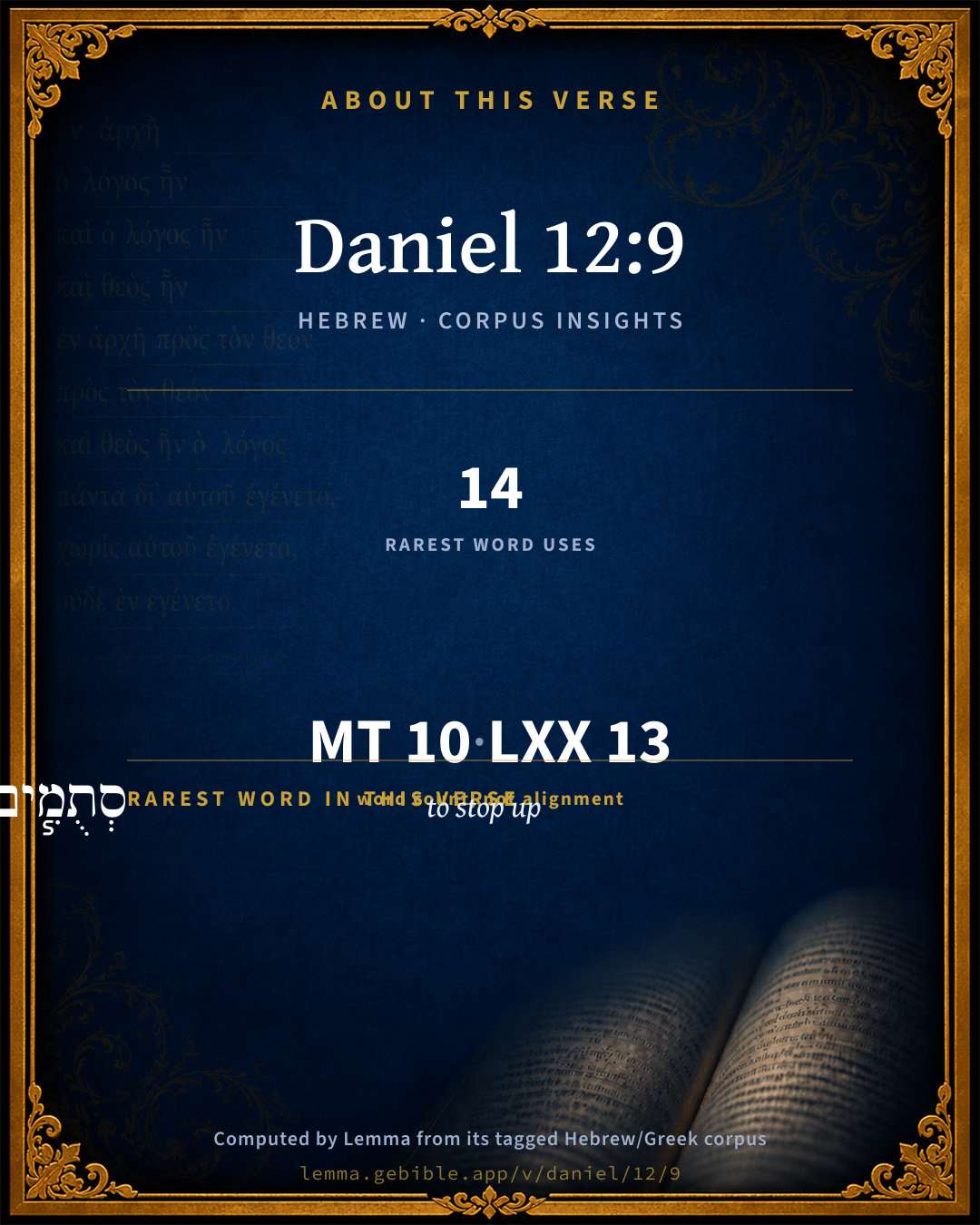
The rarest word here is סְתֻמִ֧ים to stop up H5640 — appearing just 14 times in the whole Hebrew Bible.

Shared distinctive vocabulary

סְתֻמִ֧ים to stop up H5640 occurs in 14 verses of the Hebrew Bible. Also found in:

Grammatical profile

  • 4 verbs
  • 4 nouns
  • 1 preposition
  • 1 conjunction

Verb forms

  • וַיֹּ֖אמֶר Qal · Sequential Imperfect
  • לֵ֣ךְ Qal · Imperative
  • סְתֻמִ֧ים Qal · Participle Passive
  • וַחֲתֻמִ֛ים Qal · Participle Passive

Hebrew & Septuagint length

In English translation the verse runs 20 words from the Hebrew and 19 from the Septuagint (LXX English) — closely comparable.

A rough comparison of the two English renderings, which tokenize alike — not a word-level alignment.

Word counts can differ between the Hebrew and the Greek without any difference in meaning — e.g. the Hebrew direct-object marker אֵת has no separate Greek word, and Greek often adds the article ὁ.

In the original languages it is 10 Hebrew tokens and 13 Greek tokens — but the two are counted differently (Hebrew bundles its prefixes and suffixes into one token; the Greek is in lemma form), so that isn’t a like-for-like length.

Cross-references

5

Topical passages linked to Daniel 12:9 in the Treasury of Scripture Knowledge — connected by theme and wording, ordered by reader-vote popularity; previews shown in the World English Bible.

  • Daniel 12:4 But you, Daniel, shut up the words, and seal the book, even to the time of the end: many shall run back and forth, and knowledge shall be increased."
  • Daniel 8:26 The vision of the evenings and mornings which has been told is true: but seal up the vision; for it belongs to many days [to come].
  • Isaiah 8:16 Bind up the testimony, seal the law among my disciples.
  • Isaiah 29:11 All vision is become to you as the words of a book that is sealed, which men deliver to one who is learned, saying, Read this, I pray you; and he says, I can't, for it is sealed:
  • Revelation 10:4 When the seven thunders sounded, I was about to write; but I heard a voice from the sky saying, "Seal up the things which the seven thunders said, and don't write them."

Cross-references courtesy of OpenBible.info (CC BY 4.0).

Hebrew and Greek witnesses Masoretic Hebrew ↔ Greek Septuagint

The same verse in the two great witnesses to the Old Testament, shown verse-for-verse.

These are two independent witnesses, not word-aligned to each other, and the Septuagint is shown in lemma (dictionary) form.

Hebrew Daniel 12:9 Masoretic · Westminster Leningrad Codex

וַיֹּ֖אמֶר לֵ֣ךְ דָּנִיֵּ֑אל כִּֽי סְתֻמִ֧ים וַחֲתֻמִ֛ים הַדְּבָרִ֖ים עַד עֵ֥ת קֵֽץ

He said, Go your way, Daniel; for the words are shut up and sealed until the time of the end.

World English Bible · Public Domain

Greek LXX Daniel 12:9 Septuagint · lemma form

καί εἶπον ἐγώ ἀποτρέχω δανιηλ ὅτι κατακαλύπτω καί σφραγίζω ὁ πρόσταγμα ἕως ἄν

And he said, Go, Daniel: for the words are closed and sealed up to the time of the end.

LXX2012 (modern English Septuagint) · Public Domain

On this verse, The Pulpit Commentary discusses the Septuagint’s reading. Read the note in Commentary ↓

Hebrew: Westminster Leningrad Codex (CC BY 4.0). Greek: Septuagint (public domain); English from LXX2012 (modern English Septuagint) (Public Domain). How the Septuagint differs from the Hebrew →

Commentary

Notes on Daniel 12:9 from classic Christian and Jewish commentators (each source and its license shown beneath its notes). The classic Christian expositions comment on the surrounding passage and are grouped to its opening verse, so a note may address several verses; the Jewish commentaries on the Tanakh (Rashi and others) are per-verse, so they appear only where the commentator wrote on this verse.

Lemma curates 59 commentaries, every one of them public domain or Creative Commons licensed, each selected and text-cleaned for this edition rather than reprinted as found. About our sources →

Trapp's Complete Commentary

John Trapp

Dan 12:9 And he said, Go thy way, Daniel: for the words [are] closed up and sealed till the time of the end.

Ver. 9. And he said, Go thy way, Daniel.] Quiesce, tibi satis esto - q.d., Though dearly beloved, yet of some things thou must be content to be ignorant. It should suffice thee to be of God’s court, though not altogether of his council. See Dan 12:13. There is a laudable and learned ignorance, as of unnecessaries, of impossibles, or of unprofitables; such as are the term of our lives, the end of the world, the reprobation of others, &c.

For the words are closed up,] viz., Till future ages, which are more concerned in them, and till which these things shall be concealed.

John Trapp, A Commentary or Exposition upon All the Books of the Old and New Testament (1647–1656) — public domain. Text from a community e-Sword module.

The Biblical Illustrator

Joseph S. Exell

Dan_12:9

For the words are closed

The Sealed Book

Daniel, having heard of the great troubles and afflictions that the Church was to meet with in the last days, was desirous to know how long they should continue, and to have some more particular information concerning the issue of them.

The angel said, Go thy way, Daniel; for the words are closed up and sealed till the time of the end. As if it had been said, Daniel, what hath been revealed to you already is enough to support your faith and hope, and the faith and hope of my people in future ages, amidst all the troubles and trials that they may be exercised with, and this you must be contented with in the meantime; for a full explication of the mysteries of Divine providence, of Gods dispensations towards the Church made her members, such an explication of them as will leave no darkness, doubt, or difficulty remaining, is not to be expected during the present state of things. In these words We have:

I. A SEASONABLE ADMONITION. Go thy way, Daniel. Mind your own business; apply yourself to the performance of your present duty.

1. A needful caution. Not to indulge an unwarrantable curiosity of prying into those things which God hath not seen meet to reveal, into the secrets of His government and providence.

2. A. suitable exhortation. To apply himself to his present work, and set about the performance of present duty, leaving events to the Lord.

II. THE REASON FOR THE ADMONITION. For the words are sealed up, etc. There was something intricate and mysterious in the prophecy concerning the Churchs troubles and deliverance that would not be fully unfolded until it was accomplished. By the time of the end may be understood the time when the several predictions concerning the troubles and trials that the Church was to meet with should be fulfilled. In every future period new discoveries would be made of the gracious designs and mystery of Providence respecting the Church till all were finished and unfolded. The end of time may be meant. A seal denotes security, as well as secrecy or concealment. When, therefore, it is said that the words were sealed till the time of the end, it might imply that there would be an exact accomplishment of all Gods promises concerning the Church, whatever difficulties appeared to be in the way.

1. Let us observe some things in general concerning those discoveries that God is pleased to make of His mind and will to His people in this world.

(1) All true believers are privileged with some discoveries of the mind of God that others are unacquainted with. They are all taught of God; not doctrinally, or externally, by the word only, but internally, effectually, and savingly, by the Holy Spirit. The Holy Spirit shows them many things concerning Christ; concerning His person and undertaking, righteousness, grace and salvation, which are bid from the rest of mankind.

(2) The discoveries God makes to His people He ordinarily makes to them by means of His Word. The Holy Scriptures are sufficient to make the man of God perfect, thoroughly furnished unto all good works. The work of the Spirit now is, not to make any new revelations of the will of God, but to open the understandings and enlighten the minds of men to perceive, and make a suitable improvement of, what is already revealed in the written word.

(3) God doth not reveal His mind to His people all at once, but gradually, and as He sees meet.

(4) The discoveries which God makes of His mind and will to His people in this world are still imperfect

(5) Even saints of God are too apt to indulge a sinful curiosity in prying into those things which God hath not been pleased to reveal, and which it is not necessary for them to know in their present state.

(6) However dark and intricate the dispensations of Divine providence may be, so much is made known as is sufficient to support faith and hope, and to encourage behavers in the way of duty.

2. Some of the discoveries which God makes to His people, which are sufficient to direct them in the way of duty. These discoveries may concern the people of God themselves. That He loves them. That the covenant He has made is ordered in all things and sure, immutable and everlasting. That there is a fulness of grace deposited in Christ as the Mediator of the New Covenant. That He will never leave them. That all dispensations shall turn to their advantage. These discoveries may concern the Church in general. Such as that all future troubles of the Church were foreknown and appointed by God. That they would only continue for a limited time. That all the promises would certainly be accomplished. That all the Churchs sufferings would have a glorious issue.

3. Many things are still dark to Gods people, and must remain so as long as they continue in the world. There are still things dark in the Churchs troubles, in the promises of God concerning His Church. Believers have but imperfect views of the privileges conferred upon them; and of the truths and doctrines taught in the Word of God. There is mystery in that gracious work which God has begun, and is carrying on, in souls. There is a veil upon that glory and happiness reserved for them in the other world. There are reasons why we should attend to present day, and not pry into the unrevealed.

(1) Inquiries into those things which God hath not been pleased to reveal are unprofitable and vain.

(2) What God hath clearly revealed is sufficient for their direction and encouragement in the way of duty.

(3) It is the will of God that His people, while they are in this world, should live by faith, and walk by faith.

(4) When the people of God mind their present duty, they greatly honour God. They give Him the glory due unto His name.

(5) All that is now dark and mysterious either in the purposes or promises of God, or in the dispensations of His providence, will at last be clearly manifested and unfolded. (D. Wilson.)

The Biblical Illustrator, edited by Joseph S. Exell (c. 1880s–1900s) — public domain. Text from a community e-Sword module.

Jamieson, Fausset & Brown

Robert Jamieson, A. R. Fausset & David Brown

Daniel's desire of knowing more is thus deferred "till the time of the end." John's Revelation in part reveals what here is veiled (see on Dan 12:4; Dan 8:26).

Jamieson, Fausset & Brown — Commentary Critical and Explanatory on the Whole Bible (1871) — public domain (CC PDM 1.0). Text via the HelloAO Bible API.

Adam Clarke's Commentary

Verse 9. The words are closed up] The prophecy shall not be understood, but in its accomplishment; and then the depth of the wisdom and providence of God will be clearly seen in these matters. See on Da 12:4. We must wait "till the time of the end;" and this, it appears from the following calculations, will not arrive before the TWENTIETH CENTURY. We here see the reason why these prophecies are at present so imperfectly understood. God has sealed them.

Adam Clarke's Commentary on the Bible (1810–1826) — public domain. Text from a community e-Sword/MySword module.

John Calvin's Commentaries

Although Daniel was not induced by any foolish curiosity to inquire of the angel the issue of these wonderful events, yet he did not obtain his request. God wished some of his predictions to be partially understood, and the rest to remain concealed until the full period of the complete revelation should arrive. This is the reason why the angel did not reply to Daniel. The wish in truth was pious, and, as we have previously stated, it did not contain anything unlawful; but God, knowing what was good for him, did not grant his request. He is dismissed by the angel, because the words were shut up and sealed The angel uses this expression in a sense different from the former one. For he ordered Daniel to close and seal the words like precious treasures, as they would be set at naught by many disbelievers, and by almost the whole people. Here then, he says, the words were closed up and sealed, as there was no fitting occasion for revealing them. As if he had said, nothing has been predicted either vainly or rashly, but the full blaze of light has not yet been thrown upon the prediction: hence we must wait until the truth itself is proved by the event, and thus the divine utterance of the angel is made manifest. This is the summary. He then says, until the time of the end Some one might possibly object; then for what purpose was this prediction delivered? For Daniel himself, who was instructed by the angel, could not thoroughly comprehend his own message, and the rest of the faithful, although versed in these prophetic studies, felt themselves in a labyrinth here. The answer is at hand, until the time of the end; and we must also remember that neither Daniel nor the rest of the faithful were deprived of all the advantage of this prophecy, for God explained to them whatever was sufficient for the necessities of their own times. I must pass over some points slightly, with the view of finishing today. It follows —

John Calvin's Commentaries (1540-1563) — public domain. Text from the Calvin Translation Society English edition (1840s-50s) via the Christian Classics Ethereal Library (ccel.org). Calvin's coverage is partial (roughly two-thirds of the Bible); uncommented books and verses are honest gaps, never fabricated. The 19th-century editor's footnotes and remarks are omitted so the notes are faithfully Calvin's own voice.

Ellicott's Commentary for English Readers

(9) Go thy way.—That is, be at peace. Observe that the matter is not explained to Daniel any further. He is assured that the end will most certainly come. Compare another gentle rebuke that was addressed to one who wished to see further than was fitting into the future (Joh_21:21-22).

Closed up and sealed.—To be explained as in Dan_12:4. The book is to be carefully preserved till the end of time.

A Bible Commentary for English Readers, edited by Charles John Ellicott (1878–1897) — public domain. Text from a community e-Sword module.

The Cambridge Bible for Schools and Colleges

gen. ed. J. J. S. Perowne

9. Go, Daniel, &c.] i.e. do not inquire further: for the words are shut up and sealed (Dan_12:4) till the time of the end: if Daniel does not understand them, it does not signify; they are not intended for him, but for readers in a distant future, viz. in the age of Antiochus Epiphanes, when they will first be divulged.

The Cambridge Bible for Schools and Colleges (gen. ed. J. J. S. Perowne; Cambridge University Press, 1878–1918) — public domain. Text from a community e-Sword module.

John Gill's Exposition

And he said, go thy way, Daniel,.... About thy business; attend to civil affairs, the affairs in which he was concerned in the king's court, and ask no more questions concerning this matter; but be content with the prophecies that have been delivered to thee, and with what knowledge thou hast of them: or he is bid to go and write in a book the several visions he had seen, and the predictions related to him; that he might read them, and meditate on them at his leisure, and transmit them to future posterity, for their use: or go the way of all flesh, prepare for death and eternity; for in the present state he was not to expect a full revelation of these things; but should rest satisfied with what he knew, and assure himself with the full performance of them, and that he should have his share of the blessed times in the Millennium, and of the ultimate glory, as in Dan 12:13.

For the words are closed up, and sealed till the time of the end; that is, till the time comes, or draws near, that they shall be accomplished; till then they would not be clearly understood, but remain in a great measure dark and obscure, though sure and certain: it is suggested they would not always remain so; time is the best interpreter of prophecy, and, the nearer the time of the accomplishment of it is, the clearer it appears, things leading the way to it being gradually fulfilled; but clearest of all when it is accomplished; then it is no more shut and sealed, but open and manifest; See Gill on Dan 12:4.

John Gill's Exposition of the Whole Bible (1746–1763) — public domain (CC PDM 1.0). Text via the HelloAO Bible API.

Albert Barnes' Notes on the Bible

And he said, Go thy way, Daniel - That is, make no further inquiries. All has been disclosed that is to be. At the close of his communication Dan 12:4, he had told Daniel to shut up, and seal the book, for his revelations were ended. He here repeats substantially the same thing, and he assures him that no more could be imparted on the subject.

For the words are closed up and sealed until the time of the end - He had finished his communication, and had directed Daniel to close up the record which he made of it, and to affix a seal to the volume, Dan 12:4. He regarded the whole, therefore, as closed and sealed, until the “end” should come. The events themselves would unfold the meaning of the prediction more fully, and would confirm its truth by their exact correspondence with it. Yet, though the revelation was closed, and all that the angel had designed to say had been said, he does, in the subsequent verses, throw out some suggestions as to the time, or as to some important events which were to mark the termination of the wonders referred to. They are bare hints, however, the meaning of which was to be reserved until the time when the predictions would be accomplished, and they are not of such a nature that they can be supposed to have furnished any additional light to Daniel, or to have done anything to relieve the perplexity of his mind in the case.

Albert Barnes' Notes on the Bible (1834–1885) — public domain. Text from a community e-Sword/MySword module.

Haydock's Catholic Bible Commentary

Mind. They were distracted by love, (Haydock) and rendered foolish.

George Leo Haydock (1774–1849), Haydock's Catholic Family Bible and Commentary, 1859 edition — public domain. Excludes Psalms (Douay-Rheims chapter numbering differs from Protestant) and Deuterocanonical books (Catholic canon only).

Matthew Poole's English Annotations

They shall not be clearly understood till the event make them good: see Dan 12:4, and Dan 8:26. God is choice in keeping the keys of time at his own girdle, Act 1:7.

Matthew Poole's English Annotations on the Holy Bible (1683–1685) — public domain. Text from a community e-Sword/MySword module.

Whedon's Commentary on the Bible

Daniel D. Whedon

9. See note Dan_12:4. Even prophets like Daniel cannot know all that they wish to know. Mysteries must remain. It is enough for man that all the struggles and seeming failures of the saints are known to God and that he has planned for them all a glorious future. The sun now obscured by the clouds shall shine some day with great glory, but only for the “wise” and in the “last time.”

Daniel D. Whedon (gen. ed.), Commentary on the Old and New Testaments (1874–1909) — public domain. Text from a community e-Sword module.

The Pulpit Commentary

And he said, Go thy way, Daniel; for the words are closed up and sealed till the time of the end. The Septuagint omits the last clause, and completes this verse from that which succeeds, "And he said, Depart, Daniel; for the commands are veiled and sealed until many shall be tried and shall be sanctified." Theodotion renders, "Come, Daniel, because the words are fenced and sealed till the time of the end." The Peshitta and the Vulgate agree with the Massoretic. Go thy way, Daniel. This is a refusal to grant Daniel"s prayer, but in the refusal no condemnation of Daniel is implied. The oracles were sealed until circumstance broke the seal. The purpose of prophecy was not to enable men to write history beforehand. It is to be a sign that, recognized in its fulfilment, may afford evidence of the Divinity of the message or person to whom it referred. Closed up and sealed. This verse gives us the real meaning of these words. Daniel"s oracles were not concealed and sealed from being read, but because they were not interpreted they were not understood. For even to Daniel they are "closed up and sealed." Till the time of the end. This is omitted, as may be seen above, from the Septuagint. Although this has a satisfactory meaning, yet it seems better to connect this verse more directly with that which follows.

The Pulpit Commentary (1880–1919), ed. H.D.M. Spence-Jones & Joseph S. Exell — public domain. Text from a community e-Sword module.

John Wesley's Explanatory Notes

And sealed - They shall not be clearly understood, 'till the event make them good.

John Wesley, Explanatory Notes Upon the Whole Bible (1754–1765) — public domain. Text via the GEBible commentary corpus.

Keil & Delitzsch

C. F. Keil & F. Delitzsch

The answer, לך , go thy way, Daniel, is quieting, and at the same time it contains a refusal to answer; yet it is not wholly a refusal, as is clear from Dan 12:11, Dan 12:12. The disclosure regarding the end which is given to him in these verses shows distinctly that the end of the things is not so revealed as that men shall be able to know it beforehand with certainty.

(Note: On this Calvin has well remarked: Quamvis Daniel non stulta curiositate inductus quaesierit ex angelo de fine mirabilium, tamen non obtinet, quod petebat, quia scilicet voluit Deus ad modum aliquem intelligi quae praedixerat, sed tamen aliquid manere occultum usque dum veniret maturum plenae revelationis tempus. Haec igitur ratio est, cur angelus non exaudiat Danielem. Pium quidem erat ejus votum (neque enim optat quicquam scire plus quam jus esset), verum Deus scit quod opus sit, ideo non concessit quod optabat.)

לך signifies neither go hence, i.e., depart, die (Bertholdt, Hvernick), nor go away, instead of standing waiting for an answer (Hitzig), for the angel does give him an answer; but as the formula dimittentis ut excitantis ad animi tranquillitatem (C. B. Michaelis), it has the meaning: vade Daniel, h. e. mitte hanc praesentem tuam curam. "Be at peace, leave this matter alone" (Geier and others, and similarly v. Lengerke, Kranichfeld, Kliefoth). The clause assigning the reason for the command כּי (for the words are shut up, etc.), is chiefly interpreted as referring the closing and sealing up to the incomprehensibility of the prophecy. Thus e.g., Ewald explains it: "For hidden and sealed up are the words, all the things contained in these prophecies, till the time of the end; then shall they be easily unsealed and deciphered." But since, according to Dan 12:4, Daniel himself must shut up and seal the book, the participles in the clause, assigning the reason for the command לך, cannot have the meaning of the perfect, but only state what is or shall be done: shut up - they shall be (remain) till the time of the end; thus they only denote the shutting up and sealing which must be accomplished by Daniel. But Daniel could not make the prophecy unintelligible, since (Dan 12:8) he himself did not understand it; nor could he seal it up till the time of the end, since he did not live to see the end. The shutting up and sealing which was commanded to the prophet can therefore only consist in this, that the book should be preserved in security against any defacement of its contents, so that it might be capable of being read at all times down to the time of the end, and might be used by God's people for the strengthening of their faith; cf. Dan 8:26. "Thus Daniel is calmed in regard to his not understanding it by the fact that this whole prophecy (הדּברים as in Dan 12:4) shall be guarded and placed in safety, and shall continue through all times down to the end" (Kliefoth). For the use of it in all times is supposed in Dan 12:10.

Keil & Delitzsch — Biblical Commentary on the Old Testament (1861–1891) — public domain (CC PDM 1.0). Text via the HelloAO Bible API. (Old Testament only.)

Rashi

Rabbi Shlomo Yitzchaki (Rashi)

until the time of the end until our redemption draws near.

Rashi on the Tanakh — English translations: “The Judaica Press complete Tanach with Rashi, translated by A. J. Rosenberg” (CC BY 4.0); “Pentateuch with Rashi's commentary by M. Rosenbaum and A.M. Silbermann, 1929-1934” (public domain); “The Metsudah Tanach series, Lakewood, N.J” (CC BY 4.0); and “The Book of Joshua, Metsudah Publications, 1997” (CC BY 4.0). Text via Sefaria.

Lesson kit

Teaching starters — assembled from the data on this page, not authored interpretation. Every prompt links to the verse data it draws on. Edit before teaching.

Daniel, in the Prophets, opens this verse with 10 words (10 distinct Hebrew lemmas). Its most distinctive word is çâtham (“to stop up”). A historical commentator’s framing appears above. Read the whole chapter for the surrounding context.

Discussion questions

  1. How does “to stop up” (çâtham) shape what this verse is saying?
  2. How does Genesis 26:15, which shares the word «to stop up», read alongside this verse?
  3. These translations render this verse differently; the difference is in the English rendering, not the original. What questions does that raise?
  4. «וַיֹּ֖אמֶר» is a Qal Sequential Imperfect verb. How does that grammatical form shape the action described?
  5. Compare how Trapp's Complete Commentary and The Biblical Illustrator read this verse. Where do they agree or differ?

Things to notice

Reading settings

Reading text

Shown beneath each verse's original-language words.

Old Testament
Old Testament edition

Read the OT as the Masoretic Hebrew (MT) or the Greek Septuagint (LXX).

English shown for the Greek Septuagint (in the Hebrew ↔ Greek comparison).

Comparing translations? Open the Compare panel on any verse page to stack up to four side by side.