
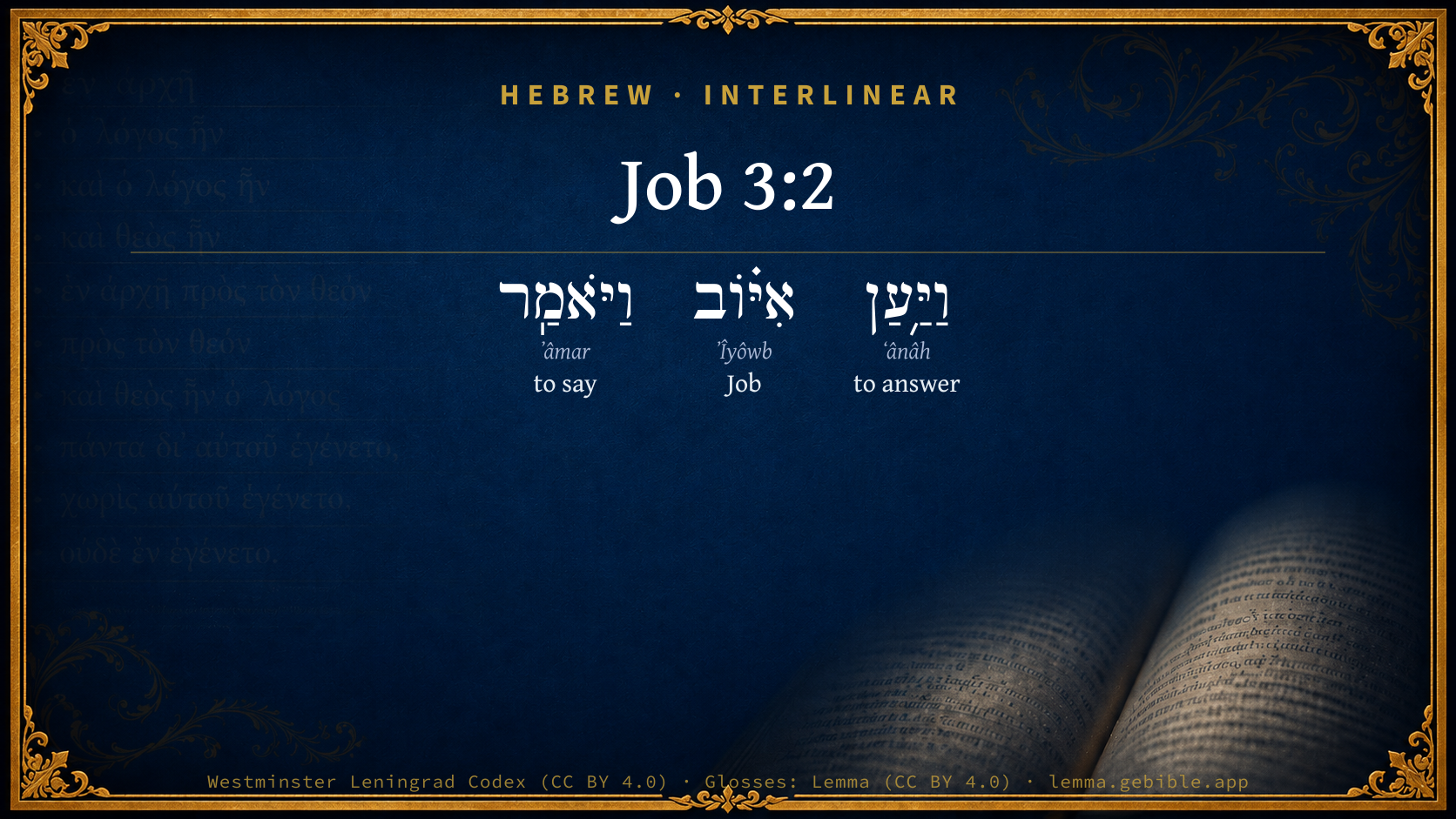
Job 3:2

Hebrew (Westminster Leningrad Codex) Job 3:2 appears in the Hebrew Old Testament. The text above is from the Westminster Leningrad Codex. Each word links to its Strong’s number, a concise gloss, and parsing drawn from the Open Scriptures Hebrew Bible morphology. Click any word for its full Brown-Driver-Briggs (BDB) entry.
Download image
Cite this verse

Job 3:2 (World English Bible). Public Domain. Lemma interlinear Bible study tool, https://lemma.gebible.app/v/job/3/2.

Show BibTeX & RIS
BibTeX
RIS
English Translation
Job answered:
World English Bible · Public Domain
Download a study sheet

One document with this verse’s original text, its word-by-word gloss line, the meaning frame, cross-references with their text, attributed commentary, and full source and license credits — printable, and it pastes into notes with its structure intact.

This verse Autodidact and up

Study sheet (.html) Plain text (.txt)

A passage Seminary Student

Up to 50 verses in one chapter. A passage sheet keeps up to 6 commentary sources and 12 cross-references per verse, in the order this page ranks them, and says so on the sheet whenever that leaves anything out. Ask for a single verse and you get the Autodidact verse sheet above.

Everything on this page stays free to read, with no account — the sheet is a download of what is already on screen, not access to it.

Want to remove ads? Support Godless Engineer
Compare translations 3

The same verse in 3 English versions, stacked beneath the original-language interlinear above. Click any original word for its lexicon entry.

Each is an independent rendering of the whole verse — the interlinear is not word-aligned to these translations.

Highlighted words mark where these versions differ — a whole-verse word diff, not a word-by-word alignment.

  • World English Bible Public Domain
    Job answered:
  • King James Version Public Domain
    And Job spake, and said,
  • unfoldingWord Literal Text CC BY-SA 4.0
    Job answered and said,

unfoldingWord Literal Text — © unfoldingWord, licensed CC BY-SA 4.0. Word-aligned USFM3 via Door43 (git.door43.org/unfoldingWord/en_ult).

Versions to compare (up to 4)

3 of 4 selected

Show all 18 translations

Every available English version of this verse, each an independent rendering of the whole verse.

  • World English Bible Public Domain
    Job answered:
  • Berean Standard Bible Public Domain
    And this is what he said:
  • Majority Standard Bible Public Domain
    And this is what he said:
  • King James Version Public Domain
    And Job spake, and said,
  • American Standard Version (1901) Public Domain
    And Job answered and said:
  • Revised Version (1885) Public Domain
    And Job answered and said:
  • Geneva Bible (1599) Public Domain
    And Iob cryed out, and sayd,
  • Douay-Rheims (1899) Public Domain
    and he said:
  • Young's Literal Translation Public Domain
    And Job answereth and saith: --
  • Literal Standard Version CC BY-SA 4.0
    And Job answers and says:
  • Unlocked Literal Bible CC BY-SA 4.0
    He said,
  • unfoldingWord Literal Text CC BY-SA 4.0
    Job answered and said,
  • Darby Bible Public Domain
    And Job answered and said,
  • World Messianic Bible Public Domain
    Job answered:
  • Webster's Bible Public Domain
    And Job spoke, and said,
  • Free Bible Version CC BY-SA 4.0
    He said,
  • Bible in Basic English Public Domain
    Job made answer and said,
  • JPS Tanakh (1917) Public Domain
    And Job spoke, and said:

Literal Standard Version (2020), Covenant Press — licensed CC BY-SA 4.0. Text via the HelloAO Bible API (eBible.org). Unlocked Literal Bible (unfoldingWord) — licensed CC BY-SA 4.0. Text via the HelloAO Bible API (eBible.org). unfoldingWord Literal Text — © unfoldingWord, licensed CC BY-SA 4.0. Word-aligned USFM3 via Door43 (git.door43.org/unfoldingWord/en_ult). Free Bible Version, Dr. Jonathan Gallagher — licensed CC BY-SA 4.0. Text via the HelloAO Bible API (eBible.org).

Word by word

More ways to search: Search by grammar → Find every occurrence → Compare this word →

Practice this passage: Drill this verse → Learn its vocabulary →

About this verse

These counts appear in no published source. They are computed here, from the morphology-tagged text and Lemma’s own curated glosses. What Lemma adds →

3
words
3
distinct lemmas
Wisdom
section

Shared distinctive vocabulary

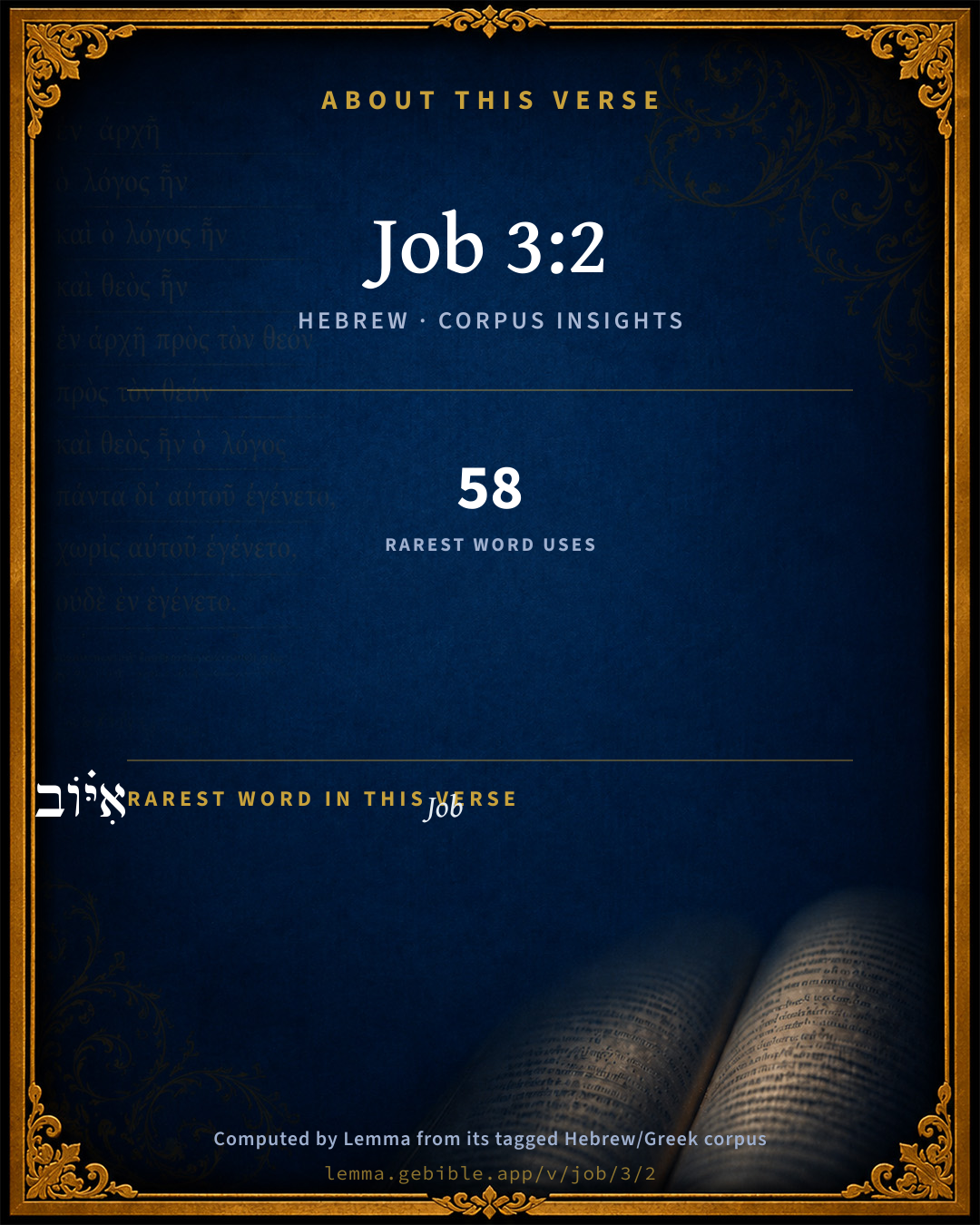
אִיּ֗וֹב Job H347 occurs in 52 verses of the Hebrew Bible. Also found in:

Grammatical profile

  • 2 verbs
  • 1 noun

Verb forms

  • וַיַּ֥עַן Qal · Sequential Imperfect
  • וַיֹּאמַֽר Qal · Sequential Imperfect

Hebrew & Septuagint length

In English translation the verse runs 2 words from the Hebrew and 1 from the Septuagint (LXX English) — closely comparable.

A rough comparison of the two English renderings, which tokenize alike — not a word-level alignment.

Word counts can differ between the Hebrew and the Greek without any difference in meaning — e.g. the Hebrew direct-object marker אֵת has no separate Greek word, and Greek often adds the article ὁ.

Hebrew and Greek witnesses Masoretic Hebrew ↔ Greek Septuagint

The same verse in the two great witnesses to the Old Testament, shown verse-for-verse.

These are two independent witnesses, not word-aligned to each other, and the Septuagint is shown in lemma (dictionary) form.

Hebrew Job 3:2 Masoretic · Westminster Leningrad Codex

וַיַּ֥עַן אִיּ֗וֹב וַיֹּאמַֽר

Job answered:

World English Bible · Public Domain

Greek LXX Job 3:2 Septuagint · lemma form

καί καταἀράομαι ὁ ἡμέρα αὐτός λέγω

saying,

LXX2012 (modern English Septuagint) · Public Domain

Hebrew: Westminster Leningrad Codex (CC BY 4.0). Greek: Septuagint (public domain); English from LXX2012 (modern English Septuagint) (Public Domain). How the Septuagint differs from the Hebrew →

Commentary

Notes on Job 3:2 from classic Christian and Jewish commentators (each source and its license shown beneath its notes). The classic Christian expositions comment on the surrounding passage and are grouped to its opening verse, so a note may address several verses; the Jewish commentaries on the Tanakh (Rashi and others) are per-verse, so they appear only where the commentator wrote on this verse.

Lemma curates 59 commentaries, every one of them public domain or Creative Commons licensed, each selected and text-cleaned for this edition rather than reprinted as found. About our sources →

Trapp's Complete Commentary

John Trapp

Job 3:2 And Job spake, and said,

Ver. 2. And Job spake, and said] Heb. Answered and said. Answered? Whom answered he? The Jewish doctors say, he answered his friends, who having hitherto said nothing to him, and heard as little from him, at length - rupere silentia voce, to destroy a silent voice, and asked him what he ailed? others more probably conceive that Job answered here to some dispute in his own mind, or rather with the devil. Some take this verse for a transition only. Others make it a preparation for Job’s future discourse, to move expectation, and win attention. The discourse indeed is all along, to Job 42:7, poetical, and very accurate, made up in hexameters (as Jerome holdeth), not by Job and his friends at the first uttering, but afterwards by Job at better leisure; or, as some think, by Moses whilst a shepherd in Midian, for the comfort of his poor countrymen in Egypt, Sic et Ionas orationem suam in ventre balaenae habitam, et David plerosque Psalmos, &c. Mercer saith that his predecessor Vatablus (as he had heard) had found out a way of scanning these hexameters to others unknown, and to all the more obscure, because the verse causeth a cloud. The first hexameter that ever was made in Greek is said to be this,

Sυμφερετε πτερατ οιωνοι κηρον τε μελισσαι.

Birds, bring your plumes, and bees, your wax at once.

John Trapp, A Commentary or Exposition upon All the Books of the Old and New Testament (1647–1656) — public domain. Text from a community e-Sword module.

Jamieson, Fausset & Brown

Robert Jamieson, A. R. Fausset & David Brown

spake--Hebrew, "answered," that is, not to any actual question that preceded, but to the question virtually involved in the case. His outburst is singularly wild and bold (Jer 20:14). To desire to die so as to be free from sin is a mark of grace; to desire to die so as to escape troubles is a mark of corruption. He was ill-fitted to die who was so unwilling to live. But his trials were greater, and his light less, than ours.

Jamieson, Fausset & Brown — Commentary Critical and Explanatory on the Whole Bible (1871) — public domain (CC PDM 1.0). Text via the HelloAO Bible API.

John Gill's Exposition

And Job spake, and said. Or "answered and said" (t), though not a word was spoken to him by his friends; he answered to his own calamity, and to their silence, as Schmidt observes; and this word is sometimes used when nothing goes before, to which the answer is, as many Jewish writers observe, as in Exo 32:27; Jarchi interprets it, "he cried", and so some others (u) render it: from henceforwards to Job 42:6, this book is written in a poetical style, in Hebrew metre as is thought, which at present is pretty much unknown, even to the Jews themselves; some have been of opinion, that the following discourses between Job and his friends were not originally delivered in metre, but were put into this form by the penman or writer of the book; but of this we cannot be certain; in the Targum in the king of Spain's Bible it is, "and Job sung and said".

(t) "et respondit", Pagninus, Montanus, Schmidt, Schultens, Michaelis. (u) "Clamavitquo", Mercerus; "nam proloquens", Junius & Tremellius, Piscator.

John Gill's Exposition of the Whole Bible (1746–1763) — public domain (CC PDM 1.0). Text via the HelloAO Bible API.

Albert Barnes' Notes on the Bible

And Job spake - Margin, as in Hebrew, “answered.” The Hebrew word used here ענה ‛ânâh “to answer,” is often employed when one commences a discourse, even though no question had preceded. It is somewhat in the sense of replying to a subject, or of speaking in a case where a question might appropriately be asked; Isa. 14:l0 (Hebrew), Zec 3:4; Deu 26:5 (Hebrew), Deu 27:14 (Hebrew). The word “to answer” ἀποκρίνομαι apokrinomai is frequently used in this way in the New Testament; Mat 17:4, Mat 17:17; Mat 28:5; Mar 9:5; Mar 10:51, et al.

Albert Barnes' Notes on the Bible (1834–1885) — public domain. Text from a community e-Sword/MySword module.

Whedon's Commentary on the Bible

Daniel D. Whedon

2. Job spake — Hebrew, answered. Not their words, but their thoughts, as he had divined them. Or it may have respect to the occurrences of the last seven days (Comp. Mat_11:25.) Umbreit regards the word as intensive, and intended to increase the force of the following word.

Daniel D. Whedon (gen. ed.), Commentary on the Old and New Testaments (1874–1909) — public domain. Text from a community e-Sword module.

The Pulpit Commentary

Vers. 2, 3. And Job spake, and said, Let the day perish wherein I was born. An idle wish, doubtless; the vague utterance of extreme despair. Days cannot perish, or, at any rate, one day cannot perish more than another. They all come, and then are gone; but no day can perish out of the year, which will always have its full complement of three hundred and sixty-five days till time shall be no more. But extreme despair does not reason. It simply gives utterance to the thoughts and wishes as they arise. Job knew that many of his thoughts were vain and foolish, and confesses it further on. (see Job_6:3) And the night in which it was said; rather, which said. Day and night are, both of them, personified, as in Psa_19:2. There is a man child conceived. A man child was always regarded in the ancient world as a special blessing, since thus the family was maintained in being. A girl passed into another family.

The Pulpit Commentary (1880–1919), ed. H.D.M. Spence-Jones & Joseph S. Exell — public domain. Text from a community e-Sword module.

Rashi

Rabbi Shlomo Yitzchaki (Rashi)

Job’s AddressNow Job raised his voice Heb. ויען, he cried out, for every expression of עניה in the Torah is only an expression of raising the voice, and the “father” of them all is (Deut. 27:14): “The Levites shall raise their voices (וענו) etc. with a loud voice.”

Rashi on the Tanakh — English translations: “The Judaica Press complete Tanach with Rashi, translated by A. J. Rosenberg” (CC BY 4.0); “Pentateuch with Rashi's commentary by M. Rosenbaum and A.M. Silbermann, 1929-1934” (public domain); “The Metsudah Tanach series, Lakewood, N.J” (CC BY 4.0); and “The Book of Joshua, Metsudah Publications, 1997” (CC BY 4.0). Text via Sefaria.

Lesson kit

Teaching starters — assembled from the data on this page, not authored interpretation. Every prompt links to the verse data it draws on. Edit before teaching.

Job, in the Wisdom, opens this verse with 3 words (3 distinct Hebrew lemmas). Its most distinctive word is ʼÎyôwb (“Job”). A historical commentator’s framing appears above. Read the whole chapter for the surrounding context.

Discussion questions

  1. The word ʼÎyôwb carries the sense “Job.” How does it shape the verse?
  2. Job 1:1 shares the word «Job» with this verse. How do the two illuminate each other?
  3. These translations render this verse differently; the difference is in the English rendering, not the original. What questions does that raise?
  4. The verb «וַיַּ֥עַן» is Qal Sequential Imperfect. How does its form color the action?
  5. Reading how Trapp's Complete Commentary and Jamieson, Fausset & Brown read this verse, where do the two commentators agree and where do they part?

Things to notice

Reading settings

Reading text

Shown beneath each verse's original-language words.

Old Testament
Old Testament edition

Read the OT as the Masoretic Hebrew (MT) or the Greek Septuagint (LXX).

English shown for the Greek Septuagint (in the Hebrew ↔ Greek comparison).

Comparing translations? Open the Compare panel on any verse page to stack up to four side by side.