Deuteronomy 33:8

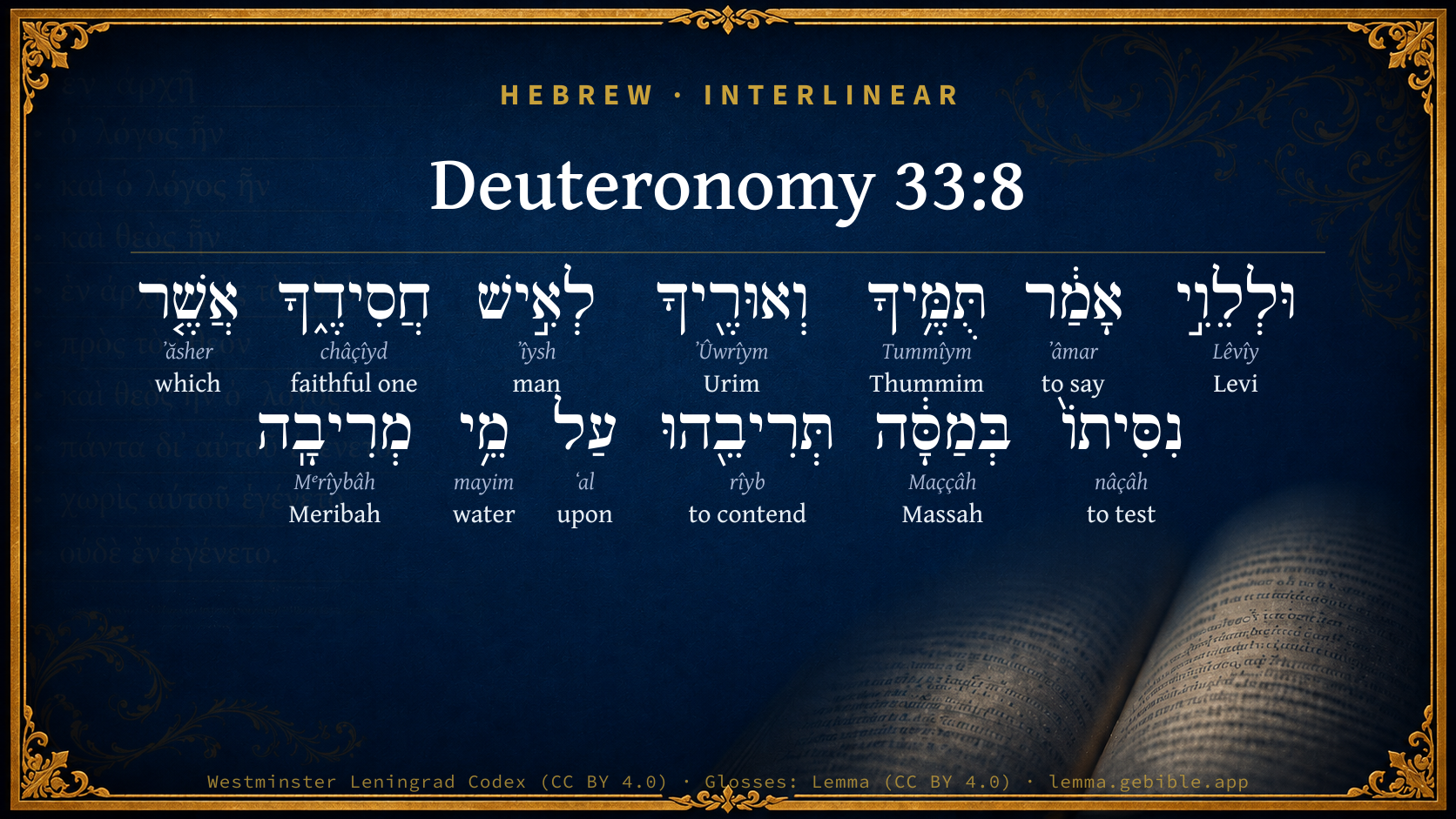
Hebrew (Westminster Leningrad Codex) Deuteronomy 33:8 appears in the Hebrew Old Testament. The text above is from the Westminster Leningrad Codex. Each word links to its Strong’s number, a concise gloss, and parsing drawn from the Open Scriptures Hebrew Bible morphology. Click any word for its full Brown-Driver-Briggs (BDB) entry.
Download image
Cite this verse

Deuteronomy 33:8 (World English Bible). Public Domain. Lemma interlinear Bible study tool, https://lemma.gebible.app/v/deuteronomy/33/8.

Show BibTeX & RIS
BibTeX
RIS
English Translation
Of Levi he said, Your Thummim and your Urim are with your godly one, Whom you did prove at Massah, With whom you did strive at the waters of Meribah;
World English Bible · Public Domain
Highlights
  • 1 first appearance in the Hebrew Bible
Full analysis ↓
Download a study sheet

One document with this verse’s original text, its word-by-word gloss line, the meaning frame, cross-references with their text, attributed commentary, and full source and license credits — printable, and it pastes into notes with its structure intact.

This verse Autodidact and up

Study sheet (.html) Plain text (.txt)

A passage Seminary Student

Up to 50 verses in one chapter. A passage sheet keeps up to 6 commentary sources and 12 cross-references per verse, in the order this page ranks them, and says so on the sheet whenever that leaves anything out. Ask for a single verse and you get the Autodidact verse sheet above.

Everything on this page stays free to read, with no account — the sheet is a download of what is already on screen, not access to it.

Want to remove ads? Support Godless Engineer
Compare translations 3

The same verse in 3 English versions, stacked beneath the original-language interlinear above. Click any original word for its lexicon entry.

Each is an independent rendering of the whole verse — the interlinear is not word-aligned to these translations.

Highlighted words mark where these versions differ — a whole-verse word diff, not a word-by-word alignment.

  • World English Bible Public Domain
    Of Levi he said, Your Thummim and your Urim are with your godly one, Whom you did prove at Massah, With whom you did strive at the waters of Meribah;
  • King James Version Public Domain
    And of Levi he said, Let thy Thummim and thy Urim be with thy holy one, whom thou didst prove at Massah, and with whom thou didst strive at the waters of Meribah;
  • unfoldingWord Literal Text CC BY-SA 4.0
    And to Levi, he said, “Your Thummim and your Urim are to your faithful man, whom you tested at Massah. You strove against him the waters of Meribah

unfoldingWord Literal Text — © unfoldingWord, licensed CC BY-SA 4.0. Word-aligned USFM3 via Door43 (git.door43.org/unfoldingWord/en_ult).

Versions to compare (up to 4)

3 of 4 selected

Show all 18 translations

Every available English version of this verse, each an independent rendering of the whole verse.

  • World English Bible Public Domain
    Of Levi he said, Your Thummim and your Urim are with your godly one, Whom you did prove at Massah, With whom you did strive at the waters of Meribah;
  • Berean Standard Bible Public Domain
    Concerning Levi he said: “Give Your Thummim to Levi and Your Urim to Your godly one, whom You tested at Massah and contested at the waters of Meribah.
  • Majority Standard Bible Public Domain
    Concerning Levi he said: “Give Your Thummim to Levi and Your Urim to Your godly one, whom You tested at Massah and contested at the waters of Meribah.
  • King James Version Public Domain
    And of Levi he said, Let thy Thummim and thy Urim be with thy holy one, whom thou didst prove at Massah, and with whom thou didst strive at the waters of Meribah;
  • American Standard Version (1901) Public Domain
    And of Levi he said, Thy Thummim and thy Urim are with thy godly one, Whom thou didst prove at Massah, With whom thou didst strive at the waters of Meribah;
  • Revised Version (1885) Public Domain
    And of Levi he said, Thy Thummim and thy Urim are with thy godly one, Whom thou didst prove at Massah, With whom thou didst strive at the waters of Meribah;
  • Geneva Bible (1599) Public Domain
    And of Leui he said, Let thy Thummim and thine Vrim be with thine Holy one, whome thou diddest proue in Massah, and didst cause him to striue at the waters of Meribah.
  • Douay-Rheims (1899) Public Domain
    To Levi also he said: Thy perfection, and thy doctrine be to thy holy man, whom thou hast proved in the temptation, and judged at the waters of contradiction:
  • Young's Literal Translation Public Domain
    And of Levi he said: -- Thy Thummim and thy Urim `are' for thy pious one, Whom Thou hast tried in Massah, Thou dost strive with Him at the waters of Meribah;
  • Literal Standard Version CC BY-SA 4.0
    And of Levi he said: Your Perfections and your Lights [are] for your pious one, || Whom You have tried in Massah, || You strive with him at the waters of Meribah;
  • Unlocked Literal Bible CC BY-SA 4.0
    About Levi, Moses said: Your Thummim and your Urim belong your loyal one, the one whom you tested at Massah, with whom you struggled at the waters of Meribah.
  • unfoldingWord Literal Text CC BY-SA 4.0
    And to Levi, he said, “Your Thummim and your Urim are to your faithful man, whom you tested at Massah. You strove against him the waters of Meribah
  • Darby Bible Public Domain
    And of Levi he said, Thy Thummim and thy Urim are for thy godly one, Whom thou didst prove at Massah, With whom thou didst strive at the waters of Meribah;
  • World Messianic Bible Public Domain
    About Levi he said, “Your Thummim and your Urim are with your godly one, whom you proved at Massah, with whom you contended at the waters of Meribah.
  • Webster's Bible Public Domain
    And of Levi he said, Let thy Thummim and thy Urim be with thy holy one, whom thou didst prove at Massah, and with whom thou didst strive at the waters of Meribah;
  • Free Bible Version CC BY-SA 4.0
    To Levi he said: “Your Thummim were given to Levi and your Urim to those dedicated to God, the ones you tested at Massah and argued with at the waters of Meribah.
  • Bible in Basic English Public Domain
    And of Levi he said, Give your Thummim to Levi and let the Urim be with your loved one, whom you put to the test at Massah, with whom you were angry at the waters of Meribah;
  • JPS Tanakh (1917) Public Domain
    And of Levi he said: Thy Thummim and Thy Urim be with Thy holy one, whom Thou didst prove at Massah, with whom Thou didst strive at the waters of Meribah;

Literal Standard Version (2020), Covenant Press — licensed CC BY-SA 4.0. Text via the HelloAO Bible API (eBible.org). Unlocked Literal Bible (unfoldingWord) — licensed CC BY-SA 4.0. Text via the HelloAO Bible API (eBible.org). unfoldingWord Literal Text — © unfoldingWord, licensed CC BY-SA 4.0. Word-aligned USFM3 via Door43 (git.door43.org/unfoldingWord/en_ult). Free Bible Version, Dr. Jonathan Gallagher — licensed CC BY-SA 4.0. Text via the HelloAO Bible API (eBible.org).

Word by word

More ways to search: Search by grammar → Find every occurrence → Compare this word →

Practice this passage: Drill this verse → Learn its vocabulary →

בְּמַסָּ֔ה
Maççâh
H4532
“in/at · Massah”
Preposition + Noun, Proper
Part of Speech
Preposition + Noun
Type
Proper
Full BDB Definition

Origin: the same as H4531

TWOT: None

Massah = "temptation" - the place in the wilderness where the Israelites tested Jehovah - also 'Meribah'
  1. וּלְלֵוִ֣י Lêvîy H3878 “and · to/for · Levi” Conjunction + Preposition + Noun, Proper
  2. אָמַ֔ר ʼâmar H559 “to say” Verb, Qal, Perfect, 3rd Person, Masculine, Singular
  3. תֻּמֶּ֥יךָ Tummîym H8550 “Thummim · your” Noun, Common, Masculine, Plural, Construct + Suffix, Personal, 2nd Person, Masculine, Singular
  4. וְאוּרֶ֖יךָ ʼÛwrîym H224 “and · Urim · your” Conjunction + Noun, Common, Masculine, Plural, Construct + Suffix, Personal, 2nd Person, Masculine, Singular
  5. לְאִ֣ישׁ ʼîysh H376 “to/for · man of” Preposition + Noun, Common, Masculine, Singular, Construct
  6. חֲסִידֶ֑ךָ châçîyd H2623 “faithful one · your” Adjective, Adjective, Masculine, Singular, Construct + Suffix, Personal, 2nd Person, Masculine, Singular
  7. אֲשֶׁ֤ר ʼăsher H834 “which” Particle, Relative
  8. נִסִּיתוֹ֙ nâçâh H5254 “to test · him” Verb, Piel, Perfect, 2nd Person, Masculine, Singular + Suffix, Personal, 3rd Person, Masculine, Singular
  9. תְּרִיבֵ֖הוּ rîyb H7378 “to contend · him” Verb, Qal, Imperfect, 2nd Person, Masculine, Singular + Suffix, Personal, 3rd Person, Masculine, Singular
  10. עַל ʻal H5921 “upon” Preposition
  11. מֵ֥י mayim H4325 “water(s) of” Noun, Common, Masculine, Plural, Construct
  12. מְרִיבָֽה Mᵉrîybâh H4809 “Meribah” Noun, Proper

About this verse

These counts appear in no published source. They are computed here, from the morphology-tagged text and Lemma’s own curated glosses. What Lemma adds →

13
words
13
distinct lemmas
Pentateuch
section

Notable vocabulary

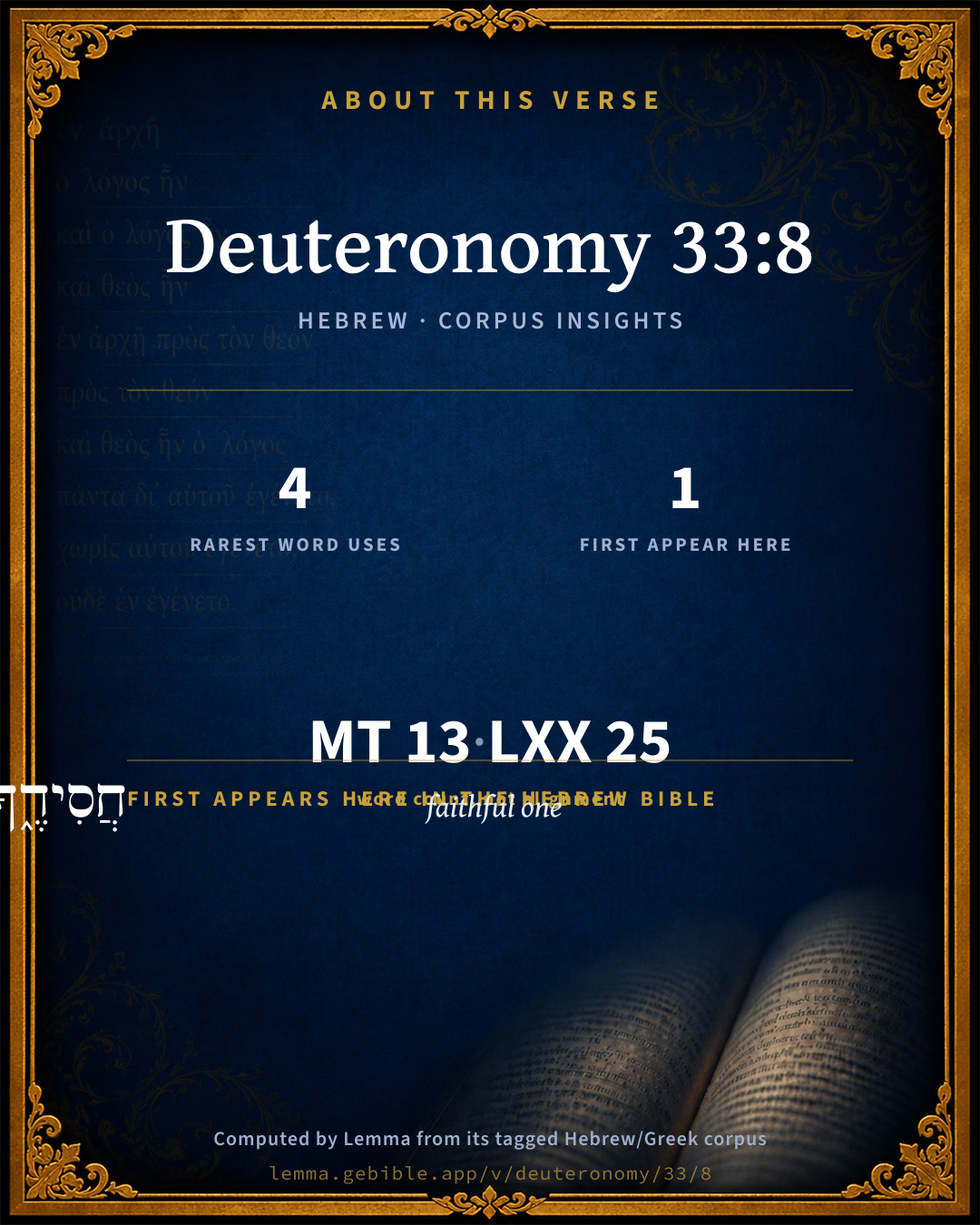
The rarest word here is בְּמַסָּ֔ה Massah H4532 — appearing just 4 times in the whole Hebrew Bible.

First appearance in Scripture

This word makes its first canonical appearance in the Hebrew Bible here:

  • חֲסִידֶ֑ךָ faithful one H2623

Shared distinctive vocabulary

בְּמַסָּ֔ה Massah H4532 occurs in 4 verses of the Hebrew Bible. Also found in:

Grammatical profile

  • 3 verbs
  • 7 nouns
  • 1 adjective
  • 1 preposition
  • 1 particle

Verb forms

  • אָמַ֔ר Qal · Perfect
  • נִסִּיתוֹ֙ Piel · Perfect
  • תְּרִיבֵ֖הוּ Qal · Imperfect

Hebrew & Septuagint length

In English translation the verse runs 30 words from the Hebrew and 31 from the Septuagint (LXX English) — closely comparable.

A rough comparison of the two English renderings, which tokenize alike — not a word-level alignment.

Word counts can differ between the Hebrew and the Greek without any difference in meaning — e.g. the Hebrew direct-object marker אֵת has no separate Greek word, and Greek often adds the article ὁ.

In the original languages it is 13 Hebrew tokens and 25 Greek tokens — but the two are counted differently (Hebrew bundles its prefixes and suffixes into one token; the Greek is in lemma form), so that isn’t a like-for-like length.

Cross-references

20

Topical passages linked to Deuteronomy 33:8 in the Treasury of Scripture Knowledge — connected by theme and wording, ordered by reader-vote popularity; previews shown in the World English Bible.

  • Exodus 17:7 He called the name of the place Massah, and Meribah, because the children of Israel quarreled, and because they tested Yahweh, saying, "Is Yahweh among us, or not?"
  • Exodus 28:30 You shall put in the breastplate of judgment the Urim and the Thummim; and they shall be on Aaron's heart, when he goes in before Yahweh: and Aaron shall bear the judgment of the children of Israel on his heart before Yahweh continually.
  • Numbers 20:13 These are the waters of Meribah; because the children of Israel strove with Yahweh, and he was sanctified in them.
  • Leviticus 8:8 He placed the breastplate on him; and in the breastplate he put the Urim and the Thummim.
  • Psalms 106:16 They envied Moses also in the camp, And Aaron, Yahweh's saint.
  • Exodus 28:36 "You shall make a plate of pure gold, and engrave on it, like the engravings of a signet, 'HOLY TO YAHWEH.'
  • Leviticus 21:7 "'They shall not marry a woman who is a prostitute, or profane; neither shall they marry a woman divorced from her husband: for he is holy to his God.
  • Numbers 16:5 and he spoke to Korah and to all his company, saying, In the morning Yahweh will show who are his, and who is holy, and will cause him to come near to him: even him whom he shall choose will he cause to come near to him.
  • Numbers 27:21 He shall stand before Eleazar the priest, who shall inquire for him by the judgment of the Urim before Yahweh: at his word shall they go out, and at his word they shall come in, both he, and all the children of Israel with him, even all the congregation.
  • Deuteronomy 8:2–3 You shall remember all the way which Yahweh your God has led you these forty years in the wilderness, that he might humble you, to prove you, to know what was in your heart, whether you would keep his commandments, or not.
  • Deuteronomy 8:16 who fed you in the wilderness with manna, which your fathers didn't know; that he might humble you, and that he might prove you, to do you good at your latter end:
  • 1 Samuel 28:6 When Saul inquired of Yahweh, Yahweh didn't answer him, neither by dreams, nor by Urim, nor by prophets.
  • 2 Chronicles 23:6 But let none come into the house of Yahweh, save the priests, and those who minister of the Levites; they shall come in, for they are holy: but all the people shall keep the charge of Yahweh.
  • Ezra 2:63 The governor said to them, that they should not eat of the most holy things, until there stood up a priest with Urim and with Thummim.
  • Ezra 8:28 I said to them, You are holy to Yahweh, and the vessels are holy; and the silver and the gold are a freewill-offering to Yahweh, the God of your fathers.
  • Nehemiah 7:65 The governor said to them, that they should not eat of the most holy things, until there stood up a priest with Urim and Thummim.
  • Psalms 16:10 For you will not leave my soul in Sheol, Neither will you allow your holy one to see corruption.
  • Psalms 81:7 You called in trouble, and I delivered you. I answered you in the secret place of thunder. I tested you at the waters of Meribah." Selah.
  • Hebrews 7:26 For such a high priest was fitting for us: holy, guiltless, undefiled, separated from sinners, and made higher than the heavens;
  • Revelation 3:7 "To the angel of the assembly in Philadelphia write: "He who is holy, he who is true, he who has the key of David, he who opens and no one can shut, and who shuts and no one opens, says these things:

Cross-references courtesy of OpenBible.info (CC BY 4.0).

Hebrew and Greek witnesses Masoretic Hebrew ↔ Greek Septuagint

The same verse in the two great witnesses to the Old Testament, shown verse-for-verse.

These are two independent witnesses, not word-aligned to each other, and the Septuagint is shown in lemma (dictionary) form.

Hebrew Deuteronomy 33:8 Masoretic · Westminster Leningrad Codex

וּלְלֵוִ֣י אָמַ֔ר תֻּמֶּ֥יךָ וְאוּרֶ֖יךָ לְאִ֣ישׁ חֲסִידֶ֑ךָ אֲשֶׁ֤ר נִסִּיתוֹ֙ בְּמַסָּ֔ה תְּרִיבֵ֖הוּ עַל מֵ֥י מְרִיבָֽה

Of Levi he said, Your Thummim and your Urim are with your godly one, Whom you did prove at Massah, With whom you did strive at the waters of Meribah;

World English Bible · Public Domain

Greek LXX Deuteronomy 33:8 Septuagint · lemma form

καί ὁ λευί εἶπον δίδωμι λευί δῆλος αὐτός καί ἀλήθεια αὐτός ὁ ἀνήρ ὁ ὅσιος ὅς πειράζω αὐτός ἐν πεῖρα λοιδορέω αὐτός ἐπί ὕδωρ ἀντιλογία

And to Levi he said, Give to Levi his manifestations, and his truth to the holy man, whom they tempted in the temptation; they reviled him at the water of strife.

LXX2012 (modern English Septuagint) · Public Domain

On this verse, The Cambridge Bible for Schools and Colleges discusses the Septuagint’s reading. Read the note in Commentary ↓

Hebrew: Westminster Leningrad Codex (CC BY 4.0). Greek: Septuagint (public domain); English from LXX2012 (modern English Septuagint) (Public Domain). How the Septuagint differs from the Hebrew →

Targum (Aramaic paraphrase)

2

The Targum is the ancient Jewish Aramaic paraphrase of the Hebrew Scriptures — an interpretive translation, not the Hebrew text itself. Onkelos (literal) and Pseudo-Jonathan (expansive) render the Torah, and Jonathan the Prophets. Coverage is partial: where no permissively-licensed English translation exists for a verse, only the Aramaic is shown. This is verse-level text, not a word-by-word alignment to the Hebrew.

  1. Targum Onkelos Torah (Genesis–Deuteronomy)
    וּלְלֵוִי אֲמַר תּוּמַיָא וְאוּרַיָא אַלְבֶּשְׁתָּא לִגְבַר דְאִשְׁתְּכַח חֲסִידָא קֳדָמָךְ דִי נַסִיתוֹהִי בְּנִסֵתָא וַהֲוָה שְׁלִים בְּחַנְתּוֹהִי עַל מֵי מַצוּתָא וְאִשְׁתְּכַח מְהֵימָן

    (no public-domain English translation for this verse)

    Targum Onkelos — Aramaic: “Onkelos Genesis” (public domain); “Onkelos Exodus” (public domain); “Onkelos Leviticus” (public domain); “Onkelos Numbers” (public domain); “Onkelos Deuteronomy” (public domain). English: “Sefaria Community Translation” (CC0 1.0 (public-domain dedication)); “J.W. Etheridge. The Targums of Onkelos and Jonathan Ben Uzziel on the Pentateuch. London: Longmans, Green, 1862” (public domain). Text via Sefaria.

  2. Targum Pseudo-Jonathan Torah (Genesis–Deuteronomy)
    וּלְשֵׁיבַט לֵוִי בְּרִיךְ משֶׁה נְבִיָא וַאֲמַר תּוּמַיָא וְאוּרַיָא אַלְבֵּישְׁתָּא לְאַהֲרן גְבַר דְאִשְׁתַּכַּח חָסִיד קֳדָמָךְ דִנְסֵית יָתֵיהּ בְּנִיסְתָא וַהֲוָה שְׁלִים בְּדַקְתֵּיהּ בְּמוֹי מַצוֹת רְקָם וְאִשְׁתַּכַּח מְהֵימָן

    And Mosheh the prophet blessed the tribe of Levi, and said, With Perfections and Lights hast Thou robed Aharon, the man whom Thou didst find devout before Thee, whom Thou didst try in the temptation, and he was sincere, and didst prove at the Contention Waters in Rekem, and he was found faithful.

    Targum Pseudo-Jonathan — Aramaic: “Targum Jonathan on Genesis” (public domain); “Targum Jonathan on Exodus” (public domain); “Targum Jonathan on Leviticus” (public domain); “Targum Jonathan on Numbers” (public domain); “Targum Jonathan on Deuteronomy” (public domain). English: “The Targum of Jonathan ben Uzziel, trans. J. W. Etheridge, London, 1862” (public domain). Text via Sefaria.

Commentary

Notes on Deuteronomy 33:8 from classic Christian and Jewish commentators (each source and its license shown beneath its notes). The classic Christian expositions comment on the surrounding passage and are grouped to its opening verse, so a note may address several verses; the Jewish commentaries on the Tanakh (Rashi and others) are per-verse, so they appear only where the commentator wrote on this verse.

Lemma curates 59 commentaries, every one of them public domain or Creative Commons licensed, each selected and text-cleaned for this edition rather than reprinted as found. About our sources →

Matthew Henry's Commentary

In blessing the tribe of Levi, Moses expresses himself more at large, not so much because it was his own tribe (for he takes no notice of his relation to it) as because it was God's tribe. The blessing of Levi has reference.

I. To the high priest, here called God's holy one (Deu 33:8), because his office was holy, in token of which, Holiness to the Lord was written upon his forehead. 1. He seems to acknowledge that God might justly have displaced Aaron and his seed, for his sin at Meribah, (Exo 17:7), which might be very remarkable, and which God might have an eye to in conferring the priesthood upon him, though no mention is made of it there. All the Chaldee paraphrasts agree that it was a trial in which he was found perfect and faithful, and stood in the trial; therefore not that, Num 20:2. He prays that the office of the high priest might ever remain: Let thy thummim and thy urim be with him. It was given him for some eminent piece of service, as appears, Mal 2:5. "Lord, let it never be taken from him." Notwithstanding this blessing, the urim and thummim were lost in the captivity, and never restored under the second temple. But this prayer has its full accomplishment in Jesus Christ, God's Holy One, and our great high priest, of whom Aaron was a type: with him who had lain in the Father's bosom from eternity the urim and thummim shall remain; for he is the wonderful and everlasting counsellor. Some translate the thummim and urim appellatively, the rather because the usual order is here inverted, and here only. Thummim signifies integrity, and Urim illumination: Let these be with thy holy one, that is, "Lord, let the high priest ever be both an upright man and an understanding man." A good prayer to be put up for the ministers of the gospel, that they may have clear heads and honest hearts; light and sincerity make a complete minister.

II. To the inferior priests and Levites, Deu 33:9-11.

1. He commends the zeal of this tribe for God when they sided with Moses (and so with God) against the worshippers of the golden calf (Exo 32:26 etc.), and, being employed in cutting off the ring-leaders in that wickedness, they did it impartially: the best friends they had in the world, though as dear to them as their next relations, they did not spare if they were idolaters. Note, Our regard to God and to his glory ought always to prevail above our regard to any creature whatsoever. And those who not only keep themselves pure from the common iniquities of the times and places in which they live, but, as they are capable, bear testimony against them, and stand up for God against the evil-doers, shall have special marks of honour put upon them. Perhaps Moses may have an eye to the sons of Korah, who refused to join with their father in his gain-saying, Num 26:11. Also to Phinebas, who executed judgment, and stayed the plague. And indeed the office of the priests and Levites, which engaged their constant attendance, at least in their turns, at God's altar, laid them under a necessity of being frequently absent from their families, which they could not take such care of, nor make such provision for, as other Israelites might. This was the constant self-denial they submitted to, that they might observe God's word, and keep the covenant of priesthood. Note, Those that are called to minister in holy things must sit loose to the relations and interests that are dearest to them in this world, and prefer the gratifying of the best friend they have, Act 21:13; Act 20:24. Our Lord Jesus knew not his mother and his brethren when they would have taken him off from his work, Mat 12:48.

2. He confirms the commission granted to this tribe to minister in holy things, which was the recompence of their zeal and fidelity, Deu 33:10. (1.) They were to deal for God with the people: "They shall teach Jacob thy judgments and Israel thy laws, both as preachers in thy religious assemblies, reading and expounding the law (Neh 8:7, Neh 8:8), and as judges, determining doubtful and difficult cases that were brought before them," Ch2 17:8, Ch2 17:9. The priests' lips kept this knowledge for the use of the people, who were to ask the law at their mouth, Mal 2:7. Even Haggai, a prophet, consulted the priests in a case of conscience, Hag 2:11, etc. Note, Preaching is necessary, not only for the first planting of churches, but for the preserving and edifying of churches when they are planted. See Eze 44:23, Eze 44:24. (2.) They were to deal for the people with God, in burning incense to the praise and glory of God, and offering sacrifices to make atonement for sin and to obtain the divine favour. This was the work of the priests, but the Levites attended and assisted in it. Those that would have benefit by their incense and offerings must diligently and faithfully observe their instructions.

3. He prays for them, Deu 33:11. (1.) That God would prosper them in their estates, and make that which was allotted them for their maintenance comfortable to them. Bless, Lord, his substance. The provision made for them was very plentiful, and came to them easily, and yet they could have no joy of it unless God blessed it to them; and, since God himself was their portion, a particular blessing might be expected to attend this portion. Bless, Lord, his virtue; so some read it. "Lord, increase thy graces in them, and make them more and more fit for their work." (2.) That he would accept them in their services: "Accept the work of his hands, both for himself and for the people for whom he ministers." Acceptance with God is that which we should all aim at, and be ambitious of, in all our devotions, whether men accept us or no (Co2 5:9), and it is the most valuable blessing we can desire either for ourselves or others. (3.) That he would take his part against all his enemies: Smite through the loins of those that rise against him. He supposes that God's ministers would have many enemies: some would hate their persons for their faithfulness, and would endeavour to do them a mischief; others would envy them their maintenance, and endeavour sacrilegiously to deprive them of it; others would oppose them in the execution of their office and not submit to the sentence of the priests; and some would aim to overthrow the office itself. Now he prays that God would blast all such attempts, and return the mischief upon the heads of the authors. This prayer is a prophecy that God will certainly reckon with those that are enemies to his ministers, and will keep up a ministry in his church to the end of time, in spite of all the designs of the gates of hell against it. Saul rose up against the Lord's priests (Sa1 22:18), and this filled the measure of his sin.

Matthew Henry's Commentary on the Whole Bible (1708–1710) — public domain (CC PDM 1.0). Text via the HelloAO Bible API.

Trapp's Complete Commentary

John Trapp

Deu 33:8 And of Levi he said, [Let] thy Thummim and thy Urim [be] with thy holy one, whom thou didst prove at Massah, [and with] whom thou didst strive at the waters of Meribah;

Ver. 8. Let thy Thummin and thy Urim.] Sincerity of life and soundness of doctrine. {See Trapp on "Exo 28:30"} There is great cause that ministers, of all men, should be much prayed for.

John Trapp, A Commentary or Exposition upon All the Books of the Old and New Testament (1647–1656) — public domain. Text from a community e-Sword module.

The Biblical Illustrator

Joseph S. Exell

Deu_33:8-11

And of Levi he said.

Levi

Levi was the third son of Jacob and Leah, and his name commemorated the desire and hope of his mother, that her husbands heart would be closely joined to her now that she had borne him three sons (Gen_29:34). The Hebrew word from which Levi is derived means to adhere, or to be closely joined. An undesigned prediction lay hid in the name thus given; for Levi was ordained by God to be the official link of union betwixt the whole nation of Israel and its spiritual Head. Through the Levitical priesthood the descendants of Jacob were to be joined unto God in a peculiar covenant; and this fact is distinctly connected with the meaning of Levis name by an inspired utterance recorded in Num_18:2. Yet, during the lifetime of Levi himself, this high spiritual destiny of his tribe could scarcely have been guessed; for this third son of Jacob was joined to his elder brother Simeon in deeds of violence and cruelty that drew upon them a common curse, which in Simeons case, as we have seen, made every blessing of the tribe impossible. The dying patriarch Israel, speaking by the spirit of prophecy, formally disinherited both these men from their natural share in the promised land of Canaan. They were to be divided and scattered (Gen_49:7). And this curse was never recalled in its terms, nor abolished in the case of Levi any more than it was in the case of Simeon; only the wonder working providence of God converted it into an occasion of blessing and honour for the one tribe, whilst leaving it in its original force of a punishment for the other tribe. The exclusion of the Levites from a landed inheritance, and their dispersion amongst the other tribes of Israel, became the highest tokens of the Divine favour towards them, and the means by which they were recognised as the channels of heavenly grace to all the nation. This remarkable change of a curse into a blessing deserves to be studied and remembered by those who are conscious of having brought themselves under the inevitable penalties of past wrong-doing. Those penalties cannot perhaps be recalled, but they can be converted into marvellous opportunities of good in a circle far wider than has been affected by the former evil. And for such a miracle of grace to be accomplished, it is only needful that human repentance and self-consecration should work together with the providence of heaven. (T. G. Rooke, B. A.)

Urim and Thummim

In the blessing of Levi by Moses, the usual order of these two mysterious words is reversed, and Thummim is put before Urim. There is probably a reason for this, namely, to suggest that Levis zeal for the right and perfect way of God, amid the general defection at Horeb, was his real title to the honourable office of interpreting Gods light and Gods truth from His holy oracles. This supreme devotion of himself to right was indeed the sole condition of his blessing and of the Divine election which it declared. (T. G. Rooke, B. A.)

The Biblical Illustrator, edited by Joseph S. Exell (c. 1880s–1900s) — public domain. Text from a community e-Sword module.

Joseph Benson's Commentary

Deu 33:8. Of Levi he said — Said to God in prayer. Let thy Thummim, &c. — That is, the Thummim and Urim which are thine, O Lord, by special institution and consecration, (understanding thereby the ephod, in which they were put, the high-priesthood to which they were appropriated, and withal the gifts and graces signified by them, and necessary for the discharge of that high office,) be with thy holy one — That is, with that priest whom thou hast consecrated to thyself, and who is holy in a more peculiar manner than the people are. He means let the family of Aaron perpetually retain the priesthood, and be endued with that uprightness in the discharge of their duty and that light and knowledge in divine things which are signified by the Thummim and Urim. Notwithstanding this blessing, the Urim and Thummim were lost in the captivity, and never restored under the second temple. But they have their full accomplishment in Jesus Christ, God’s Holy One, and our great High-Priest, of whom Aaron was but a type. With him, who had lain in the Father’s bosom from eternity, the Urim and Thummim shall ever remain, for he is the wonderful and everlasting Counsellor. Whom thou didst prove at Massah — That is, try and rebuke, but yet didst not take away the priesthood from him. With whom thou didst strive — Whom thou didst reprove and chastise. Le Clerc, however, refers these words to the people. Whom thou, O Israel, didst prove or tempt at Massah, and with whom thou didst strive, &c. — Which happened twice. See Exo 17:2, and Num 20:2. In both these places, it appears that Aaron was tempted, and tried, and strove against, by the people no less than Moses.

Joseph Benson's Commentary on the Old and New Testaments (1811–1818) — public domain. Text from a community e-Sword module.

Keil & Delitzsch

C. F. Keil & F. Delitzsch

Levi. - Deu 33:8, Deu 33:9. "Thy right and Thy light is to Thy godly man, whom Thou didst prove in Massah, and didst strive with him at the water of strife; who says to his father and his mother, I see him not; and does not regard his brethren, and does not know his sons: for they observed Thy word, and kept Thy covenant." This blessing is also addressed to God as a prayer. The Urim and Thummim - that pledge, which the high priest wore upon his breast-plate, that the Lord would always give His people light to preserve His endangered right (vid., Exo 28:29-30), - are here regarded as a prerogative of the whole of the tribe of Levi. Thummim is placed before Urim, to indicate at the outset that Levi had defended the right of the Lord, and that for that very reason the right of the Urim and Thummim had been given to him by the Lord. "Thy holy one" is not Aaron, but Levi the tribe-father, who represents the whole tribe to which the blessing applies; hence in Deu 33:9 and Deu 33:10 the verb passes into the plural. To define more precisely the expression "Thy holy one," reference is made to the trials at Massah and at the water of strife, on the principle that the Lord humbles His servants before He exalts them, and confirms those that are His by trying and proving them. The proving at Massah refers to the murmuring of the people on account of the want of water at Rephidim (Exo 17:1-7, as in Deu 6:16 and Deu 9:22), from which the place received the name of Massah and Jeribah; the striving at the water of strife, to the rebellion of the people against Moses and Aaron on account of the want of water at Kadesh (Num 20:1-13). At both places it was primarily the people who strove with Moses and Aaron, and thereby tempted God. For it is evident that even at Massah the people murmured not only against Moses, but against their leaders generally, from the use of the plural verb, "Give ye us water to drink" (Exo 17:2). This proving of the people, however, was at the same time a proof, to which the Lord subjected the heads and leaders of the nation, for the purpose of trying their faith. And thus also, in Deu 8:2., the whole of the guidance of Israel through the desert is described as a trial and humiliation of the people by the Lord. But in Moses and Aaron, the heads of the tribe of Levi, the whole of the tribe of Levi was proved. The two provings by means of water are selected, as Schultz observes, "because in their correlation they were the best adapted to represent the beginning and end, and therefore the whole of the temptations."

Deu 33:9-11

In these temptations Levi had proved itself "a holy one," although in the latter Moses and Aaron stumbled, since the Levites had risen up in defence of the honour of the Lord and had kept His covenant, even with the denial of father, mother, brethren, and children (Mat 10:37; Mat 19:29). The words, "who says to his father," etc., relate to the event narrated in Exo 32:26-29, where the Levites draw their swords against the Israelites their brethren, at the command of Moses, after the worship of the golden calf, and execute judgment upon the nation without respect of person. To this we may add Num 25:8, where Phinehas interposes with his sword in defence of the honour of the Lord against the shameless prostitution with the daughters of Moab. On these occasions the Levites manifested the spirit which Moses predicates here of all the tribe. By the interposition at Sinai especially, they devoted themselves with such self-denial to the service of the Lord, that the dignity of the priesthood was conferred upon their tribe in consequence. - In Deu 33:10 and Deu 33:11, Moses celebrates this vocation: "They will teach Jacob Thy rights, and Israel Thy law; bring incense to Thy nose, and whole-offering upon Thine altar. Bless, Lord, his strength, and let the work of his hands be well-pleasing to Thee: smite his adversaries and his haters upon the hips, that they may not rise!" The tribe of Levi had received the high and glorious calling to instruct Israel in the rights and commandments of God (Lev 10:11), and to present the sacrifices of the people to the Lord, viz., incense in the holy place, whole-offering in the court. "Whole-offering," a term applied to the burnt-offering, which is mentioned instar omnium as being the leading sacrifice. The priests alone were actually entrusted with the instruction of the people in the law and the sacrificial worship; but as the rest of the Levites were given them as assistants in their service, this service might very properly be ascribed to the whole tribe; and no greater blessing could be desired for it than that the Lord should give them power to discharge the duties of their office, should accept their service with favour, and make their opponents powerless. The enemies and haters of Levi were not only envious persons, like Korah and his company (Num 16:1), but all opponents of the priests and Levites. The loins are the seat of strength (Psa 69:24; Job 40:16; Job 31:1; 17). This is the only place in which מן is used before a finite verb, whereas it often stands before the infinitive (e.g., Gen 27:1; Gen 31:29).

Keil & Delitzsch — Biblical Commentary on the Old Testament (1861–1891) — public domain (CC PDM 1.0). Text via the HelloAO Bible API. (Old Testament only.)

Tyndale Open Study Notes

Tyndale Open Resources

33:8 Levi was Jacob’s third son by Leah (Gen 29:34). The Levites, particularly those descended from Aaron, were entrusted with the priesthood (see Exod 28:1; 32:29; Num 3:9). • Thummim and Urim were precious stones embedded in or suspended from the breastpiece of the ephod, a garment worn by the chief priest. These stones could be consulted to determine God’s will. Their names may be translated “perfections” and “lights,” respectively (see study note on Exod 28:30). • Massah means “[place of] testing,” referring to an incident when the people ran out of water and tested the Lord (see study note on Deut 6:16; Exod 17:1-7). • Meribah means “[place of] contention,” referring to another occasion when the people of Israel fought with the Lord until he brought them water from a rock (Num 20:13, 24).

Tyndale Open Study Notes — © Tyndale Open Resources, licensed CC BY-SA 4.0. Text via the HelloAO Bible API.

Jamieson, Fausset & Brown

Robert Jamieson, A. R. Fausset & David Brown

of Levi he said--The burden of this blessing is the appointment of the Levites to the dignified and sacred office of the priesthood (Lev 10:11; Deu 22:8; Deu 17:8-11), a reward for their zeal in supporting the cause of God, and their unsparing severity in chastising even their nearest and dearest relatives who had participated in the idolatry of the molten calf (Exo 32:25-28; compare Mal 2:4-6).

Jamieson, Fausset & Brown — Commentary Critical and Explanatory on the Whole Bible (1871) — public domain (CC PDM 1.0). Text via the HelloAO Bible API.

Adam Clarke's Commentary

Verse 8. Of Levi he said] Concerning the Urim and Thummim, See Clarke on Ex 28:30.

Thy holy one] Aaron primarily, who was anointed the high priest of God, and whose office was the most holy that man could be invested with. Therefore Aaron was called God's holy one, and the more especially so as he was the type of the MOST HOLY and blessed Jesus, from whom the Urim - all light and wisdom, and Thummim - all excellence, completion, and perfection, are derived.

Whom thou didst prove, c.] God contended with Aaron as well as with Moses at the waters of Meribah, and excluded him from the promised land because he did not sanctify the Lord before the people.

From the words of St. Paul, 1Co 10:8-12, it is evident that these words, at least in a secondary sense, belong to Christ. He is the Holy One who was tempted by them at Massah, who suffered their manners in the wilderness, who slew 23,000 of the most incorrigible transgressors, and who brought them into the promised land by his deputy, Joshua, whose name and that of Jesus have the same signification.

Adam Clarke's Commentary on the Bible (1810–1826) — public domain. Text from a community e-Sword/MySword module.

Ellicott's Commentary for English Readers

(8) And of Levi.—Next to Joseph, this tribe has the largest share in Moses’ last words, as we might naturally expect, it being his own tribe. The character of the priest is the principal subject. The blessing may be thus paraphrased: “Let thy Thummim and thy Urim (the chief high-priestly ornaments) be ever with some saintly man of thine, like him whom thou (Israel) didst tempt in Massah, and with whom thou didst strive at the waters of Meribah (Moses’ own departed brother Aaron is alluded to, for the people murmured against them both in both places), like him (Eleazar or Phinehas) who said to his father and to his mother, ‘I have not seen him,’ &c. These are the priests that shall teach Jacob thy judgments and Israel thy law.” The conduct of the tribe of Levi at Sinai is alluded to, when they stood by Moses and slew the idolaters. Who headed them on that occasion we are not told. Eleazar or Phinehas may be intended. The conduct of Phinehas (in Numbers 25) is also a case in point. As Rashi observes, “his father and his mother, his brethren and children” cannot be taken literally, because the tribe of Levi on the whole was faithful. The fathers, mothers, brethren, and children chiefly belonged to the other tribes.

Let thy Thummim and thy Urim.—See Exo_28:30. “Thy Thummim and thy Urim” may refer to Israel, or to Levi, or to Jehovah Himself. In the last case, He must be thought to have tried Levi at Massah, and striven with Moses and Aaron at the waters of Meribah. It is not at all easy to distribute the pronouns with certainty in this speech.

If the writer of Deuteronomy was unconscious of any difference between priest and Levite, how is the mention of Urim and Thummim to be explained?

A Bible Commentary for English Readers, edited by Charles John Ellicott (1878–1897) — public domain. Text from a community e-Sword module.

The Cambridge Bible for Schools and Colleges

gen. ed. J. J. S. Perowne

8. The children of the third generation … shall enter the congregation] Jer_36:14 mentions a man under King Jehoiakim called Yehudi, i.e. Jew, whose great-grandfather was called Kushi, i.e. Egyptian, and whose father and grandfather had names derived from the name of Israel’s God.

9–14 (10–15). Of the Holiness of the Camp

In camp Israel shall avoid every evil (Deu_33:9). If a man suffer from pollution he must leave the camp till evening, bathe and then return (Deu_33:10 f.). There shall be a place outside for natural needs, where a man shall cover with earth what comes from him (Deu_33:12 f.); Israel’s God, who walketh the camp, must not see shameful things (Deu_33:14).—In the Sg. address, like other laws of War, Deu_20:1-19 f., Deu_21:10-14, and with the same form of opening, and appeal to the same sacred reason.

The reason is D’s own, in his language, but the ideas behind the law were primitive: either, as in the case of the first, sexual uncleanness as a disqualification for service—already in practice in Israel (1Sa_21:5, 2Sa_11:11); or, as in the case of the second, the danger of leaving one’s excrement exposed, as though it might be used in magic against one (Frazer, Golden Bough, i. 327 f.; Schwally, Kriegsalterthümer, 61 f., 67). See further note introd. to ch. 20. This law is therefore possibly an earlier one, adapted and partly transformed by D. See below on Deu_33:14. A parallel in P, Num_5:1-4. For Brahminical laws for the same occasions see Beauchamp’s edition of Dubois, Hindu Manners, etc.,2 239 ff.

8 And of Levi he said:—

Give Leví Thy Thummím,

Thine Urím to the man of Thy grace,

Whom Thou didst prove at Probation

And strive with (?) at Waters-of-Strife;

9 Who said of his father and mother,

I do not regard them;

Nor avowed he his brothers,

Nor acknowledged his sons;

But Thine oracles they kept,

And guarded Thy covenant.

10 They deliver Thy judgements to Jacob,

And Thy law to Israel;

They set up smoke in Thy nostrils,

Holocausts up on Thine altar.

11 Bless Thou his service, O Lord,

And accept the work of his hands!

Shatter his opponents’ loins,

And his haters past their opposing.

8. Thy Thummim, etc.] This line is overloaded and has no parallel. Prefix (with LXX) Give Levi, and the result is two parallel lines of 3 + 3 or 3 + 2 as above.

Thummim and Urim] In inverse order from other records of them in the O.T.:—1Sa_14:41 (LXX); P, Exo_28:30, Lev_8:8; Ezr_2:63, Neh_7:65. They were the two sacred lots used by the priest in giving decisions. See Dri.’s full note, Exod. 313 f.

thy godly one] Cp. LXX τῷ ἀνδρὶ τῷ ὁσίῳ; Heb. ’ish hasîdĕka, the man who showed thee ḥesed or true love; or, more probably from the context, to whom thou didst show ḥesed. It is possible to render to the men of him to whom thou, etc., i.e. Levi or Moses or Aaron. The emendation ḥasdĕka or ḥasadĕka, of thy grace, is attractive (Ball).

Whom thou didst prove at Massah, etc.] It is difficult if not impossible to harmonise this couplet with the stories of what happened at Massah = Probation and at Merîbah = Strife as told by JE, Exo_17:1 b–7, and JP, Num_20:2-13 (cp. above Deu_6:16, Deu_9:22, Deu_32:51).

For at Massah the people is said to have striven with Moses and to have tempted or proved Jehovah; and at Meribah to have striven with Moses and Aaron for bringing them into the desert and with Jehovah Himself, who gave them water but blamed Moses and Aaron for want of faith. Here on the other hand it is Jehovah who proves, and contends with Levi, the tribe, who are not mentioned in the above narratives. It is possible to argue, however, that what happened at, Massah was God’s proving of Moses by means of a critical situation; and that at Meribah He did in His providence strive or debate with Moses and Aaron by similarly critical circumstances (cp. Psa_81:7); and therefore that this couplet is a possible, if free, interpretation of the above narratives. In that case we may take its relative, whom, and thy godly one of the previous line either as meaning Moses or Aaron or the whole tribe as represented by them. There would remain the discrepancy that while this ‘Blessing’ implies that Levi issued successfully from the proof and strife put upon them by God; P, Num_20:12 f., records the failure of the faith of Moses and Aaron. Calvin seeks to remove this by regarding our couplet as ‘added by way of exception … Moses magnifies God’s mercy by this allusion in that He dignified Aaron with so great an honour, notwithstanding his having been overcome with impatience and fallen’; and he quotes the analogy of Christ’s call to Peter to feed His sheep after Peter had thrice denied Him (Joh_21:15-17).

Others explain the couplet as referring to a proof of the tribe Levi not recorded elsewhere (yet cp. Exo_32:26 ff.). Others (e.g. Wellh. Hist. 184, Steuern.) translate for whom (instead of with whom) Thou didst strive—whom Thou didst champion, i.e. by giving them the power to bring forth water from the desert rocks. Yet it is also possible to read the vb as a Hiphil, whom Thou causedst to strive or whom Thou broughtest into strife.

The Cambridge Bible for Schools and Colleges (gen. ed. J. J. S. Perowne; Cambridge University Press, 1878–1918) — public domain. Text from a community e-Sword module.

John Gill's Exposition

Who said unto his father and to his mother, I have not seen him,.... Which some understand of the high priests who were of this tribe, and according to the law were not to defile themselves, or mourn for a father or mother, Lev 21:11; or rather, as others, of their having no respect to them in judgment, but determining all causes that came before them according to the law of God, and the rules of justice and equity, in the most impartial manner, without having any regard to the nearest relations to them: with this compare what Christ the antitype of Levi says, in Mat 12:49,

neither did he acknowledge his brethren, nor knew his own children; had no respect to persons in judgment, though ever so nearly related: many restrain this to the affair of the golden calf, when the tribe of Levi gathered together, girded their swords on their thighs, and slew every man his brother, companion, and neighbour, guilty of that idolatry, Exo 32:26,

for they have observed thy word, and kept thy covenant; the law of God, spoken by him, and had the nature of a covenant with the people of Israel: this the tribe of Levi observed, not only what respects the worship of God, and the contrary to it, idolatry, but all other moral and religious duties; Christ fulfilled the whole law, and did always and all things what pleased the Lord, Joh 8:29.

John Gill's Exposition of the Whole Bible (1746–1763) — public domain (CC PDM 1.0). Text via the HelloAO Bible API.

Albert Barnes' Notes on the Bible

Thy holy one - i. e., Levi, regarded as the representative of the whole priestly and Levitical stock which sprang from him. The contrast between the tone of this passage and that of Gen 49:5-7 is remarkable. Though the prediction of Jacob respecting the dispersion of this tribe held good, yet it was so overruled as to issue in honor and reward. The recovery of God’s favor is to be traced to the faithfulness with which Moses and Aaron, who came of this tribe, served God in their high offices; and to the zeal and constancy which conspicuous persons of the tribe (e. g. Phinehas, Num 25:11 ff), and the whole tribe itself (compare Exo 32:26), manifested on critical occasions in supporting the leaders of the people. The same reasons led to Levi’s being selected for the special service of God in the sanctuary (Deu 10:8 ff, and Num 8:5 ff); and for the office of instructing their brethren in the knowledge of the Law. The events at Massah and Meribah, the one occurring at the beginning, the other toward the end, of the forty years’ wandering, serve to represent the whole series of trials by which God proved and exercised the faith and obedience of this chosen tribe.

Albert Barnes' Notes on the Bible (1834–1885) — public domain. Text from a community e-Sword/MySword module.

Haydock's Catholic Bible Commentary

Holy man. Aaron and his successors in the priesthood. (Challoner) --- They were adorned with the Urim and Thummim, which are here rendered perfection and doctrine. (Calmet) --- Septuagint, "give to Levi his insignia, (delous) and his truth, to the holy man, the same whom they tried at the temptation, they spoke ill of him at the waters," &c. It was in consequence of the seditious conduct of the Israelites that the two brothers betrayed a want of confidence in God, and were excluded from the land of promise, as Moses often reminds them, chap. iii. 26. (Haydock) --- Temptation. The place which goes by this name is at Raphidim, near Horeb, Exodus xvii. 6. But the word here probably includes all the other places, where the Hebrews tempted God, and particularly that, where so holy a man as Aaron was permitted to fall. (Calmet) (Numbers xx. 12.) --- The priesthood is the peculiar blessing and honour of the tribe of Levi. (Menochius)

George Leo Haydock (1774–1849), Haydock's Catholic Family Bible and Commentary, 1859 edition — public domain. Excludes Psalms (Douay-Rheims chapter numbering differs from Protestant) and Deuterocanonical books (Catholic canon only).

Matthew Poole's English Annotations

Thy Thummim and thy Urim be with thy holy one; the Thummim and the Urim, which are thine, O Lord, by special institution and consecration; by which he understands the ephod, in which they were put, Exo 28:30, by a synecdoche, and the high priesthood, to which they were appropriated, by a metonymy; and withal the gifts and graces signified by the Urim and Thummim, and necessary for the discharge of that high office, shall be with thy holy one, i.e. with that Levite, that priest, which thou hast consecrated to thyself, and which is holy in a more peculiar manner than all the people were, i.e. the priesthood shall be confined to and continued in Aaron’s family.

Whom thou didst prove: this seems added by way of anticipation; although thou didst try him, and rebuke him, and shut him out of Canaan for his miscarriage about fetching water out of the rock, yet thou didst not therefore take away the priesthood from him.

At Massah; not at that Massah mentioned Exo 17, which is also called

Meribah, where neither Moses nor Aaron are reproved, nor is Aaron so much as named, but at that other Meribah, Num 20, where this is expressed, which as it is called by one of the names of that place, Exo 17, to wit, Meribah, Num 20, so it may be here called by its other name, Massah; and well may the same names be given to those two places, because the occasion of them was in a great measure one and the same. Though this place may be otherwise rendered, whom thou didst try in trying, or with trial, i.e. whom thou didst exactly and thoroughly try, such repetitions being very frequent and elegant in the Hebrew language. And it may be observed, that in the Hebrew text here are two several prepositions, though the English translation render them both by at, here beth, in or with, and in the next branch al, at, or near, or concerning the waters of Meribah; which may seem to intimate that the former is not the name of the place, as the latter is: why else should they not have been expressed by the same preposition?

With whom thou didst strive, or, contend, i.e. whom thou didst reprove and chastise, as that phrase signifies, Isa 49:25; Jer 2:9.

Matthew Poole's English Annotations on the Holy Bible (1683–1685) — public domain. Text from a community e-Sword/MySword module.

Whedon's Commentary on the Bible

Daniel D. Whedon

8-11. Of Levi he said — This is also addressed to Jehovah as a prayer.

“Thy Thummim and thy Urim,

Thy right and thy light.”

For Thummim and Urim see what is said in Exo_28:30, and Lev_8:8.

Thy holy one — Moses and Aaron were the noblest members of the tribe of Levi. With almost unwavering steadfastness they had served Jehovah through the wilderness wandering. Aaron, as high priest, is referred to as the holy one. In Psa_106:16, he is called Jehovah’s holy one. Although Aaron is no longer living when Moses pronounces the benediction on the tribes, he may be considered as the representative of the high priesthood. And in one sense he may be deemed the representative of the tribe.

Massah — Comp. Exo_17:1-7.

Meribah — Comp. Num_20:1-13. The reference to these two places favours the idea that a real person is referred to in the expression thy holy one, namely, Jehovah.

Daniel D. Whedon (gen. ed.), Commentary on the Old and New Testaments (1874–1909) — public domain. Text from a community e-Sword module.

The Pulpit Commentary

Vers. 8-11. The blessing on Levi is also in the form of a prayer. In Jacob"s blessing, Simeon is joined with Levi, but Moses passes him over altogether, probably because, as Jacob foretold, he was to be scattered among his brethren, (Gen_49:7) and so lose his tribal individuality. Simeon, however, is included in the general blessing pronounced on Israel; and as this tribe received a number of towns within the territory of Judah, (Jos_19:2-9) it was probably regarded as included in the blessing on that tribe. Thy Thummim and thy Urim; thy Right and thy Light. (cf. Exo_28:30) The high priest wore the breast-plate on which these were placed when he went in before the Lord; and this is here represented as the prerogative of the whole tribe. Thy holy one; i.e. Levi, the tribe-father, representing the whole tribe to which the blessing applies; hence in the following verses the verb passes into the plural. For "holy one," it would be better to read "pious" or "godly one;" literally, the man thy pious one. Some would render "the man thy favored one," or "the man of thy friendship;" but this is wholly arbitrary, the word (dysij) has no such meaning. To explain this more particularly, reference is made to the trials at Massah and the waters of Meribah (strife), when the people rebelled and murmured against Moses and Aaron, whereby the piety of these men was put to the test, and in them, the heads of the tribe of Levi, the whole tribe was proved. (On Massah, see Exo_17:1-7; and on the waters of strife, see Num_20:1-13) In these trials, Levi had proved himself faithful and godly, having risen up in defense of the honor of Jehovah, and in support of his covenant, though in the latter case both Moses and Aaron stumbled. Who said unto his father and to his mother, etc. This refers to what is narrated in Exo_32:26-29, when the Levites drew their swords against their brethren at the command of Moses, to execute judgment without respect of person, because of the sin of the people in the matter of the golden calf. (of also Num_25:8, and, for the principle here implicitly commended, see Mat_10:37 Mat_19:29; Luk_14:26) Because of their zealous devotion to the claims and service of the Lord, the dignity of the priesthood had been conferred on this tribe; and to them belonged the high office of being instructors of the people in Divine things, and of presenting the sacrifices of the people to the Lord. For those entrusted with such an office, nothing was more to be desired than that they should be blessed with power rightly to discharge the duties of their office, that their service should be accepted with favor, and that their enemies and haters should be foiled and rendered impotent; and for this Moses prays on their behalf.

Vers. 8-11. The blessing of Levi; or, entire devotion to God a necessary qualification for ministerial service.

Moses and Aaron were themselves of the tribe of Levi. Consequently, Moses is here speaking of his own tribe; he forecasts its future; he seems in a remarkable manner to revoke the harsh sentence of the patriarch Jacob upon it. Nor is this altogether unaccounted for. The tribe had manifested a genuine repentance by a remarkable zeal for God"s honor on several occasions. It was the tribe, moreover, which God had selected from the rest, to minister in holy things; and these facts, blending themselves with a painful reminiscence of his own breakdown at Meribah, give the character to the blessing of Moses. The points therein which furnish a basis for historic and homiletic teaching are these:

1. Here is an office divinely appointed and assigned to a particular tribe holy one" (ver. 8).

2. Here is a history, in some sort chequered and sad, connected with the tribe (ver. 8) "Meribah". (Num_20:1-13) There had been a grievous failure on Aaron"s part too, as well as on that of Moses. (Exo 32:, Exo_32:33) Still, as a whole, the tribe had been marked by great zeal for God, great concern for his honor, and great devotion to his service. (ver. 9; cf. Num_8:14-26 Num_25:1-15; Exo_32:26-28) The honor of God was deemed by this tribe paramount to all personal and family considerations.

3. Here is a commission for the discharge of varied duties resting on the tribe (ver. 10) teaching, incense, sacrifice. (see Deu_10:8; Mal_2:4-7) The duties of the priesthood were more varied than is generally supposed (cf. Dean Stanley on the Jewish Church, vol. 2. lect. 36.). Whatever a man could be or do to help his people in prayer, work, war, worship, knowledge, or life, all this was charged upon the priest.

4. Here is a danger espied to which the tribe would be liable (ver. 11) that rise against him;" "them that hate him." This hatred had already manifested itself in jealousy. (Num_16:3, et seq .) It is very suggestive that we find one of the Reubenites, a tribe which had lost its birthright, concerned in that conspiracy. There always has been and there will be jealousy and odium towards God"s ministers, as "taking too much upon them." As Moses had found it out already, he knew by some experience what it was likely to be in the future. Hence:

5. Here is a prayer which takes its shape from a review of the varied facts named above (ver. 11), that a blessing might attend on their consecrated energies: Bless, Lord, his strength;" that the work might be accepted in God"s sight; and that the enemies and haters of the tribe, who rose up in jealousy against the office and those who filled it, might be put to utter shame!

Here is a mass of truth suggested of great interest and value.

I There is a ministry appointed by God under the Christian economy.

II To this office great honor now belongs.

III Its faithful discharge makes varied demands on those who hold it.

IV These demands cannot be rightly met without entire and unreserved consecration.

V However faithful God"s ministers may be, they wilt certainly meet with hatred and opposition.

VI That their work may, in the midst of all difficulty, be divinely accepted and guarded, may well be made matter of earnest prayer.

Vers. 8-11. Levi.

The priestly tribe. Its curse (Gen_49:7) turned into a blessing. Repentance and zeal cut off the entail of a curse, or so transform it that out of the very curse God evokes a blessing. (cf. Exo_32:29; Psa_106:31)

I THE GROUND OF THE BLESSING.

1. Levi"s fidelity (ver. 8). "Among the faithless, faithful only he." The zeal and constancy of the tribe on critical occasions had been remarkable. Learn how the wicked, returning to God and proving zealous in his service, may retrieve past forfeitures and win great honor.

2. Levi"s renunciation of earthly ties (ver. 9). Christ also requires that no earthly tie be allowed to stand between his disciples and the allegiance they owe to him. (Mat_10:37)

II THE BLESSING ITSELF.

1. Great privileges were conferred.

(1) Levi was to be the medium of Gods revelations. Urim and Thummim (ver. 8). This privilege of the tribe receives its highest fulfillment in Christ God"s "Holy One," by pre-eminence, and the Revealer of all his counsel to men. Note: The Urim and Thummim is attributed to the whole tribe, equally with burning incense and offering sacrifice (ver. 10), though no one pretends that the prerogative of consulting through the oracle belonged to any other than the high priest. This shows the futility of the argument that in Deuteronomy all Levites must be held as priests because priestly functions are in Deu_10:8, etc., attributed to the tribe as such.

(2) They were to teach the Law to Israel (ver. 10). This privilege now preserved by ministers of the gospel, and other teachers in the Christian Church. In Levi"s fidelity and spirit of consecration we see the qualifications required for such work.

(3) They were to burn incense and offer sacrifice. This privilege has its fulfillment in Christians in general, in whose personal consecration and offering of spiritual sacrifices, with the incense of prayers, the character of a "royal priesthood" is maintained. (1Pe_2:5, 1Pe_2:9) Their sacrifices are acceptable through the High Priest, Christ.

2. Great promises were given (ver. 10). His substance would be blessed, and special protection afforded him. God"s servants have all an interest in these promises, especially those whose sacred calling deprives them of the ordinary means of livelihood. J.O.

Vers. 8-11. The priestly tribe.

The abuse of the priestly office has brought the name of priest into contempt. Best things, when corrupt, become the worst. Sour milk and rotten grapes and stained snow are things most obnoxious. Yet a true priest is the noblest form of man the greatest benefactor of his species. A pompous, bedizened, arrogant ecclesiastic, is not a true priest. God"s priest is meek, self-forgetful, saintly, Christlike.

I PURITY AND CONSECRATION ARE THE ESSENTIAL QUALIFICATIONS FOR THE PRIESTHOOD. Levi is here described as "thy holy one." This was God"s ideal, though never fully realized except in Christ. If there was not perfect purity of character, there was the nascent germ within the inner yearning and desire after holiness. Levi was the rude type, the rough outline of the perfect priest. A further qualification was consecration. This personal righteousness was to be practical. It was required to be actively devoted to the service of God. Regard for God was to dominate regard for earthly relatives. When called to God"s service, the Levite was to regard his parents as if he had them not; he was to forget his brethren and his father"s house; yea, he must love his children as though he loved them not. God first; every one else must find a subordinate place (ver. 9). Here we have the forecast of Christ"s axiom, "He that loveth father or mother more than me, is not worthy of me." Further, this character was a tested one. To an office so responsible, God does not admit a novice. Mere innocence is not a qualification. There must be tried and tested character character tried in the furnace of temptation. So with respect to this tribe of Levi; him "thou didst prove at Massah," with him "thou didst strive at the waters of Meribah.

II PRIESTLY CONSECRATION IS A CONDITION FOR RECEIVING REVELATION FROM GOD. "Let thy Thummim and thy Urim be with thy holy one." Although it is confessedly difficult to determine precisely what the Urim and the Thummim were, it is obvious that it was God"s ancient method for revealing his will to Israel. In emergencies, whether personal or national, it was the practice to ask counsel of God by means of the Urim and Thummim. It is a necessity that there should be internal fitness in order to receive and transmit the will of God. Light can only circulate through a fitting medium. Music can only be transmitted by a specific conductor. As it is in the natural world, so in the spiritual, only the pure in heart can see God. His will is revealed only to the dutiful. "The secret of the Lord is with them that fear him." On this account, God"s priests have often been God"s prophets; e.g. Jeremiah, Ezekiel, Samuel, and John the Baptist. Moses too belonged to the tribe of Levi.

III PRIESTLY CONSECRATION INCLUDES SERVICE GODWARD AND MANWARD. (Ver. 10.) Every true priest is a mediator between God and men. He receives of God and imparts to men; be receives from men and presents unto God. The only perfect Mediator is the "Son of the Highest;" but, in a humbler sphere, earthly priests are also mediators. They receive God"s Law from the fountain of his lips, and they convey it unto their brethren. Every real teacher is a real mediator. He delivers unto others that which he has first received. The priest has also a service to perform Godward. He brings human offerings before the Most High the offerings of gratitude and praise. But men have sinned, and this sad fact must be recognized. They stand in urgent need of Divine mercy. Hence substantial proofs of penitence and confession are required. God has a proper and prescribed method for conveying his mercy. He will be approached in the way of sacrifice, and it is part of the priest"s vocation to present "whole burnt sacrifice upon God"s altar.

IV COMPLETE CONSECRATION ENSURES COMPLETE SALVATION. Salvation is many-sided; it is negative and positive. It embraces deliverance from every evil, present and future; it embraces every good that can enrich and ennoble the man. While we care wholly for God"s interests, he will most completely care for ours. No external substance will bring us any real advantage unless God"s blessing be upon it, ay, pervade it. The Levites were compelled by official duties to be often absent from their families and homesteads, which needed therefore special protection from God. "Bless, Lord, his substance." But more important yet was it for the whole nation that the offerings and intercessions of the priests might find acceptance with God. If anything upon their part should nullify the offices of religion, the effect would be unspeakably disastrous. Therefore, looking along the vista of the future in fervent anticipation, Moses prays, "Accept the work of his hands." It is as if he had said, "Let thy gracious plan for pardoning and saving men completely succeed!" And lastly, he prays for the priest"s security against all foes. We may not here confine our thoughts to foreign adversaries. The true and faithful priest will always, find enemies in proportion to his fidelity. His foes shall be those of his own household. They will assail his earnestness, suspect his motives, attack his reputation. But God shall undertake his servant"s cause. He will, in his own way, so smite his foes, that they shall be completely silenced; "they shall not rise again. D.

The Pulpit Commentary (1880–1919), ed. H.D.M. Spence-Jones & Joseph S. Exell — public domain. Text from a community e-Sword module.

John Wesley's Explanatory Notes

Let thy Urim - The Thummim and the Urim, which are thine, O Lord by special institution and consecration, (by which he understands the ephod in which they were put, and the high priesthood, to which they were appropriated, and withal the gifts and graces signified by the Urim and Thummim, and necessary for the discharge of that high-office) shall be with thy holy one, that is, with that priest, whom thou hast consecrated to thyself, and who is holy in a more peculiar manner than all the people were; that is, the priesthood shall be confined to and continued in Aaron's family. Whom thou didst prove - Altho' thou didst try him, and rebuke him, yet thou didst not take away the priesthood from him. At Massah - Not at that Massah mentioned Exod. xvii, 7, which is also called Meribah, but at that other Meribah, Num. xx, 13. Thou didst strive - Whom thou didst reprove and chastise.

John Wesley, Explanatory Notes Upon the Whole Bible (1754–1765) — public domain. Text via the GEBible commentary corpus.

Scofield Reference Notes

C. I. Scofield

Thummim

(See Scofield "Exo 28:30") .

The Scofield Reference Bible (1917 edition), notes by C. I. Scofield — public domain. Text from a community e-Sword module.

unfoldingWord translationNotes

Door43 World Missions Community

General Information:

Moses continues to bless the tribes of Israel, which he began to do in Deuteronomy 33:2. The blessings are short poems. (See: Parallelism)

Your Thummim and your Urim

These were sacred stones the high priest carried on his breastplate and used at times to determine God's will. Here "your" refers to Yahweh. (See: Forms of You and Translate Unknowns)

your loyal one

"your holy one" or "the one who seeks to please you." This refers to the tribe of Levi.

Massah

See how you translated this in Deuteronomy 6:16. Translator may add a footnote that says: "The name 'Massah' means 'testing.'"

Meribah

See how you translated this in Deuteronomy 32:51. Translator may add a footnote that says: "The name 'Meribah' means 'argue' or 'quarrel.'"

translationWords

Levi

test

water

unfoldingWord translationNotes — © Distant Shores Media and the Door43 World Missions Community, licensed CC BY-SA 4.0. Source: git.door43.org/Door43/en_tn.

Rashi

Rabbi Shlomo Yitzchaki (Rashi)

וללוי אמר means AND OF LEVI HE SAID (not to Levi).

תמיך ואוריך THY THUMMIM AND URIM — He is addressing God (not Levi).

אשר נסיתו במסה WHOM THOU DIDST TRY WITH TRIALS — [Since this is said in praise of the Levites] we may gather from it that they did not murmur together with the other tribes.

תריבהו וגו׳ THOU DIDST STRIVE WITH HIM [AT THE WATERS OF MERIBAH] — Understand this as the Targum has it: (“Thou didst put him to the test”). — Another explanation of תריבהו על מי מריבה: Thou didst seek an occasion against him to come with a pretext, for if Moses said, “Hear now, ye rebels”, what sin did Aaron and Miriam commit? (why were they not allowed to enter the land?) Sifrei Devarim 349:3).

Rashi on the Tanakh — English translations: “The Judaica Press complete Tanach with Rashi, translated by A. J. Rosenberg” (CC BY 4.0); “Pentateuch with Rashi's commentary by M. Rosenbaum and A.M. Silbermann, 1929-1934” (public domain); “The Metsudah Tanach series, Lakewood, N.J” (CC BY 4.0); and “The Book of Joshua, Metsudah Publications, 1997” (CC BY 4.0). Text via Sefaria.

Ramban (Nachmanides)

Rabbi Moshe ben Nachman (Ramban / Nachmanides)

UL’LEIVI’ HE SAID - “and ‘of’ Levi means “and ‘to’ Levi.” But Rashi translates the prefix lamed here, as “of.” he said.” This is Rashi’s language, and it is also the opinion of the commentators. It is like the expressions: say ‘li’ (of me):. he is my brother;, literally: “to me,” is interpreted as “of me.” and the men of the place asked him ‘l’ishto’ (about his wife)., 26:7. Here also, the word l’ishto, literally: “to his wife,” means “of his wife.” There are many such examples. In my opinion [the expression here is to be understood literally: “and ‘to’ Levi he said”] because Moses had mentioned the names of Reuben and Judah in his blessing [of them], saying, Let Reuben live, the voice of Judah, but he did not mention the names of the other tribes in [the text of] their blessings. Therefore Scripture states, And to Levi he said, To Benjamin he said [in order to make it clear to whom he was addressing his blessing]. This indicates that the tribes were facing him [Moses], and he called Levi and put his eyes upon him and said, thy Thummim and thy Urim. Similarly he blessed each tribe face to face.

WHOM THOU DIDST PROVE ‘B’MASSAH’ — “that You tested him by trial. is thus not a name of a place (Exodus 17:7), but “test, trial.” This is Ibn Ezra’s interpretation. Ramban will explain that the word is the name of a place. And the purport thereof is that Levi was scrupulous in whatever You tried him with, and no reproach could be found in him except [for the affair at] the waters of Meribah, for which You have already punished him [by depriving Moses and Aaron of the right to enter the Land]. He made the calf, however, [on the wrong assumption that it was] for the glory of G-d [and therefore, because it was a mistake rather than an intentional sin, Moses did not mention it here].” This is the language of Rabbi Abraham ibn Ezra. And in the Sifre it is stated: 349. “Whom Thou didst prove ‘b’massah’ — You tested him many times and he was found perfect in all trials. With whom Thou didst strive at the waters of Meribah. Unfounded charges were turned against him [Aaron] at the waters of Meribah. If Moses said, Hear now, ye rebels [for which he was punished], what did Aaron and Miriam do?”In line with the plain meaning of Scripture, it seems to me that the correct interpretation is that b’massah simply refers to the place where the people tested G-d, in Rephidim [which was subsequently renamed Massah u’Meribah]. The verse [here] states: “Your Thummim and your Urim, 28:30 (Vol. II, pp. 480-483). This is a reference to the High Priesthood, for it was the High Priest who wore the breastplate in which were the Urim and Thummim (ibid.). will forever be with your holy ones, with his seed after him, whom Thou didst prove at Massah when the children of Israel sinned and tested G-d concerning water., 17:2. And he [the tribe of Levi] was not among the company of them that gathered themselves against the Eternal because he believed in G-d and in His word that He will bring them forth water out of the rock of flint. On the second occasion You strove with him and punished him [by decreeing that Moses and Aaron would die in the wilderness] at the waters of ‘Meribah’ [i.e., ‘the quarrelling’] of Israel, for it was on account of their [Israel’s] striving that the punishment came and not that he [Aaron] trespassed against G-d — for he believed from the start, as well, that it is You who turned the rock into a pool of water, [the flint into a fountain of waters]. Surely [Aaron believed] this [second time at Kadesh] after already having seen it [at Rephidim].” Moses thus intimates that that sin was the fault of the people, for, because of their strife, Moses and Aaron thought that they were required to act the way they did, since the Divine Glory might have departed as an outcome of their punishment, this being what is stated, They angered Him also at the waters of Meribah, and it went ill with Moses because of them., 106:32.And the meaning of ‘t’riveihu’ (with whom Thou didst strive) is similar to the expression ‘rivah’ (strive), O Eternal, with them that strive with me, 35:1. the verse here meaning: “You have paid him [i.e., Aaron] the consequence of the strife which the children of Israel strove with the Eternal. It is possible that its meaning is as the Rabbi said in the Sifre [quoted above] 349. that these are references to s’kufim, that is, unfounded charges. He alludes to the insignificance of the sin and the severity of the punishment, similar to, through them that are nigh unto Me I will be sanctified. Such also is the opinion of Onkelos who rendered the text here: “Whom You tested with trials and he was [found to be] perfect,” the trials being the strife of the children of Israel and their testing of the Eternal. However, since he was found perfect the first time [at Rephidim], surely he believed in the word of G-d on the second occasion. You tried his heart at the waters of Meribah — and foundest his heart faithful before Thee, for “it is revealed and known before the throne of Thy Glory” that he [Aaron] believes in You and in Your word. But the punishment came upon him because of Israel, as I have explained on the verse, Also the Eternal was angry with me for your sakes. Now Moses spoke first of the priests, for he said to the tribe of Levi that the Urim and Thummim, 28:30 (Vol. II, pp. 480-483). This is a reference to the High Priesthood, for it was the High Priest who wore the breastplate in which were the Urim and Thummim (ibid.). will be to his holy one [the High Priest] from among them. Afterwards he said of the whole tribe that He tested them in the affair of the calf, in Egypt, (Verse 9) in Egypt” (Sifre, Brachah 350). and in the wilderness (Verse 9) in the wilderness. Another interpretation: For they have observed Thy word in Egypt. And keep Thy covenant in the affair of the spies” (Sifre, Brachah 350). — and, therefore, they shall teach His ordinances to Jacob. Such also is the opinion of Onkelos who rendered the verse: “These [men] are fit to teach your laws etc.” Or it may be that he speaks of them [the Levites] with reference to the future, as explained by Rabbi Abraham ibn Ezra. The expression they shall teach Jacob Thine ordinances refers to all of the Levites, and they shall put incense relates to the priests of that tribe.

Ramban (Nachmanides) on the Tanakh — English translation: “Commentary on the Torah by Ramban (Nachmanides). Translated and annotated by Charles B. Chavel. New York, Shilo Pub. House, 1971-1976” (CC BY 4.0). Text via Sefaria.

Lesson kit

Teaching starters — assembled from the data on this page, not authored interpretation. Every prompt links to the verse data it draws on. Edit before teaching.

Deuteronomy, in the Pentateuch, opens this verse with 13 words (13 distinct Hebrew lemmas). Its most distinctive word is Maççâh (“Massah”). A historical commentator’s framing appears above. Read the whole chapter for the surrounding context.

Discussion questions

  1. The word Maççâh carries the sense “Massah.” How does it shape the verse?
  2. This is the first place “faithful one” appears in Scripture (first appears here). What does its debut here establish?
  3. How does Exodus 17:7, which shares the word «Massah», read alongside this verse?
  4. These translations render this verse differently; the difference is in the English rendering, not the original. What questions does that raise?
  5. «אָמַ֔ר» is a Qal Perfect verb. How does that grammatical form shape the action described?
  6. Compare how Matthew Henry's Commentary and Trapp's Complete Commentary read this verse. Where do they agree or differ?

Things to notice

Reading settings

Reading text

Shown beneath each verse's original-language words.

Old Testament
Old Testament edition

Read the OT as the Masoretic Hebrew (MT) or the Greek Septuagint (LXX).

English shown for the Greek Septuagint (in the Hebrew ↔ Greek comparison).

Comparing translations? Open the Compare panel on any verse page to stack up to four side by side.