
2 Samuel 19:23

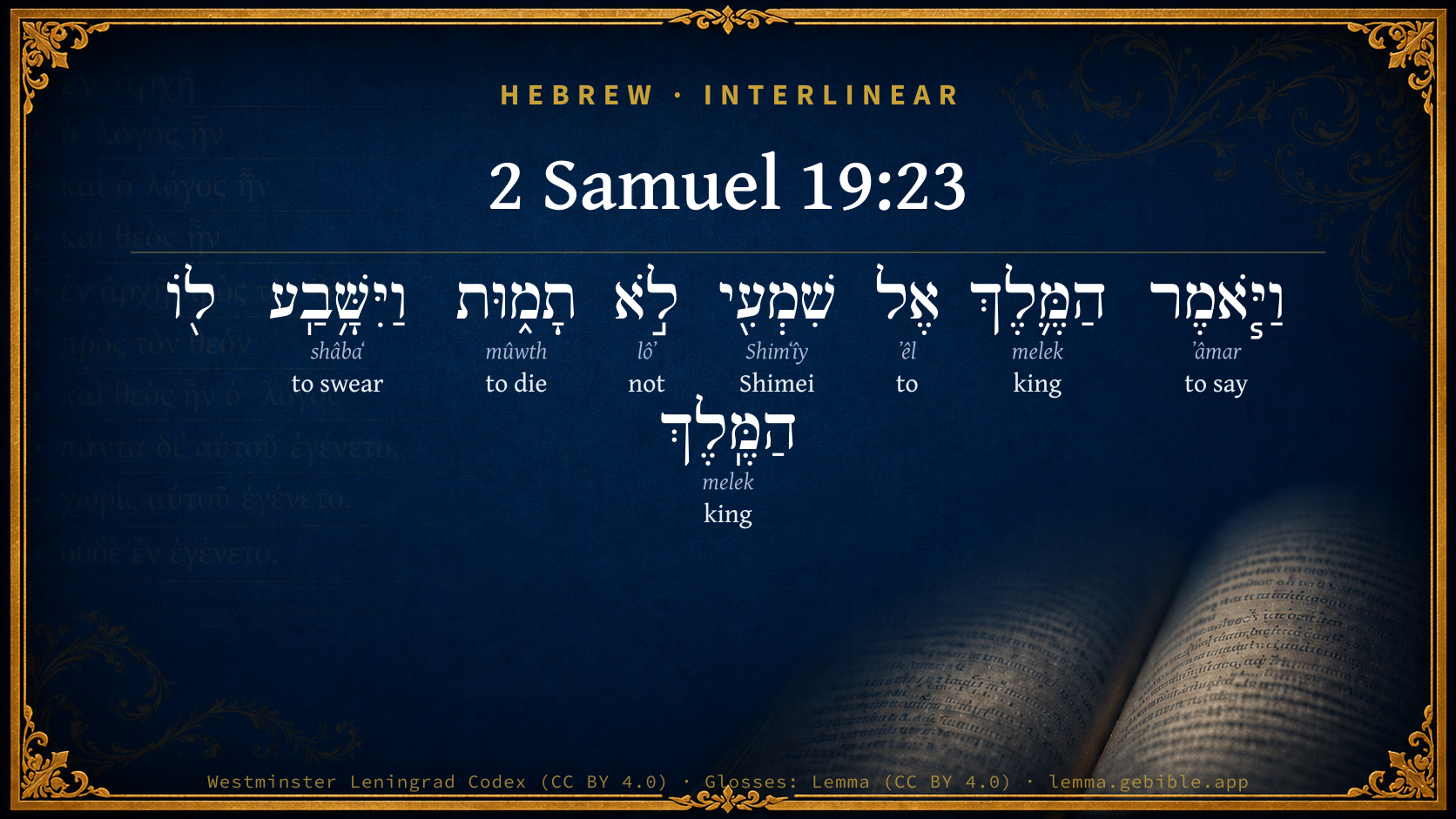
Hebrew (Westminster Leningrad Codex) 2 Samuel 19:23 appears in the Hebrew Old Testament. The text above is from the Westminster Leningrad Codex. Each word links to its Strong’s number, a concise gloss, and parsing drawn from the Open Scriptures Hebrew Bible morphology. Click any word for its full Brown-Driver-Briggs (BDB) entry.
Download image
Cite this verse

2 Samuel 19:23 (World English Bible). Public Domain. Lemma interlinear Bible study tool, https://lemma.gebible.app/v/2-samuel/19/23.

Show BibTeX & RIS
BibTeX
RIS
English Translation
The king said to Shimei, You shall not die. The king swore to him.
World English Bible · Public Domain
Download a study sheet

One document with this verse’s original text, its word-by-word gloss line, the meaning frame, cross-references with their text, attributed commentary, and full source and license credits — printable, and it pastes into notes with its structure intact.

This verse Autodidact and up

Study sheet (.html) Plain text (.txt)

A passage Seminary Student

Up to 50 verses in one chapter. A passage sheet keeps up to 6 commentary sources and 12 cross-references per verse, in the order this page ranks them, and says so on the sheet whenever that leaves anything out. Ask for a single verse and you get the Autodidact verse sheet above.

Everything on this page stays free to read, with no account — the sheet is a download of what is already on screen, not access to it.

Want to remove ads? Support Godless Engineer
Compare translations 3

The same verse in 3 English versions, stacked beneath the original-language interlinear above. Click any original word for its lexicon entry.

Each is an independent rendering of the whole verse — the interlinear is not word-aligned to these translations.

Highlighted words mark where these versions differ — a whole-verse word diff, not a word-by-word alignment.

  • World English Bible Public Domain
    The king said to Shimei, You shall not die. The king swore to him.
  • King James Version Public Domain
    Therefore the king said unto Shimei, Thou shalt not die. And the king sware unto him.
  • unfoldingWord Literal Text CC BY-SA 4.0
    And the king said to Shimei, “You shall not die.” And the king swore to him.

unfoldingWord Literal Text — © unfoldingWord, licensed CC BY-SA 4.0. Word-aligned USFM3 via Door43 (git.door43.org/unfoldingWord/en_ult).

Versions to compare (up to 4)

3 of 4 selected

Show all 18 translations

Every available English version of this verse, each an independent rendering of the whole verse.

  • World English Bible Public Domain
    The king said to Shimei, You shall not die. The king swore to him.
  • Berean Standard Bible Public Domain
    So the king said to Shimei, “You shall not die.” And the king swore an oath to him.
  • Majority Standard Bible Public Domain
    So the king said to Shimei, “You shall not die.” And the king swore an oath to him.
  • King James Version Public Domain
    Therefore the king said unto Shimei, Thou shalt not die. And the king sware unto him.
  • American Standard Version (1901) Public Domain
    And the king said unto Shimei, Thou shalt not die. And the king sware unto him.
  • Revised Version (1885) Public Domain
    And the king said unto Shimei, Thou shalt not die. And the king sware unto him.
  • Geneva Bible (1599) Public Domain
    Therefore the King saide vnto Shimei, Thou shalt not die, and the king sware vnto him.
  • Douay-Rheims (1899) Public Domain
    And the king said to Semei: Thou shalt not die. And he swore unto him.
  • Young's Literal Translation Public Domain
    And the king saith unto Shimei, `Thou dost not die;' and the king sweareth to him.
  • Literal Standard Version CC BY-SA 4.0
    And the king says to Shimei, “You do not die”; and the king swears to him.
  • Unlocked Literal Bible CC BY-SA 4.0
    So the king said to Shimei, “You will not die.” So the king promised him with an oath.
  • unfoldingWord Literal Text CC BY-SA 4.0
    And the king said to Shimei, “You shall not die.” And the king swore to him.
  • Darby Bible Public Domain
    And the king said to Shimei, Thou shalt not die. And the king swore to him.
  • World Messianic Bible Public Domain
    The king said to Shimei, “You will not die.” The king swore to him.
  • Webster's Bible Public Domain
    Therefore the king said to Shimei, Thou shalt not die. And the king swore to him.
  • Free Bible Version CC BY-SA 4.0
    David turned to Shimei and swore an oath to him, “You're not going to die.”
  • Bible in Basic English Public Domain
    So the king said to Shimei, You will not be put to death. And the king gave him his oath.
  • JPS Tanakh (1917) Public Domain
    (19-24) And the king said unto Shimei: 'Thou shalt not die.' And the king swore unto him.

Literal Standard Version (2020), Covenant Press — licensed CC BY-SA 4.0. Text via the HelloAO Bible API (eBible.org). Unlocked Literal Bible (unfoldingWord) — licensed CC BY-SA 4.0. Text via the HelloAO Bible API (eBible.org). unfoldingWord Literal Text — © unfoldingWord, licensed CC BY-SA 4.0. Word-aligned USFM3 via Door43 (git.door43.org/unfoldingWord/en_ult). Free Bible Version, Dr. Jonathan Gallagher — licensed CC BY-SA 4.0. Text via the HelloAO Bible API (eBible.org).

Word by word

More ways to search: Search by grammar → Find every occurrence → Compare this word →

Practice this passage: Drill this verse → Learn its vocabulary →

שִׁמְעִ֖י
Shimʻîy
H8096
“Shimei”
Noun, Proper
Part of Speech
Noun
Type
Proper
Full BDB Definition

Origin: from H8088

TWOT: None

Shimei or Shimhi or Shimi or Shimea = "renowned" - a Benjamite, son of Gera of the house of Saul in the time of David - a Benjamite, son of Elah and commissariat officer in the time of Solomon - the Ramathite in charge of the vineyards of David - son of Gershon and grandson of Levi - a Levite, son of Jeduthun and chief of the 10th division of singers in the time of David - a Levite of the sons of Heman who took part in the purification of the temple in the time of king Hezekiah of Judah - a Levite, brother of Cononiah in charge of receiving the tithes and offerings in the reign of king Hezekiah of Judah - a Levite who had a foreign wife in the time of Ezra - a Judaite, son of Pedaiah and brother of Zerubbabel - a Simeonite, son of Zacchur - a Reubenite, son of Gog and father of Micah - one of the sons of Hashum who had a foreign wife in the time of Ezra - one of the sons of Bani who had a foreign wife in the time of Ezra - a Benjamite, son of Kish, father of Jair, and grandfather of Mordecai in the time of Esther - a Levite, son of Jahath, grandson of Gershon, and great grandson of Levi - Benjamite, father of Adaiah, Beraiah, and Shimrath. Spelled 'Shimhi'
  1. וַיֹּ֧אמֶר ʼâmar H559 “and · to say” Conjunction + Verb, Qal, Sequential Imperfect, 3rd Person, Masculine, Singular
  2. הַמֶּ֛לֶךְ melek H4428 “the · king” Particle, Definite Article + Noun, Common, Masculine, Singular, Absolute
  3. אֶל ʼêl H413 “to” Preposition
  4. לֹ֣א lôʼ H3808 “not” Particle, Negative
  5. תָמ֑וּת mûwth H4191 “to die” Verb, Qal, Imperfect, 2nd Person, Masculine, Singular
  6. וַיִּשָּׁ֥בַֽע shâbaʻ H7650 “and · to swear” Conjunction + Verb, Niphal, Sequential Imperfect, 3rd Person, Masculine, Singular
  7. הַמֶּֽלֶךְ melek H4428 “the · king” Particle, Definite Article + Noun, Common, Masculine, Singular, Absolute

About this verse

These counts appear in no published source. They are computed here, from the morphology-tagged text and Lemma’s own curated glosses. What Lemma adds →

9
words
7
distinct lemmas
Historical
section

Shared distinctive vocabulary

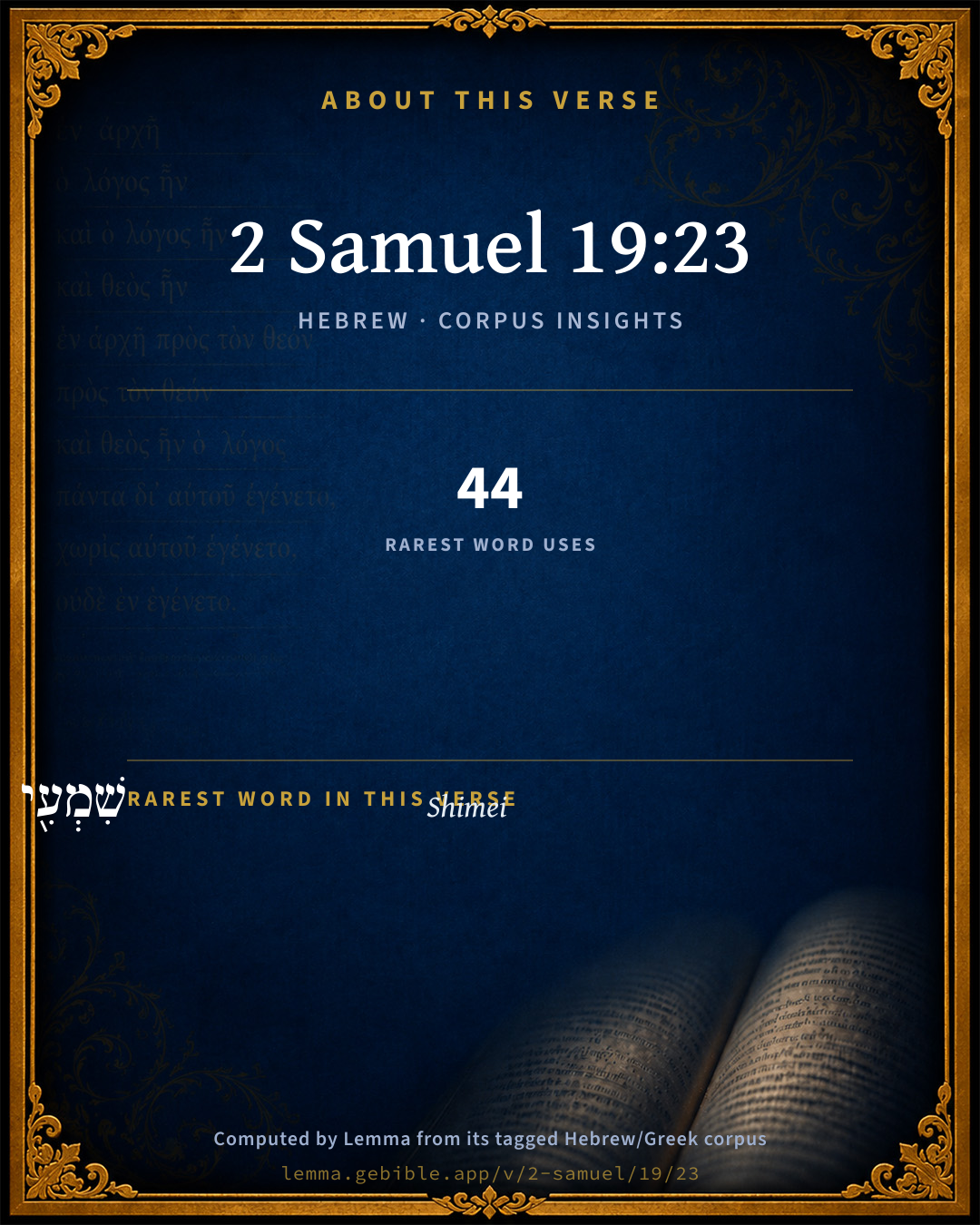
שִׁמְעִ֖י Shimei H8096 occurs in 40 verses of the Hebrew Bible. Also found in:

Grammatical profile

  • 3 verbs
  • 3 nouns
  • 2 prepositions
  • 1 particle

Verb forms

  • וַיֹּ֧אמֶר Qal · Sequential Imperfect
  • תָמ֑וּת Qal · Imperfect
  • וַיִּשָּׁ֥בַֽע Niphal · Sequential Imperfect

Repetition

A word recurs within this verse — often emphatic in Hebrew:

  • הַמֶּ֛לֶךְ king H4428 ×2

Hebrew & Septuagint length

In English translation the verse runs 14 words from the Hebrew and 16 from the Septuagint (LXX English) — closely comparable.

A rough comparison of the two English renderings, which tokenize alike — not a word-level alignment.

Word counts can differ between the Hebrew and the Greek without any difference in meaning — e.g. the Hebrew direct-object marker אֵת has no separate Greek word, and Greek often adds the article ὁ.

Cross-references

6

Topical passages linked to 2 Samuel 19:23 in the Treasury of Scripture Knowledge — connected by theme and wording, ordered by reader-vote popularity; previews shown in the World English Bible.

  • 1 Kings 2:8–9 Behold, there is with you Shimei the son of Gera, the Benjamite, of Bahurim, who cursed me with a grievous curse in the day when I went to Mahanaim; but he came down to meet me at the Jordan, and I swore to him by Yahweh, saying, I will not put you to death with the sword.
  • 1 Kings 2:46 So the king commanded Benaiah the son of Jehoiada; and he went out, and fell on him, so that he died. The kingdom was established in the hand of Solomon.
  • 1 Kings 2:37 For on the day you go out, and pass over the brook Kidron, know you for certain that you shall surely die: your blood shall be on your own head.
  • 1 Samuel 28:10 Saul swore to her by Yahweh, saying, As Yahweh lives, there shall no punishment happen to you for this thing.
  • 1 Samuel 30:15 David said to him, Will you bring me down to this troop? He said, Swear to me by God, that you will neither kill me, nor deliver me up into the hands of my master, and I will bring you down to this troop.
  • Hebrews 6:16 For men indeed swear by a greater one, and in every dispute of theirs the oath is final for confirmation.

Cross-references courtesy of OpenBible.info (CC BY 4.0).

Hebrew and Greek witnesses Masoretic Hebrew ↔ Greek Septuagint

The same verse in the two great witnesses to the Old Testament, shown verse-for-verse.

These are two independent witnesses, not word-aligned to each other, and the Septuagint is shown in lemma (dictionary) form.

Hebrew 2 Samuel 19:23 Masoretic · Westminster Leningrad Codex

וַיֹּ֧אמֶר הַמֶּ֛לֶךְ אֶל שִׁמְעִ֖י לֹ֣א תָמ֑וּת וַיִּשָּׁ֥בַֽע ל֖וֹ הַמֶּֽלֶךְ

The king said to Shimei, You shall not die. The king swore to him.

World English Bible · Public Domain

Greek LXX 2 Samuel 19:23 Septuagint · lemma form

καί εἶπον δαυίδ τίς ἐγώ καί σύ υἱός σαρουιας ὅτι γίγνομαι ἐγώ σήμερον εἰς ἐπίβουλος σήμερον οὐ θανατόω τις ἀνήρ ἐκ ἰσραήλ ὅτι οὐ οἶδα εἰ σήμερον βασιλεύω ἐγώ ἐπί ὁ ἰσραήλ

And the king said to Semei, You shall not die: and the king swore to him.

LXX2012 (modern English Septuagint) · Public Domain

Hebrew: Westminster Leningrad Codex (CC BY 4.0). Greek: Septuagint (public domain); English from LXX2012 (modern English Septuagint) (Public Domain). How the Septuagint differs from the Hebrew →

Targum (Aramaic paraphrase)

1

The Targum is the ancient Jewish Aramaic paraphrase of the Hebrew Scriptures — an interpretive translation, not the Hebrew text itself. Onkelos (literal) and Pseudo-Jonathan (expansive) render the Torah, and Jonathan the Prophets. Coverage is partial: where no permissively-licensed English translation exists for a verse, only the Aramaic is shown. This is verse-level text, not a word-by-word alignment to the Hebrew.

  1. Targum Jonathan Prophets (Joshua–Malachi)
    וַאֲמַר דָוִד מַה לִי וּלְכוֹן בְּנֵי צְרוּיָה אֲרֵי תֶהֱווֹן לִי יוֹמָא דֵין לִסְטַן יוֹמָא דֵין יִתְקְטֵיל גַבְרָא בְּיִשְׂרָאֵל אֲרֵי הֲלָא יְדַעְנָא אֲרֵי יוֹמָא דֵין אֲנָא מַלְכָּא עַל יִשְׂרָאֵל:

    (no public-domain English translation for this verse)

    Targum Jonathan — Aramaic: “Mikraot Gedolot” (public domain). English: “Sefaria Community Translation” (CC0 1.0 (public-domain dedication)); “London "Chaldee Paraphrase," 1871” (public domain). Text via Sefaria.

Commentary

Notes on 2 Samuel 19:23 from classic Christian and Jewish commentators (each source and its license shown beneath its notes). The classic Christian expositions comment on the surrounding passage and are grouped to its opening verse, so a note may address several verses; the Jewish commentaries on the Tanakh (Rashi and others) are per-verse, so they appear only where the commentator wrote on this verse.

Lemma curates 59 commentaries, every one of them public domain or Creative Commons licensed, each selected and text-cleaned for this edition rather than reprinted as found. About our sources →

Trapp's Complete Commentary

John Trapp

2Sa 19:23 Therefore the king said unto Shimei, Thou shalt not die. And the king sware unto him.

Ver. 23. Thou shalt not die.] Quod me attingit tibi condono; et facti iudicium aliis relinquo: I pardon thee for my part, and leave others to judge of thy fact, and to deal with thee as is meet, for thy future offences. Thou shalt not die ex meo iussu, et iam, {a} by my command, and at this time.

{a} Piscat.

John Trapp, A Commentary or Exposition upon All the Books of the Old and New Testament (1647–1656) — public domain. Text from a community e-Sword module.

Tyndale Open Study Notes

Tyndale Open Resources

19:23 David’s oath of protection was not binding on David’s heir, Solomon, who later ordered Shimei’s execution for far less serious crimes (1 Kgs 2:36-46).

Tyndale Open Study Notes — © Tyndale Open Resources, licensed CC BY-SA 4.0. Text via the HelloAO Bible API.

Geneva Bible (1599)

Geneva Bible translators

By my hands, or during my life, as read 1 Kings 2:8, 9.

Geneva Bible (1599) marginal notes — public domain. Text via Bolls.life.

Ellicott's Commentary for English Readers

(23) The king sware unto him.—This oath of David assuring immunity to Shimei brings to mind his dying charge to Solomon concerning him (1Ki_2:8-9): “His hoar head bring thou down to the grave with blood.” The whole transaction is to be viewed from a political point. Shimei had been guilty of high treason in David’s distress; at his return he had confessed his fault, and exerted himself to help on David’s restoration to the throne. He had accordingly been pardoned, and David, somewhat rashly, had confirmed this pardon with an oath, in such a way that he was unable to punish any subsequent treasonable tendencies showing themselves in Shimei. From the character of the man, however, and from Solomon’s address to him in 1Ki_2:44, it is plain that he remained thoroughly disloyal. David saw this, and hindered by his oath from treating him as he deserved, pointed out the case to Solomon. Solomon settled the matter by a compact (into which Shimei willingly entered), that his life should be forfeited whenever he should go out of Jerusalem. There he was under supervision; elsewhere he could not be trusted. After a few years he violated this condition, and was executed. David had made a rash oath, and observed it to the letter, but no farther, towards a thorough traitor.

A Bible Commentary for English Readers, edited by Charles John Ellicott (1878–1897) — public domain. Text from a community e-Sword module.

The Cambridge Bible for Schools and Colleges

gen. ed. J. J. S. Perowne

23. the king sware unto him] David cannot be acquitted of breaking the spirit if not the letter of his oath by the charge which he gave to Solomon (1Ki_2:8 ff.).

The Cambridge Bible for Schools and Colleges (gen. ed. J. J. S. Perowne; Cambridge University Press, 1878–1918) — public domain. Text from a community e-Sword module.

John Gill's Exposition

Therefore the king said unto Shimei, thou shalt not die,.... This day by my hands, or order, or by the sword, Kg1 2:8,

and the king sware unto him; that he should not die for that offence, or for that only; but if he committed a new one, this oath was no longer binding on him, and not at all upon his heir and successor.

John Gill's Exposition of the Whole Bible (1746–1763) — public domain (CC PDM 1.0). Text via the HelloAO Bible API.

Haydock's Catholic Bible Commentary

Die, during my life, (Menochius) or by my hand, without some farther transgression. Hence the oath is worded, I will not kill thee with the sword, 3 Kings ii. 8. (Haydock) --- Solomon was charged not to let his crime pass unpunished. But he did not kill him till he had shewed his disobedience. (Calmet) --- The oaths of parents do not always (Haydock) pertain to their heirs. (Grotius)

George Leo Haydock (1774–1849), Haydock's Catholic Family Bible and Commentary, 1859 edition — public domain. Excludes Psalms (Douay-Rheims chapter numbering differs from Protestant) and Deuterocanonical books (Catholic canon only).

Matthew Poole's English Annotations

Thou shalt not die, to wit, this day, as Abishai desireth; nor whilst I live, nor by my hands, as it is repeated and explained, 1Ki 2:8; nor for this cause alone. For though David gave order to Solomon for his punishment after his death; nor was it fit for the public good that such a horrid crime should go unpunished; yet he would not have him punished for this fault alone, but for some other capital crime, which he presumed Shimei’s temper would easily betray him to, and Solomon’s deep wisdom would easily find out, 1Ki 2:9.

The king sware unto him, that he would not put him to death with the sword, as it is expressed, 1Ki 2:8.

Matthew Poole's English Annotations on the Holy Bible (1683–1685) — public domain. Text from a community e-Sword/MySword module.

Whedon's Commentary on the Bible

Daniel D. Whedon

23. The king sware unto him — That during his reign he should not be put to death. But he charged Solomon to bring his hoary head to the grave with blood. 1Ki_2:8-9.

Daniel D. Whedon (gen. ed.), Commentary on the Old and New Testaments (1874–1909) — public domain. Text from a community e-Sword module.

The Pulpit Commentary

The king sware unto him. David"s magnanimity was not the result merely of policy, but also of joyful feeling at seeing all the tribes so readily welcome him back to the throne. But in spite of his oath, he orders Solomon to execute him, regarding what he had done as a sin past forgiveness. In so doing we can hardly acquit David of breaking his oath, even granting that Shimei"s repentance was insincere, and that the motive of his actions was the desire simply to save his life. But we must remember that our Lord described his injunction, "that ye love one another," as "a new commandment"; (Joh_13:34) and the utmost that can be said in David"s favour is that his character was generous and full of chivalry. A half excuse may be found for his order in the supposition that Shimei was an inveterate conspirator, and dangerous to Solomon"s peace. This view seems confirmed by the command given to Shimei to build a house at Jerusalem, (1Ki_2:36) where he would always be under surveillance. But had not David himself praised the man who "sweareth to his own hurt, and changeth not"? (Psa_15:4)

The Pulpit Commentary (1880–1919), ed. H.D.M. Spence-Jones & Joseph S. Exell — public domain. Text from a community e-Sword module.

Rashi

Rabbi Shlomo Yitzchaki (Rashi)

Should a man die today? This is a question. Because today I am [truly] king. Until now I thought A great man as this [Shimi] would not have shamed me unless God had decreed to end my kingdom, and He had told him, 'Curse Dovid.' But now that he regrets it I know that I am [truly] king.

Rashi on the Tanakh — English translations: “The Judaica Press complete Tanach with Rashi, translated by A. J. Rosenberg” (CC BY 4.0); “Pentateuch with Rashi's commentary by M. Rosenbaum and A.M. Silbermann, 1929-1934” (public domain); “The Metsudah Tanach series, Lakewood, N.J” (CC BY 4.0); and “The Book of Joshua, Metsudah Publications, 1997” (CC BY 4.0). Text via Sefaria.

Lesson kit

Teaching starters — assembled from the data on this page, not authored interpretation. Every prompt links to the verse data it draws on. Edit before teaching.

2 Samuel, in the Historical, opens this verse with 9 words (7 distinct Hebrew lemmas). Its most distinctive word is Shimʻîy (“Shimei”). A historical commentator’s framing appears above. Read the whole chapter for the surrounding context.

Discussion questions

  1. What does “Shimei” (Shimʻîy) contribute to the verse as a whole?
  2. Exodus 6:17 shares the word «Shimei» with this verse. How do the two illuminate each other?
  3. “king” occurs 2× in this one verse. What is the effect of the repetition?
  4. The translations on this page render this verse differently — a whole-verse word diff, not a word-by-word alignment. What might account for the different wordings?
  5. The verb «וַיֹּ֧אמֶר» is Qal Sequential Imperfect. How does its form color the action?
  6. Reading how Trapp's Complete Commentary and Tyndale Open Study Notes read this verse, where do the two commentators agree and where do they part?

Things to notice

Reading settings

Reading text

Shown beneath each verse's original-language words.

Old Testament
Old Testament edition

Read the OT as the Masoretic Hebrew (MT) or the Greek Septuagint (LXX).

English shown for the Greek Septuagint (in the Hebrew ↔ Greek comparison).

Comparing translations? Open the Compare panel on any verse page to stack up to four side by side.