
2 Samuel 19:41

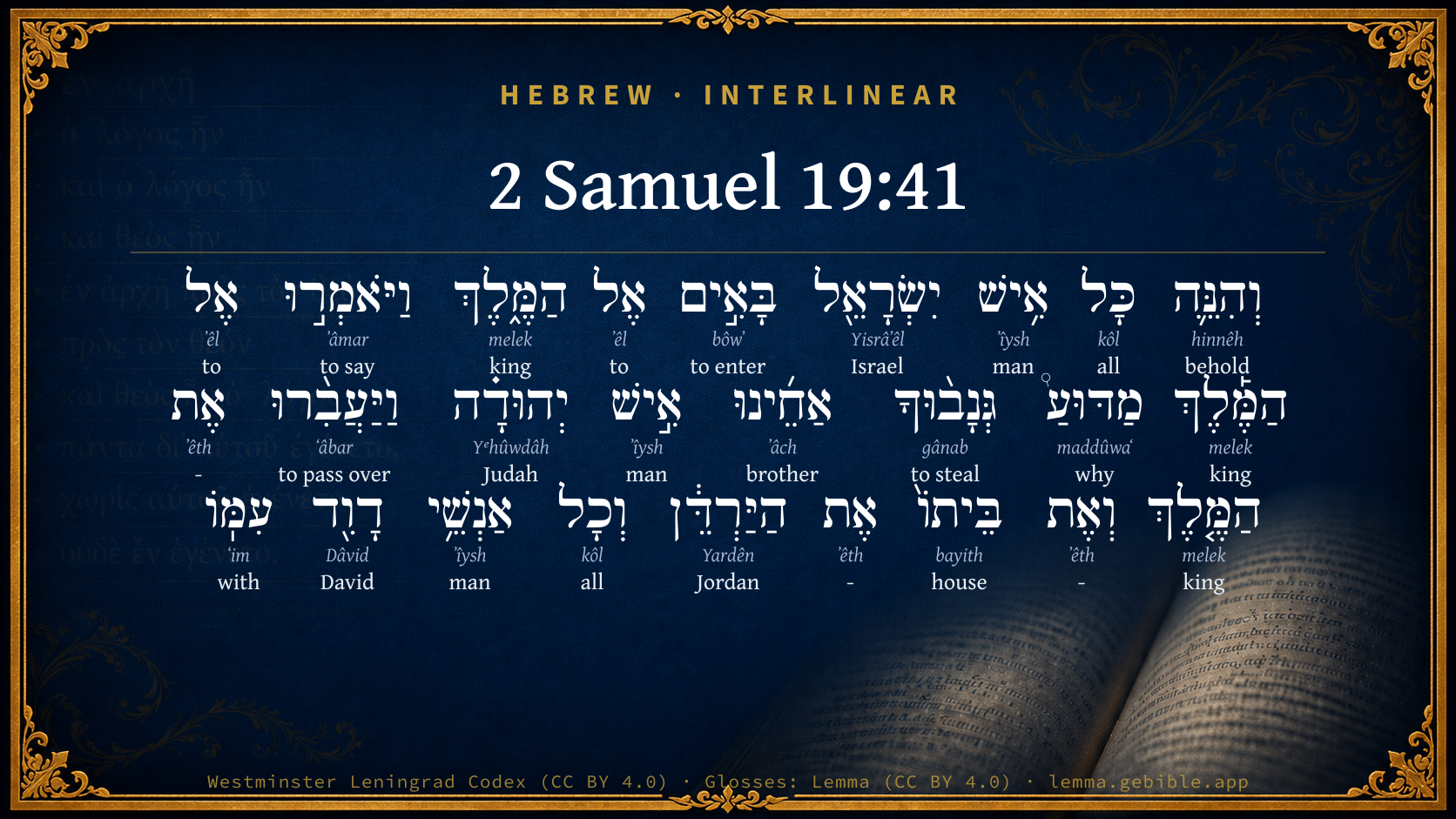
Hebrew (Westminster Leningrad Codex) 2 Samuel 19:41 appears in the Hebrew Old Testament. The text above is from the Westminster Leningrad Codex. Each word links to its Strong’s number, a concise gloss, and parsing drawn from the Open Scriptures Hebrew Bible morphology. Click any word for its full Brown-Driver-Briggs (BDB) entry.
Download image
Cite this verse

2 Samuel 19:41 (World English Bible). Public Domain. Lemma interlinear Bible study tool, https://lemma.gebible.app/v/2-samuel/19/41.

Show BibTeX & RIS
BibTeX
RIS
English Translation
Behold, all the men of Israel came to the king, and said to the king, Why have our brothers the men of Judah stolen you away, and brought the king, and his household, over the Jordan, and all David's men with him?
World English Bible · Public Domain
Download a study sheet

One document with this verse’s original text, its word-by-word gloss line, the meaning frame, cross-references with their text, attributed commentary, and full source and license credits — printable, and it pastes into notes with its structure intact.

This verse Autodidact and up

Study sheet (.html) Plain text (.txt)

A passage Seminary Student

Up to 50 verses in one chapter. A passage sheet keeps up to 6 commentary sources and 12 cross-references per verse, in the order this page ranks them, and says so on the sheet whenever that leaves anything out. Ask for a single verse and you get the Autodidact verse sheet above.

Everything on this page stays free to read, with no account — the sheet is a download of what is already on screen, not access to it.

Want to remove ads? Support Godless Engineer
Compare translations 3

The same verse in 3 English versions, stacked beneath the original-language interlinear above. Click any original word for its lexicon entry.

Each is an independent rendering of the whole verse — the interlinear is not word-aligned to these translations.

Highlighted words mark where these versions differ — a whole-verse word diff, not a word-by-word alignment.

  • World English Bible Public Domain
    Behold, all the men of Israel came to the king, and said to the king, Why have our brothers the men of Judah stolen you away, and brought the king, and his household, over the Jordan, and all David's men with him?
  • King James Version Public Domain
    And, behold, all the men of Israel came to the king, and said unto the king, Why have our brethren the men of Judah stolen thee away, and have brought the king, and his household, and all David's men with him, over Jordan?
  • unfoldingWord Literal Text CC BY-SA 4.0
    And behold, all of the men of Israel were coming to the king, and they said to the king, “Why did our brothers, the men of Judah, steal you away and bring the king and his house across the Jordan and all of the men of David with him?”

unfoldingWord Literal Text — © unfoldingWord, licensed CC BY-SA 4.0. Word-aligned USFM3 via Door43 (git.door43.org/unfoldingWord/en_ult).

Versions to compare (up to 4)

3 of 4 selected

Show all 18 translations

Every available English version of this verse, each an independent rendering of the whole verse.

  • World English Bible Public Domain
    Behold, all the men of Israel came to the king, and said to the king, Why have our brothers the men of Judah stolen you away, and brought the king, and his household, over the Jordan, and all David's men with him?
  • Berean Standard Bible Public Domain
    Soon all the men of Israel came to the king and asked, “Why did our brothers, the men of Judah, take you away secretly and bring the king and his household across the Jordan, together with all of David’s men?”
  • Majority Standard Bible Public Domain
    Soon all the men of Israel came to the king and asked, “Why did our brothers, the men of Judah, take you away secretly and bring the king and his household across the Jordan, together with all of David’s men?”
  • King James Version Public Domain
    And, behold, all the men of Israel came to the king, and said unto the king, Why have our brethren the men of Judah stolen thee away, and have brought the king, and his household, and all David's men with him, over Jordan?
  • American Standard Version (1901) Public Domain
    And, behold, all the men of Israel came to the king, and said unto the king, Why have our brethren the men of Judah stolen thee away, and brought the king, and his household, over the Jordan, and all David's men with him?
  • Revised Version (1885) Public Domain
    And, behold, all the men of Israel came to the king; and said unto the king, Why have our brethren the men of Judah stolen thee away, and brought the king, and his household, over Jordan, and all David’s men with him?
  • Geneva Bible (1599) Public Domain
    And behold, all the men of Israel came to the King, and sayd vnto the King, Why haue our brethren the men of Iudah stollen thee away, and haue brought the King and his houshold, and all Dauids men with him ouer Iorden?
  • Douay-Rheims (1899) Public Domain
    Therefore all the men of Israel running together to the king, said to him: Why have our brethren the men of Juda stolen thee away, and have brought the king and his household over the Jordan, and all the men of David with him?
  • Young's Literal Translation Public Domain
    And, lo, all the men of Israel are coming unto the king, and they say unto the king, `Wherefore have they stolen thee -- our brethren, the men of Judah?' (and they bring the king and his household over the Jordan, and all the men of David with him).
  • Literal Standard Version CC BY-SA 4.0
    And behold, all the men of Israel are coming to the king, and they say to the king, “Why have our brothers, the men of Judah, stolen you—and they bring the king and his household over the Jordan, and all the men of David with him?”
  • Unlocked Literal Bible CC BY-SA 4.0
    Soon all the men of Israel began to come to the king and say to the king, “Why have our brothers, the men of Judah, stolen you away and brought the king and his family over the Jordan, and all David's men with him?”
  • unfoldingWord Literal Text CC BY-SA 4.0
    And behold, all of the men of Israel were coming to the king, and they said to the king, “Why did our brothers, the men of Judah, steal you away and bring the king and his house across the Jordan and all of the men of David with him?”
  • Darby Bible Public Domain
    And behold, all the men of Israel came to the king, and said to the king, Why have our brethren the men of Judah stolen thee away, and have brought the king, and his household, and all David's men with him, over the Jordan?
  • World Messianic Bible Public Domain
    Behold, all the men of Israel came to the king, and said to the king, “Why have our brothers the men of Judah stolen you away, and brought the king and his household, over the Jordan, and all David’s men with him?”
  • Webster's Bible Public Domain
    And behold, all the men of Israel came to the king, and said to him, Why have our brethren the men of Judah stolen thee away, and have brought the king, and his household, and all David's men with him, over Jordan?
  • Free Bible Version CC BY-SA 4.0
    But soon the men of Israel who were there came to the king and asked him, “Why did our brothers, the men of Judah, secretly take Your Majesty away and bring you and your household across the Jordan, together with all your men?”
  • Bible in Basic English Public Domain
    Then the men of Israel came to the king and said, Why have our countrymen of Judah taken you away in secret and come over Jordan with the king and all his family, because all his people are David's men?
  • JPS Tanakh (1917) Public Domain
    (19-42) And, behold, all the men of Israel came to the king, and said unto the king: 'Why have our brethren the men of Judah stolen thee away, and brought the king, and his household, over the Jordan, and all David's men with him?'

Literal Standard Version (2020), Covenant Press — licensed CC BY-SA 4.0. Text via the HelloAO Bible API (eBible.org). Unlocked Literal Bible (unfoldingWord) — licensed CC BY-SA 4.0. Text via the HelloAO Bible API (eBible.org). unfoldingWord Literal Text — © unfoldingWord, licensed CC BY-SA 4.0. Word-aligned USFM3 via Door43 (git.door43.org/unfoldingWord/en_ult). Free Bible Version, Dr. Jonathan Gallagher — licensed CC BY-SA 4.0. Text via the HelloAO Bible API (eBible.org).

Word by word

More ways to search: Search by grammar → Find every occurrence → Compare this word →

Practice this passage: Drill this verse → Learn its vocabulary →

גְּנָב֨וּךָ
gânab
H1589
“to steal · you”
Verb, Qal, Perfect, 3rd Person, Common, Plural + Suffix, Personal, 2nd Person, Masculine, Singular
Part of Speech
Verb
Stem
Qal
Form
Perfect
Person
3rd Person
Gender
Common
Number
Plural
Full BDB Definition

Origin: a primitive root

TWOT: 364

to steal, steal away, carry away - (Qal) to steal - (Niphal) to be stolen - (Piel) to steal away - (Pual) to be stolen away, be brought by stealth - (Hithpael) to go by stealth, steal away
  1. וְהִנֵּ֛ה hinnêh H2009 “and · behold” Conjunction + Particle, Demonstrative
  2. כָּל kôl H3605 “all of” Noun, Common, Masculine, Singular, Construct
  3. אִ֥ישׁ ʼîysh H376 “man of” Noun, Common, Masculine, Singular, Construct
  4. יִשְׂרָאֵ֖ל Yisrâʼêl H3478 “Israel” Noun, Proper
  5. בָּאִ֣ים bôwʼ H935 “entering” Verb, Qal, Participle Active, Masculine, Plural, Absolute
  6. אֶל ʼêl H413 “to” Preposition
  7. הַמֶּ֑לֶךְ melek H4428 “the · king” Particle, Definite Article + Noun, Common, Masculine, Singular, Absolute
  8. וַיֹּאמְר֣וּ ʼâmar H559 “and · to say” Conjunction + Verb, Qal, Sequential Imperfect, 3rd Person, Masculine, Plural
  9. אֶל ʼêl H413 “to” Preposition
  10. הַמֶּ֡לֶךְ melek H4428 “the · king” Particle, Definite Article + Noun, Common, Masculine, Singular, Absolute
  11. מַדּוּעַ֩ maddûwaʻ H4069 “why” Particle, Interrogative
  12. אַחֵ֜ינוּ ʼâch H251 “brothers · our” Noun, Common, Masculine, Plural, Construct + Suffix, Personal, 1st Person, Common, Plural
  13. אִ֣ישׁ ʼîysh H376 “man of” Noun, Common, Masculine, Singular, Construct
  14. יְהוּדָ֗ה Yᵉhûwdâh H3063 “Judah” Noun, Proper
  15. וַיַּעֲבִ֨רוּ ʻâbar H5674 “and · to pass over” Conjunction + Verb, Hiphil, Sequential Imperfect, 3rd Person, Masculine, Plural
  16. אֶת ʼêth H853 “-” Particle, Direct Object
  17. הַמֶּ֤לֶךְ melek H4428 “the · king” Particle, Definite Article + Noun, Common, Masculine, Singular, Absolute
  18. וְאֶת ʼêth H853 “and · -” Conjunction + Particle, Direct Object
  19. בֵּיתוֹ֙ bayith H1004 “house · his” Noun, Common, Masculine, Singular, Construct + Suffix, Personal, 3rd Person, Masculine, Singular
  20. אֶת ʼêth H853 “-” Particle, Direct Object
  21. הַיַּרְדֵּ֔ן Yardên H3383 “the · Jordan” Particle, Definite Article + Noun, Proper
  22. וְכָל kôl H3605 “and · all of” Conjunction + Noun, Common, Masculine, Singular, Construct
  23. אַנְשֵׁ֥י ʼîysh H376 “men of” Noun, Common, Masculine, Plural, Construct
  24. דָוִ֖ד Dâvid H1732 “David” Noun, Proper
  25. עִמּֽוֹ ʻim H5973 “with · him” Preposition + Suffix, Personal, 3rd Person, Masculine, Singular

About this verse

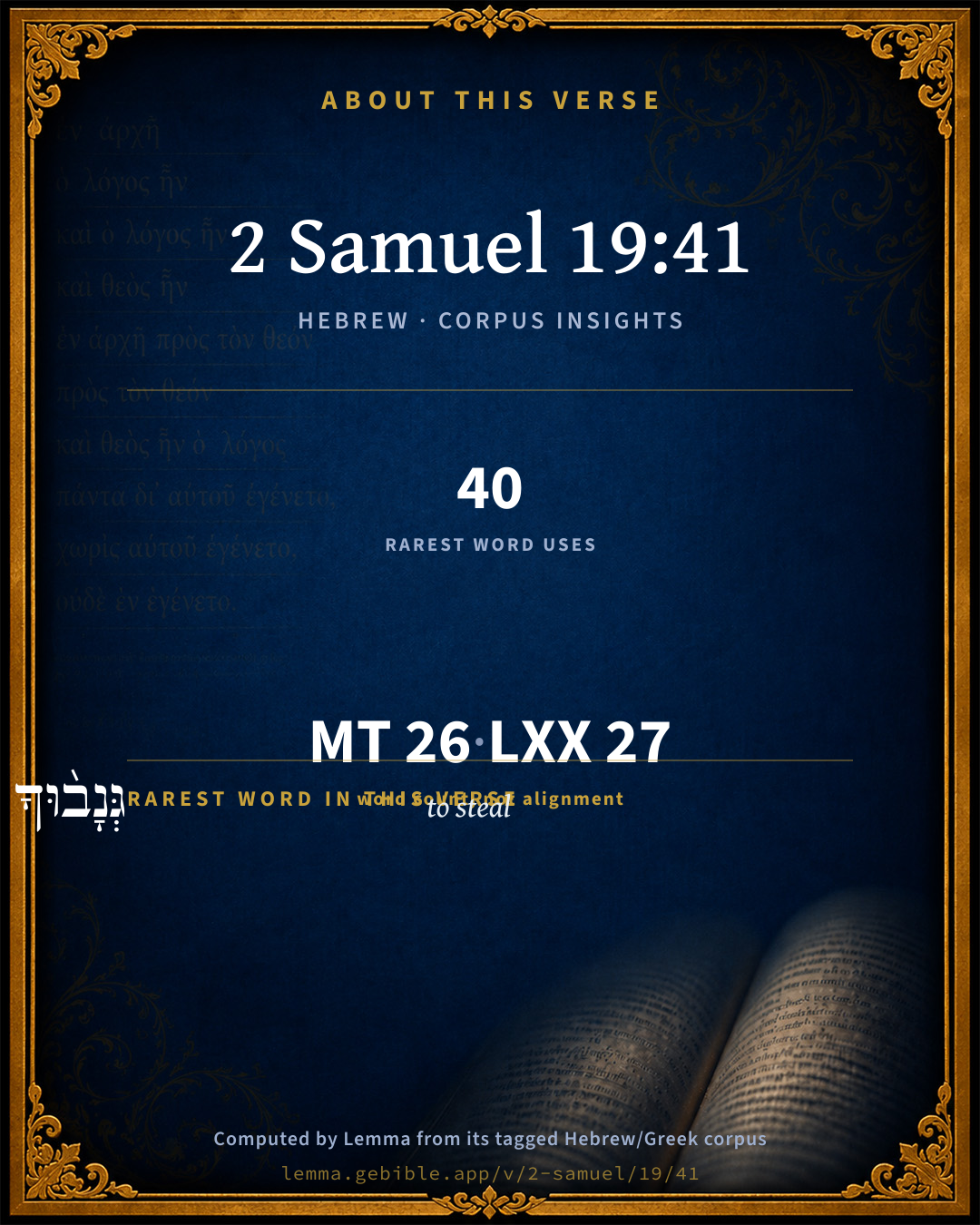
These counts appear in no published source. They are computed here, from the morphology-tagged text and Lemma’s own curated glosses. What Lemma adds →

26
words
18
distinct lemmas
Historical
section

Shared distinctive vocabulary

גְּנָב֨וּךָ to steal H1589 occurs in 36 verses of the Hebrew Bible. Also found in:

Grammatical profile

  • 4 verbs
  • 14 nouns
  • 3 prepositions
  • 5 particles

Verb forms

  • בָּאִ֣ים Qal · Participle Active
  • וַיֹּאמְר֣וּ Qal · Sequential Imperfect
  • גְּנָב֨וּךָ Qal · Perfect
  • וַיַּעֲבִ֨רוּ Hiphil · Sequential Imperfect

Repetition

Words recur within this verse — often emphatic in Hebrew:

  • אִ֥ישׁ man H376 ×3
  • הַמֶּ֑לֶךְ king H4428 ×3
  • כָּל all H3605 ×2
  • אֶל to H413 ×2

Hebrew & Septuagint length

In English translation the verse runs 42 words from the Hebrew and 47 from the Septuagint (LXX English) — closely comparable.

A rough comparison of the two English renderings, which tokenize alike — not a word-level alignment.

Word counts can differ between the Hebrew and the Greek without any difference in meaning — e.g. the Hebrew direct-object marker אֵת has no separate Greek word, and Greek often adds the article ὁ.

In the original languages it is 26 Hebrew tokens and 27 Greek tokens — but the two are counted differently (Hebrew bundles its prefixes and suffixes into one token; the Greek is in lemma form), so that isn’t a like-for-like length.

Cross-references

5

Topical passages linked to 2 Samuel 19:41 in the Treasury of Scripture Knowledge — connected by theme and wording, ordered by reader-vote popularity; previews shown in the World English Bible.

  • Judges 8:1 The men of Ephraim said to him, Why have you served us thus, that you didn't call us, when you went to fight with Midian? They did chide with him sharply.
  • Judges 12:1 The men of Ephraim were gathered together, and passed northward; and they said to Jephthah, Why did you pass over to fight against the children of Ammon, and didn't call us to go with you? we will burn your house on you with fire.
  • Genesis 31:26–27 Laban said to Jacob, "What have you done, that you have deceived me, and carried away my daughters like captives of the sword?
  • 2 Samuel 19:3 The people got them by stealth that day into the city, as people who are ashamed steal away when they flee in battle.
  • John 7:5–6 For even his brothers didn't believe in him.

Cross-references courtesy of OpenBible.info (CC BY 4.0).

Hebrew and Greek witnesses Masoretic Hebrew ↔ Greek Septuagint

The same verse in the two great witnesses to the Old Testament, shown verse-for-verse.

These are two independent witnesses, not word-aligned to each other, and the Septuagint is shown in lemma (dictionary) form.

Hebrew 2 Samuel 19:41 Masoretic · Westminster Leningrad Codex

וְהִנֵּ֛ה כָּל אִ֥ישׁ יִשְׂרָאֵ֖ל בָּאִ֣ים אֶל הַמֶּ֑לֶךְ וַיֹּאמְר֣וּ אֶל הַמֶּ֡לֶךְ מַדּוּעַ֩ גְּנָב֨וּךָ אַחֵ֜ינוּ אִ֣ישׁ יְהוּדָ֗ה וַיַּעֲבִ֨רוּ אֶת הַמֶּ֤לֶךְ וְאֶת בֵּיתוֹ֙ אֶת הַיַּרְדֵּ֔ן וְכָל אַנְשֵׁ֥י דָוִ֖ד עִמּֽוֹ

Behold, all the men of Israel came to the king, and said to the king, Why have our brothers the men of Judah stolen you away, and brought the king, and his household, over the Jordan, and all David's men with him?

World English Bible · Public Domain

Greek LXX 2 Samuel 19:41 Septuagint · lemma form

καί διαβαίνω ὁ βασιλεύς εἰς γάλγαλα καί χαμααμ διαβαίνω μετά αὐτός καί πᾶς ὁ λαός ιουδα διαβαίνω μετά ὁ βασιλεύς καί γέ ὁ ἥμισυς ὁ λαός ἰσραήλ

And behold, all the men of Israel came to the king, and said to the king, Why have our brethren the men of Juda stolen you away, and caused the king and all his house to pass over Jordan, and all the men of David with him?

LXX2012 (modern English Septuagint) · Public Domain

Hebrew: Westminster Leningrad Codex (CC BY 4.0). Greek: Septuagint (public domain); English from LXX2012 (modern English Septuagint) (Public Domain). How the Septuagint differs from the Hebrew →

Targum (Aramaic paraphrase)

1

The Targum is the ancient Jewish Aramaic paraphrase of the Hebrew Scriptures — an interpretive translation, not the Hebrew text itself. Onkelos (literal) and Pseudo-Jonathan (expansive) render the Torah, and Jonathan the Prophets. Coverage is partial: where no permissively-licensed English translation exists for a verse, only the Aramaic is shown. This is verse-level text, not a word-by-word alignment to the Hebrew.

  1. Targum Jonathan Prophets (Joshua–Malachi)
    וַעֲבַר מַלְכָּא לְגִלְגְלָא וְכִמְהָן עֲבַר עִימֵיהּ וְכָל עַמָא דְבֵית יְהוּדָה אַעְבָּרוּ יַת מַלְכָּא וְאַף פַּלְגוּת עַמָא דְיִשְׂרָאֵל:

    (no public-domain English translation for this verse)

    Targum Jonathan — Aramaic: “Mikraot Gedolot” (public domain). English: “Sefaria Community Translation” (CC0 1.0 (public-domain dedication)); “London "Chaldee Paraphrase," 1871” (public domain). Text via Sefaria.

Commentary

Notes on 2 Samuel 19:41 from classic Christian and Jewish commentators (each source and its license shown beneath its notes). The classic Christian expositions comment on the surrounding passage and are grouped to its opening verse, so a note may address several verses; the Jewish commentaries on the Tanakh (Rashi and others) are per-verse, so they appear only where the commentator wrote on this verse.

Lemma curates 59 commentaries, every one of them public domain or Creative Commons licensed, each selected and text-cleaned for this edition rather than reprinted as found. About our sources →

Trapp's Complete Commentary

John Trapp

2Sa 19:41 And, behold, all the men of Israel came to the king, and said unto the king, Why have our brethren the men of Judah stolen thee away, and have brought the king, and his household, and all David’s men with him, over Jordan?

Ver. 41. Why have they … stolen thee away?] Fetched thee home without our privity: as if they alone had true title to thee, and true love toward thee? This is the voice of those who will shortly fight against David under the son of Bichri; so little hold is there of popular favour.

And all David’s men with him, over Jordan.] Or thus; - "Why have our brethren the men of Judah stolen thee away, and have brought the king and his household over Jordan? Now all the men of David were with him," that is, his soldiers; - and this made the men of Judah so bold and fierce, as 2Sa 19:42-43.

John Trapp, A Commentary or Exposition upon All the Books of the Old and New Testament (1647–1656) — public domain. Text from a community e-Sword module.

Joseph Benson's Commentary

2Sa 19:41. All the men of Israel — That is, those that were present. It appears that David, to gratify his own tribe, had marched on, not expecting the coming of all the great men of Israel, who were making themselves ready to wait upon him. And therefore, when they were come together, and found that the tribe of Judah were unexpectedly beforehand with them, they resented the slight put upon them; and being joined and supported in their resentment by the rest of their brethren who had reconducted the king in conjunction with Judah, they all with one voice warmly expostulated with the king upon it. Why have the men of Judah stolen thee away? — That is, why did they hasten the matter so, and not expect our concurrence and assistance, who were as zealous as themselves to bring the king back? And all David’s men with him — All his officers, guards, and soldiers. This is mentioned as an aggravation of their fault, that they not only brought the king over Jordan, but all his men too, without asking their advice.

Joseph Benson's Commentary on the Old and New Testaments (1811–1818) — public domain. Text from a community e-Sword module.

The Preacher's Complete Homiletical Commentary

Joseph S. Exell (gen. ed.)

CRITICAL AND EXPOSITORY NOTES.—

“There.” “In Gilgal, at the assembly of the tribes; the word indicates directly the place; indirectly the time of the following history.” (Erdmann). “A man of Belial.” A worthless man. “He was,” says Luther, “one of the great rogues of the high nobility, who had a large retinue among the people, and consideration or name, as Catiline in Rome.” “A Benjamite.” “Probably one of the rabid Sauline party, if he were not, as is possible, of Saul’s own family.” (Erdmann) “To his tents.” “See on 2Sa_19:8.”

2Sa_19:2. “Went up.” “From the plain of Gilgal to the hill country of Ephraim.” (Erdmann).

MAIN HOMILETICS OF THE PARAGRAPH.—Chapter 2Sa_19:41, to 2Sa_20:2

THE REBELLION OF SHEBA

I. The fidelity of those who serve from self-interest cannot be depended on for a single day. All the acts of the men of Israel at this time seem to have been inspired by one consideration only, viz., What line of policy looks most likely to promote our interests? There was no question as to their duty, either to God or man. Hence they rallied to the standard of Absalom when he bid fair to overturn the throne of his father, returned to David when they found they had embarked in a losing cause, and revolted again from him the first moment all did not fall out in accordance with their wishes. So little are those to be depended on who have no higher rule of life, and so greatly are those to be pitied who put their trust in them. “We have ten parts in David,” said they, and, almost in the same breath, We have no part in him. To-day, Hosanna, to-morrow, Crucify.—Henry.

II. The unreasoning discontent of the multitude is the opportunity of the selfish and ambitions leader. There are always men quick to take advantage of the passion and ignorance of their fellow creatures, and to use them as stepping stones for their own aggrandisement. But for the foolish petulance of the men of Israel on this occasion, this son of Bichri would have never had even the pitiful notoriety which he thereby acquired; and there have been many like him in all ages who have only risen from obscurity by similar means. It would have been indeed for the peace of the world if all such reckless men had met with as speedy a downfall as did Sheba, but they have often lived long enough to involve many more in a common ruin. Before men give themselves up to the leadership of another they should consider well whither he is leading them and what guarantees he can give that his motives are pure. But they cannot do this if they themselves are under the dominion of pride and envy, as the men of Israel were at this time. Where any unruly passion is in the ascendant, the voices of reason and conscience are not listened to, and downfall of some kind must come.

OUTLINES AND SUGGESTIVE COMMENTS

Chap, 19, 2Sa_19:41-43. In the conduct of the different tribes on this occasion, we may see a faithful picture of what is every day to be witnessed in the world around us. While some men, although convinced of the proper course to pursue, are still talking about their intentions—are consulting with their own interests—resolving, and hesitating, and again resolving—yet, after all doing nothing effectually; others like the tribe of Judah, when once persuaded of their duty, admit no farther argument on its expediency, but act with promptitude and decision. This forward zeal, however, gave great umbrage to the rest of Israel, for, like other worldly characters, it was not so much the good itself that they desired to see done, as to have themselves the credit of performing it.—Lindsay.

The Preacher's Complete Homiletical Commentary (gen. ed. Joseph S. Exell; Funk & Wagnalls, c. 1892) — public domain (pre-1929). A full-Bible homiletical/sermon-outline anthology covering 65 of 66 books (2 John is absent from the source module). Text from a community e-Sword module.

The Expositor's Bible

CHAPTER X X V I I.

THE INSURRECTION OF SHEBA.

2Sa_19:41-43; 2Sa_20:1-26.

DAVID was now virtually restored to his kingdom; but he had not even left Gilgal when fresh troubles began. The jealousy between Judah and Israel broke out in spite of him. The cause of complaint was on the part of the ten tribes; they were offended at not having been waited for to take part in escorting the king to Jerusalem. First, the men of Israel, in harsh language, accused the men of Judah of having stolen the king away, because they had transported him over the Jordan. To this the men of Judah replied that the king was of their kin; therefore they had taken the lead, but they had received no special reward or honour in consequence. The men of Israel, however, had an argument in reply to this: they were ten tribes, and therefore had so much more right to the king; and Judah had treated them with contempt in not consulting or co-operating with them in bringing him back. It is added that the words of the men of Judah were fiercer than the words of the men of Israel.

It is in a poor and paltry light that both sides appear in this inglorious dispute. There was no solid grievance whatever, nothing that might not have been easily settled if the soft answer that turneth away wrath had been resorted to instead of fierce and exasperating words. Alas I that miserable tendency of our nature to take offence when we think we have been overlooked, - what mischief and misery has it bred in the world! The men of Israel were foolish to take offence; but the men of Judah were neither magnanimous nor forbearing in dealing with their unreasonable humour. The noble spirit of clemency that David had shown awakened but little permanent response. The men of Judah, who were foremost in Absalom's rebellion, were like the man in the parable that had been forgiven ten thousand talents, but had not the generosity to forgive the trifling offence committed against them, as they thought, by their brethren of Israel. So they seized their fellow-servant by the throat and demanded that he should pay them the uttermost farthing. Judah played false to his national character; for he was not "he whom his brethren should praise."

What was the result? Any one acquainted with human nature might have foretold it with tolerable certainty. Given on one side a proneness to take offence, a readiness to think that one has been overlooked, and on the other a want of forbearance, a readiness to retaliate, - it is easy to see that the result will be a serious breach. It is just what we witness so often in children. One is apt to be dissatisfied, and complains of ill-treatment; another has no forbearance, and retorts angrily: the result is a quarrel, with this difference, that while the quarrels of children pass quickly away, the quarrels of nations or of factions last miserably long.

Much inflammable material being thus provided, a casual spark speedily set it on fire, Sheba, an artful Benjamite, raised the standard of revolt against David, and the excited ten tribes, smarting with the fierce words of the men of Judah, flocked to his standard. Most miserable proceeding! The quarrel had begun about a mere point of etiquette, and now they cast off God's anointed king, and that, too, after the most signal token of God's anger had fallen on Absalom and his rebellious crew. There are many wretched enough slaveries in this world, but the slavery of pride is perhaps the most mischievous and humiliating of all.

And here it cannot be amiss to call attention to the very great neglect of the rules and spirit of Christianity that is apt, even at the present day, to show itself among professing Christians in connection with their disputes. This is so very apparent that one is apt to think that the settlement of quarrels is the very last matter to which Christ's followers learn to apply the example and instructions of their Master. When men begin in earnest to follow Christ, they usually pay considerable attention to certain of His precepts; they turn away from scandalous sins, they observe prayer, they show some interest in Christian objects, and they abandon some of the more frivolous ways of the world. But alas! when they fall into differences, they are prone in dealing with them to leave all Christ's precepts behind them. See in what an unlovely and unloving spirit the controversies of Christians have usually been conducted; how much of bitterness and personal animosity they show, how little forbearance and generosity; how readily they seem to abandon themselves to the impulses of their own hearts. Controversy rouses temper, and temper creates a tempest through which you cannot see clearly. And how many are the quarrels in Churches or congregations that are carried on with all the heat and bitterness of unsanctified men! How much offence is taken at trifling neglects or mistakes! Who remembers, even in its spirit, the precept in the Sermon on the Mount, "If any man smite thee on the right cheek, turn to him the other also"? Who remembers the beatitude, "Blessed are the peacemakers, for they shall be called the children of God"? Who bears in mind the Apostle's horror at the unseemly spectacle of saints carrying their quarrels to heathen tribunals, instead of settling them as Christians quietly among themselves? Who weighs the earnest counsel, "Endeavour to keep the unity of the Spirit in the bond of peace"? Who prizes our gracious Lord's most blessed legacy, ''Peace I leave with you, My peace I give unto you; not as the world giveth give I unto you"? Do not all such texts show that it is incumbent on Christians to be most careful and watchful, when any difference arises, to guard against carnal feeling of every kind, and strive to the very utmost to manifest the spirit of Christ? Yet is it not at such times that they are most apt to leave all their Christianity behind them, and engage in unseemly wrangles with one another? Does not the devil very often get it all his own way, whoever may be in the right, and whoever in the wrong? And is not frequent occasion given thereby to the enemy to blaspheme, and, in the very circumstances that should bring out in clear and strong light the true spirit of Christianity, is there not often, in place of that, an exhibition of rudeness and bitterness that makes the world ask, What better are Christians than other men?

But let us return to King David and his people. The author of the insurrection was "a man of Belial, whose name was Sheba." He is called "the son of Bichri, a Benjamite." Benjamin had a son whose name was Becher, and the adjective formed from that would be Bichrite; some have thought that Bichri denotes not his father, but his family. Saul appears to have been of the same family (see Speaker's Commentary in loco). It is thus quite possible that Sheba was a relation of Saul, and that he had always cherished a grudge against David for taking the throne which he had filled. Here, we may remark in passing, would have been a real temptation to Mephibosheth to join an insurrection, for if this had succeeded he was the man who would naturally have become king. But there is no reason to believe that Mephibosheth favoured Sheba, and therefore no reason to doubt the truth of the account he gave of himself to David. The war-cry of Sheba was an artful one - "We have no part in David, neither have we inheritance in the son of Jesse." It was a scornful and exaggerated mockery of the claim that Judah had asserted as being of the same tribe with the king, whereas the other tribes stood in no such relation to him. "Very well," was virtually the cry of Sheba - "if we have no part in David, neither any inheritance in the son of Jesse, let us get home as fast as possible, and leave his friends, the tribe of Judah, to make of him what they can." It was not so much a setting up of a new rebellion as a scornful repudiation of all interest in the existing king. Instead of going with David from Gilgal to Jerusalem, they went up every man to his tent or to his home. It is not said that they intended actively to oppose David, and from this part of the narrative we should suppose that all that they intended was to make a public protest against the unworthy treatment which they held that they had received. It must have greatly disturbed the pleasure of David's return to Jerusalem that this unseemly secession occurred by the way. A chill must have fallen upon his heart just as it was beginning to recover its elasticity. And much anxiety must have haunted him as to the issue - whether or not the movement would go on to another insurrection like Absalom's; or whether, having discharged their dissatisfied feeling, the people of Israel would return sullenly to their allegiance.

Nor could the feelings of King David be much soothed when he re-entered his home. The greater part of his family had been with him in his exile, and when he returned his house was occupied by the ten women whom he had left to keep it, and with whom Absalom had behaved dishonourably. And here was another trouble resulting from the rebellion that could not be adjusted in a satisfactory way. The only way of disposing of them was to put them in ward, to shut them up in confinement, to wear out the rest of their lives in a dreary, joyless widowhood. All joy and brightness was thus taken out of their lives, and personal freedom was denied them. They were doomed, for no fault of theirs, to the weary lot of captives, cursing the day, probably, when their beauty had brought them to the palace, and wishing that they could exchange lots with the humblest of their sisters that breathed the air of freedom. Strange that, with all his spiritual instincts, David could not see that a system which led to such miserable results must lie under the curse of God!

As events proceeded, it appeared that active mischief was likely to arise from Sheba's movement. He was accompanied by a body of followers, and the king was afraid lest he should get into some fenced city, and escape the correction which his wickedness deserved. He accordingly sent Amasa to assemble the men of Judah, and return within three days. This was Amasa's first commission after his being appointed general of the troops. Whether he found the people unwilling to go out again immediately to war, or whether they were unwilling to accept him as their general, we are not told, but certainly he tarried longer than the time appointed. Thereupon the king, who was evidently alarmed at the serious dimensions which the insurrection of Sheba was assuming, sent for Abishai, Joab's brother, and ordered him to take what troops were ready and start immediately to punish Sheba. Abishai took "Joab's men, and the Cherethites and the Pelethites, and all the mighty men." With these he went out from Jerusalem to pursue after Sheba. How Joab conducted himself on this occasion is a strange but characteristic chapter of his history. It does not appear that he had any dealings with David, or that David had any dealings with him. He simply went out with his brother, and, being a man of the strongest will and greatest daring, he seems to have resolved on some fit occasion to resume his command in spite of all the king's arrangements.

They had not gone farther from Jerusalem than the Pool of Gibeon when they were overtaken by Amasa, followed doubtless by his troops. When Joab and Amasa met, Joab, actuated by jealousy towards him as having superseded him in the command of the army, treacherously slew him, leaving his dead body on the ground, and, along with Abishai, prepared to give pursuit after Sheba. An officer of Joab's was stationed beside Amasa's dead body, to call on the soldiers, when they saw that their chief was dead, to follow Joab as the friend of David. But the sight of the dead body of Amasa only made them stand still - horrified, most probably, at the crime of Joab, and unwilling to place themselves under one who had been guilty of such a crime. The body of Amasa was accordingly removed from the highway into the field, and his soldiers were then ready enough to follow Joab. Joab was now in undisturbed command of the whole force, having set aside all David's arrangements as completely as if they had never been made. Little did David thus gain by superseding Joab and appointing Amasa in his room. The son of Zeruiah proved himself again too strong for him. The hideous crime by which he got rid of his rival was nothing to him. How he could reconcile all this with his duty to his king we are unable to see. No doubt he trusted to the principle that "success succeeds," and believed firmly that if he were able entirely to suppress Sheba's insurrection and return to Jerusalem with the news that every trace of the movement was obliterated, David would say nothing of the past, and silently restore the general who, with all his faults, did so well in the field.

Sheba was quite unable to offer opposition to the force that was thus led against him. He retreated northwards from station to station, passing in succession through the different tribes, until he came to the extreme northern border of the land. There, in a town called Abel-beth-Maachah, he took refuge, till Joab and his forces, accompanied by the Berites, a people of whom we know nothing, having overtaken him at Abel, besieged the town. Works were raised for the purpose of capturing Abel, and an assault was made on the wall for the purpose of throwing it down. Then a woman, gifted with the wisdom for which the place was proverbial, came to Joab to remonstrate against the siege. The ground of her remonstrance was that the people of Abel had done nothing on account of which their city should be destroyed. Joab, she said, was trying to destroy "a city and a mother in Israel," and thereby to swallow up the inheritance of the Lord. In what sense was Joab seeking to destroy a mother in Israel? The word seems to be used to denote a mother-city or district capital, on which other places were depending. What you are trying to destroy is not a mere city of Israel, but a city which has its family of dependent villages, all of which must share in the ruin if we are destroyed. But Joab assured the woman that he had no such desire. All that he wished was to get at Sheba, who had taken refuge within the city. If that be all, said the woman, I will engage to throw his head to thee over the wall. It was the interest of the people of the city to get rid of the man who was bringing them into so serious a danger. It was not difficult for them to get Sheba decapitated, and to throw his head over the wall to Joab. By this means the conspiracy was ended. As in Absalom's case, the death of the leader was the ruin of the cause. No further stand was made by any one. Indeed, it is probable that the great body of Sheba's followers had fallen away from him in the course of his northern flight, and that only a handful were with him in Abel. So "Joab blew a trumpet, and they retired from the city, every man to his tent. And Joab returned unto Jerusalem, to the king."

Thus, once again, the land had rest from war. At the close of the chapter we have a list of the chief officers of the kingdom, similar to that given in chapter 8 at the close of David's foreign wars. It would appear that, peace being again restored, pains were taken by the king to improve and perfect the arrangements for the administration of the kingdom. The changes on the former list are not very numerous. Joab was again at the head of the army; Benaiah, as before, commanded the Cherethites and the Pelethites; Jehoshaphat was still recorder; Sheva (same as Seraiah) was scribe; and Zadok and Abiathar were priests. In two cases there was a change. A new office had been instituted - "Adoram was over the tribute;" the subjugation of so many foreign states which had to pay a yearly tribute to David called for this change. In the earlier list it is said that the king's sons were chief rulers. No mention is made of king's sons now; the chief ruler is Ira the Jairite. On the whole, there was little change; at the close of this war the kingdom was administered in the same manner and almost by the same men as before.

There is nothing to indicate that the kingdom was weakened in its external relations by the two insurrections that had taken place against David. It is to be observed that both of them were of very short duration. Between Absalom's proclamation of himself at Hebron and his death in the wood of Ephraim there must have been a very short interval, not more than a fortnight. The insurrection of Sheba was probably all over in a week. Foreign powers could scarcely have heard of the beginning of the revolts before they heard of the close of them. There would be nothing therefore to give them any encouragement to rebel against David, and they do not appear to have made any such attempt. But in another and higher sense these revolts left painful consequences behind them. The chastening to which David was exposed in connection with them was very humbling. His glory as king was seriously impaired. It was humiliating that he should have had to fly from before his own son. It was hardly less humiliating that he was seen to lie so much at the mercy of Joab. He is unable to depose Joab, and when he tries to do so, Joab not only kills his successor, but takes possession by his own authority of the vacant place. And David can say nothing. In this relation of David to Joab we have a sample of the trials of kings. Nominally supreme, they are often the servants of their ministers and officers. Certainly David was not always his own master. Joab was really above him; frustrated, doubtless, some excellent plans; did great service by his rough patriotism and ready valour, but injured the good name of David and the reputation of his government by his daring crimes. The retrospect of this period of his reign could have given little satisfaction to the king, since he had to trace it, with all its calamities and sorrows, to his own evil conduct. And yet what David suffered, and what the nation suffered, was not, strictly speaking, the punishment of his sin. God had forgiven him his sin. David had sung, "Blessed is the man whose iniquity is forgiven, whose sin is covered." What he now suffered was not the visitation of God's wrath, but a fatherly chastening, designed to deepen his contrition and quicken his vigilance. And surely we may say. If the fatherly chastening was so severe, what would the Divine retribution have been? If these things were done in the green tree, what would have been done in the dry? If David, even though forgiven, could not but shudder at all the terrible results of that course of sin which began with his allowing himself to lust after Bathsheba, what must be the feeling of many a lost soul, in the world of woe, recalling its first step in open rebellion against God, and thinking of all the woes, innumerable and unutterable, that have sprung therefrom? Oh, sin, how terrible a curse thou bringest! What serpents spring up from the dragon's teeth! And how awful the fate of those who awake all too late to a sense of what thou art! Grant, O God, of Thine infinite mercy, that we all may be wise in time; that we may ponder the solemn truth, that "the wages of sin is death"; and that, without a day's delay, we may flee for refuge to lay hold of the hope set before us, and find peace in believing on Him who came to take sin away by the sacrifice of Himself!

William Robertson Nicoll, ed., The Expositor's Bible (London: Hodder & Stoughton, 1887–1910) — public domain. 65 of 66 books (1 Corinthians is not separately keyed, as that volume carries no machine-parseable verse references); section-level commentary keyed to the opening verse. Introductory and overview sections not keyed to a specific passage are excluded.

Tyndale Open Study Notes

Tyndale Open Resources

19:41-43 This dispute, prompted by David’s favoring his own tribe of Judah, reflects the roots of the division that eventually split Judah and Israel into separate nations (1 Kgs 11:31; 12:16, 20). • Weren’t we the first: See 2 Sam 19:11-12.

Tyndale Open Study Notes — © Tyndale Open Resources, licensed CC BY-SA 4.0. Text via the HelloAO Bible API.

Geneva Bible (1599)

Geneva Bible translators

Toward Jerusalem.

Geneva Bible (1599) marginal notes — public domain. Text via Bolls.life.

Ellicott's Commentary for English Readers

(41) All the men of Israel.—When David had crossed the Jordan, he naturally made a halt at Gilgal, and then the representatives of the remaining tribes came to him, full of wrath at the apparent neglect of them. Jealousies between the tribes, and especially between Judah on the one side and the ten tribes on the other, had all along existed, the tribe of Ephraim being particularly sensitive (Jdg_8:1; Jdg_12:1). By the successful wars of Saul these jealousies were held in check, but broke out in national separation on his death; after seven and a half years they were partially healed by David, and were kept in abeyance by the wise administration of Solomon, but at his death they broke out with fresh power, and dismembered the nation for ever.

A Bible Commentary for English Readers, edited by Charles John Ellicott (1878–1897) — public domain. Text from a community e-Sword module.

The Cambridge Bible for Schools and Colleges

gen. ed. J. J. S. Perowne

41–43. Dispute between the men of Judah and the men of Israel

41. And behold, all the men of Israel] This must be read in connexion with the preceding verse which introduces and explains it. The northern tribes had been foremost in proposing the restoration (2Sa_19:9-10), but owing no doubt to tribal jealousies, they had not been invited by the men of Judah to the gathering at Gilgal to welcome the king. Consequently only a fraction of them, probably those from the immediate neighbourhood and the trans-Jordanic country, were there. But while the king was still at Gilgal, the rest of the Israelite representatives arrived, and complained to David that they had been unwarrantably forestalled by Judah, and cheated of the honour and privilege of escorting him back. Cp. the instances of Ephraimite jealousy in Jdg_8:1; Jdg_12:1.

stolen thee away] Brought thee home without our knowledge. They justly censured the men of Judah for doing by themselves that which should have been the united act of the whole nation, and possibly suspected that David himself was not altogether blameless (2Sa_19:11-12).

The Cambridge Bible for Schools and Colleges (gen. ed. J. J. S. Perowne; Cambridge University Press, 1878–1918) — public domain. Text from a community e-Sword module.

John Gill's Exposition

And, behold, all the men of Israel came to the king,.... A large number of them, the other part that did not come over with David, some of their principal men, who met him upon the road:

and said unto the king, why have our brethren, the men of Judah, stolen thee away; secretly, privately, and unknown to them, and were bringing him back to Jerusalem:

and have brought the king, and his household, and all David's men with him, over Jordan? him, and his family, and soldiers.

John Gill's Exposition of the Whole Bible (1746–1763) — public domain (CC PDM 1.0). Text via the HelloAO Bible API.

Albert Barnes' Notes on the Bible

It seems that David and his whole party made a halt at Gilgal 2Sa 19:15; 1Sa 11:14, and possibly made some solemn agreement there about the kingdom. But while they were there, “all the men of Israel,” representatives from the tribes not included in “half the people of Israel” 2Sa 19:40, came up in great wrath at finding that the restoration had been accomplished without consulting them, and accused the men of Judah of unfair dealing.

Albert Barnes' Notes on the Bible (1834–1885) — public domain. Text from a community e-Sword/MySword module.

Haydock's Catholic Bible Commentary

Stolen; as if the king were not the common father of all. (Salien)

George Leo Haydock (1774–1849), Haydock's Catholic Family Bible and Commentary, 1859 edition — public domain. Excludes Psalms (Douay-Rheims chapter numbering differs from Protestant) and Deuterocanonical books (Catholic canon only).

Matthew Poole's English Annotations

All the men of Israel, to wit, such as were present.

Stolen thee away, i.e. conveyed thee over Jordan hastily and privily, not expecting nor desiring our consent and concurrence in the business, which we were no less ready to afford than they. It is also a secret reflection upon the king, for permitting this precipitation.

All David’s men, i.e. all thy men; such changes of persons being most frequent in the Hebrew language; thy officers, and guards, and soldiers. This is mentioned as an aggravation of their fault, that they did not only carry the king over Jordan, but all his men too, without asking their advice.

Matthew Poole's English Annotations on the Holy Bible (1683–1685) — public domain. Text from a community e-Sword/MySword module.

Whedon's Commentary on the Bible

Daniel D. Whedon

41. Why… Judah stolen thee away — Violent outburst of a deep jealousy that had been long maturing.

All David’s men — His faithful adherents who had fled with him from Jerusalem or had rallied to his standard at Mahanaim.

Daniel D. Whedon (gen. ed.), Commentary on the Old and New Testaments (1874–1909) — public domain. Text from a community e-Sword module.

The Pulpit Commentary

Why have our brethren the men of Judah stolen thee away? Why, that is, have they acted by stealth and without our concurrence? As they were discussing the matter, their decision should have been awaited, and David should not have crossed until formally invited so to do. The half of Israel consisted, probably, of the trans-Jordanic tribes, upon whom those on the west of the river looked contemptuously, and of Shimei and his Benjamites, and a few more in the immediate neighbourhood. The trans-Jordanie tribes are probably those described in ver. 39 as "the people who went with David over Jordan;" for certainly a powerful body of the men who had defeated Absalom would escort David back to Jerusalem to overawe the malcontents and prevent any opposition to his return.

The Pulpit Commentary (1880–1919), ed. H.D.M. Spence-Jones & Joseph S. Exell — public domain. Text from a community e-Sword module.

John Wesley's Explanatory Notes

All - Such as were present. Stolen - That is, conveyed thee over Jordan hastily, not expecting our concurrence. David's men - All thy officers, guards, and soldiers. This is mentioned as an aggravation of their fault, that they did not only carry the king over Jordan, but all his men too, without asking their advice.

John Wesley, Explanatory Notes Upon the Whole Bible (1754–1765) — public domain. Text via the GEBible commentary corpus.

Lesson kit

Teaching starters — assembled from the data on this page, not authored interpretation. Every prompt links to the verse data it draws on. Edit before teaching.

2 Samuel, in the Historical, opens this verse with 26 words (18 distinct Hebrew lemmas). Its most distinctive word is gânab (“to steal”). A historical commentator’s framing appears above. Read the whole chapter for the surrounding context.

Discussion questions

  1. How does “to steal” (gânab) shape what this verse is saying?
  2. Genesis 30:33 shares the word «to steal» with this verse. How do the two illuminate each other?
  3. “man” occurs 3× in this one verse. What is the effect of the repetition?
  4. These translations render this verse differently; the difference is in the English rendering, not the original. What questions does that raise?
  5. The verb «בָּאִ֣ים» is Qal Participle Active. How does its form color the action?
  6. Reading how Trapp's Complete Commentary and Joseph Benson's Commentary read this verse, where do the two commentators agree and where do they part?

Things to notice

Reading settings

Reading text

Shown beneath each verse's original-language words.

Old Testament
Old Testament edition

Read the OT as the Masoretic Hebrew (MT) or the Greek Septuagint (LXX).

English shown for the Greek Septuagint (in the Hebrew ↔ Greek comparison).

Comparing translations? Open the Compare panel on any verse page to stack up to four side by side.