
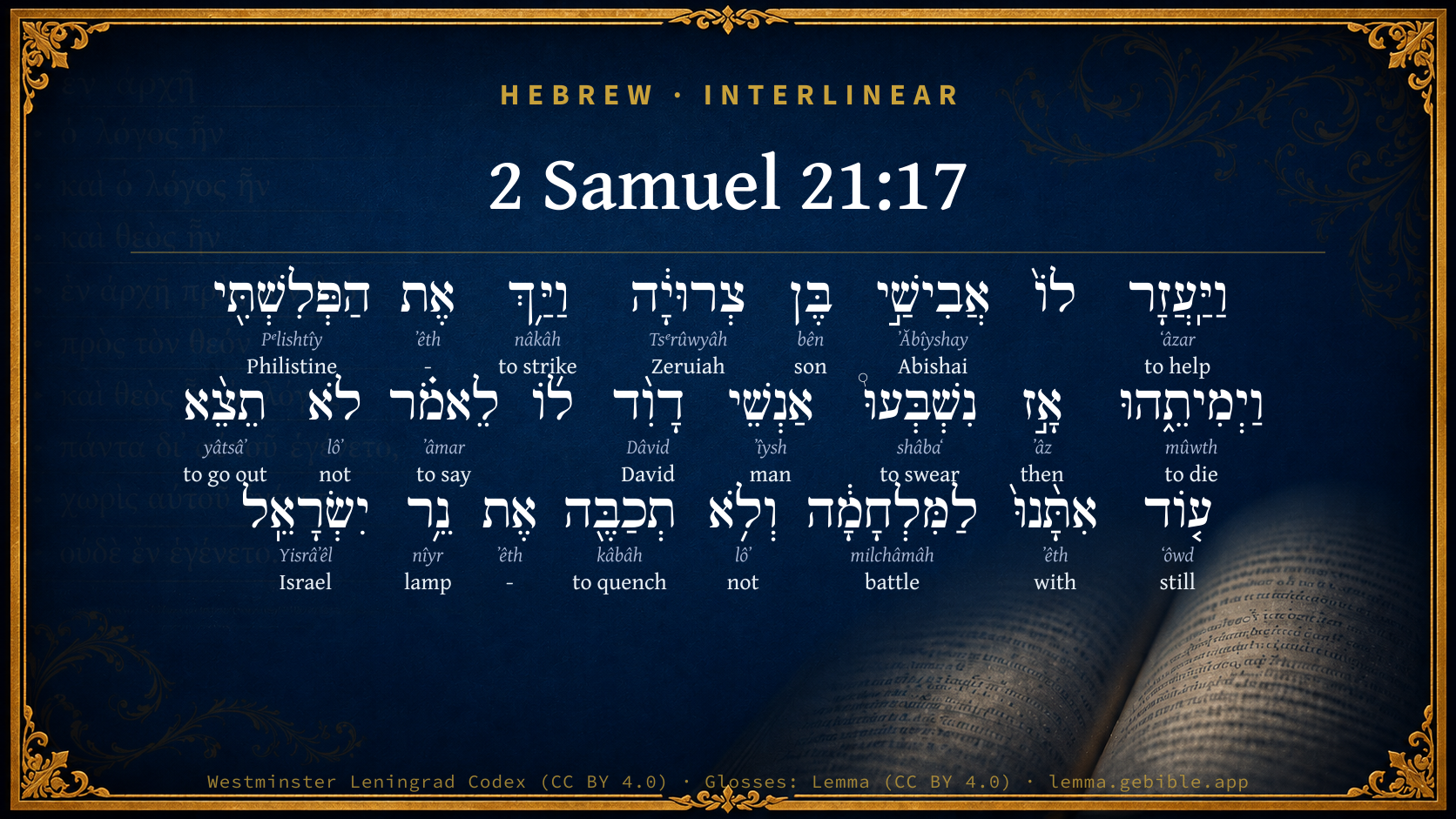
2 Samuel 21:17

Hebrew (Westminster Leningrad Codex) 2 Samuel 21:17 appears in the Hebrew Old Testament. The text above is from the Westminster Leningrad Codex. Each word links to its Strong’s number, a concise gloss, and parsing drawn from the Open Scriptures Hebrew Bible morphology. Click any word for its full Brown-Driver-Briggs (BDB) entry.
Download image
Cite this verse

2 Samuel 21:17 (World English Bible). Public Domain. Lemma interlinear Bible study tool, https://lemma.gebible.app/v/2-samuel/21/17.

Show BibTeX & RIS
BibTeX
RIS
English Translation
But Abishai the son of Zeruiah helped him, and struck the Philistine, and killed him. Then the men of David swore to him, saying, You shall go no more out with us to battle, that you don't quench the lamp of Israel.
World English Bible · Public Domain
Download a study sheet

One document with this verse’s original text, its word-by-word gloss line, the meaning frame, cross-references with their text, attributed commentary, and full source and license credits — printable, and it pastes into notes with its structure intact.

This verse Autodidact and up

Study sheet (.html) Plain text (.txt)

A passage Seminary Student

Up to 50 verses in one chapter. A passage sheet keeps up to 6 commentary sources and 12 cross-references per verse, in the order this page ranks them, and says so on the sheet whenever that leaves anything out. Ask for a single verse and you get the Autodidact verse sheet above.

Everything on this page stays free to read, with no account — the sheet is a download of what is already on screen, not access to it.

Want to remove ads? Support Godless Engineer
Compare translations 3

The same verse in 3 English versions, stacked beneath the original-language interlinear above. Click any original word for its lexicon entry.

Each is an independent rendering of the whole verse — the interlinear is not word-aligned to these translations.

Highlighted words mark where these versions differ — a whole-verse word diff, not a word-by-word alignment.

  • World English Bible Public Domain
    But Abishai the son of Zeruiah helped him, and struck the Philistine, and killed him. Then the men of David swore to him, saying, You shall go no more out with us to battle, that you don't quench the lamp of Israel.
  • King James Version Public Domain
    But Abishai the son of Zeruiah succored him, and smote the Philistine, and killed him. Then the men of David sware unto him, saying, Thou shalt go no more out with us to battle, that thou quench not the light of Israel.
  • unfoldingWord Literal Text CC BY-SA 4.0
    But Abishai, the son of Zeruiah, helped him, and he struck the Philistine, and he killed him. Then the men of David adjured him, saying, “You shall not go out with us to battle anymore, so you do not extinguish the lamp of Israel.”

unfoldingWord Literal Text — © unfoldingWord, licensed CC BY-SA 4.0. Word-aligned USFM3 via Door43 (git.door43.org/unfoldingWord/en_ult).

Versions to compare (up to 4)

3 of 4 selected

Show all 18 translations

Every available English version of this verse, each an independent rendering of the whole verse.

  • World English Bible Public Domain
    But Abishai the son of Zeruiah helped him, and struck the Philistine, and killed him. Then the men of David swore to him, saying, You shall go no more out with us to battle, that you don't quench the lamp of Israel.
  • Berean Standard Bible Public Domain
    But Abishai son of Zeruiah came to his aid, struck the Philistine, and killed him. Then David’s men swore to him, “You must never again go out with us to battle, so that the lamp of Israel may not be extinguished.”
  • Majority Standard Bible Public Domain
    But Abishai son of Zeruiah came to his aid, struck the Philistine, and killed him. Then David’s men swore to him, “You must never again go out with us to battle, so that the lamp of Israel may not be extinguished.”
  • King James Version Public Domain
    But Abishai the son of Zeruiah succored him, and smote the Philistine, and killed him. Then the men of David sware unto him, saying, Thou shalt go no more out with us to battle, that thou quench not the light of Israel.
  • American Standard Version (1901) Public Domain
    But Abishai the son of Zeruiah succored him, and smote the Philistine, and killed him. Then the men of David sware unto him, saying, Thou shalt go no more out with us to battle, that thou quench not the lamp of Israel.
  • Revised Version (1885) Public Domain
    But Abishai the son of Zeruiah succoured him, and smote the Philistine, and killed him. Then the men of David sware unto him, saying, Thou shalt go no more out with us to battle, that thou quench not the lamp of Israel.
  • Geneva Bible (1599) Public Domain
    But Abishai the sonne of Zeruiah succoured him, and smote the Philistim, and killed him. Then Dauids men sware vnto him, saying, Thou shalt goe no more out with vs to battell, lest thou quench the light of Israel.
  • Douay-Rheims (1899) Public Domain
    And Abisai the son of Sarvia rescued him, and striking the Philistine killed him. Then David's men swore unto him, saying: Thou shalt go no more out with us to battle, lest thou put out the lamp of Israel.
  • Young's Literal Translation Public Domain
    and Abishai son of Zeruiah giveth help to him, and smiteth the Philistine, and putteth him to death; then swear the men of David to him, saying, `Thou dost not go out again with us to battle, nor quench the lamp of Israel.'
  • Literal Standard Version CC BY-SA 4.0
    and Abishai son of Zeruiah gives help to him, and strikes the Philistine, and puts him to death; then the men of David swear to him, saying, “You do not go out with us to battle again, nor quench the lamp of Israel.”
  • Unlocked Literal Bible CC BY-SA 4.0
    But Abishai son of Zeruiah rescued David, attacked the Philistine, and killed him. Then the men of David swore to him, saying, “You must not go to battle anymore with us, so that you do not put out the lamp of Israel.”
  • unfoldingWord Literal Text CC BY-SA 4.0
    But Abishai, the son of Zeruiah, helped him, and he struck the Philistine, and he killed him. Then the men of David adjured him, saying, “You shall not go out with us to battle anymore, so you do not extinguish the lamp of Israel.”
  • Darby Bible Public Domain
    And Abishai the son of Zeruiah succoured him, and smote the Philistine and killed him. Then the men of David swore to him, saying, Thou shalt go no more out with us to battle, that thou quench not the lamp of Israel.
  • World Messianic Bible Public Domain
    But Abishai the son of Zeruiah helped him, and struck the Philistine and killed him. Then the men of David swore to him, saying, “Don’t go out with us to battle any more, so that you don’t quench the lamp of Israel.”
  • Webster's Bible Public Domain
    But Abishai the son of Zeruiah succored him, and smote the Philistine, and killed him. Then the men of David swore to him, saying, Thou shalt go out no more with us to battle, that thou mayest not extinguish the light of Israel.
  • Free Bible Version CC BY-SA 4.0
    But Abishai, son of Zeruiah, came to his rescue, attacked the Philistine, and killed him. Then David's men made him promise, saying, “Don't ever go out with us to battle again, so that the Israel's light isn't snuffed out!”
  • Bible in Basic English Public Domain
    But Abishai, the son of Zeruiah, came to his help, and, turning on the Philistine, gave him his death-blow. Then David's men took an oath, and said, Never again are you to go out with us to the fight, so that you may not put out the light of Israel.
  • JPS Tanakh (1917) Public Domain
    But Abishai the son of Zeruiah succoured him, and smote the Philistine, and killed him. Then the men of David swore unto him, saying: 'Thou shalt go no more out with us to battle, that thou quench not the lamp of Israel.'

Literal Standard Version (2020), Covenant Press — licensed CC BY-SA 4.0. Text via the HelloAO Bible API (eBible.org). Unlocked Literal Bible (unfoldingWord) — licensed CC BY-SA 4.0. Text via the HelloAO Bible API (eBible.org). unfoldingWord Literal Text — © unfoldingWord, licensed CC BY-SA 4.0. Word-aligned USFM3 via Door43 (git.door43.org/unfoldingWord/en_ult). Free Bible Version, Dr. Jonathan Gallagher — licensed CC BY-SA 4.0. Text via the HelloAO Bible API (eBible.org).

Word by word

More ways to search: Search by grammar → Find every occurrence → Compare this word →

Practice this passage: Drill this verse → Learn its vocabulary →

תְכַבֶּ֖ה
kâbâh
H3518
“to quench”
Verb, Piel, Imperfect, 2nd Person, Masculine, Singular
Part of Speech
Verb
Stem
Piel
Form
Imperfect
Person
2nd Person
Gender
Masculine
Number
Singular
Full BDB Definition

Origin: a primitive root

TWOT: 944

to quench, put out, be put out, be quenched, be extinguished - (Qal) to be quenched, be extinguished - (Piel) to quench, extinguish
  1. וַיַּֽעֲזָר ʻâzar H5826 “and · to help” Conjunction + Verb, Qal, Sequential Imperfect, 3rd Person, Masculine, Singular
  2. אֲבִישַׁ֣י ʼĂbîyshay H52 “Abishai” Noun, Proper
  3. בֶּן bên H1121 “son of” Noun, Common, Masculine, Singular, Construct
  4. צְרוּיָ֔ה Tsᵉrûwyâh H6870 “Zeruiah” Noun, Proper
  5. וַיַּ֥ךְ nâkâh H5221 “and · to strike” Conjunction + Verb, Hiphil, Sequential Imperfect, 3rd Person, Masculine, Singular
  6. אֶת ʼêth H853 “-” Particle, Direct Object
  7. הַפְּלִשְׁתִּ֖י Pᵉlishtîy H6430 “the · Philistine” Particle, Definite Article + Noun, Gentilic, Masculine, Singular, Absolute
  8. וַיְמִיתֵ֑הוּ mûwth H4191 “and · to die · him” Conjunction + Verb, Hiphil, Sequential Imperfect, 3rd Person, Masculine, Singular + Suffix, Personal, 3rd Person, Masculine, Singular
  9. אָ֣ז ʼâz H227 “then” Adverb
  10. נִשְׁבְּעוּ֩ shâbaʻ H7650 “to swear” Verb, Niphal, Perfect, 3rd Person, Common, Plural
  11. אַנְשֵׁי ʼîysh H376 “men of” Noun, Common, Masculine, Plural, Construct
  12. דָוִ֨ד Dâvid H1732 “David” Noun, Proper
  13. לֵאמֹ֗ר ʼâmar H559 “to say” Preposition + Verb, Qal, Infinitive Construct
  14. לֹא lôʼ H3808 “not” Particle, Negative
  15. תֵצֵ֨א yâtsâʼ H3318 “to go out” Verb, Qal, Imperfect, 2nd Person, Masculine, Singular
  16. ע֤וֹד ʻôwd H5750 “still” Adverb
  17. אִתָּ֨נוּ֙ ʼêth H854 “with · us” Preposition + Suffix, Personal, 1st Person, Common, Plural
  18. לַמִּלְחָמָ֔ה milchâmâh H4421 “to/for the · battle” Preposition, Determined + Noun, Common, Feminine, Singular, Absolute
  19. וְלֹ֥א lôʼ H3808 “and · not” Conjunction + Particle, Negative
  20. אֶת ʼêth H853 “-” Particle, Direct Object
  21. נֵ֥ר nîyr H5216 “lamp of” Noun, Common, Masculine, Singular, Construct
  22. יִשְׂרָאֵֽל Yisrâʼêl H3478 “Israel” Noun, Proper

About this verse

These counts appear in no published source. They are computed here, from the morphology-tagged text and Lemma’s own curated glosses. What Lemma adds →

25
words
21
distinct lemmas
Historical
section

Notable vocabulary

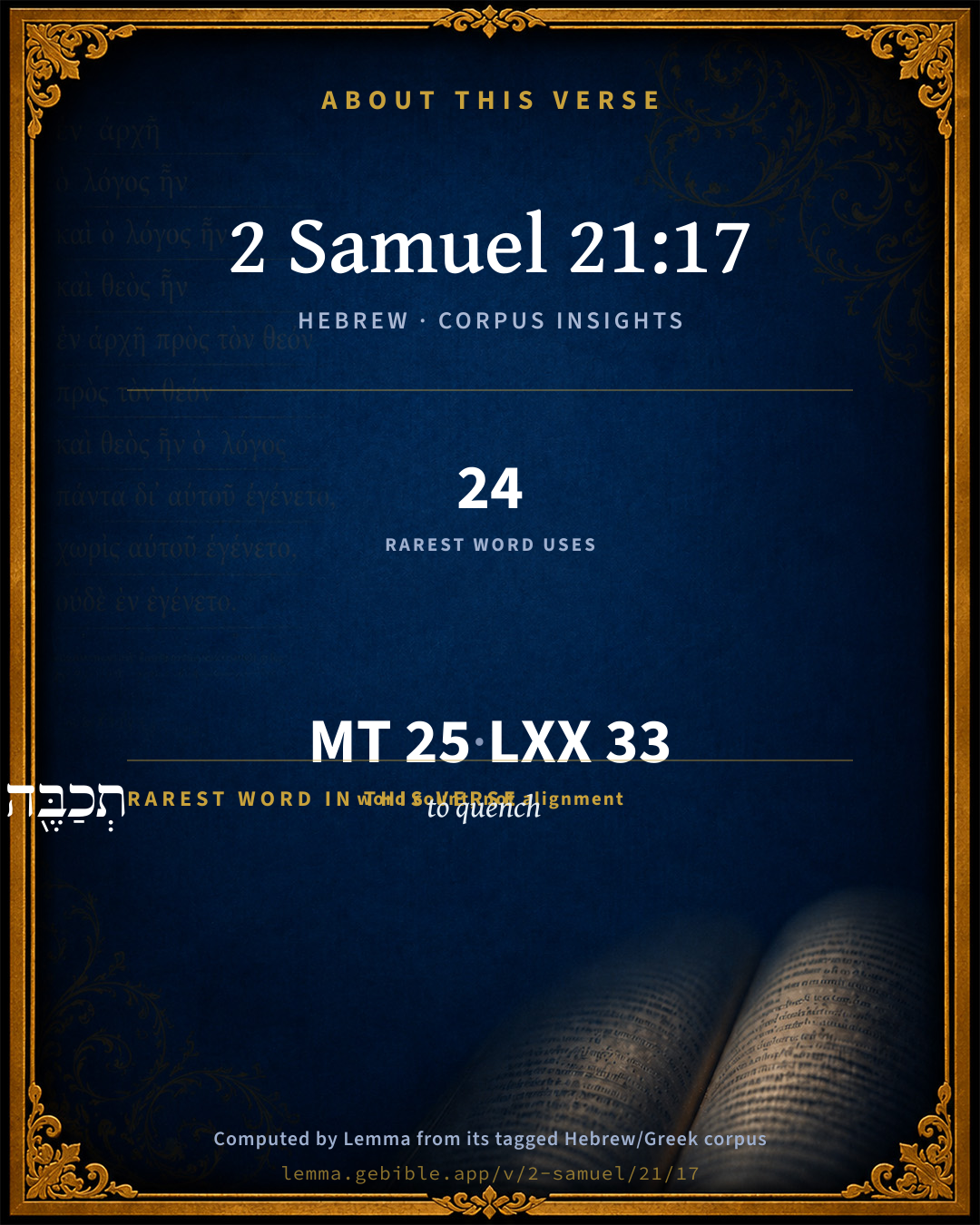
The rarest word here is תְכַבֶּ֖ה to quench H3518 — appearing just 24 times in the whole Hebrew Bible.

Shared distinctive vocabulary

תְכַבֶּ֖ה to quench H3518 occurs in 24 verses of the Hebrew Bible. Also found in:

Grammatical profile

  • 7 verbs
  • 9 nouns
  • 3 prepositions
  • 2 adverbs
  • 4 particles

Verb forms

  • וַיַּֽעֲזָר Qal · Sequential Imperfect
  • וַיַּ֥ךְ Hiphil · Sequential Imperfect
  • וַיְמִיתֵ֑הוּ Hiphil · Sequential Imperfect
  • נִשְׁבְּעוּ֩ Niphal · Perfect
  • לֵאמֹ֗ר Qal · Infinitive Construct
  • תֵצֵ֨א Qal · Imperfect
  • תְכַבֶּ֖ה Piel · Imperfect

Repetition

A word recurs within this verse — often emphatic in Hebrew:

Hebrew & Septuagint length

In English translation the verse runs 42 words from the Hebrew and 42 from the Septuagint (LXX English) — the same length.

A rough comparison of the two English renderings, which tokenize alike — not a word-level alignment.

Word counts can differ between the Hebrew and the Greek without any difference in meaning — e.g. the Hebrew direct-object marker אֵת has no separate Greek word, and Greek often adds the article ὁ.

In the original languages it is 25 Hebrew tokens and 33 Greek tokens — but the two are counted differently (Hebrew bundles its prefixes and suffixes into one token; the Greek is in lemma form), so that isn’t a like-for-like length.

Cross-references

12

Topical passages linked to 2 Samuel 21:17 in the Treasury of Scripture Knowledge — connected by theme and wording, ordered by reader-vote popularity; previews shown in the World English Bible.

  • 1 Kings 11:36 To his son will I give one tribe, that David my servant may have a lamp always before me in Jerusalem, the city which I have chosen me to put my name there.
  • 2 Samuel 18:3 But the people said, You shall not go forth: for if we flee away, they will not care for us; neither if half of us die, will they care for us: but you are worth ten thousand of us; therefore now it is better that you are ready to help us out of the city.
  • 1 Kings 15:4 Nevertheless for David's sake did Yahweh his God give him a lamp in Jerusalem, to set up his son after him, and to establish Jerusalem;
  • Psalms 132:17 There I will make the horn of David to bud. I have ordained a lamp for my anointed.
  • 2 Samuel 20:6–10 David said to Abishai, Now will Sheba the son of Bichri do us more harm than did Absalom: take your lord's servants, and pursue after him, lest he get him fortified cities, and escape out of our sight.
  • 2 Samuel 14:7 Behold, the whole family is risen against your handmaid, and they say, Deliver him who struck his brother, that we may kill him for the life of his brother whom he killed, and so destroy the heir also. Thus will they quench my coal which is left, and will leave to my husband neither name nor remainder on the surface of the earth.
  • 2 Samuel 22:19 They came on me in the day of my calamity; But Yahweh was my stay.
  • 2 Samuel 22:29 For you are my lamp, Yahweh; Yahweh will lighten my darkness.
  • Psalms 46:1 God is our refuge and strength, A very present help in trouble.
  • Psalms 144:10 You are he who gives salvation to kings, Who rescues David, his servant, from the deadly sword.
  • John 1:8–9 He was not the light, but was sent that he might testify about the light.
  • John 5:35 He was the burning and shining lamp, and you were willing to rejoice for a while in his light.

Cross-references courtesy of OpenBible.info (CC BY 4.0).

Hebrew and Greek witnesses Masoretic Hebrew ↔ Greek Septuagint

The same verse in the two great witnesses to the Old Testament, shown verse-for-verse.

These are two independent witnesses, not word-aligned to each other, and the Septuagint is shown in lemma (dictionary) form.

Hebrew 2 Samuel 21:17 Masoretic · Westminster Leningrad Codex

וַיַּֽעֲזָר לוֹ֙ אֲבִישַׁ֣י בֶּן צְרוּיָ֔ה וַיַּ֥ךְ אֶת הַפְּלִשְׁתִּ֖י וַיְמִיתֵ֑הוּ אָ֣ז נִשְׁבְּעוּ֩ אַנְשֵׁי דָוִ֨ד ל֜וֹ לֵאמֹ֗ר לֹא תֵצֵ֨א ע֤וֹד אִתָּ֨נוּ֙ לַמִּלְחָמָ֔ה וְלֹ֥א תְכַבֶּ֖ה אֶת נֵ֥ר יִשְׂרָאֵֽל

But Abishai the son of Zeruiah helped him, and struck the Philistine, and killed him. Then the men of David swore to him, saying, You shall go no more out with us to battle, that you don't quench the lamp of Israel.

World English Bible · Public Domain

Greek LXX 2 Samuel 21:17 Septuagint · lemma form

καί βοηθέω αὐτός αβεσσα υἱός σαρουιας καί πατάσσω ὁ ἀλλόφυλος καί θανατόω αὐτός τότε ὄμνυμι ὁ ἀνήρ δαυίδ λέγω οὐ ἐκἔρχομαι ἔτι μετά ἐγώ εἰς πόλεμος καί οὐ μή σβέννυμι ὁ λύχνος ἰσραήλ

And Abessa the son of Saruia helped him and struck the Philistine, and killed him. Then the men of David swore, saying, You shall not any longer go out with us to battle, and you shall not quench the lamp of Israel.

LXX2012 (modern English Septuagint) · Public Domain

Hebrew: Westminster Leningrad Codex (CC BY 4.0). Greek: Septuagint (public domain); English from LXX2012 (modern English Septuagint) (Public Domain). How the Septuagint differs from the Hebrew →

Targum (Aramaic paraphrase)

1

The Targum is the ancient Jewish Aramaic paraphrase of the Hebrew Scriptures — an interpretive translation, not the Hebrew text itself. Onkelos (literal) and Pseudo-Jonathan (expansive) render the Torah, and Jonathan the Prophets. Coverage is partial: where no permissively-licensed English translation exists for a verse, only the Aramaic is shown. This is verse-level text, not a word-by-word alignment to the Hebrew.

  1. Targum Jonathan Prophets (Joshua–Malachi)
    וּסְעֵיד לֵיהּ אֲבִישַׁי בַּר צְרוּיָה וּמְחָא יַת פְּלִשְׁתָּאָה וְקַטְלֵיהּ בְּכֵן קַיָימוּ גַבְרֵי דָוִד לֵיהּ לְמֵימַר לָא תִּפּוֹק עוֹד עִמָנָא לִקְרָבָא וְלָא תִיטְפֵי יַת מַלְכוּתָא דְיִשְׂרָאֵל:

    (no public-domain English translation for this verse)

    Targum Jonathan — Aramaic: “Mikraot Gedolot” (public domain). English: “Sefaria Community Translation” (CC0 1.0 (public-domain dedication)); “London "Chaldee Paraphrase," 1871” (public domain). Text via Sefaria.

Commentary

Notes on 2 Samuel 21:17 from classic Christian and Jewish commentators (each source and its license shown beneath its notes). The classic Christian expositions comment on the surrounding passage and are grouped to its opening verse, so a note may address several verses; the Jewish commentaries on the Tanakh (Rashi and others) are per-verse, so they appear only where the commentator wrote on this verse.

Lemma curates 59 commentaries, every one of them public domain or Creative Commons licensed, each selected and text-cleaned for this edition rather than reprinted as found. About our sources →

Trapp's Complete Commentary

John Trapp

2Sa 21:17 But Abishai the son of Zeruiah succoured him, and smote the Philistine, and killed him. Then the men of David sware unto him, saying, Thou shalt go no more out with us to battle, that thou quench not the light of Israel.

Ver. 17. That thou quench not the light of Israel.] As Epaminondas, by his death, did the Thebans, who were after that famous for their calamities, and no more for their victories. The body drowneth not whilst the head is above water; when that once sinketh, death is near: so here. Pray therefore for the preservation of good princes; we cannot pray for them, and not pray for ourselves.

John Trapp, A Commentary or Exposition upon All the Books of the Old and New Testament (1647–1656) — public domain. Text from a community e-Sword module.

Joseph Benson's Commentary

2Sa 21:17. That thou quench not the light of Israel — Lest thou be slain, and thereby thy people lose their glory and happiness, and even be utterly ruined. Good kings are, in Scripture, justly called the light of their people, because the beauty and glory, the conduct and direction, the comfort and safety, and welfare of a people depend greatly upon them. A noble image this of a king!

Joseph Benson's Commentary on the Old and New Testaments (1811–1818) — public domain. Text from a community e-Sword module.

Tyndale Open Study Notes

Tyndale Open Resources

21:17 Abishai was an accomplished warrior and fiercely loyal to David, whom he heroically rescued (see “Abishai” Profile). • the light of Israel? Cp. 18:3. Both passages reflect the glowing adoration that David’s men had for him.

Tyndale Open Study Notes — © Tyndale Open Resources, licensed CC BY-SA 4.0. Text via the HelloAO Bible API.

Geneva Bible (1599)

Geneva Bible translators

For the glory and wealth of the country standeth in the preservation of the godly magistrate.

Geneva Bible (1599) marginal notes — public domain. Text via Bolls.life.

Adam Clarke's Commentary

Verse 17. That thou quench not the light of Israel.] David is here considered as the lamp by which all Israel was guided, and without whom all the nation must be involved in darkness. The lamp is the emblem of direction and support. Light is used in this sense by Homer: -

Ουδε τι Πατροκλῳ γενομην φαος, αυδ ' ἑταροισιπ

Τοις αλλοις, οἱ δη πολεες δαμεν Ἑκτορι διῳ.

Iliad, lib. xviii. ver. 102.

"I have neither been a LIGHT to Patroclus nor to his

companions, who have been slain by the noble Hector."

Adam Clarke's Commentary on the Bible (1810–1826) — public domain. Text from a community e-Sword/MySword module.

Ellicott's Commentary for English Readers

(17) And smote.—The original leaves it doubtful whether Abishai is the nominative to the verb, or whether it should be simply he, referring to David. 2Sa_21:22 seems to imply that one at least of the sons of the giant fell by David’s own hand.

Sware unto him.—This was a solemn transaction, by which David should hereafter be restrained from personal exposure in battle. That he should be spoken of as “the light of Israel” implies that his government over all Israel had continued long enough already to make its immense benefits sensible.

A Bible Commentary for English Readers, edited by Charles John Ellicott (1878–1897) — public domain. Text from a community e-Sword module.

The Cambridge Bible for Schools and Colleges

gen. ed. J. J. S. Perowne

17. and smote] Perhaps, and he (David) smote; as 2Sa_21:22 seems to imply that one of them fell by David’s own hand.

that thou quench not the light of Israel] Extinguishing the lamp is a natural metaphor for changing the light of prosperity into the darkness of calamity; and in particular David’s sovereignty was the lamp which God’s favour had lighted for the well-being of His people. An Arab in misfortune says, “Fate has put out my lamp.” Cp. Job_18:6; Pro_13:9. The expression light of Israel seems to indicate that David was already king of all Israel, and if so, the incident may have happened in one of the wars recorded in ch. 2Sa_5:17-25.

The Cambridge Bible for Schools and Colleges (gen. ed. J. J. S. Perowne; Cambridge University Press, 1878–1918) — public domain. Text from a community e-Sword module.

John Gill's Exposition

And it came to pass after this,.... After the former battle:

that there was again a battle with the Philistines at Gob; in Ch1 20:4 it is called Gezer; either the place had two names, or these two places were near each other; so that the battle may be said to be fought both at the one and at the other, being fought equally near to both:

then Sibbechai the Hushathite slew Saph, which was of the sons of the giant; who is called Sippai, Ch1 20:4; he had his name from the lintel of a door, being as high as one, so tall that he could scarce go under one. Sibbechai was one of David's worthies, Ch1 11:29; perhaps a descendant of Hushah, who sprung from Judah, Ch1 4:4.

John Gill's Exposition of the Whole Bible (1746–1763) — public domain (CC PDM 1.0). Text via the HelloAO Bible API.

Haydock's Catholic Bible Commentary

Lamp; glory and protection. Achilles reproaches himself for not having been "a light to" his friend. (Homer, Iliad Greek: S.)

George Leo Haydock (1774–1849), Haydock's Catholic Family Bible and Commentary, 1859 edition — public domain. Excludes Psalms (Douay-Rheims chapter numbering differs from Protestant) and Deuterocanonical books (Catholic canon only).

Matthew Poole's English Annotations

Lest thou be slain, and thereby thy people be ruined. Good kings are in Scripture justly called the light of their people, as 1Ki 11:36; 15:4; Psa 132:17, because the beauty and glory, the conduct and direction, the comfort, and safety, and welfare of a people depend upon them, and come from them.

Matthew Poole's English Annotations on the Holy Bible (1683–1685) — public domain. Text from a community e-Sword/MySword module.

Whedon's Commentary on the Bible

Daniel D. Whedon

17. Sware unto him — The word נשׁבעו seems here to have rather a causative signification, made him swear; that is, administered an oath unto him.

Quench not the light of Israel — David’s position as king over Israel and leader of the armies was like that of the sun in the heavens, or a lamp in a house. Let it be suddenly removed, and all would be involved in darkness and terror. Compare 2Sa_18:3.

Daniel D. Whedon (gen. ed.), Commentary on the Old and New Testaments (1874–1909) — public domain. Text from a community e-Sword module.

The Pulpit Commentary

The men of David sware unto him. David"s men were specifically the mighties, who had so long been his friends and companions. They now bound him by an oath never again to fight in person, lest he should be singled out for combat by some warrior among the enemy and slain. The light of Israel. The lamp in the dwelling was the proof that there was life there, and so it became the symbol of prosperity. In Job_18:5, 6 the extinction of the lamp signifies the destruction of the family. David was evidently now king, and under him Israel was advancing to freedom and empire. His death would have plunged the nation back into weakness and probable ruin.

The lamp of Israel.

In the view of his followers, David was the lamp (Hebrew, naer) or glory of the nation, and the continuance of his life and reign was essential to its welfare. This is a striking testimony to their estimate of his personal character and faithful and prosperous rule. Similar language is used of others. "He was the lamp that burueth and shineth," etc. (Joh_5:35; Mat_5:14) And every faithful servant of God is "a light giver in the world". (Php_2:15) Such a lamp is

I KINDLED BY THE GRACIOUS HAND OF GOD, the true Glory of Israel, the Father of lights, the Fountain of life and light. (Psa_36:9) None are so ready to recognize dependence upon God for life and all good as the devout man himself.

Thou art my Lamp, O Jehovah, And Jehovah enlightens my darkness. (2Sa_22:29; Psa_18:28 Psa_27:1)

"David"s regal life and actions were the light which the grace of God had kindled for the benefit of Israel." Whatever his gifts, his graces, his position, his success, they am all humbly, gratefully, and constantly ascribed to their Divine Source by the faithful servant; and, whilst we admire him, we should "glorify God in him" (1Co_15:10; Gal_1:24)

II CONDUCTIVE TO THE REAL WELFARE OF MEN. "Neither do men light a lamp and put it under the bushel," etc.. (Mat_5:15)

Heaven does with us as we with torches do, Not light them for themselves," etc. ("Measure for Measure," act 1 sc. 1.)

By his counsel, his example, his endeavours, his prayers, he renders invaluable service to others in directing them in perplexity and peril; preserving them from error and evil; stimulating them to effort and conflict; and contributing to their safety, prosperity, and lasting happiness.

III EXPOSED TO IMMINENT DANGER OF EXTINCTION. The light is liable to be quenched. Life is always precarious; the life of some peculiarly so; like that of David when he went down into the conflict (vers. 15, 16; 2Sa_5:17-25) waxed faint, and was set upon by the giant Ishbi-benob, in a new suit of armour. And it is not only natural life, but also moral and spiritual life, that is beset by danger. The part which a good man takes in the conflict between good and evil attracts the attention of his adversaries, makes him a special object of attack; (1Ki_22:31) his efforts are exhausting, and his zeal is apt to consume him. (Psa_69:9 Psa_119:139) "Ernestus, Duke of Luneburg, caused a burning lamp to be stamped on his coin, with these four letters, A.S.M.C., by which was meant, Aliis serviens meipsum contero, By giving light to others I consume myself (Spencer).

IV WORTHY OF BEING HIGHLY ESTEEMED, carefully sustained, and zealously guarded. "And Abishai succoured him, and he Abishai, or perhaps David, ver. 22 killed him," etc. The preserving care of God (2Sa_8:14) does not render needless human sympathy, assistance, prudence, resolution. (2Sa_18:3) He who freely spends his strength and risks his life for others ought to be esteemed, considered, defended, and helped by them (1Th_5:12, 1Th_5:23; 2Th_3:2; Heb_13:17) and, herein, they also benefit themselves and the whole community. "If any man serve me, let him follow me," etc.. D. (Joh_12:26-28)

The unquenchable Light.

thou quench not the light of Israel." "The men of David" who thus speak, and doubtless the multitude of his subjects, regarded him as the light (literally, as in Revised Version, "the lamp") of the nation its guiding mind, its safety, glory, and joy. His death would involve the nation in darkness in perplexity, confusion, peril, and trouble. Such was likely enough to be the consequence of his death at that period. Nevertheless, David, as a moral and spiritual light, burns on still for all peoples and generations. Death did not quench this light. More emphatically is this true of Jesus Christ our King.

I HE IS THE LIGHT OF MEN. Intended ultimately to "lighten every man;" actually enlightening those who receive him. He is their:

1. Teacher and Guide. Through whose revelations they know God and himself and themselves; sin and righteousness; heaven, and the way to it; perdition, and how to escape it; the real worth of things; the wisdom needful for the guidance of life. Christ sheds light upon all things the light by which their true character and relations are made apparent.

2. Safety and Salvation. In darkness is peril; in light security.

3. Glory. Imparting to them of his own lustre.

4. Joy. In knowledge and conscious safety are peace and happiness and hope; in ignorance, doubt, and perplexity, is unhappiness.

II HIS LIGHT CANNOT BE QUENCHED.

1. Not the light of his personal glory In the battle with his foes and ours, hefell and died; but he rose again, and to a greater brightness of glory, in consequence of his death. His cross itself is a great light for men. He lives above all the power of his enemies. He goes with his people to battle, but cannot be touched by the foe.

2. Nor the Light he has become to men through the knowledge he hasgiven to the world. Great and formidable and persistent have been the efforts to extinguish the light; but it burns on unquenched and unquenchable. It may be obscured here and there, and for a time, but it can never go out. It will yet shine forth over the whole earth, and scatter all the darkness of error and sin.

3. Nor the Light he is to each of his believing people. Through life, and indeath, and forever, he remains their Light. His presence in their hearts is their wisdom and joy under all circumstances.

Then:

1. Be grateful for him.

2. Accept the light he sheds.

3. "Walk as children of light.

4. Be lights yourselves. Shine by speech, and especially in yourlives. G.W.

The Pulpit Commentary (1880–1919), ed. H.D.M. Spence-Jones & Joseph S. Exell — public domain. Text from a community e-Sword module.

Rashi

Rabbi Shlomo Yitzchaki (Rashi)

[Came] to his aid. He helped him with his prayer as is brought in [chapter] Cheilek.

Rashi on the Tanakh — English translations: “The Judaica Press complete Tanach with Rashi, translated by A. J. Rosenberg” (CC BY 4.0); “Pentateuch with Rashi's commentary by M. Rosenbaum and A.M. Silbermann, 1929-1934” (public domain); “The Metsudah Tanach series, Lakewood, N.J” (CC BY 4.0); and “The Book of Joshua, Metsudah Publications, 1997” (CC BY 4.0). Text via Sefaria.

Lesson kit

Teaching starters — assembled from the data on this page, not authored interpretation. Every prompt links to the verse data it draws on. Edit before teaching.

2 Samuel, in the Historical, opens this verse with 25 words (21 distinct Hebrew lemmas). Its most distinctive word is kâbâh (“to quench”). A historical commentator’s framing appears above. Read the whole chapter for the surrounding context.

Discussion questions

  1. What does “to quench” (kâbâh) contribute to the verse as a whole?
  2. Leviticus 6:12 shares the word «to quench» with this verse. How do the two illuminate each other?
  3. “not” occurs 2× in this one verse. What is the effect of the repetition?
  4. These translations render this verse differently; the difference is in the English rendering, not the original. What questions does that raise?
  5. The verb «וַיַּֽעֲזָר» is Qal Sequential Imperfect. How does its form color the action?
  6. Reading how Trapp's Complete Commentary and Joseph Benson's Commentary read this verse, where do the two commentators agree and where do they part?

Things to notice

Reading settings

Reading text

Shown beneath each verse's original-language words.

Old Testament
Old Testament edition

Read the OT as the Masoretic Hebrew (MT) or the Greek Septuagint (LXX).

English shown for the Greek Septuagint (in the Hebrew ↔ Greek comparison).

Comparing translations? Open the Compare panel on any verse page to stack up to four side by side.