
Psalms 94:4

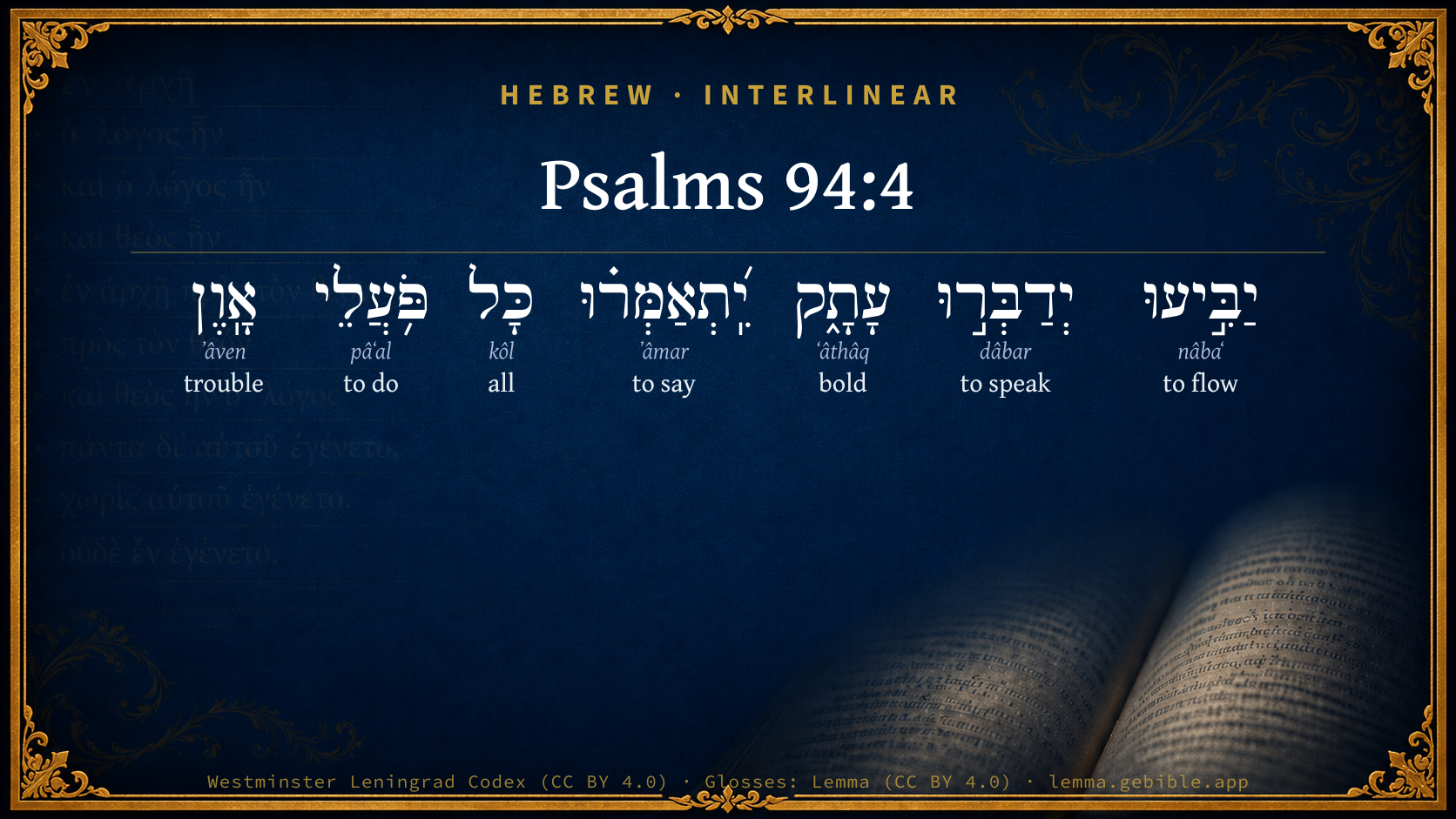
Hebrew (Westminster Leningrad Codex) Psalms 94:4 appears in the Hebrew Old Testament. The text above is from the Westminster Leningrad Codex. Each word links to its Strong’s number, a concise gloss, and parsing drawn from the Open Scriptures Hebrew Bible morphology. Click any word for its full Brown-Driver-Briggs (BDB) entry.
Download image
Cite this verse

Psalms 94:4 (World English Bible). Public Domain. Lemma interlinear Bible study tool, https://lemma.gebible.app/v/psalms/94/4.

Show BibTeX & RIS
BibTeX
RIS
English Translation
They pour out arrogant words. All the evil-doers boast.
World English Bible · Public Domain
Download a study sheet

One document with this verse’s original text, its word-by-word gloss line, the meaning frame, cross-references with their text, attributed commentary, and full source and license credits — printable, and it pastes into notes with its structure intact.

This verse Autodidact and up

Study sheet (.html) Plain text (.txt)

A passage Seminary Student

Up to 50 verses in one chapter. A passage sheet keeps up to 6 commentary sources and 12 cross-references per verse, in the order this page ranks them, and says so on the sheet whenever that leaves anything out. Ask for a single verse and you get the Autodidact verse sheet above.

Everything on this page stays free to read, with no account — the sheet is a download of what is already on screen, not access to it.

Want to remove ads? Support Godless Engineer
Compare translations 3

The same verse in 3 English versions, stacked beneath the original-language interlinear above. Click any original word for its lexicon entry.

Each is an independent rendering of the whole verse — the interlinear is not word-aligned to these translations.

Highlighted words mark where these versions differ — a whole-verse word diff, not a word-by-word alignment.

  • World English Bible Public Domain
    They pour out arrogant words. All the evil-doers boast.
  • King James Version Public Domain
    How long shall they utter and speak hard things? and all the workers of iniquity boast themselves?
  • unfoldingWord Literal Text CC BY-SA 4.0
    They pour out, they speak, arrogance; all doers of evil praise themselves.

unfoldingWord Literal Text — © unfoldingWord, licensed CC BY-SA 4.0. Word-aligned USFM3 via Door43 (git.door43.org/unfoldingWord/en_ult).

Versions to compare (up to 4)

3 of 4 selected

Show all 18 translations

Every available English version of this verse, each an independent rendering of the whole verse.

  • World English Bible Public Domain
    They pour out arrogant words. All the evil-doers boast.
  • Berean Standard Bible Public Domain
    They pour out arrogant words; all workers of iniquity boast.
  • Majority Standard Bible Public Domain
    They pour out arrogant words; all workers of iniquity boast.
  • King James Version Public Domain
    How long shall they utter and speak hard things? and all the workers of iniquity boast themselves?
  • American Standard Version (1901) Public Domain
    They prate, they speak arrogantly: All the workers of iniquity boast themselves.
  • Revised Version (1885) Public Domain
    They prate, they speak arrogantly: all the workers of iniquity boast themselves.
  • Geneva Bible (1599) Public Domain
    They prate and speake fiercely: all the workers of iniquitie vaunt themselues.
  • Douay-Rheims (1899) Public Domain
    Shall they utter, and speak iniquity: shall all speak who work injustice?
  • Young's Literal Translation Public Domain
    They utter -- they speak an old saw, All working iniquity do boast themselves.
  • Literal Standard Version CC BY-SA 4.0
    They utter—they speak arrogance, || All working iniquity boast [about] themselves.
  • Unlocked Literal Bible CC BY-SA 4.0
    They pour out their arrogant words; all those who do evil boast.
  • unfoldingWord Literal Text CC BY-SA 4.0
    They pour out, they speak, arrogance; all doers of evil praise themselves.
  • Darby Bible Public Domain
    [How long] shall they utter [and] speak insolence -- all the workers of iniquity boast themselves?
  • World Messianic Bible Public Domain
    They pour out arrogant words. All the evildoers boast.
  • Webster's Bible Public Domain
    How long shall they utter and speak hard things? and all the workers of iniquity boast themselves?
  • Free Bible Version CC BY-SA 4.0
    How long will you let them pour out their arrogant words? How long will these evil people go on boasting?
  • Bible in Basic English Public Domain
    Words of pride come from their lips; all the workers of evil say great things of themselves.
  • JPS Tanakh (1917) Public Domain
    They gush out, they speak arrogancy; all the workers of iniquity bear themselves loftily.

Literal Standard Version (2020), Covenant Press — licensed CC BY-SA 4.0. Text via the HelloAO Bible API (eBible.org). Unlocked Literal Bible (unfoldingWord) — licensed CC BY-SA 4.0. Text via the HelloAO Bible API (eBible.org). unfoldingWord Literal Text — © unfoldingWord, licensed CC BY-SA 4.0. Word-aligned USFM3 via Door43 (git.door43.org/unfoldingWord/en_ult). Free Bible Version, Dr. Jonathan Gallagher — licensed CC BY-SA 4.0. Text via the HelloAO Bible API (eBible.org).

Word by word

More ways to search: Search by grammar → Find every occurrence → Compare this word →

Practice this passage: Drill this verse → Learn its vocabulary →

About this verse

These counts appear in no published source. They are computed here, from the morphology-tagged text and Lemma’s own curated glosses. What Lemma adds →

7
words
7
distinct lemmas
Wisdom
section

Notable vocabulary

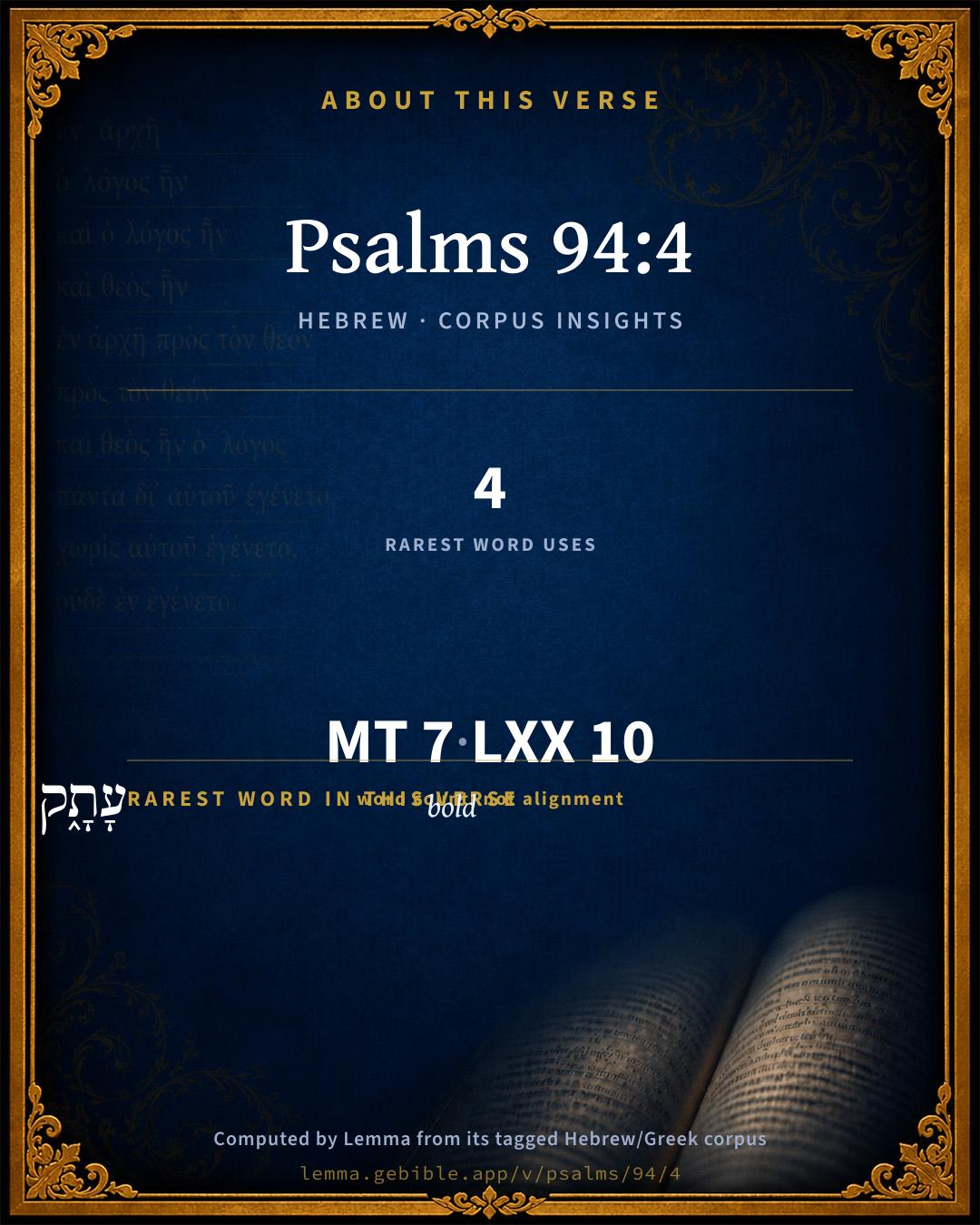
The rarest word here is עָתָ֑ק bold H6277 — appearing just 4 times in the whole Hebrew Bible.

Shared distinctive vocabulary

עָתָ֑ק bold H6277 occurs in 4 verses of the Hebrew Bible. Also found in:

Grammatical profile

  • 4 verbs
  • 2 nouns
  • 1 adjective

Verb forms

  • יַבִּ֣יעוּ Hiphil · Imperfect
  • יְדַבְּר֣וּ Piel · Imperfect
  • יִֽ֝תְאַמְּר֗וּ Hithpael · Imperfect
  • פֹּ֥עֲלֵי Qal · Participle Active

Hebrew & Septuagint length

In English translation the verse runs 9 words from the Hebrew and 14 from the Septuagint (LXX English) — closely comparable.

A rough comparison of the two English renderings, which tokenize alike — not a word-level alignment.

Word counts can differ between the Hebrew and the Greek without any difference in meaning — e.g. the Hebrew direct-object marker אֵת has no separate Greek word, and Greek often adds the article ὁ.

In the original languages it is 7 Hebrew tokens and 10 Greek tokens — but the two are counted differently (Hebrew bundles its prefixes and suffixes into one token; the Greek is in lemma form), so that isn’t a like-for-like length.

Cross-references

23

Topical passages linked to Psalms 94:4 in the Treasury of Scripture Knowledge — connected by theme and wording, ordered by reader-vote popularity; previews shown in the World English Bible.

  • Psalms 31:18 Let the lying lips be mute, Which speak against the righteous insolently, with pride and contempt.
  • Psalms 52:1 Why do you boast of mischief, mighty man? God's loving kindness endures continually.
  • Psalms 140:3 They have sharpened their tongues like a serpent. Viper's poison is under their lips. Selah.
  • Daniel 7:25 He shall speak words against the Most High, and shall wear out the saints of the Most High; and he shall think to change the times and the law; and they shall be given into his hand until a time and times and half a time.
  • Jude 1:14–15 About these also Enoch, the seventh from Adam, prophesied, saying, "Behold, the Lord came with ten thousands of his holy ones,
  • Revelation 13:5–6 A mouth speaking great things and blasphemy was given to him. Authority to make war for forty-two months was given to him.
  • Exodus 15:9–10 The enemy said, 'I will pursue, I will overtake, I will divide the spoil. My desire shall be satisfied on them. I will draw my sword, my hand shall destroy them.'
  • Job 21:14–15 They tell God, 'Depart from us, For we don't want to know about your ways.
  • Psalms 10:2–7 In arrogance, the wicked hunt down the weak; They are caught in the schemes that they devise.
  • Psalms 59:7 Behold, they spew with their mouth. Swords are in their lips, "For," they say, "who hears us?"
  • Psalms 59:12 For the sin of their mouth, and the words of their lips, Let them be caught in their pride, For the curses and lies which they utter.
  • Psalms 64:3–4 Who sharpen their tongue like a sword, And aim their arrows, deadly words,
  • Psalms 73:8–9 They scoff and speak with malice. In arrogance, they threaten oppression.
  • Proverbs 30:14 There is a generation whose teeth are like swords, And their jaws like knives, To devour the poor from the earth, and the needy from among men.
  • Isaiah 10:13–15 For he has said, By the strength of my hand I have done it, and by my wisdom; for I have understanding: and I have removed the bounds of the peoples, and have robbed their treasures, and like a valiant man I have brought down those who sit [on thrones]:
  • Isaiah 37:24–25 By your servants have you defied the Lord, and have said, With the multitude of my chariots am I come up to the height of the mountains, to the innermost parts of Lebanon; and I will cut down the tall cedars of it, and the choice fir trees of it; and I will enter into its farthest height, the forest of its fruitful field;
  • Jeremiah 18:18 Then said they, Come, and let us devise devices against Jeremiah; for the law shall not perish from the priest, nor counsel from the wise, nor the word from the prophet. Come, and let us strike him with the tongue, and let us not give heed to any of his words.
  • Daniel 7:8 I considered the horns, and, behold, there came up among them another horn, a little one, before which three of the first horns were plucked up by the roots: and, behold, in this horn were eyes like the eyes of a man, and a mouth speaking great things.
  • Daniel 7:11 I saw at that time because of the voice of the great words which the horn spoke; I saw even until the animal was slain, and its body destroyed, and it was given to be burned with fire.
  • Daniel 8:11 Yes, it magnified itself, even to the prince of the host; and it took away from him the continual [burnt offering], and the place of his sanctuary was cast down.
  • Daniel 11:36–37 The king shall do according to his will; and he shall exalt himself, and magnify himself above every god, and shall speak marvelous things against the God of gods; and he shall prosper until the indignation be accomplished; for that which is determined shall be done.
  • Matthew 12:24 But when the Pharisees heard it, they said, "This man does not cast out demons, except by Beelzebul, the prince of the demons."
  • Matthew 12:34 You offspring of vipers, how can you, being evil, speak good things? For out of the abundance of the heart, the mouth speaks.

Cross-references courtesy of OpenBible.info (CC BY 4.0).

Hebrew and Greek witnesses Masoretic Hebrew ↔ Greek Septuagint

The same verse in the two great witnesses to the Old Testament, shown verse-for-verse.

You’re reading Greek Psalm 93 (Hebrew Psalm 94). The Septuagint counts the superscription, so verse numbers can differ from the Hebrew — chapter-level alignment, not verse-by-verse. Numbering follows Rahlfs.

These are two independent witnesses, not word-aligned to each other, and the Septuagint is shown in lemma (dictionary) form.

Hebrew Psalms 94:4 Masoretic · Westminster Leningrad Codex

יַבִּ֣יעוּ יְדַבְּר֣וּ עָתָ֑ק יִֽ֝תְאַמְּר֗וּ כָּל פֹּ֥עֲלֵי אָֽוֶן

They pour out arrogant words. All the evil-doers boast.

World English Bible · Public Domain

Greek LXX Greek Psalm 93:4 Septuagint · lemma form

φθέγγομαι καί λαλέω ἀδικία λαλέω πᾶς ὁ ἐργάζομαι ὁ ἀνομία

They will utter and speak unrighteousness; all the workers of iniquity will speak so.

LXX2012 (modern English Septuagint) · Public Domain

Hebrew: Westminster Leningrad Codex (CC BY 4.0). Greek: Septuagint (public domain); English from LXX2012 (modern English Septuagint) (Public Domain). How the Septuagint differs from the Hebrew →

Commentary

Notes on Psalms 94:4 from classic Christian and Jewish commentators (each source and its license shown beneath its notes). The classic Christian expositions comment on the surrounding passage and are grouped to its opening verse, so a note may address several verses; the Jewish commentaries on the Tanakh (Rashi and others) are per-verse, so they appear only where the commentator wrote on this verse.

Lemma curates 59 commentaries, every one of them public domain or Creative Commons licensed, each selected and text-cleaned for this edition rather than reprinted as found. About our sources →

The Cambridge Bible for Schools and Colleges

gen. ed. J. J. S. Perowne

4. The verses run in pairs, and it seems preferable, with A.V., to regard Psa_94:4 as a continuation of the question in Psa_94:3, rather than, with R.V., to render it as an affirmative sentence. Workers of iniquity is the subject to the whole verse.

(How long) shall all workers of iniquity

Belch out, talk arrogantly, act haughtily?

Cp. Psa_59:2; Psa_59:7; Psa_31:18. The exact sense of the last verb is doubtful. It may mean ‘exalt themselves,’ or ‘speak proudly one with another.’

The Cambridge Bible for Schools and Colleges (gen. ed. J. J. S. Perowne; Cambridge University Press, 1878–1918) — public domain. Text from a community e-Sword module.

Trapp's Complete Commentary

John Trapp

Psa 94:4 [How long] shall they utter [and] speak hard things? [and] all the workers of iniquity boast themselves?

Ver. 4. How long shall they utter] Heb. They will bluster (or well-out, as a fountain), they will speak hard things (speak millstones, throw daggers), they will boast themselves (talk largely of their good parts and practices); all this is expressed by an elegant asyndeton, {a} to show that they did all this ordinarily and incessantly.

Aκολαστον εχοντες γλωσσαν, αισχιστην νοσον

(Euripid.).

{a} A rhetorical figure which omits the conjunction.

John Trapp, A Commentary or Exposition upon All the Books of the Old and New Testament (1647–1656) — public domain. Text from a community e-Sword module.

J. A. Alexander on Psalms

Joseph Addison Alexander

4. (Psa 94:4) (How long) shall they pour forth, utter insolence, talk of themselves—all the workers of iniquity? This is usually taken as an independent proposition, they pour forth, etc. But it seems a more natural construction to continue the interrogation from the other sentence. Pour forth is a figure for excessive and unadvised speech. See above, on Psa 59:7, and compare Psa 19:2. Utter in words, speak, talk. Insolence, arrogance, as in Psa 75:5). The last verb is a reflexive form of the verb to say, occurring only here. According to the general analogy of those forms, it may mean to talk to one's self, or of one's self, or with each other. The second agrees best with what is said just before of their insolent or arrogant discourse.

Joseph Addison Alexander, The Psalms Translated and Explained (1850) — public domain. Text from a community e-Sword module.

Adam Clarke's Commentary

Verse 4. They utter and speak] יביאו yabbiu, their hearts get full of pride and insolence; and then, from the abundance of such vile hearts, the mouth speaks; and the speech is of hard things, threatenings which they are determined to execute, boastings of their power, authority, &c.

Adam Clarke's Commentary on the Bible (1810–1826) — public domain. Text from a community e-Sword/MySword module.

John Calvin's Commentaries

4 They pour forth, they speak hard things He shows in still clearer terms, how their fierceness in persecution was such that they did not scruple to glory in their guilt. The Hebrew verb נבע, nabang, means more than to speak. Literally it signifies to rush or boil forth, and comes to denote figuratively the uttering of reckless or rash words. We see how wicked men are instigated by pride and vain-glory, to demean and disgrace themselves so far as to boast vain-gloriously of their power, breathing forth threatenings of bloodshed, violence, and monstrous cruelty. It is to such ebullitions that the Psalmist refers, when men who are lost to all sense of shame and modesty boast of the wickedness which they can perpetrate at will. This is what he means by their speaking hard things, uttering discourse which is under no restraint of fear, or prudential consideration, but which launches into the most unbridled license. As the Lord’s people had formerly to endure the heavy trial of seeing the Church subjected to this wild tyranny and misrule, we should account it no strange thing to see the Church suffering still under miserable misgovernment, or positive oppression, but should pray for help from God, who, though he connives at wickedness for a time, eventually comes to the deliverance of his children.

John Calvin's Commentaries (1540-1563) — public domain. Text from the Calvin Translation Society English edition (1840s-50s) via the Christian Classics Ethereal Library (ccel.org). Calvin's coverage is partial (roughly two-thirds of the Bible); uncommented books and verses are honest gaps, never fabricated. The 19th-century editor's footnotes and remarks are omitted so the notes are faithfully Calvin's own voice.

Ellicott's Commentary for English Readers

(4) How long . . . and.—It is better to omit the italics, and render: They speak out of utter impudence: all evil-doers boast. The word rendered “boast” is by modern scholars connected with the Arabian title Emir, a “commander.” They make themselves out to be persons of distinction, or, perhaps, lord it over God’s people.

A Bible Commentary for English Readers, edited by Charles John Ellicott (1878–1897) — public domain. Text from a community e-Sword module.

John Gill's Exposition

How long shall they utter and speak hard things?,.... Against Christ, his person and offices, his ministers, his people, his truths and ordinances; this is very applicable to antichrist, who has a mouth speaking blasphemies, and which he opens, and with it blasphemes God, his tabernacle, and them that dwell in it, Rev 13:5. The Targum is,

"will they utter and speak reproachful words?''

contumelies or calumnies; and such are uttered by the antichristian party against the true professors of religion in great abundance, as water out of a fountain, as the first word (a) used signifies; see Jde 1:15,

and all the workers of iniquity boast themselves; the just character of the followers of antichrist, who work an abomination, and make a lie, and whose whole course of life, and even of religion, is a series of sin and iniquity, Rev 21:27, these lift up themselves against, the Lord, like the high branches of a tree, as Aben Ezra; or praise themselves, as Jarchi; being proud, they are boasters; boast of their antiquity and precedence, of their wealth and riches, of their power and authority, of infallibility, and works of supererogation, and the like.

(a) "effutient", Montanus, Tigurine version, Vatablus; "effutiunt", Musculus; "scaturiunt", Cocceius.

John Gill's Exposition of the Whole Bible (1746–1763) — public domain (CC PDM 1.0). Text via the HelloAO Bible API.

Albert Barnes' Notes on the Bible

How long shall they utter and speak hard things? - The word rendered utter means to pour forth - as water from a fountain; to pour forth copiously. The meaning is, that they seemed to be full, and that they poured forth evil words as a fountain pours forth water. The phrase “hard things” means proud, unfeeling, insolent things; things which are unjust, unkind, severe, harsh.

And all the workers of iniquity boast themselves? - Boast of their power and their success. How long shall they be permitted to have such success as may seem to justify them in their exultation?

Albert Barnes' Notes on the Bible (1834–1885) — public domain. Text from a community e-Sword/MySword module.

Matthew Poole's English Annotations

Utter; or, pour forth freely, constantly, abundantly, as a fountain doth waters, as this Hebrew word signifies.

Hard things; grievous, and insolent, and intolerable words against thee and thy people; blasphemous, malicious, contemptuous, and minatory words.

Boast themselves; boast of their invincible power, and prosperous success in their wicked designs.

Matthew Poole's English Annotations on the Holy Bible (1683–1685) — public domain. Text from a community e-Sword/MySword module.

The Treasury of David

Charles H. Spurgeon

Ver. 4. How long shall they utter and speak hard things? The ungodly are not content with deeds of injustice, but they add hard speeches, boasting, threatening, and insulting over the saints. Will the Lord for ever endure this? Will he leave his own children much longer to be the prey of their enemies? Will not the insolent speeches of his adversaries and theirs at last provoke his justice to interfere? Words often wound more than swords, they are as hard to the heart as stones to the flesh; and these are poured forth by the ungodly in redundance, for such is the force of the word translated utter; and they use them so commonly that they become their common speech (they utter and speak them) will this always be endured?

And all the workers of iniquity boast themselves? they even soliloquise and talk to themselves, and of themselves, in arrogance of Spirit, as if they were doing some good deed when they crush the poor and needy, and spit their spite on gracious men. It is the nature of workers of iniquity to boast, just as it is a characteristic of good men to be humblewill their boasts always be suffered by the great Judge, whose ear hears all that they say? Long, very long, have they had the platform to themselves, and loud, very loud, have been their blasphemies of God, and their railings at his saintswill not the day soon come when the threatened heritage of shame and everlasting contempt shall be meted out to them?

Thus the oppressed plead with their Lord, and shall not God avenge his own elect? Will he not speak out of heaven to the enemy and say, "Why persecutest thou me"?

Psalms 94:5*

Charles H. Spurgeon's The Treasury of David (1869–1885) — public domain. Psalms only. Text from a community e-Sword/MySword module.

The Pulpit Commentary

How long shall they utter and speak hard things? rather, they pour forth, they utter arrogant things; literally, arrogance. And all the workers of iniquity boast themselves; or, "carry themselves proudly" (Cheyne).

The Pulpit Commentary (1880–1919), ed. H.D.M. Spence-Jones & Joseph S. Exell — public domain. Text from a community e-Sword module.

John Wesley's Explanatory Notes

Utter - Or pour forth freely, constantly, abundantly, as a fountain doth waters (so this Hebrew word signifies.) Hard things - Insolent, and intolerable words against thee and thy people.

John Wesley, Explanatory Notes Upon the Whole Bible (1754–1765) — public domain. Text via the GEBible commentary corpus.

Keil & Delitzsch

C. F. Keil & F. Delitzsch

The second strophe describes those over whom the first prays that the judgment of God may come. הבּיע (cf. הטּיף) is a tropical phrase used of that kind of speech that results from strong inward impulse and flows forth in rich abundance. The poet himself explains how it is here (cf. Psa 59:8) intended: they speak עתק, that which is unrestrained, unbridled, insolent (vid., Psa 31:19). The Hithpa. התאמּר Schultens interprets ut Emiri (Arab. 'mı̂r, a commander) se gerunt; but אמיר signifies in Hebrew the top of a tree (vid., on Isa 17:9); and from the primary signification to tower aloft, whence too אמר, to speak, prop. effere = effari, התאמּר, like התימּר in Isa 61:6, directly signifies to exalt one's self, to carry one's self high, to strut. On ודכּאוּ cf. Pro 22:22; Isa 3:15; and on their atheistical principle which ויּאמרוּ places in closest connection with their mode of action, cf. Psa 10:11; Psa 59:8 extrem. The Dagesh in יּהּ, distinct from the Dag. in the same word in Psa 94:12, Psa 118:5, Psa 118:18, is the Dag. forte conjunct. according to the rule of the so-called דחיק.

Keil & Delitzsch — Biblical Commentary on the Old Testament (1861–1891) — public domain (CC PDM 1.0). Text via the HelloAO Bible API. (Old Testament only.)

Rashi

Rabbi Shlomo Yitzchaki (Rashi)

boast Heb. יתאמרו. They praise themselves, as (Deut. 26:17f.): “you praised (האמרת),” and “praised you (האמירך).”

Rashi on the Tanakh — English translations: “The Judaica Press complete Tanach with Rashi, translated by A. J. Rosenberg” (CC BY 4.0); “Pentateuch with Rashi's commentary by M. Rosenbaum and A.M. Silbermann, 1929-1934” (public domain); “The Metsudah Tanach series, Lakewood, N.J” (CC BY 4.0); and “The Book of Joshua, Metsudah Publications, 1997” (CC BY 4.0). Text via Sefaria.

Lesson kit

Teaching starters — assembled from the data on this page, not authored interpretation. Every prompt links to the verse data it draws on. Edit before teaching.

Psalms, in the Wisdom, opens this verse with 7 words (7 distinct Hebrew lemmas). Its most distinctive word is ʻâthâq (“bold”). A historical commentator’s framing appears above. Read the whole chapter for the surrounding context.

Discussion questions

  1. The word ʻâthâq carries the sense “bold.” How does it shape the verse?
  2. How does 1 Samuel 2:3, which shares the word «bold», read alongside this verse?
  3. These translations render this verse differently. What is at stake in choosing one wording over another?
  4. «יַבִּ֣יעוּ» is a Hiphil Imperfect verb. How does that grammatical form shape the action described?
  5. Compare how The Cambridge Bible for Schools and Colleges and Trapp's Complete Commentary read this verse. Where do they agree or differ?

Things to notice

Reading settings

Reading text

Shown beneath each verse's original-language words.

Old Testament
Old Testament edition

Read the OT as the Masoretic Hebrew (MT) or the Greek Septuagint (LXX).

English shown for the Greek Septuagint (in the Hebrew ↔ Greek comparison).

Comparing translations? Open the Compare panel on any verse page to stack up to four side by side.