
2 Samuel 21:16

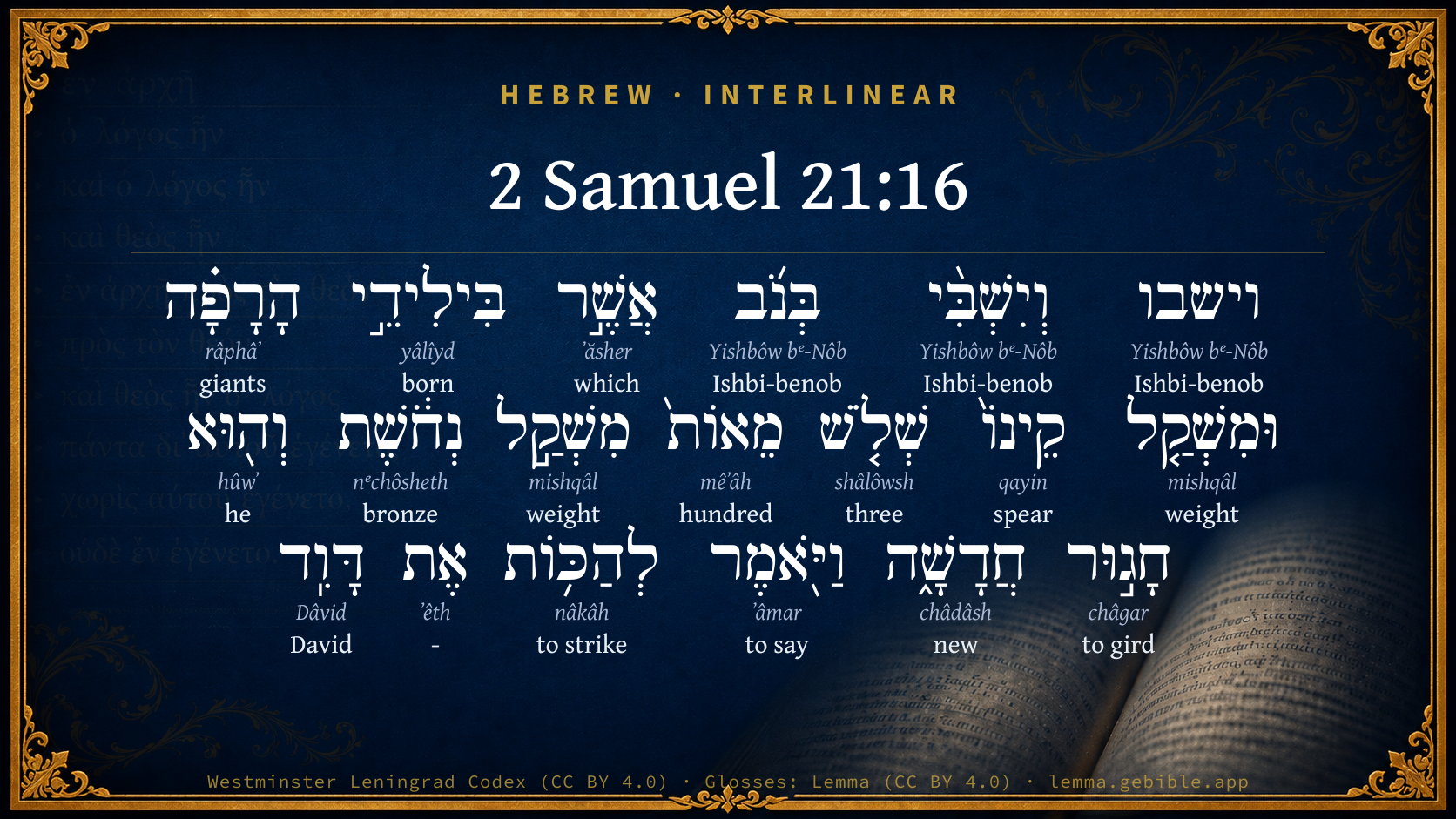
Hebrew (Westminster Leningrad Codex) 2 Samuel 21:16 appears in the Hebrew Old Testament. The text above is from the Westminster Leningrad Codex. Each word links to its Strong’s number, a concise gloss, and parsing drawn from the Open Scriptures Hebrew Bible morphology. Click any word for its full Brown-Driver-Briggs (BDB) entry.
Download image
Cite this verse

2 Samuel 21:16 (World English Bible). Public Domain. Lemma interlinear Bible study tool, https://lemma.gebible.app/v/2-samuel/21/16.

Show BibTeX & RIS
BibTeX
RIS
English Translation
and Ishbibenob, who was of the sons of the giant, the weight of whose spear was three hundred [shekels] of brass in weight, he being girded with a new [sword], thought to have slain David.
World English Bible · Public Domain
Highlights
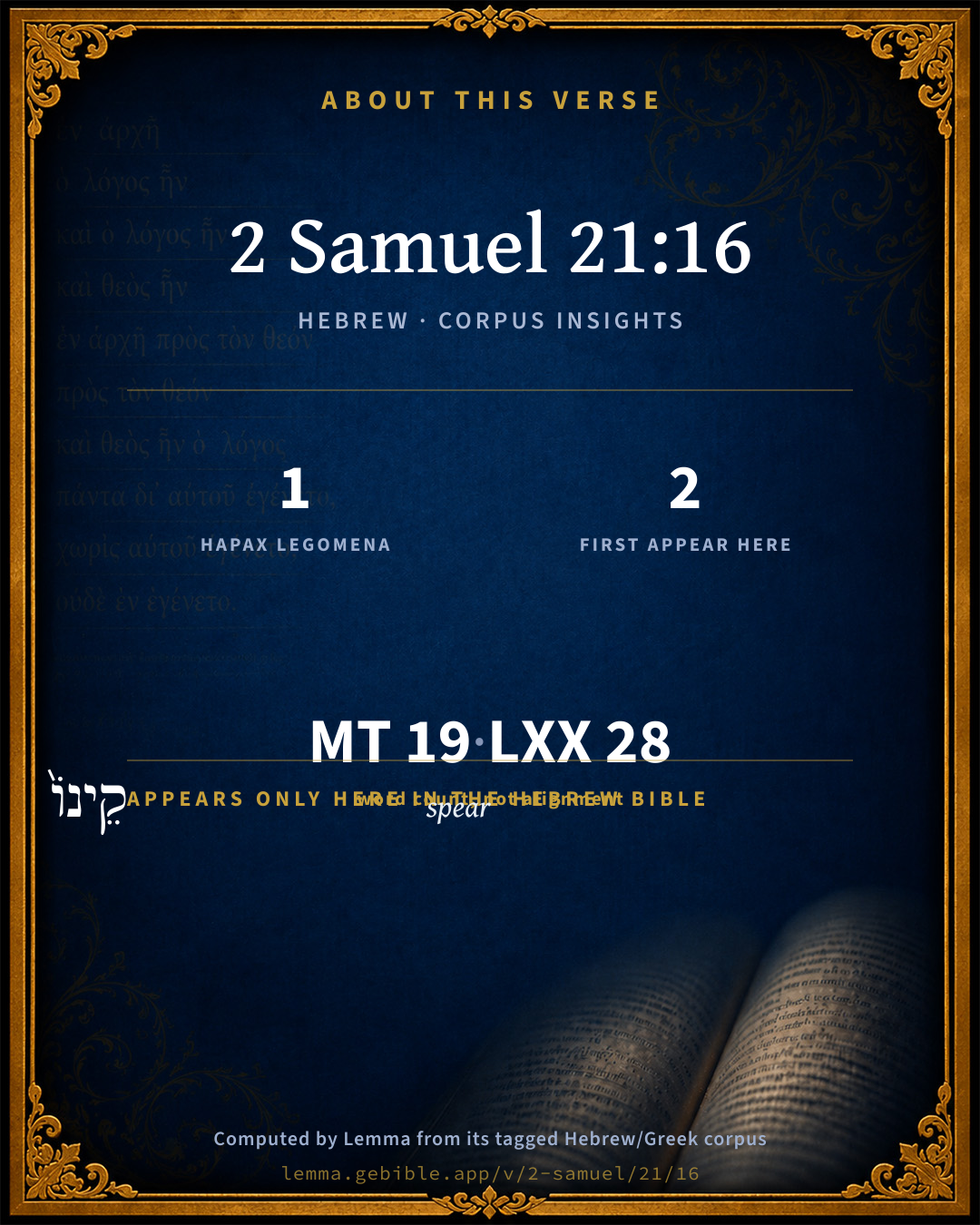
  • 1 hapax legomenon — only here in the Hebrew Bible
  • 2 first appearances in the Hebrew Bible
Full analysis ↓
Download a study sheet

One document with this verse’s original text, its word-by-word gloss line, the meaning frame, cross-references with their text, attributed commentary, and full source and license credits — printable, and it pastes into notes with its structure intact.

This verse Autodidact and up

Study sheet (.html) Plain text (.txt)

A passage Seminary Student

Up to 50 verses in one chapter. A passage sheet keeps up to 6 commentary sources and 12 cross-references per verse, in the order this page ranks them, and says so on the sheet whenever that leaves anything out. Ask for a single verse and you get the Autodidact verse sheet above.

Everything on this page stays free to read, with no account — the sheet is a download of what is already on screen, not access to it.

Want to remove ads? Support Godless Engineer
Compare translations 3

The same verse in 3 English versions, stacked beneath the original-language interlinear above. Click any original word for its lexicon entry.

Each is an independent rendering of the whole verse — the interlinear is not word-aligned to these translations.

Highlighted words mark where these versions differ — a whole-verse word diff, not a word-by-word alignment.

  • World English Bible Public Domain
    and Ishbibenob, who was of the sons of the giant, the weight of whose spear was three hundred [shekels] of brass in weight, he being girded with a new [sword], thought to have slain David.
  • King James Version Public Domain
    And Ishbibenob, which was of the sons of the giant, the weight of whose spear weighed three hundred shekels of brass in weight, he being girded with a new sword, thought to have slain David.
  • unfoldingWord Literal Text CC BY-SA 4.0
    And Ishbi Benob, who among the children of Rapha, and the weight of his spear 300 of bronze in weight, and he was girded a new, and he said to strike David.

unfoldingWord Literal Text — © unfoldingWord, licensed CC BY-SA 4.0. Word-aligned USFM3 via Door43 (git.door43.org/unfoldingWord/en_ult).

Versions to compare (up to 4)

3 of 4 selected

Show all 18 translations

Every available English version of this verse, each an independent rendering of the whole verse.

  • World English Bible Public Domain
    and Ishbibenob, who was of the sons of the giant, the weight of whose spear was three hundred [shekels] of brass in weight, he being girded with a new [sword], thought to have slain David.
  • Berean Standard Bible Public Domain
    Then Ishbi-benob, a descendant of Rapha, whose bronze spear weighed three hundred shekels and who was bearing a new sword, resolved to kill David.
  • Majority Standard Bible Public Domain
    Then Ishbi-benob, a descendant of Rapha, whose bronze spear weighed three hundred shekels and who was bearing a new sword, resolved to kill David.
  • King James Version Public Domain
    And Ishbibenob, which was of the sons of the giant, the weight of whose spear weighed three hundred shekels of brass in weight, he being girded with a new sword, thought to have slain David.
  • American Standard Version (1901) Public Domain
    and Ishbibenob, who was of the sons of the giant, the weight of whose spear was three hundred `shekels' of brass in weight, he being girded with a new `sword', thought to have slain David.
  • Revised Version (1885) Public Domain
    and Ishbi-benob, which was of the sons of the giant, the weight of whose spear was three hundred shekels of brass in weight, he being girded with a new sword, thought to have slain David.
  • Geneva Bible (1599) Public Domain
    Then Ishi-benob which was of the sonnes of Haraphah (the head of whose speare wayed three hundreth shekels of brasse) euen he being girded with a newe sword, thought to haue slaine Dauid.
  • Douay-Rheims (1899) Public Domain
    Jesbibenob, who was of the race of Arapha, the iron of whose spear weighed three hundred ounces, being girded with a new sword, attempted to kill David.
  • Young's Literal Translation Public Domain
    and Ishbi-Benob, who `is' among the children of the giant -- the weight of his spear `is' three hundred `shekels' weight of brass, and he is girded with a new one -- speaketh of smiting David,
  • Literal Standard Version CC BY-SA 4.0
    and Ishbi-Benob, who [is] among the children of the giant—the weight of his spear [is] three hundred [shekels in] weight of bronze, and he is girded with a new one—speaks of striking David,
  • Unlocked Literal Bible CC BY-SA 4.0
    Ishbi-Benob, a descendant of the giants, whose bronze spear weighed three hundred shekels, and who was armed with a new sword, intended to kill David.
  • unfoldingWord Literal Text CC BY-SA 4.0
    And Ishbi Benob, who among the children of Rapha, and the weight of his spear 300 of bronze in weight, and he was girded a new, and he said to strike David.
  • Darby Bible Public Domain
    And Ishbibenob, who was of the children of Raphah -- the weight of his lance was three hundred shekels of bronze, and he was girded with new [armour] -- thought to smite David.
  • World Messianic Bible Public Domain
    and Ishbibenob, who was of the sons of the giant, the weight of whose spear was three hundred shekels of bronze in weight, he being armed with a new sword, thought he would kill David.
  • Webster's Bible Public Domain
    And Ishbi-benob, who was of the sons of the giant, the weight of whose spear was three hundred shekels of brass in weight, he being girded with a new sword, thought to have slain David.
  • Free Bible Version CC BY-SA 4.0
    Ishbi-benob, one of the descendants of Rapha, whose bronze spear weighed three hundred shekels, and who was carrying a new sword, said he was going to kill David.
  • Bible in Basic English Public Domain
    And there came against David one of the offspring of the Rephaim, whose spear was three hundred shekels of brass in weight, and having a new sword, he made an attempt to put David to death.
  • JPS Tanakh (1917) Public Domain
    And Ishbibenob, who was of the sons of the giant, the weight of whose spear was three hundred shekels of brass in weight, he being girded with new armour, thought to have slain David.

Literal Standard Version (2020), Covenant Press — licensed CC BY-SA 4.0. Text via the HelloAO Bible API (eBible.org). Unlocked Literal Bible (unfoldingWord) — licensed CC BY-SA 4.0. Text via the HelloAO Bible API (eBible.org). unfoldingWord Literal Text — © unfoldingWord, licensed CC BY-SA 4.0. Word-aligned USFM3 via Door43 (git.door43.org/unfoldingWord/en_ult). Free Bible Version, Dr. Jonathan Gallagher — licensed CC BY-SA 4.0. Text via the HelloAO Bible API (eBible.org).

Word by word

More ways to search: Search by grammar → Find every occurrence → Compare this word →

Practice this passage: Drill this verse → Learn its vocabulary →

קֵינוֹ֙
qayin
H7013
“spear · his”
Noun, Common, Masculine, Singular, Construct + Suffix, Personal, 3rd Person, Masculine, Singular
Part of Speech
Noun
Type
Common
Gender
Masculine
Number
Singular
State
Construct
Full BDB Definition

Origin: from H6969 in the original sense of fixity

TWOT: 2015a

spear
  1. וישבו Yishbôw bᵉ-Nôb H3430 “and · Ishbi-benob” Conjunction + Noun, Proper
  2. וְיִשְׁבִּ֨י Yishbôw bᵉ-Nôb H3430 “and · Ishbi-benob” Conjunction + Noun, Proper
  3. בְּנֹ֜ב Yishbôw bᵉ-Nôb H3430 “Ishbi-benob” Noun, Proper
  4. אֲשֶׁ֣ר ʼăsher H834 “which” Particle, Relative
  5. בִּילִידֵ֣י yâlîyd H3211 “in/at · those born of” Preposition + Noun, Common, Masculine, Plural, Construct
  6. הָרָפָ֗ה râphâʼ H7497 “the · giants” Particle, Definite Article + Noun, Gentilic, Masculine, Singular, Absolute
  7. וּמִשְׁקַ֤ל mishqâl H4948 “and · weight of” Conjunction + Noun, Common, Masculine, Singular, Construct
  8. שְׁלֹ֤שׁ shâlôwsh H7969 “three” Adjective, Cardinal number, Feminine, Singular, Absolute
  9. מֵאוֹת֙ mêʼâh H3967 “hundred” Adjective, Cardinal number, Both, Plural, Absolute
  10. מִשְׁקַ֣ל mishqâl H4948 “weight of” Noun, Common, Masculine, Singular, Construct
  11. נְחֹ֔שֶׁת nᵉchôsheth H5178 “bronze” Noun, Common, Feminine, Singular, Absolute
  12. וְה֖וּא hûwʼ H1931 “and · he” Conjunction + Pronoun, Personal, 3rd Person, Masculine, Singular
  13. חָג֣וּר châgar H2296 “girded” Verb, Qal, Participle Passive, Masculine, Singular, Absolute
  14. חֲדָשָׁ֑ה châdâsh H2319 “new” Adjective, Adjective, Feminine, Singular, Absolute
  15. וַיֹּ֖אמֶר ʼâmar H559 “and · to say” Conjunction + Verb, Qal, Sequential Imperfect, 3rd Person, Masculine, Singular
  16. לְהַכּ֥וֹת nâkâh H5221 “to strike” Preposition + Verb, Hiphil, Infinitive Construct
  17. אֶת ʼêth H853 “-” Particle, Direct Object
  18. דָּוִֽד Dâvid H1732 “David” Noun, Proper

About this verse

These counts appear in no published source. They are computed here, from the morphology-tagged text and Lemma’s own curated glosses. What Lemma adds →

19
words
16
distinct lemmas
Historical
section

Notable vocabulary

1 hapax legomenon — a word that appears only here in the entire Hebrew Bible:

  • קֵינוֹ֙ spear H7013

First appearance in Scripture

These words make their first canonical appearance in the Hebrew Bible here:

  • וישבו Ishbi-benob H3430
  • קֵינוֹ֙ spear H7013

Grammatical profile

  • 3 verbs
  • 10 nouns
  • 3 adjectives
  • 1 pronoun
  • 2 particles

Verb forms

  • חָג֣וּר Qal · Participle Passive
  • וַיֹּ֖אמֶר Qal · Sequential Imperfect
  • לְהַכּ֥וֹת Hiphil · Infinitive Construct

Repetition

Words recur within this verse — often emphatic in Hebrew:

  • וישבו Ishbi-benob H3430 ×3
  • וּמִשְׁקַ֤ל weight H4948 ×2

Hebrew & Septuagint length

In English translation the verse runs 35 words from the Hebrew and 36 from the Septuagint (LXX English) — closely comparable.

A rough comparison of the two English renderings, which tokenize alike — not a word-level alignment.

Word counts can differ between the Hebrew and the Greek without any difference in meaning — e.g. the Hebrew direct-object marker אֵת has no separate Greek word, and Greek often adds the article ὁ.

In the original languages it is 19 Hebrew tokens and 28 Greek tokens — but the two are counted differently (Hebrew bundles its prefixes and suffixes into one token; the Greek is in lemma form), so that isn’t a like-for-like length.

Cross-references

14

Topical passages linked to 2 Samuel 21:16 in the Treasury of Scripture Knowledge — connected by theme and wording, ordered by reader-vote popularity; previews shown in the World English Bible.

  • 2 Samuel 21:18 It came to pass after this, that there was again war with the Philistines at Gob: then Sibbecai the Hushathite killed Saph, who was of the sons of the giant.
  • 2 Samuel 21:20 There was again war at Gath, where was a man of great stature, who had on every hand six fingers, and on every foot six toes, four and twenty in number; and he also was born to the giant.
  • Genesis 6:4 The Nephilim were in the earth in those days, and also after that, when God's sons came to men's daughters. They bore children to them: the same were the mighty men who were of old, men of renown.
  • Genesis 14:5 In the fourteenth year Chedorlaomer came, and the kings who were with him, and struck the Rephaim in Ashteroth Karnaim, and the Zuzim in Ham, and the Emim in Shaveh-kiriathaim,
  • Numbers 13:32–33 They brought up an evil report of the land which they had spied out to the children of Israel, saying, The land, through which we have gone to spy it out, is a land that eats up the inhabitants of it; and all the people who we saw in it are men of great stature.
  • Deuteronomy 1:28 Where are we going up? our brothers have made our heart to melt, saying, The people are greater and taller than we; the cities are great and fortified up to the sky; and moreover we have seen the sons of the Anakim there.
  • Deuteronomy 2:10 (The Emim lived therein before, a people great, and many, and tall, as the Anakim:
  • Deuteronomy 2:21 a people great, and many, and tall, as the Anakim; but Yahweh destroyed them before them; and they succeeded them, and lived in their place;
  • Deuteronomy 3:11 (For only Og king of Bashan remained of the remnant of the Rephaim; behold, his bedstead was a bedstead of iron; isn't it in Rabbah of the children of Ammon? nine cubits was the length of it, and four cubits the breadth of it, after the cubit of a man.)
  • Deuteronomy 9:2 a people great and tall, the sons of the Anakim, whom you know, and of whom you have heard say, Who can stand before the sons of Anak?
  • 1 Samuel 17:4–5 There went out a champion out of the camp of the Philistines, named Goliath, of Gath, whose height was six cubits and a span.
  • 1 Samuel 17:45–51 Then said David to the Philistine, You come to me with a sword, and with a spear, and with a javelin: but I come to you in the name of Yahweh of hosts, the God of the armies of Israel, whom you have defied.
  • 2 Samuel 5:18 Now the Philistines had come and spread themselves in the valley of Rephaim.
  • 2 Samuel 21:22 These four were born to the giant in Gath; and they fell by the hand of David, and by the hand of his servants.

Cross-references courtesy of OpenBible.info (CC BY 4.0).

Hebrew and Greek witnesses Masoretic Hebrew ↔ Greek Septuagint

The same verse in the two great witnesses to the Old Testament, shown verse-for-verse.

These are two independent witnesses, not word-aligned to each other, and the Septuagint is shown in lemma (dictionary) form.

Hebrew 2 Samuel 21:16 Masoretic · Westminster Leningrad Codex

וישבו וְיִשְׁבִּ֨י בְּנֹ֜ב אֲשֶׁ֣ר בִּילִידֵ֣י הָרָפָ֗ה וּמִשְׁקַ֤ל קֵינוֹ֙ שְׁלֹ֤שׁ מֵאוֹת֙ מִשְׁקַ֣ל נְחֹ֔שֶׁת וְה֖וּא חָג֣וּר חֲדָשָׁ֑ה וַיֹּ֖אמֶר לְהַכּ֥וֹת אֶת דָּוִֽד

and Ishbibenob, who was of the sons of the giant, the weight of whose spear was three hundred [shekels] of brass in weight, he being girded with a new [sword], thought to have slain David.

World English Bible · Public Domain

Greek LXX 2 Samuel 21:16 Septuagint · lemma form

καί ιεσβι ὅς εἰμί ἐν ὁ ἔκγονος ὁ ραφα καί ὁ σταθμός ὁ δόρυ αὐτός τριακόσιοι σίκλος ὁλκή χαλκοῦς καί αὐτός περιζώννυμι κορύνη καί διανοέομαι πατάσσω ὁ δαυίδ

And Jesbi, who was of the progeny of Rapha, and the head of whose spear was three hundred shekels of brass in weight, who also was girded with a club, even he thought to strike David.

LXX2012 (modern English Septuagint) · Public Domain

On this verse, Haydock's Catholic Bible Commentary discusses the Septuagint’s reading. Read the note in Commentary ↓

Hebrew: Westminster Leningrad Codex (CC BY 4.0). Greek: Septuagint (public domain); English from LXX2012 (modern English Septuagint) (Public Domain). How the Septuagint differs from the Hebrew →

Targum (Aramaic paraphrase)

1

The Targum is the ancient Jewish Aramaic paraphrase of the Hebrew Scriptures — an interpretive translation, not the Hebrew text itself. Onkelos (literal) and Pseudo-Jonathan (expansive) render the Torah, and Jonathan the Prophets. Coverage is partial: where no permissively-licensed English translation exists for a verse, only the Aramaic is shown. This is verse-level text, not a word-by-word alignment to the Hebrew.

  1. Targum Jonathan Prophets (Joshua–Malachi)
    וְיִשְׁבִּי בְּנוֹב דִי בִּבְנֵי גִבָּרָא וּמַתְקַל סוֹפִינֵיהּ מַתְקַל תְּלַת מְאָה סַלְעִין דִנְחָשָׁא הוּא אֲסִיר אִסְפַּנְקֵי חַדְתָּא וַאֲמַר לְמִקְטַל יַת דָוִד:

    (no public-domain English translation for this verse)

    Targum Jonathan — Aramaic: “Mikraot Gedolot” (public domain). English: “Sefaria Community Translation” (CC0 1.0 (public-domain dedication)); “London "Chaldee Paraphrase," 1871” (public domain). Text via Sefaria.

Commentary

Notes on 2 Samuel 21:16 from classic Christian and Jewish commentators (each source and its license shown beneath its notes). The classic Christian expositions comment on the surrounding passage and are grouped to its opening verse, so a note may address several verses; the Jewish commentaries on the Tanakh (Rashi and others) are per-verse, so they appear only where the commentator wrote on this verse.

Lemma curates 59 commentaries, every one of them public domain or Creative Commons licensed, each selected and text-cleaned for this edition rather than reprinted as found. About our sources →

Trapp's Complete Commentary

John Trapp

2Sa 21:16 And Ishbibenob, which [was] of the sons of the giant, the weight of whose spear [weighed] three hundred [shekels] of brass in weight, he being girded with a new [sword], thought to have slain David.

Ver. 15. Which was of the sons of the giant.] Such as were those before the flood, and the Zamzummims, {Deu 2:20} and that Gabbara in Pliny brought out of Arabia, under the empire of Claudius, who was nine feet and nine inches high.

Thought to have slain David.] This happened, saith Josephus, when the enemies being put to flight, David pursued them before all others.

John Trapp, A Commentary or Exposition upon All the Books of the Old and New Testament (1647–1656) — public domain. Text from a community e-Sword module.

Tyndale Open Study Notes

Tyndale Open Resources

21:16 a descendant of the giants: Cp. Gen 14:5; Deut 2:10-11, 20-21; 3:11.

Tyndale Open Study Notes — © Tyndale Open Resources, licensed CC BY-SA 4.0. Text via the HelloAO Bible API.

Geneva Bible (1599)

Geneva Bible translators

Which amount to nine pounds three quarters.

That is, of the race of giants.

Geneva Bible (1599) marginal notes — public domain. Text via Bolls.life.

Adam Clarke's Commentary

Verse 16. Being girded with a new sword] As the word sword is not in the original, we may apply the term new to his armour in general; he had got new arms, a new coat of mail, or something that defended him well, and rendered him very formidable: or it may mean a strong or sharp sword.

Adam Clarke's Commentary on the Bible (1810–1826) — public domain. Text from a community e-Sword/MySword module.

Ellicott's Commentary for English Readers

(16) Ishbi-benob.—The name is a strange one, and it is generally thought that some error has crept into the text, but none of the suggested emendations are free from difficulty. Perhaps the most probable is that in the Speaker’s Commentary, by which for Ishbi (the Hebrew margin) they halted is read, and benob, by a very slight change in one letter, becomes at Gob; then a clause is supplied, there was a man, so that the whole reads, “David waxed faint, and they halted at Gob. And there was a man which was of the sons,” &c.; 2Sa_21:18 (as well as 2Sa_21:19) seems to imply a previous battle in Gob.

Three hundred shekels.—About eight pounds; just half the weight of Goliath’s spear-head (1Sa_17:7).

Girded with a new sword.—The word sword is not in the original, and its omission, where intended, is unusual. Either it should be girded with new armour, or else the word for new is intended to denote some otherwise unknown weapon.

A Bible Commentary for English Readers, edited by Charles John Ellicott (1878–1897) — public domain. Text from a community e-Sword module.

The Cambridge Bible for Schools and Colleges

gen. ed. J. J. S. Perowne

16. Ishbi-benob] Perhaps = “dweller on a height,” a name given him because he lived in some inaccessible castle. But there are good reasons for suspecting that there is some corruption in the text, and that the giant’s real name has been lost.

of the sons of the giant] The word for sons is one specially used of the progeny of the giant races of Canaan (Num_13:22; Num_13:28; Jos_15:14). Râphâh, or with the article ha-Râphâh, translated “the giant,” may be a quasi proper-name for the father of the four giants here mentioned, or, more probably, for the founder of the tribe of Rephaim. The Vulg. has Arapha, and hence comes Harapha, the name of the giant introduced in Milton’s Samson Agonistes.

three hundred shekels] About nine pounds: half the weight of Goliath’s spear head.

brass] See note on ch. 2Sa_8:8.

with a new sword] There is no substantive expressed in the Hebrew: the Vulg. supplies sword: others suit of armour: the Sept. reads a mace instead of the word new, and this suggests the probability that the original reading was some rare word, denoting a specially formidable kind of weapon.

The Cambridge Bible for Schools and Colleges (gen. ed. J. J. S. Perowne; Cambridge University Press, 1878–1918) — public domain. Text from a community e-Sword module.

John Gill's Exposition

But Abishai the son of Zeruiah succoured him,.... Observing him in danger, made haste to his relief:

and smote the Philistine, and killed him; it seems as if Abishai engaged with the Philistine, and killed him; but inasmuch as it will bear to be interpreted of David, and since the four giants here and hereafter mentioned are said to fall by the hand of David and his servants, Sa2 21:22, it may be thought that this man fell by his hand; seeing it is clear that all the rest fell by the hands of his servants:

then the men of David sware unto him; after they had observed the danger he was exposed unto, and how narrowly he escaped with his life:

saying, thou shalt go no more with us to battle; they had persuaded him not to go to the battle with Absalom; they had suffered him to go with them now, he being, no doubt, forward and pressing to it; but now they were resolute, and determined he should never go more:

that thou quench not the light of Israel; signifying that their glory and prosperity depended on his life, and that, should he be taken away, they should be in affliction and adversity, their honour and their happiness would be at an end; the Targum is,"thou mayest not extinguish the kingdom of Israel,''the light and glory of it.

John Gill's Exposition of the Whole Bible (1746–1763) — public domain (CC PDM 1.0). Text via the HelloAO Bible API.

Albert Barnes' Notes on the Bible

Ishbi-benob - A corrupt reading. The whole passage should perhaps run thus: “And David waxed faint. So they halted in Gob (as in 2Sa 21:18-19). And there was a man (in Gob) which was of the sons of the giant, etc.”

Sons of the giant - The “giant” here 2Sa 21:18, 2Sa 21:20, 2Sa 21:22 is “ha-Raphah,” whence, the “Rephaim” Gen 14:5; Deu 2:11. The sons of Ha-raphah, or Rephaim, are different from the “Nephilim,” or Giants Gen 6:4; Num 13:33. The sons of Anak were not strictly Rephaim, but Nephilim.

Three hundred shekels of brass - About eight pounds. Goliath’s spear’s head weighed “six hundred shekels of iron.”

Albert Barnes' Notes on the Bible (1834–1885) — public domain. Text from a community e-Sword/MySword module.

Haydock's Catholic Bible Commentary

Jesbibenob may signify, "Jesbi, the son of Ob." Septuagint, "Jesbe, of Nob, who was of the race of the giants." Arapha seems to have been one of great fame, (ver. 18, 21, 22) who had several children; unless other giants assumed his name. (Calmet) --- Ounces. Hebrew, "sicles of brass, in weight." Sicles is only understood, as on similar occasions. Neither is sword expressed; (Haydock) so that some think he had on a new suit of armour. Symmachus, "a sword." Roman Septuagint, "a club." The weight of the whole spear is specified in Hebrew, Septuagint, &c., (Calmet) as weighing "300---of brass," (Haydock) of which metal it seems to have been formed, as the Jews had no such money till the captivity. (Calmet)

George Leo Haydock (1774–1849), Haydock's Catholic Family Bible and Commentary, 1859 edition — public domain. Excludes Psalms (Douay-Rheims chapter numbering differs from Protestant) and Deuterocanonical books (Catholic canon only).

Matthew Poole's English Annotations

The giant; so called by way of eminency. Or, of Rapha, a giant so called.

The weight of whose spear weighed three hundred shekels: see 1Sa 17:5.

With a new sword, or rather, with a new girdle or belt; for, first, This was the usual habit of soldiers, 1Sa 18:4; 2Sa 18:11; 1Ki 2:5; Isa 5:27, and when it was of an extraordinary fashion and price, an ensign of dignity and command in the army, Eze 23:15. So this may be mentioned to note that this was the first time either of his going out to fight, or of his advancement to some eminent place in the army; which made him desirous to signalize himself with some great action. Secondly, This supplement is more natural and usual, the word girdle being easily supplied from the word

being girded; such ellipses of conjugate words being frequent in the Hebrew tongue, as Num 11:14; Psa 76:12; Mat 20:12. Thirdly, The newness of the sword seems to have no emphasis nor significancy for the present purpose, seeing an old and tried sword would seem more considerable for his encouragement than one new and unproved.

Matthew Poole's English Annotations on the Holy Bible (1683–1685) — public domain. Text from a community e-Sword/MySword module.

Whedon's Commentary on the Bible

Daniel D. Whedon

16. Ishbi-benob — The name means, his dwelling on the hill, and was perhaps given him on account of some high citadel or castle which he occupied.

Sons of the giant — Or, sons of Raphah. On the ancient giant race, Rephaim, compare Gen_14:5; Gen_15:20; and Deu_3:11. The word Raphah (or Rapha, as in 1Ch_20:4) seems to have been the proper name of the father of a race of giants that dwelt among the Philistines, but he was doubtless related to the more ancient Rephaim.

Weight of whose spear — The reference is doubtless to the metal head of his spear.

Three hundred shekels — About nine pounds, half the weight of Goliath’s. See 1Sa_17:7.

New sword — Better to supply the word armour in place of sword. His entire military garb was new.

Daniel D. Whedon (gen. ed.), Commentary on the Old and New Testaments (1874–1909) — public domain. Text from a community e-Sword module.

The Pulpit Commentary

Ishbi-benob. The Hebrew has Ishbo-benob, which Gesenius interprets as meaning "dweller upon the height." But surely the man"s name would not be Hebrew; he was a Raphah, and we shall not be able to explain his name until we know the language of the Rephaim. Of the sons of the giant; Hebrew, of the children of the Raphah; that is, he belonged to the race of the Rephaim, the word not signifying "sons," but the members of a stock. It is translated "children" in Num_13:22, Num_13:28, etc. (For the Rephaim, see note on 2Sa_5:18) "The Raphah" may be the mythic progenitor of the Rephaim, but more probably it is simply the singular of "Rephaim," and "children of the Raphah" a more poetic way of describing the race. Three hundred shekels. It weighed, therefore, about eight pounds; the spearhead of Goliath was just twice as heavy. (1Sa_17:7) Girded with a new. The Vulgate supplies "sword," which the Authorized Version has adopted. The Septuagint reads a "mace" instead of "new;" others think that he had a new suit of armour. If the narrator had thought it of sufficient importance to let us know that the article was new, he would scarcely have left the thing itself unspecified. It is evident, however, that the Septuagint did not read hadasha, "new," but the name of some strange warlike instrument, which being unknown to the scribes, they substituted for it a word which they did know, but which makes no sense. We cannot, however, depend upon the translation of the Septuagint, "mace." The want of special knowledge on the part of the translators of the Septuagint, though partly accounted for by the long absence from Palestine of its authors, and their having to depend entirely upon such knowledge of their language as survived at Alexandria, is more than we should have expected or can quite understand. Here, however, there is nothing remarkable in their not knowing the exact meaning of this carious weapon of the Rephaite; but plainly it could not be a mace, but must have been something that could be gift upon him. The Authorized Version, moreover, gives a look of probability to the insertion of "sword," which is wanting in the Hebrew; for it does not connect his purpose of killing David with the hadasha. The Hebrew is, "And Ishbo-benob, who was a Rephaite, and whose spear weighed three hundred shekels, and who was girt with a hadasha; and he thought to smite David.

Vers. 16-22.

Giant killers.

These huge monsters were dangerous enemies. To slay them was to do valuable service to king and country. To assail them required much courage. Those who killed any of them gained great renown; and their names and deeds were recorded in the chronicles of the kingdom, and, as to some of them, have found a place in the Book of books.

I SOME GIANT FOES OF THE DIVINE KING AND KINGDOM THAT NEED TO BE DESTROYED. We may name superstition, whether pagan, papal, or protestant; infidelity; selfishness; pride; tyranny, ecclesiastical or political; slavery; sensuality; intemperance; war; mammon. Singly, or in partial union, they assail the subjects of Christ, and oppose them in their endeavours to extend his kingdom. And behind lie the devil and his angels, ever active and formidable. (Eph_6:11, Eph_6:12)

II TO BATTLE AGAINST THESE MONSTERS IS THE DUTY OF ALL CHRIST"S SERVANTS.

1. It is involved in their Christian calling. The new nature which is given to them is instinctively hostile to Satan and his works. The endeavour to serve God and benefit men necessarily brings them into conflict with these powers of darkness. The attacks made on themselves compel them to fight in self-defence. (1Pe_5:8, 1Pe_5:9)

2. They are supplied with arms and armour for the purpose. (Eph_6:11-17)

1. The enslaved and degraded condition to which these giant evils have reduced their victims appeals to and stimulates them.

2. Their own happy condition under the reign of Christ supplies them witha powerful motive.

3. Regard for him impels and strengthens them. Loyalty, desire for his glory, the hope of his approval, and of the honours and rewards he bestows.

III HEROES IN THE FIGHT ATTAIN TO DISTINCTION AND REWARD.

1. Who are the heroes? Not those who engage these giants (nominally) as a profession and for the sake of earthly rewards. But such as

(1) renounce for themselves their service, which all who profess to oppose them do not;

(2) show great zeal in contending against them;

(3) cheerfully expose themselves to hardship and peril in doing so, displaying conspicuous courage and endurance. Those faithful in times of persecution, confessors, martyrs. Those who bear the gospel to savages, or encounter dangerous climates in seeking its extension.

2. Their honours and rewards.

(1) In many cases, success; not, alas! in killing these giants they are not dead yet but in preserving themselves, and rescuing others from their power, and in diminishing their dominions.

(2) Enrolment in the Divine records. Many illustrious names are written in human records; more have been overlooked; but all are in the "book of remembrance written before" God. (Mal_3:16)

(3) Final promotion to honour, power, and blessedness (see 2Ti_4:7, 2Ti_4:8; and the promises made in Revelation 2. and 3. to "him that overcometh"). G.W.

The Pulpit Commentary (1880–1919), ed. H.D.M. Spence-Jones & Joseph S. Exell — public domain. Text from a community e-Sword module.

Rashi

Rabbi Shlomo Yitzchaki (Rashi)

A spear case weighing. It is like a case that is at the top of spear's handle that is called aristuille in O.F., and it is made like a hat There is something comparable to it in Maseches Zevochim, "What were the pomegranates of the tunic similar to? They were like the caps on babies' heads" The caps [are called] hemles in O.F.

Who was armed. Armed with a new sword. I heard [an explanation] that on that day he was intitiated into the wearing of battle dress and it is the manner of those so initiated to [try to] be successful and mighty on the day of their initiation to make a name for themselves. That is why, he said he was going to kill Dovid.

Rashi on the Tanakh — English translations: “The Judaica Press complete Tanach with Rashi, translated by A. J. Rosenberg” (CC BY 4.0); “Pentateuch with Rashi's commentary by M. Rosenbaum and A.M. Silbermann, 1929-1934” (public domain); “The Metsudah Tanach series, Lakewood, N.J” (CC BY 4.0); and “The Book of Joshua, Metsudah Publications, 1997” (CC BY 4.0). Text via Sefaria.

Lesson kit

Teaching starters — assembled from the data on this page, not authored interpretation. Every prompt links to the verse data it draws on. Edit before teaching.

2 Samuel, in the Historical, opens this verse with 19 words (16 distinct Hebrew lemmas). Its most distinctive word is qayin (“spear”). A historical commentator’s framing appears above. Read the whole chapter for the surrounding context.

Discussion questions

  1. What does “spear” (qayin) contribute to the verse as a whole?
  2. 1 word here appears nowhere else in the Hebrew Bible. Why might the author reach for such rare wording?
  3. 2 words make their first appearance in Scripture here. What does this debut establish?
  4. How does 2 Samuel 21:18, which shares this passage’s theme, read alongside this verse?
  5. What does the repetition of “Ishbi-benob” (3× in this one verse) do in this verse?
  6. These translations render this verse differently. What is at stake in choosing one wording over another?
  7. «חָג֣וּר» is a Qal Participle Passive verb. How does that grammatical form shape the action described?
  8. Compare how Trapp's Complete Commentary and Tyndale Open Study Notes read this verse. Where do they agree or differ?

Things to notice

  • 1 word in this verse appears nowhere else in the Hebrew Bible.
  • 2 words make their first canonical appearance in Scripture here.
  • This verse counts 19 Hebrew ↔ 28 Greek words.
  • These translations choose different wording for 25 words in this verse.
  • “Ishbi-benob” occurs 3× in this single verse.

Reading settings

Reading text

Shown beneath each verse's original-language words.

Old Testament
Old Testament edition

Read the OT as the Masoretic Hebrew (MT) or the Greek Septuagint (LXX).

English shown for the Greek Septuagint (in the Hebrew ↔ Greek comparison).

Comparing translations? Open the Compare panel on any verse page to stack up to four side by side.