2 Samuel 19:34

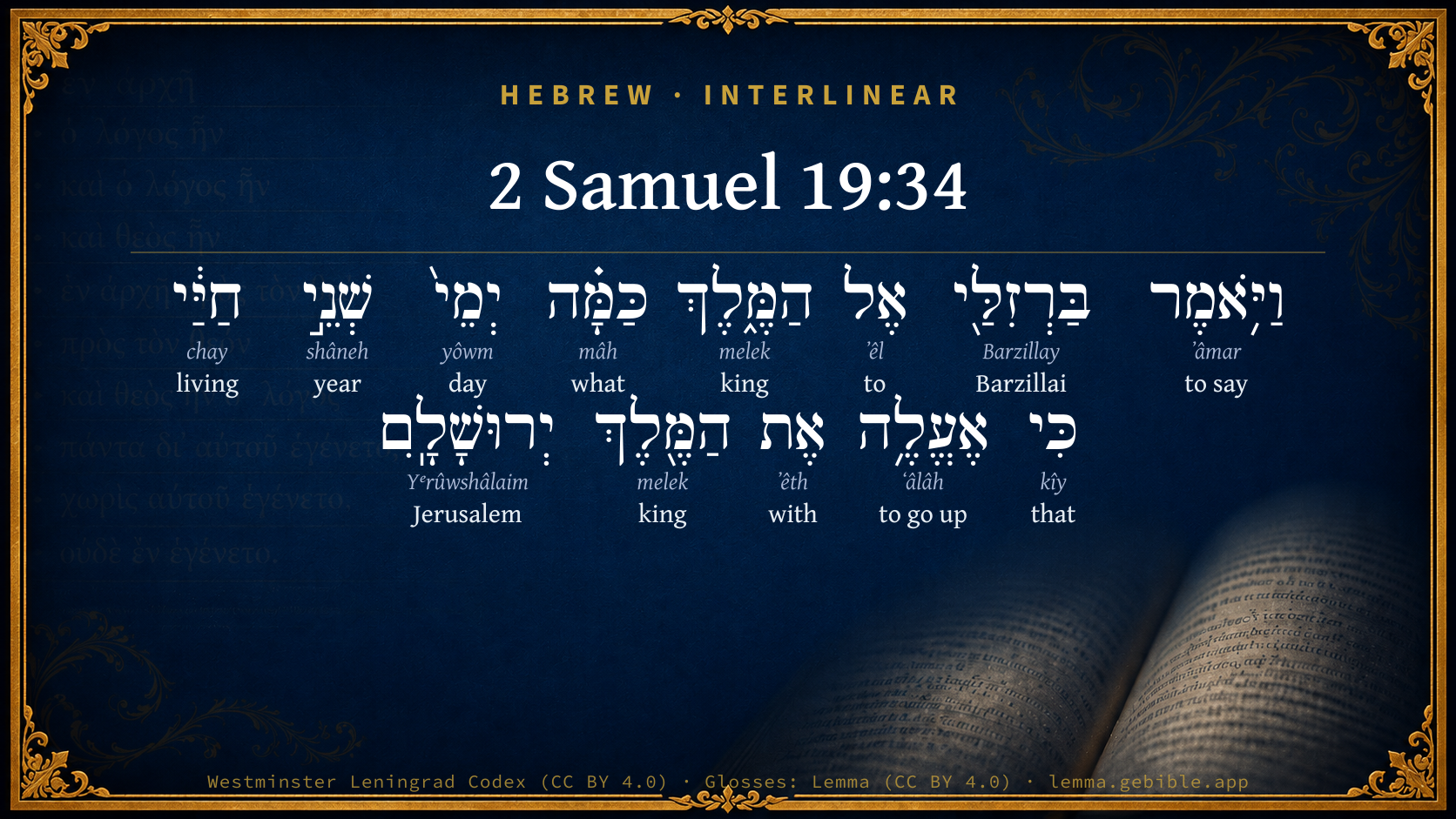
Hebrew (Westminster Leningrad Codex) 2 Samuel 19:34 appears in the Hebrew Old Testament. The text above is from the Westminster Leningrad Codex. Each word links to its Strong’s number, a concise gloss, and parsing drawn from the Open Scriptures Hebrew Bible morphology. Click any word for its full Brown-Driver-Briggs (BDB) entry.
Download image
Cite this verse

2 Samuel 19:34 (World English Bible). Public Domain. Lemma interlinear Bible study tool, https://lemma.gebible.app/v/2-samuel/19/34.

Show BibTeX & RIS
BibTeX
RIS
English Translation
Barzillai said to the king, How many are the days of the years of my life, that I should go up with the king to Jerusalem?
World English Bible · Public Domain
Download a study sheet

One document with this verse’s original text, its word-by-word gloss line, the meaning frame, cross-references with their text, attributed commentary, and full source and license credits — printable, and it pastes into notes with its structure intact.

This verse Autodidact and up

Study sheet (.html) Plain text (.txt)

A passage Seminary Student

Up to 50 verses in one chapter. A passage sheet keeps up to 6 commentary sources and 12 cross-references per verse, in the order this page ranks them, and says so on the sheet whenever that leaves anything out. Ask for a single verse and you get the Autodidact verse sheet above.

Everything on this page stays free to read, with no account — the sheet is a download of what is already on screen, not access to it.

Want to remove ads? Support Godless Engineer
Compare translations 3

The same verse in 3 English versions, stacked beneath the original-language interlinear above. Click any original word for its lexicon entry.

Each is an independent rendering of the whole verse — the interlinear is not word-aligned to these translations.

Highlighted words mark where these versions differ — a whole-verse word diff, not a word-by-word alignment.

  • World English Bible Public Domain
    Barzillai said to the king, How many are the days of the years of my life, that I should go up with the king to Jerusalem?
  • King James Version Public Domain
    And Barzillai said unto the king, How long have I to live, that I should go up with the king unto Jerusalem?
  • unfoldingWord Literal Text CC BY-SA 4.0
    But Barzillai said to the king, “How many the days of the years of my life, that I should go up with the king Jerusalem?

unfoldingWord Literal Text — © unfoldingWord, licensed CC BY-SA 4.0. Word-aligned USFM3 via Door43 (git.door43.org/unfoldingWord/en_ult).

Versions to compare (up to 4)

3 of 4 selected

Show all 18 translations

Every available English version of this verse, each an independent rendering of the whole verse.

  • World English Bible Public Domain
    Barzillai said to the king, How many are the days of the years of my life, that I should go up with the king to Jerusalem?
  • Berean Standard Bible Public Domain
    But Barzillai replied, “How many years of my life remain, that I should go up to Jerusalem with the king?
  • Majority Standard Bible Public Domain
    But Barzillai replied, “How many years of my life remain, that I should go up to Jerusalem with the king?
  • King James Version Public Domain
    And Barzillai said unto the king, How long have I to live, that I should go up with the king unto Jerusalem?
  • American Standard Version (1901) Public Domain
    And Barzillai said unto the king, How many are the days of the years of my life, that I should go up with the king unto Jerusalem?
  • Revised Version (1885) Public Domain
    And Barzillai said unto the king, How many are the days of the years of my life, that I should go up with the king unto Jerusalem?
  • Geneva Bible (1599) Public Domain
    And Barzillai said vnto the king, Howe long haue I to liue, that I should goe vp with the king to Ierusalem?
  • Douay-Rheims (1899) Public Domain
    And Berzellai said to the king: How many are the days of the years of my life, that I should go up with the king to Jerusalem?
  • Young's Literal Translation Public Domain
    And Barzillai saith unto the king, `How many `are' the days of the years of my life, that I go up with the king to Jerusalem?
  • Literal Standard Version CC BY-SA 4.0
    And Barzillai says to the king, “How many [are] the days of the years of my life, that I go up with the king to Jerusalem?
  • Unlocked Literal Bible CC BY-SA 4.0
    Barzillai replied to the king, “How many days are left in the years of my life, that I should go up with the king to Jerusalem?
  • unfoldingWord Literal Text CC BY-SA 4.0
    But Barzillai said to the king, “How many the days of the years of my life, that I should go up with the king Jerusalem?
  • Darby Bible Public Domain
    And Barzillai said to the king, How many are the days of the years of my life, that I should go up with the king to Jerusalem?
  • World Messianic Bible Public Domain
    Barzillai said to the king, “How many are the days of the years of my life, that I should go up with the king to Jerusalem?
  • Webster's Bible Public Domain
    And Barzillai said to the king, How long have I to live, that I should go up with the king to Jerusalem?
  • Free Bible Version CC BY-SA 4.0
    “How much longer do you think I have to live so I could go to Jerusalem and stay there with the king?” Barzillai replied.
  • Bible in Basic English Public Domain
    And Barzillai said to the king, How much of my life is still before me, for me to go up to Jerusalem with the king?
  • JPS Tanakh (1917) Public Domain
    (19-35) And Barzillai said unto the king: 'How many are the days of the years of my life, that I should go up with the king unto Jerusalem?

Literal Standard Version (2020), Covenant Press — licensed CC BY-SA 4.0. Text via the HelloAO Bible API (eBible.org). Unlocked Literal Bible (unfoldingWord) — licensed CC BY-SA 4.0. Text via the HelloAO Bible API (eBible.org). unfoldingWord Literal Text — © unfoldingWord, licensed CC BY-SA 4.0. Word-aligned USFM3 via Door43 (git.door43.org/unfoldingWord/en_ult). Free Bible Version, Dr. Jonathan Gallagher — licensed CC BY-SA 4.0. Text via the HelloAO Bible API (eBible.org).

Word by word

More ways to search: Search by grammar → Find every occurrence → Compare this word →

Practice this passage: Drill this verse → Learn its vocabulary →

בַּרְזִלַּ֖י
Barzillay
H1271
“Barzillai”
Noun, Proper
Part of Speech
Noun
Type
Proper
Full BDB Definition

Origin: from H1270

TWOT: None

Barzillai = "my iron" - a Gileadite leader who helped David defeat Absalom's rebellion - a priest, son-in-law to Barzillai the Gileadite - an Israelite from Mahalath whose son Adriel married Michal, Saul's daughter
  1. וַיֹּ֥אמֶר ʼâmar H559 “and · to say” Conjunction + Verb, Qal, Sequential Imperfect, 3rd Person, Masculine, Singular
  2. אֶל ʼêl H413 “to” Preposition
  3. הַמֶּ֑לֶךְ melek H4428 “the · king” Particle, Definite Article + Noun, Common, Masculine, Singular, Absolute
  4. כַּמָּ֗ה mâh H4100 “like/as · what” Preposition + Particle, Interrogative
  5. יְמֵי֙ yôwm H3117 “days of” Noun, Common, Masculine, Plural, Construct
  6. שְׁנֵ֣י shâneh H8141 “year” Adjective, Cardinal number, Masculine, Dual, Construct
  7. חַיַּ֔י chay H2416 “living things · my” Noun, Common, Masculine, Plural, Construct + Suffix, Personal, 1st Person, Common, Singular
  8. כִּי kîy H3588 “that” Conjunction
  9. אֶעֱלֶ֥ה ʻâlâh H5927 “to go up” Verb, Qal, Imperfect, 1st Person, Common, Singular
  10. אֶת ʼêth H854 “with” Preposition
  11. הַמֶּ֖לֶךְ melek H4428 “the · king” Particle, Definite Article + Noun, Common, Masculine, Singular, Absolute
  12. יְרוּשָׁלִָֽם Yᵉrûwshâlaim H3389 “Jerusalem” Noun, Proper

About this verse

These counts appear in no published source. They are computed here, from the morphology-tagged text and Lemma’s own curated glosses. What Lemma adds →

13
words
12
distinct lemmas
Historical
section

Notable vocabulary

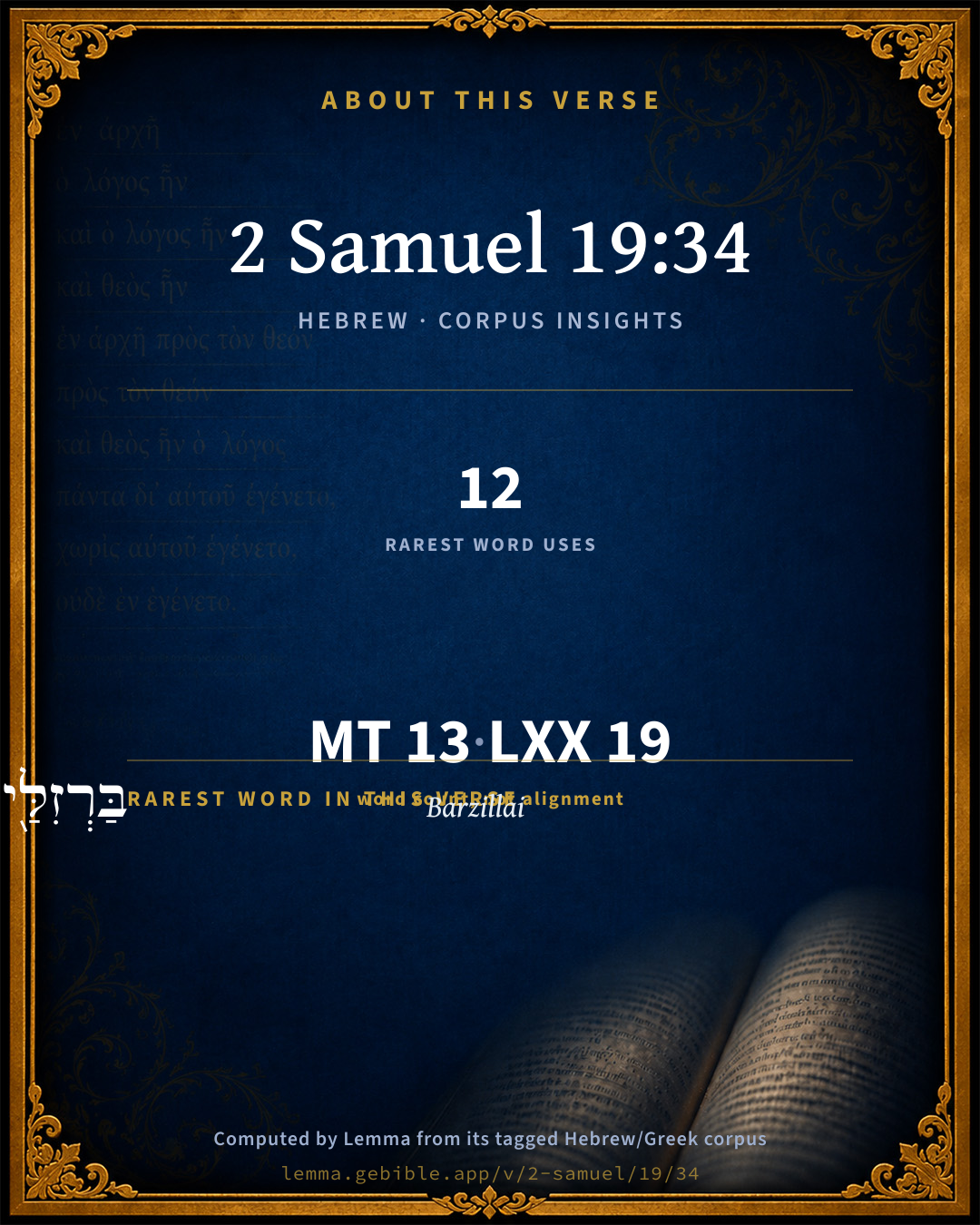
The rarest word here is בַּרְזִלַּ֖י Barzillai H1271 — appearing just 12 times in the whole Hebrew Bible.

Shared distinctive vocabulary

בַּרְזִלַּ֖י Barzillai H1271 occurs in 10 verses of the Hebrew Bible. Also found in:

Grammatical profile

  • 2 verbs
  • 6 nouns
  • 1 adjective
  • 2 prepositions
  • 1 conjunction
  • 1 particle

Verb forms

  • וַיֹּ֥אמֶר Qal · Sequential Imperfect
  • אֶעֱלֶ֥ה Qal · Imperfect

Repetition

A word recurs within this verse — often emphatic in Hebrew:

  • הַמֶּ֑לֶךְ king H4428 ×2

Hebrew & Septuagint length

In English translation the verse runs 26 words from the Hebrew and 27 from the Septuagint (LXX English) — closely comparable.

A rough comparison of the two English renderings, which tokenize alike — not a word-level alignment.

Word counts can differ between the Hebrew and the Greek without any difference in meaning — e.g. the Hebrew direct-object marker אֵת has no separate Greek word, and Greek often adds the article ὁ.

In the original languages it is 13 Hebrew tokens and 19 Greek tokens — but the two are counted differently (Hebrew bundles its prefixes and suffixes into one token; the Greek is in lemma form), so that isn’t a like-for-like length.

Cross-references

5

Topical passages linked to 2 Samuel 19:34 in the Treasury of Scripture Knowledge — connected by theme and wording, ordered by reader-vote popularity; previews shown in the World English Bible.

  • 1 Corinthians 7:29 But I say this, brothers: the time is short, that from now on, both those who have wives may be as though they had none;
  • James 4:14 Whereas you don't know what your life will be like tomorrow. For what is your life? For you are a vapor, that appears for a little time, and then vanishes away.
  • Genesis 47:8–9 Pharaoh said to Jacob, "How many are the days of the years of your life?"
  • Job 14:14 If a man dies, shall he live again? All the days of my warfare would I wait, Until my release should come.
  • Psalms 39:5–6 Behold, you have made my days handbreadths. My lifetime is as nothing before you. Surely every man stands as a breath." Selah.

Cross-references courtesy of OpenBible.info (CC BY 4.0).

Hebrew and Greek witnesses Masoretic Hebrew ↔ Greek Septuagint

The same verse in the two great witnesses to the Old Testament, shown verse-for-verse.

These are two independent witnesses, not word-aligned to each other, and the Septuagint is shown in lemma (dictionary) form.

Hebrew 2 Samuel 19:34 Masoretic · Westminster Leningrad Codex

וַיֹּ֥אמֶר בַּרְזִלַּ֖י אֶל הַמֶּ֑לֶךְ כַּמָּ֗ה יְמֵי֙ שְׁנֵ֣י חַיַּ֔י כִּי אֶעֱלֶ֥ה אֶת הַמֶּ֖לֶךְ יְרוּשָׁלִָֽם

Barzillai said to the king, How many are the days of the years of my life, that I should go up with the king to Jerusalem?

World English Bible · Public Domain

Greek LXX 2 Samuel 19:34 Septuagint · lemma form

καί εἶπον ὁ βασιλεύς πρός βερζελλι σύ διαβαίνω μετά ἐγώ καί διατρέφω ὁ γῆρας σύ μετά ἐγώ ἐν ἰερουσαλήμ

And Berzelli said to the king, How many are the days of the years of my life, that I should go up with the king to Jerusalem?

LXX2012 (modern English Septuagint) · Public Domain

Hebrew: Westminster Leningrad Codex (CC BY 4.0). Greek: Septuagint (public domain); English from LXX2012 (modern English Septuagint) (Public Domain). How the Septuagint differs from the Hebrew →

Targum (Aramaic paraphrase)

1

The Targum is the ancient Jewish Aramaic paraphrase of the Hebrew Scriptures — an interpretive translation, not the Hebrew text itself. Onkelos (literal) and Pseudo-Jonathan (expansive) render the Torah, and Jonathan the Prophets. Coverage is partial: where no permissively-licensed English translation exists for a verse, only the Aramaic is shown. This is verse-level text, not a word-by-word alignment to the Hebrew.

  1. Targum Jonathan Prophets (Joshua–Malachi)
    וַאֲמַר מַלְכָּא לְבַרְזִלַי אַתְּ עֲבַר עִמִי וַאֲסוֹבַר יָתָךְ עִמִי בִּירוּשְׁלֵם:

    (no public-domain English translation for this verse)

    Targum Jonathan — Aramaic: “Mikraot Gedolot” (public domain). English: “Sefaria Community Translation” (CC0 1.0 (public-domain dedication)); “London "Chaldee Paraphrase," 1871” (public domain). Text via Sefaria.

Commentary

Notes on 2 Samuel 19:34 from classic Christian and Jewish commentators (each source and its license shown beneath its notes). The classic Christian expositions comment on the surrounding passage and are grouped to its opening verse, so a note may address several verses; the Jewish commentaries on the Tanakh (Rashi and others) are per-verse, so they appear only where the commentator wrote on this verse.

Lemma curates 59 commentaries, every one of them public domain or Creative Commons licensed, each selected and text-cleaned for this edition rather than reprinted as found. About our sources →

Trapp's Complete Commentary

John Trapp

2Sa 19:34 And Barzillai said unto the king, How long have I to live, that I should go up with the king unto Jerusalem?

Ver. 34. How long have I to live?] q.d., My breath is corrupt - or, my spirits are spent - my days are extinct, the graves are ready for me, as Job 17:1. Pedetentim morior, as that old poet Alexis said, I die piecemeal, sensim sine sensu, every day yielding somewhat to death. It is therefore high time for old people to make up their litte bundles, and prepare to begone hence, as Sturmius wrote to Zanchy.

John Trapp, A Commentary or Exposition upon All the Books of the Old and New Testament (1647–1656) — public domain. Text from a community e-Sword module.

The Biblical Illustrator

Joseph S. Exell

2Sa_19:34-40

How long have I to live, that I should go up with the King unto Jerusalem?

Barzillais refusal of Davids invitation to Jerusalem considered

I. A serious consideration of approaching death is peculiarly proper for aged persons. Barzillai, in his reply to David, seems to have the near approach of death chiefly in view. And surely such a view was exceedingly proper and becoming for a person of his age, though he seemed possessed of much strength and vigour. But some circumstances make it peculiarly proper that the aged should make these thoughts familiar and habitual to them.

1. The speedy period of their lives is more certain than that of others. There is a probability that they who are in the prime or morning of their days may continue many years; but there is no probability that the aged should.

2. The infirmities which are peculiar to, or most frequent in old age, make the consideration of death highly proper.

3. The remembrance of the many relations, friends, and acquaintance whom they have survived, should excite this disposition in them.

II. The prospect of a speedy removal out or this world, should wean our affections from it.

1. The prospect of death should make the aged dead to the honours and pleasures of this world.

2. The prospect of death should lead them to get free from the cares of the world, as far as they lawfully can.

(1) Their capacity for business is generally weakened. This is Barzillais reasoning in the verse after the text; Can I discern between good and evil?

(2) If their capacities continue ever so good, they bare more important concerns to mind, and but a little time for them. The one thing needful, the great business relating to their souls and eternity is sufficient to engage all the time which they can spare from that needful rest which old age requires.

(3) The more cares you have upon your hands the more will your dying thoughts be disturbed, and your last Work be interrupted.

(4) By various worldly cares the soul will be less disposed and qualified for the heavenly world. The immoderate love of the world is utterly inconsistent with the love of the Father; and such a love of it as may be regular and allowable in the prime or middle of life, may be immoderate and unjustifiable in old age. (J. Orton.)

I am this day fourscore years old.

Venerable age: its trials and consolations

I. Length of days is a scriptural blessing. It was eminently such under the Hebrew theocracy, where earthly allotments were the perpetual types of spiritual favour. As death was a penalty, so the shortening of human life was counted as a marked expression of the Divine displeasure, as where the Psalmist exclaims: He brought down my strength in my journey, and shortened my days. But I said, O my God, take me not away in the midst of mine age. For when Thou art angry all our days are gone. But alway, and through all generations, has the hoary head been counted a crown of glory to the righteous. Old age is not to be associated, as a matter of course, with decrepitude or the decays of nature. It has its own appropriate beauty, as well as youth. Undeniably the aged are entitled to our liveliest sympathies and our most sedulous attentions. They have reached the border land. They stand hovering between two worlds, and must shortly vanish and be no more seen. They are going from us, and we in our turn may require the kindness and attention which we bestow. But there are trials incident to old age, and which no power of human sympathy can avert or permanently relieve.

1. Infirmity of body is one. The vigours of life are failing. The fibre of a constitution which withstood all the assaults of threescore years, and promised well for a longer continuance, suddenly gives way.

2. Another trial of the aged is the altered aspect of society, the absence of contemporaries and companions, and the deepening loneliness of life. To outlive their generation, even by a little, is to walk a solitary path.

3. I will mention but one other trial to which the aged are exposed--that, namely, which lies in the tendency to depression and the decay of natural spirits.

II. The consolations which attend and comfort the aged believer.

1. As a rule, and as a blessedness often attained, the last days of the Christian are his best days, and the end better than the beginning.

2. And, again, the aged saint finds comfort in looking back, and holding in review the way over which he has passed. The retrospection of seventy or eighty years presents God continually in forms and ministries of providential care which are only estimated fully, at the end.

3. Finally, the past revelation of Gods mercy and goodness is the best pledge of eternal glory. (W. F. Morgan, D. D.)

The Sabbath of life

Of the Christian it has been said: The decay, and wasting, and infirmities of old age will be, as Dr. Guthrie called these symptoms of his own approaching death, only the land-birds, lighting on the shrouds, telling the weary mariner that he is nearing the desired haven. It is a favourite speculation of mine that, if spared to sixty, we then enter on the seventh decade of human life, and that this, if possible, should be turned into the Sabbath of our earthly pilgrimage, and spent Sabbatically, as if on the shores of an eternal world, or in the outer courts, as it were, of the temple that is above, the tabernacle that is in heaven. (Dr. Chalmers.)

Lifes Winter

A grateful admirer of Charles Dickens desired to give the great novelist in his old age a token of affection. He gave him a beautiful piece of plate to stand on his dining-table. As first designed, it was to have represented the four seasons. The giver said, however, I could not bear to offer him a reminder of the bleak and cold season, so there were but, the three figures--the types of Hope and Beauty and Bounty. The great man was touched by the beautiful gift, and by the kindliness of the thought that had designed it; but he said more than once or twice, I never look at it but I think most of winter. We may try, by little artificial devices, to rid ourselves of all reminders of lifes winter, but they will be futile. The Christian philosophy of life recognises that we must have our winters, and it gives us strength to face and endure them, a day at a time, assured that the gloomiest winter is but the herald of the spring time that will never fail.

The Biblical Illustrator, edited by Joseph S. Exell (c. 1880s–1900s) — public domain. Text from a community e-Sword module.

Joseph Benson's Commentary

2Sa 19:34. Barzillai said, How long have I to live, &c. — In a spirit of true wisdom, and becoming moderation, he declined accepting the king’s generous offer. The pleasures of a court had no charms for him in that advanced age, being then fourscore years old; his senses and appetites were long since palled, and both music and banquets had lost all their relish. He therefore begged the king to give him leave to wait upon him over the river, and then return to his own city, there to die in peace, and be laid in the grave of his father and his mother.

Joseph Benson's Commentary on the Old and New Testaments (1811–1818) — public domain. Text from a community e-Sword module.

MacLaren's Expositions of Holy Scripture

Alexander MacLaren

2 Samuel

BARZILLAI

2Sa 19:34 - 2Sa 19:37.

To the Young.

People often fancy that religion is only good to die by, and many exhortations are addressed to the young, founded on the possibility that an early death may be their lot. That, no doubt, is a very solemn consideration, but it is by no means the sole ground on which such an appeal may or should be rested. To some of you an early death is destined. To the larger number of you will be granted a life protracted to middle age, and to some of you silver hair will come, and you may see your children’s children. I wish to win you seriously to look forward to the life on earth that is before you, and to the end to which it is likely to come, if you be spared in the world long enough.

The little picture in these verses is a very beautiful one. David had been fleeing from his rebellious Absalom, and his adversity had winnowed his friends. He had crossed the Jordan to the hill-country beyond, and there, while he was lurking with his crown in peril, and a price on his head, and old friends dropping from him in their eagerness to worship the rising sun, this Barzillai with others brought him seasonable help {2Sa 17:23}, When David returned victorious, Barzillai met him again. David offered to take him to Jerusalem and to set him in honour there, The old man answered in the words of our text.

Now I take them for the sake of the picture of old age which they give us. Look at them: the intellectual powers are dimmed, all taste for the pleasures and delights of sense is gone, ambition is dead, capacity for change is departed. What is left? This old man lives in the past and in the future; the early child-love of the father and mother who, eighty years ago, rejoiced over his cradle, remains fresh; he cannot ‘any more hear the voice of the singing men and women,’ but he can hear the tones, clear over all these years, of the dear ones whom he first learned to love. The furthest past is fresh and vivid, and his heart and memory are true to it. Also he looks forward familiarly and calmly to the very near end, and lives with the thought of death. He keeps house with it now. It is nearer to him than the world of living men. In memory is half of his being, and in hope is the other half. All his hopes are now simplified and reduced to one, a hope to die and be united again with the dear ones whom he had so long remembered. And so he goes back to his city, and passes out of the record-an example of a green and good old age.

Now, young people, is not that picture one to touch your hearts? You think in your youthful flush of power and interest, that life will go on for ever as it has begun, and it is all but impossible to get you to look forward to what life must come to. I want you to learn from that picture of a calm, bright old age, a lesson or two of what life will certainly do to you, that I may found on these certainties the old, old appeal, ‘Remember now thy Creator in the days of thy youth’.

I. Life will gradually rob you of your interest in all earthly things.

Your time of life is full of ebullient feeling, and sees freshness, glory, and beauty everywhere. Even the least enthusiastic men are enthusiastic in their early days. You have physical strength, the keenness of unpalled senses, the delights of new powers, the blessedness of mere living. All this springs partly from physical causes, partly from the novelty of your position. Thank God! all young creatures are happy, and you among the rest.

Now, I do not ask you to restrain and mortify these things. But I do ask you to remember the end. It is as certain that joys will pall, it is as certain that subjects of interest will be exhausted, it is as certain that powers will decay, as that they now are what they are. All these grave, middle-aged, careful people round you were like you once. You, if you live, will be like them. The spring tints are natural, but they are transient; the blossoms are not always on the fruit-trees.

Think, then, of the End: to make you thankful; to stimulate you; but also to lead you to take for your object what will never pall. All created things go. Only the gospel provides you with a theme which never becomes stale, with objects which are inexhaustible.

Here is a lesson for-

{a} Thinkers: ‘Knowledge, it shall vanish away.’

{b} Sensualists: ‘Man delights me not, nor woman either.’ How old was he who said that?

{c} Ambitious, self-advancing men.

Is it worth your while to devote yourself to transient aims?

Is it congruous with your dignity as immortal souls?

Is it innocent or guilty?

Is the gospel not a thing to live by as well as to die by?

II. Life will certainly rob you of the power to change.

Barzillai knew that David’s court was no place for him; he had been bred on the mountains of Gilead, and his habits suited only a simple country life. The court might be better, but he could not fit into it. But there was his boy Chimham; take him, he was young enough to bend and mould.

Now this is true in a far loftier way. I need not dwell on the universality of this law, how it applies to all manner of men, but I use it now in reference only to the gospel and your relation to it. You will never again be so likely to become a Christian, if you let these early days pass.

You say, ‘I will have my fling, sow my wild oats, will wait a little longer, and then’-and then what? You will find that it is infinitely harder to close with Christ than it would have been before.

While you delay, you are stiffening into the habit of rejection. Custom is one of our mightiest friends or foes.

While you delay, you are doing violence to conscience, and so weakening that to which the gospel appeals.

While you delay, you are becoming more familiar with the unreceived message and so weakening the power of the gospel.

While you delay, you are adding to the long list of your sins.

While you delay, youth is slipping from you.

Make a mark with a straw on the clay and it abides; hammer on the brick with iron and it only breaks. Youth is a brief season. It is the season for forming habit, for receiving impression, for building up character. ‘The sluggard will not plough by reason of the cold, therefore shall he beg in harvest and have nothing.’ Your present time is seed time. God forbid that I should say that it is impossible, but I do say that it is hard, for ‘a man to be born again when he is old.’

If you do become Christ’s servant later in life, your whole condition will be different from what it would have been if you had begun when young to trust and love Him. Think of the difficulty of rooting out habits and memories. Think of the horrid familiarity with evil. Think of the painful contrition for wasted years, which must be theirs who are hired at the eleventh hour, after standing all the day idle.

Contrast the experience of him who can say, ‘I Thy servant fear God from my youth,’ who has been led by God’s mercy from childhood in the narrow way, who by early faith in Christ has been kept in the slippery ways of youth.

Of the one we can but say, ‘Is not this a brand plucked from the burning?’ The other is ‘innocent of much transgression.’

I have small hope of changing middle-aged and old men. To you I turn, you young men and women, you children, and to each of you I say, ‘Wilt thou not from this time say, My Father, Thou art the guide of my youth?’

III. Life will certainly deepen your early impressions.

The old Barzillai dying looks back to his early days.

So I point the lesson: ‘Keep thy heart with all diligence,’ and let your early thoughts be bright and pure ones.

Remember that you will never find any love like a father’s and mother’s. Don’t do what will load your memories in after days with sharp reproaches.

IV. Life will bring you nearer and nearer to the grave.

Hope after hope dies out, and there is nothing left but the hope to die. How beautiful the facing of it so as to become calmly familiar with it, making it an object of hope, with bright visions of reunion!

How can such an old age so bright and beautiful be secured? Surely the one answer is,-by faith in Jesus Christ.

Think of an old Christian resting, full of years, full of memories, full of hopes, to whom the stir of the present is nothing, who has come so near the place where the river falls into the great sea that the sounds on the banks are unheard. It is calm above the cataract, and though there be a shock when the stream plunges over the precipice, yet a rainbow spans the fall, and the river peacefully mingles with the shoreless, boundless ocean.

Dear young friends, ‘what shall the end be’? It is for yourselves to settle. Oh, take Christ for your Lord! Then, though so far as regards the bodily life the ‘youths shall faint and be weary,’ as regards the true self the life may be one of growing maturity, and at last you may ‘come to the grave as a shock of corn that is fully ripe.’

Trust, love, and serve Jesus, that thus calm, thus beautiful, may be your days here below, that if you die young you may die ripe enough for heaven, and that if God spares you to ‘reverence and the silver hairs,’ you may crown a holy life by a peaceful departure, and, sitting in the antechamber of death, may not grieve for the departure of youth and strength and buoyancy and activity, knowing that ‘they also serve who only stand and wait,’ and then may shake off the clog and hindrance of old age when you pass into the presence of God, and there, as being the latest-born of heaven, may more than renew your youth, and may enter on a life which weariness and decay never afflict, but with which immortal youth, with its prerogatives of endless hope, of keenest delight, of unwearying novelty, of boundless joy, abides for evermore.

Alexander MacLaren, Expositions of Holy Scripture (1904–1910) — public domain. Text from a community e-Sword module.

Geneva Bible (1599)

Geneva Bible translators

Hebrew, how many days are the years of my life?

Geneva Bible (1599) marginal notes — public domain. Text via Bolls.life.

John Gill's Exposition

And Barzillai said unto the king,.... In answer to the grateful proposal he made:

how long have I to live; that could not be said with exactness by any; but it might be probably conjectured from the age he was of, and the infirmities that attended him, that he could not live long; it was but a short time he had to be in the world:

that I should go up with the king to Jerusalem? take so long a journey as that, seeing he might die before he got thither; and if he did not, since it could not be thought he should live long, he could not think of it, or judge it advisable at such an age to take such a journey, change his place of abode, and manner of living.

John Gill's Exposition of the Whole Bible (1746–1763) — public domain (CC PDM 1.0). Text via the HelloAO Bible API.

Matthew Poole's English Annotations

Seeing my time of continuance in this world is but short, it is not advisable to change my habitation, or to give thee or myself any further trouble.

Matthew Poole's English Annotations on the Holy Bible (1683–1685) — public domain. Text from a community e-Sword/MySword module.

unfoldingWord translationNotes

Door43 World Missions Community

How many days are left in the years of my life, that I should go up with the king to Jerusalem?

Here Barzillai means that he is old and that there is no reason for him to accompany David. This rhetorical question can be translated as a statement. AT: "I am certainly not going to live many more years. There is no good reason for me to go up with the king to Jerusalem." (See: Rhetorical Question)

eighty years old

"80 years old" (See: Numbers)

Can I distinguish between good and bad?

Barzillai uses rhetorical questions to emphasize why he does not want to go to Jerusalem. Here "good" and "bad" refer to what is desirable and what is not. This question can be written as a statement. AT: "I cannot distinguish between what is desirable and what is not." (See: Rhetorical Question)

Can your servant taste what I eat or what I drink?

Barzillai uses rhetorical questions to emphasize why he does not want to go to Jerusalem. This question can be written as a statement. AT: "I cannot enjoy the taste of what I eat and drink." (See: Rhetorical Question)

Can I hear any more the voice of singing men and singing women?

Barzillai uses rhetorical questions to emphasize why he does not want to go to Jerusalem. This question can be written as a statement. AT: "I cannot hear well the voices of singing men and singing women." (See: Rhetorical Question)

Why then should your servant be a burden to my master the king?

Barzillai uses this rhetorical question to emphasize that he does not want to be a burden to the king. This can be written as a statement. AT: "Your servant should not go with you and be a burden to you." (See: Rhetorical Question)

Why should the king repay me with such a reward?

Barzillai uses this rhetorical question to emphasize that he does not know why the king would reward him this way. This can be written as a statement. AT: "I do not know why the king would repay me with such a great reward" (See: Rhetorical Question)

translationWords

life

reward

unfoldingWord translationNotes — © Distant Shores Media and the Door43 World Missions Community, licensed CC BY-SA 4.0. Source: git.door43.org/Door43/en_tn.

Lesson kit

Teaching starters — assembled from the data on this page, not authored interpretation. Every prompt links to the verse data it draws on. Edit before teaching.

2 Samuel, in the Historical, opens this verse with 13 words (12 distinct Hebrew lemmas). Its most distinctive word is Barzillay (“Barzillai”). A historical commentator’s framing appears above. Read the whole chapter for the surrounding context.

Discussion questions

  1. The word Barzillay carries the sense “Barzillai.” How does it shape the verse?
  2. 2 Samuel 17:27 shares the word «Barzillai» with this verse. How do the two illuminate each other?
  3. “king” occurs 2× in this one verse. What is the effect of the repetition?
  4. These translations render this verse differently; the difference is in the English rendering, not the original. What questions does that raise?
  5. The verb «וַיֹּ֥אמֶר» is Qal Sequential Imperfect. How does its form color the action?
  6. Reading how Trapp's Complete Commentary and The Biblical Illustrator read this verse, where do the two commentators agree and where do they part?

Things to notice

Reading settings

Reading text

Shown beneath each verse's original-language words.

Old Testament
Old Testament edition

Read the OT as the Masoretic Hebrew (MT) or the Greek Septuagint (LXX).

English shown for the Greek Septuagint (in the Hebrew ↔ Greek comparison).

Comparing translations? Open the Compare panel on any verse page to stack up to four side by side.