Esther 5:4

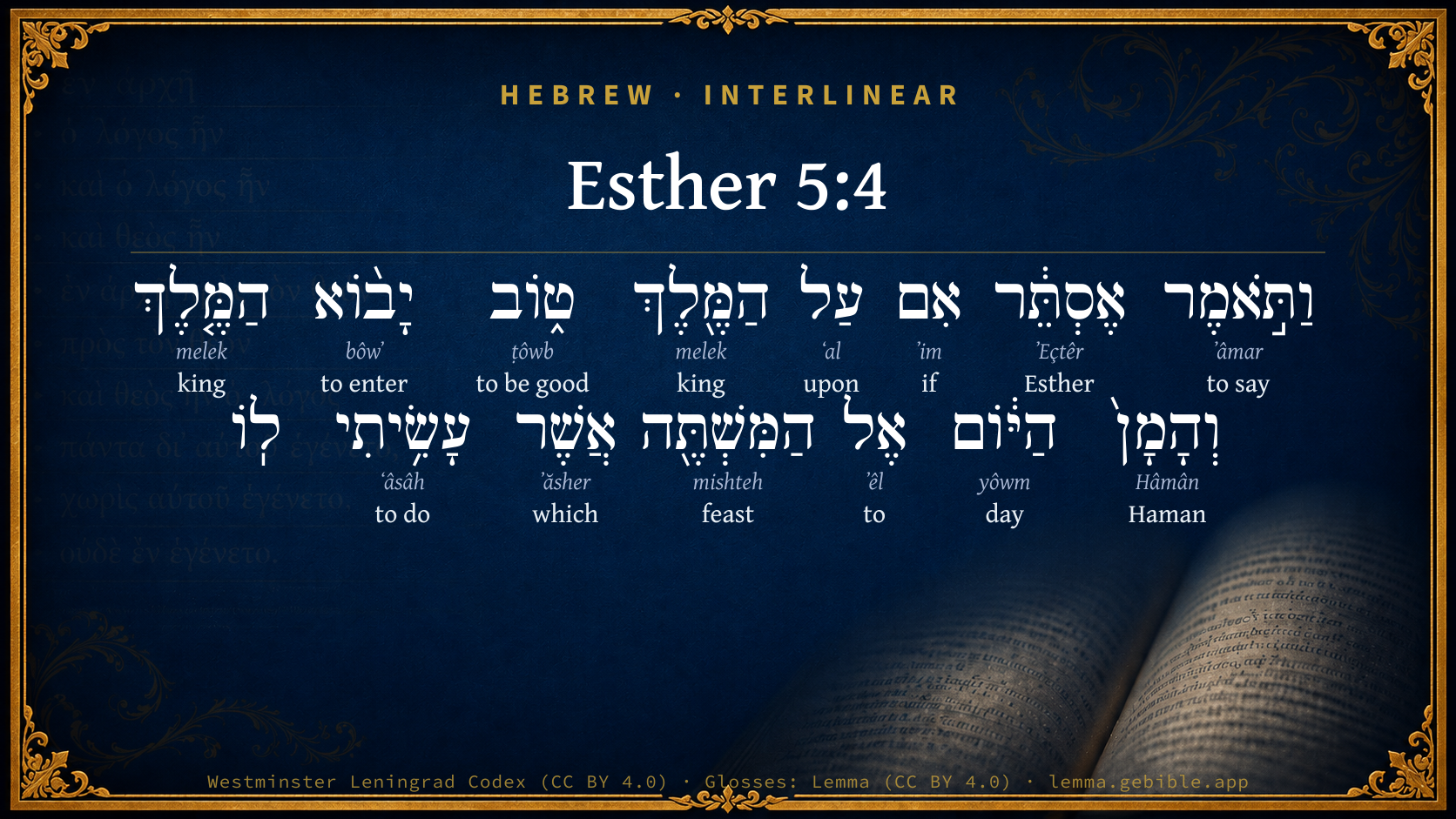
Hebrew (Westminster Leningrad Codex) Esther 5:4 appears in the Hebrew Old Testament. The text above is from the Westminster Leningrad Codex. Each word links to its Strong’s number, a concise gloss, and parsing drawn from the Open Scriptures Hebrew Bible morphology. Click any word for its full Brown-Driver-Briggs (BDB) entry.
Download image
Cite this verse

Esther 5:4 (World English Bible). Public Domain. Lemma interlinear Bible study tool, https://lemma.gebible.app/v/esther/5/4.

Show BibTeX & RIS
BibTeX
RIS
English Translation
Esther said, If it seem good to the king, let the king and Haman come this day to the banquet that I have prepared for him.
World English Bible · Public Domain
Download a study sheet

One document with this verse’s original text, its word-by-word gloss line, the meaning frame, cross-references with their text, attributed commentary, and full source and license credits — printable, and it pastes into notes with its structure intact.

This verse Autodidact and up

Study sheet (.html) Plain text (.txt)

A passage Seminary Student

Up to 50 verses in one chapter. A passage sheet keeps up to 6 commentary sources and 12 cross-references per verse, in the order this page ranks them, and says so on the sheet whenever that leaves anything out. Ask for a single verse and you get the Autodidact verse sheet above.

Everything on this page stays free to read, with no account — the sheet is a download of what is already on screen, not access to it.

Want to remove ads? Support Godless Engineer
Compare translations 3

The same verse in 3 English versions, stacked beneath the original-language interlinear above. Click any original word for its lexicon entry.

Each is an independent rendering of the whole verse — the interlinear is not word-aligned to these translations.

Highlighted words mark where these versions differ — a whole-verse word diff, not a word-by-word alignment.

  • World English Bible Public Domain
    Esther said, If it seem good to the king, let the king and Haman come this day to the banquet that I have prepared for him.
  • King James Version Public Domain
    And Esther answered, If it seem good unto the king, let the king and Haman come this day unto the banquet that I have prepared for him.
  • unfoldingWord Literal Text CC BY-SA 4.0
    And Esther said, “If it is good to the king, let the king come with Haman today to the banquet that I have made for him.”

unfoldingWord Literal Text — © unfoldingWord, licensed CC BY-SA 4.0. Word-aligned USFM3 via Door43 (git.door43.org/unfoldingWord/en_ult).

Versions to compare (up to 4)

3 of 4 selected

Show all 18 translations

Every available English version of this verse, each an independent rendering of the whole verse.

  • World English Bible Public Domain
    Esther said, If it seem good to the king, let the king and Haman come this day to the banquet that I have prepared for him.
  • Berean Standard Bible Public Domain
    “If it pleases the king,” Esther replied, “may the king and Haman come today to the banquet I have prepared for the king.”
  • Majority Standard Bible Public Domain
    “If it pleases the king,” Esther replied, “may the king and Haman come today to the banquet I have prepared for the king.”
  • King James Version Public Domain
    And Esther answered, If it seem good unto the king, let the king and Haman come this day unto the banquet that I have prepared for him.
  • American Standard Version (1901) Public Domain
    And Esther said, If it seem good unto the king, let the king and Haman come this day unto the banquet that I have prepared for him.
  • Revised Version (1885) Public Domain
    And Esther said, If it seem good unto the king, let the king and Haman come this day unto the banquet that I have prepared for him.
  • Geneva Bible (1599) Public Domain
    Then saide Ester, If it please the King, let the King and Haman come this day vnto the banket, that I haue prepared for him.
  • Douay-Rheims (1899) Public Domain
    But she answered: If it please the king. I beseech thee to come to me this day, and Aman with thee to the banquet which I have prepared.
  • Young's Literal Translation Public Domain
    And Esther saith, `If unto the king `it be' good, the king doth come in, and Haman, to-day, unto the banquet that I have made for him;'
  • Literal Standard Version CC BY-SA 4.0
    And Esther says, “If to the king [it be] good, the king comes in, and Haman, today, to the banquet that I have made for him”;
  • Unlocked Literal Bible CC BY-SA 4.0
    Esther said, “If it pleases the king, let the king and Haman come today to a feast that I have prepared for him.”
  • unfoldingWord Literal Text CC BY-SA 4.0
    And Esther said, “If it is good to the king, let the king come with Haman today to the banquet that I have made for him.”
  • Darby Bible Public Domain
    And Esther said, If it seem good to the king, let the king and Haman come this day to the banquet that I have prepared for him.
  • World Messianic Bible Public Domain
    Esther said, “If it seems good to the king, let the king and Haman come today to the banquet that I have prepared for him.”
  • Webster's Bible Public Domain
    And Esther answered, If it shall seem good to the king, let the king and Haman come this day to the banquet that I have prepared for him.
  • Free Bible Version CC BY-SA 4.0
    Esther replied, “If it please Your Majesty, may the king and Haman come today to a dinner I have prepared for him.”
  • Bible in Basic English Public Domain
    And Esther in answer said, If it seems good to the king, let the king and Haman come today to the feast which I have made ready for him.
  • JPS Tanakh (1917) Public Domain
    And Esther said: 'If it seem good unto the king, let the king and Haman come this day unto the banquet that I have prepared for him.'

Literal Standard Version (2020), Covenant Press — licensed CC BY-SA 4.0. Text via the HelloAO Bible API (eBible.org). Unlocked Literal Bible (unfoldingWord) — licensed CC BY-SA 4.0. Text via the HelloAO Bible API (eBible.org). unfoldingWord Literal Text — © unfoldingWord, licensed CC BY-SA 4.0. Word-aligned USFM3 via Door43 (git.door43.org/unfoldingWord/en_ult). Free Bible Version, Dr. Jonathan Gallagher — licensed CC BY-SA 4.0. Text via the HelloAO Bible API (eBible.org).

Word by word

More ways to search: Search by grammar → Find every occurrence → Compare this word →

Practice this passage: Drill this verse → Learn its vocabulary →

ט֑וֹב
ṭôwb
H2895
“good”
Adjective, Adjective, Masculine, Singular, Absolute
Part of Speech
Adjective
Type
Adjective
Gender
Masculine
Number
Singular
State
Absolute
Full BDB Definition

Origin: a primitive root

TWOT: 793

to be good, be pleasing, be joyful, be beneficial, be pleasant, be favourable, be happy, be right - (Qal) - to be pleasant, be delightful - to be glad, be joyful - to be better - to be well with, be good for - to be pleasing - (Hiphil) to do well, do good, act right, act rightly
  1. וַתֹּ֣אמֶר ʼâmar H559 “and · to say” Conjunction + Verb, Qal, Sequential Imperfect, 3rd Person, Feminine, Singular
  2. אֶסְתֵּ֔ר ʼEçtêr H635 “Esther” Noun, Proper
  3. אִם ʼim H518 “if” Conjunction
  4. עַל ʻal H5921 “upon” Preposition
  5. הַמֶּ֖לֶךְ melek H4428 “the · king” Particle, Definite Article + Noun, Common, Masculine, Singular, Absolute
  6. יָב֨וֹא bôwʼ H935 “to enter” Verb, Qal, Imperfect, 3rd Person, Masculine, Singular
  7. הַמֶּ֤לֶךְ melek H4428 “the · king” Particle, Definite Article + Noun, Common, Masculine, Singular, Absolute
  8. וְהָמָן֙ Hâmân H2001 “and · Haman” Conjunction + Noun, Proper
  9. הַיּ֔וֹם yôwm H3117 “the · day” Particle, Definite Article + Noun, Common, Masculine, Singular, Absolute
  10. אֶל ʼêl H413 “to” Preposition
  11. הַמִּשְׁתֶּ֖ה mishteh H4960 “the · feast” Particle, Definite Article + Noun, Common, Masculine, Singular, Absolute
  12. אֲשֶׁר ʼăsher H834 “which” Particle, Relative
  13. עָשִׂ֥יתִי ʻâsâh H6213 “to do” Verb, Qal, Perfect, 1st Person, Common, Singular

About this verse

These counts appear in no published source. They are computed here, from the morphology-tagged text and Lemma’s own curated glosses. What Lemma adds →

15
words
13
distinct lemmas
Historical
section

Notable vocabulary

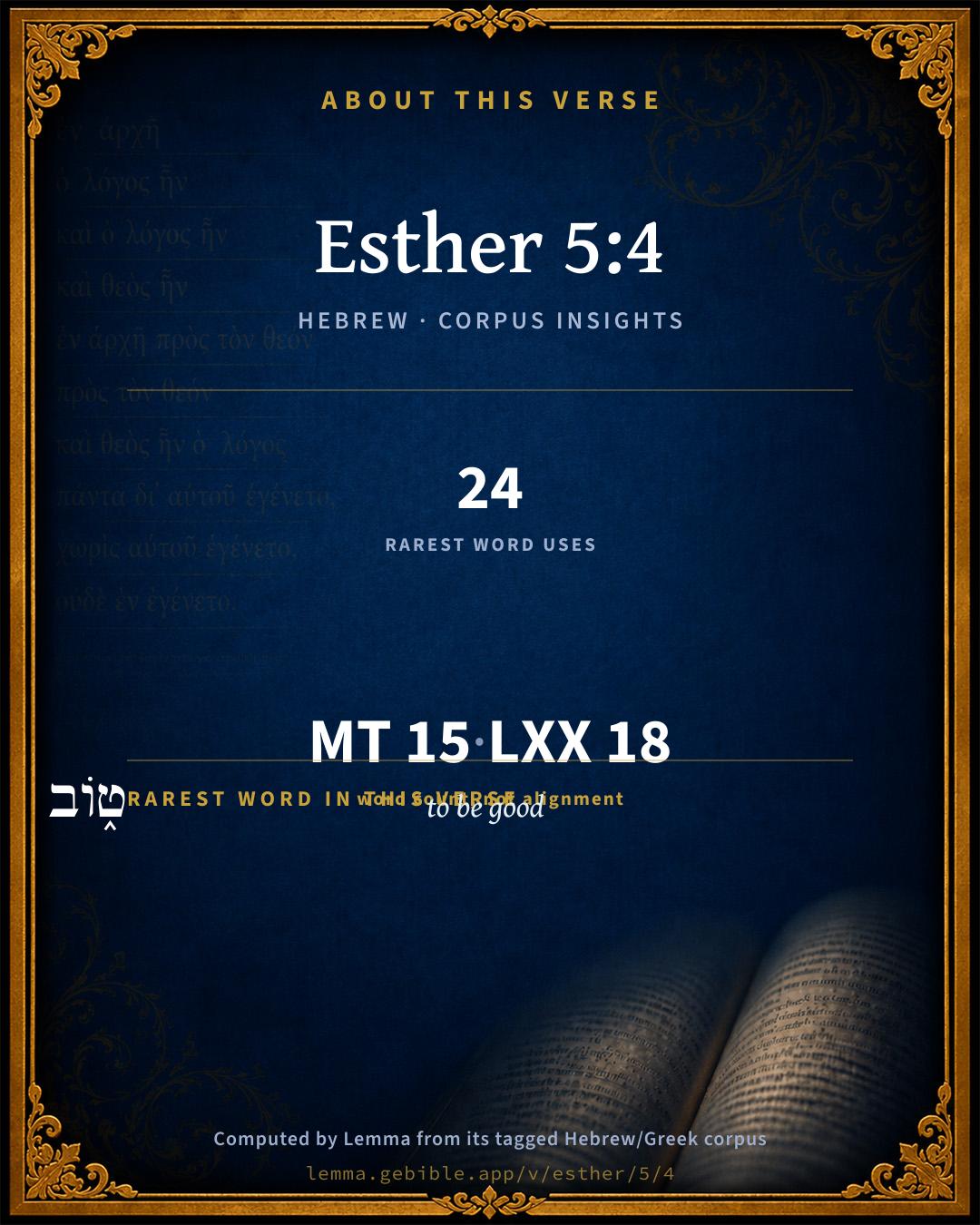
The rarest word here is ט֑וֹב to be good H2895 — appearing just 24 times in the whole Hebrew Bible.

Shared distinctive vocabulary

ט֑וֹב to be good H2895 occurs in 24 verses of the Hebrew Bible. Also found in:

Grammatical profile

  • 3 verbs
  • 6 nouns
  • 1 adjective
  • 3 prepositions
  • 1 conjunction
  • 1 particle

Verb forms

  • וַתֹּ֣אמֶר Qal · Sequential Imperfect
  • יָב֨וֹא Qal · Imperfect
  • עָשִׂ֥יתִי Qal · Perfect

Repetition

A word recurs within this verse — often emphatic in Hebrew:

  • הַמֶּ֖לֶךְ king H4428 ×2

Hebrew & Septuagint length

In English translation the verse runs 26 words from the Hebrew and 31 from the Septuagint (LXX English) — closely comparable.

A rough comparison of the two English renderings, which tokenize alike — not a word-level alignment.

Word counts can differ between the Hebrew and the Greek without any difference in meaning — e.g. the Hebrew direct-object marker אֵת has no separate Greek word, and Greek often adds the article ὁ.

In the original languages it is 15 Hebrew tokens and 18 Greek tokens — but the two are counted differently (Hebrew bundles its prefixes and suffixes into one token; the Greek is in lemma form), so that isn’t a like-for-like length.

Cross-references

7

Topical passages linked to Esther 5:4 in the Treasury of Scripture Knowledge — connected by theme and wording, ordered by reader-vote popularity; previews shown in the World English Bible.

  • Esther 5:8 if I have found favor in the sight of the king, and if it please the king to grant my petition, and to perform my request, let the king and Haman come to the banquet that I shall prepare for them, and I will do tomorrow as the king has said.
  • Proverbs 29:11 A fool vents all of his anger, But a wise man brings himself under control.
  • Esther 3:15 The posts went forth in haste by the king's commandment, and the decree was given out in Shushan the palace. The king and Haman sat down to drink; but the city of Shushan was perplexed.
  • Psalms 112:5 It is well with the man who deals graciously and lends. He will maintain his cause in judgment.
  • 1 Corinthians 14:20 Brothers, don't be children in thoughts, yet in malice be babies, but in thoughts be mature.
  • Genesis 27:25 He said, "Bring it near to me, and I will eat of my son's venison, that my soul may bless you." He brought it near to him, and he ate. He brought him wine, and he drank.
  • Genesis 32:20 You shall say, 'Not only that, but behold, your servant, Jacob, is behind us.'" For, he said, "I will appease him with the present that goes before me, and afterward I will see his face. Perhaps he will accept me."

Cross-references courtesy of OpenBible.info (CC BY 4.0).

Hebrew and Greek witnesses Masoretic Hebrew ↔ Greek Septuagint

The same verse in the two great witnesses to the Old Testament, shown verse-for-verse.

These are two independent witnesses, not word-aligned to each other, and the Septuagint is shown in lemma (dictionary) form.

Hebrew Esther 5:4 Masoretic · Westminster Leningrad Codex

וַתֹּ֣אמֶר אֶסְתֵּ֔ר אִם עַל הַמֶּ֖לֶךְ ט֑וֹב יָב֨וֹא הַמֶּ֤לֶךְ וְהָמָן֙ הַיּ֔וֹם אֶל הַמִּשְׁתֶּ֖ה אֲשֶׁר עָשִׂ֥יתִי לֽוֹ

Esther said, If it seem good to the king, let the king and Haman come this day to the banquet that I have prepared for him.

World English Bible · Public Domain

Greek LXX Esther 5:4 Septuagint · lemma form

ἐν δέ ὁ πότος εἶπον ὁ βασιλεύς πρός εσθηρ τίς εἰμί βασίλισσα εσθηρ καί εἰμί σύ ὅσος ἀξιόω

And Esther said, To-day is my great day: if then it seem good to the king, let both him and Aman come to the feast which I will prepare this day.

LXX2012 (modern English Septuagint) · Public Domain

Hebrew: Westminster Leningrad Codex (CC BY 4.0). Greek: Septuagint (public domain); English from LXX2012 (modern English Septuagint) (Public Domain). How the Septuagint differs from the Hebrew →

Commentary

Notes on Esther 5:4 from classic Christian and Jewish commentators (each source and its license shown beneath its notes). The classic Christian expositions comment on the surrounding passage and are grouped to its opening verse, so a note may address several verses; the Jewish commentaries on the Tanakh (Rashi and others) are per-verse, so they appear only where the commentator wrote on this verse.

Lemma curates 59 commentaries, every one of them public domain or Creative Commons licensed, each selected and text-cleaned for this edition rather than reprinted as found. About our sources →

Trapp's Complete Commentary

John Trapp

Est 5:4 And Esther answered, If [it seem] good unto the king, let the king and Haman come this day unto the banquet that I have prepared for him.

Ver. 4. And Esther answered] She did not presently pour forth her whole heart into the king’s bosom, rail against Haman, beg for her people, &c., but prudently reserveth herself till a fitter opportunity. Unadvised open-heartedness is a fruit of fool-hardiness, Pro 29:11 : "A fool uttereth all his mind" (ye shall have it presently, so near his mouth doth it lie, that all will out suddenly): "but a wise man keepeth it in till afterwards," or, in an inner room ( in ulteriori animi recessu), as the word may be rendered, till he see his time to produce it.

If it seem good to the king] Princes must have silken words given them, as the mother of Artaxerxes (perhaps Esther) told one. The rule of old was η ηκιστα, η ηδιστα, short or sweet.

Let the king and Haman come this day to the banquet] She knew that the king loved Haman’s company, and especially at a banquet. It was policy in Rebecca to provide such savoury meat as the old man loved; so here. Be wise as serpents. David is commended for his prudent (and thereby prosperous) deporting himself in Saul’s house, 1Sa 18:14 God gave Solomon politic wisdom exceeding much. Who is a faithful and a wise servant? saith our Saviour, &c., Mat 24:45. And "who is a wise man and endued with knowledge (saith St James) amongst you? let him show out of a good conversation his works, with meekness of wisdom," Jas 3:13. But if it were policy in Esther to invite Haman, whom she hated, was it likewise piety? did she not dissemble? R. Solomon saith, she invited Haman alone with the king, that other courtiers might envy him, and so undermine him. But that is but a sorry excuse, neither doth Lyra’s allegation of her good intention much mend the matter. They answer better, who say, that she invited him, that she might accuse him to his face; and so cut off all matter of his excuse or escape. Hereby also she would show, saith Lavater, that she accused him, not out of wrath or revenge; but that she was drawn to it, and, as it were, driven by mere necessity.

John Trapp, A Commentary or Exposition upon All the Books of the Old and New Testament (1647–1656) — public domain. Text from a community e-Sword module.

Joseph Benson's Commentary

Est 5:4. Let the king and Haman come this day unto the banquet — She thought it prudent not to open her mind to him immediately, but first to try how he stood affected to her, and endeavour to endear herself more to him, that he might be the better disposed to grant her request. To accomplish which purpose still more effectually, she desired to entertain him at her banquet a second time, Est 5:8. And she, each time, invited Haman, that by showing such respect to the king’s great favourite she might insinuate herself the more into the king’s affection; and that, if she saw fit, she might then present her request to the king.

Joseph Benson's Commentary on the Old and New Testaments (1811–1818) — public domain. Text from a community e-Sword module.

Tyndale Open Study Notes

Tyndale Open Resources

5:4 If it please the king: Esther showed proper deference (cp. 1:12).

Tyndale Open Study Notes — © Tyndale Open Resources, licensed CC BY-SA 4.0. Text via the HelloAO Bible API.

Jamieson, Fausset & Brown

Robert Jamieson, A. R. Fausset & David Brown

let the king and Haman come this day unto the banquet that I have prepared for him--There was great address in this procedure of Esther's; for, by showing such high respect to the king's favorite, she would the better insinuate herself into the royal affections; and gain a more suitable opportunity of making known her request.

Jamieson, Fausset & Brown — Commentary Critical and Explanatory on the Whole Bible (1871) — public domain (CC PDM 1.0). Text via the HelloAO Bible API.

Adam Clarke's Commentary

Verse 4. Let the king and Haman come this day unto the banquet] It was necessary to invite Haman to prevent his suspicion, and that he might not take any hasty step which might have prevented the execution of the great design.

Adam Clarke's Commentary on the Bible (1810–1826) — public domain. Text from a community e-Sword/MySword module.

Ellicott's Commentary for English Readers

(4) Let the king and Haman come this day unto the banquet.—It was natural enough that, with so much depending on her request, the queen should show some hesitation: if anything took an untoward turn (for, in spite of the king’s promise, she evidently felt uneasy) it might mean total ruin. She therefore temporises; she at any rate gains time, she secures a specially favourable opportunity for bringing forward the request, and the king clearly sees that she has kept her real petition in reserve by himself again raising the question. It will be noticed that so long as Esther is working her way up to the due vantage-ground, the king is addressed in the third person, let the king come,” but when she makes the decisive appeal, in the second, “in thy sight, O king.”

A Bible Commentary for English Readers, edited by Charles John Ellicott (1878–1897) — public domain. Text from a community e-Sword module.

The Cambridge Bible for Schools and Colleges

gen. ed. J. J. S. Perowne

4. That a subject like Haman should be admitted to make a third at the banquet to which the king was invited by his consort, seemed a specially marked instance of favour, arising from the position which the minister held in the estimation of his royal master. The higher the honour paid, the more startling and effective is the favourite’s ruin.

The Cambridge Bible for Schools and Colleges (gen. ed. J. J. S. Perowne; Cambridge University Press, 1878–1918) — public domain. Text from a community e-Sword module.

John Gill's Exposition

And Esther answered, if it seem good unto the king,.... She humbly submits it to his pleasure, suggesting it would be exceeding grateful to her, could it be granted:

let the king and Haman come this day unto the banquet that I have prepared for him; for the king; and supposing it would be acceptable to him, and the rather engage him to come to it, she invited his favourite; and chiefly, that she might have an opportunity of accusing him before the king to his face, and when alone.

John Gill's Exposition of the Whole Bible (1746–1763) — public domain (CC PDM 1.0). Text via the HelloAO Bible API.

Albert Barnes' Notes on the Bible

Esther seems to have been afraid to make her real request of Xerxes too abruptly. She concluded that the king would understand that she had a real petition in the background, and would recur to it, as in fact he did Est 5:6; Est 7:2.

Albert Barnes' Notes on the Bible (1834–1885) — public domain. Text from a community e-Sword/MySword module.

Haydock's Catholic Bible Commentary

Prepared. It was not prudent to declare her request, when many improper persons were present; and Aman was not there. (Menochius) --- She thought that the hilarity, occasioned by innocent feasting, (Haydock) might be a means of obtaining more effectually what she wanted. (Menochius) --- If the prudence of this world suggest much address, why may not virtue employ the same arts for good purposes? Esther had to obtain two great points; to make the king retract his edict, andto abandon his favourite. She is afraid therefore of being too hasty, (Calmet) and invites the king again, to increase by this delay his desire to of knowing her request, and that he might bind himself to grant it more effectually. (Worthington) --- She invites Aman alone, who would thus be more envied by the other courtiers; (Lyranus) while she manifested an open dispostion, and disdained to accuse the absent. (Tirinus)

George Leo Haydock (1774–1849), Haydock's Catholic Family Bible and Commentary, 1859 edition — public domain. Excludes Psalms (Douay-Rheims chapter numbering differs from Protestant) and Deuterocanonical books (Catholic canon only).

Matthew Poole's English Annotations

She invited Haman; partly that by showing such respect to the king’s great favourite she might insinuate herself into the king’s good opinion and affection; and partly that, if she saw fit, she might then present her request to the king.

Matthew Poole's English Annotations on the Holy Bible (1683–1685) — public domain. Text from a community e-Sword/MySword module.

Whedon's Commentary on the Bible

Daniel D. Whedon

4. The king and Haman — She would have Haman present with the king when she makes her accusation, that he may have no chance to turn the king’s mind from the view of his wicked plot which she proposes to present.

This day unto the banquet that I have prepared — Great was her prudence and caution in not making known her request publicly, and equal wisdom was evinced by having the banquet already prepared, that with the least possible delay she might thoroughly commit the king to her wishes. These measures rendered more probable the desired accomplishment of her plans.

Daniel D. Whedon (gen. ed.), Commentary on the Old and New Testaments (1874–1909) — public domain. Text from a community e-Sword module.

The Pulpit Commentary

Let the king and Haman come this day unto the banquet that l have prepared. Such an invitation as this was very unusual. Ordinarily the king and queen dined separately, each in their own apartments; family gatherings, however, not being unknown (Plut., "Vit. Artaxerx.," Athen., "Deipnsoph.," 4. p. 145, A). But for the queen to invite not only the king, but also another male guest, not a relation, was a remarkable innovation, and must have seemed to the fortunate recipient of the invitation a high act of favour.

Vers. 4-14.

Prudence versus Guile.

I EVERYTHING HAS ITS SEASON. Why did not Esther at once lay open her heart to the king? Was she confused by his unexpected kindness, or seized with timidity at the moment of peril? Most likely she was prompted by an intuitive feeling that the time was not fit. She might lose everything by precipitancy. It is wise to study occasion or opportunity. Many failures have resulted solely from want of attention to time and place. (Ecc_3:1)

II PRUDENCE WORKS PATIENTLY. The invitation to the banquet would provide a better opportunity. Yet Esther again deferred her request, though the king repeated his promise to grant her any boon, to "the half of his kingdom." She was acting now not in the dark, or under impulse, but under a new light and in watchful thought. Her regaining of influence over the king gave her confidence and made her patient. Her woman"s instinct told her that by prolonging suspense she would increase her power. The king once hers, she could defy Haman. So she worked and waited. The prudence of the righteous may be more than a match for the guile of the wicked. These sometimes seem to resemble each other; but the distinction between is, that while prudence is honourable in method and pure in motive, guile is impure and unscrupulous. God disciplines his people into patience, and then sends them deliverance through it. It is often harder to wait than to work or to suffer. Patience, therefore, is an excelling grace (Psa_40:1-4; Jam_1:3, Jam_1:4)

III THE BITTER MINGLES WITH THE SWEET IN THE CUP OF THE WICKED. Haman was a proud man when he went forth from the banquet. To have been alone with the king and queen at their private feast, and to be invited to a similar feast on the next day, was almost too much honour for his vain soul to bear. But he had not gone far when his eye fell on the unbending Mordecai. Then indignation took possession of his heart. What a humbling of pride! what a beclouding of joy! So is it always with the happiness of the wicked. It is ever meeting with signs of menace a word, a look, an attitude, an enemy which make it fade. A Mordecai sits at the gate that leads from its feastings. Evil joys are attended by a mocking shade which has only to appear to turn them into wormwood.

IV HOUSEHOLD SYMPATHIES. It was natural that Haman, on reaching home from the palace, should call his friends around him, and tell them of the double honour he had received. Nothing is pleasanter to behold than a united family in which there is a free sharing of confidences and sympathies, all the members rejoicing in the happiness of each. But if the family be godless and wicked, and bound together by common interests of an evil kind, then all the pleasantness of the picture vanishes. Such was the family of Haman. His wife and friends knew the arts by which he had gained the royal favour, and the terrible revenge he was about to execute on the whole Jewish race for the offence of Mordecai. Yet they flattered him as be flattered the king, and stimulated him in his abounding crimes. Saddest of sights that of a family whose bond is wickedness! Learn, further

1. How character influences. A man who acquires power draws about him his own circle, and infuses his spirit into all the members of it. Children catch the spirit and habits of their parents. Men are known by the companions that attract them.

2. How pride puffs itself up. It was a glowing story which Haman told of his wealth, and grandeur, and promotions, and of the special honours which even Esther was conferring on him. His vanity plumed itself rarely before his admiring hearers. But to us the exhibition is repugnant. It was a self-feeding of all that was worst in the man, and a kindling of hateful fires in the hearts that were listening. The boaster little suspected what the favour of Esther meant. "Pride goeth before destruction.

3. How pride resents affront. The recital of an ill-gotten glory was ended by a confession that all was dimmed by the remembrance of one man. The higher his advancement to honour, the more deeply did the iron of the Jew"s contempt enter into Haman"s soul. He described to his home circle his passing of Mordecai at the king"s gate, and the difficulty with which he had restrained an outflow of his passion. The self-restraint of evil men in presence of supposed insult is exercised not that they may overlook or forget, but that they may inflict a deadlier vengeance.

4. How the result of consultations will be in accordance with the spirit thatgoverns them. The practical question before Haman and his friends came to be, How should Mordecai be dealt with? There was no thought of pity or forgiveness, or even of silent contempt. The insulted favourite could no longer, even in prospect of the coming slaughter, possess his soul in patience. The conclusion arrived at was consistent with the fierce animosity that had communicated itself to every breast. Justice, compassion, wisdom were swallowed up in the common hatred. Notice

(1) The proposer of the scheme of punishment. We infer that it was Zeresh, the wife of Haman. She, as his most intimate companion, would be most influenced by his spirit, and would enter most sympathetically into his ambitious projects. The tenderest nature may become brutalised by the dominance of evil.

(2) The nature of the adopted proposal. It consisted of three parts:

(a) That a gallows fifty cubits high should be constructed for the hanging of Mordecai. The higher the gibbet, the more conspicuous, and therefore the more satisfying the vengeance of the favourite.

(b) That Haman was to get the king"s sanction for the hanging of the Jew on the morrow. Having secured a decree for the destruction of all the Jews, it would be an easy matter to obtain the premature sacrifice of this one Jew.

(c) That Haman, having done this business, was to "go in merrily with the king unto the banquet." Merrily! with so much evil in his heart! with so much blood on his head!. (Psa_1:1 Psa_2:1-4)

V GOD SENDS BLINDNESS TO THOSE WHOM HE MEANS TO DESTROY. Haman had no perception of any influences that were working against him. So vainly secure was his sense of power with the king, that he took Esther"s banquets as intended to confer special honour on himself. God had entered the lists against him. It was God who had given to Mordecai the heroism of faith. It was God who had strengthened the timid Esther, and given her "a mouthpiece and wisdom." And it was God who bad allowed Haman to erect a gallows for himself. How blind we become when we fight against God! D.

The Pulpit Commentary (1880–1919), ed. H.D.M. Spence-Jones & Joseph S. Exell — public domain. Text from a community e-Sword module.

John Wesley's Explanatory Notes

Haman - Whom she invited, that by shewing such respect to the king's great favourite, she might insinuate herself the more into the king's affection; and, that if she saw fit, she might then present her request to the king.

John Wesley, Explanatory Notes Upon the Whole Bible (1754–1765) — public domain. Text via the GEBible commentary corpus.

Rashi

Rabbi Shlomo Yitzchaki (Rashi)

let the king and Haman come Our Sages stated many reasons for the matter. What did Esther see (i.e., what motivated her) to invite Haman? In order to make the king and the princes jealous of him, that the king should think that he desired her and kill him, and many other reasons.

to the banquet Heb. (הַמִשְּׁתֶּה) lit. drinking feast. Every banquet is called (מִשְּׁתֶּה) on account of the wine, which is the principal feature.

Rashi on the Tanakh — English translations: “The Judaica Press complete Tanach with Rashi, translated by A. J. Rosenberg” (CC BY 4.0); “Pentateuch with Rashi's commentary by M. Rosenbaum and A.M. Silbermann, 1929-1934” (public domain); “The Metsudah Tanach series, Lakewood, N.J” (CC BY 4.0); and “The Book of Joshua, Metsudah Publications, 1997” (CC BY 4.0). Text via Sefaria.

Lesson kit

Teaching starters — assembled from the data on this page, not authored interpretation. Every prompt links to the verse data it draws on. Edit before teaching.

Esther, in the Historical, opens this verse with 15 words (13 distinct Hebrew lemmas). Its most distinctive word is ṭôwb (“to be good”). A historical commentator’s framing appears above. Read the whole chapter for the surrounding context.

Discussion questions

  1. How does “to be good” (ṭôwb) shape what this verse is saying?
  2. Numbers 11:18 shares the word «to be good» with this verse. How do the two illuminate each other?
  3. “king” occurs 2× in this one verse. What is the effect of the repetition?
  4. These translations render this verse differently; the difference is in the English rendering, not the original. What questions does that raise?
  5. The verb «וַתֹּ֣אמֶר» is Qal Sequential Imperfect. How does its form color the action?
  6. Reading how Trapp's Complete Commentary and Joseph Benson's Commentary read this verse, where do the two commentators agree and where do they part?

Things to notice

Reading settings

Reading text

Shown beneath each verse's original-language words.

Old Testament
Old Testament edition

Read the OT as the Masoretic Hebrew (MT) or the Greek Septuagint (LXX).

English shown for the Greek Septuagint (in the Hebrew ↔ Greek comparison).

Comparing translations? Open the Compare panel on any verse page to stack up to four side by side.