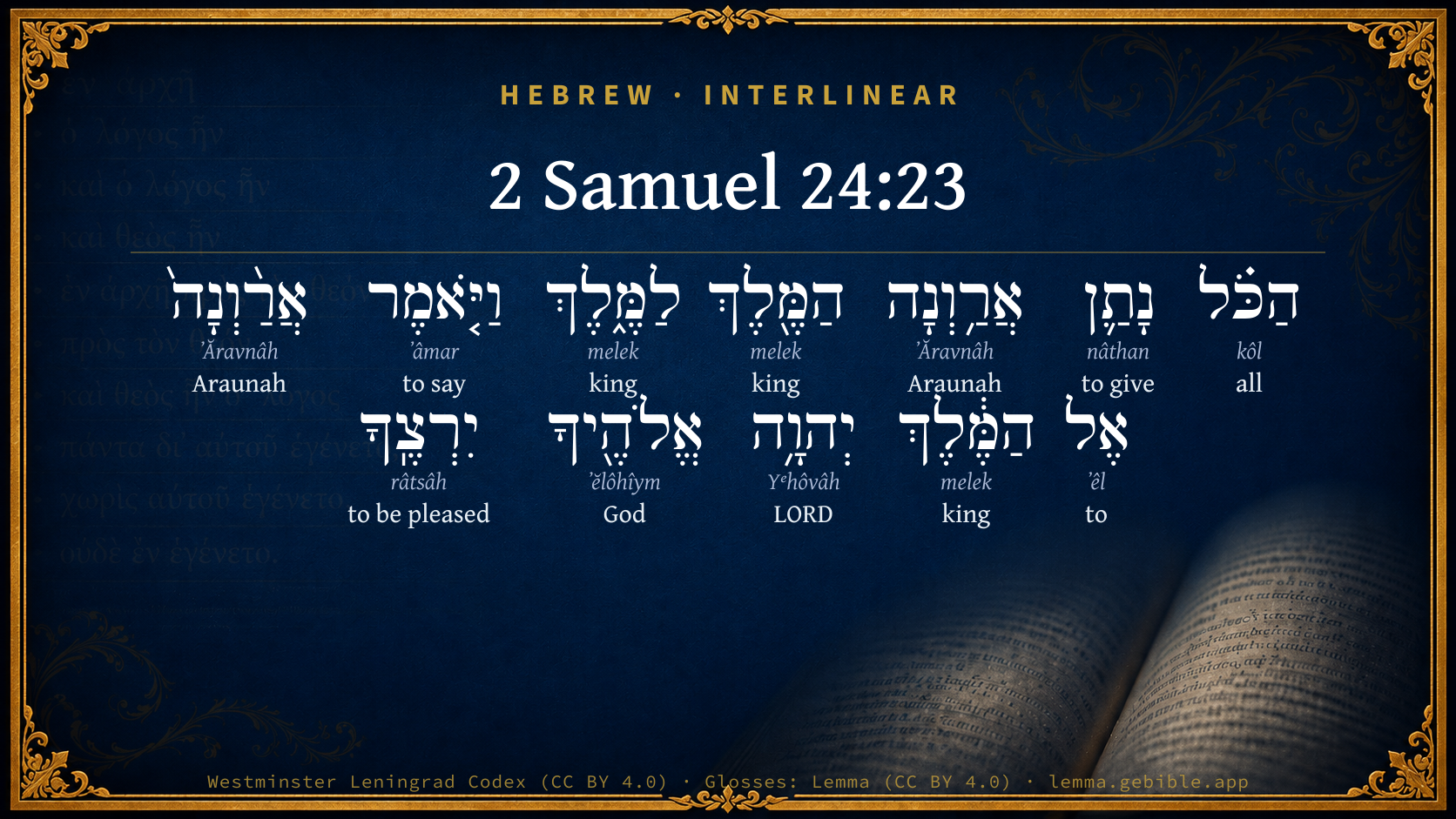
2 Samuel 24:23

Hebrew (Westminster Leningrad Codex) 2 Samuel 24:23 appears in the Hebrew Old Testament. The text above is from the Westminster Leningrad Codex. Each word links to its Strong’s number, a concise gloss, and parsing drawn from the Open Scriptures Hebrew Bible morphology. Click any word for its full Brown-Driver-Briggs (BDB) entry.
Download image
Cite this verse

2 Samuel 24:23 (World English Bible). Public Domain. Lemma interlinear Bible study tool, https://lemma.gebible.app/v/2-samuel/24/23.

Show BibTeX & RIS
BibTeX
RIS
English Translation
all this, king, does Araunah give to the king. Araunah said to the king, Yahweh your God accept you.
World English Bible · Public Domain
Download a study sheet

One document with this verse’s original text, its word-by-word gloss line, the meaning frame, cross-references with their text, attributed commentary, and full source and license credits — printable, and it pastes into notes with its structure intact.

This verse Autodidact and up

Study sheet (.html) Plain text (.txt)

A passage Seminary Student

Up to 50 verses in one chapter. A passage sheet keeps up to 6 commentary sources and 12 cross-references per verse, in the order this page ranks them, and says so on the sheet whenever that leaves anything out. Ask for a single verse and you get the Autodidact verse sheet above.

Everything on this page stays free to read, with no account — the sheet is a download of what is already on screen, not access to it.

Want to remove ads? Support Godless Engineer
Compare translations 3

The same verse in 3 English versions, stacked beneath the original-language interlinear above. Click any original word for its lexicon entry.

Each is an independent rendering of the whole verse — the interlinear is not word-aligned to these translations.

Highlighted words mark where these versions differ — a whole-verse word diff, not a word-by-word alignment.

  • World English Bible Public Domain
    all this, king, does Araunah give to the king. Araunah said to the king, Yahweh your God accept you.
  • King James Version Public Domain
    All these things did Araunah, as a king, give unto the king. And Araunah said unto the king, The LORD thy God accept thee.
  • unfoldingWord Literal Text CC BY-SA 4.0
    Everything, Araunah gives, O king, to the king.” And Araunah said to the king, “May Yahweh your God be pleased with you.”

unfoldingWord Literal Text — © unfoldingWord, licensed CC BY-SA 4.0. Word-aligned USFM3 via Door43 (git.door43.org/unfoldingWord/en_ult).

Versions to compare (up to 4)

3 of 4 selected

Show all 18 translations

Every available English version of this verse, each an independent rendering of the whole verse.

  • World English Bible Public Domain
    all this, king, does Araunah give to the king. Araunah said to the king, Yahweh your God accept you.
  • Berean Standard Bible Public Domain
    O king, Araunah gives all these to the king.” He also said to the king, “May the LORD your God accept you.”
  • Majority Standard Bible Public Domain
    O king, Araunah gives all these to the king.” He also said to the king, “May the LORD your God accept you.”
  • King James Version Public Domain
    All these things did Araunah, as a king, give unto the king. And Araunah said unto the king, The LORD thy God accept thee.
  • American Standard Version (1901) Public Domain
    all this, O king, doth Araunah give unto the king. And Araunah said unto the king, Jehovah thy God accept thee.
  • Revised Version (1885) Public Domain
    all this, O king, doth Araunah give unto the king. And Araunah said unto the king, The LORD thy God accept thee.
  • Geneva Bible (1599) Public Domain
    (All these things did Araunah as a King giue vnto the King: and Araunah saide vnto the King, The Lord thy God be fauourable vnto thee)
  • Douay-Rheims (1899) Public Domain
    All these things Areuna as a king gave to the king: and Areuna said to the king: The Lord thy God receive thy vow.
  • Young's Literal Translation Public Domain
    the whole hath Araunah given, `as' a king to a king; and Araunah saith unto the king, `Jehovah thy God doth accept thee.'
  • Literal Standard Version CC BY-SA 4.0
    Araunah has given the whole [as] a king to a king; and Araunah says to the king, “Your God YHWH accepts you.”
  • Unlocked Literal Bible CC BY-SA 4.0
    All this, my king, I, Araunah, will give to you.” Then he said to the king, “May Yahweh your God accept you.”
  • unfoldingWord Literal Text CC BY-SA 4.0
    Everything, Araunah gives, O king, to the king.” And Araunah said to the king, “May Yahweh your God be pleased with you.”
  • Darby Bible Public Domain
    All these things, O king, doth Araunah give to the king. And Araunah said to the king, Jehovah thy God accept thee.
  • World Messianic Bible Public Domain
    All this, O king, does Araunah give to the king.” Araunah said to the king, “May the LORD your God accept you.”
  • Webster's Bible Public Domain
    All these things did Araunah, as a king, give to the king. And Araunah said to the king, The LORD thy God accept thee.
  • Free Bible Version CC BY-SA 4.0
    Your Majesty, I, Araunah, give it all to the king.” Araunah concluded by saying, “May the Lord your God respond positively to you.”
  • Bible in Basic English Public Domain
    All this does the servant of my lord the king give to the king. And Araunah said, May the Lord your God be pleased with your offering!
  • JPS Tanakh (1917) Public Domain
    All this did Araunah the king give unto the king. And Araunah said unto the king: 'The LORD thy God accept thee.'

Literal Standard Version (2020), Covenant Press — licensed CC BY-SA 4.0. Text via the HelloAO Bible API (eBible.org). Unlocked Literal Bible (unfoldingWord) — licensed CC BY-SA 4.0. Text via the HelloAO Bible API (eBible.org). unfoldingWord Literal Text — © unfoldingWord, licensed CC BY-SA 4.0. Word-aligned USFM3 via Door43 (git.door43.org/unfoldingWord/en_ult). Free Bible Version, Dr. Jonathan Gallagher — licensed CC BY-SA 4.0. Text via the HelloAO Bible API (eBible.org).

Word by word

More ways to search: Search by grammar → Find every occurrence → Compare this word →

Practice this passage: Drill this verse → Learn its vocabulary →

אֲרַ֥וְנָה
ʼĂravnâh
H728
“Araunah”
Noun, Proper
Part of Speech
Noun
Type
Proper
Full BDB Definition

Origin: all by orthographical variation for H771

TWOT: None

= "joyful shouting of Jah ( 2Sa 24:18 )" = "make ye to shine ( 2Sa 24:16 )" = "joyful shouting of Jah ( 2Sa 24:18 )" - a Jebusite who sold David the site for an altar
  1. הַכֹּ֗ל kôl H3605 “the · all” Particle, Definite Article + Noun, Common, Masculine, Singular, Absolute
  2. נָתַ֛ן nâthan H5414 “to give” Verb, Qal, Perfect, 3rd Person, Masculine, Singular
  3. הַמֶּ֖לֶךְ melek H4428 “the · king” Particle, Definite Article + Noun, Common, Masculine, Singular, Absolute
  4. לַמֶּ֑לֶךְ melek H4428 “to/for the · king” Preposition, Determined + Noun, Common, Masculine, Singular, Absolute
  5. וַיֹּ֤אמֶר ʼâmar H559 “and · to say” Conjunction + Verb, Qal, Sequential Imperfect, 3rd Person, Masculine, Singular
  6. אֲרַ֨וְנָה֙ ʼĂravnâh H728 “Araunah” Noun, Proper
  7. אֶל ʼêl H413 “to” Preposition
  8. הַמֶּ֔לֶךְ melek H4428 “the · king” Particle, Definite Article + Noun, Common, Masculine, Singular, Absolute
  9. יְהוָ֥ה Yᵉhôvâh H3068 “LORD” Noun, Proper
  10. אֱלֹהֶ֖יךָ ʼĕlôhîym H430 “God(s) · your” Noun, Common, Masculine, Plural, Construct + Suffix, Personal, 2nd Person, Masculine, Singular
  11. יִרְצֶֽךָ râtsâh H7521 “to be pleased · you” Verb, Qal, Imperfect, 3rd Person, Masculine, Singular + Suffix, Personal, 2nd Person, Masculine, Singular

About this verse

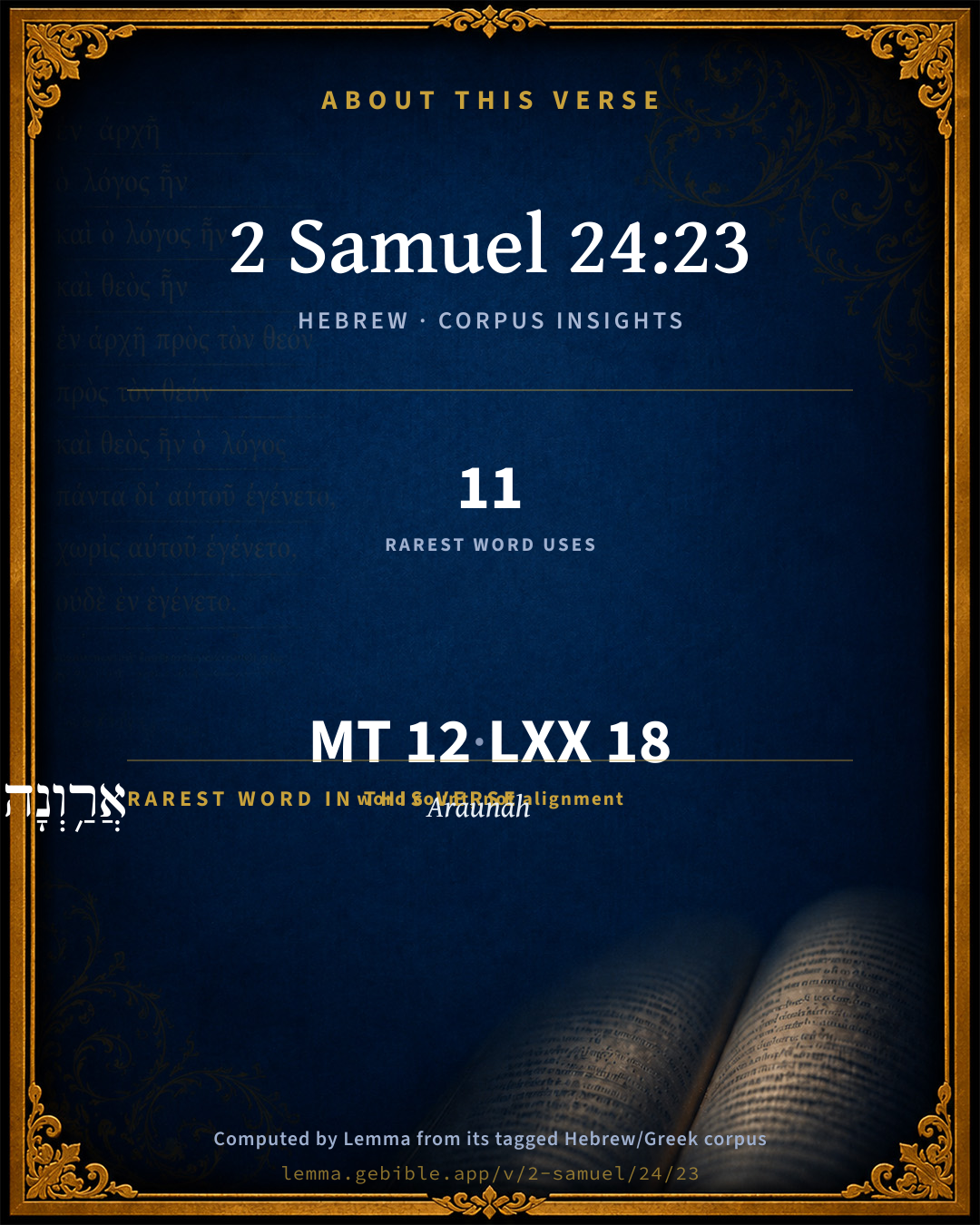
These counts appear in no published source. They are computed here, from the morphology-tagged text and Lemma’s own curated glosses. What Lemma adds →

12
words
9
distinct lemmas
Historical
section

Notable vocabulary

The rarest word here is אֲרַ֥וְנָה Araunah H728 — appearing just 11 times in the whole Hebrew Bible.

Shared distinctive vocabulary

אֲרַ֥וְנָה Araunah H728 occurs in 7 verses of the Hebrew Bible. Also found in:

Grammatical profile

  • 3 verbs
  • 8 nouns
  • 1 preposition

Verb forms

  • נָתַ֛ן Qal · Perfect
  • וַיֹּ֤אמֶר Qal · Sequential Imperfect
  • יִרְצֶֽךָ Qal · Imperfect

Repetition

Words recur within this verse — often emphatic in Hebrew:

  • הַמֶּ֖לֶךְ king H4428 ×3
  • אֲרַ֥וְנָה Araunah H728 ×2

Hebrew & Septuagint length

In English translation the verse runs 19 words from the Hebrew and 18 from the Septuagint (LXX English) — closely comparable.

A rough comparison of the two English renderings, which tokenize alike — not a word-level alignment.

Word counts can differ between the Hebrew and the Greek without any difference in meaning — e.g. the Hebrew direct-object marker אֵת has no separate Greek word, and Greek often adds the article ὁ.

In the original languages it is 12 Hebrew tokens and 18 Greek tokens — but the two are counted differently (Hebrew bundles its prefixes and suffixes into one token; the Greek is in lemma form), so that isn’t a like-for-like length.

Cross-references

10

Topical passages linked to 2 Samuel 24:23 in the Treasury of Scripture Knowledge — connected by theme and wording, ordered by reader-vote popularity; previews shown in the World English Bible.

  • Ezekiel 20:40–41 For in my holy mountain, in the mountain of the height of Israel, says the Lord Yahweh, there shall all the house of Israel, all of them, serve me in the land: there will I accept them, and there will I require your offerings, and the first fruits of your offerings, with all your holy things.
  • Job 42:8–9 Now therefore, take to yourselves seven bulls and seven rams, and go to my servant Job, and offer up for yourselves a burnt offering; and my servant Job shall pray for you, for I will accept him, that I not deal with you according to your folly. For you have not spoken of me the thing that is right, as my servant Job has."
  • Psalms 20:3–4 Remember all your offerings, And accept your burnt sacrifice. Selah.
  • Psalms 45:16 Your sons will take the place of your fathers. You shall make them princes in all the earth.
  • Isaiah 32:8 But the noble devises noble things; and in noble things shall he continue.
  • Isaiah 60:7 All the flocks of Kedar shall be gathered together to you, the rams of Nebaioth shall minister to you; they shall come up with acceptance on my altar; and I will glorify the house of my glory.
  • Hosea 8:13 As for the sacrifices of my offerings, they sacrifice flesh and eat it; But Yahweh doesn't accept them. Now he will remember their iniquity, And punish their sins. They will return to Egypt.
  • Romans 15:30–31 Now I beg you, brothers, by our Lord Jesus Christ, and by the love of the Spirit, that you strive together with me in your prayers to God for me,
  • 1 Timothy 2:1–2 I exhort therefore, first of all, that petitions, prayers, intercessions, and givings of thanks, be made for all men:
  • 1 Peter 2:5 You also, as living stones, are built up as a spiritual house, to be a holy priesthood, to offer up spiritual sacrifices, acceptable to God through Jesus Christ.

Cross-references courtesy of OpenBible.info (CC BY 4.0).

Hebrew and Greek witnesses Masoretic Hebrew ↔ Greek Septuagint

The same verse in the two great witnesses to the Old Testament, shown verse-for-verse.

These are two independent witnesses, not word-aligned to each other, and the Septuagint is shown in lemma (dictionary) form.

Hebrew 2 Samuel 24:23 Masoretic · Westminster Leningrad Codex

הַכֹּ֗ל נָתַ֛ן אֲרַ֥וְנָה הַמֶּ֖לֶךְ לַמֶּ֑לֶךְ וַיֹּ֤אמֶר אֲרַ֨וְנָה֙ אֶל הַמֶּ֔לֶךְ יְהוָ֥ה אֱלֹהֶ֖יךָ יִרְצֶֽךָ

all this, king, does Araunah give to the king. Araunah said to the king, Yahweh your God accept you.

World English Bible · Public Domain

Greek LXX 2 Samuel 24:23 Septuagint · lemma form

ὁ πᾶς δίδωμι ορνα ὁ βασιλεύς καί εἶπον ορνα πρός ὁ βασιλεύς κύριος ὁ θεός σύ εὐλογέω σύ

Orna gave all to the king: and Orna said to the king, The Lord your God bless you.

LXX2012 (modern English Septuagint) · Public Domain

On this verse, Adam Clarke's Commentary discusses the Septuagint’s reading. Read the note in Commentary ↓

Hebrew: Westminster Leningrad Codex (CC BY 4.0). Greek: Septuagint (public domain); English from LXX2012 (modern English Septuagint) (Public Domain). How the Septuagint differs from the Hebrew →

Targum (Aramaic paraphrase)

1

The Targum is the ancient Jewish Aramaic paraphrase of the Hebrew Scriptures — an interpretive translation, not the Hebrew text itself. Onkelos (literal) and Pseudo-Jonathan (expansive) render the Torah, and Jonathan the Prophets. Coverage is partial: where no permissively-licensed English translation exists for a verse, only the Aramaic is shown. This is verse-level text, not a word-by-word alignment to the Hebrew.

  1. Targum Jonathan Prophets (Joshua–Malachi)
    כֹּלָא יְהַב אֲרַוָן מַלְכָּא לְמַלְכָּא דִי בְעָא מִנֵיהּ מַלְכָּא וַאֲמַר אֲרַוָן לְמַלְכָּא יְיָ אֱלָהָךְ יְקַבֵּיל קוּרְבָּנָךְ בְּרַעֲוָא:

    (no public-domain English translation for this verse)

    Targum Jonathan — Aramaic: “Mikraot Gedolot” (public domain). English: “Sefaria Community Translation” (CC0 1.0 (public-domain dedication)); “London "Chaldee Paraphrase," 1871” (public domain). Text via Sefaria.

Commentary

Notes on 2 Samuel 24:23 from classic Christian and Jewish commentators (each source and its license shown beneath its notes). The classic Christian expositions comment on the surrounding passage and are grouped to its opening verse, so a note may address several verses; the Jewish commentaries on the Tanakh (Rashi and others) are per-verse, so they appear only where the commentator wrote on this verse.

Lemma curates 59 commentaries, every one of them public domain or Creative Commons licensed, each selected and text-cleaned for this edition rather than reprinted as found. About our sources →

Trapp's Complete Commentary

John Trapp

2Sa 24:23 All these [things] did Araunah, [as] a king, give unto the king. And Araunah said unto the king, The LORD thy God accept thee.

Ver. 23. All these things did Araunah as a king give unto the king.] He had a princely spirit, though but a subject’s purse: Regum aequabat opes animis, as Virgil saith {a} of that old Tarentine. Some {b} think that he had been a king of the Jebusites, and was now in great esteem with David, as being a proselyte, and his friend.

{a} Georg. iv.

{b} Joseph.

John Trapp, A Commentary or Exposition upon All the Books of the Old and New Testament (1647–1656) — public domain. Text from a community e-Sword module.

Joseph Benson's Commentary

2Sa 24:23. All these things did Araunah as a king — That is, with a royal bounty; give unto the king — He not only offered, but actually gave them; he resigned his right and property in them to David; though David, by his refusal, returned it to Araunah again. The words in the Hebrew are, these things gave Araunah the king unto the king. From whence some infer that, before the taking of Jerusalem, he was the king of the Jebusites; or a man of the greatest authority among them, like a king; or was descended from the blood royal of the Jebusites. But neither the Greek, nor the Syriac, nor the Arabic copies have the word king, nor had the Vulgate it, till the edition published by Sextus; nor was it in the Chaldee Paraphrast, in the time of Kimchi, who cites it thus: Araunah gave to the king what the king asked of him. The Lord thy God accept thee — He was a Jebusite by nation, but a sincere and hearty proselyte; which made him so liberal in his offers to God’s service, and the common good of God’s people.

Joseph Benson's Commentary on the Old and New Testaments (1811–1818) — public domain. Text from a community e-Sword module.

Geneva Bible (1599)

Geneva Bible translators

That is, abundantly: for as some write, he was King of Jerusalem before David won the tower.

Geneva Bible (1599) marginal notes — public domain. Text via Bolls.life.

Jamieson, Fausset & Brown

Robert Jamieson, A. R. Fausset & David Brown

All these things did Araunah, as a king, give--Indicating, as the sense is, that this man had been anciently a heathen king or chief, but was now a proselyte who still retained great property and influence in Jerusalem, and whose piety was evinced by the liberality of his offers. The words, "as a king," are taken by some to signify simply, "he gave with royal munificence."

Jamieson, Fausset & Brown — Commentary Critical and Explanatory on the Whole Bible (1871) — public domain (CC PDM 1.0). Text via the HelloAO Bible API.

Adam Clarke's Commentary

Verse 23. As a king, give unto the king.] Literally, All these did King Araunah give unto the king. That there could not be a king of the Jebusites on Mount Moriah, is sufficiently evident; and that there was no other king than David in the land, is equally so: the word המלך hammelech, "the king," given here to Araunah, is wanting in the Septuagint, Syriac, and Arabic; in three of Kennicott's and De Rossi's MSS., and in the parallel place in Chronicles: and, it is very probable, never made a part of the text. Perhaps it should be read, All these did Arnunah give unto the king.

There is, however, a difficulty here. David had taken the fortress of the Jebusites many years before; yet it is evident that Araunah was proprietor of the soil at this time. It is not clear that he was a subject of David; but he paid him respect as a neighbour and a king. This is merely possible.

Adam Clarke's Commentary on the Bible (1810–1826) — public domain. Text from a community e-Sword/MySword module.

Ellicott's Commentary for English Readers

(23) All these things did Araunah.—This clause should be rendered as a part of Araunah’s address to David: “The whole, O king, does Araunah give unto the king.” (Comp. 1Ch_21:23.) Then, after a moment’s pause, he added, “The LORD thy God accept thee.” The first word king, however, is omitted in some MSS., and in the LXX., Vulg., and Syr. The word “give,” of course, means only offer. David actually bought the threshing-floor and other things required.

A Bible Commentary for English Readers, edited by Charles John Ellicott (1878–1897) — public domain. Text from a community e-Sword module.

The Cambridge Bible for Schools and Colleges

gen. ed. J. J. S. Perowne

23. All these things, &c.] Render, The whole doth Araunah, O king, give unto the king. The words are a continuation of Araunah’s speech in 2Sa_24:22. Cp. 1Ch_21:23. Although the rendering, “the whole did king Araunah give unto the king,” is grammatically possible, it is inconceivable that so important a fact as that Araunah was the former king of Jebus should be only mentioned in so incidental a way, and the striking picture drawn by Dean Stanley (Lect. II. 111) of the meeting of the two princes—“the fallen king of the ancient fortress, the new king of the restored capital, each moved alike by the misfortune of a city which in different senses belonged to each”—must be given up as destitute of historical foundation. But the word O king is not found in the Sept. or Vulg., and should probably be omitted. In this case the words will be the narrator’s summary of Araunah’s offer: “the whole did Araunah give unto the king:” give, as in the strikingly similar offer of Ephron to Abraham, meaning offer. See Gen_23:11.

accept thee] The same word is used of God’s acceptance of prayer and sacrifice in Job_33:26 (E. V. be favourable); Eze_20:40-41; Eze_43:27, &c.

The Cambridge Bible for Schools and Colleges (gen. ed. J. J. S. Perowne; Cambridge University Press, 1878–1918) — public domain. Text from a community e-Sword module.

John Gill's Exposition

And the king said unto Araunah, nay, but I will surely buy it of thee at a price,.... And a full price too, Ch1 21:24; that is, give him as much for it as it was worth:

neither will I offer burnt offerings to the Lord my God of that which doth cost me nothing; which shows an ingenuous spirit, and contrary to the temper of many, who like to serve the Lord in the cheapest manner, or with little cost to themselves:

so David bought the threshingfloor and the oxen for fifty shekels of silver; which, reckoning a shekel at two shillings and sixpence, made but just six pounds five shillings of our money; though its value is but about two shillings and four pence farthing, which reduces the sum; in Ch1 21:25, David is said to give six hundred shekels of gold by weight; two ways are proposed by the Jews (i) for the reconciling of the difficulty; the one is, that fifty shekels were collected out of every tribe, and twelve times fifty make six hundred shekels, and these were of the value or weight of gold; but this seems not likely, that it should be collected out of all the tribes, and since it appears plainly to be the king's purchase, and with his money: the other is, that there were two purchases, the first was of the threshingfloor, oxen, and instruments, which were bought for fifty shekels of silver, as here, and the other was a purchase of the place, as it is called in the book of Chronicles; that large space of ground on which afterwards the temple, and all the courts adjoining to it, were built, and which was now Araunah's farm, and on which were his dwelling house, and other buildings; and for all this David gave him six hundred shekels of gold, which made three hundred ounces (k) and reckoning gold as twelve times the value of silver, according to Brerewood (l), it amounted to four hundred fifty pounds of our money; and learned men have not been able to give a better solution of this difficulty; and with this Montanus (m) agrees. Bochart and Noldius have taken another way, but not so clear and satisfactory; the Septuagint of Ch1 21:25 has fifty shekels, as here.

(i) T. Bab. Zebachim, fol. 116. 2. (k) Vid. Gronov. de Pecunia Vet. l. 3. c. 7. p. 369. (l) De Ponder. & Pretiis, c. 5. (m) Tubal-Cain, p. 15. So Hieron. Trad. Heb. fol. 80. F.

John Gill's Exposition of the Whole Bible (1746–1763) — public domain (CC PDM 1.0). Text via the HelloAO Bible API.

Albert Barnes' Notes on the Bible

Either, “the whole O king does Araunah give unto the king;” or (2) “the whole did king Araunah give to the king.” The former is preferable.

Albert Barnes' Notes on the Bible (1834–1885) — public domain. Text from a community e-Sword/MySword module.

Haydock's Catholic Bible Commentary

As a king. Literally, king Areuna:" e may have been substituted for c, "like," though the latter word is often understood. (Haydock) --- Some suppose that he was formerly king of the Jebusites, (Vatable) or one of their descendants, (Grotius) or possessed of great riches, &c. But why is the title never given to him elsewhere? (Bochart) --- The Septuagint, Syriac, and many Latin copies, do not recognize it; nor was it found in the Chaldean, in the 12th age [12th century]. Yet without making any changes, we may translate, "O king, Areuna has given all these things to the king." The Jews often speak of themselves in the third person, out of respect. (Le Clerc.) (Calmet)

George Leo Haydock (1774–1849), Haydock's Catholic Family Bible and Commentary, 1859 edition — public domain. Excludes Psalms (Douay-Rheims chapter numbering differs from Protestant) and Deuterocanonical books (Catholic canon only).

Matthew Poole's English Annotations

As a king; the particle as being understood, as it oft is in the Hebrew, i.e. with a royal bounty. Or, Arannab the king, as he might be called, either because he was king of the Jebusites before David took their city, or because he was the son and heir of that king.

These things did Araunah give; he not only offered, but actually gave them, i.e. he actually resigned his right and property in them unto David; for so he did; and David by his refusal returned it to Araunah again.

The Lord thy God accept thee; he was a Jebusite by nation, but a hearty proselyte; which made him so liberal in his offers to God’s service, and the common good of God’s people.

Matthew Poole's English Annotations on the Holy Bible (1683–1685) — public domain. Text from a community e-Sword/MySword module.

Whedon's Commentary on the Bible

Daniel D. Whedon

23. All these things did Araunah, as a king, give unto the king — Literally, the whole gave Araunah, the king, to the king. Keil proposes to take the king as a vocative, and regard the sentence as a continuation, from 2Sa_24:22, of Araunah’s words — All this giveth Araunah, O king, to the king. But this makes the next words, and Araunah said, etc., superfluous.

It is better to suppose that Araunah had formerly been a king or sheik of the Jebusites, and was still occasionally spoken of as such. The supposition is favoured by the statement of Josephus that he was a very wealthy man, and it is no contradiction, as Keil affirms, to the fact that David bought all these things to say also that Araunah gave them, for he plainly did give them, but the king afterwards refused to accept them without price.

Daniel D. Whedon (gen. ed.), Commentary on the Old and New Testaments (1874–1909) — public domain. Text from a community e-Sword module.

The Pulpit Commentary

All these did Araunah, as a king, give unto the king. The Hebrew is, "The whole gave Araunah the king to the king;" and so the Vulgate, dedit Areuna rex regi. The rendering of the Revised Version (and Keil), "All this, O king, doth Araunah give unto the king," requires a change both of the order and of the tense. It is, of course, possible (though highly is probable) that Araunah was the representative of the kings of Jebus, and a titular monarch, like the Maori king in New Zealand. But the word is omitted in the Septuagint and Syriac, and is probably a mere repetition of the following word. The remark is made in order to point out Araunah"s generosity; and to mark even more clearly how hearty and sincere he was in his offering, the narrator adds, in Araunah"s own words, his prayer for God"s acceptance of David and his offering.

Acceptance with God.

Lord thy God accept thee." A good wish, flowing from good will, and all the heartier because of the occasion. For Divine acceptance of the king and his offerings meant deliverance for the nation, Araunah included, from the ravages of the pestilence. The sincerity of his wish was proved by the substantial offers with which it was accompanied.

I THE BLESSING DESIRED. Araunah referred to the favourable reception by God of David"s offerings. In the widest sense, acceptance with God includes:

1. Acceptance of ourselves. Our reception by God into his friendship and favour. Unless the man is accepted, his offerings cannot be. God receives nothing from his enemies a truth which should be very seriously pondered by multitudes of his professed worshippers, who give him outward homage, but withhold from him themselves. Who, then, are accepted by God? Those who come to him according to his appointment, with repentance, faith, self-devotement, confessing sin, trusting to the mercy and entering on the service of God. Under the Christian dispensation, men are accepted through faith in Jesus Christ. When we receive him as Saviour and Lord, God receives us. (comp. Rom_5:1, Rom_5:2)

2. Acceptance of our worship. Which includes devout exercises of mind and heart, study of the Word of God, pious meditation, praises and thanksgivings, prayers. What worship is accepted? Such as is offered in the name of Jesus (Joh_16:23, Joh_16:24; Eph_3:12; Php_2:10, Revised Version) Sincere (Isa_29:13; Joh_4:24) humble, (Luk_18:10-14) reverential, (Heb_12:28) yet trustful and affectionate as children. (Rom_8:15) Not that of slaves or mercenaries.

3. Acceptance of our gifts. We give to God when we give for the support of his worship and the spread of his kingdom, and when we give to the poor for his sake. (Mat_25:40) Our gifts are acceptable

(1) when presented with pure hearts, not ostentatiously to gain human applause, (Mat_6:2-4) not with a view to atone for sin and obtain pardon, not to bribe men to unholy compliances;

(2) when they are our own property, not the fruit of dishonesty, oppression, or injustice;

(3) when they are in due proportion to our ability. (2Co_8:12)

4. Acceptance of active service. Labours for the good of others, temporal and spiritual. All honest work springing from and guided by Christian principles.

II THE DESIRE ITSELF. In this case it was a patriotic desire. It is always pious and benevolent. Pious, as it recognizes the necessity of God"s favour and approbation to the well being of men, and implies his willingness to be favourable to them. Benevolent, as it is a desire that others should enjoy the most essential and all comprehensive of blessings, without which other blessings are of small and temporary value. Not health or wealth, not acceptance with men, not long life, not intellectual superiority, not refinement of taste, etc., are of primary importance; and these should not be first in our minds when seeking the welfare whether of ourselves or of others; but the favour of Almighty God, and, as the sure means of securing this, the possession of Christian. faith and holiness. "Wherefore" let us "labour that, whether present or absent" (living or dying), "we," and all in whom we are interested, yea, all mankind, "may be accepted of him". G.W. (2Co_5:9)

The Pulpit Commentary (1880–1919), ed. H.D.M. Spence-Jones & Joseph S. Exell — public domain. Text from a community e-Sword module.

Rashi

Rabbi Shlomo Yitzchaki (Rashi)

Aravnoh the prince. He was the chief officer of the Yevusi [fortress].

Rashi on the Tanakh — English translations: “The Judaica Press complete Tanach with Rashi, translated by A. J. Rosenberg” (CC BY 4.0); “Pentateuch with Rashi's commentary by M. Rosenbaum and A.M. Silbermann, 1929-1934” (public domain); “The Metsudah Tanach series, Lakewood, N.J” (CC BY 4.0); and “The Book of Joshua, Metsudah Publications, 1997” (CC BY 4.0). Text via Sefaria.

Radak

Rabbi David Kimhi (Radak)

Aravnah the king – He was the king of the Jebusites who dwelled in Jerusalem. Even in the days of David the Jebusites remained in Jerusalem, just as they had remained there after the conquest by Yehudah, as it is written “…but the Jebusites dwelt with the children of Judah in Jerusalem to this day.” (Yehoshua 15:63) They lived as a subject people, paying a tax of servitude to Yehudah and Benyamin in order to keep their homes, vineyards and fields. This field and threshing floor belonged to Aravnah the Jebusite and he wanted to give them to David, but he did not want to accept them except as a full purchase. Even after David conquered the stronghold, he allowed the Jebusites who had been there originally under tax and servitude to stay in the city of Jerusalem until Shlomo built the Holy Temple. These Jebusites were not one of the seven nations, but rather Phillistines descended from Avimelech as I explained in the book of Yehoshua. Therefore it was permissible to leave them settled in the land on the condition that they not cause others to sin, as it says “They shall not dwell in your land, lest they cause you to sin against Me…” (Shemot 23:33) So long as they are not sinning, meaning that they have accepted upon themselves the seven Noachide laws, it is permissible to leave them in the land. In some versions the Targum translated ‘All this Aravnah the king gave to the king’ as ‘Aravnah gave to the king that which the king asked of him.’

Radak on the Tanakh — English translations: “Sefaria Community Translation” (CC0 1.0 (public-domain dedication)); “Eliyahu Munk, HaChut Hameshulash” (CC BY 4.0); “Rabbi Mike Feuer, Jerusalem Anthology” (CC BY 4.0); and “R. David Kimhi on the first book of Psalms, Translated by R.G. Finch, London, 1919” (public domain). Text via Sefaria.

Lesson kit

Teaching starters — assembled from the data on this page, not authored interpretation. Every prompt links to the verse data it draws on. Edit before teaching.

2 Samuel, in the Historical, opens this verse with 12 words (9 distinct Hebrew lemmas). Its most distinctive word is ʼĂravnâh (“Araunah”). A historical commentator’s framing appears above. Read the whole chapter for the surrounding context.

Discussion questions

  1. How does “Araunah” (ʼĂravnâh) shape what this verse is saying?
  2. 2 Samuel 24:16 shares the word «Araunah» with this verse. How do the two illuminate each other?
  3. “king” occurs 3× in this one verse. What is the effect of the repetition?
  4. The translations on this page render this verse differently — a whole-verse word diff, not a word-by-word alignment. What might account for the different wordings?
  5. The verb «נָתַ֛ן» is Qal Perfect. How does its form color the action?
  6. Reading how Trapp's Complete Commentary and Joseph Benson's Commentary read this verse, where do the two commentators agree and where do they part?

Things to notice

Reading settings

Reading text

Shown beneath each verse's original-language words.

Old Testament
Old Testament edition

Read the OT as the Masoretic Hebrew (MT) or the Greek Septuagint (LXX).

English shown for the Greek Septuagint (in the Hebrew ↔ Greek comparison).

Comparing translations? Open the Compare panel on any verse page to stack up to four side by side.