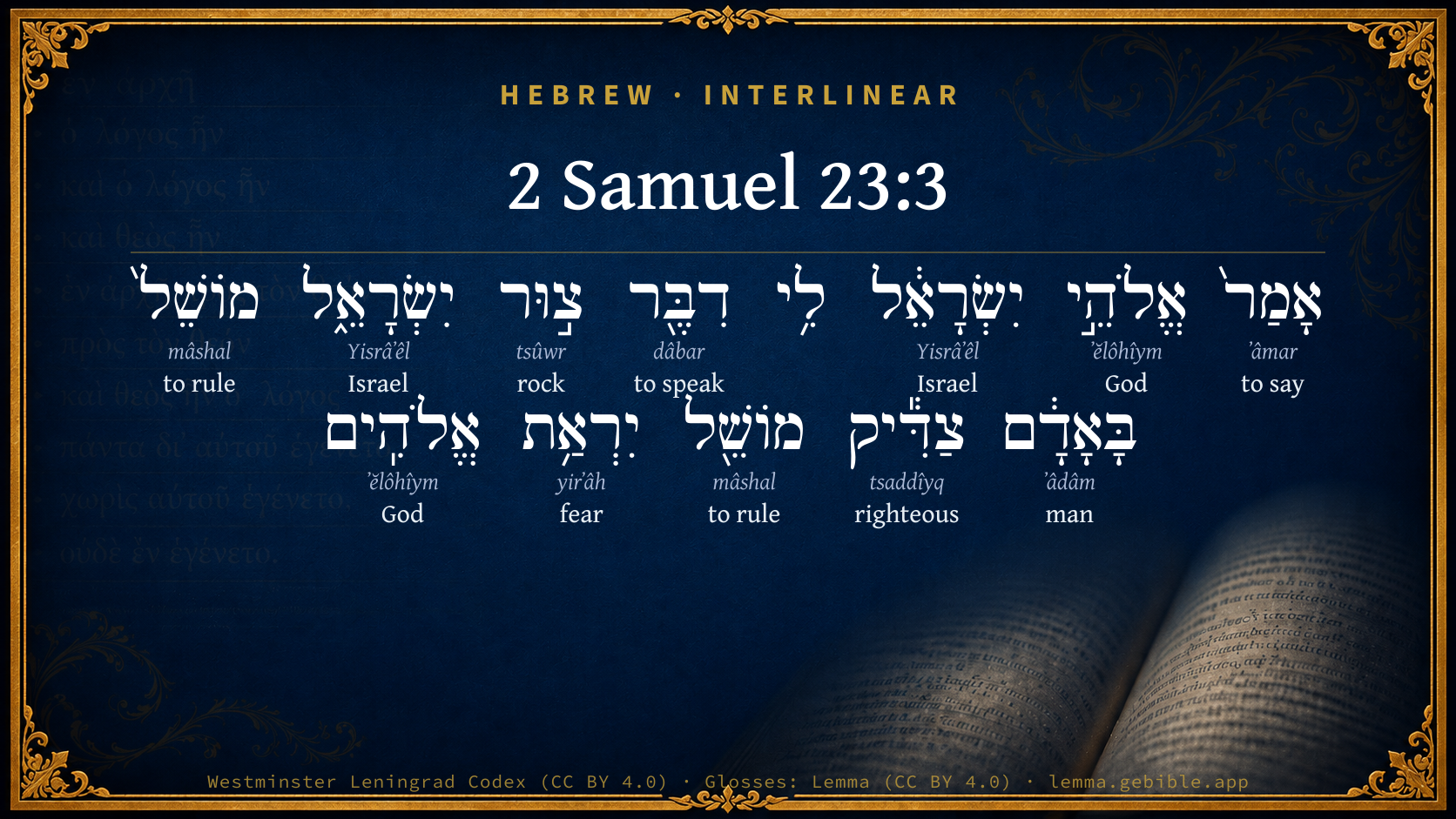
2 Samuel 23:3

Hebrew (Westminster Leningrad Codex) 2 Samuel 23:3 appears in the Hebrew Old Testament. The text above is from the Westminster Leningrad Codex. Each word links to its Strong’s number, a concise gloss, and parsing drawn from the Open Scriptures Hebrew Bible morphology. Click any word for its full Brown-Driver-Briggs (BDB) entry.
Download image
Cite this verse

2 Samuel 23:3 (World English Bible). Public Domain. Lemma interlinear Bible study tool, https://lemma.gebible.app/v/2-samuel/23/3.

Show BibTeX & RIS
BibTeX
RIS
English Translation
The God of Israel said, The Rock of Israel spoke to me: One who rules over men righteously, Who rules in the fear of God,
World English Bible · Public Domain
Download a study sheet

One document with this verse’s original text, its word-by-word gloss line, the meaning frame, cross-references with their text, attributed commentary, and full source and license credits — printable, and it pastes into notes with its structure intact.

This verse Autodidact and up

Study sheet (.html) Plain text (.txt)

A passage Seminary Student

Up to 50 verses in one chapter. A passage sheet keeps up to 6 commentary sources and 12 cross-references per verse, in the order this page ranks them, and says so on the sheet whenever that leaves anything out. Ask for a single verse and you get the Autodidact verse sheet above.

Everything on this page stays free to read, with no account — the sheet is a download of what is already on screen, not access to it.

Want to remove ads? Support Godless Engineer
Compare translations 3

The same verse in 3 English versions, stacked beneath the original-language interlinear above. Click any original word for its lexicon entry.

Each is an independent rendering of the whole verse — the interlinear is not word-aligned to these translations.

Highlighted words mark where these versions differ — a whole-verse word diff, not a word-by-word alignment.

  • World English Bible Public Domain
    The God of Israel said, The Rock of Israel spoke to me: One who rules over men righteously, Who rules in the fear of God,
  • King James Version Public Domain
    The God of Israel said, the Rock of Israel spake to me, He that ruleth over men must be just, ruling in the fear of God.
  • unfoldingWord Literal Text CC BY-SA 4.0
    The God of Israel spoke to me, the Rock of Israel said, ‘A righteous one ruling over man ruling the fear of God,

unfoldingWord Literal Text — © unfoldingWord, licensed CC BY-SA 4.0. Word-aligned USFM3 via Door43 (git.door43.org/unfoldingWord/en_ult).

Versions to compare (up to 4)

3 of 4 selected

Show all 18 translations

Every available English version of this verse, each an independent rendering of the whole verse.

  • World English Bible Public Domain
    The God of Israel said, The Rock of Israel spoke to me: One who rules over men righteously, Who rules in the fear of God,
  • Berean Standard Bible Public Domain
    The God of Israel spoke; the Rock of Israel said to me, ‘He who rules the people with justice, who rules in the fear of God,
  • Majority Standard Bible Public Domain
    The God of Israel spoke; the Rock of Israel said to me, ‘He who rules the people with justice, who rules in the fear of God,
  • King James Version Public Domain
    The God of Israel said, the Rock of Israel spake to me, He that ruleth over men must be just, ruling in the fear of God.
  • American Standard Version (1901) Public Domain
    The God of Israel said, The Rock of Israel spake to me: One that ruleth over men righteously, That ruleth in the fear of God,
  • Revised Version (1885) Public Domain
    The God of Israel said, the Rock of Israel spake to me: One that ruleth over men righteously, that ruleth in the fear of God,
  • Geneva Bible (1599) Public Domain
    The God of Israel spake to me, ye strength of Israel saide, Thou shalt beare rule ouer men, being iust, and ruling in the feare of God.
  • Douay-Rheims (1899) Public Domain
    The God of Israel said to me, the strong one of Israel spoke, the ruler of men, the just ruler in the fear of God.
  • Young's Literal Translation Public Domain
    He said -- the God of Israel -- to me, He spake -- the Rock of Israel: He who is ruling over man `is' righteous, He is ruling in the fear of God.
  • Literal Standard Version CC BY-SA 4.0
    He said—the God of Israel—to me, || He spoke—the Rock of Israel: He who is ruling over man [is] righteous, || He is ruling in the fear of God.
  • Unlocked Literal Bible CC BY-SA 4.0
    The God of Israel spoke, the Rock of Israel said to me, 'The one who rules righteously over men, who rules in the fear of God.
  • unfoldingWord Literal Text CC BY-SA 4.0
    The God of Israel spoke to me, the Rock of Israel said, ‘A righteous one ruling over man ruling the fear of God,
  • Darby Bible Public Domain
    The God of Israel said, The Rock of Israel spoke to me, The ruler among men shall be just, Ruling in the fear of God;
  • World Messianic Bible Public Domain
    The God of Israel said, the Rock of Israel spoke to me, ‘One who rules over men righteously, who rules in the fear of God,
  • Webster's Bible Public Domain
    The God of Israel said, the Rock of Israel spoke to me, He that ruleth over men must be just, ruling in the fear of God.
  • Free Bible Version CC BY-SA 4.0
    Israel's God spoke; Israel's Rock told me, ‘He who rules the people justly, he who rules respecting God,
  • Bible in Basic English Public Domain
    The God of Israel said, the word of the Rock of Israel came to me: When an upright king is ruling over men, when he is ruling in the fear of God,
  • JPS Tanakh (1917) Public Domain
    The God of Israel said, The Rock of Israel spoke to me: 'Ruler over men shall be the righteous, even he that ruleth in the fear of God,

Literal Standard Version (2020), Covenant Press — licensed CC BY-SA 4.0. Text via the HelloAO Bible API (eBible.org). Unlocked Literal Bible (unfoldingWord) — licensed CC BY-SA 4.0. Text via the HelloAO Bible API (eBible.org). unfoldingWord Literal Text — © unfoldingWord, licensed CC BY-SA 4.0. Word-aligned USFM3 via Door43 (git.door43.org/unfoldingWord/en_ult). Free Bible Version, Dr. Jonathan Gallagher — licensed CC BY-SA 4.0. Text via the HelloAO Bible API (eBible.org).

Word by word

More ways to search: Search by grammar → Find every occurrence → Compare this word →

Practice this passage: Drill this verse → Learn its vocabulary →

יִרְאַ֥ת
yirʼâh
H3374
“fear of”
Noun, Common, Feminine, Singular, Construct
Part of Speech
Noun
Type
Common
Gender
Feminine
Number
Singular
State
Construct
Full BDB Definition

Origin: from H3373

TWOT: 907b

fear, terror, fearing - fear, terror - awesome or terrifying thing (object causing fear) - fear (of God), respect, reverence, piety - revered
  1. אָמַר֙ ʼâmar H559 “to say” Verb, Qal, Perfect, 3rd Person, Masculine, Singular
  2. אֱלֹהֵ֣י ʼĕlôhîym H430 “God(s) of” Noun, Common, Masculine, Plural, Construct
  3. יִשְׂרָאֵ֔ל Yisrâʼêl H3478 “Israel” Noun, Proper
  4. דִבֶּ֖ר dâbar H1696 “to speak” Verb, Piel, Perfect, 3rd Person, Masculine, Singular
  5. צ֣וּר tsûwr H6697 “rock of” Noun, Common, Masculine, Singular, Construct
  6. יִשְׂרָאֵ֑ל Yisrâʼêl H3478 “Israel” Noun, Proper
  7. מוֹשֵׁל֙ mâshal H4910 “ruling” Verb, Qal, Participle Active, Masculine, Singular, Absolute
  8. בָּאָדָ֔ם ʼâdâm H120 “in/at the · man” Preposition, Determined + Noun, Common, Masculine, Singular, Absolute
  9. צַדִּ֕יק tsaddîyq H6662 “righteous” Adjective, Adjective, Masculine, Singular, Absolute
  10. מוֹשֵׁ֖ל mâshal H4910 “ruling” Verb, Qal, Participle Active, Masculine, Singular, Absolute
  11. אֱלֹהִֽים ʼĕlôhîym H430 “God(s)” Noun, Common, Masculine, Plural, Absolute

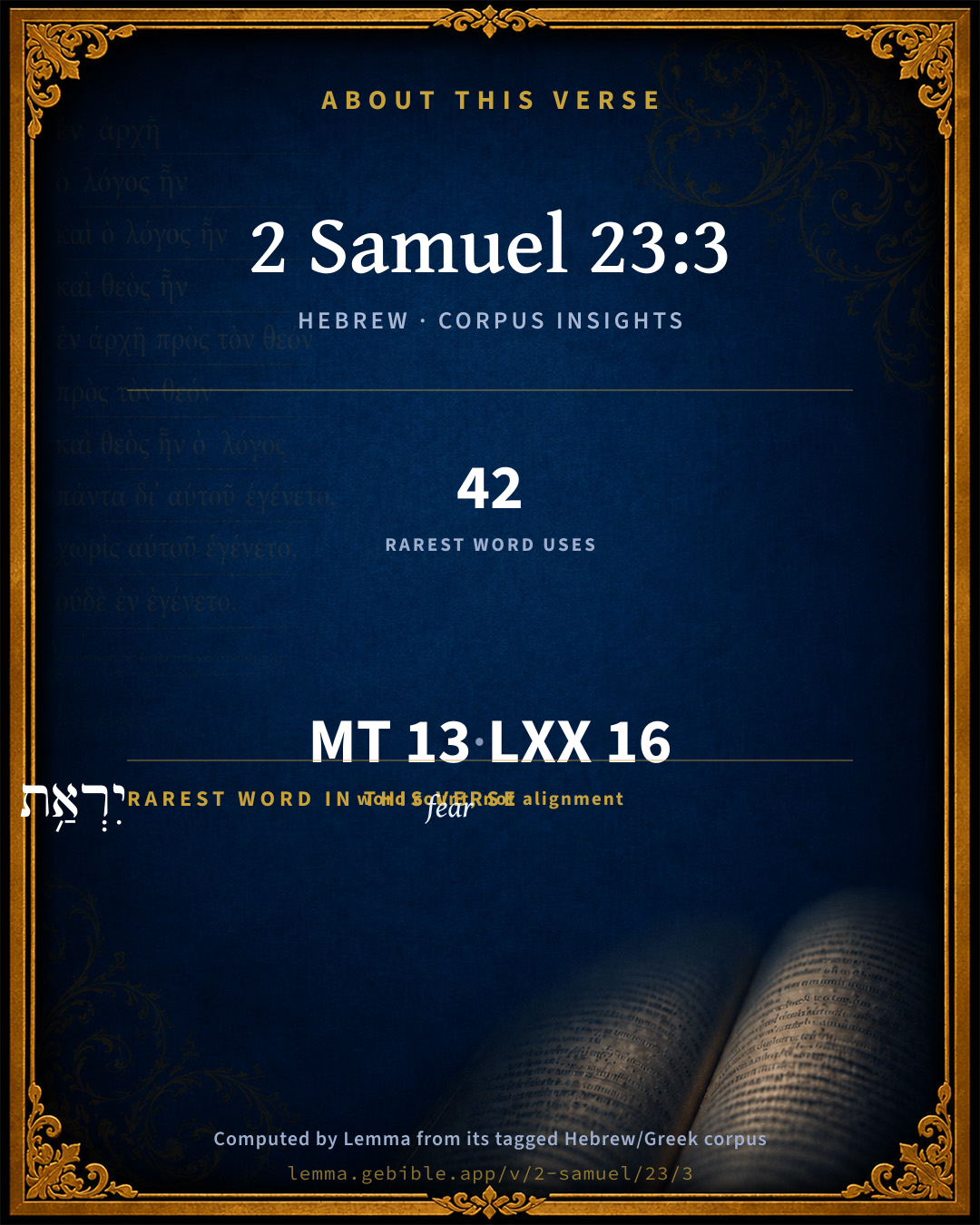
About this verse

These counts appear in no published source. They are computed here, from the morphology-tagged text and Lemma’s own curated glosses. What Lemma adds →

13
words
9
distinct lemmas
Historical
section

Shared distinctive vocabulary

יִרְאַ֥ת fear H3374 occurs in 42 verses of the Hebrew Bible. Also found in:

Grammatical profile

  • 4 verbs
  • 7 nouns
  • 1 adjective
  • 1 preposition

Verb forms

  • אָמַר֙ Qal · Perfect
  • דִבֶּ֖ר Piel · Perfect
  • מוֹשֵׁל֙ Qal · Participle Active
  • מוֹשֵׁ֖ל Qal · Participle Active

Repetition

Words recur within this verse — often emphatic in Hebrew:

  • אֱלֹהֵ֣י God H430 ×2
  • יִשְׂרָאֵ֔ל Israel H3478 ×2
  • מוֹשֵׁל֙ to rule H4910 ×2

Hebrew & Septuagint length

In English translation the verse runs 25 words from the Hebrew and 28 from the Septuagint (LXX English) — closely comparable.

A rough comparison of the two English renderings, which tokenize alike — not a word-level alignment.

Word counts can differ between the Hebrew and the Greek without any difference in meaning — e.g. the Hebrew direct-object marker אֵת has no separate Greek word, and Greek often adds the article ὁ.

In the original languages it is 13 Hebrew tokens and 16 Greek tokens — but the two are counted differently (Hebrew bundles its prefixes and suffixes into one token; the Greek is in lemma form), so that isn’t a like-for-like length.

Cross-references

23

Topical passages linked to 2 Samuel 23:3 in the Treasury of Scripture Knowledge — connected by theme and wording, ordered by reader-vote popularity; previews shown in the World English Bible.

  • Deuteronomy 32:4 The Rock, his work is perfect; For all his ways are justice: A God of faithfulness and without iniquity, Just and right is he.
  • Exodus 18:21 Moreover you shall provide out of all the people able men, such as fear God: men of truth, hating unjust gain; and place such over them, to be rulers of thousands, rulers of hundreds, rulers of fifties, and rulers of tens.
  • 2 Samuel 22:32 For who is God, save Yahweh? Who is a rock, save our God?
  • Psalms 72:2 He will judge your people with righteousness, And your poor with justice.
  • Exodus 23:6–8 "You shall not deny justice to your poor people in their lawsuits.
  • Deuteronomy 16:18–20 Judges and officers shall you make you in all your gates, which Yahweh your God gives you, according to your tribes; and they shall judge the people with righteous judgment.
  • Psalms 82:3–4 "Defend the weak, the poor, and the fatherless. Maintain the rights of the poor and oppressed.
  • Zechariah 9:9 Rejoice greatly, daughter of Zion! Shout, daughter of Jerusalem! Behold, your king comes to you! He is righteous, and having salvation; Lowly, and riding on a donkey, Even on a colt, the foal of a donkey.
  • Hebrews 1:8 but of the Son he says, "Your throne, O God, is forever and ever; The scepter of uprightness is the scepter of your Kingdom.
  • Genesis 33:20 He erected an altar there, and called it El Elohe Israel.
  • Exodus 19:5–6 Now therefore, if you will indeed obey my voice, and keep my covenant, then you shall be my own possession from among all peoples; for all the earth is mine;
  • Deuteronomy 32:30–31 How should one chase a thousand, Two put ten thousand to flight, Except their Rock had sold them, Yahweh had delivered them up?
  • 2 Samuel 22:2–3 and he said, Yahweh is my rock, and my fortress, and my deliverer, even mine;
  • 2 Chronicles 19:7–9 Now therefore let the fear of Yahweh be on you; take heed and do it: for there is no iniquity with Yahweh our God, nor respect of persons, nor taking of bribes.
  • Psalms 42:9 I will ask God, my rock, "Why have you forgotten me? Why do I go mourning because of the oppression of the enemy?"
  • Isaiah 11:1–5 There shall come forth a shoot out of the stock of Jesse, and a branch out of his roots shall bear fruit.
  • Isaiah 32:1 Behold, a king shall reign in righteousness, and princes shall rule in justice.
  • Jeremiah 23:5 Behold, the days come, says Yahweh, that I will raise to David a righteous Branch, and he shall reign as king and deal wisely, and shall execute justice and righteousness in the land.
  • Exodus 20:2 "I am Yahweh your God, who brought you out of the land of Egypt, out of the house of bondage.
  • Nehemiah 5:14 Moreover from the time that I was appointed to be their governor in the land of Judah, from the twentieth year even to the two and thirtieth year of Artaxerxes the king, [that is], twelve years, I and my brothers have not eaten the bread of the governor.
  • Psalms 110:2 Yahweh will send forth the rod of your strength out of Zion. Rule in the midst of your enemies.
  • Proverbs 31:9 Open your mouth, judge righteously, And serve justice to the poor and needy."
  • Exodus 3:15 God said moreover to Moses, "You shall tell the children of Israel this, 'Yahweh, the God of your fathers, the God of Abraham, the God of Isaac, and the God of Jacob, has sent me to you.' This is my name forever, and this is my memorial to all generations.

Cross-references courtesy of OpenBible.info (CC BY 4.0).

Hebrew and Greek witnesses Masoretic Hebrew ↔ Greek Septuagint

The same verse in the two great witnesses to the Old Testament, shown verse-for-verse.

These are two independent witnesses, not word-aligned to each other, and the Septuagint is shown in lemma (dictionary) form.

Hebrew 2 Samuel 23:3 Masoretic · Westminster Leningrad Codex

אָמַר֙ אֱלֹהֵ֣י יִשְׂרָאֵ֔ל לִ֥י דִבֶּ֖ר צ֣וּר יִשְׂרָאֵ֑ל מוֹשֵׁל֙ בָּאָדָ֔ם צַדִּ֕יק מוֹשֵׁ֖ל יִרְאַ֥ת אֱלֹהִֽים

The God of Israel said, The Rock of Israel spoke to me: One who rules over men righteously, Who rules in the fear of God,

World English Bible · Public Domain

Greek LXX 2 Samuel 23:3 Septuagint · lemma form

λέγω ὁ θεός ἰσραήλ ἐγώ λαλέω φύλαξ ἰσραήλ παραβολή εἶπον ἐν ἄνθρωπος πῶς κραταιόω φόβος θεός

The God of Israel says, A watchman out of Israel spoke to me a parable: I said among men, How will you⌃ strengthen the fear of the anointed?

LXX2012 (modern English Septuagint) · Public Domain

Hebrew: Westminster Leningrad Codex (CC BY 4.0). Greek: Septuagint (public domain); English from LXX2012 (modern English Septuagint) (Public Domain). How the Septuagint differs from the Hebrew →

Targum (Aramaic paraphrase)

1

The Targum is the ancient Jewish Aramaic paraphrase of the Hebrew Scriptures — an interpretive translation, not the Hebrew text itself. Onkelos (literal) and Pseudo-Jonathan (expansive) render the Torah, and Jonathan the Prophets. Coverage is partial: where no permissively-licensed English translation exists for a verse, only the Aramaic is shown. This is verse-level text, not a word-by-word alignment to the Hebrew.

  1. Targum Jonathan Prophets (Joshua–Malachi)
    אֲמַר דָוִד אֱלָהָא דְיִשְׂרָאֵל עֲלַי מַלֵיל תַּקִיפָא דְיִשְׂרָאֵל דְשַׁלִיט בִּבְנֵי אֱנָשָׁא קוּשְׁטָא דָאִין אֲמַר לְמַנָאָה לִי מַלְכָּא דְהוּא מְשִׁיחָא דַעֲתִיד דִיקוּם וְיִשְׁלוֹט בִּדְחַלְתָּא דַיָי:

    (no public-domain English translation for this verse)

    Targum Jonathan — Aramaic: “Mikraot Gedolot” (public domain). English: “Sefaria Community Translation” (CC0 1.0 (public-domain dedication)); “London "Chaldee Paraphrase," 1871” (public domain). Text via Sefaria.

Commentary

Notes on 2 Samuel 23:3 from classic Christian and Jewish commentators (each source and its license shown beneath its notes). The classic Christian expositions comment on the surrounding passage and are grouped to its opening verse, so a note may address several verses; the Jewish commentaries on the Tanakh (Rashi and others) are per-verse, so they appear only where the commentator wrote on this verse.

Lemma curates 59 commentaries, every one of them public domain or Creative Commons licensed, each selected and text-cleaned for this edition rather than reprinted as found. About our sources →

The Cambridge Bible for Schools and Colleges

gen. ed. J. J. S. Perowne

3, 4. The oracular brevity of these verses hardly admits of translation, and makes the meaning of them obscure. They may be rendered:

A ruler over men, a righteous one!

a ruler in the fear of God!

and he shall be as the light of morning when the sun riseth;

a morning without clouds;

when from sunshine, from rain, grass springeth from earth.

The second half of 2Sa_23:3 draws, with a few strong strokes—there are but six words in the original—an outline portrait of an ideal king, ruling with perfect justice, controlled and guided by the fear of God. 2Sa_23:4 depicts in figurative language the blessings of his reign.

His appearance will be like the life-giving sunshine of a cloudless morning; blessings will follow him as verdure clothes the earth from the united influences of sunshine and rain.

In order to appreciate the force of the latter figure, it must be borne in mind that verdure is not perpetual in Palestine, as with us. There what in June is “a brown, hard-baked, gaping plain, with only here and there the withered stems of thistles and centaureas to tell that life had ever existed there” is clothed in spring after the rains with “a deep solid growth of clovers and grasses.” David had been familiar with the yearly transformation of the dry and dusty downs of Beth-lehem into a lovely garden of brilliant flowers; an apt emblem of the gracious influences of the perfect rule of an ideal king upon a hard and desert world. Cp. Isa_32:15; Isa_35:1-2. See Tristram’s Nat. Hist. of the Bible, p. 454.

This prophecy is the companion and complement of the prophecy in ch. 7 There the promise of an eternal dominion is given to the house of David, finding a partial fulfilment in his descendants, and a complete fulfilment only in Christ: here David himself is taught by inspiration to draw the portrait of a ruler, some features of which were partially realised in Solomon and the better kings of Judah, but which finds it perfect realisation only in Christ.

The features of the portrait are developed and the outlines filled in by subsequent prophets, with ever increasing clearness pointing forward to Him Who was to fulfil and more than fulfil all the anticipations of prophecy.

Thus for the ruler cp. Mic_5:2 : for the characteristic of righteousness cp. Psa_72:1-3 (primarily referring to Solomon); Isa_11:1-5 : Zec_9:9 : and especially Jer_23:5; Jer_33:15 : for the fear of the Lord, cp. Isa_11:2. The figure of the fertilising rain is borrowed in Psa_72:6 : cp. Isa_44:3-4 : that of the light is repeated in Pro_4:18 : and the closing words of the last prophet, “Unto you shall the Sun of righteousness arise” (Mal_4:2), combine and re-echo these last words of David.

The Cambridge Bible for Schools and Colleges (gen. ed. J. J. S. Perowne; Cambridge University Press, 1878–1918) — public domain. Text from a community e-Sword module.

Trapp's Complete Commentary

John Trapp

2Sa 23:3 The God of Israel said, the Rock of Israel spake to me, He that ruleth over men [must be] just, ruling in the fear of God.

Ver. 3. The God of Israel.] God the Father.

The Rock of Israel.] God the Son, who is one with the Father and the Holy Spirit: and is said to have spoken to David by the Holy Spirit.

He that ruleth over men must be just.] This, God told David: and this, dying David telleth his son and successor Solomon; whom he would have to know, that regimen without righteousness is but robbery with authority, and soon turneth into tyranny. An unjust judge is a very thief, saith Columella, {a} as an unskilful physician is a manslayer.

Ruling in the fear of God.] Royalty without religion is but eminent dishonour. This, Jethro knew; and therefore preseribeth that princes and rulers should be men of courage, fearing God, {Exo 18:21} when he cast Moses a mould for a polity in Israel, &c. {Psa 2:10-11 2Ch 19:7}

{a} Lib. i.

John Trapp, A Commentary or Exposition upon All the Books of the Old and New Testament (1647–1656) — public domain. Text from a community e-Sword module.

The Biblical Illustrator

Joseph S. Exell

2Sa_23:3

The Rock of Israel spake to me.

The voice of a rock

The phraseology is peculiarly dramatic and picturesque.

I. The rock has a voice; the Rock of Israel had been speaking to him ever since he had been in the kingly seat of power. Davids wild and outlaw life had made him know what was the value of a stronghold, a shelter, a refuge. Rocks had been in his experience his best friends for many a year. Rocks were unchanging in their affection for him; they were immovable in their stability; they were impregnable for defence; often he had found rest under the shadow of a great rock in a weary land. What had this Rock of Israel said to him during this wonderful career?

1. For one thing, it had told him, as a counsel of superior wisdom, that he ought to reign righteously all his life: He that ruleth over men must be just, ruling in the fear of God.

2. For another thing, the Rock had spoken the terms and the conditions of a fine promise. A just ruler would be prospered in proportion to the purity and piety of his administration: And he shall be as the light of the morning when the sun riseth, even a morning without clouds; as the tender grass springing out of the earth by clear shining after rain.

3. And for the best thing of all, the Rock had assured him graciously of a permanent continuance of the Divine favour: Although my house be not so with God, yet He hath made with me an everlasting covenant, ordered in all things, and sure: for this is all my salvation, and all my desire, although he make it not to grow.

II. Modern religious experience. What are the conditions of implicit trust in the Lord of our salvation, such trust ah will insure peace and comfort?

1. The main condition of resting in the Lord is found in looking outside of ones self. There is a habit of morbid self-examination which needs to be shunned. The more conscientious any believer is, the more apt he is to press unnecessary scrutiny of introspection.

2. The next condition of spiritual repose is found in the avoiding of unwise counsellors. Once a Christian friend wrote a letter to me, saying that she had just, after a long struggle, come to something like peace in believing, when along came a so-called evangelist to torment her before her time, telling her that all we have to do is to accept salvation as we would accept a book from Christs hand. She could not do this so easily, and hence she was informed again that her faith had no foundation upon which to be secure. It would break up two-thirds of the business firms in the United States if an evangelist were to keep going round among the counting-rooms, telling people that they were in jeopardy every hour unless they could come to absolute confidence in their senior partners; and then they must be sure, still, that they have the-right kind of confidence in them; and then they must be modest, and become surest of all that they are not becoming over-sure of anything this side of heaven. Human beings cannot get on with this; they cannot live so with God or with man. We must cultivate some measure of unquestioning trust. We must learn to trust our trust, and not keep rooting it up. No plant grows which is continually being rooted up.

3. Another condition of rest in God is found in drawing a clear distinction between historic faith and saving faith. What secures to us a perfect salvation is spiritual trust in the Saviour, and this is the gift of the Holy Ghost. And whoever says that we receive Divine grace as we would receive a book from a mans hand, is simply mistaken in ignorance, or is misunderstood in his statement. Mechanical acts are frightfully poor illustrations of deep religious exercises. Some sort of fervour, some degree of emotion, is needed in order to appreciate Divine grace and receive it fitly. Tameness and lukewarmness are simply insipid. It is a heart-trust that God asks for, not a mere head-trust. A maiden may be told by her enthusiastic lover that it is as easy to trust him for ever with her life as it is to take a flower he offers; she knows better. It is easy to receive facts, perhaps, but not so easy to understand experiences which lie deeper than any mere outward acts. Historic faith is not necessarily saving faith.

4. Yet again: we are to cultivate confidence in the slowly reached answers to our prayers for Divine grace.

5. Yet again: we must distinguish between emotions, and religious states. The one may vary, the other is fixed Faith is a very different thing from the result of faith; and confidence of faith is even a different thing from faith itself; and yet the safety of a soul depends on faith, and nothing else. We are justified by faith--not by joy or peace or love or hope or zeal. These last are the results of faith, generally, and will depend largely upon temperament and education.

6. Finally, this unbroken courage is a condition of rest. We must not think everything is lost when we happen to have become beclouded. That faith is the best which has been tried and tested. In my study lies a little flower. It came to me long ago, by the hand of one who plucked it upon the highest ridge ever reached in the Rocky Mountains. It is of a rich purple colour, light and graceful in form, and retains yet, I imagine, a faint and delicate perfume. The lesson which it teaches me is one of endurance and patience. Away up there, where the snow lies late and the storms come early, it has held its own. The bleak solitudes had no charm for it; nay, I think that this flower was created to give a charm to a solitude which would have been the bleaker without it. To me it is the symbol of trust--absolute and implicit trust in God. It is a living thing that knows how to keep its warmth in despite of ice, and its beauty in despite of desolation all around it. (C. S. Robinson, D. D.)

He that ruleth over men must be just.

The importance of character in rulers

Mr. Stead quotes from Major Lennards How We Made Rhodesia, a passage to illustrate Dr. Jamesons opinions on morality and public life. What differences can it make in a man as a legislator what his morals are, if he has genius and intellect, and can use them? I cannot see how in any way morals can affect a mans intellect, and so long as he keeps his immoralities to himself, I do not see how they can affect any one else. So the Prime Minister of Cape Colony. The man who cannot see the influence of morality upon mind, how it affects motive and outlook, and his whole attitude and action in public affairs may have many gifts, but he is unfit to be Prime Minister of any colony or state. Far higher than the view of the modern Prime Minister of South Africa was that which inspired that ancient, Prime Minister of North Africa, who regarded his position as a trust, and his work as a mission from God. And Joseph said: It was not you that sent me hither, but God; and He hath made me a father to Pharaoh, and lord of all ills house, and a ruler throughout all the land of Egypt.

A righteous monarch

When Alfred made his laws his difficulties were only beginning. He had to depend for their execution on the Ealdermen and Thanes, most of whom were rude, uncultivated warriors, unable even to read the laws they had to administer. Many also were careless and unprincipled, either taking no pains about the matter at all, or favouring the rich against the poor. Alfred accordingly undertook the enormous labour of going over in person and in detail almost all cases in the kingdom. When he found, as he did very often, that the judgment given was unjust, he would send for the offending judge, and ask him why he had delivered it, taking great pains to ascertain whether this was done out of greed or partiality, or out of simple ignorance. Probably a judge who was convicted of the former would be suspended or superseded. But more often the perplexed Thane or Ealderman, when hard pressed, would stammer out the candid confession, An it please you, my lord king, I did not know any better. Asset has preserved us a specimen of the reproof that would follow, which he calls discreet and moderate. I wonder truly at your insolence that, whereas, by Gods favour and mine, you have occupied the rank and office of the Wise, you have neglected the studies and labours of the Wise. Either, therefore, at once resign your office or endeavour more zealously to study the lessons of wisdom. Such are my commands. He adds that the judges, almost without exception, chose to learn their duties properly rather than to resign them. (J. Alcock.)

The Biblical Illustrator, edited by Joseph S. Exell (c. 1880s–1900s) — public domain. Text from a community e-Sword module.

MacLaren's Expositions of Holy Scripture

Alexander MacLaren

2 Samuel

THE DYING KING’S LAST VISION AND PSALM

THE ROYAL JUBILEE 1

2Sa 23:3 - 2Sa 23:4.

One of the Psalms ascribed to David sounds like the resolves of a new monarch on his accession. In it the Psalmist draws the ideal of a king, and says such things as, ‘I will behave myself wisely, in a perfect way. I will set no wicked thing before mine eyes. I hate the work of them that turn aside. Mine eyes shall be upon the faithful of the land, that they may dwell with me.’ That psalm we may regard as the first words of the king when, after long, weary years, the promise of Samuel’s anointing was fulfilled, and he sat on the throne.

My text comes from what purports to be the last words of the same king.

He looks back, and again the ideal of a monarch rises before him. The psalm, for it is a psalm, though it is not in the Psalter, is compressed to the verge of obscurity; and there may be many questions raised about its translation and its bearing. These do not need to occupy us now, but the words which I have selected for my text may, perhaps, best be represented to an English reader in some such sentence as this-’If {or when} one rules over men justly, ruling in the fear of God, then it shall be as the light of the morning when the sun riseth, even a morning without clouds.’ With such a monarch all the interests of his people will prosper. His reign will be like the radiant dawn of a cloudless day, and his land like the spring pastures when the fresh, green grass is wooed out of the baked earth by the combined influence of rain and sunshine. David’s little kingdom was surrounded by giant empires, in which brute force, wielded by despotic will, ground men down, or squandered their lives recklessly. But the King of Israel had learned, partly by the experience of his own reign, and partly by divine inspiration, that such rulers are not true types of a monarch after God’s own heart. This ideal king is neither a warrior nor a despot. Two qualities mark him, Justice and Godliness. Pharaoh and his like, oppressors, were as the lightning which blasts and scorches. The true king was to be as the sunshine that vitalises and gladdens. ‘He shall come down like rain upon the mown grass, and as showers that water the earth.’

We do not need to ask the question here, though it might be very relevant on another occasion, whether this portraiture is a mere ideal, floating in vacuo, or whether it is a direct prophecy of that expected Messianic king who was to realise the divine ideal of sovereignty. At all events we know that, in its highest and deepest significance, the picture of my text has lived and breathed human breath, in Jesus Christ, who both in His character and in His influence on the world, fulfilled the ideal that floated before the eyes of the aged king.

I do not need to follow the course of thought in this psalm any farther. You will have anticipated my motive for selecting this text now. It seems to me to gather up, in vivid and picturesque form, the thoughts and feelings which to-day are thrilling through an Empire, to which the most extended dominion of these warrior kings of old was but a speck. On such an occasion as this I need not make any apology, I am sure, for diverging from the ordinary topics of pulpit address, and associating ourselves with the many millions who to-day are giving thanks for Queen Victoria.

My text suggests two lines along which the course of our thoughts may run. The one is the personal character of this ideal monarch; the other is its effects on his subjects.

I. Now, with regard to the former, the pulpit is, in my judgment, not the place either for the discussion of current events or the pronouncing of personal eulogiums. But I shall not be wandering beyond my legitimate province, if I venture to try to gather into a few words the reasons, in the character and public life of our Queen, for the thankfulness of this day. Our text brings out, as I have said, two great qualities as those on which a throne is to be established, Justice and Godliness. Now, the ancient type of monarch was the fountain of justice, in a very direct sense; inasmuch as it was his office, not only to pronounce sentence on criminals, but to give decisions on disputed questions of right. These functions have long ceased to be exercised by our monarchs, but there is still room for both of those qualities-the Justice which holds an even balance between parties and strifes, the Righteousness which has supreme regard to the primary duties that press alike upon prince and pauper, and the Godliness which, as I believe, is the root from which all righteousness, as between man and man, and as between prince and subject, must ever flow. Morality is the garb of religion; religion is the root of morality. He, and only he, will hold an even balance and discharge his obligations to man, whose life is rooted in, and his acts under the continual influence of, the fear of God which has in it no torment, but is the parent of all things good.

We shall not be flatterers if we thankfully recognise in our Sovereign Lady the presence of both these qualities. I have spoken of the first inaugural words of the King of Israel, and the resolutions that he made. It is recorded that when, to the child of eleven years of age, the announcement was made that she stood near in the line of succession to the throne, the tremulous young lips answered, ‘It is a great responsibility; but I will be good.’ And all round the world to-day her subjects attest that the aged monarch has kept the little maiden’s vow. Contrast that life with the lives of the other women who have sat on the throne of England. Think of the brilliant Queen, whose glories our greatest poets were not ashamed to sing, with the Tudor masterfulness in her, and not a little of the Tudor grossness and passion, and remember the blots that stained her glories. Think of her sister, the morbidly melancholy tool of priests, who goes down the ages branded with an epithet only too sadly earned. Think of another woman that ruled over England in name, the weak instrument of base intrigues. And then turn to this life which we are looking upon to-day. Think of the nameless scandals, the hideous immorality of the reigns that preceded hers, and you will not wonder that every decent man and every modest woman was thankful that, with the young girl, there came a breath of purer air into the foul atmosphere. I am old enough to remember hearing, as a boy, the talk of my elders as to the probabilities of insurrection if, instead of our Queen, there had come to the throne the brother of her two predecessors. The hopes of those early days have been more than fulfilled.

It is not for us to determine the religious character of others, and that is too sacred a region for us to enter; but this we may say, that in all these sixty years of diversified trial, there has been no act known to us outsiders inconsistent with the highest motive, the fear of the Lord; and some of us who have worshipped in the humble Highland church where she has bowed have felt that on the throne of Britain sat a Christian.

Nor need we forget how, from that root of fear of God, there has come that wondrous patience and faithfulness to duty, the form of ‘Justice’ which is possible for a constitutional monarch. We have little notion of how pressing and numerous and continual the royal duties must necessarily be. They have been discharged, even when the blow that struck all sunshine out of life left an irrepressible shrinking from pageantry and pomp. Joys come; joys go. Duties abide, and they have been done.

Nor can we forget, either, how the very difficult position of a constitutional monarch, with the semblance of power and the reality of narrow restrictions, has been filled. Our Sovereign has never set herself against the will of the people, expressed by its legitimate representatives, even when that will may have imposed upon her the sanction of changes which she did not approve. And that is much to say. We have seen young despots whose self-will has threatened to wreck a nation’s prosperity.

Nor can we forget how all the immense influence of position and personality has been thrown on the side of purity and righteousness. Even we outsiders know how, more than once or twice, she has steadfastly set her face against the admission to her presence of men and women of evil repute, and has in effect repeated David’s proclamation against vice and immorality at his accession: ‘He that worketh wickedness shall not dwell within my house.’

Nor must we forget, either, the simplicity, the beauty, the tenderness of her wedded and family life, her love of rural quiet, and of wholesome communion with Nature, and her eagerness to take her people into her confidence, as set forth in the book which, whatever its literary merits, speaks of her earnest appreciation of Nature and her wish for the sympathy of her subjects.

Then came the bolt from the blue, that sudden crash that wrecked the happiness of a life. Many of us, I have no doubt, remember that dreary December Sunday morning when, while the nation was standing in expectation of another calamity from across the Atlantic, there flashed through the land the news of the Prince’s death; thrilling all hearts, and bringing all nearer to her, the lonely widow, than they had ever been in her days of radiant happiness. How pathetically, silently, nobly, devoutly, that sorrow has been borne, it is not for us to speak. She has become one of the great company of sad and lonely hearts, and in her sadness has shown an eager desire to send messages of sympathy to all whom she could reach, who were in like darkness and sorrow.

Brethren, I have ventured to diverge so far from the ordinary run of pulpit ministrations because I feel that to-day all of us, whatever may be our political or ecclesiastical relationships and proclivities, are one in thanking God for the monarch whose life has been without a stain, and her reign without a blot.

II. Now let me say a word as to the other line of thought which my text suggests, the effect of such a reign on the condition of the subject.

Now, of course, in the narrowly limited domain of that strange creation, a constitutional monarchy, there is far less opportunity for the Sovereign’s direct influence on the Subject than there was in the ancient kingdoms of which David was thinking in his psalm. The marvellous progress of Britain during these sixty years is due, not to our Sovereign, but to a multitude of strenuous workers and earnest thinkers in a hundred different departments, as well as to the evolution of the gifts that come down to us from our ancient inheritance of freedom. But we shall much mistake if, for that reason, we set aside the monarch’s character and influence as of no account in the progress

A supposition, which is a violent one, may be made which will set this matter in clearer light. Suppose that during these sixty years we had had a king on the throne of England like some of the kings we have had. The sentiment of loyalty is not now of such a character as that it will survive a vicious sovereign. If we had had such a monarch as I have hinted at, the loyalty of the good would for all these years have been suffering a severe strain, and the forces that make for evil would have been disastrously strengthened. Dangers escaped are unnoticed, but one twelvemonth of the reign of a profligate would shake the foundations of the monarchy, and would open the floodgates of vice; and we should then know how much the nation owed to the Queen whose life was pure, and who cast all her influence on the side of ‘things that are lovely and of good report.’

Take another supposition. Suppose that during these years of wonderful transition, when the whole aspect of English politics and society has been transformed, we had had a king like George III., who set his opinion against the nation’s will constitutionally expressed. Then no man knows with what storm and tumult, with what strife and injury, the inevitable transition would have been effected. Be sure of this, that the wise self-effacement of our Sovereign during these critical years of change is largely the reason why they have been years of peace, in which the new has mingled itself with the old without revolution or disturbance. It is due to her in a very large degree that

‘Freedom broadens slowly down

From precedent to precedent.’

I need not dilate on the changed Britain that she looks out upon and rules to-day. I need not speak-there will be many voices to do that, in not altogether agreeable notes, for there will be a dash of too much self-complacency in them-about progress in material wealth, colonial expansion, the increase of education, the gentler manners, the new life that has been breathed over art and literature, the achievements in science and philosophy, the drawing together of classes, the bridging over of the great gulf between rich and poor by some incipient and tentative attempts at sympathy and brotherhood.

Nor need I dwell upon the ecclesiastical signs of the times, in which, mingled as they are, there is at least this one great good, that never since the early days have so large a proportion of Christian men been ‘seeking after the things that make for peace,’ and realising the oneness of all believers who hold the Headship of Christ.

All this review falls more properly into other hands than mine. Only I would put in a caution-do not let us mingle self-conceit with our congratulations; and, above all, do not let us ‘rest and be thankful.’ There is much to be done yet. Listening ears can catch on every side vague sounds that tell of unrest and of the stirrings into wakefulness of

‘The spirit of the years to come,

Yearning to mix itself with life.’

I seem to hear all around me the rushing in the dark of a mighty current that is bearing down upon us. Great social questions are rapidly coming to the front-the questions of distribution of wealth, abolition of privilege, the relations of labour and capital, and many others are clamant to be dealt with at least, if not solved. There Is much to be done before Jesus Christ is throned as King of England. War has to be frowned down; the brotherhood of man has to be realised, temperance has to be much more largely practised than it is.

I need not go over the catalogue of desiderata, of agenda-things that have to be done-in the near future. Only this I would say-Christian men and women are the last people who should be ready to ‘rest and be thankful,’ for the principles of the Gospel that we profess, which have never been applied to the life of nations as they ought to be, will solve the questions which make the despair of so many in this generation. We shall best express our thankfulness for these past sixty years by each of us taking our part in the great movement which, in the inevitable drift of things to democracy, is going to ‘cast the kingdom old into another mould,’ and which will, I pray, make our people more of what John Milton long ago called them, ‘God’s Englishmen.’ We have taught the nations many things. Our Parliament is called the Mother of Parliaments. Ours is

‘The land where, girt with friends or foes,

A man may say the thing he will.’

It has taught the nations a tempered freedom, and that a monarchy may be a true republic. May we rise to the height of our privileges and responsibilities, and teach our subject peoples, not only mechanics, science, law, free trade, but a loftier morality, and the name of Him by whom kings reign and princes decree justice!

We, members of the free Churches of England, come seldom under the notice of royalty, and have little acquaintance with courts, but we yield to none in our recognition of the virtues and in our sympathy with the sorrows of the Sovereign Lady, the good woman, who rules these lands, and we all heartily thank God for her to-day, and pray that for long years still to come the familiar letters V.R. may stand, as they have stood to two generations, as the symbol of womanly purity and of the faithful discharge of queenly duty.

1 Preached on the occasion of Queen Victoria’s Diamond Jubilee.

Alexander MacLaren, Expositions of Holy Scripture (1904–1910) — public domain. Text from a community e-Sword module.

Adam Clarke's Commentary

Verse 3. The Rock of Israel] The Fountain whence Israel was derived.

He that ruleth over men must be just] More literally, מושל באדם צדיק moshel baadam tsaddik, He that ruleth in man is the just one; or, The just one is the ruler among men.

Ruling in the fear of God.] It is by God's fear that Jesus Christ rules the hearts of all his followers; and he who has not the fear of God before his eyes, can never be a Christian.

Adam Clarke's Commentary on the Bible (1810–1826) — public domain. Text from a community e-Sword/MySword module.

Ellicott's Commentary for English Readers

(3) The Rock of Israel.—Comp. 2Sa_22:3. A frequent Scriptural comparison, appropriate here, to show the perfect reliability of what God declares.

He that ruleth.—The English gives the true sense, but the original is exceedingly elliptical, both here and in the following verse. The fundamental point of all just government has never been more perfectly set forth:—that it must be “in the fear of God.”

A Bible Commentary for English Readers, edited by Charles John Ellicott (1878–1897) — public domain. Text from a community e-Sword module.

John Gill's Exposition

The God of Israel said,.... To David, or by him; he who was the covenant God of Israel literally considered, and is the covenant God and Father of the whole spiritual Israel, and who is owned, believed in, and worshipped by them:

the Rock of Israel spake to me; the same with the God of Israel in other words, who is the strength and security of Israel; or the second divine Person, the Son and Word of God, is meant, who is often called a rock in Scripture; and is the rock on which the Israel or church of God is built, and in whom it remains safe and firm, the gates of hell not being able to prevail against it; and so here is an instance and proof of a trinity of persons in the Godhead; the God of Israel, Jehovah the Father; the Rock of Israel, Jehovah the Son; and the Spirit of Jehovah, as in Sa2 23:2, who is Jehovah the Spirit: now what was said by these three divine Persons to David, and by him, and concerning himself as a type of the Messiah, follows:

he that ruleth over men must be just, ruling in the fear of God; which is a character every king among men ought to have, administering justice to their subjects; ruling not only according to the laws of the land, but according to the law of God; having his fear before their eyes, and acting with a view to his honour and glory, whose vicegerents they are, and to whom they are accountable; they should rule with gentleness and humanity, considering they are men, and not brutes, they rule over. Agamemnon in Homer is often called "king of men". This character, in all respects, was found in David, Sa2 8:15; and may be here given as an instruction to his son and successor, Solomon; and is in all respects applicable to the Messiah, who is a "ruler" or King by the designation of his father; a ruler "over men", even over all men, yea, over the greatest of men, King of kings, and Lord of lords, and especially, and in an eminent sense, King of saints; and he is "just", a King that reigns in righteousness, righteous in all his ways and works, and particularly just as a King, as well as in all his other characters, see Jer 23:5; and upon whom, as man and Mediator, the Spirit of "the fear of the Lord" rests, and under the influence of which, as such, he has acted, Isa 11:1; so the Targum applies these words to the Messiah thus,"the true Judge said, he would appoint to me a King, who is the Messiah, who shall arise and rule in the fear of the Lord:''and they may be rendered, there shall be "a ruler over men, just, ruling in the fear of God"; or ruling, appointing, ordering, and directing the worship of God, and the ordinances of it under the Gospel dispensation, as Christ did, see Mat 28:18.

John Gill's Exposition of the Whole Bible (1746–1763) — public domain (CC PDM 1.0). Text via the HelloAO Bible API.

Haydock's Catholic Bible Commentary

Strong one. This is one of the most common titles of God, 1 Kings ii. 2. Hebrew, "the rock." --- In the fear. Hebrew, "of the fear;" that is, of the just, who live in the fear of God. Such abstract expressions are frequent; so "the son of the captivity, of riches," &c., mean a captive or a rich man. (Calmet) --- God spoke such words to David as tended to promote solid virtue and piety. (Haydock) --- We may explain the ruler, &c., of the Messias, who shall diffuse grace and glory throughout the earth. Protestants, "He that ruleth over men, must be just, ruling in the fear of God." An excellent lesson for all in power. (Haydock)

George Leo Haydock (1774–1849), Haydock's Catholic Family Bible and Commentary, 1859 edition — public domain. Excludes Psalms (Douay-Rheims chapter numbering differs from Protestant) and Deuterocanonical books (Catholic canon only).

Matthew Poole's English Annotations

The Rock of Israel; he who is the strength, and defence, and protector of his people; which he here manifests by obliging and directing kings and rulers so to manage their power and authority. as may most conduce to their comfort and benefit.

Spake to me, by way of command; or, of me, by way of prediction and promise concerning me and my house, and the Messias who is to come out of my loins.

He that ruleth over men must be just, ruling in the fear of God: thus it is a precept or declaration of the duty of kings, and particularly of Solomon his son, (to whom as a dying man he gives this advice,) and of his successors the kings of God’s Israel, for whose instruction he gives this rule. And so here are the two principal parts of a king’s duty, answerable to the two tables of God’s law, justice towards men, and piety towards God, both which he is to maintain and promote among his people; to which if you add benignity and clemency, whereby a king renders his government not frightful and burdensome, but acceptable and amiable to his people, which possibly may be meant by the following similitudes, here is a complete character of an excellent prince or governor. Others make it a prophecy of Christ; and then the words are or may be thus rendered, There shall be a Ruler over men, (or rather, among men, as the Hebrew word properly signifies, to wit, the Messias, who, though he be the eternal and invisible God, yet shall visibly appear and rule among men,) a just or righteous one, (a title oft given to Christ, as Isa 53:11; Jer 23:5,6; 33:15; Zec 9:9)

ruling in the fear of the Lord, making it his great business to advance the service, and worship, and glory of the Lord; or, as it is in the Hebrew, ruling the fear of the Lord, i.e. governing and ordering the worship of God, which is oft called the fear of God. And so this clause is added to prevent or remove scandals and offences which might be taken at the Messias when he should come, because of his changing and abrogating the ceremonial law; and to insinuate that he should have no less power in the governing of God’s house and worship than Moses had, and that he might make such laws as he thought meet. And if this be the meaning of the place, then as Jacob, being greatly afflicted with the troubles which he by the Spirit of prophecy foresaw were coming upon his posterity, comforts himself with the thoughts of that great and glorious salvation of God, which he also foresaw and waited for, Gen 49:18; so David, reflecting upon the great disorders, and miscarriages, and calamities which had already arisen in his house, and either wisely presaging or foreseeing by the Spirit of the Lord, 2Sa 23:2, that the same sins and miseries should be fall his posterity and successors, he supports and comforts himself with this consideration, that one of them should be a most excellent person, just, and pious, and merciful, and an unspeakable blessing to David himself, and to all his family and people, and to the whole world, even the great Messias, who was undoubtedly revealed to and expected by David, as appears by many passages of the Psalms, and by other scriptures.

Matthew Poole's English Annotations on the Holy Bible (1683–1685) — public domain. Text from a community e-Sword/MySword module.

Whedon's Commentary on the Bible

Daniel D. Whedon

3. Rock of Israel — So called because he was their firm foundation, their sure protection and defence. See Deu_32:4.

He that ruleth — The exact grammatical construction of the word thus translated (מושׁל it is impossible to decide, for it seems to be left designedly uncertain. The psalmist, by a few master strokes, draws the picture of a righteous, God-fearing ruler, and the blessings of his reign, but he does not say that he himself was that ruler, nor does he say decidedly at all who he was, or when he should appear; but the reference in 2Sa_23:5 to the everlasting covenant which God had made with his house makes it very evident that his eye was upon that promised “Seed” of Nathan’s prophecy, of whom Jehovah said: “I will be his father and he shall be my son.” Chap. 2Sa_7:14.

Righteous — An epithet describing the character and administration of him that ruleth. The inspired singer portrays that coming Ruler by the disconnected exclamatory utterances of an emotional style. The meaning is, however, clear. Under the righteous rule of the person here described, no worthy subject shall go unrewarded, no offender escape the strictest penalties of law. The prominent virtue of the model ruler and magistrate is righteousness.

Daniel D. Whedon (gen. ed.), Commentary on the Old and New Testaments (1874–1909) — public domain. Text from a community e-Sword module.

The Pulpit Commentary

Vers. 3, 4. He that ruleth, etc. This rendering of the Hebrew is very beautiful, and fit to be graven on the hearts of rulers. There is often almost an inspiration in the renderings of the Authorized Version. Grammatically, nevertheless, the psalm declares the blessedness of the king who is just, and may be translated as follows:

He that ruleth over men righteously, That ruleth in the fear of God And as the morning light shall he be, when the sun riseth, A morning without clouds; Yea, as the tender grass from the earth, from sunshine, from rain.

A king who rules his people justly is as glorious as the sun rising in its strength to drive away the works of darkness, and give men, by precept and example, the light of clear knowledge of their duty. But the last metaphor is especially beautiful. In the summer, vegetation dries up under the burning heat of the sun; all is bare and brown, and a few withered stalks of the coarser plants alone remain. But when the rains come, followed by bright sunshine, nature at one burst flashes into beauty, and the hillsides and plains are covered with the soft green of the reviving grass, through which myriads of flowers soon push their way, and clothe the landscape with bright colours. So a just and upright government calls into being countless forms of human activity, and fosters all that is morally beautiful, while it checks the blighting influences of unregulated passion and selfish greed.

Vers. 3-7.

An oracle concerning the King Messiah.

1. The hope of salvation, and more especially of the establishment of thekingdom of heaven upon earth, was, in some measure, fulfilled in the reign of David, the Lord"s messiah. In his character as theocratic ruler he was a type (prefigurement or anticipatory outline) of Christ. (1Sa_2:10) "The type is prophecy in deed.

2. Under Divine inspiration, he formed an ideal of a theocratic ruler, in connection with his own personality and history. Hence the representations contained in the Messianic psalms (16, 22.), in some things transcend his experience, and in others are mingled with his infirmities.

1. In this oracle or Divine saying (as in Psalm 110., and perhaps others) he looked forward to the realization of his ideal at a future time. "No part whatever of the Old Testament is introduced with a greater majesty of language, or more excites the expectation of some splendid and glorious sense, than the last words of David" (Kennicott). The promise of eternal dominion to his house was joined with an intimation of his death; (2Sa_7:12) and "these last words show how, in consequence of the consciousness of his own guilt, the image of the Messiah was separated from his subjectivity, and came before him as a majestic form of the future. He, the highly favoured one, who had considered himself immortal, (Ps 16) must now die! He therefore grasps the pillars of the promise, ceases to connect the Messianic hopes with himself, and as a prophet beholds the future of his seed" (Delitzsch). "These words are not merely a lyric effusion of the promise, but a prophetic declaration concerning the true king of the kingdom of God" (Keil). "They form the keystone of his life;

2. his prophetic legacy; to which the cycle of psalms 138-145, must be regarded as supplementary" (Hengstenberg). "If there is any part of Scripture which betrays the movements of the human individual soul, it is this precious fragment of David"s life. If there be any part which claims for itself, and which gives evidence of the breathings of the Spirit of God, it is this also. Such a rugged two-edged monument is a fitting memorial of the man who was at once the king and the prophet, the penitent and the saint of the ancient Church" (Stanley).

3. The ideal of a theocratic ruler was only partially realized in Solomon and other kings of the house of David. (Ps 45 Ps 72 Isa 32)

1. Although the hope of a more adequate realization thereof was again andagain disappointed, it was not extinguished, but became more and more spiritual and exalted (Riehm, "Messianic Prophecy;" C.A. Row, "The Jesus of the Evangelists;" W.F. Adeney, "The Hebrew Utopia").

2. At length the hope of Israel was perfectly fulfilled in the Person, work, and glory of our Lord Jesus Christ. (Luk_1:32; Mat_22:43; Act_2:36; Eph_1:20-22; Rev_1:18) "In using the Old Testament now, especially for purposes of edification, we should feel that we fail to do justice to the Old Testament, if, when expounding any truth taught in it, we do not bring into connection with the passage explained the highest form of the truth as revealed in the New Testament" (A.B. Davidson, "Messianic Prophecy," Expositor, 8.). What is here said must, on this principle, be referred to Christ; and it may be referred to him, with more or less propriety, in his earthly life, in his heavenly dominion, or at his second appearing. It indicates

I HIS EXALTED CHARACTER and principles of government. As if present at the commencement of "the golden age," David beholds

A ruler over men literally, in man", just A ruler fearing God!

Many a ruler, like "the unjust judge," neither fears God nor regards man. He acquires his position by craft and bloodshed, and exercises his power in oppression and ungodliness. Not so the ruler here depicted; who is distinguished by:

1. Rectitude of heart, of speech, and of conduct; in the laws according to which he rules, and his administration of them, rendering to every man according to his deeds; herein resembling, reflecting, and representing the

2. rectitude of God; and protecting and promoting the best interests of men (Psa_72:4; Isa_9:7 Isa_11:1-10; Jer_23:5 Jer_30:9; Eze_34:23, Eze_34:24; Hos_3:5 Mic_5:1-5; Zec_9:9, Zec_9:10) "The history of the actual David supplies the subject matter for these idealizations. David is the original prototype on which they are formed, and round whose person they cluster. They may be described as David idealized" (C.A. Row).

3. Piety; the fear of offending God, reverence for his Name, delight in his fellowship, obedience to his will, opposition to his adversaries, dependence on his strength, and devotion to his honour and glory. "When he that rules is just, it is as if he did not rule, but the fear of the Lord ruled in the earth" (Barrett, "A Synopsis of Criticisms").

4. Rectitude united with piety; founded upon it, pervaded by it, and expressive of it; his supreme aim and constant endeavour being the establishment of the kingdom of God. All this is realized, even beyond expectation, in the wonderful Person of Christ, and his just and merciful reign over mankind. "Put together your ideal of true greatness of soul power combined with gentleness; dignity with no pride; benevolence with no weakness; sympathy and love for humanity as it is, and especially for the poor, the sad, the suffering. Let your ideal be stainless, and even unsuspected of stain; and let him cheerfully and patiently live and die for men who misunderstood and even hated him. This is what you will see in the history of Christ the Messiah of humanity as well as the Jews" (J.M. Wilson). "The type set up in the Gospels as the Christian type is the essence of man"s moral nature clothed with a personality so vivid and intense as to excite through all ages the most intense affection; yet divested of all those peculiar characteristics and accidents of place and time by which human personalities are marked. What other notion than this can philosophy form of Divinity manifest on earth?" (Goldwin Smith, quoted by Liddon, "Some Elements," etc., p. 218).

II HIS BENEFICENT INFLUENCE.

And (his appearance is) as the light of morning, (at) the rising of the sun, A morning without clouds; (and the effect thereof as when) From brightness (and ) from lain verdure (springs) from (out of) the earth.

As the influence of an unjust and ungodly ruler is powerful for evil, so the influence of the King Messiah is powerful for good, and much more abundantly. (Psa_72:6, Psa_72:7, Psa_72:16) It is like that of

... the great minister Of nature, that upon the world imprints The virtue of the heaven, and doles out Time for us with his beam. (Dante. )

The sun is the source of light, heat, and force; of life, health, fertility, beauty, and gladness. What a change takes place in the whole aspect of nature at the approach of "the powerful king of day"! A similar change takes place in the moral and spiritual world at the rising of the Sun of Righteousness (Mal_4:2; Isa_60:2) In him, who is "the Light of the world," Jehovah himself becomes manifest to men, "visits and redeems his people," and "gives light to them that sit in darkness and in the shadow of death," etc.. (Luk_1:68-79) "Even as the light of the morning shall he arise, Jehovah the Sun" (Pye Smith, "Scripture Testimony to the Messiah"). At his appearance, and under his influence:

1. Darkness is dispersed; the long dreary night of ignorance, error, injustice, impiety, oppression, discord, and misery, "and the veil that is spread over all nations". (Isa_25:7)

2. Light is diffused; the light of truth, pure and bright; revelations of heavenly love and mercy; a spirit of gentleness and tenderness, "of wisdom and might;" guiding, quickening, healing, and saving.

3. Life abounds with the peaceful fruits of righteousness; spontaneously, readily, universally; as, when (after a season of drought, or in spring) heavy showers have fallen and bright sunshine breaks forth, the earth clothes itself in fresh and "tender green". (Isa_35:1, Isa_35:2) "The kingdom of God is righteousness, peace, and joy in the Holy Ghost." The one true King of men has come, his influence is powerfully and widely felt, and it is constantly, increasing; nevertheless we see not yet all things subdued unto him. Like prophets and kings of old, we still wait for his appearing. "For he must reign till he hath put all enemies under his feet". (1Co_15:25)

III HIS ASSURED MANIFESTATION.

(there is sure pound for my expectation, for) is not my house (not myself merely) thus with (related to) God (that out of it such an exalted ruler and his beneficial influence shall proceed)?

For (because) he has established to me an everlasting covenant (to this effect),

Arranged in all (respects) and kept;

For (therefore) all my salvation (involved therein) and all (his) good pleasure (expressed therein)

For (therefore, I say) will he not cause (them) to sprout (to be fully accomplished)?

pedge of this just ruler was the eternal covenant which God had concluded with him" (Tholuck). The whole oracle is founded upon this covenant (solemn promise, sacred engagement, arrangement, constitution, dispensation), securing eternal dominion to his house and the blessings of salvation to the subjects of his kingdom. (2Sa_7:13, 2Sa_7:10, 2Sa_7:24) "The Davidic covenant is the embodiment of the hope of David, and the theme of his last meditations. In this swanlike song David clings to the Messianic promise as his greatest delight" (C.A. Briggs, "Messianic Prophecy").

1. It cannot fail of fulfilment, in the appearing and reign of the Messiah; because of:

(1) The faithfulness of God, "the Rock of Israel" (ver. 3), its Author;

(2) its having been actually made,

(3) with the express assurance of these things,

(4) "to David, and his seed forever"; (2Sa_22:51)

(5) carefully arranged, provided with everything adapted to effect the proper end thereof, and to avert failure, even through apostasy; (2Sa_7:14, 2Sa_7:15)

(6) and its being constantly preserved, guarded, watched over, until completely fulfilled.

1. In its fulfilment, the promised salvation of the people of God, and his gracious purposes concerning them, will be accomplished. "All my salvation," etc. "The dying Israelite looked forward to the grand destiny of his people, and lost his personality in the larger life of the nation, and thus triumphed over death through the thought of the immortality and future blessedness of the collective Israel" (W.F. Adeney); or rather he expected

2. to share with them, in some way, their glorious inheritance (Psa_61:5, 6 73:23, 26; Isa_54:10-14 Isa_55:3, Isa_55:4; Dan_12:3, Dan_12:4, Dan_12:13)

3. On this the servant of God rests with strong confidence and blessed hope, in life and death. (Gen_49:18) "We are saved by hope." And "when Christ, who is our Life, shall be manifested, then shall ye also with him be manifested in glory" (Col_3:4; 1Jn_3:2; 2Pe_3:13)

My God, the covenant of thy love Abides forever sure; And in its matchless grace I feel My happiness secure.

IV HIS FINAL JUDGMENT on the wicked.

And worthlessness literally, "Belial, ungodly men" as thorns thrust away (are) all of them; For (because) not with the (unarmed) hand are they seized; And (but) the man who touches them Is filled (fills his hand, provides himself) with iron, And shaft of spear (i.e. a long spear), And with fire are they utterly burned on the spot.

It is the tart of a just and godly ruler to punish evil doers. The undue leniency of David was followed by disastrous consequences; (2Sa_3:39 2Sa_13:21 2Sa_14:33 2Sa_19:23 2Sa_20:10) and, at the close of his life, he charged his successor to vindicate the Law wherein he had himself failed to do so. (1Ki_2:1-9) The coming King is not only a Saviour, but also a Judge; and to him all judgment is committed. (Joh_5:22, Joh_5:27) "There rises up before him (David) a field overrun with thorns, which the Divine ministers pluck up with gauntleted hands, and beat down with their burnished spears, and commit to the consuming flames" (S. Cox, "Expositor"s Note-Book"). His judgment is:

1. Just.

2. Certain.

3. Irresistible.

4. Complete.

The day of grace, during which forbearance has been shown in vain, is followed by the day of wrath D. (Mal_4:1; Mat_3:12 Mat_13:40; Heb_6:7)

The Pulpit Commentary (1880–1919), ed. H.D.M. Spence-Jones & Joseph S. Exell — public domain. Text from a community e-Sword module.

John Wesley's Explanatory Notes

Rock - He who is the strength, and defense, and protector of his people; which he manifests by directing kings and rulers so to manage their power as may most conduce to their comfort and benefit. Ruleth - Here are the two principal parts of a king's duty, answerable to the two tables of God's law, justice towards men, and piety towards God, both which he is to maintain and promote among his people.

John Wesley, Explanatory Notes Upon the Whole Bible (1754–1765) — public domain. Text via the GEBible commentary corpus.

Scofield Reference Notes

C. I. Scofield

fear

(See Scofield "Psa 19:9").

The Scofield Reference Bible (1917 edition), notes by C. I. Scofield — public domain. Text from a community e-Sword module.

unfoldingWord translationNotes

Door43 World Missions Community

General Information:

This continues David's last words.

The God of Israel spoke, the Rock of Israel ... me

Here the "God of Israel" is the same as the "Rock of Israel." The two phrases say essentially the same thing. David compares God to a rock to emphasize his power to protect his people. (See: Parallelism and Metaphor)

The one who rules righteously over men, who rules in the fear of God

These two sentences both say that the king will respect God and do what God wants him to do. (See: Parallelism)

in the fear of God

"respecting God"

He will be like the morning light ... sunshine after rain

Here God is comparing the king to the morning light and sunshine after the rain. These are all ways of saying this king would be a delight to God and a blessing for the people. These two phrases have a similar meaning and are used for emphasis. AT: "He will be a delight to all" (See: Simile and Parallelism)

translationWords

Israel

righteous

fear

light

earth

unfoldingWord translationNotes — © Distant Shores Media and the Door43 World Missions Community, licensed CC BY-SA 4.0. Source: git.door43.org/Door43/en_tn.

Rashi

Rabbi Shlomo Yitzchaki (Rashi)

The Rock of Yisroel spoke to me. The Rock of Yisroel spoke to and commanded me that I should be a ruler over men, over Yisroel who are called "men" as it is written, "You are men." [He also told me] that I will be a righteous person, a ruler and a God fearing person. Our Rabbis interpreted [this verse] with a different explanation: Dovid said [as follows:] "The God of Yisroel spoke to me, the Rock of Yisroel spoke to me, I am ruler over men. And who rules over me? The righteous man, because I [may] issue a decree and he [can] annul it." But according to the flow of these verses it is the first explanation that is the simple interpretation of these verses.

Rashi on the Tanakh — English translations: “The Judaica Press complete Tanach with Rashi, translated by A. J. Rosenberg” (CC BY 4.0); “Pentateuch with Rashi's commentary by M. Rosenbaum and A.M. Silbermann, 1929-1934” (public domain); “The Metsudah Tanach series, Lakewood, N.J” (CC BY 4.0); and “The Book of Joshua, Metsudah Publications, 1997” (CC BY 4.0). Text via Sefaria.

Lesson kit

Teaching starters — assembled from the data on this page, not authored interpretation. Every prompt links to the verse data it draws on. Edit before teaching.

2 Samuel, in the Historical, opens this verse with 13 words (9 distinct Hebrew lemmas). Its most distinctive word is yirʼâh (“fear”). A historical commentator’s framing appears above. Read the whole chapter for the surrounding context.

Discussion questions

  1. The word yirʼâh carries the sense “fear.” How does it shape the verse?
  2. How does Genesis 20:11, which shares the word «fear», read alongside this verse?
  3. What does the repetition of “God” (2× in this one verse) do in this verse?
  4. The translations on this page render this verse differently — a whole-verse word diff, not a word-by-word alignment. What might account for the different wordings?
  5. «אָמַר֙» is a Qal Perfect verb. How does that grammatical form shape the action described?
  6. Compare how The Cambridge Bible for Schools and Colleges and Trapp's Complete Commentary read this verse. Where do they agree or differ?

Things to notice

Reading settings

Reading text

Shown beneath each verse's original-language words.

Old Testament
Old Testament edition

Read the OT as the Masoretic Hebrew (MT) or the Greek Septuagint (LXX).

English shown for the Greek Septuagint (in the Hebrew ↔ Greek comparison).

Comparing translations? Open the Compare panel on any verse page to stack up to four side by side.