Judges 10:11

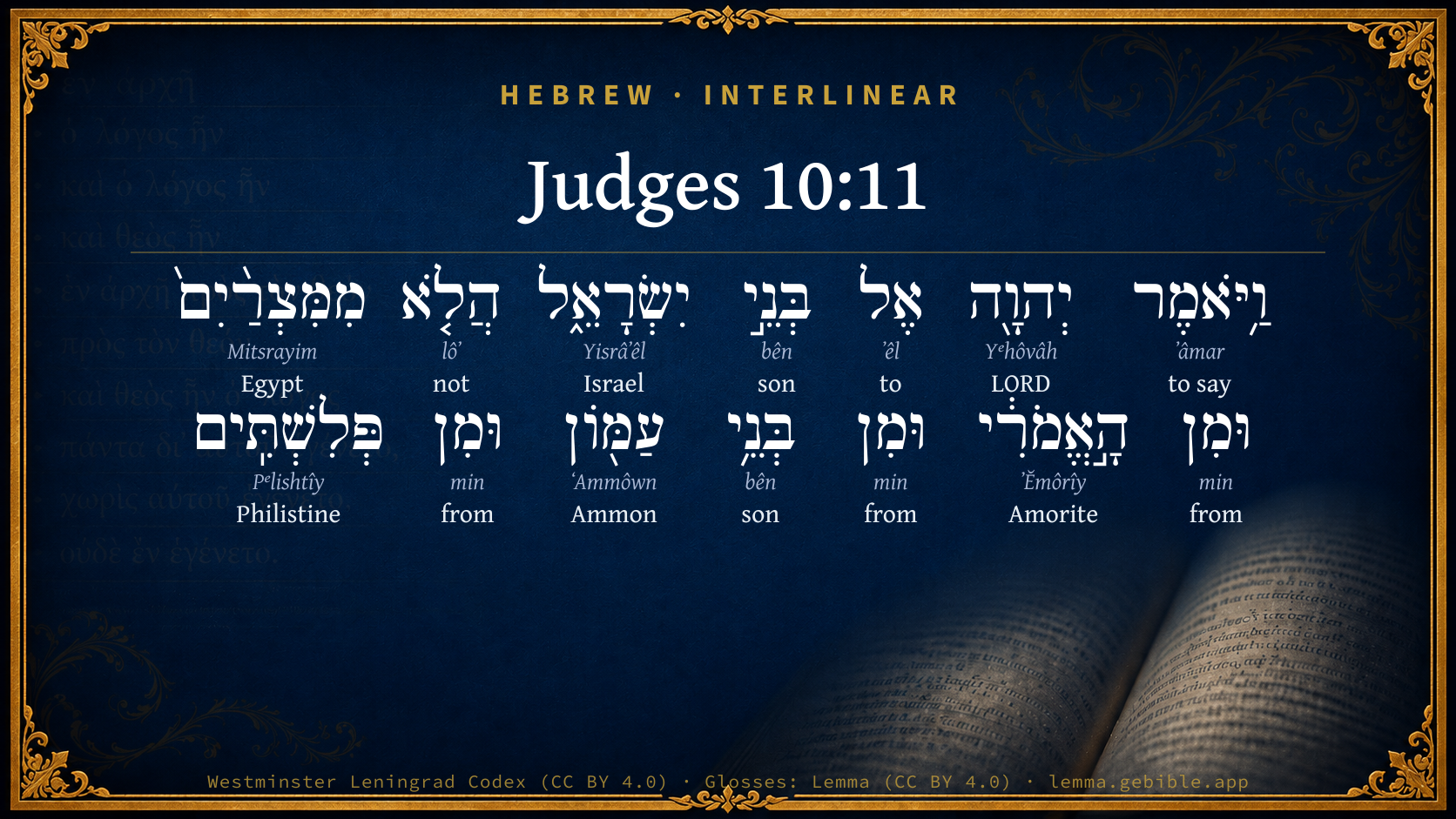
Hebrew (Westminster Leningrad Codex) Judges 10:11 appears in the Hebrew Old Testament. The text above is from the Westminster Leningrad Codex. Each word links to its Strong’s number, a concise gloss, and parsing drawn from the Open Scriptures Hebrew Bible morphology. Click any word for its full Brown-Driver-Briggs (BDB) entry.
Download image
Cite this verse

Judges 10:11 (World English Bible). Public Domain. Lemma interlinear Bible study tool, https://lemma.gebible.app/v/judges/10/11.

Show BibTeX & RIS
BibTeX
RIS
English Translation
Yahweh said to the children of Israel, Didn't I save you from the Egyptians, and from the Amorites, from the children of Ammon, and from the Philistines?
World English Bible · Public Domain
Download a study sheet

One document with this verse’s original text, its word-by-word gloss line, the meaning frame, cross-references with their text, attributed commentary, and full source and license credits — printable, and it pastes into notes with its structure intact.

This verse Autodidact and up

Study sheet (.html) Plain text (.txt)

A passage Seminary Student

Up to 50 verses in one chapter. A passage sheet keeps up to 6 commentary sources and 12 cross-references per verse, in the order this page ranks them, and says so on the sheet whenever that leaves anything out. Ask for a single verse and you get the Autodidact verse sheet above.

Everything on this page stays free to read, with no account — the sheet is a download of what is already on screen, not access to it.

Want to remove ads? Support Godless Engineer
Compare translations 3

The same verse in 3 English versions, stacked beneath the original-language interlinear above. Click any original word for its lexicon entry.

Each is an independent rendering of the whole verse — the interlinear is not word-aligned to these translations.

Highlighted words mark where these versions differ — a whole-verse word diff, not a word-by-word alignment.

  • World English Bible Public Domain
    Yahweh said to the children of Israel, Didn't I save you from the Egyptians, and from the Amorites, from the children of Ammon, and from the Philistines?
  • King James Version Public Domain
    And the LORD said unto the children of Israel, Did not I deliver you from the Egyptians, and from the Amorites, from the children of Ammon, and from the Philistines?
  • unfoldingWord Literal Text CC BY-SA 4.0
    Then Yahweh said to the sons of Israel, “ not from the Egyptians and from the Amorite and from the sons of Ammon and from the Philistines

unfoldingWord Literal Text — © unfoldingWord, licensed CC BY-SA 4.0. Word-aligned USFM3 via Door43 (git.door43.org/unfoldingWord/en_ult).

Versions to compare (up to 4)

3 of 4 selected

Show all 18 translations

Every available English version of this verse, each an independent rendering of the whole verse.

  • World English Bible Public Domain
    Yahweh said to the children of Israel, Didn't I save you from the Egyptians, and from the Amorites, from the children of Ammon, and from the Philistines?
  • Berean Standard Bible Public Domain
    The LORD replied, “When the Egyptians, Amorites, Ammonites, Philistines,
  • Majority Standard Bible Public Domain
    The LORD replied, “When the Egyptians, Amorites, Ammonites, Philistines,
  • King James Version Public Domain
    And the LORD said unto the children of Israel, Did not I deliver you from the Egyptians, and from the Amorites, from the children of Ammon, and from the Philistines?
  • American Standard Version (1901) Public Domain
    And Jehovah said unto the children of Israel, `Did' not `I save you' from the Egyptians, and from the Amorites, from the children of Ammon, and from the Philistines?
  • Revised Version (1885) Public Domain
    And the LORD said unto the children of Israel, Did not I save you from the Egyptians, and from the Amorites, from the children of Ammon, and from the Philistines?
  • Geneva Bible (1599) Public Domain
    And the Lord sayd vnto the children of Israel, Did not I deliuer you from the Egyptians and from the Amorites, from the children of Ammon and from the Philistims?
  • Douay-Rheims (1899) Public Domain
    And the Lord said to them: Did not the Egyptians and the Amorrhites, and the children of Ammon and the Philistines,
  • Young's Literal Translation Public Domain
    And Jehovah saith unto the sons of Israel, ``Have I' not `saved you' from the Egyptians, and from the Amorite, from the Bene-Ammon, and from the Philistines?
  • Literal Standard Version CC BY-SA 4.0
    And YHWH says to the sons of Israel, “[Have I] not [saved you] from the Egyptians, and from the Amorite, from the sons of Ammon, and from the Philistines?
  • Unlocked Literal Bible CC BY-SA 4.0
    Yahweh said to the people of Israel, “Did I not deliver you from the Egyptians, the Amorites, the Ammonites, the Philistines,
  • unfoldingWord Literal Text CC BY-SA 4.0
    Then Yahweh said to the sons of Israel, “ not from the Egyptians and from the Amorite and from the sons of Ammon and from the Philistines
  • Darby Bible Public Domain
    And the LORD said to the people of Israel, "Did I not deliver you from the Egyptians and from the Amorites, from the Ammonites and from the Philistines?
  • World Messianic Bible Public Domain
    The LORD said to the children of Israel, “Didn’t I save you from the Egyptians, and from the Amorites, from the children of Ammon, and from the Philistines?
  • Webster's Bible Public Domain
    And the LORD said to the children of Israel, Did not I deliver you from the Egyptians, and from the Amorites, from the children of Ammon, and from the Philistines?
  • Free Bible Version CC BY-SA 4.0
    The Lord replied to the Israelites, “Didn't I save you from the Egyptians, the Amorites, the Ammonites, the Philistines,
  • Bible in Basic English Public Domain
    And the Lord said to the children of Israel, Were not the Egyptians and the Amorites and the children of Ammon and the Philistines
  • JPS Tanakh (1917) Public Domain
    And the LORD said unto the children of Israel: 'Did not I save you from the Egyptians, and from the Amorites, from the children of Ammon, and from the Philistines?

Literal Standard Version (2020), Covenant Press — licensed CC BY-SA 4.0. Text via the HelloAO Bible API (eBible.org). Unlocked Literal Bible (unfoldingWord) — licensed CC BY-SA 4.0. Text via the HelloAO Bible API (eBible.org). unfoldingWord Literal Text — © unfoldingWord, licensed CC BY-SA 4.0. Word-aligned USFM3 via Door43 (git.door43.org/unfoldingWord/en_ult). Free Bible Version, Dr. Jonathan Gallagher — licensed CC BY-SA 4.0. Text via the HelloAO Bible API (eBible.org).

Word by word

More ways to search: Search by grammar → Find every occurrence → Compare this word →

Practice this passage: Drill this verse → Learn its vocabulary →

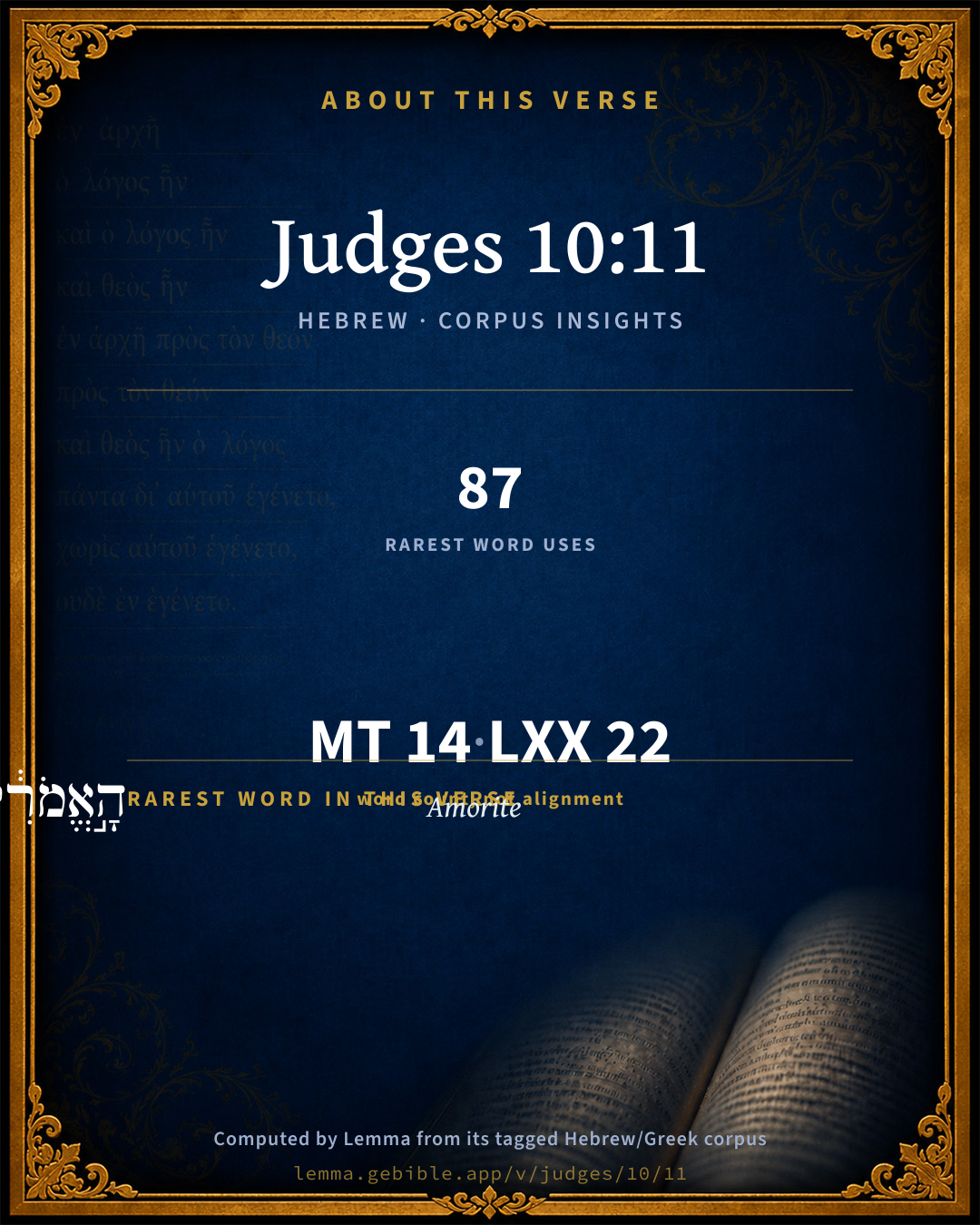
הָ֣אֱמֹרִ֔י
ʼĔmôrîy
H567
“the · Amorite”
Particle, Definite Article + Noun, Gentilic, Masculine, Singular, Absolute
Part of Speech
Particle + Noun
Type
Gentilic
Gender
Masculine
Number
Singular
State
Absolute
Full BDB Definition

Origin: probably a patronymic from an unused name derived from H559 in the sense of publicity, i.e. prominence

TWOT: 119

Amorite = "a sayer" - one of the peoples of east Canaan and beyond the Jordan, dispossessed by the Israelite incursion from Egypt
  1. וַ֥יֹּאמֶר ʼâmar H559 “and · to say” Conjunction + Verb, Qal, Sequential Imperfect, 3rd Person, Masculine, Singular
  2. יְהוָ֖ה Yᵉhôvâh H3068 “LORD” Noun, Proper
  3. אֶל ʼêl H413 “to” Preposition
  4. בְּנֵ֣י bên H1121 “sons of” Noun, Common, Masculine, Plural, Construct
  5. יִשְׂרָאֵ֑ל Yisrâʼêl H3478 “Israel” Noun, Proper
  6. הֲלֹ֤א lôʼ H3808 “not” Particle, Interrogative + Particle, Negative
  7. מִמִּצְרַ֨יִם֙ Mitsrayim H4714 “from · Egypt” Preposition + Noun, Proper
  8. וּמִן min H4480 “and · from” Conjunction + Preposition
  9. וּמִן min H4480 “and · from” Conjunction + Preposition
  10. בְּנֵ֥י bên H1121 “sons of” Noun, Common, Masculine, Plural, Construct
  11. עַמּ֖וֹן ʻAmmôwn H5983 “Ammon” Noun, Proper
  12. וּמִן min H4480 “and · from” Conjunction + Preposition
  13. פְּלִשְׁתִּֽים Pᵉlishtîy H6430 “Philistines” Noun, Gentilic, Masculine, Plural, Absolute

About this verse

These counts appear in no published source. They are computed here, from the morphology-tagged text and Lemma’s own curated glosses. What Lemma adds →

14
words
11
distinct lemmas
Historical
section

Grammatical profile

  • 1 verb
  • 8 nouns
  • 4 prepositions
  • 1 particle

Verb forms

  • וַ֥יֹּאמֶר Qal · Sequential Imperfect

Repetition

Words recur within this verse — often emphatic in Hebrew:

  • בְּנֵ֣י son H1121 ×2
  • וּמִן from H4480 ×3

Hebrew & Septuagint length

In English translation the verse runs 27 words from the Hebrew and 30 from the Septuagint (LXX English) — closely comparable.

A rough comparison of the two English renderings, which tokenize alike — not a word-level alignment.

Word counts can differ between the Hebrew and the Greek without any difference in meaning — e.g. the Hebrew direct-object marker אֵת has no separate Greek word, and Greek often adds the article ὁ.

In the original languages it is 14 Hebrew tokens and 22 Greek tokens — but the two are counted differently (Hebrew bundles its prefixes and suffixes into one token; the Greek is in lemma form), so that isn’t a like-for-like length.

Cross-references

12

Topical passages linked to Judges 10:11 in the Treasury of Scripture Knowledge — connected by theme and wording, ordered by reader-vote popularity; previews shown in the World English Bible.

  • Exodus 14:30 Thus Yahweh saved Israel that day out of the hand of the Egyptians; and Israel saw the Egyptians dead on the seashore.
  • Numbers 21:21–25 Israel sent messengers to Sihon king of the Amorites, saying,
  • Judges 3:31 After him was Shamgar the son of Anath, who struck of the Philistines six hundred men with an ox-goad: and he also saved Israel.
  • Numbers 21:35 So they struck him, and his sons and all his people, until there was none left him remaining: and they possessed his land.
  • Judges 2:1–3 The angel of Yahweh came up from Gilgal to Bochim. He said, I made you to go up out of Egypt, and have brought you to the land which I swore to your fathers; and I said, I will never break my covenant with you:
  • Judges 3:11–15 The land had rest forty years. Othniel the son of Kenaz died.
  • 1 Samuel 12:8 When Jacob was come into Egypt, and your fathers cried to Yahweh, then Yahweh sent Moses and Aaron, who brought forth your fathers out of Egypt, and made them to dwell in this place.
  • Nehemiah 9:9–11 You saw the affliction of our fathers in Egypt, and heard their cry by the Red Sea,
  • Psalms 78:51–53 And struck all the firstborn in Egypt, The chief of their strength in the tents of Ham.
  • Psalms 106:8–11 Nevertheless he saved them for his name's sake, That he might make his mighty power known.
  • Psalms 135:10–11 Who struck many nations, And killed mighty kings,
  • Hebrews 11:29 By faith, they passed through the Red sea as on dry land. When the Egyptians tried to do so, they were swallowed up.

Cross-references courtesy of OpenBible.info (CC BY 4.0).

Hebrew and Greek witnesses Masoretic Hebrew ↔ Greek Septuagint

The same verse in the two great witnesses to the Old Testament, shown verse-for-verse.

These are two independent witnesses, not word-aligned to each other, and the Septuagint is shown in lemma (dictionary) form.

Hebrew Judges 10:11 Masoretic · Westminster Leningrad Codex

וַ֥יֹּאמֶר יְהוָ֖ה אֶל בְּנֵ֣י יִשְׂרָאֵ֑ל הֲלֹ֤א מִמִּצְרַ֨יִם֙ וּמִן הָ֣אֱמֹרִ֔י וּמִן בְּנֵ֥י עַמּ֖וֹן וּמִן פְּלִשְׁתִּֽים

Yahweh said to the children of Israel, Didn't I save you from the Egyptians, and from the Amorites, from the children of Ammon, and from the Philistines?

World English Bible · Public Domain

Greek LXX Judges 10:11 Septuagint · lemma form

καί εἶπον κύριος πρός ὁ υἱός ἰσραήλ μή οὐ ἐκ αἴγυπτος καί ἀπό ὁ ἀμορραῖος καί ἀπό υἱός αμμων καί ἀπό φυλιστιιμ

And the Lord said to the children of Israel, Did I not save you from Egypt and from the Amorite, and from the children of Ammon, and from the Phylistines,

LXX2012 (modern English Septuagint) · Public Domain

Hebrew: Westminster Leningrad Codex (CC BY 4.0). Greek: Septuagint (public domain); English from LXX2012 (modern English Septuagint) (Public Domain). How the Septuagint differs from the Hebrew →

Targum (Aramaic paraphrase)

1

The Targum is the ancient Jewish Aramaic paraphrase of the Hebrew Scriptures — an interpretive translation, not the Hebrew text itself. Onkelos (literal) and Pseudo-Jonathan (expansive) render the Torah, and Jonathan the Prophets. Coverage is partial: where no permissively-licensed English translation exists for a verse, only the Aramaic is shown. This is verse-level text, not a word-by-word alignment to the Hebrew.

  1. Targum Jonathan Prophets (Joshua–Malachi)
    וַאֲמַר יְיָ לִבְנֵי יִשְׂרָאֵל הֲלָא מִמִצְרַיִם וּמִן אֱמוֹרָאָה וּמִן בְּנֵי עַמוֹן וּמִפְּלִשְׁתָּאֵי:

    (no public-domain English translation for this verse)

    Targum Jonathan — Aramaic: “Mikraot Gedolot” (public domain). English: “Sefaria Community Translation” (CC0 1.0 (public-domain dedication)); “London "Chaldee Paraphrase," 1871” (public domain). Text via Sefaria.

Commentary

Notes on Judges 10:11 from classic Christian and Jewish commentators (each source and its license shown beneath its notes). The classic Christian expositions comment on the surrounding passage and are grouped to its opening verse, so a note may address several verses; the Jewish commentaries on the Tanakh (Rashi and others) are per-verse, so they appear only where the commentator wrote on this verse.

Lemma curates 59 commentaries, every one of them public domain or Creative Commons licensed, each selected and text-cleaned for this edition rather than reprinted as found. About our sources →

Trapp's Complete Commentary

John Trapp

Jdg 10:11 And the LORD said unto the children of Israel, [Did] not [I deliver you] from the Egyptians, and from the Amorites, from the children of Ammon, and from the Philistines?

Ver. 11. Did not I deliver you from the Egyptians?] They instance their sins, and God’s benefits - teaching us to keep catalogues - for an aggravation of their sins. See Deu 32:5-6 Ezr 9:13-14. There is here an angry aposiopesis; for these words, "I deliver you," are not in the original. Those that are angry use to utter imperfect speeches.

John Trapp, A Commentary or Exposition upon All the Books of the Old and New Testament (1647–1656) — public domain. Text from a community e-Sword module.

Joseph Benson's Commentary

Jdg 10:11. The Lord said unto Israel — Either by some prophet whom he raised up, and sent for this purpose, or by the high-priest consulting God for them by Urim and Thummim. For we find that the Israelites, notwithstanding their idolatries, when they were sorely afflicted, bethought themselves of repairing to the tabernacle, and asking counsel of the Lord. Did not I deliver you from the Amorites? — Both Sihon and Og, and their people, and other kings of the Amorites. From the children of Ammon — Who were confederate with the Moabites, Jdg 3:13-14.

Joseph Benson's Commentary on the Old and New Testaments (1811–1818) — public domain. Text from a community e-Sword module.

Geneva Bible (1599)

Geneva Bible translators

By stirring them up some prophets, as Judg. 6:8.

Geneva Bible (1599) marginal notes — public domain. Text via Bolls.life.

Jamieson, Fausset & Brown

Robert Jamieson, A. R. Fausset & David Brown

the Lord said . . . Did I not deliver you from the Egyptians--The circumstances recorded in this and the following verses were not probably made through the high priest, whose duty it was to interpret the will of God.

Jamieson, Fausset & Brown — Commentary Critical and Explanatory on the Whole Bible (1871) — public domain (CC PDM 1.0). Text via the HelloAO Bible API.

Adam Clarke's Commentary

Verse 11. And the Lord said] By what means these reproofs were conveyed to the Israelites, we know not: it must have been by an angel, a prophet, or some holy man inspired for the occasion.

Adam Clarke's Commentary on the Bible (1810–1826) — public domain. Text from a community e-Sword/MySword module.

The Cambridge Bible for Schools and Colleges

gen. ed. J. J. S. Perowne

11. not … from the Egyptians] The missing verb is supplied by the RV., cf. Exo_14:30; did not I bring you up would be better—the verb usually found with from Egypt, Jdg_2:1, Jdg_6:8; then the rest of the verse must be an editorial expansion. But if the restoration of the RV. be kept, the whole verse can be regarded as a conventional summary; no distinct oppression by the Amorites is recorded.

The Cambridge Bible for Schools and Colleges (gen. ed. J. J. S. Perowne; Cambridge University Press, 1878–1918) — public domain. Text from a community e-Sword module.

John Gill's Exposition

And the Lord said unto the children of Israel,.... By a prophet he sent unto them, as Kimchi and Abarbinel, see Jdg 6:8, whom Ben Gersom takes to be Phinehas, but he could not be living at this time; or by an angel, a created one, sent on this occasion; or the uncreated one, the Son and Word of God, who might appear in an human form, and to whom all that is here said is applicable:

did not I deliver you from the Egyptians; by bringing them out of subjection and bondage to them, and by delivering them out of their hands at the Red sea:

and from the Amorites; the kings of Sihon and Og, whose countries were taken from them, and put into their hands, when they attempted to stop them in their march to the land of Canaan:

from the children of Ammon; when they joined with the Moabites against them, Jdg 3:13.

and from the Philistines? in the times of Shamgar, Jdg 3:31.

John Gill's Exposition of the Whole Bible (1746–1763) — public domain (CC PDM 1.0). Text via the HelloAO Bible API.

Albert Barnes' Notes on the Bible

(See the marginal references). The Israelites were delivered from the “Egyptians” at the Exodus; from the “Amorites” in the victories over Sihon, and Og, and the five kings of the Amorites Jos 10:5; from the “children of Ammon” by Ehud; and from the “Philistines,” by the hand of Shamgar (compare 1Sa 12:9).

Albert Barnes' Notes on the Bible (1834–1885) — public domain. Text from a community e-Sword/MySword module.

Haydock's Catholic Bible Commentary

Said by the mouth of an angel, or of some prophet. (Menochius)

George Leo Haydock (1774–1849), Haydock's Catholic Family Bible and Commentary, 1859 edition — public domain. Excludes Psalms (Douay-Rheims chapter numbering differs from Protestant) and Deuterocanonical books (Catholic canon only).

Matthew Poole's English Annotations

The Lord said; either by himself, the Son of God appearing in a visible shape, which then was usual; or by some prophet whom he raised and sent to this purpose; or by the high priest, who was consulted in the case.

The Amorites; both Sihon and Og, and their people, Num 21, and other kings of the Amorites within Jordan, Jos 10:5.

The children of Ammon were confederate with the Moabites, Jdg 3:13,14.

The Philistines. See Jdg 3:31.

Matthew Poole's English Annotations on the Holy Bible (1683–1685) — public domain. Text from a community e-Sword/MySword module.

Whedon's Commentary on the Bible

Daniel D. Whedon

11. The Lord said — How the Lord spake on this occasion we are not told, and the question can only be a subject of conjecture. Some have thought he spoke by a prophet; others, by some sublime theophany. Keil thinks the answer was given in front of the tabernacle at Shiloh, where the people had assembled to call on the Lord, and came either through the high priest, or by an inward voice which aroused in their consciences the memory of the Lord’s gracious acts and their ingratitude and apostasy.

From the Egyptians — By all the miracles of the exodus from that house of bondage, minutely described in the first fourteen chapters of Exodus.

Amorites — In the days of Moses. Num_21:21-32.

Ammon — Who joined with Moab in the oppression from which Ehud delivered Israel. Jdg_3:13.

Philistines — In the days of Shamgar. Jdg_3:31.

Daniel D. Whedon (gen. ed.), Commentary on the Old and New Testaments (1874–1909) — public domain. Text from a community e-Sword module.

The Pulpit Commentary

Did not I deliver you, etc. These references to former deliverances are of great historical value, and not the least so as they allude to events of which the existing records give no account, or a very imperfect one. They show the existence of a real history in the background of that which has been preserved in the Bible. (see Jud_1:8:13, note) From the Egyptians, as related at large in the Book of Exodus; from the Amorites, as related in Num_21:21-35; from the children of Ammon, who were confederate with the Moabites under Ehud, as we learn from Jud_1:3:13; from the Philistines, as is briefly recorded in Jud_1:3:31.

The Pulpit Commentary (1880–1919), ed. H.D.M. Spence-Jones & Joseph S. Exell — public domain. Text from a community e-Sword module.

John Wesley's Explanatory Notes

The Lord said - Either by some prophet whom he raised and sent for this purpose: or by the high-priest, who was consulted in the case. From the Amorites - Both Sihon and Og, and their people, and other kings of the Amorites within Jordan. Of Ammon - Who were confederate with the Moabites, chap. iii, 13, 14.

John Wesley, Explanatory Notes Upon the Whole Bible (1754–1765) — public domain. Text via the GEBible commentary corpus.

Rashi

Rabbi Shlomo Yitzchaki (Rashi)

Was it not from Mitzrayim. There are seven salvations here, corresponding with the seven pagan gods they worshiped.

Rashi on the Tanakh — English translations: “The Judaica Press complete Tanach with Rashi, translated by A. J. Rosenberg” (CC BY 4.0); “Pentateuch with Rashi's commentary by M. Rosenbaum and A.M. Silbermann, 1929-1934” (public domain); “The Metsudah Tanach series, Lakewood, N.J” (CC BY 4.0); and “The Book of Joshua, Metsudah Publications, 1997” (CC BY 4.0). Text via Sefaria.

Lesson kit

Teaching starters — assembled from the data on this page, not authored interpretation. Every prompt links to the verse data it draws on. Edit before teaching.

Judges, in the Historical, opens this verse with 14 words (11 distinct Hebrew lemmas). Its most distinctive word is ʼĔmôrîy (“Amorite”). A historical commentator’s framing appears above. Read the whole chapter for the surrounding context.

Discussion questions

  1. How does “Amorite” (ʼĔmôrîy) shape what this verse is saying?
  2. How does Exodus 14:30, which shares this passage’s theme, read alongside this verse?
  3. What does the repetition of “son” (2× in this one verse) do in this verse?
  4. These translations render this verse differently. What is at stake in choosing one wording over another?
  5. «וַ֥יֹּאמֶר» is a Qal Sequential Imperfect verb. How does that grammatical form shape the action described?
  6. Compare how Trapp's Complete Commentary and Joseph Benson's Commentary read this verse. Where do they agree or differ?

Things to notice

Reading settings

Reading text

Shown beneath each verse's original-language words.

Old Testament
Old Testament edition

Read the OT as the Masoretic Hebrew (MT) or the Greek Septuagint (LXX).

English shown for the Greek Septuagint (in the Hebrew ↔ Greek comparison).

Comparing translations? Open the Compare panel on any verse page to stack up to four side by side.